
The link below is to a book review of ‘Falling Upwards – How We Took to the Air,’ by Richard Holmes.
For more visit:
http://www.guardian.co.uk/books/2013/may/18/falling-upwards-richard-holmes-review

The link below is to a book review of ‘Falling Upwards – How We Took to the Air,’ by Richard Holmes.
For more visit:
http://www.guardian.co.uk/books/2013/may/18/falling-upwards-richard-holmes-review
The link below is to a book review of ‘Murder as a Fine Art,’ by David Morrell.
The link below is to a book review of ‘Inferno,’ by Dan Brown.
For more visit:
http://www.express.co.uk/entertainment/books/400282/Book-Review-Inferno
The link below is to a book review of ‘Clampdown: Pop-Cultural Wars on Class and Gender,’ by Rhian E. Jones.
For more visit:
http://www.guardian.co.uk/books/2013/may/16/clampdown-pop-cultural-jones-review
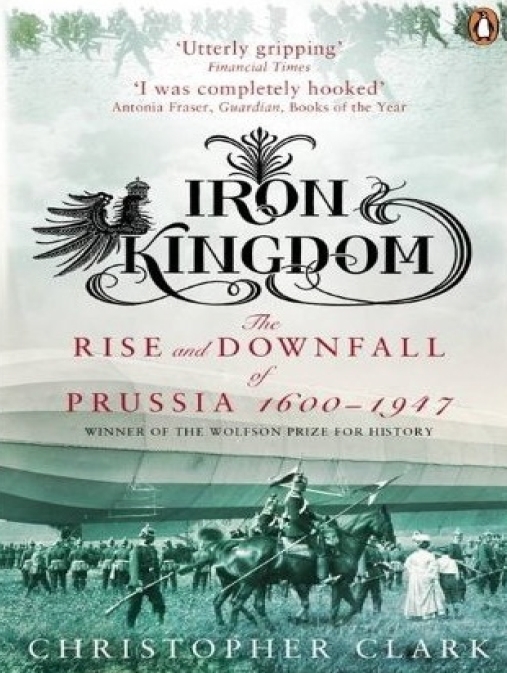 The ‘Iron Kingdom – The Rise and Downfall of Prussia 1600-1947,’ by Christopher Clark is a somewhat massive work at 820 pages. It is a book that I wanted to read right from the moment I came across it, which wasn’t all that long ago. You see, I didn’t know all that much about Prussia. I knew it was tied up with the history of Germany, that Prussia fought the Napoleonic French forces at Waterloo and that the Napoleonic French forces had earlier defeated the Prussians. What I didn’t know about Prussia, this book soon made me aware of – as well as reminding me that I actually knew a lot more about Prussia than I had thought.
Doubtless 800+ pages seems somewhat daunting to many readers, many of whom would baulk at the size of this work and move on to much smaller books that can be completed in less time. Having said that, this book isn’t too difficult to read at all. I spent a bit longer than a week reading it and enjoyed it immensely. I read somewhere someone say that this book reads like a novel, which though I don’t think it is a description that is entirely accurate, it certainly points in the right direction as the book is really quite easy to read. I found myself quite caught up in it all, as I followed the development of the Prussian nation and empire and its eventual transformation into a greater German nation and empire, before it was destroyed by the Nazis and the defeat of World War II, following which the Prussian state basically ceased to exist as an allied retaliation for the war.
The book doesn’t just follow the military history of Prussia – indeed it could be said that the military history is somewhat sparse on the ground in this work with very little time really devoted to the wars of Prussia, though each one is treated within the body of the work. This history of Prussia digs into all facets of Prussian history, including the development of the monarchy and nation, the culture, education, the politics, the social welfare development and policies of Prussia, etc. It is more of a thorough introduction to the history of Prussia, a work that whets the appetite for more and perhaps encourages a deeper research of Prussian history. The experience of reading the Iron Kingdom has me wanting to research more the 30 Years War, the Austrian-Hungarian Empire, a number of the other wars involving the Prussians and perhaps more detailed biographical works regarding the Great Elector, Frederick the Great, Bismark, etc.
So my overall impression after reading the book was that I wasn’t disappointed in it at all, even though I would have liked to have found out more about the various wars. Certainly I am the richer for having read the Iron Kingdom and it is a book I could see myself reading again at some point. I highly recommend the Iron Kingdom, especially to those interested in the development not only of Prussia and Germany, but also of Europe. A great read that I really enjoyed.
Buy this book at Amazon:
http://www.amazon.com/Iron-Kingdom-Downfall-1600-1947-ebook/dp/B002RI9PMM/
The link below is to a book review of ‘Articulate While Black: Barack Obama, Language, and Race in the US,’ by H. Samy Alim and Geneva Smitherman.
For more visit:
http://blogs.lse.ac.uk/lsereviewofbooks/2013/05/13/12846/
Chapter 2: Crown of Thieves
‘Crown of Thieves’ opens well enough for Agnes and her friend Janet. They have freedom to enjoy, but too soon the 2nd chapter continues the narrative of despair and forced labor that petty thieves were required to fulfill as payment for their crimes. First in Glasgow and then in Kilmarnock, where their hopes for a better life were cut short as a consequence of their short careers in petty crime. In such a setting, in such a time, there was little for street kids to do in order to survive and so to petty thieving they often returned. It was their undoing in a society that knew little of compassion and nothing of social welfare.
From Kilmarnock, via the trial in Ayr, the lives of Agnes McMillan and Janet Houston were propelled in an entirely unexpected direction – transportation to Van Diemen’s Land for a period of seven years. In reality there would be no return. They were convicts headed for Tasmania, Australia, as it is now known. The chapter ends with their arrival in London and Newgate Prison.
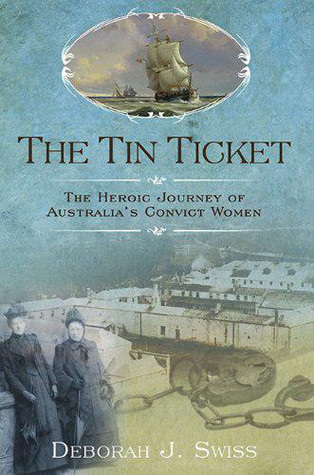
The Tin Ticket brings to life the harsh realities of life for the homeless and poor of Britain. They were products of a harsh system that punished those that could do little to help themselves and seldom was help offered to enable them to lift themselves out of their predicament. Certainly deserved criminals were transported to the penal colonies, but far too often it was those who fell through the cracks of an unsympathetic society that were punished for what they had become in order to survive. The recorded history of transportation takes on a human face through the stories of Agnes McMillan and Janet Houston. It is a reminder that convicts were real people and often not all that criminal at all.
Buy this book at Amazon:
http://www.amazon.com/gp/product/B0043RSIWI/
The link below is to a book review of ‘The Kind of Preaching God Blesses,’ by Steven J. Lawson.
For more visit:
http://www.challies.com/book-reviews/the-kind-of-preaching-god-blesses
The link below is to a book review of ‘Let’s Get Visible – How to Get Noticed and Sell More Books’ by David Gaughran.
For more visit:
http://www.teleread.com/ebooks/review-lets-get-visible-how-to-get-noticed-and-sell-more-books-by-david-gaughran/
Chapter 1: The Grey-Eyed Girl
Well I lasted one day before reading some more of this book – but I did finish one of the other books I was reading first and posted a book review of it, so that wasn’t too bad. I’ve convinced myself anyway, so I can now continue reading this book as well.
The first chapter begins the story of Agnes McMillan Roberts, a convict sent to Van Diemen’s Land (now known as Tasmania) from Glasgow in Scotland.
This first chapter paints a terrible picture of conditions for the poorer families of Glasgow in the 1820s. The early years were tough years for Agnes and her childhood was cut short by the abandonment of her parents – first her father, then her mother (who basically stopped being one). In the place of family, Agnes aged 12 found support in a ‘street gang’ of young girls and this led ultimately to her arrest for burglary. Her partner in crime and life was 13-year-old Janet Houston, who took the younger Agnes under her wing.
Fighting to survive the elements in a filthy city, petty crime was one of very few options open to Agnes and she took it. She was to pay the penalty for being a survivor, a penalty that she was required to pay because society failed to care for the less fortunate of her day. Her small gang of young girls were arrested at the scene of their crime and quickly sentenced.
Agnes and Janet were sentenced to 18 months forced labor at a woolen mill, working 15 hour days, 7 days a week. They were basically slaves, child slaves and poorly treated ones at that. Life at the mill was 18 months of torture, a slave labor that no child should have to endure. Yet this was the life that beckoned for thousands of children across Britain during the so-called Industrial Revolution. Child exploitation and exploitation of the poor were signs of the times.
Reading this chapter you can’t but feel for Agnes and her friend Janet. Abandoned by society, with no hope for survival except by embracing a world of what you could call the underbelly of 1820s Glasgow. To survive they turned to a life of petty crime. Sure they were by definition criminals, but it is difficult to feel anything but pity and compassion toward these young girls given the circumstances in which they lived. From out of the frying pan and into the fire though was the result, in what is just a terribly sad childhood for these young girls.
This first chapter leaves you asking yourself just who were the real criminals in all of this? Are the parents the real criminals? Are the upper class to blame for this? Is it the government’s fault? Is it society as a whole? 1820s Glasgow certainly makes me glad to be living in 21st century Australia.
Buy this book at Amazon:
http://www.amazon.com/gp/product/B0043RSIWI/


You must be logged in to post a comment.