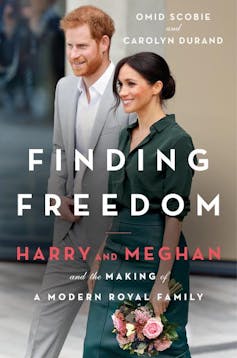
Finding Freedom was published on August 11. HarperCollins Publishers
A new book about the Duke and Duchess of Sussex is generating sensational headlines about their private life, defiance of Queen Elizabeth and how Prince William “behaved like a snob” to his future sister-in-law.
It is also the latest foray of British royals into the minefield that is royal
biography.
Finding Freedom: Harry and Meghan and the Making of a Modern Royal Family, by royal reporters Omid Scobie and Carolyn Durand, promises stories about how the royal couple has struggled with “the many rumours and misconceptions that [have] plagued” them since their 2017 engagement.
A spokesperson for the couple has firmly said they “did not contribute to ‘Finding Freedom’”. But there is widespread speculation Harry and Meghan were nevertheless involved, given the level of detail in the book.
According to the publishers, HarperCollins, the biography has been produced with “unique access and written with the participation of those closest to the couple”.
‘Never explain, never complain’
We’ve seen this before, and it is a tale that seldom ends happily or well. In 1976, John Wheeler-Bennett, official biographer of George VI, observed royal biography is
not to be entered into advisedly or lightly; but reverently, discreetly, advisedly, soberly and in the fear of God.
Wheeler-Bennett was here referring to the role of the royal biographer, but could just as easily have been referring to the royals themselves.
The royals are not supposed to go on the record and speak of private matters. The dictum ruling the House of Windsor for the best part of the 19th and 20th centuries was they should “never explain, never complain”.
In 1947, when hearing of a former servant’s plans to write about her time in royal service, the Queen Mother summed up the royal family’s strong expectations when she said:
people in positions of confidence with us must be utterly oyster.
Subsequently, the royal family was dismayed when the Duke of Windsor fed his story to a ghostwriter in 1951’s A King’s Story, outlining his own version of the abdication crisis. Prince Philip also disapproved strongly of Prince Charles’s candid revelations in Jonathan Dimbleby’s 1994 book Prince of Wales: A Biography and subsequent interview.
Diana’s experience
Prince Harry could also have learned some valuable lessons from his own mother, who flouted the “utterly oyster” rule.
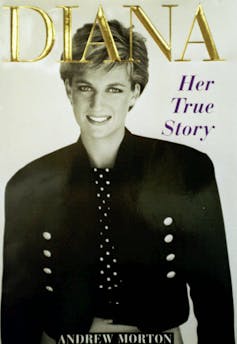
Diana: Her True Story generated waves of controversy for the Princess in 1992. PA/AAP
Diana, Princess of Wales, was behind the most famous royal biography of all time when she commissioned Andrew Morton to “ghost” her tale of marital woe and royal suffering with the 1992 tell-all Diana: Her True Story.
Her True Story was a huge commercial success – having sold more than ten million copies as of 2017. But after the book’s publication, Buckingham Palace and conservative media outlets went after Morton, expressing disbelief a royal princess would talk to a tabloid journalist with no official royal biographer status.
After publicly eviscerating Morton, and the airing of Diana’s explosive 1995 Panorama interview, the palace and establishment then went after Diana. Conservative MP and close friend of Prince Charles, Nicholas Soames, claimed she must have been “in the advanced stages of paranoia” to have been disclosing the types of things she had.
Diana thought Her True Story would act as a passport to freedom. She hoped it would help her separate from the royals, while keeping her privileges intact. As journalist Tina Brown wrote in her 2007 book, The Diana Chronicles, the princess thought she would get to keep all
the good bits of being a princess and doing her own global thing without Charles around to cramp her style. She did not factor in the power of royal disapproval and its consequences.
Nor did she factor in “the risk of … the Palace ‘going nuclear’ and continuing until there [is] nothing left”.
Critically, Diana had thought the revelations in Her True Story would invite her estranged royal relations’ sympathy. As Brown also notes,
she had been so long in her private panic room she thought this deafening public scream would solve the matter once and for all.
Brown records how Diana quickly regretted the book, telling her friend David Puttnam shortly before the book’s release in 1992,
I’ve done a really stupid thing. I have allowed a book to be written. I felt it was a good idea, a way of clearing the air, but now I think it was a very stupid thing that will cause all kinds of terrible trouble.
Diana was right. The biography and the Panorama interview hastened Diana’s exit from the royal enclosure. This gave her a short spell of relief and exultation. But this was followed by unhappiness that she had to live, in effect, in exile.
A long-running soap
With release of another sensational royal biography – that very much gives one side of the story – the parallels between Diana and her son are uncanny.
Harry and Meghan obviously already have a rocky relationship with the palace, given their split with the royal family in March.
Harry and Meghan are trying to win the PR war, but history suggests a ‘tell-all’ book is a dangerous move. DPPA/AAP
Their latest public pronouncement about their “true story” (albeit via interlocutors) is the latest salvo being fired in the long-running soap opera known as “The Windsors”. It has obviously been made to try to win a public relations war. Indeed, public relations is what the royals do. They don’t have “jobs” as such, but merely have to be “seen to be”.
Finding Freedom might have felt like a good idea to the Sussexes — an opportunity to set the record straight – but as Diana’s experience suggests, they may well come to regret the opening of their particular oyster of royal rage.
Their contribution of yet another chapter to the Windsor soap is one that will likely prove unstoppable, insatiable even. And one thing is almost certain: Harry and Meghan will very probably lose any editorial control they thought they had over their own story.
In the year then of our Lord 1348, there happened at Florence, the finest city in all Italy, a most terrible plague…
Giovanni Boccaccio introduces his acclaimed collection of novellas, the Decameron, with a reference to the most terrifying existential crisis of his time: the decimating effects of the bubonic plague in the 1348 outbreak known as the Black Death.
Boccaccio’s book, written between 1348 and 1353, has been acclaimed as an exemplar of vernacular literary prose, and a commentary on the “peste” that swept through Europe that year.
A classic of medieval plague literature, it continues to be cited by physicians and epidemiologists to this day for its vivid depiction of a disease that held a city under siege.
In the introduction to his book, Boccaccio estimates that more than 100,000 people – over half of the city’s inhabitants – died within the walls of Florence between March 1348 and the following July.
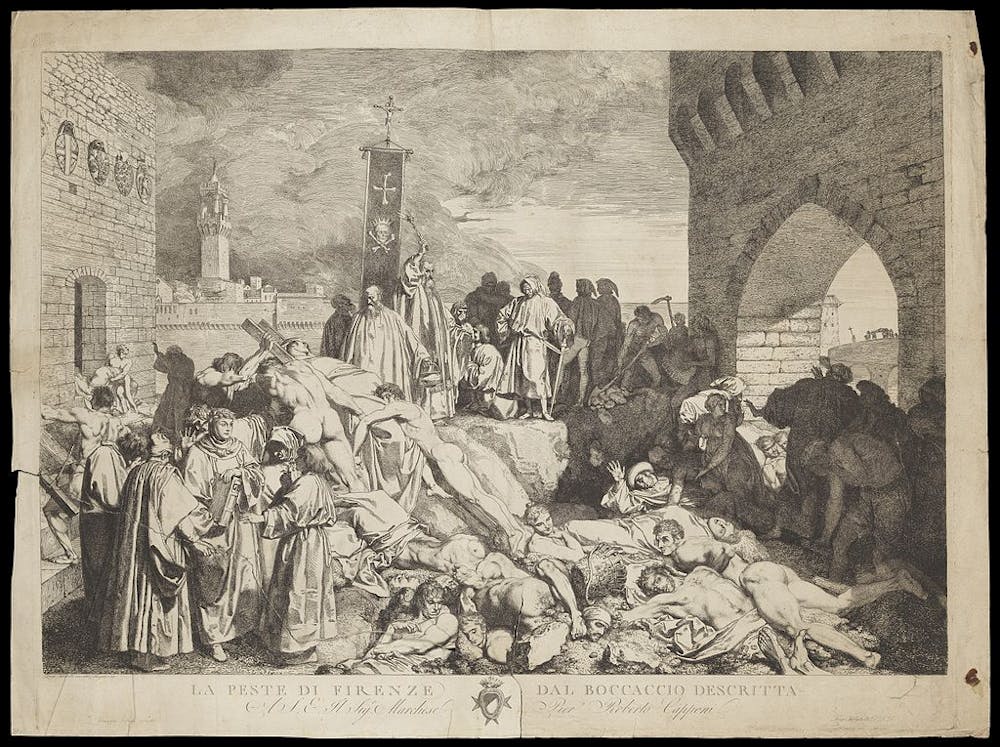
He vividly describes physical, social and psychological sufferings, writing of people dying in the street, rotting corpses, plague boils, swollen glands known as “buboes” – some the size of eggs, others as large as apples – bruises and the blackening skin that foreshadowed death.
Boccaccio’s introduction is followed by ten sections containing short stories. Each of the book’s ten storytellers tells a story a day for ten days. Derived from Greek, the word decameron means ten days and is an allusion to Saint Ambrose’s Hexameron, a poetic account of the creation story, Genesis, told over six days.
The Decameron is a tale of renewal and recreation in defiance of a decimating pandemic. Boccaccio attributes the cause of this terrible plague to either malignant celestial influences or divine punishment for the iniquity of Florentine society.
The plague of Florence in 1348, as described in Boccaccio’s Decameron. Etching by L. Sabatelli after himself. Credit: Wellcome Collection/Wikimedia Commons
Social distancing and fragrant nose coverings
Unlike the plague of 1340 – which killed an estimated 15,000 Florentines – that of 1348 was, according to Boccaccio, far more contagious, spreading with greater vigour and speed.
It was extraordinary, in his view, that the disease did not merely spread from human to human but crossed species too. He saw two pigs dying within moments of biting infected clothing in the street.
Florentine officials removed household waste and contaminants from the city in attempts to eradicate the deadly pestilence, and banned infected people from entering.
They issued public pleas and advised residents on measures that would minimise risk of contagion, such as social distancing and increased personal hygiene.
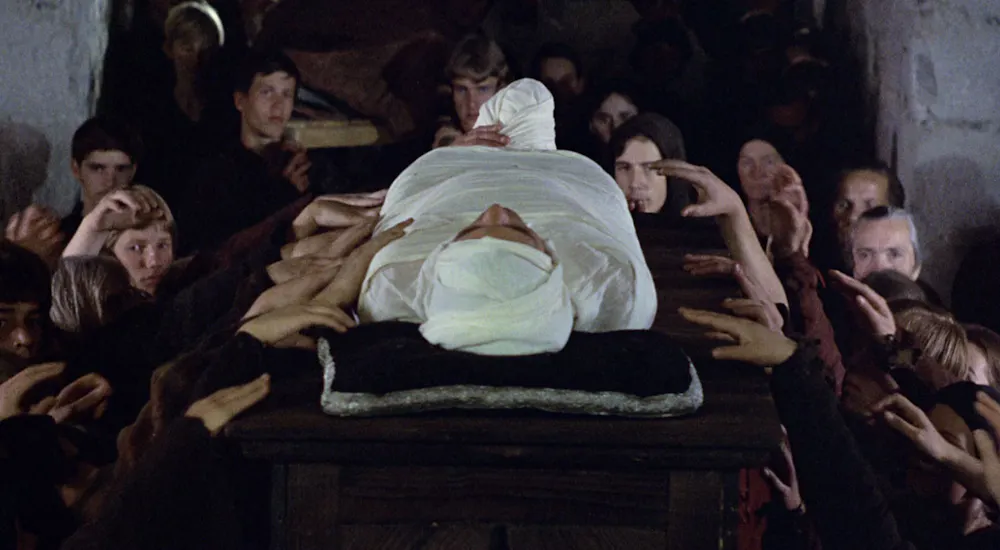
A scene from Pasolini’s 1971 film The Decameron. Produzioni Europee Associate (PEA), Les Productions Artistes Associés, Artemis Film
Boccaccio, in the same introduction, takes aim at those who fled the sick to protect their own health and in doing so degraded the social fabric.
Extreme interpretations of social distancing led to people shunning neighbours and members of their extended and immediate families. In some cases, he writes, parents even deserted their children.
While some took conservative measures – self-isolating indoors in small numbers, eating and drinking moderately and shutting out contact from the outside – others, he writes, roamed freely, gratifying their senses and meeting their desires for food, fun and sex:
…satisfying their every yearning, laughing and mocking at every mournful accident; and so they vowed to spend day and night, for they would go to one tavern, then to another, living without any rule or measure…
Others still consumed only what their bodies needed and excluded contact with the infected. But they wandered wherever they wished, carrying bunches of fragrant flowers, herbs, or spices, or wearing them across their noses in a bid to repel the infection and the offensive odour of death.
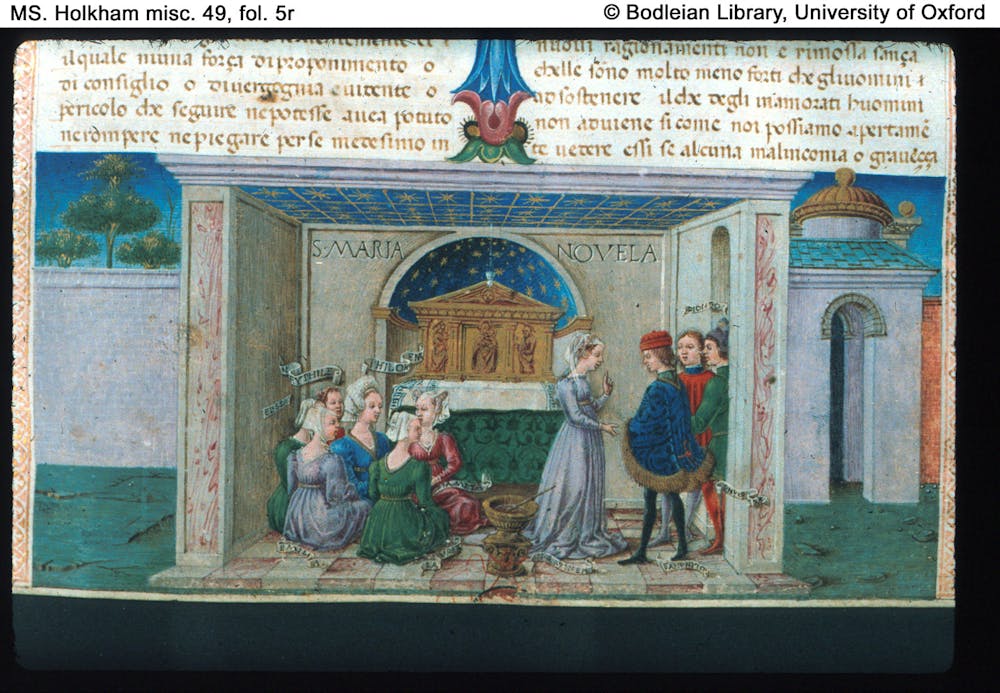
Manuscript from the Decameron illustrated by Taddeo Crivelli. Wikimedia Commons
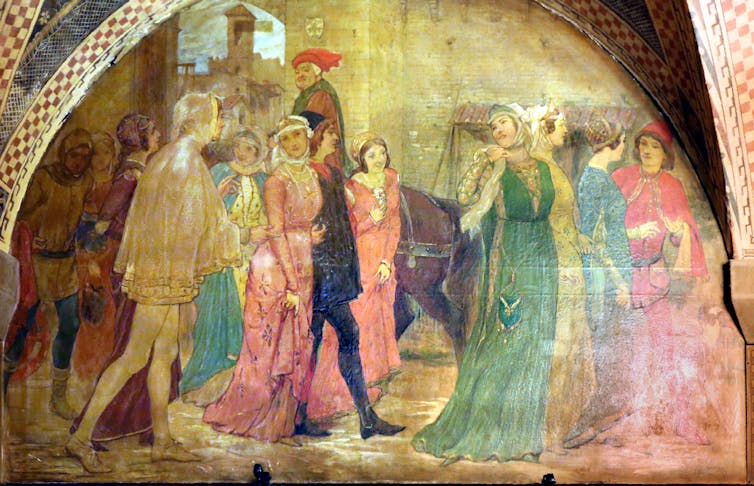
Boccaccio’s unfavourable account, lamenting moral degradation and the enormous human suffering, is interrupted by a ray of light in the form of seven young noblewomen and three young gentlemen who appear in the Church of Santa Maria Novella on a Tuesday morning.
They become the storytellers of the Decameron. Collected as a brigade (brigata), they exhibit civility, gentility, strength and a commitment to duty.
Boccaccio presents them as decorous and untarnished, having each cared for their loved ones while within the city walls. He gives each a name that suits their personal qualities, choosing monikers from his own and other literary works. They are: Pampinea, Filomena, Neifile, Filostrato, Fiammetta, Elissa, Dioneo, Lauretta, Emilia and Panfilo.
Refuge through story
At the suggestion of the eldest noblewoman, Pampinea, the brigata leave the terrible pestilence and their devastated, plague-ridden city to take refuge in a rural villa in the nearby hills.
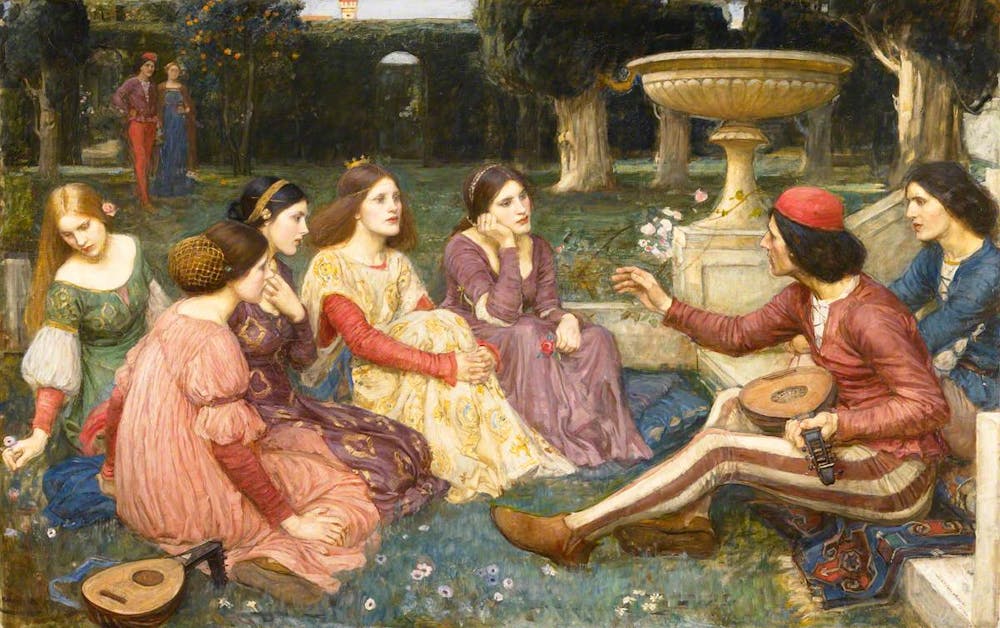
They are not abandoning others, she assures the group, as their relatives have either died or fled. The ten pass time by partaking in banquets, playing games, dancing, singing and telling stories.
Each member of the group narrates one story every day across the following ten days, under the supervision of the elected king or queen for the day. The proceedings close with singing and a dance.
John William Waterhouse, 1916, A Tale from the Decameron. John William Waterhouse/Wikimedia Commons
Over those ten days, the brigata tell 100 stories. In them, they name real people – historical, contemporaries and near contemporaries – who would have been recognisable to readers of the Decameron in Boccaccio’s lifetime.
This gives a semblance of reality to the stories told inside an otherwise imaginary scene. The stories reflect Boccaccio’s accounts of moral decay in Florence at the time. Corruption and debauchery abound.
How then do the pastimes of the brigata bring about renewal and recreation?
The Decameron situates vices within fiction and serves as a guide for preserving the mind during physical isolation. Retreating from a stricken city to live a simple life in a communal isolation, the brigata entertain each other and by following disciplined, structured rituals, recover some of the predictability and certainty that, according to Boccaccio, had been lost.
Contemporary resonances
The Decameron was the first prose masterpiece to be written in the Tuscan vernacular, making it more accessible to readers who could not read Latin. It was first distributed in manuscript form in the 1370’s and almost 200 copies were printed over the following two centuries.
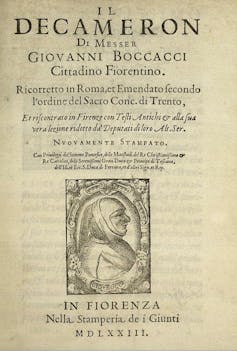
The work was censured in 1564 by the Council of Trent and a “corrected” version, expunging all references to clerics, monasteries and churches, was released in 1573.
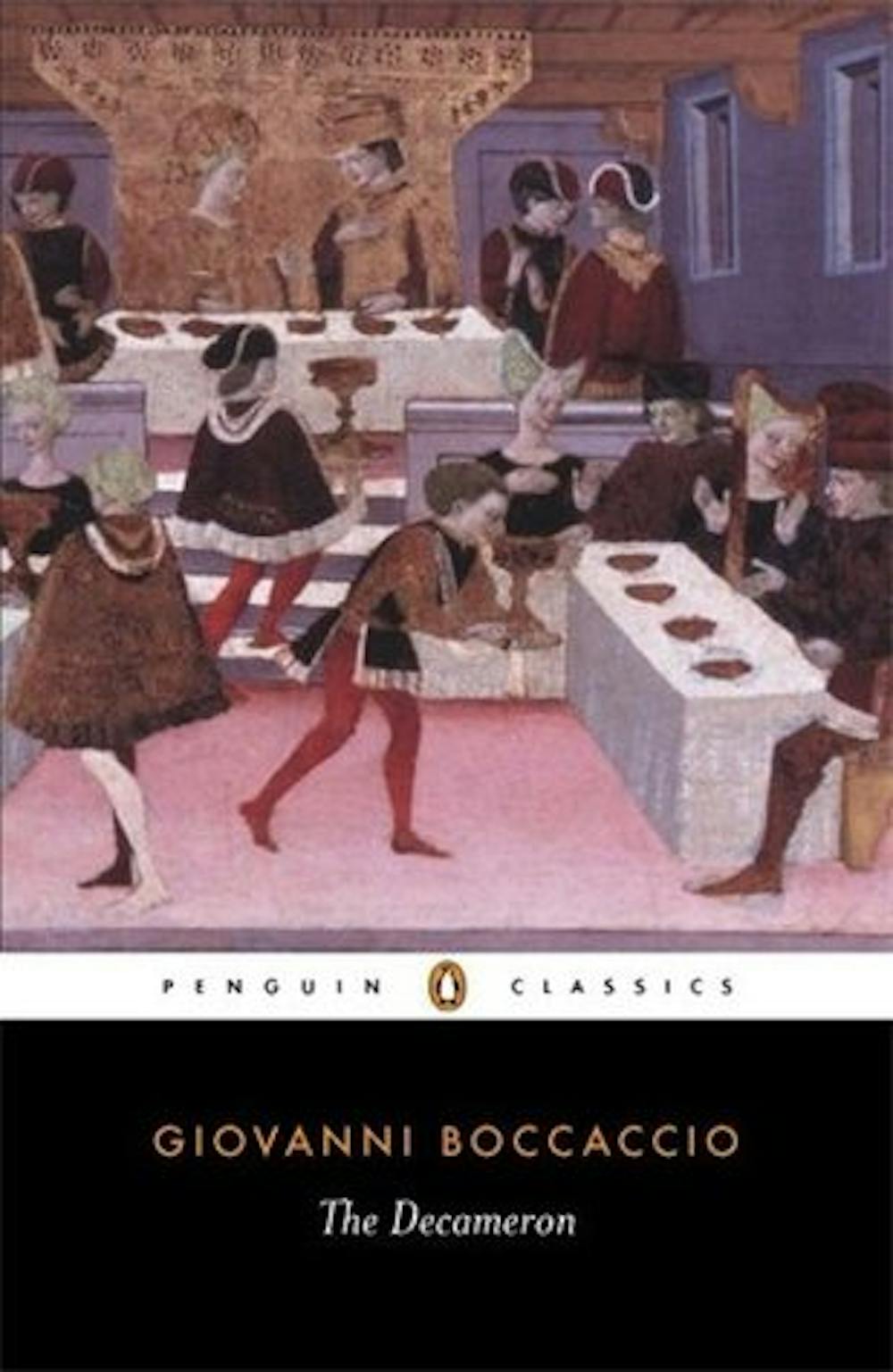
Cover page of the Decameron, heavily redacted (recorrected) in 1573 by orders of the Council of Trent. Fransplace/Wikimedia Commons
Boccaccio’s introduction to the Decameron is a frame-story – a narrative that frames another story or a collection of stories.
This form became a popular literary model for enveloping collections of short stories that blend oral storytelling and literature. Variations and borrowings are seen in Chaucer’s Canterbury Tales and Shakespeare’s All’s Well That Ends Well.
The most well-known film adaptation of the Decameron is the first of a trio of masterpieces in Pier Paolo Pasolini’s 1971 Trilogy of Life. Showcasing ten of the 100 stories in the Decameron, it remains one of Italy’s most popular films.
The Decameron will resonate with modern readers as we grapple with the horror of our own current pandemic. The book is a prescription for psychological survival, a way of mentally distancing from terrible visions, death counts and grim economic forecasts.
Although its framing events took place over 600 years ago, the Decameron’s modern readers, like Boccaccio’s brigata, will find comfort in company and optimism and a sense of certainty in the programmed rituals it describes.
Through its 100 stories, readers can vicariously experience situations that are out of their reach. They can be entertained, find lots to laugh about, and ultimately celebrate the joy and restorative powers of storytelling itself.






 At the BookShelf

You must be logged in to post a comment.