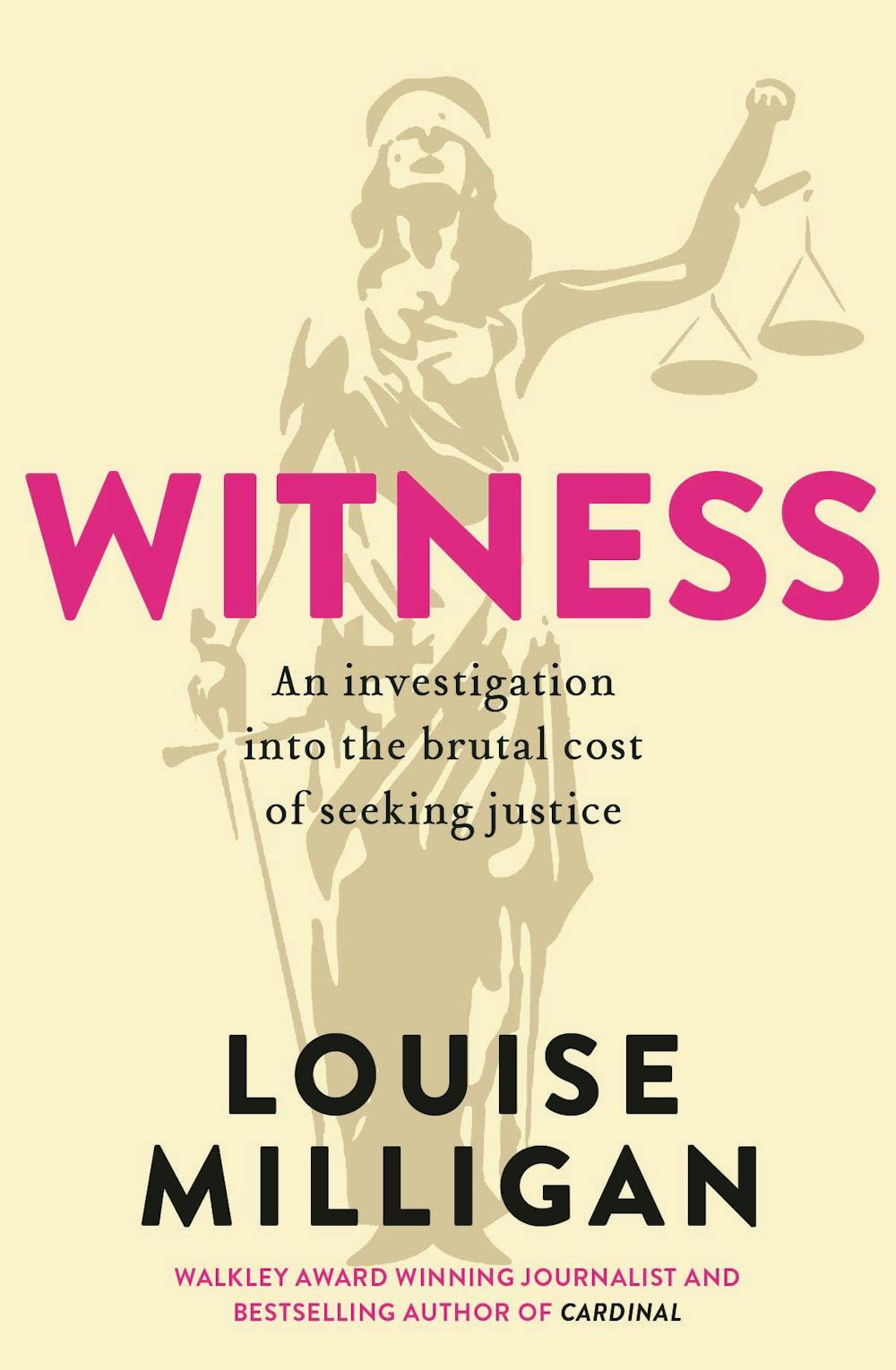
Book review: Witness, by Louise Milligan (Hachette).
Louise Milligan’s new book, Witness, is an excoriating critique of the failures of the criminal justice system in sexual assault trials.
Informed by Milligan’s two decades of experience as an investigative journalist, including her specialist work as a court reporter and her sustained coverage of the trials of George Pell, her analysis is enriched by in-depth interviews with prosecutors, defence counsel, solicitors, judges and academics.
Witness is both a gripping revelation of rarely-heard experts’ opinions about the realities and flaws of criminal procedure, and a devastating critique of the system.
The book is further inspired by detailed consideration of the experience of complainants in two high-profile cases, which Milligan had previously covered in Sydney and Melbourne.
These include Saxon Mullins, a young woman who was the complainant in a rape case that involved two trials, two appeals, and judicial errors. Her experience influenced a Law Reform Commission inquiry into the law of consent. She is now working with criminologists and advocates to develop minimum standards in rape laws to better define consent.
Also examined in detail is the case of former St Kevin’s student Paris Street, who allowed Milligan to reproduce a letter he wrote about his experience of being cross-examined at the age of 15.
Witness is informed, too, by Milligan’s own experience of being cross-examined as a witness in the 2018 committal hearing of Cardinal George Pell. Here Milligan displays courage in divulging the personal toll taken.
“You don’t sleep the night before that first day in court …” she writes. “You vomit … Your mind spins … You cry …”
Her visceral description of the attempted destruction of her own character and credibility in cross-examination testifies to the brutality of many witnesses’ encounters with the criminal trial process.
Witness recognises that for many complainants, their experience of the criminal justice system is traumatic. Through multiple case studies of cross-examination, centring mostly on cases in Victoria and NSW, Milligan demonstrates the best known dimension of this brutality, laying bare the chasm between complainants’ expectations of the system, and the reality of its operation.
Complainants, she shows, are stunned to realise the trial process is not about establishing truth. Often, they feel they are on trial.
Milligan recognises this experience is only partly due to the adversarial criminal justice system being centred neither on the complainant, nor on truth. Our system enables prosecution by the state: the complainant is simply a witness, subject to rules of evidence and procedure.
Core doctrines protecting the accused exist to prevent state abuse of power. This systemic environment is overlaid by features of sexual assault trials, which often turn on the complainant’s credibility and word against that of the accused.
Milligan’s book is balanced. Neither she, nor her interviewees object to principles of presumed innocence until proven guilty, or the standard of proof. She accepts counsel’s obligation to strongly defend their client, but focuses on the professional ethic of choice in how this is achieved.
Crucially, Witness emphasises that many defence counsel do treat complainants with dignity and respect, and still defend their client admirably.
But at the book’s core is a justified sense of outrage at those who choose to treat complainants and witnesses with a hostility causing its own trauma; a special kind of systemic abuse.
Tactical shifts and empathy deficits
The interviews in Witness trace fascinating shifts in professional culture. Milligan identifies a change in defence cross-examination tactics from the outright aggression of the past. One interviewee admits “there was a time when you’d just try and eviscerate [the complainant]. And I don’t think juries are impressed by that now.”
Still, Milligan finds much room for improvement. Several defence counsel reveal they changed their approach — not because they have greater understanding about the nature of sexual assault and trauma, or empathy for the complainant, but because it was no longer effective for their client.
Others, still reliant on aggression, rationalise their approach as simply doing their job, to “ask the hard questions”. However, Milligan suggests this is simply a disingenuous cloak for cruelty, starkly contrasting it with defence counsel who do a brilliant job without brutalising victims.
Elsewhere in Witness, she charts the historic male dominance of the legal profession and the limits this places on the capacity for change.
Witness looks at how generations of gender discrimination still shape the legal profession and the running of trials. Shutterstock
A particularly striking dimension of Witness is its revelation that the adversarial system is brutal for legal practitioners, too.
Milligan’s interviews elicit numerous admissions of excessive drinking to cope with the stress, including the trauma of having to try to break down complainants.
One lawyer describes this activity as requiring “a complete separation of self”.
Milligan’s experience
Milligan’s account of her own cross-examination in the Pell committal by Robert Richter QC is exhaustive and compelling. Reflecting on the experience, she repeatedly references the Evidence Act s 41, which imposes a duty on the court to disallow improper questions and improper questioning, including questions that are intimidating or humiliating, or are asked in an insulting way.
Yet, it is clear she felt insufficiently protected by this section of the Act, and by other laws giving the court control over how witnesses should be questioned.
Virtually every question was asked, she writes, in a belittling or insulting way. By the end of the day, she “had never felt more alone”, despite all her experience, preparation, and team of lawyers. What hope do complainants have, she asks, who lack these resources, and were already traumatised?
An argument for change
Witness eloquently affirms how the criminal justice system is maladapted to meet the needs of complainants.
The system is broken. For sex crimes, rates of complaints, prosecutions, and convictions are persistently low.
Knowing the brutal experience awaiting them, victims often do not complain, or withdraw from proceeding, undermining the rule of law. Because these are qualitatively different kinds of cases, leaders in the field have long argued that sexual assault trials require more fundamental changes.
Yet, even without more radical change, Witness insists a minimum acceptable standard of professional practice – treating witnesses with dignity and respect – is required and achievable, without compromising fair trial rights.
Protections against humiliating treatment of witnesses need to be properly enforced by judges and prosecutors. As one QC admits to Milligan, reforms about judicial directions and improper questioning “don’t mean anything if the prosecutor doesn’t intervene and the judge or magistrate isn’t in control of the courtroom”.
Milligan also suggests complainants would benefit from an expert advisor to assist them in navigating the system, and to protect against unduly intimidatory tactics.
This suggestion is supported by many of her interviewees, including both prosecutors and defence counsel.
Having interviewed so many witnesses, having borne witness to these trials, and having been a witness herself, Milligan is uniquely placed to reflect on the process.
She challenges legal practitioners to be part of the problem, or part of the solution. With Witness, a triumph of intellect and empathy, Milligan has chosen to be part of the solution.
In David Foster Wallace’s Infinite Jest (1996), even the years have their price. They have been sold off and named. Year of the Whopper. Year of the Perdue Wonderchicken. Year of the Depend Adult Undergarment. Time has been reduced to another opportunity for corporate sponsorship, as if it were a Premier League football stadium.
The characters who inhabit Wallace’s world feel the pernicious grip of consumerism even more acutely than we do. They battle with the same addictions: to entertainment; to drugs and alcohol, of course; to sporting success at any cost. Sadly, we recognise each of these in our society. But at least our years haven’t been put up for sale. Yet.
Infinite Jest narrates a vision of the near future, which is now our recent past. The novel depicts a conjectural North American superstate during the first decade of the 21st century. But what if we were we living out Wallace’s speculative fiction? In a number of frightening ways, we are. One thing is for certain: there would be a clear contender for 2020 sponsorship. It would be the Year of Zoom.
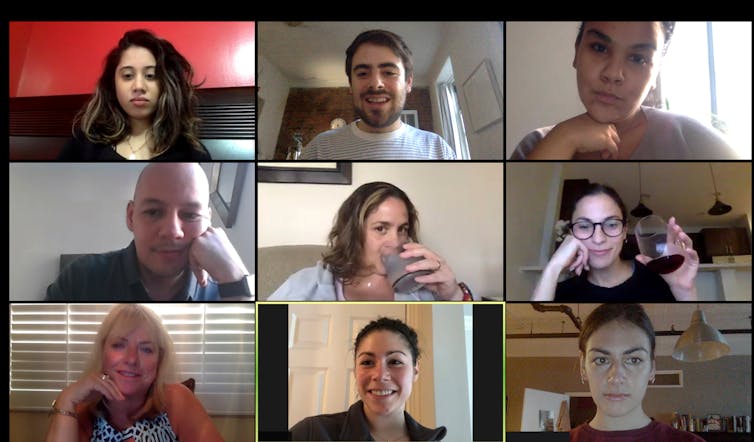
Or Teams. Or Meet. Since the COVID-19 restrictions on our lives began in March, these platforms have become household names. Many of us have had to grow familiar with their distinct idiosyncrasies in order to work or socialise. Infinite Jest provides something of a user guide to handling video calls. However, it is not a ringing endorsement of them. Quite the opposite.
That Infinite Jest predicts video calls is hardly noteworthy. Communicating at a distance through a screen has long been a staple ingredient of science fiction. What is so eerily prescient about video calls in the novel is not its description of their rise. It is the reasons Wallace gives for their demise.
Ahead of his time: the late author David Foster Wallace. Steve Rhodes/Flickr via Wikimedia Commons, CC BY-SA
Wallace calls it “videophony”. This nascent video-telephonic technology enjoyed “AN INTERVAL OF HUGE CONSUMER POPULARITY” before demand “COLLAPSED LIKE A KICKED TENT”. A capitalised passage of faux media analysis concludes that phone users “ACTUALLY PREFERRED THE RETROGRADE OLD LOWTECH BELL-ERA VOICE-ONLY TELEPHONIC INTERFACE AFTER ALL”. It then asks: “WHY THE ABRUPT CONSUMER RETREAT BACK TO GOOD OLD VOICE-ONLY TELEPHONING?”
Wallace’s narrator answers the call. People rejected videophony because of “(1) emotional stress, (2) physical vanity, (3) a certain queer kind of self-obliterating logic in the microeconomics of consumer high-tech”. The pandemic has proven Wallace right on all three counts.
Fancy a Zoom later?
At the beginning of lockdown, we flocked to video conferencing. It was – and remains – an invaluable means of staving off boredom and loneliness. But we have begun to feel the effects of what Wallace identified more strongly in recent months.
We held pub quizzes, then we stopped. We agreed to Zoom every week, then we didn’t. As Wallace puts it: “it turned out that there was something terribly stressful about visual telephone interfaces that hadn’t been stressful at all about voice-only interfaces.”
Plenty of people had been regularly making video calls long before the COVID-19 outbreak. Back then, however, the technology wasn’t serving as a substitute for face-to-face interaction to the same extent. In Infinite Jest, consumers have the luxury of rediscovering an earlier technology, the merits of which passed them by the first time around. We are not in the same position. We know full well the value of what we lack in lockdown – and every call has been coloured by the mourning of its loss.
We continue to use video calls in part because we know that this is as good as it’s going to get for some time. Socialising indoors is once again illegal for millions of people across the UK and elsewhere. So we have developed the videophonic coping strategies that Wallace envisioned.
Thankfully, we have been spared the “emotional stress” of realising that – as Wallace puts it – “traditional audio-only phone conversations allowed you to presume that the person on the other end was paying complete attention to you while also permitting you not to have to pay anything even close to complete attention to her.” Each of us had that earth-shattering realisation midway through our first Skype call, however many years ago. Incredibly, up till then we had never been “haunted by the suspicion that the person on the other end’s attention might be similarly divided”.
Lockdown has been more troubling for our “physical vanity”. Wallace foresaw the “shiny pallid indefiniteness” of seeing our own faces on screen. They are “not just unflattering but somehow evasive, furtive, untrustworthy, unlikeable.” To combat what Wallace terms “Video-Physiognomic Dysphoria”, the telecommunications industry devised “High-Definition Masking”. What started as composites of “flattering multi-angle photos” culminated in “a form-fitting polybutylene-resin mask”. We are not quite at that stage. Yet.
Background information
Our vanity extends far beyond our faces. Or rather, behind our faces to the backdrops that frame them. The early weeks of lockdown were littered with stories mocking politicians and journalists for their carefully curated bookshelves. But who among us cannot empathise with these contrivances? Wallace knew we would want to communicate “the sort of room that best reflected the image” of ourselves that we “wanted to transmit”. In my experience, this means having to resist the urge to tailor the spines on display to match the reading habits and political allegiances of every caller. The call ends up beginning well before the scheduled time.
The alternative isn’t much better. In Infinite Jest, people cover their videophone lens with a “Transmittable-Tableau”. These are “high-quality transmission-ready photographs, scaled down to diorama-like proportions”. Not such a ridiculous idea, given the wide range of video call backgrounds currently available.
The artfully staged bookshelf and the digital backdrop both run risks. The former can be construed as being horrendously self-involved. The latter invites the inference that there is something to hide behind whatever high-resolution facsimile the disembodied head is looming in front of. The key is to find the sweet spot between not appearing too concerned with one’s appearance, while shielding the call participants from the chaos lying slightly out of frame.
Which brings me to Wallace’s third reason for the failure of videophony. In its final throes, there emerged a “chic integrity” in rejecting videophony as “tacky vain slavery to corporate PR and high-tech novelty”. I have noticed a similar trend in recent weeks. Some callers now take a wonderful stance against vanity.
The messier the background, the better. Unsuitable lighting now trumps precisely directed anglepoise lamps. Which begs the question: why bother with the video component of video calls at all? Is the “self-obliterating logic in the microeconomics of consumer high-tech” starting to take hold, as Wallace prophesied?
Wallace’s narration announces that videophony is “less like having the good old phone ring than having the doorbell ring and having to throw on clothes and attach prostheses and do hair-checks in the foyer mirror before answering the door”. These inconveniences would be a small price to pay if it meant our doorbells would ring again. And I don’t mean for another Amazon delivery.









 At the BookShelf
You must be logged in to post a comment.