Unknown's avatar

Know your place – poetry after the Black Death reflected fear of social change


Chaucer commended those who followed their societal roles and condemned those who didn’t.
Morphart Creation/Shutterstock

Stephen Rigby, University of Manchester

The sharp fall in population caused by the waves of plague which followed the arrival of the Black Death in 1348 led to one of the most dramatic periods of economic and social change in English history. By 1377, the population was around only a half of its pre-plague level but for those who survived there were new opportunities.

With a great deal of land now available, peasants could obtain larger holdings and rent them on more favourable terms. Likewise, those who worked for wages could take advantage of the labour shortage to obtain higher wages enjoy more varied diets – with more meat and dairy – and buy a wider range of manufactured goods.

The second half of the 14th century was thus a period of rising living standards, social mobility and increasing class conflict as the lower orders now sought to obtain improved terms from their landlords and employers.

The dramatic social changes of these years drew several responses from contemporary poets. In the medieval period, imaginative literature was often seen as having an ethical function by teaching virtue, which was defined as fulfilling the expected tasks of their social order. Modern literary critics often see imaginative literature challenging dominant ideologies or providing a sanctioned space for the expression of social dissidence. By contrast, the work of poets in the post-plague era often sought to buttress the social hierarchy against the threats with which it was now confronted.

Langland and Gower against the peasants

Such sentiments are to be found in William Langland’s allegorical poem, Piers Plowman (B-version written c. 1380). Here, the poet expresses his sympathy for those who were genuinely poor or hard-working but echoes post-plague labour legislation and attacked those who, he believed, preferred to beg rather than work.

There had been frequent complaints in parliament about labourers who preferred handouts to work or who took advantage of the labour shortage to demand higher wages. In response, a series of laws were introduced to reduce labour mobility and freeze wages at their pre-plague levels. Langland also calls upon the knightly class to defend the community from those “wasters” who refused to work and criticised the labourers who impatiently demanded higher wages and refused to obey the new legislation.

Contemporary moralists complained about those who rose above their allotted station in life and so in 1363 a law was passed that specified the food and dress that were appropriate for each social class. In line with such attitudes, Langland railed against the presumption of labourers who disdained day-old vegetables, bacon and cheap ale and instead demanded fresh meat, fish and fine ale.
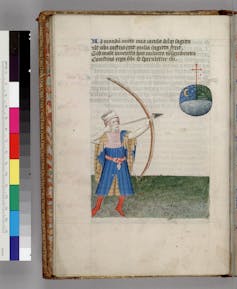
John Gower depicted as an archer in Vox Clamantis.
Berkley

Similar views are expressed in John Gower’s poem Vox Clamantis (the Voice of One Crying in the Wilderness) where the peasants are attacked for being idle and utterly wicked. The common people had fallen into an evil disposition in which they ignored the labour laws and were only willing to work if they received the highest pay.

When the lower orders refused to know their place, as in the Great Revolt of 1381 (also known as the Peasants’ Revolt), they were denounced by contemporary chroniclers as wicked, treacherous, and diabolical. In line with such criticism, Gower’s poem includes an allegorical account of the rising that portrays the rebels as farmyard animals rising up against their masters. They subsequently turn into monsters that attack humanity and becoming followers of Satan in their attachment to wrongdoing and slaughter.

Chaucer’s difficult voice

However, if Langland and Gower were openly hostile to the aspirations of the peasants and the labourers, Geoffrey Chaucer has proved more difficult to read. For many critics, Chaucer is a writer who prefers to present his readers with questions rather than providing them with stock answers. To them, his use of multiple voices and shifting perspectives pose a challenge to the accepted contemporary beliefs and exposes the kind of ideology found in the works of a Gower as partial and inadequate.
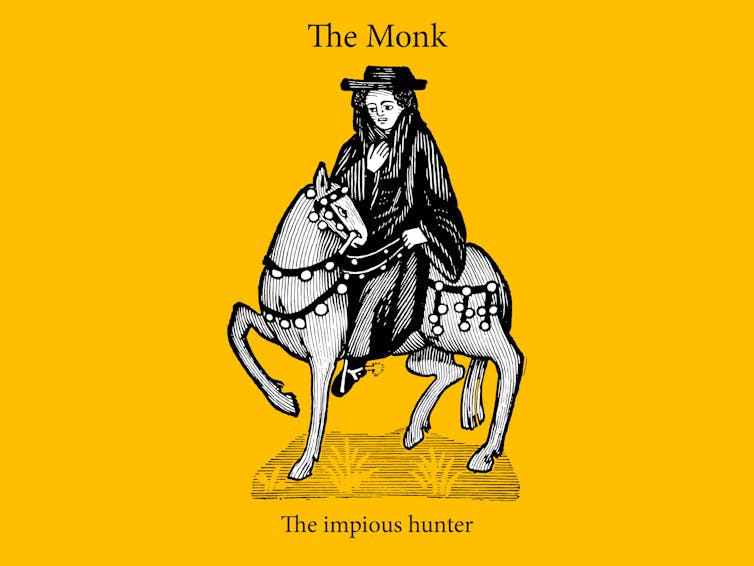
Instead of committing to a pious life of study and prayer, the monk pursued the pleasure of hunting.
Morphart Creation/Shutterstock

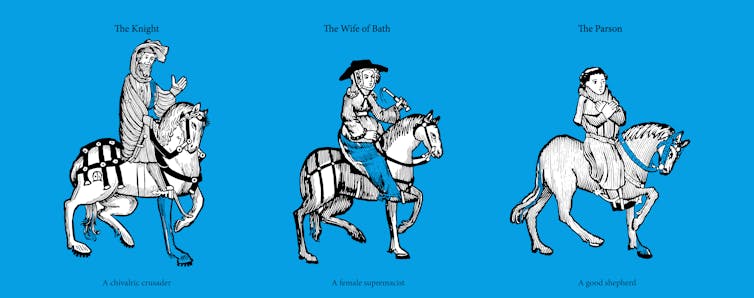
Yet for other critics, Chaucer is much more conservative or even, as the medieval scholar Alcuin Blamires puts it, reactionary in his outlook. After all, among the pilgrims in the Canterbury Tales, those who are presented as admirable are the ones who dutifully perform the traditional functions of their social estate. For example, the Parson is a good shepherd to his flock, the Knight is a chivalrous crusader, and the Plowman works hard and faithfully pays his tithes. It is those who fail in their duties or seek to rise above their station whom Chaucer satirises – as when the Monk prefers hunting to a life of study and prayer or when the Wife of Bath seeks female supremacy in marriage.

Certainly, the Parson offers us a socially conservative message when, at the end of the Canterbury Tales, he preaches that as part of the divinely arranged cosmic order, God has ordained that some people should be of higher social rank and others should be lower. People should, therefore, render honour and obedience not only to God but also to their spiritual fathers and their secular superiors. Nobody should lament their misfortunes or envy the prosperity of others but rather should endure adversity in patience in the hope of obtaining joy and ease in the next life.

Given that medieval literary theory regards the ending of a text as being particularly important in conveying its meaning, we may perhaps regard Chaucer’s views as being in line with his Parson. If so, then Chaucer’s response to the social change of his day may have been rather closer to the views of Gower and Langland than many of his modern readers would like to admit.
Read and listen more from the Recovery series here.The Conversation

Stephen Rigby, Emeritus Professor of Medieval Social and Economic History, University of Manchester

This article is republished from The Conversation under a Creative Commons license. Read the original article.
Unknown's avatar

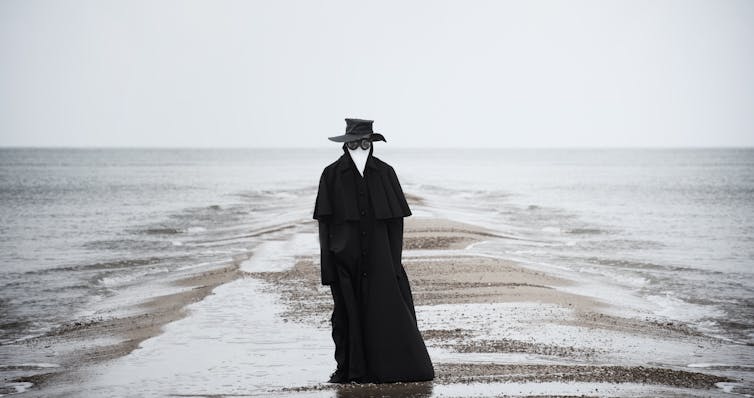
How medieval writers struggled to make sense of the Black Death


The Black Death inspired medieval writers to document their era of plague. Their anxieties and fears are starkly reminiscent of our own even if their solutions differ.
(Shutterstock)

Kriston R. Rennie, The University of Queensland

A plague of serious proportions is ravaging the world. But not for the first time.

From 1347-51, the Black Death killed anywhere from one-tenth to one-half (or more) of Europe’s population.

One English chronicler, Thomas Walsingham, noted how this “great mortality” transformed the known world: “Towns once packed with people were emptied of their inhabitants, and the plague spread so thickly that the living were hardly able to bury the dead.” As death tolls rose at exponential rates, rents dwindled, and swaths of land fell to waste “for want of the tenants who used to cultivate it….

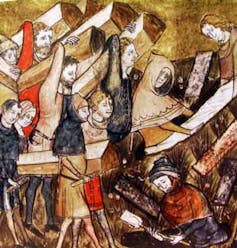
Pierart dou Tielt’s miniature, Burying Plague Victims of Tournai.
(Wikimedia Commons)

As a medieval historian, I’ve been teaching the subject of plague for many years. If nothing else, the feelings of panic between the Black Death and the COVID-19 pandemic are reminiscent.

Like today’s crisis, medieval writers struggled to make sense of the disease; theories on its origins and transmission abounded, some more convincing than others. Whatever the result, “… so much misery ensued,” wrote another English author, it was feared that the world would “hardly be able to regain its previous condition.

A disease without borders

Medieval writers produced a variety of answers for the plague’s origins. Gabriele de Mussis’ Historia de Morbo attributed the cause to “the mire of manifold wickedness,” the “numberless vices,” and the “limitless capacity for evil” exhibited by an entire human race no longer fearing the judgement of God.

Describing its eastern origins, he further noted how the Genoese and Venetians had imported the disease to western Europe from Caffa (modern-day Ukraine); “carrying the darts of death,” disembarking sailors at these Italian port-cities unwittingly spread the “poison” to their relations, kinsmen and neighbours.

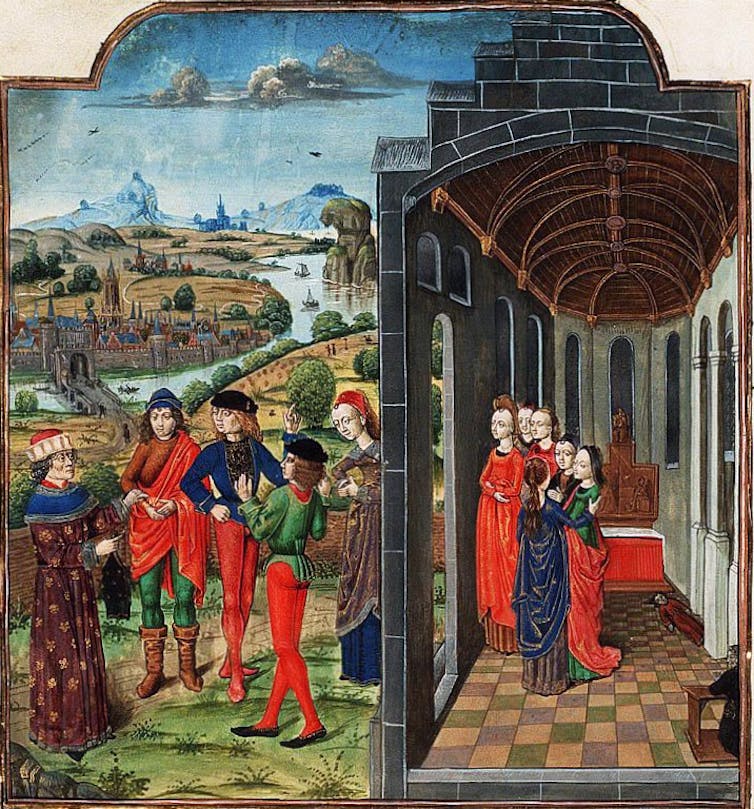
Master of Bruges of 1482’s rendering of Giovanni Boccaccio and Florentines who have fled from the plague.
(Royal Library of the Netherlands)

Containing the disease seemed nearly impossible. As Giovanni Boccaccio wrote about Florence, the outcome was all the more severe as those suffering from the disease “mixed with people who were still unaffected …” Like a “fire racing through dry or oily substances,” healthy persons became ill.

Possessing the power to “kill large numbers by air alone,” through breath or conversation, it was thought, the plague “could not be avoided.”

Looking for a cure

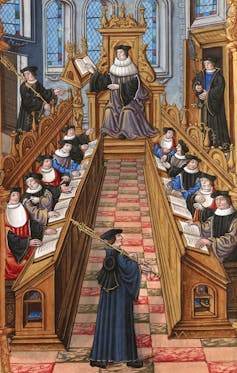
Scholars worked tirelessly to find a cure. The Paris Medical Faculty devoted its energies to discovering the causes of these amazing events, which even “the most gifted intellects” were struggling to comprehend. They turned to experts on astrology and medicine about the causes of the epidemic.

Étienne Colaud’s ‘A meeting of doctors at the university of Paris.’ From the ‘Chants royaux’ manuscript.
(Bibliothèque Nationale de France).

On the pope’s orders, anatomical examinations were carried out in many Italian cities “to discover the origins of the disease.” When the corpses were opened up, all victims were found to have “infected lungs.”

Not content with lingering uncertainty, Parisian masters turned towards ancient wisdom and compiled a book of existing philosophical and medical knowledge. Yet they also acknowledged the limitations in finding a “sure explanation and perfect understanding,” quoting Pliny to the effect that “some accidental causes of storms are still uncertain, or cannot be explained.”

Self-isolation and travel bans

Prevention was critical. Quarantine and self-isolation were necessary measures.

In 1348, to prevent the illness from spreading through the Tuscan region of Pistoia, strict fines were enforced against the movement of peoples. Guards were placed at the city’s gates to prevent travellers entering or leaving.

These civic ordinances stipulated against importing linen or woollen cloths that might carry the disease. Demonstrating similar sanitation concerns, bodies of the dead were to remain in place until properly enclosed in a wooden box “to avoid the foul stench which comes from dead bodies”; moreover, graves were dug “two and a half arms-lengths deep.”

Butchers and retailers nevertheless remained open. And yet a number of regulations were imposed so that “the living are not made ill by rotten and corrupt food,” with further bans to minimize the “stink and corruption” considered harmful to Pistoia’s citizens.

Community response and resolve

Authorities responded in different ways to the outbreak. Recognizing the plague’s arrival by ship, the people of Messina “expelled the Genoese from the city and harbour with all speed.” In central Europe, foreigners and merchants were banished from the inns and “compelled to leave the area immediately.”

These were severe measures, but seemingly necessary given the varied social reaction to plague. As Boccaccio famously recounted in his Decameron, the whole spectrum of human behaviour ensued: from extreme religious devotion, sober living, self-isolation and a restricted diet to warding off evil through heavy drinking, singing and merrymaking.

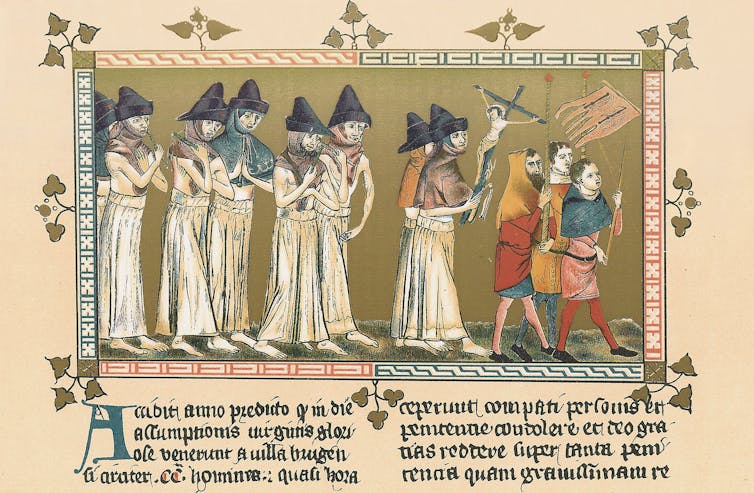
The flagellants at Doornik in 1349. The people are pictured performing flagellations as an act of penance.
(Wikimedia Commons)

The fear of contagion eroded social customs. The number of dead grew so high in many regions that proper burials and religious services became impossible to perform: new religious customs emerged pertaining to preparing for and presiding over death.

Families were changed. An account from Padua mentions how “wife fled the embrace of a dear husband, the father that of a son and the brother that of a brother.”

Ultimately, there is a human element to plague too often lost in the historical record. Its influence should not be underestimated or forgotten. The modern response to pandemic evokes a similar community response. Different in scope and scale, and indeed in medical practice, administrative and public health actions remain critical.

But in 2020, we are not, as Boccaccio lamented, seeing the law and social order break down. Essential duties and responsibilities are still being carried out. Against our own 21st-century plague, wisdom and ingenuity are prevailing; citizens hang on “the advice of physicians and all the power of medicine,” which unlike the 14th century, is anything but “profitless and unavailing.”The Conversation

Kriston R. Rennie, Visiting Fellow at the Pontifical Institute of Mediaeval Studies, Toronto, and Associate Professor in Medieval History, The University of Queensland

This article is republished from The Conversation under a Creative Commons license. Read the original article.