

Raluca Radulescu, Bangor University and Lisa Blower, Bangor University
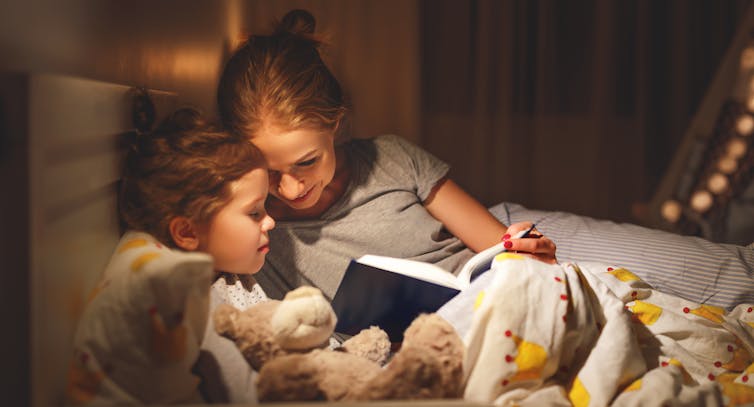
Speaking at the 2018 Hay Festival, His Dark Materials author Philip Pullman said: “To share a bedtime story is one of the greatest experiences of childhood and parenthood.” This couldn’t be more true. Besides helping sleepyheads absorb language through the familiar voices that nurture them, understand the complexities of their world, and the reasons behind their feelings, bedtime stories show how childhood can be the greatest adventure of all.
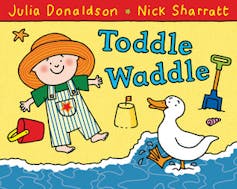
1. Toddle Waddle by Julia Donaldson
Age range: two to five years
Macmillan Children’s Books
Even the youngest child can engage with sound, colour and fun, and this book (illustrated by Nick Sharratt) is filled with bright joy and wonderful onomatopoeia. From the sound of flip-flops to the excitement of slurping a drink at the beach and the music made by different instruments, the sounds, then words, are a wonderful introduction to the intricacies of language.
2. Mr Men & Little Miss books by Roger Hargreaves
Age range: three years+
Hargreaves’ colourful 2D characters behaving to type are a wonderful way to identify with basic emotions by interpreting colour as a feeling. As journalist and author Lucy Mangan puts it in her memoir Bookworm: “Of course uppitiness is purple. Of course happiness is yellow.” These are no fuss, easy to follow collectables – and bitesize too, so you can gobble through second helpings before turning out the light.
3. The Lorax by Dr Seuss
Age range: three to eight years

HarperCollins
No child should grow up without The Lorax. They’ll never be the same when they’ve learned about the Swannee-swans, Humming fish, and Bar-ba-loots bears, their Truffula trees being cut by the mysterious and scruple-free Once-ler. While the environmental message of the book is even more urgent now than it was when The Lorax was first published in 1971, the story is just as entrancing, instructive – without preaching – and, above all, as hopeful as ever. A wonderful wise Lorax speaks for the trees, and for all the world’s children, who want to keep the future green.
4. My Big Shouting Day, by Rebecca Patterson
Age range: two to eight years
A funny picture book for younger readers that will resonate with many parents for its keen perspective on patience. It positively encourages under-fours to shout along with grumpy Bella who gets up on the wrong side of the bed. It shows the child that it’s ok to feel angry – heck, they’ll be a teenager soon enough – but it also gives them permission to express it, and reminds them that tomorrow is always a new day.
5. The Moomin books by Tove Jansson
Age range: three to eight years
The Moomins’ home, Moominvalley, is a place of wonder and fun, populated by fairy-like, round creatures that resemble hippopotamuses, but enjoy human hobbies such as writing memoirs (Moomin papa), making jam (Moomin mama), and playing make-believe (Moomintroll and Snork Maiden). Their adventurous side comes out at all opportunities, stirred by friends Little My and Snufkin, or by mysterious intruders.
First published between 1945 and 1970, in recent years the stories have been tailored for both younger (soft and flap books) and older children (hardback storybooks). The Moomin books tell dream-like stories while tackling questions about love, friendships, encounters with strangers, and so on. An all-round winner.
6. Alice in Wonderland by Lewis Carroll

Wikimedia
Age range: four to 11 years
The first true book written for children about children never fails to bewitch and baffle. Young Alice-like readers can explore the topsy-turvey Wonderland, while the grown-ups reading to them will appreciate the metaphorical Mad Hatter and role of the white rabbit as leader in the adventure in a way they wouldn’t have been able to as a child. Carroll’s book is a celebration of a child’s wonder and curiosity, and fears of growing bigger too. It invites you to talk dreams and nightmares, to accept the weird and extraordinary and, best of all, to conjure up your own adventure down the rabbit hole. It’s a rite of passage, ideal for sharing.
7. Norse Myths: Tales of Odin, Thor and Loki, retold by Kevin Crossley-Holland
Age range: five to 12 years
In a world where comic book superheroes and heroines reign supreme, these legends can entrance a young mind forever. This selection of Norse myths brings all the gritty dark stuff about trickster Loki together with tales of hammer-wielding Thor, and the machinations of Asgardean king Odin and goddess of love, battle and death, Freyja. It tickles the imagination of the young and challenges the parent too. Fabulous illustrations by Jeffrey Alan Love accompany Crossley-Holland’s delightful retelling, bringing these ancient stories to life in a way that no other anthology has.
8. Charlie and The Chocolate Factory by Roald Dahl
Age range: eight to 12 years

Penguin Random House
This chocolate wonderland is the perfect read-aloud book, thanks to Dahl’s masterful use of the English language. Amid all the magic and invention is a wagging finger providing moral lessons on the perils of being greedy, or a brat or overly competitive – and that goes for the adult reader too. Thank goodness then for Willy Wonka, the man who really never grew up, and his band of oompa-loompahs who punish the bad, reward the good, then provide reason for it all through song.
In truth, there is no right book to share – there are plenty of them available these days – nor should there be any chronological order to how and what we read. These are just some suggestions on ways to make bedtime a little more magical. But never underestimate how marvellous it can be to reread a childhood favourite to the little one you’re now tucking in to bed. It could inspire a passion for reading and spark an interest that lasts a lifetime.
 The age ranges used in this article are mostly based on interest and reading level ratings from Book Trust.
Raluca Radulescu, Professor of Medieval Literature and English Literature, Bangor University and Lisa Blower, Lecturer in Creative Writing, Bangor University
This article was originally published on The Conversation. Read the original article.

 At the BookShelf
