
Unknown's avatar

Secrets and scandals: where Malcolm Turnbull’s memoir fits in the rich history of prime ministerial books


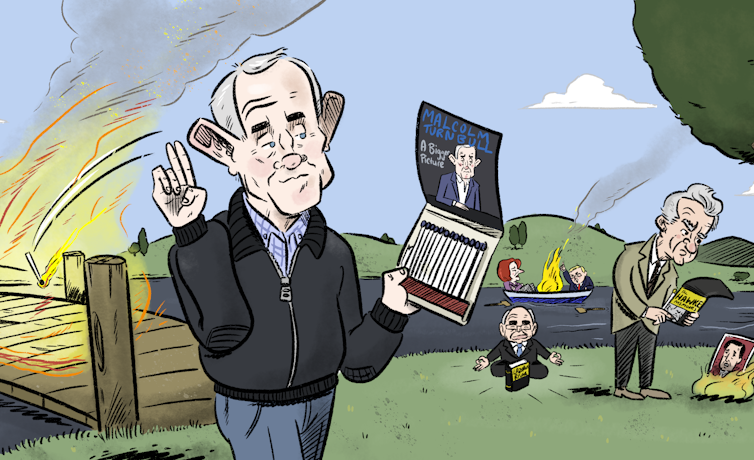
Wes Mountain/The Conversation, CC BY-ND

Joshua Black, Australian National University

Landing in the middle of the coronavirus pandemic, it may seem strange former prime minister Malcolm Turnbull’s memoir has generated so much political controversy.

Turnbull has been accused of hypocrisy and championing socialism, and has been threatened with expulsion from the Liberal Party.


Read more:
Politics with Michelle Grattan: Former Prime Minister Malcolm Turnbull on his autobiography, ‘A Bigger Picture’


In A Bigger Picture, Turnbull deals candidly with his antagonists inside the Coalition, who fought him bitterly on the same-sex marriage reform and climate policy. Similarly, he names and shames those he blames for the leadership insurgency of August 2018. All of this was expected, but none of it must please the current government.

But is the book any more inflammatory than previous prime ministerial memoirs?

Political controversy is a trademark of political memoir publishing in Australia. A Bigger Picture is just another page in that story.

Until the 1960s, prime ministerial memoirs were the exception, not the rule. Between 1945 and 1990, just three former prime ministers chose to publish books about their political lives. Two of them – Billy Hughes and Robert Menzies – produced two books each, and both political veterans sought to avoid “telling tales out of school”. Both seemed more interested in foreign affairs, particularly our imperial relationship to the UK in the case of Menzies.

The dismissal of the Whitlam government provoked both Sir John Kerr and Gough Whitlam to publish their memoirs. After reading extracts of Kerr’s Matters for Judgement, Whitlam decided to “set the record straight immediately” by writing The Truth of the Matter. His second book, The Whitlam Government, was also designed to make a political splash. Promising to explain the “development and implementation” of his policy program, the book was timed for release on the tenth anniversary of the dismissal itself, ensuring maximum publicity.

Since then, political controversy has accompanied prime ministerial memoirs, in part because incumbent political parties and leaders have had a vested interest in how these books might affect their popularity.

In his 1994 political memoir, Bob Hawke accused his rival and successor, Paul Keating, of calling Australia “the arse-end of the world” during an argument about the Labor leadership. Further, Hawke accused Keating of failing to support Australia’s involvement in the Gulf War against Saddam Hussein’s invasion of Kuwait in 1990.

Keating, who was attacked in parliament in October 1994 over the claims, called both allegations “lies”. Hawke offered to take a lie-detector test to prove his sincerity. Senior ALP figures recorded their outrage at Hawke’s memoir. But Hawke hit back, describing them as “precious self-appointed guardians of proper behaviour”.

Hawke’s predecessor also damaged his relationship with his own party in the process of publishing his memoirs. Malcolm Fraser’s Political Memoirs, written with journalist Margaret Simons, was recognised as one of Australia’s top ten books of 2010. His outspokenness – in the book and in his post-prime-ministerial life more generally – earned him many attacks from Coalition MPs.

John Howard handled the politics of his memoirs better than most politicians. Though the book was antagonistic toward his former treasurer, Peter Costello, Howard promised to “deal objectively” with events and relationships in Lazarus Rising. Ever the party stalwart, Howard and his publishers re-issued the book after the 2013 election with a new chapter that touted Tony Abbott’s “high intelligence, discipline […] good people skills”.

Kevin Rudd and Julia Gillard both publicly took aim at one another in their memoirs, which made for plenty of media fodder. In My Story, Gillard described Rudd’s leadership as a descent into “paralysis and misery”. Rudd returned fire, calling her book her “latest contribution to Australian fiction”. However, he was unable to dent the book’s commercial success.

Four years later, Rudd in The PM Years accused Gillard of plotting “with the faceless men” to become prime minister. In a bid to patch over the historic rifts, he subsequently promised the Labor Party’s 2018 National Conference that the “time for healing” had come.

Critics of Turnbull’s book – such as Sky News’ Andrew Bolt and 2GB’s Ben Fordham – have argued that he and his publishers, Hardie Grant, were wrong to “betray confidences” and divulge “private conversations”.

In reality, political memoirs have always pushed against conventions of political secrecy. In the 1970s, British cabinet minister Richard Crossman published his Diaries, which included detailed descriptions of how cabinet functioned. The British establishment subsequently conducted the Radcliffe review into political memoirs and diaries. It found such material should be kept secret for 15 years, but that civil servants could do little to stop their political masters from publishing.

In 1999, Australia’s Neal Blewett was warned that publishing his A Cabinet Diary, recorded seven years earlier, could lead to prosecution under the Crimes Act because it revealed confidential cabinet discussions. Calling the public service’s bluff, Blewett published anyway. He explained in the book that “a few egos will be bruised, but cabinet ministers are a robust lot”. His diary shed significant light on the trials and tribulations of a ministerial life.

Since then, countless MPs and ministers have published books that claim to accurately represent personal conversations, some based on private notes (as Costello claimed in his memoirs), others on diary entries (as is the case in Turnbull’s book). In recent years, politicians have reproduced text messages and email exchanges in their books, as Bob Carr did in his 2014 book, Diary of a Foreign Minister. In each version of history, the author is the essential policymaker.


Read more:
View from The Hill: Malcolm Turnbull gives his very on-the-record account of Scott Morrison


In his book, Turnbull reveals private conversations and WhatsApp exchanges with colleagues, world leaders, public servants and more. His accounts of cabinet discussions are hardly ground-breaking: cabinet debates about the economy and national security under the Abbott government, for instance, were thoroughly detailed in Niki Savva’s The Road to Ruin, while the acrimonious debates about energy policy, same-sex marriage and home affairs inside the Turnbull government were laid bare in David Crowe’s Venom. Similarly, Turnbull’s criticisms of News Corporation’s biased reporting have been aired elsewhere, and stop short of Rudd’s argument in The PM Years that Rupert Murdoch should be the subject of a royal commission.

Turnbull’s book is another addition to the history of incendiary political memoir publishing in Australia. Political parties and their media associates have confirmed once again that a successful parliamentary memoir requires deft political management.

Ultimately, A Bigger Picture is not the compendium of revelations that some may perceive. Instead, it is another picture of politics in which “character” and “leadership” reign supreme at the expense of all other political forces.The Conversation

Joshua Black, PhD Candidate, School of History, National Centre of Biography, Australian National University

This article is republished from The Conversation under a Creative Commons license. Read the original article.


Unknown's avatar

Why do I dwell on the past?


Dwelling on the past, like writing in a diary, is part of being human and helps us form our identity. But not all memories are helpful.
from www.shutterstock.com

Laura Jobson, Monash University

Many of us enjoy writing in a diary, reading autobiographies or nostalgically reflecting with others about past times.

Why is remembering our past so important? Are there downsides? And what can we do if dwelling on the past bothers us?


Read more:
Explainer: what is memory?


Memories make us human

Over several decades, researchers have shown remembering your past is fundamental to being human, and has four important roles.

1. Memories help form our identity

Our personal memories give us a sense of continuity — the same person (or sense of self) moving through time. They provide important details of who we are and who we would like to be.


Read more:
Why we remember our youth as one big hedonistic party


2. Memories help us solve problems

Memories offer us potential solutions to current problems and help guide and direct us when solving them.


Read more:
Most people think playing chess makes you ‘smarter’, but the evidence isn’t clear on that


3. Memories make us social

Personal memories are essential for social interactions. Being able to recall personal memories provides important material when making new friends, forming relationships and maintaining ones we already have.


Read more:
The power of ‘our song’, the musical glue that binds friends and lovers across the ages


4. Memories help us regulate our emotions

Our memories provide examples of similar situations we’ve been in before. This allows us to reflect on how we managed that emotion before and what we can learn from that experience.

Such memories can also help us manage strong negative emotions. For example, when someone is feeling sad they can take time to dwell on a positive memory to improve their mood.


Read more:
Health Check: how food affects mood and mood affects food


Memories help us function in our wider society

Dwelling on our personal memories not only helps us as individuals. It also allows us to operate in our socio-cultural context; society and culture influence the way we remember our past.

For instance, in Western individualistic cultures people tend to recall memories that are long, specific, detailed and focus on the individual.

In contrast, in East Asian cultures people tend to recall more general memories focusing on social interactions and significant others. Researchers have seen these differences in children and adults.


Read more:
‘Remember when we…?’ Why sharing memories is soul food


Indeed, the way parents discuss past events with their children differs culturally.

Parents from Western cultures focus more on the child and the child’s thoughts and emotions than East Asian parents. So, there are even cultural differences in the ways we teach our children to dwell on the past.

People from Western individualistic cultures tend to recollect specific unique memories that reaffirm someone’s uniqueness, a value emphasised in Western cultures. In contrast, in East Asian cultures memories function to assist with relatedness and social connection, a value emphasised in East Asian cultures.

Memories and ill health

As dwelling on the past plays such a crucial role in how we function as humans, it is unsurprising that disruptions in how we remember arise in several psychological disorders.

People with depression, for instance, tend to remember more negative personal memories and fewer positive personal memories than those without depression. For example, someone with depression may remember failing an exam rather than remembering their academic successes.

People with depression are more likely to remember the bad times rather than the good.
from www.shutterstock.com

People with depression also have great difficulty remembering something from a specific time and place, for instance “I really enjoyed going to Sam’s party last Thursday”. Instead they provide memories of general experiences, for instance, “I like going to parties”.

We have found people with depression also tend to structure their life story differently and report more negative life stories. They also tend to remember periods of their life, such as going to university, as either distinctly positive or negative (rather than a combination of both).

Disturbances in memory are also the hallmarks of post-traumatic stress disorder. This is when unwanted, distressing personal memories of the trauma spontaneously pop into the mind.


Read more:
Explainer: what is post-traumatic stress disorder?


People with anxiety disorders also tend to have biases when remembering their personal past. For instance, all of us, unfortunately, experience social blunders from time to time, such as tripping getting onto a bus or spilling a drink at a party. However, people with social anxiety are more likely to be consumed with feelings of embarrassment and shame when remembering these experiences.


Read more:
Explainer: what is social anxiety disorder?


Finally, an excessive, repetitive dwelling on your past, without generating solutions, can be unhelpful. It can result in emotional distress and in extreme instances, emotional disorders, such as depression, anxiety and post-traumatic stress disorder.

I don’t want to dwell on the past. What can I do?

If dwelling on the past bothers you, these practical tips can help.

Set aside a certain time of the day for your memories. You could write in a diary or write down your worries. Writing about important personal experiences in an emotional way for as little as 15 minutes a day can improve your mental and physical health.

Practice remembering specific positive memories from your past. This can allow you to engage differently with your memories and gain a new perspective on your memories.

Learn and practise mindfulness strategies. Instead of dwelling on painful memories, a focus on the present moment (such as attending to your breath, focusing on what you can currently see, smell or hear) can help break a negative cycle

When dwelling on past memories try being proactive and generate ideas to solve problems rather than just being passive.

See your GP or health practitioner if you’re distressed about dwelling on your past.


If this article has raised issues for you, or if you’re concerned about someone you know, call Lifeline on 13 11 14.The Conversation

Laura Jobson, Senior Lecturer in Clinical Psychology, Monash University

This article is republished from The Conversation under a Creative Commons license. Read the original article.

Unknown's avatar

The Difference Between Memoir and Autobiography


Unknown's avatar

Whose line is it anyway? The murderer, his mother, and the ghost writers


Christopher Kremmer, UNSW Australia

This is a story about stories. Who writes them. Who owns them and what happens when the two things get muddled. It’s a story about true stories, life stories, stories written by amateurs and professionals. It sounds a warning to the growing number of readers who aspire to publish their own memoirs, and those who write the lives of others.

“Who owns the story?” is the question that lies at the heart of Sonya Voumard’s new book The Media and the Massacre, published this month to coincide with the 20th anniversary of Martin Bryant’s murderous rampage at Port Arthur in Tasmania.

In it, Voumard ponders the case of Bryant’s mother, Carleen, a woman widely reviled by genetic association for the sins of her son, but driven as a mother to tell her side of the story.

It goes like this. After two suicide attempts triggered by the reporting of the 10th anniversary of the massacre, Carleen Bryant writes a 15,000 word memoir of her life before and since that terrible Sunday, April 28th 1996, when Martin Bryant slaughtered 35 men, women and children.

She is not a fluent writer, so friends suggest she seek help from professionals. A literary agent is found, and a journalist, Robert Wainwright of The Sydney Morning Herald is recommended. A $200,000 book deal with a major publisher is mentioned.

Ms Bryant forwards a copy of her memoir to Wainwright, but there are hiccups early on when he passes it on – allegedly without her knowledge – to her daughter, seeking the daughter’s involvement in the project.

A June 2007 meeting in Hobart, at which Wainwright’s wife – another Herald journalist Paola Totaro – joins the writing team, smooths over the trouble. However, when the journalists’ nine-page draft outline of their proposed book – entitled Martin My Son – arrives, relations deteriorate rapidly.

In Voumard’s words, Carleen Bryant became “convinced that the story they (the journalists) wanted to tell was not hers but theirs”. In October 2007, Bryant withdrew from the project, and requested that Wainwright and Totaro return her personal documents and other materials. They did so some months later, by which time all contact between the parties had ceased.

There was, therefore, as Voumard tells it, considerable surprise on the part of Bryant and her friends when, in May 2009, Wainwright and Totaro published Born or Bred? Martin Bryant: the making of a mass murderer. In it, they included at least 29 extracts from her as yet unpublished memoir, allegedly without her permission.

The ins and outs of the legal proceedings that followed cannot be briefly summarised. They are, in any case, subject to the confidentiality clause of an out of court settlement. Bryant also complained to the Australian Press Council, the Media Entertainment and Arts Alliance (MEAA), the Sydney Morning Herald and Fairfax Books claiming breach of copyright. But the publication and sale of Born or Bred? was not impeded.

Voumard, a Sydney-based former journalist and now a writer and academic, and some of the people she quotes in her book, including the criminal lawyer Greg Barns and Ms Bryant’s lawyer Steven Lewis of Slater and Gordon, feel that an injustice was done. Wainwright and Totaro reportedly claimed they were given the memoir “freely and without caveat”, but in Voumard’s view, Bryant had simply agreed to the preparation of a draft outline.

The literary intersections of journalism, creative non-fiction, book publishing and “ghost-writing” are crowded, with a variety of conflicting interests but no single code of ethics.

Is a journalist bound by copyright laws when someone eager to tell own their story hands them their unpublished account of a highly newsworthy subject without conditions attached? Are they bound by their various journalism codes of ethics when writing books, rather than news stories?

As Wainwright and Totaro wrote in the preface to their book, it was Carleen Bryant who withdrew from “their” project, not the other way around. “When she withdrew, the project turned instead into a hunt for the truth and answers.”

This statement, however, sits awkwardly with what appears to have been a lack of any attempt at fact-checking with their albeit uncooperative star source in the months immediately prior to publication.

Voumard’s book, though far from perfect – neither Bryant nor the journalists could be persuaded to talk to her – it is a useful contribution to our understanding of these important issues and the questions they raise.

Although primarily focused on the Bryant-Wainwright-Totaro conflict, she engages with a range of other journalistic and literary approaches to reporting on violent crime, including Carol Altmann’s After Port Arthur (2006).

Voumard talks to a number of senior Australian journalists who reflect on the fact that Port Arthur inspired a new and more mindful approach to the impact of their craft when interviewing traumatised people – a theme later expanded on by Columbia Journalism School’s Dart Center Asia-Pacific.

As a journalist herself, Voumard knows where to look for the Fourth Estate’s ethical weaknesses, and is critical of her own.

“Not all journalists are the same …,” she writes. “At our best, we do good work – bear witness, seek truth, give voice, explain. At our worst we exploit our subjects.”

For Carleen Bryant, having her say via the agency of professional writers was a once in a lifetime chance to achieve a longed for public understanding of the cross she has had to bear.

As one of her close friends tells Voumard, Bryant

wanted to establish herself in the minds of the people of Hobart as she was, rather than as others believed. She wanted them to know that she wasn’t a terrible mother, or the mother of a monster, that she did her best in every way for her son, that she had a loving husband.

But when a story involves hot button issues like mass-murder, journalists’ ethical compasses veer toward the perceived “public interest”, an approach that is not known for its sensitivity to the feelings or views of anyone associated with the killer.

Journalists remain publishers’ first pick for ghost-writing assignments because they write quickly and colourfully, are not afraid of imposing a given meaning on a set of available facts, know what makes headlines and meet their deadlines. But for some stories, that is not the ideal approach.

As Voumard writes,

Carleen Bryant lost the ability to say to others who she was. Her life story and that of her family had been appropriated, attacked, raked over and profited from by so many media organisations for so many years that her identity effectively disintegrated.

Ms Bryant, whose only son was sentenced to 1,035 years prison without parole, has spent most of the past 20 years living alone in a caravan park an hour’s drive north of Hobart. She eventually published her own book, My Story (2010), with a small, but empathetic Hobart-based publishing house

The publisher, Michael Ludeke, took the unusual step of inviting his new author to collect her book from the printers, telling her,

You should come and see this too. This is your book. The people at the printers would like to meet you.

A happy, if not perfect ending to an amateur life writer’s long struggle to be heard.

The Conversation

Christopher Kremmer, Senior Lecturer in Journalism, School of the Arts & Media, UNSW Australia

This article was originally published on The Conversation. Read the original article.

Unknown's avatar

Australia is awash with political memoir, but only some will survive the flood


Jane Messer

Last year more than a dozen political memoirs were published in Australia. From Bob Carr’s Diary of a Foreign Minister to Greg Combet’s The Fights of My Life, from Rob Oakeshott’s The Independent Member for Lyne to Bob Brown’s Optimism, one could be forgiven for thinking Australia is a nation of political junkies.

Or that we’re fascinated by the personalities, policies and procedures that shape our political landscape. But are we really, and if not, why so many books?

The deluge shows no signs of abating, with a similar number of titles expected this year. Already we’ve seen the release of Shadow Minister Chris Bowen’s The Money Men, reflections by Federal Labour members Mark Butler and Andrew Leigh, with former Victorian Labour leader John Brumby’s practical “lessons”, The Long Haul, in press.

Liberals, once laggards in this genre, are stepping up in growing numbers. Federal Minister Christopher Pyne’s “hilarious” A Letter To My Children is out, and Peter Reith’s The Reith Papers is underway. Also in press is the genuinely unauthorised Born to Rule: the Unauthorised Biography of Malcolm Turnbull.

First nurtured by John Iremonger of Hale & Iremonger, Melbourne University Press now leads the way with the genre. MUP Director, Louise Adler, is notorious for her enthusiasm and her efforts to contract politicians of all parties and persuasions. But even Adler has reservations, writing in September’s Meanjin that “the political memoir is unabashedly myopic, subjective and reflexively partisan”.

Tony Abbott, then Federal Oppositon MP, signs copies of his book during the launch Battlelines in Sydney in 2009.
Dean Lewins/AAP, CC BY-ND

One argument for the proliferation of political memoirs is that they enable the public to engage with politicians outside the frenzy of the 24/7 news cycle. Certainly the popularity of Annabel Crabb’s ABC show Kitchen Cabinet suggests there’s some weight to this “getting to know the person beyond the sound-bite” theory.

Some argue the 24-hour media cycle has debased politics to such a degree that voters are searching for a depth of focus missing from parliament and mainstream media coverage and finding it through other channels.

Based on the sales figures, a publisher can safely bet that an Australian political memoir or biography is likely to pay its own way, at the very least. Even the slow ones mostly sell more than a few thousand copies.

But do sales say anything meaningful about these books’ impact on our political process or cultural debate? And how to measure the impact of the political memoir on democratic process?

The genre has been trending for a few years now, propelled in no small part by the success of Bob Hawke’s The Hawke Memoirs (1994) which sold 75,000 copies, and John Howard’s Lazarus Rising (2011), which sold upwards of 100,000.

As far back as 2007, David Marr in his analysis of John Howard’s prime ministership, His Master’s Voice: the corruption of public debate under Howard, despaired of the increase in public “chatter” and the sabotage of free speech. Paradoxically, it was during this period, and subsequently, that political memoirs and biographies increased in number.

Thanks to the introduction of Nielsen BookScan in 2002 and its collection of reliable national book sales figures, metrical research into the book industry and reading patterns is now possible.

But what readers make of the content of these books, and how they contribute to Australian culture, is difficult to accurately discern.

Dr Jan Zwar conducted a close analysis of a range of narrative nonfiction books and their contribution to cultural debate during the Howard years 2003-2008. In an essay for the Journal of the Association for the Study of Australian Literature she observed that “experiences of the actual readers remain a mystery behind the wall of data”.

Former Prime Minister Julia Gillard launching her book My Story in Sydney, 2014.
Dean Lewins/AAP

Other forms of media mediate the relationship between the memoir, its author and the wider readership. Syndicated publication of extracts, the author’s appearances through radio, television, online and print media to discuss the book, and appearances at writers festivals and festivals of ideas are all channels key to ensuring the possibility of the memoir’s broader ideas being promulgated.

In her 2012 essay More than Michael Moore: Contemporary Australian Book Reading Patterns and the Wars on Iraq and Afghanistan, Zwar proposed that it is through these “longer term, less obvious ways” that these texts have discursive impact.

Former PM, Julia Gillard, by way of example, has appeared at half a dozen writers festivals in Australia and New Zealand alongside her memoir, My Story (2015), although no one I spoke to nominated the memoir as being influential or contributing to the debate. Yet, with large live audiences, Gillard clearly is contributing.

The memoir is the prop for the event, and contributes to an already existing discussion of broader “Gillard” topics such as women in politics and education reform.

Similarly, Anna Bligh, former Premier of Queensland, speaking on the ABC program Q&A in August, firmly linked her memoir, Through the Wall: Reflections on Leadership, Love and Survival (2015), to her key message of encouragement to young women to pursue a career in politics, and not to be fearful of the walls “built of the solid bricks of prejudice” (to quote from the book).

The Latham Diaries by former federal opposition leader Mark Latham go on sale in Sydney in 2005.
Mick Tsikas/AAP

Mark Latham’s Latham’s Diaries, originally published in 2005, eclipses all other political memoirs and autobiographies in my research for impact, in terms of readers recalling and engaging with its dissection of the Labor Party in the post-Keating years, the Australian political system more broadly, and its insistence that there ought to be serious debate about political philosophy.

Whatever one may think of Latham today, this memoir has contributed to debate and critiques of Australian democratic process in the new century. Natalie Mast recently argued on The Conversation that, ten years on from its publication, “the flaws in our political system that Latham highlighted continue to affect us”.

It is both the specialist and the general reader that the politicians are appealing to, with general readers contributing the bulk of sales, and thus the economic viability of the genre. But it is the political analysts and historians, journalists, lobbyists, festival directors, politicians and would-be politicians who are the most critical readers of these books and who enable a memoir’s impact.

Laura Tingle, the Australian Financial Review’s political editor, has possibly read them all. According to Tingle, the “young things” in the current caucus are “hoovering up” Gareth Evans’ Inside the Hawke–Keating Government: A Cabinet Diary (2014) to gain an understanding of how the government worked.

Knowing what happened is not of course equivalent to energetic debate and discourse, but it is a starting point.

Ex-Foreign Minister Bob Carr signs his Diary of a Foreign Minister in Sydney in 2014.
Jesse Matheson/AAP

Tingle nominated three other books of influence from recent years. Tony Abbott’s Battlelines (2013) continues to “reverberate” as readers realise it has not clarified Abbott’s beliefs, but just added to the mix. Malcolm Fraser’s Dangerous Allies (2014), which followed on from his Political Memoirs, is having impact because of the quality of its insights and argument, though strictly speaking it is not a memoir.

Tingle also nominates Bob Carr’s Diary of a Foreign Minister (2014), despite it blowing up across social media over Carr’s love of activated almonds and other personal nonsense about his abs and pyjamas. But from Tingle’s perspective, Carr’s diary holds value for its uniquely positioned observations of the Gillard cabinet.

You effectively had an outsider/ journalist reporting on what he saw in a government that was crumbling. For that reason, I think it is going to be an on-going source for many years on what happened in the Gillard period.

Margaret Simons, Director of the Centre for Advanced Journalism and co-author of Malcolm Fraser: The Political Memoirs, pointed to other works as influential, but again, they’re not wholly memoirs, nor all recent: suggesting the genre does indeed have limitations.

Simons identified the Latham Diaries, the late John Button’s 2002 Quarterly Essay, Beyond Belief: what future for Labour (part memoir, part critique), and thirdly, Clare O’Neil and Tim Watts’ 2015 Two Futures: Australia at a Critical Moment.

Too young to be documenting their political lives through memoir, this pair are not looking back, but forwards.

The Conversation

Jane Messer, Senior Lecturer in Creative Writing

This article was originally published on The Conversation. Read the original article.

Unknown's avatar

Article: Tips for Writing Your Autobiography


The link below is to an article that provides some tips on writing your story.

For more visit:
http://www.rachellegardner.com/2012/09/4-tips-for-writing-your-personal-story/

Unknown's avatar

Article: Autobiography


The following link is to an article about autobiographies. It is a useful article and well worth the read.

For more visit:
http://www.themillions.com/2012/05/in-defense-of-autobiography.html