
Unknown's avatar

‘Rona’, ‘iso’, ‘quazza’ — words of the year speak to our Australian take on COVID


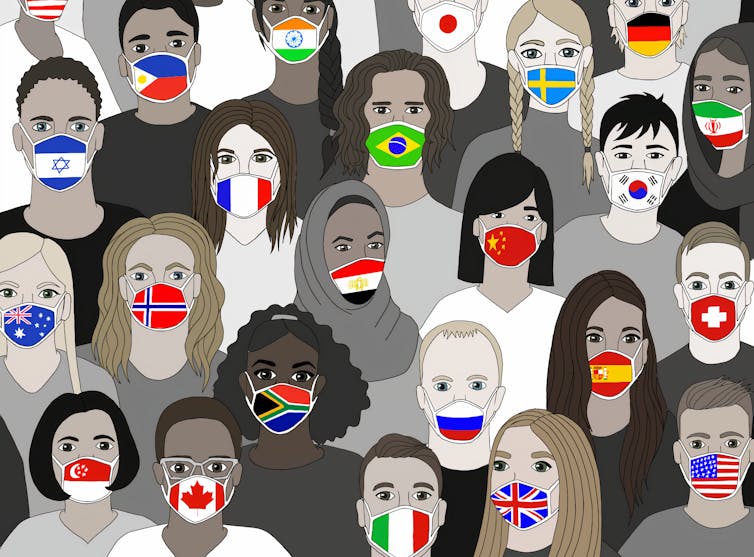
Unsplash/United Nations, CC BY

Roland Sussex, The University of Queensland

Language is like archaeology. It lays down evidence for following generations to excavate and write PhD theses about. Layers of the stuff. And such has been the language of the year of COVID.

Not surprisingly, COVID has spawned an efflorescence of words and expressions. And these will certainly be dug up for analysis by our descendants.

In Australia we have a characteristic way of repurposing words, and we have applied it to COVID. Isolation became “iso”, which was crowned (joke: corona is Latin for crown) Word of the Year, or WOTY, by the Australian National Dictionary.

And coronavirus became “rona”, the Macquarie Dictionary’s COVID WOTY for 2020, announced today.

The Macquarie has departed from its usual practice (as has the Oxford English Dictionary) and anointed not one but two WOTYs (should that be WOTIES?): one to honour the way COVID has dominated our world, thinking and language this year; and another across-the-board WOTY as well. Their latter choice was “doomscrolling”, the practice of continuing to read news online or on social media when you know there’s nothing new in the news, and it’s all miserable.


Read more:
‘Iso’, ‘boomer remover’ and ‘quarantini’: how coronavirus is changing our language


Short, not necessarily sweet

Iso and rona are diminutives or hypocoristics. I have a database of over 6,000 of these in Australian English. These are derived forms of words that express an emotional overtone, usually amiable and solidaristic (“barbie” for barbecue; “servo” for service station), sometimes pejorative (“commo” for communist, “drongo” for well, an idiot).

But my personal nomination for the 2020 WOTY is “quazza” for quarantine. I predicted its birth and was fulfilled when it duly appeared.

Quazza follows a pattern in Australian English where R becomes Z: Terry gives “Tezza”, Barry gives “Bazza”, and quarantine yields “quazza”. Which is a long way from the Italian word quarantina, a reference to the 40-day period ships had to anchor off Italy in days gone by to prove there was no plague on board.

These diminutives serve an important purpose. They de-demonise threatening words. Without reducing the level of the words’ threat, the diminutives imply: this is something we can get our minds around and manage.

And gradually, with some temporary reversals, that is what we have done, and much more effectively than most other countries. Though whether the diminutives have medical force is not yet proven.

Person in mask looks at laptop in darkened room
‘Doomscrolling’ captures the intersection of this year’s unfolding catastrophes and social media.
Unsplash, CC BY

Getting the message

Of course, there’s more to the influence of language under COVID than diminutives. In terms of public health and communication, three key agencies have driven our handling of the pandemic: scientists, policymakers and the public.

In Australia, the passage of information and action between these three entities has worked rather well. Science has transmitted reliable and helpful analyses of coronavirus and COVID-19 to policymakers. They informed our understanding of specific pandemic terms like “incubation” and “reinfection”.

State and federal governments have issued action guidelines with terms like “COVID safe”. And the public has created their own shorthand like the diminutives described above to make it all a bit friendlier.


Read more:
We’re not all in this together. Messages about social distancing need the right cultural fit


Australians have accessed the science through the media and the internet, and have generally acted responsibly.
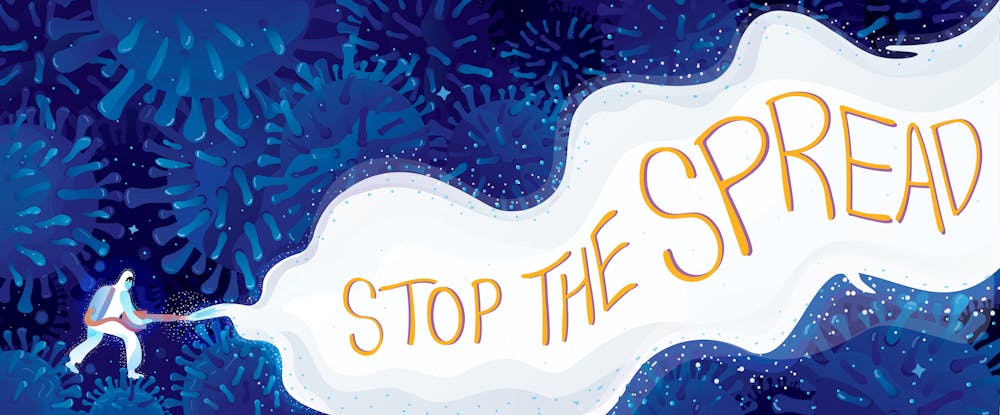
Using words consistently and specifically is vital when it comes to health messages.
Unsplash/United Nations, CC BY

The key mechanism for communicating along the three axes between science, policymakers and the public involves messaging. Words matter in this context. What is needed is simple, direct, transparent and plausible language. Translations for multilingual communities are also vital.

Australian authorities have used words effectively and fairly consistently (though not always). The words and terms have fallen within four broad lexical categories:

1. isolation — lockdown, isolation, quarantine

2. distance — social distancing, venue capacity

3. hygiene — handwashing, sanitiser (or “hand sanny” in Australian slang), masks

3. social — COVID safe, flatten the curve, stop the spread, WFH (work from home).

The British messaging was much less effective, moving from “Protect the NHS” (National Health Service) to “Stay alert” without specifying what people should be alert to.


Read more:
Coronavirus anti-vaxxers: one in six British people would refuse a vaccine – here’s how to change their minds


Going the distance

Unfortunately, many countries took up the phrase “social distancing”, when what was needed was “physical distancing”, continuing social interaction as an important part of maintaining well being. The World Health Organisation agrees.

Next time — and there certainly will be a next time — we need to be better prepared.

There will be new vocabulary to describe, and perhaps to help tame, potential new threats. The messaging may be very similar, and we will know, from our experience with COVID-19 in 2020, how best to stop “covidiots” from acting “coronacrazy”.


Read more:
How COVID-19 is changing the English language


The Conversation


Roland Sussex, Professor Emeritus, The University of Queensland

This article is republished from The Conversation under a Creative Commons license. Read the original article.

Unknown's avatar

How the dictionary is totes taking up the vernacular


Kate Burridge, Monash University

There’s a new arrival on the dictionary scene – the much-anticipated second edition of the Australian National Dictionary, known fondly as AND.

As I recently wrote, these beautiful two volumes should certainly put to rest any fears people might have about the continued place of “tree-dictionaries” in an age of e-books and digital libraries.

These more than 16,000 Australianisms have generated lots of excitement – and not surprisingly. Words are the most observable part of any language and English-speakers seem fascinated by the ins and outs of expressions.

Look at the media attention when dictionaries announce the winner of their Word of the Year competition. There’s nowhere near the same excitement with other aspects of the language.

There were no breaking news stories when linguists announced developments affecting the conjunction “because” (for example, “I’ve been missing out on sleep because binge-watching Game of Thrones” or “I missed the ending because fell asleep”).

Dictionary editors are among the new celebrities, answering questions like: what is the longest word in the language? Is there a word to describe those who drink their own bathwater? How many words do speakers know? And, perhaps the thorniest question of all – when should new expressions enter the dictionary?

Vocabulary changes more than other aspects of language and lexicographers are constantly redrawing the exclusion boundary for marginal vocabulary items. “Yeah-no” has been around since the 1990s, but is only now appearing in dictionaries.

And while many original misspellings now have entries, such as “miniscule” (with its erroneous “i”) and even “nucular”, an entry for “accomodation” (with one “m”) seems a long way off.

It’s not easy for dictionary-makers. They are seen as the guardians of the language and when they take on board expressions like “yeah-no” and “nucular”, we hear howls about declining standards. Yet people will usually discard dictionaries if they don’t keep up-to-date.

Dictionary-making was more straightforward for early lexicographers, who sourced words almost exclusively from books. So, it was formal written language that typically made it into dictionaries.

Words were written on cards each time they were used and, when there was a substantial collection of cards, it could be established that a word was in general usage. So, they were largely respectable expressions, and anything that snuck under the radar would be well and truly branded (originally with symbols like asterisks or daggers, and later with more precise usage labels like “low”, “barbarous”, “vulgar”, as appeared in Samuel Johnson’s 1755 dictionary).

These days it’s all very different. Lexicographers consider an array of different language forms, including newspapers, magazines, pamphlets, menus, memos, TV and radio broadcasts and, of course, emails, chat-room discussions and blogs.

So it’s not surprising to find that the informal aspect has been significantly boosted in the new-look AND. Of course, this reflects the strong attachment to the vernacular in Australia, but it’s also in keeping with the marked shift towards informal ways of speaking and writing generally – even public language is becoming progressively more casual and everyday.

So dictionaries are now much faster to take up “slanguage”. In the Collins Official Scrabble Words, even “innit” (“isn’t it”), “grrl” (“feisty female”) and “thang” (“thing”) have the stamp of approval. Once it could take years and years for such colloquialisms to appear in print, perhaps then to be picked up by lexicographers and placed in some dictionary — or perhaps never.

So like many other dictionaries these days, AND shows an assortment of distinguished entries and boisterous slang. Additions from the world of economics and politics, for example, include sedate terms-of-art (“aspirational voter”, “economic rationalism”, “negative gearing”, “scrutineer”) as well as colloquialisms (“keep the bastards honest”, “Hawkespeak”, “hip-pocket nerve”, “wombat trail”).

And the current editorial team has continued the AND tradition and not tagged these entries with labels like “colloquial” or “slang” (though “-ist” language is occasionally labelled derogatory).

So don’t believe the concerned hype that accompanied the 2014 edition of Tony Thorne’s Dictionary of Contemporary Slang. It added only three new Australianisms (“tockley” for “penis”, “ort” for “buttocks” and “unit” for “bogan”), prompting a frenzy of headlines like:

The rise and fall of Australian slang.

I’m not sure how Thorne missed “selfie”, Australia’s contribution to the international lexicon – after all, it was the Oxford Dictionaries’ Word of the Year in 2013.

Articles expressed the fear that the glory days of Australian slang were over. AND should help to quell such fears – “hornbag”, “budgie smugglers”, “grey nomad”, “chateau cardboard” are among the many treasures you will find there.

Some of these entries appear so scruffy that you might wonder at the wisdom of the editors including them at all (“snot block”, “ranga”, “reg grundies”, “ambo”, “rurosexual”, “seppo”, “trackie daks”, “spunk rat”, “goon of fortune” come to mind). Of course, slang is in the eye of the beholder – even Samuel Johnson included a few (unbranded) personal favourites, like “belly timber” for “food”.

But in this case, you can take comfort in the fact that these expressions will have been tracked and meticulously analysed. They aren’t newly minted coinages and wouldn’t be there unless they “had legs”.

It seems to me almost impossible for printed dictionaries to keep up with the changing nature of vocabulary these days. People just love creating words.

In fact, scientists have recently discovered that learning the meaning of new words can stimulate exactly those same pleasure circuits in our brain as sex, gambling, drugs and eating, the pleasure-associated region called the ventral striatum.

The surge of excitement when we encounter a new word is the recently coined “neologasm”. And that really says it all.

The Conversation

Kate Burridge, Professor of Linguistics, Monash University

This article was originally published on The Conversation. Read the original article.

Unknown's avatar

Do you know a Bunji from a Boorie? Meet our dictionary’s new Indigenous words


Bruce Moore, Australian National University

A new edition of the Australian National Dictionary has just been published. It contains 16,000 words and while the first edition (published in 1988) included about 250 words from 60 Aboriginal and Torres Strait Islander languages, the latest has more than 500 words from 100 languages.

Conventional wisdom has it that borrowings of this kind usually occur in the initial “contact” period. In 1770, for instance, James Cook and Joseph Banks collected the word kangaroo from the Guugu Yimithirr language in the area now known as Cooktown in Queensland, and it immediately came into use in English.

Soon after the initial batches of convicts arrived in Sydney from 1788 onwards, words from local languages were taken up, especially for new flora and flora and for things associated with the Indigenous people: koala, wallaby, kurrajong, waratah, woomera, corroboree. Later, the language of the Perth area provided jarrah, kylie (a word for “boomerang”), numbat, and quokka. The language of the Geelong area provided the mythical monster the bunyip.

The Indigenous word waratah was quickly adopted.
Internet archive book image/flickr

Some Aboriginal words, although noted in the early period, were not used widely in Australian English until much later. Perhaps the most startling example of this is the word quoll, which comes from the Guugu Yimithirr language, and was also collected by Cook and Banks in 1770.

When the Europeans arrived in 1788, they did not use quoll or other Indigenous names for these marsupials. Instead, they used the term native cat, preferring to construct terms based on superficial resemblances to things of their “known” world. It wasn’t until the 1960s that quoll was reintroduced, and eventually replaced native cat, largely due to the efforts of the naturalist David Fleay, who highlighted the absurdity of some of the vernacular names for Australian animals.

It took nearly 200 years for the word quoll to be widely used.
WA Department of Parks and Wildlife/AAP

Many of the new Aboriginal words in this edition refer to flora and fauna, and many of these result from an interest in using Indigenous names rather than imposed English descriptive ones.

Thus, the southern and northern forms of the marsupial mole are now referred to by their Western Desert language names itjaritjari and kakarratul. The rodent once called the heath mouse is now known by its indigenous name dayang, from the Woiwurrung language of the Melbourne area. The amphibious rodent formerly known as water rat, is now more commonly referred to in southern Australia as the rakali, from the Ngarrindjeri language.

Other additions to the dictionary include (from the Noongar language of the Perth area) balga for the grass tree, coojong for the golden wreath wattle, moitch for the flooded gum and moort for Eucalyptus platypus.

Coojong, formerly known as golden wreath wattle.
liesvanrompaey/flickr, CC BY

The increasing interest in bush tucker has meant the inclusion of akudjura for the bush tomato, from the Alyawarr language of the southern region of the Northern Territory, and gubinge, from Nyul Nyul and Yawuru of northern Western Australia, for an edible plum-like fruit.

Other new terms reflect a renewed interest in aspects of Aboriginal and Torres Strait Islander culture and various kinds of activism on the part of Indigenous peoples.

They include bunji, “a mate, a close friend a kinsman” (from Warlpiri and other languages of the Northern Territory and northern Queensland), boorie, “a boy, a child” (from Wiradjuri), jarjum, “a child” (from Bundjalung), kumanjayi, “a substitute name for a dead person” (from Western Desert language), pukamani “a funeral rite” (from Tiwi), rarrk “a cross-hatching design in art” (from Yolngu languages), tjukurpa, “the Dreaming; traditional law” (from Western Desert language) and yidaki, “a didgeridoo” (from Yolngu languages).

Performance of a Yidaki Didg and Dance at Sydney Opera House in 2000.
Adam Pretty/AAP

The word migaloo – “a white person” – comes from Biri and other northern Queensland languages, where it originally meant “a ghost, a spirit”; many Australians are familiar with this word as a name for the albino humpback whale that migrates along the east coast of Australia.


Author provided

Many of these terms begin their transition to mainstream Australian English in forms of Aboriginal English, and some of them are primarily used in Aboriginal English.

In addition to the words from Indigenous languages, there are numerous terms new to the dictionary that render Indigenous concepts and aspects of traditional culture, formed from the resources of English.

These include such terms as: carved tree, dreamtime being, freshwater people, keeping place, law woman, paint up, saltwater people, secret women’s business, smoking ceremony, songline, sorry business, welcome to country.

A smoking ceremony at the Aboriginal Tent Embassy in Canberra earlier this year.
Mick Tsikas/AAP

Others derive from more specific political contexts and political activism: Day of Mourning, great Australian silence, Invasion Day, Mabo, tent embassy, traditional ownership and white blindfold (“a view of Australian history that emphasises the achievements of white society and ignores Aboriginal society”).

This is a dictionary based on historical principles. This means that each entry maps the full history of a word, establishing its origin, and documenting its use over time with illustrative quotations from books, newspapers, and the like. Words and meanings are included if they are exclusively Australian, or used in Australia in special or significant ways.

The dictionary, edited at the Australian National Dictionary Centre at the Australian National University, and published by Oxford University Press, will be launched today at Parliament House in Canberra.

The Conversation

Bruce Moore, Visiting Fellow in the School of Literature, Languages, and Linguistics, Australian National University

This article was originally published on The Conversation. Read the original article.