Unknown's avatar

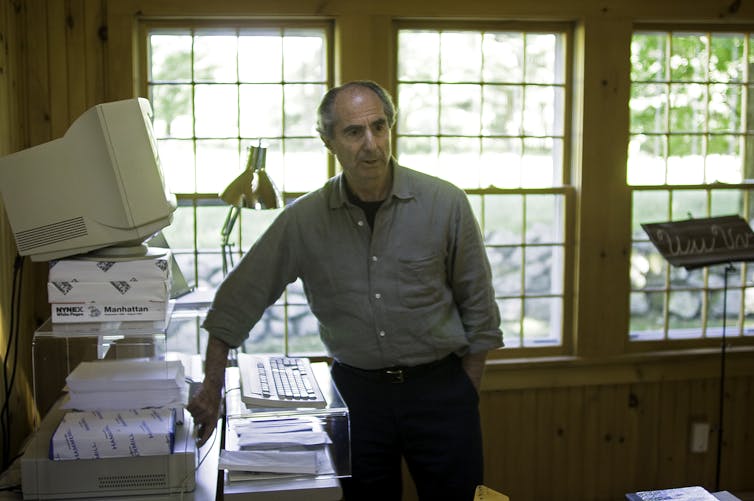
Was Philip Roth a misogynist?


File 20180523 117628 26oipr.png?ixlib=rb 1.1

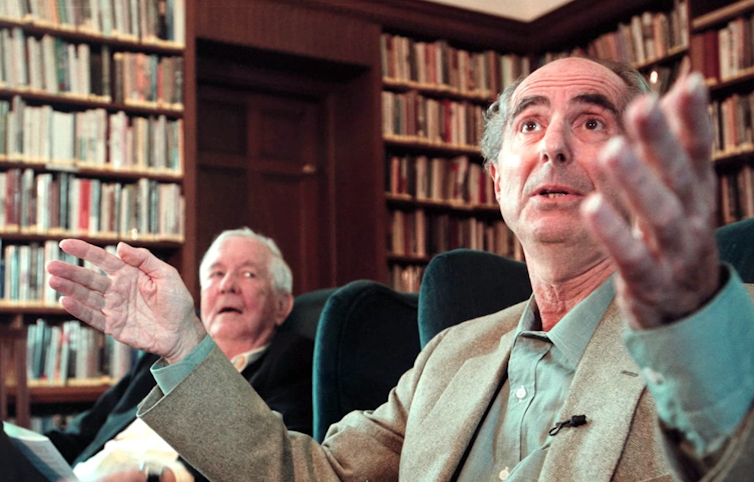
Associated Press/YouTube

Mike Witcombe, Bath Spa University

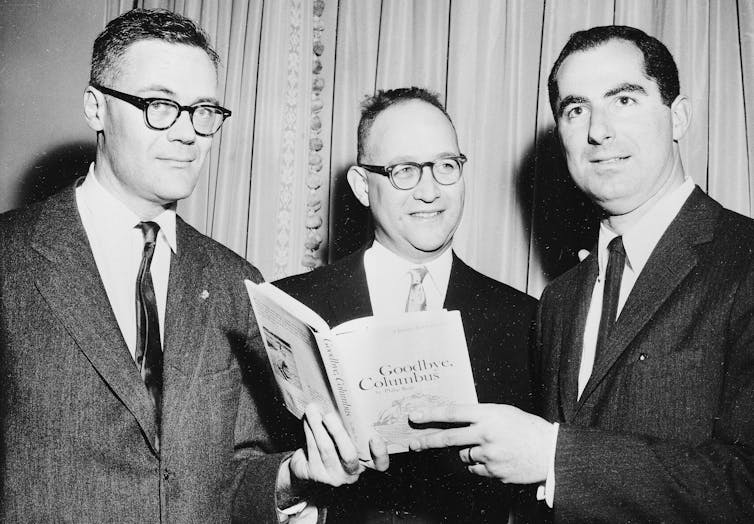
When the late American author Philip Roth was awarded the Man Booker International Prize in 2011, he did so amidst a storm of debate. In a way, it felt only fitting for a writer who has been viewed as controversial ever since his first book, Goodbye, Columbus led to him being lambasted by a crowd at New York’s Yeshiva University in 1962 (the crowd were angry about his depictions of Jewish identity).

Ten years later, he had drawn the public ire of Irving Howe, a leading intellectual that many considered the “voice” of the Jewish-American literary establishment. Roth was so wounded by this attack that he incorporated Howe into a character in his 1981 novel Zuckerman Unbound – he got his own back in his own way.

In short, Roth wasn’t the type to shy away from a good argument, and the discussions around his Man Booker award reignited one of the most familiar ones.

Carmen Callil, one of the award’s judges, resigned from the panel in protest when she learned that Roth was to be awarded the prize. Although she insisted that this was purely an issue of literary merit, her connections with the publishing house Virago, who had published a tell-all memoir by Roth’s ex-wife, led some to speculate that her resignation may have been motivated by questions over Roth’s portrayal of women.

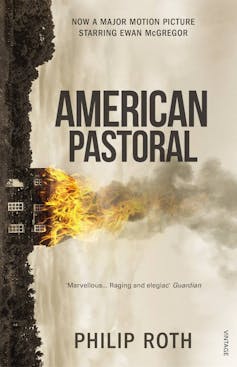
Vintage

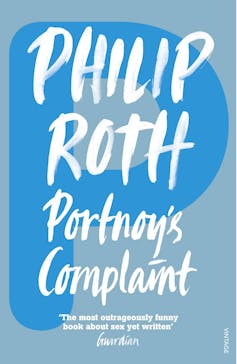
These questions began to reach academic circles as early as 1976, when literary scholar Mary Allen argued that Roth had an “enormous rage and disappointment with womankind”. This was echoed over 30 years later when Vivian Gornick (herself one of the first critics to attack Roth’s misogyny) wrote that “for Philip Roth, women are monstrous”. This criticism stemmed from Roth’s depictions of volatile marriages and an emphasis on visceral male sexuality in his fiction, most notably in 1969’s infamous novel Portnoy’s Complaint. The book reviewer George Stade offered a common critique in his argument that Roth’s women were either “vicious and alluring” or “virtuous and boring”.

As with his earlier use of Irving Howe, Roth also drags his feminist critics into his fiction. A scene in his 1990 novel Deception sees him imagine himself in a courtroom, defending himself from charges of misogyny. This is an argument that Roth was inviting his readers to take part in. Many have taken up the challenge.

By the time that Deception was published, this debate had escalated to the point of a critical commonplace. As Callil’s and Gornick’s interjections prove, this has had a lasting legacy. A 2012 special edition of Philip Roth Studies which explored the topic of “Roth and Women” was introduced with the claim that “sexism or flat-out accusations of misogyny is often presented as a fait accompli when dealing with Roth”. It’s such a commonplace that it becomes hard to ignore as a fan of Roth, and impossible to ignore as a student of his work.

In a 2013 poll for New York Magazine, a selection of leading writers were asked for their opinions on his legacy. When asked: “Is Roth a misogynist?” and given a list of potential responses, 53% of respondents opted for “Well…”. This uncertain response sums up the critical and popular perspective on Roth. While the older view of Roth-as-misogynist still holds some sway, several recent think-pieces have been published by self-identified feminists defending Roth’s work in creative ways. With the success of TV programmes such as Girls, that take explicitly Rothian themes about sex and gender in new directions, the debate could well be moving on to new ground.

This isn’t to say that Roth is in the clear. Few scholars would defend scenes such as the one we find in 1974’s My Life as a Man, in which an instance of domestic abuse is described in a manner so laconic that it comes across as indefensibly vicious to many modern readers – including myself. Perhaps the work being done by scholars, biographers, and cultural critics over recent years offers a middle ground that can change the question from “Is Roth a misogynist?” to “Do Roth’s discussions of gender have anything to tell us in 2018?”

I think they do, but I’m hardly objective. As a scholar of Roth, the urge to defend his work is instinctive for me; the sense of loss I’ve felt following news of his death has surprised me. But news of Roth’s death has already provoked discussions about his lasting influence that have been ongoing since his retirement back in 2012, and will go on for the foreseeable future; these debates are not new.

The ConversationThese issues of legacy will be determined by how basic questions about Roth’s work will be discussed over the coming weeks, months and years. I hope they will continue the trend towards seeing Roth’s depictions of women as a complex and problematic, but deeply fascinating, topic.

Mike Witcombe, Lecturer in English Literature, Bath Spa University

This article was originally published on The Conversation. Read the original article.

Unknown's avatar

Everything you need to know about ‘femoir’ – the bestselling books that celebrate female success


File 20180514 133577 1nwr7pi.jpg?ixlib=rb 1.1
How the female memoir helps to celebrates women’s voices.
Pexles

Anne-Marie Evans, York St John University

The reviews have not always been kind. The texts are rarely perceived as “literary” or even particularly important – so they don’t get taken seriously. But the celebrity “femoir” – a memoir authored by a well-known female actor or comedian – has become a staple of the publishing trade over the last few years.

As I explain in a recent book chapter, the femoir occupies an important place in contemporary women’s writing because they promote female empowerment. The books also embrace body positivity, and address the importance of having a supportive female community of friends.

These women writers already have hugely successful careers before they begin to write their femoirs. Lena Dunham, for example, was the creator, writer, star, and sometimes director of the hit HBO series Girls – which received a range of Emmy awards and nominations. Amy Poehler and Tina Fey are both veterans of Saturday Night Live, and Fey was the creator, writer, and star of 30 Rock, while Poehler starred in the hugely popular Parks and Recreation. Mindy Kaling, on the other hand, was the first Indian American woman to both star in and produce her own show, The Mindy Project. So why this sudden need to tell their story in print?

Brand woman

One reason might be that writing, and autobiography in particular, is a great way for women to develop their public brand. Suzanne Ferris, who has researched and published on popular women’s writing, compares the femoir to chick lit – as this new style of memoir often follow the traditional structure of a female protagonist overcoming various personal and professional obstacles.

The reader might hear about one of Kaling’s bad dates, or about Fey’s struggles to balance being a mother and being a professional working woman. But within the genre, each writer also emphasises professional advancement over personal success.

None of these books ever offer any real details about the women’s personal lives beyond a few anecdotes that could be shared on a late night talk show. But the femoir offers the reader the illusion they are being told highly privileged information, and this is hugely important part of the genre’s appeal.

Speaking out

For Dunham, Fey, Poehler and Kaling, writing has always been an important part of their career. Although they are famous for performing, most of them started out as writers. Kaling, for example, got her break as a one of the writers for the US version of The Office.

Writing for The Guardian Hadley Freeman suggests that the main difference between memoir and femoir is the construction of the narrative voice. A memoir is usually published because the story is special or unique, but the very appeal of the femoir is that its writer is – apparently – just like the imagined (female) reader.

From top left, Ellen DeGeneres, Sarah SilverMan, Mindy Kaling and Amy Schumer.
Shutterstock

As a narrative voice, the author of the femoir must be funny and relatable. She must be every woman to every reader, or her book will not be successful. This is a hugely important part of the brand. A femoir is not meant to be a weighty autobiography but instead is designed to be a fun and entertaining read.

As well as a life story, a femoir nearly always features some kind of interactive element. Amy Poehler’s Yes Please is broken up with collages and photos, and there are even several sections where the reader can make her own notes, suggesting an even closer imagined affinity between celebrity narrative voice and the reader.

Female communities

Men, of course, are rarely asked to account for their professional achievement. But for these authors, telling their story becomes a useful way for female comedians to explain their brand and recount their successes.

One of the most striking features of the femoirs is how much the writers tend to reference other female writers in the genre. There is a lot of emphasis on how important it is to have the support of other women. Fey, for example, writes several “love letters” to her friend and frequent collaborator, Poehler, encouraging the idea that female community is central to individual female accomplishment.

Feminist novels don’t always have to be heavyweight.
Pexels

There are, of course, a lot of criticisms to be made of the femoir. They are highly performative types of writing, they are designed to be commercial, and some of them have clearly been helped along by ghost writers. But the genre is still hugely popular and several UK performers – Caitlin Moran, Sara Pascoe, Sarah Millican – have joined the ranks in recent years.

The ConversationAlthough femoirs are often dismissed as celebrity memoir (which is undeniably what they are) it is sometimes forgotten that many of these women all wrote their own material for the stage and screen long before they began to write a version of their autobiographies. The femoir is just their latest medium.

Anne-Marie Evans, Subject Director: English Literature, York St John University

This article was originally published on The Conversation. Read the original article.

Unknown's avatar

Decorating With Books


The link below is to an article that takes a look at 5 ideas for decorating with books, which really isn’t my thing (at least not in a primary sense).

For more visit:
https://www.washingtonpost.com/entertainment/books/5-ideas-for-decorating-with-books-guilt-free/2018/05/22/62d55cf6-4d79-11e8-b725-92c89fe3ca4c_story.html

Unknown's avatar

Philip Roth’s journey from ‘enemy of the Jews’ to great Jewish-American novelist


File 20180525 88002 1jfgwn1.jpg?ixlib=rb 1.1
Philip Roth would call the Jewish resistance to his work “the luckiest break I could have had.”
AP Photo/Douglas Healey

Brett Ashley Kaplan, University of Illinois at Urbana-Champaign

Like many, I was shocked to learn of novelist Philip Roth’s death.

Just a few months ago he was writing to me, making all sorts of snarky comments on the Dictionary of Literary Biography entry I had written about him.

For example, I had noted similarities between Henry Miller’s so-sexual-it-was-banned “Tropic of Cancer” and Roth’s 1995 novel, “Sabbath’s Theater.”

In the margins of the proofs, Roth penned the snide remark: “I read Tropic of Cancer in 1959 or 58. It was hardly on my mind almost 40 years later.”

These kinds of sharp comments were typical of Roth. While I was conducting research for “Jewish Anxiety and the Novels of Philip Roth” at the Roth manuscript collection in the Library of Congress, I was able to see many of his handwritten comments back to his editor. “Keep it to yourself!” he’d write in rebuke to a critique or suggestion.

Roth’s stubbornness wasn’t isolated to these small events. Early in his career, Jewish community members loudly critiqued his work, arguing that, if not openly anti-Semitic, his fiction at least catalyzed anti-Semitic thought. Yet Roth refused to capitulate, staying true to artistic vision. Though he would eventually be mostly embraced by many Jews – including Jewish women like me – it took decades for widespread acceptance to take place.

Roth, the Jewish anti-Semite?

Much of the early criticism of Roth’s work was related to the way he depicted his Jewish characters.

Published in 1959, the collection “Goodbye, Columbus” was Roth’s first major work.

The title novella traces a summer romance between Neil Klugman and Brenda Patimkin. The problem, especially for Brenda’s family, is class. Neil, a librarian and the son of Jewish immigrants, just can’t quite seem to fit in with the country club clique that surrounds the Patimkins.

At the time, some Jewish leaders and parents, especially those that wanted to assimilate into American culture, balked at “Goodbye, Columbus.” The Jews in Roth’s stories were not depicted as beacons of good taste – as literary, educated, tasteful and well-disciplined representatives of the assimilated mainstream. Instead they were either crass – like Neil’s Aunt Gladys – or ostentatiously wealthy, like Brenda’s father.

The rebukes were swift, and often hyperbolic.

For example, Rabbi Theodore Lewis said that Roth “depicts the Jewish characters in his short stories and novels as depraved and lecherous creatures.”

During the 1960 ceremonies for the National Book Awards, Philip Roth, on the right, holds up ‘Goodbye, Columbus’ with fellow winners Robert Lowell and Richard Ellmann.
AP Photo

But if Lewis thought “Goodbye, Columbus” was “lecherous,” he was in for an unpleasant surprise.

Roth’s smash hit, “Portnoy’s Complaint,” published 10 years later, features a young Jewish bachelor, Alexander Portnoy, who is consumed with sexual longing and frustration. Portnoy narrates the whole novel, in monologic form, to his therapist, Dr. Spielvogel, telling him that he is the “Raskolnikov of jerking off – the sticky evidence is everywhere!” Portnoy describes himself as a “sex maniac” who will not “control the fires in his putz, the fevers in his brain.”

Jewish philosopher Gershom Scholem, writing in Haaretz soon after the publication of “Portnoy’s Complaint,” argued that Roth “revels in obscenity” and claimed that “this is just the book the anti-Semites have been waiting for.”

The Holocaust looms large

It is easy to forget now, but many of the rabbis and other Jewish community members who denounced Roth’s prose had lived through World War II. They’d seen all the Nazi propaganda portraying overly sexual Jewish men raping or taking “pure” Aryan women.

As historian Dagmar Herzog points out in her study “Sex After Fascism,” “Sexual demonization of Jews was a pervasive feature of antisemitism.”

But by populating novels with hypersexual Jewish men who lusted after “shiksas,” or non-Jews, Roth was actually flipping Nazi propaganda on its head. Rather than suppress this lust, Roth sought to normalize and celebrate it: Jews, just like everyone else, could want to have massive amounts of sex and not be ashamed.

Yet because some of his Jewish readers were so close to the anti-Semitism that ultimately culminated in the Holocaust, they were unable to comprehend this reversal; they could only perceive the similarity between Roth’s depictions and those of Nazi propagandist Joseph Goebbels.

While Roth could have easily ignored this censure, he engaged his detractors head-on by including their attacks in his work. Nathan Zuckerman, who appears as the narrator of many of Roth’s novels, has often been described as one of Roth’s alter-egos.

In Roth’s 1979 novel “The Ghost Writer,” the character Judge Wapter asks Nathan Zuckerman, “Can you honestly say that there is anything in your short story that would not warm the heart of a Julius Streicher or a Joseph Goebbels?”

In “Zuckerman Unbound” (1981), Nathan, who had recently published “Carnovsky” – a fictional version of “Portnoy’s Complaint” – is considered the “enemy of the Jews.” He is told that it would be “hardly possible to write of Jews with more bile and contempt and hatred.”

By including the controversy in his novels, Roth was able to both air his rage at being unjustly labeled anti-Semitic, while responding to – and, in some cases, lampooning – his detractors.

The tide turns

For years, Roth remained a polarizing figure in the literary world: Reviewers either loved him or hated him.

But a turning point came with the publication of his prescient novel “The Plot Against America” in 2004.

In it, he imagines a counterhistory in which aviator Charles Lindbergh has become a fascist, anti-Semitic president, and Newark, New Jersey’s Jews are sent to assimilation camps in the Midwest.

With Roth explicitly exploring – and condemning – anti-Semitism in America, critics could no longer claim that Roth was lending anti-Semites a hand. The question of negative stereotyping of his Jewish characters had largely been forgotten by 2004, but this novel was Roth’s most sustained focus on the deep terrors of anti-Semitism in America.

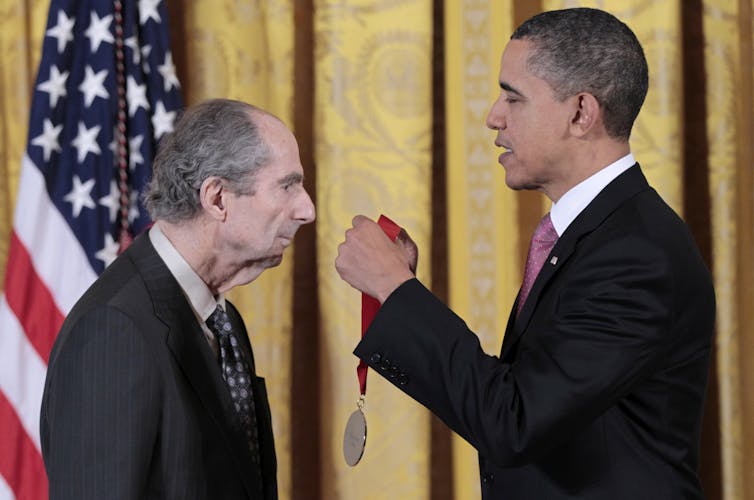
President Barack Obama presents a National Humanities Medal to Roth in 2011.
AP Photo/Pablo Martinez

Roth was likely thrilled that, in the results of a New York Times poll asking “What is the best work of American fiction in the last 25 years?” six of Roth’s novels were included among the 21 runners-up. In 2013, when Vulture asked 30 literary figures “Is Roth the greatest living American novelist?” 77 percent voted yes.

Roth lived to see his canonization as a great American writer – a great Jewish-American writer at that – something unforeseeable in the old days when he was supposedly bad for the Jews.

Many Roth scholars, myself included, were in Newark five years ago to celebrate the author’s 80th birthday. He seemed utterly hale and hearty as he read out passages from “Sabbath’s Theater,” and a parade of literary stars – many of them Jewish – sang his praises and toasted his stunning prose.

As the character Sabbath reflects, “The dead were anything other than dead.”

The ConversationOlav ha-sholom, Roth.

Brett Ashley Kaplan, Professor of Comparative and World Literature, Director, Program in Jewish Culture and Society, Director, Initiative in Holocaust, Genocide, Memory Studies, University of Illinois at Urbana-Champaign

This article was originally published on The Conversation. Read the original article.
Unknown's avatar

The Purpose of Libraries


The link below is to an article that considers the purpose of libraries.

For more visit:
https://www.the-tls.co.uk/articles/public/libraries-symposium/

Unknown's avatar

Philip Roth was the best post-war American writer, no ifs or buts


David Brauner, University of Reading

For so long an enfant terrible of the American literary world, by the end of his life Philip Roth had become one of its elder statesmen. In a career that spanned more than half a century, Roth’s work ran the gamut of literary modes and genres.

There’s the high seriousness of Letting Go (1962) and the low humour of The Great American Novel (1973). There are the extravagant excesses of Portnoy’s Complaint (1969), couched in the form of a psychoanalytical monologue, and the pared-down, elliptical exchanges of Deception (1990), a novel written entirely in dialogue.


Vintage

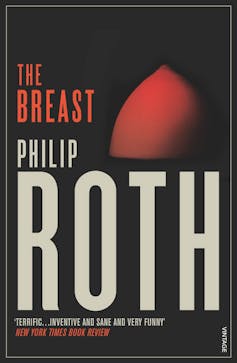
Then think of the social realism of Goodbye, Columbus (1959), that’s plot turns on the use of a birth control device in the period prior to the availability of the contraceptive pill, or the grotesque surrealism of The Breast (1972), the story of a professor of literature who metamorphoses overnight into a giant mammary gland. The versatility and variety of his work doesn’t end there. He also wrote an outrageous satire of an incumbent president in Our Gang (1971) and a dystopian tale of a fascist presidency in The Plot Against America (2004).

Although the style and content of Roth’s fiction is extraordinarily diverse, there is always audible a distinctive voice: irreverent yet earnest, questioning yet authoritative, subtle and nuanced yet powerful and passionate. But above all, Roth is obsessive, compulsive, restless, driven.

In an interview with the Paris Review in 1984, Roth remarked of his 1983 novel The Anatomy Lesson that: “The book won’t leave you alone. Won’t let up.” This applies equally to all his work. Roth’s work grabs you and won’t let you go. At one point in The Ghost Writer (1979) Nathan Zuckerman – the author protagonist of many of Roth’s novels – is told by his mentor, E I Lonoff, that he has “the most compelling voice I’ve encountered in years”.

It is that compelling voice which bewitched me when I read the opening pages of Portnoy’s Complaint as a teenager. It is that voice which still held me in thrall as I read the final words of his final novel, Nemesis (2010), as a middle-aged professor.

I have been reading Roth for over 30 years and writing about him, on and off, for more than two decades, and as with any long-term relationship, mine with Roth has had its ups and downs. But I have never felt like walking out or giving up. Roth will be remembered – and deserves to be celebrated – for his fearlessness, his formal audacity and stylistic brilliance, and his ability to reinvent himself in unexpected and sometimes startling ways.

In terms of his critical reputation, you could divide Roth’s career into three phases. There are the early successes of Goodbye, Columbus and Portnoy’s Complaint in the late 1950s and 60s, respectively, followed by the relatively fallow years of the 1970s and 80s, and then the triumphant second coming in the 1990s and the 2000s.


Vintage

Yet this narrative is too simplistic. The period of greatest critical hostility and indifference – a period in which, to quote Nathan Zuckerman (pre-empting Roth’s critics, as ever), the author was widely accused of “disappear[ing] right up [his] own asshole” – was also a period of intensive experimentation, which revealed Roth’s refusal to rest on his laurels and determination to interrogate his own aesthetic and ethical beliefs with a rigour of which very few artists are capable.

Although the work produced in the 1970s and 80s was uneven, it paved the way for much of what was to follow and resulted in two masterpieces – The Ghost Writer (1979) and The Counterlife (1986). These novels stand alongside Sabbath’s Theater (1994) and American Pastoral (1997) as among the greatest post-war American novels.

The ConversationRoth was a writer who polarised opinion, provoking strong reactions in many of his readers, but whether you loved him or hated him, his canonical status is beyond question. I believe he will come to be seen not merely as the preeminent post-war American novelist but as the most important American author of the 20th and early 21st centuries.

David Brauner, Professor of Contemporary Literature, University of Reading

This article was originally published on The Conversation. Read the original article.

Unknown's avatar

Agatha Christie: world’s first historical whodunnit was inspired by 4,000 year-old letters


File 20180521 14960 aniq8e.jpg?ixlib=rb 1.1

Agatha Christie Trust

Nicky Nielsen, University of Manchester

When the ancient Egyptian priest and landowner Heqanakhte wrote a series of rather acerbic letters to his extended family sometime during the 12th Dynasty (1991-1802BC), he could not have known that he was creating the framework around which the British crime writer Agatha Christie (1890-1976) would, some 4,000 years later, weave one of the world’s first historical crime novels.

Death Comes as the End (1944) is the only one of Christie’s novels not to be set in the 20th century and not to feature any European characters. The death of a priest’s concubine sets off a series of murders within the family and, as in Christie’s more familiar 20th-century whodunnits, the scene is soon littered with bodies. The book is due to be adapted for the screen by the BBC in 2019.

While there are numerous plot parallels in the Heqanakhte Letters (as these papyri would come to be known), the letters themselves provide an unparalleled glimpse into land management and everyday family life in ancient Egypt. In the letters, Heqanakhte provides his children with meticulous calculations of crop yields and instructions for land investments followed by the stern injunction that he would consider any deviation from his instructions akin to theft.

The letters also contain allusions to some disharmony within the family caused by the recent addition of Heqanakhte’s second wife to the household, much like in the novel where the arrival of Imhotep’s concubine, Nofret provokes murderous hatred.

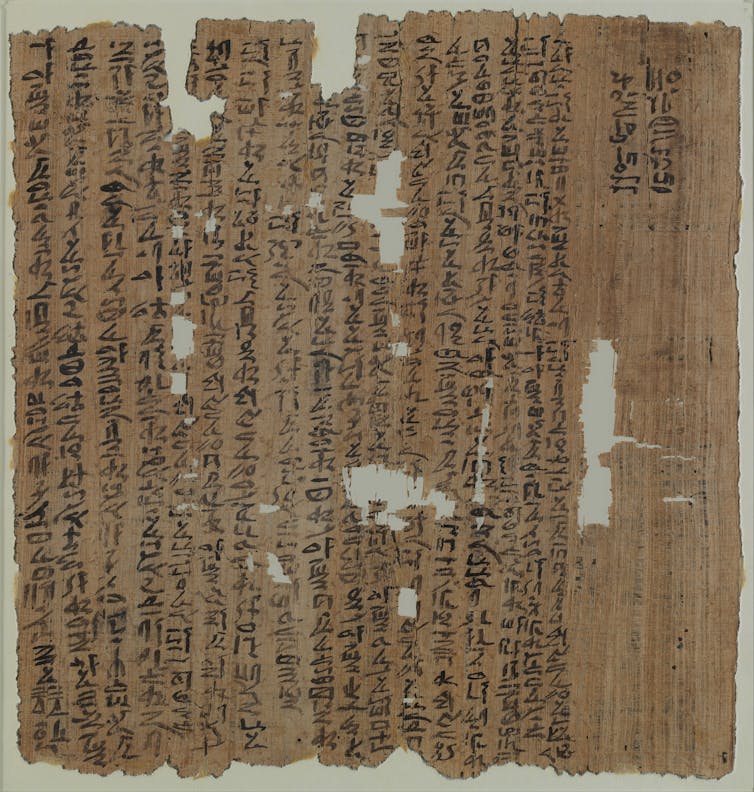
Heqanakht Letter I, Rogers Fund and Edward S. Harkness Gift, 1922.
New York Metropolitan Museum of Art

The Heqanakhte Letters are trivial in their content but unique in their form: It is very rare for this level of detail concerning the family dynamics to survive the thousands of years which separate us from Middle Kingdom Egyptians. The letters were found in the 1920s by American archaeologists from the Metropolitan Museum of Art while excavating the tomb of the Middle Kingdom vizier Ipi near modern-day Luxor. Translations of the papyri and scholarly investigations followed shortly afterwards, a study which continues to this day.

Christie in Egypt

Christie certainly knew a thing or two about both ancient and modern Egypt. She first visited the country as a young woman in the winter of 1910, staying with her mother Clara for three months at Cairo’s glitzy Gezirah Palace Hotel. The experience had a clear impact on her – her first (unpublished) novel Snow Upon the Desert (1910) was set in Cairo.

Later, she drew further on her experience of life in Egypt and the experience of tourists visiting the country during the first half of the 20th century when writing the short story, The Adventure of the Egyptian Tomb (1923) and, 14 years later, Death on the Nile, which follows the orotund Belgian detective Hercule Poirot as he attempts to solve the (some might argue needlessly complicated) murder of a wealthy heiress honeymooning in the Land of Pharaohs. In other words, peak Christie.

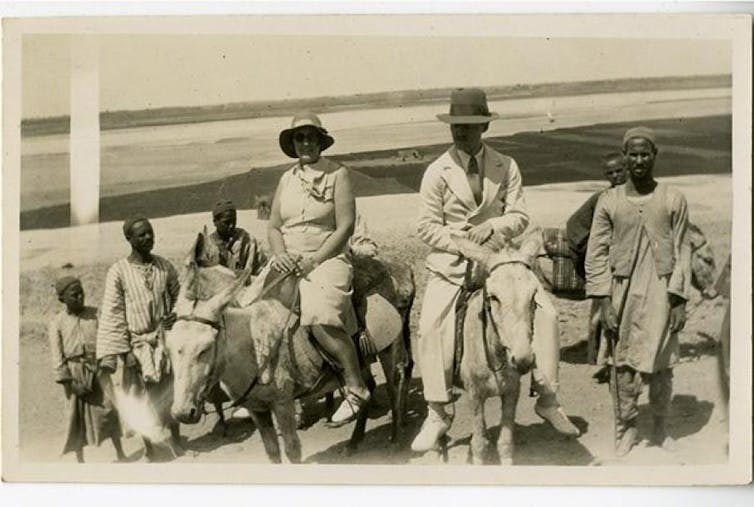
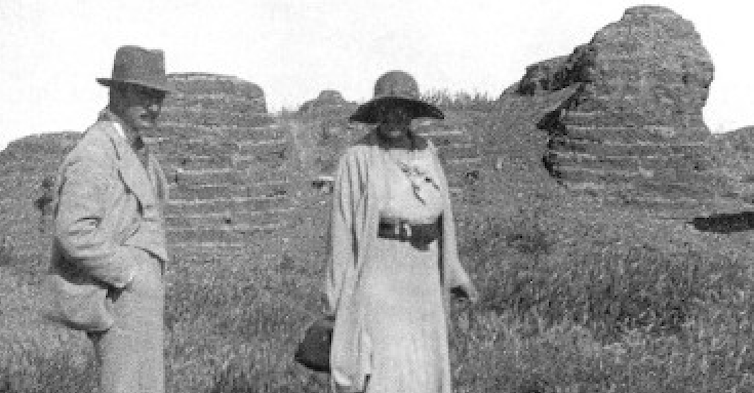
Agatha Christie with Max Mallowan at Tell Halaf in Syria.

Christie’s marriage to British archaeologist Max Mallowan in 1930 reinforced her fascination with the ancient Near East and ancient Egypt. The marriage – and the financial success of her novels – provided her with ample opportunity to travel both as a tourist and an archaeologist in the region, experiences which in turn resulted in the autobiographical Come Tell Me How You Live (1946) and inspired further travels for her fictional Belgian detective in Murder in Mesopotamia (1936) and Appointment with Death (1938).

Bringing Egypt to life

However, it was her friendship with the Egyptologist Stephen Glanville, a professor at University College London who served with Mallowan during World War II, which prompted her to explore the possibility of writing a historical whodunnit moving her narrative from Art Deco drawing rooms to the dusty desert on the Theban West bank. Death Comes as the End was written by Christie during the height of war and, as Christie herself states in the author’s note, “the inspiration of both characters and plot was derived” from the Heqanakhte letters. Glanville served as a historical sounding board and consultant, a role for which he was eminently suited, having written the seminal book Daily Life in Ancient Egypt in 1930.

While the book received praise from critics upon its publication in 1944, it did cause some ructions in Christie’s own family life. Mallowan was not altogether happy that she had collaborated with Glanville. He wrote to Glanville expressing concern about the work to which Glanville rather pointedly replied: “I am not clear whether you are afraid that the book will damage her reputation as a detective story writer, or whether you think that archaeology should not demean itself by masquerading in a novel.”

The ConversationDeath Comes as the End is not among Christie’s most famous works, but it remains a fascinating experiment: a marriage between archaeology, Egyptology and fiction writing, a formula many later authors have dutifully followed. Along with Christie’s other works set in Egypt and the Near East it is also a tangible testament to the enduring fascination Western societies have for these ancient cultures.
Nicky Nielsen, Lecturer in Egyptology, University of Manchester

This article was originally published on The Conversation. Read the original article.

Unknown's avatar

The Best Sherlock Holmes Stories According to Arthur Conan Doyle


The link below is to an article that takes a look at 12 of the best Sherlock Holmes stories according to Arthur Conan Doyle.

For more visit:
https://lithub.com/the-12-best-sherlock-holmes-stories-according-to-arthur-conan-doyle/

Unknown's avatar

An armchair, a desk and 4000 books: the Horne family study gets a second life


File 20180521 42242 1cm8cf.jpg?ixlib=rb 1.1
The study shared by Donald and Myfanwy Horne photographed in 2014.
Karl Schwerdtfeger Photography.

Julia Horne, University of Sydney

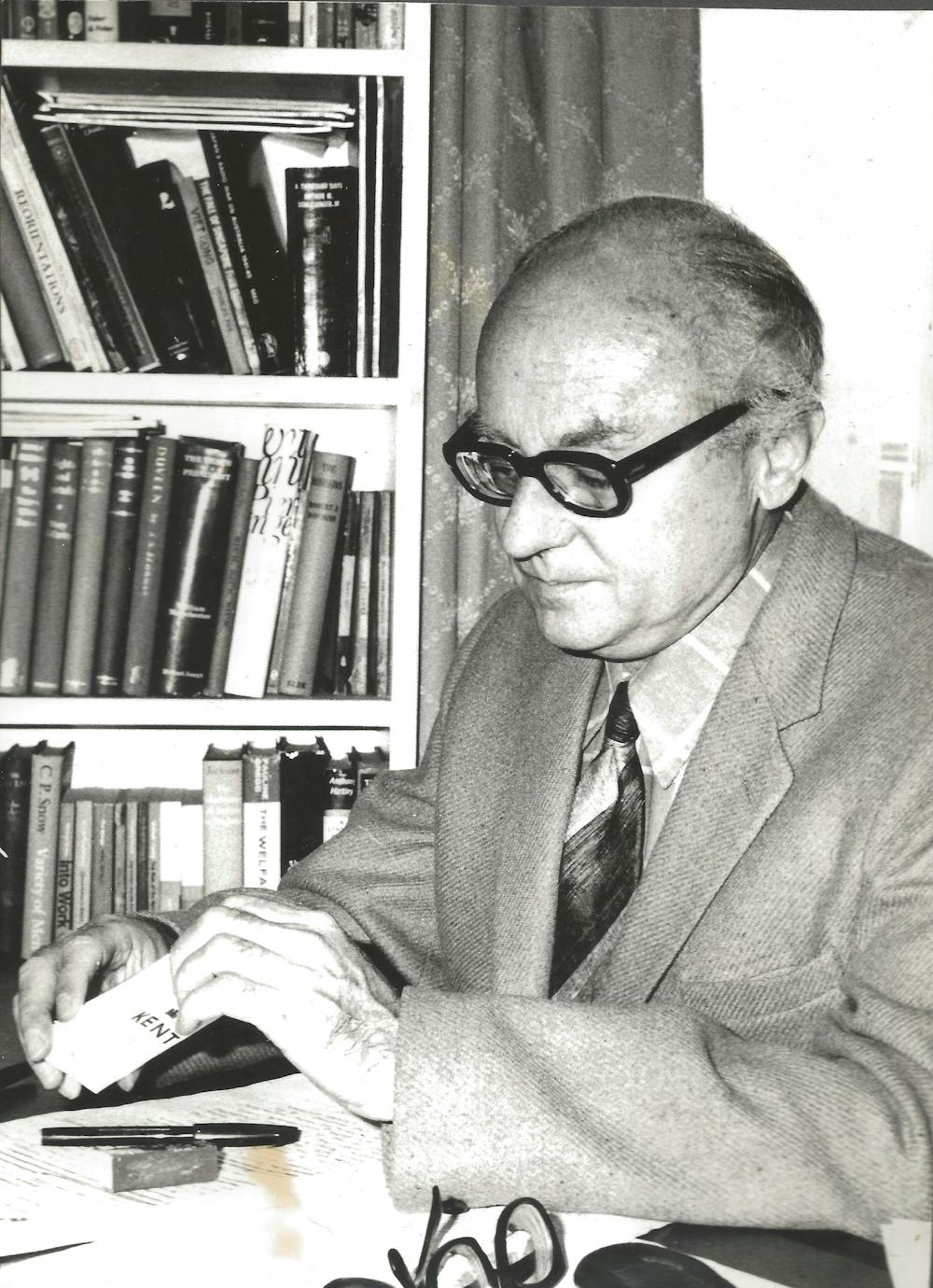
The Donald and Myfanwy Horne Room will open today in a gracious space in the State Library of New South Wales. One side of it is adorned with objects from the home where I lived with my family, my father Donald Horne (1921-2005), author of The Lucky Country and numerous other books, and my mother, journalist and editor Myfanwy Horne (1933-2013) who wrote as Myfanwy Gollan.

The rest of the room is set aside for study based on ideals of scholarly curiosity, imaginative inquiry and intellectual creativity. As my father wrote shortly before he died, words like curiosity and imagination help “celebrate scholarship and the marvels of the intellectual life more generally”.

Donald Horne at his desk in 1969.
Author provided

The State Library has selected certain objects from my family home to inspire their scholars and fellows program — an upholstered mid-20th century armchair, a large 19th century pedestal desk and a collection of some 4000 books.

The armchair, now upholstered in a dark green material over the original knobbly grey fabric, was acquired by my parents to furnish their first home in 1960, a small, rented two-bedroom garden flat in Sydney’s leafy Double Bay.

It was on this chair, in 1964, that my father sat “pen in hand, pad on knee”, as my mother later wrote, “to write The Lucky Country”. I was too young to remember this act of defiance, as some now see it — after all, surely a serious writer sits at a desk. The act itself was born out of necessity, and only later became symbolic (at least in my parents’ minds) when my father acquired a new string to his professional bow — a writer of books.


Read more:
Donald Horne’s ‘lucky country’ and the decline of the public intellectual


In the early years of their marriage in their small flat, my parents had a choice: to turn a spare room into a dining room or into a study with a desk. A dining room it became, and instead of a desk, they purchased a mahogany dining table. Not only does this choice show the importance of the dining room in middle class Australia, but also the consequence my parents gave to the well-planned dinner party. My father even brought to his marriage several signature dishes, including a delectable petit pois dish I still cook to this day as well as Ted Moloney’s and George Molnar’s Cooking for Bachelors (1959).

The Lucky Country came out of formal quests for knowledge, but also arose out of congenially robust discussion around the dining room table. My mother acquired a new professional role, as editor of all her husband’s books and much of his other published writing. The armchair, then, marks a state of transformation in my parents’ working and personal lives and in their home, as an enduring workshop of ideas.

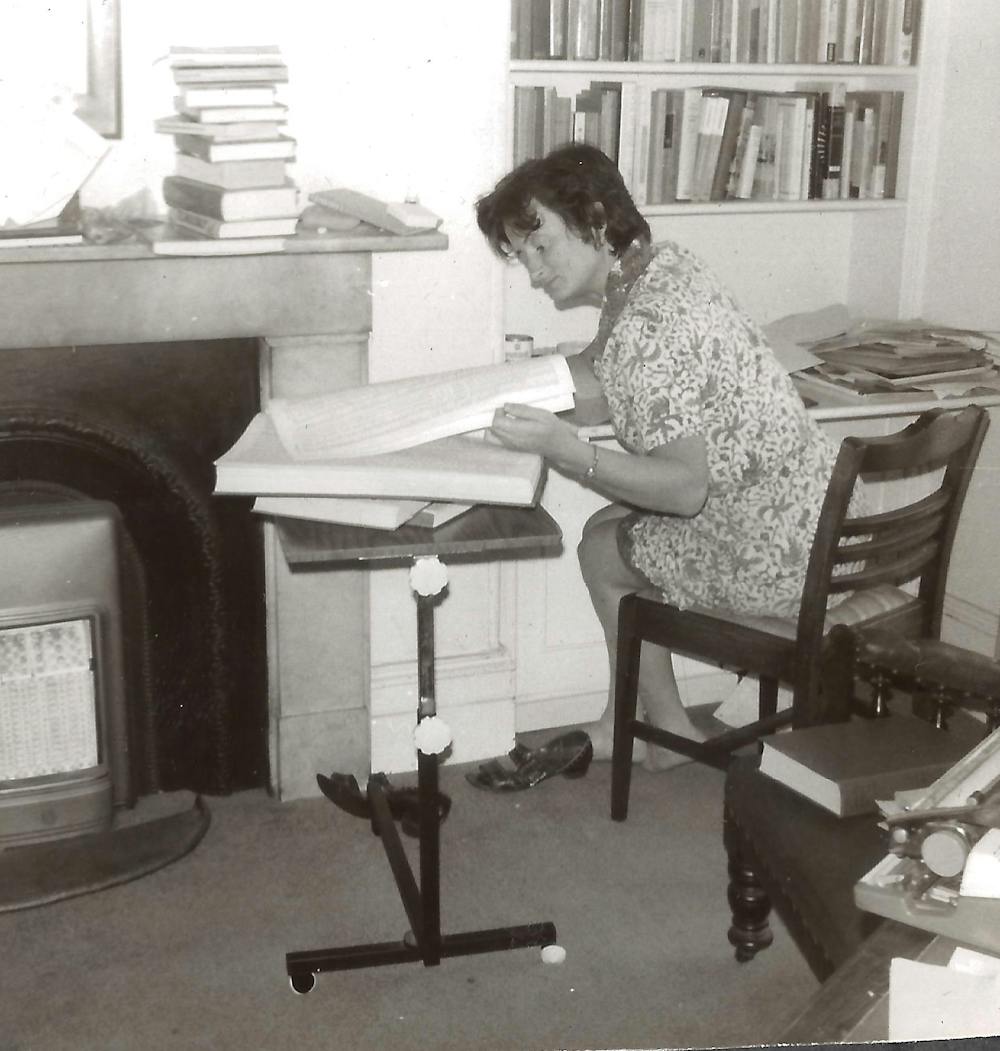
Myfanwy Horne at her desk in the study, 1973.
Author provided.

In 1966, we moved from our rented flat to our new house, a late 19th century two-storey terrace with room for both a dining room and a study. It remained my parents’ home for the rest of their lives and was not sold until 2015. The spacious, high-ceiling upstairs room at the front was soon furnished as a writers’ study.

Book cases graced either side of the fireplace, one with a small built-in desk for my mother to work at on her typewriter. The French doors leading on to the front verandah were shaded by heavy, satin, mustard coloured curtains. The centrepiece was the large, 19th century pedestal desk chosen by my mother. Placed in the middle of the room at a slightly raffish angle, my father savoured the room as a place to write, surrounded by bookcase-lined walls.

As he later wrote, “sitting at the desk Myfanwy had chosen for me became one of our essential ceremonies” of intellectual life together. “My writing came from a joint workshop of which she was a part. Not only the dinners and lunch parties that helped keep things going: without her emotional support and intellectual support I don’t know that I would have ‘become a writer’.”

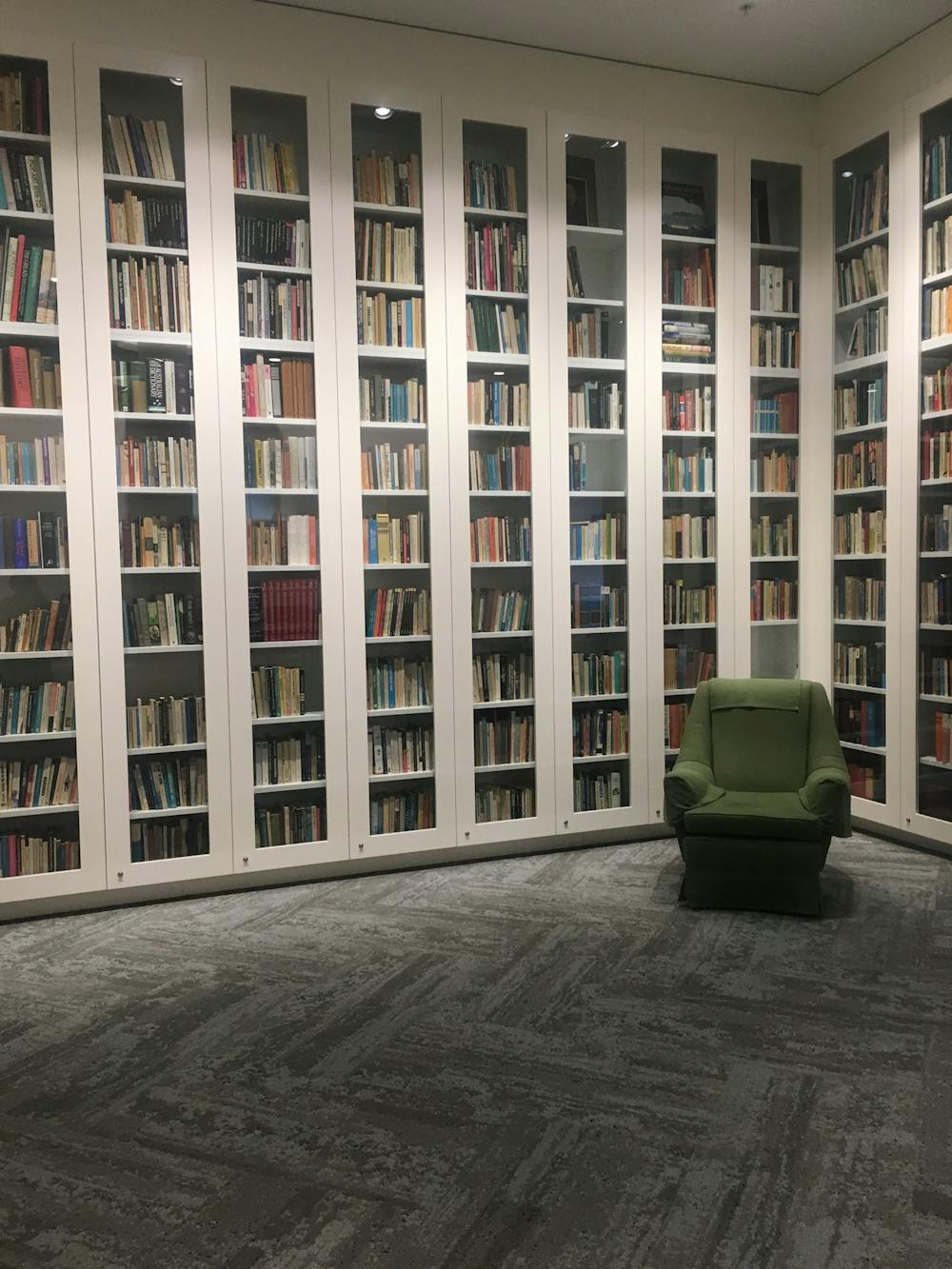
Books and the green armchair in the Donald and Myfanwy Horne Room.
Photo courtesy of the State Library of New South Wales.

Books that influenced my father’s writing and thinking are now displayed in beautiful glass cabinetry in the State Library. You can peruse the spines for a quick trip through 20th century ideas, global politics and history, its revolutions, art, political philosophy, sociology. Well-thumbed copies include A Vindication of the Rights of Woman by the 18th century advocate of women’s rights, Mary Wollstonecraft, and The Eiffel Tower and Other Mythologies by the 20th century cultural theorist, Roland Barthes, for its critique of bourgeois culture.

Many of the books include his annotations — paper clips, discrete dots, vertical lines and squiggles — making it possible to trace some of what inspired his own social and political critique. The English translations of the writings of the Italian Marxist philosopher Antonio Gramsci, for instance, were marked up for his favourite passages on hegemony, “common sense” and the idea that we are all intellectuals. They represent, in many ways, his scholarly footnotes.

“I’ll just go to the study to look it up,” is a refrain I often heard from my parents. Rather than reconstruct their study, the artefacts in the State Library’s Donald and Myfanwy Horne Room have been chosen to continue the intellectual pursuit of conversation and ideas.

The ConversationYou can work at the desk, sit in the green armchair and — by application to the librarian — peruse the books and decipher the scrawls left by my father. These objects are not only tokens of two productive writing lives, but an inspiration to future generations who believe that books and ideas matter.

Julia Horne, University Historian and Principal Research Fellow, History, University of Sydney

This article was originally published on The Conversation. Read the original article.

Unknown's avatar

2018 Man Booker International Winner


The links below are to articles looking at the winner of the 2018 Man Booker International Prize.

For more visit:
https://bookriot.com/2018/05/22/man-booker-international-prize-winner-flights/
https://www.theguardian.com/books/2018/may/22/olga-tokarczuk-flights-wins-man-booker-international-prize-polish