The conflict that exists within the organisations that own Britain’s newspapers, and the strategies that they employ in running their businesses, was recently brought into sharp focus. One of the key regional players, Johnston Press, went from publicly-listed administration to a controversial, private rebirth within 24 hours, prompting a wider debate around the state of the industry.
The company, which owns major regionals such as The Scotsman and the Yorkshire Post as well as the nationally popular i newspaper, announced on November 16 that it was in administration only to reveal the following day it had been bought out by its debtors and would continue to operate as before but under the new name of JPIMedia.
While it undoubtedly leaves the newspaper titles in a healthier financial position for now, whether or not any optimism will be long-lasting, given the state of the UK’s print newspaper market, is a matter of some conjecture.
In September 2018, I made a submission to the Cairncross Review – a government initiative to examine the options for securing a sustainable future for high quality journalism. The events of the past week have led me back to the following extract:
During the past decade of declining revenues, the traditional local news publishers have used a smoke and mirrors approach to mask their editorial cutbacks. News content has become more regionalised and less relevant, patch offices and receptions have been closing, while titles have continued to be branded as local. There are understandable business reasons for this happening, but these public limited companies have always had profits at their core, often prioritising their shareholders over their readers.
This tension remains at the heart of many newspaper companies – and it is also a parallel to the historic and counter-intuitive decision-making that still remains when it comes to print and web content.
If everyone in the industry – regional or national – knew then what they know now about the challenges faced with monetising their websites through a commercial base then I’m sure the landscape would be very different. The assumption that display advertisers, classifieds, property and motors would migrate seamlessly into digital was fatally flawed because the traditional media giants did not anticipate the competition that would spring up. They had no track record of overcoming it by making their own offerings better than the rest.
And while they were struggling to compete online, time and cash should have been reinvested into the printed products which, while on a declining sales trend, still remain profitable and well-read by certain key demographics.
What the events surrounding the Johnston Press have done is to complete a jigsaw whose outline was already well-known – that the eye-watering return on sales figures pocketed during the 1990s and 2000s were part of a recipe for the mess the industry now finds itself in.
Printing money
So what value remains in printing traditional newspapers, as opposed to an online-only approach favoured by titles such as The Independent?
There is plenty of evidence that demonstrates the continuing demise of print. But the value of print is not purely economic in nature, and should not be placed in a silo away from the value it brings to news brands as a whole.
There is a negative correlation between the popularity of a newspaper and the trust the reader has in it. If you were to place the sales and trust rankings of the main ten titles in the UK side-by-side you’d see the order turned on its head. Trust is a valuable commodity that not only gives credibility to the printed product but also pervades into the perception of the online offering of the same brand.
Take the Guardian. With one of the highest trust ratings for a national newspaper – and despite its relatively low print sales – it has been able to leverage that emotional attachment and use it to develop an online contribution scheme that will enable it to break even by April 2019. While the printed product may appear to be in decline, it still acts as a firm foundation for the overall news brand as it seeks to evolve.
Newspapers also remain an integral part of the profits in many media portfolios. Within Johnston Press, the printed offshoot of The Independent, the i newspaper, was the jewel in the crown, bought for £24m in 2016 and now being touted at a value of £60m. At a regional level, concentrating resources and a focus on print remains a core and profitable component of several groups, especially those in private ownership, such as Iliffe Media, which owns a range of local newspapers.
For the many
But the perceived value of the newspaper format should not be limited to the balance sheet – there is value for the reader, too. And sometimes it takes a holistic view to fully appreciate what this consists of. While the web may be ideal for delivering bespoke content that can be accessed via search, the newspaper allows people an opportunity for a deep dive into the news – not only reading the stories they are primarily concerned with, but stumbling across material they would never have known about otherwise.
Stories that educate and inform them about their community, their country, their world. Curated for them by trained professionals, rather than through the vagaries of any unregulated social platform. Providing what society needs rather than what an audience wants.
There is a compelling argument that printed newspapers will cease to exist, or may remain in existence as a niche offering. But freed from the shackles of shareholdings – and with a model that promotes a long-term sustainable future over short-term profits – there is an equally compelling argument that newspapers, and the journalism within them, can continue to be a universally valuable part of the media landscape for some time to come.
In 1996, a graduate student named Mark Robson was creating a digital catalog of the University of Leeds’ Brotherton Library when he discovered a small manuscript on the shelf. The elegantly titled “Poems Breathed Forth by the Noble Hadassas” contained 120 poems and a half-finished prose romance.
As far as Robson could tell, the manuscript hadn’t been read in over 250 years. He hadn’t heard of the “Noble Hadassas” – nor had anyone he asked.
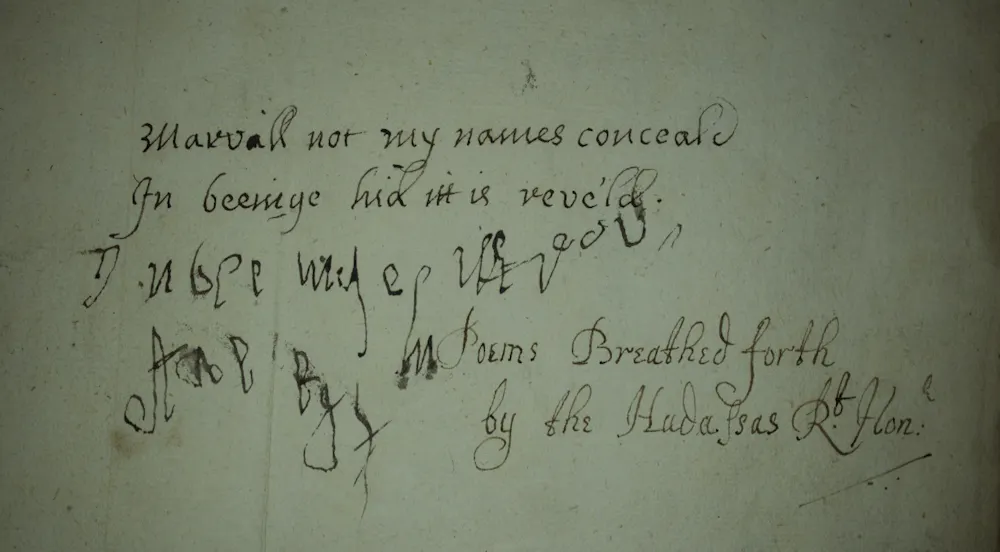
But a riddle scribbled in the manuscript offered a hint about her true name: “Marvel not my name’s concealed / In being hid it is revealed.”
In the Biblical story of Esther, “Hadassah” is Esther’s Jewish name. In early modern England, “Hester” and “Esther” were versions of the same name. They’re also anagrams. That allusion to “Esther” – in addition to a couple of references to an estate named Broadfield – gave scholars just enough evidence to search public records for possible authors.
The mystery manuscript turned out to be a collection of poems by a 17th-century English woman named Hester Pulter.
At first glance, the verses of a self-taught, unpublished poet might not seem remarkable. But Pulter was writing in an era of chaos and change in England. She was eager to explore some of the most exciting scientific ideas of the time. And in a time when women were expected to be silent and chaste, she took risks in her poetry and confidently expressed her ideas.
Now, a collaboration between literary scholars across the globe is bringing Hester Pulter’s poems to the public, in the form of an open-access digital edition called The Pulter Project, which launched on Nov. 15, 2018.
Who was Hester Pulter?
Pulter was born into the aristocratic Ley family in 1605 and married Arthur Pulter when she was relatively young. After marrying, she spent much of her life at the isolated Pulter estate, which was over a day’s journey from London. She wrote most of her poems at home and would occasionally travel to London to visit other family members.
Since Pulter mainly kept to herself and rarely left her home, most of what we know about Hester comes from public records. She gave birth to 15 children, only two of which survived to adulthood, and lived through the English Civil War, which lasted from 1642 to 1651.
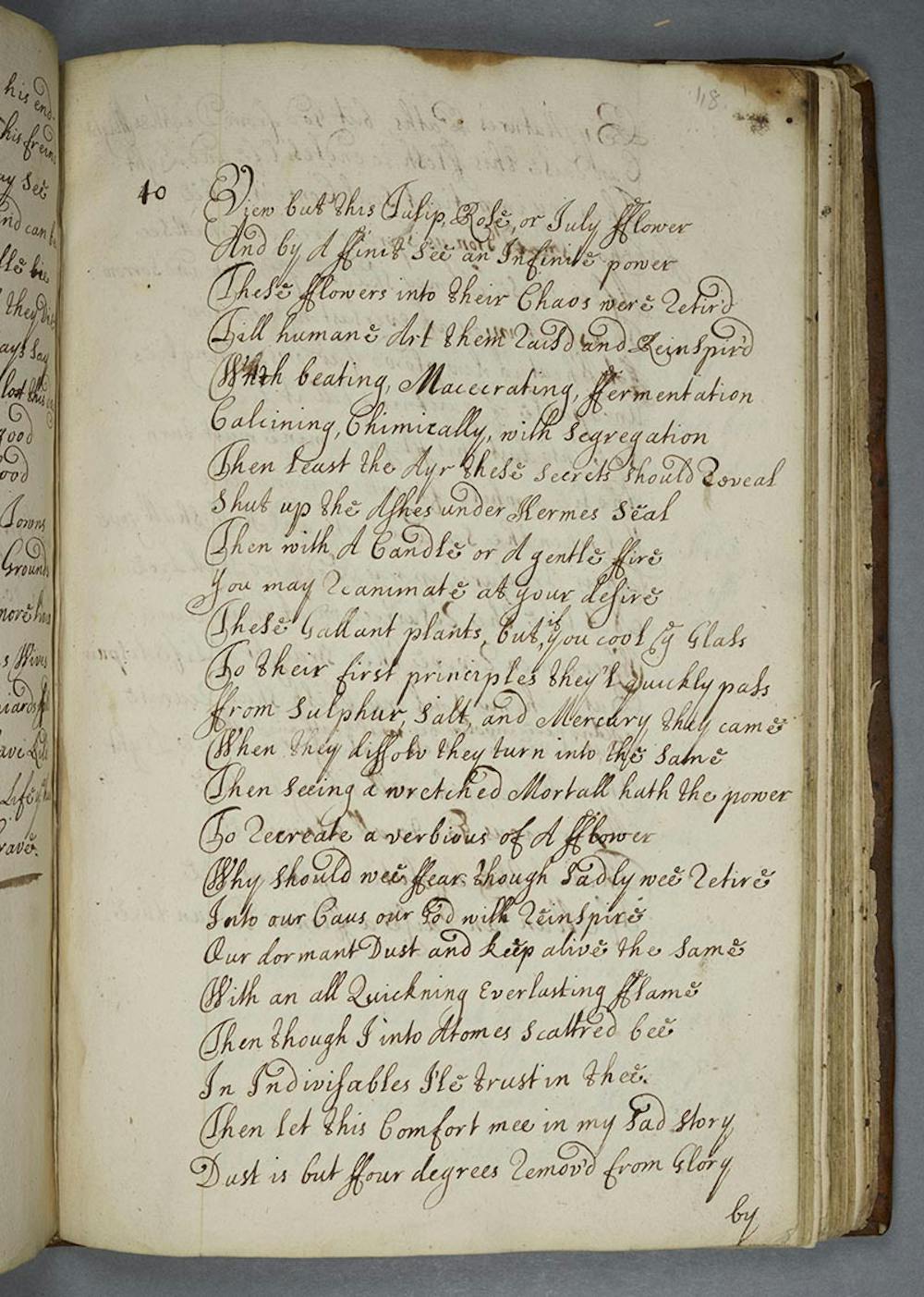
The original manuscript of Hester Pulter’s ‘View But This Tulip.’ University of Leeds Library, Brotherton Collection, MS Lt q 32
Literary scholar Alice Eardley, who produced the first scholarly edition of Pulter’s works in 2014, has suggested that Pulter’s relative isolation inoculated her from pressure by readers or literary society to conform to a certain style or subject matter. It gave her the freedom to write innovative, opinionated, emotionally complex poetry.
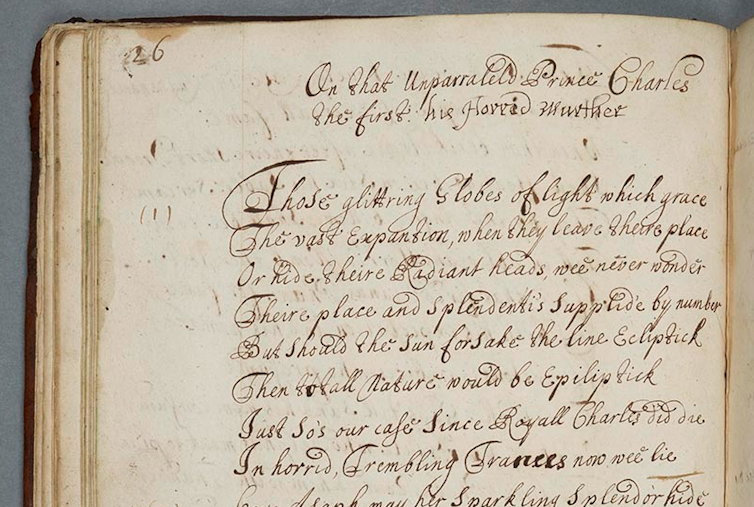
Pulter’s poems, which range from the political to the autobiographical, appear to have been written throughout the 1640s and 1650s. In the 1660s, Hester worked with a scribe to create a presentation copy of her draft poems, making notes and annotations on the manuscript.
It’s likely she never intended to publish her poems, however. In 17th-century England, women who published risked being seen as vulgar and sexually suspect. In order to avoid slander, the few women who did publish usually wrote about topics more aligned with proper womanly values: household guides, devotional books and diaries or memoirs of their husbands.
An aristocratic woman like Hester would have been expected to behave modestly, keep quiet and focus on her household rather than write about political conflicts and scientific experimentation. Pulter’s small family may have read her work, but it seems that her poems sat untouched after her death until they were rediscovered in 1996.
Poetry that’s observant, personal and political
Although Pulter lived a relatively isolated existence, her poems reveal a deep intellectual engagement with the most pressing issues and ideas of the mid-1600s. From the references she makes in her work, it’s clear that she had read works of natural history, alchemy and descriptions of America like William Wood’s “New England’s Prospect.”
She also appears to have kept up with major scientific discoveries, including Galilean astronomy and the microscope. In “Universal Dissolution,” she acknowledges Galileo’s discoveries, describing the sun as the “front and center of all light,” the star around which all other “orbs perpetually do run.”
Pulter was also a keen observer of nature. In “The Pismire,” she describes watching an ant colony at work for an afternoon. “View But This Tulip” shows off her familiarity with alchemy and early experimental practices, and in it she begins to think about the human body as composed of recyclable atoms. These poems place her within a culture of experimental observation that was part of the rise of modern science.
And she certainly didn’t shy away from expressing her political views.
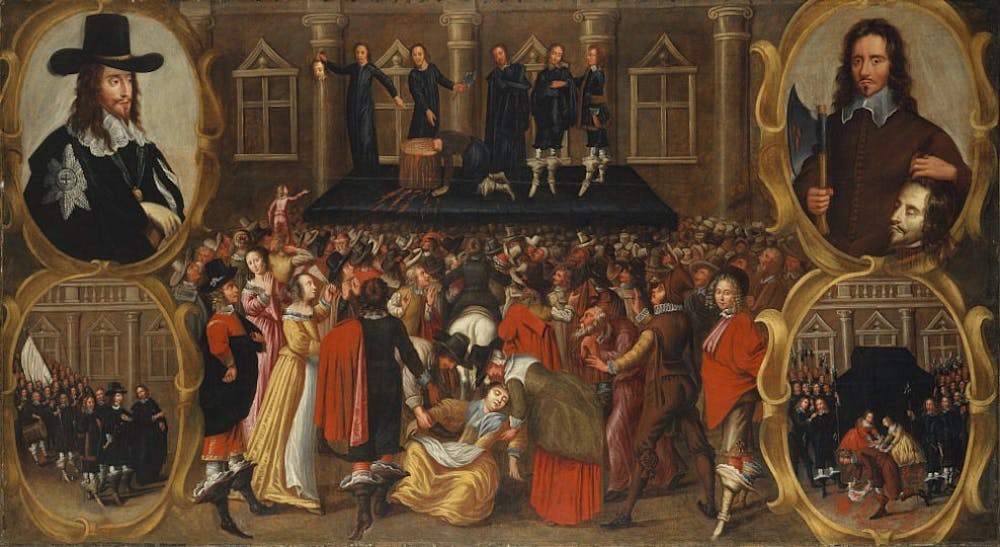
Hester’s parents were Royalists – supporters of Charles I – and she remained a Royalist even when many of her extended family and neighbors supported Parliament instead. Many of her poems express grief at the havoc the civil war caused in England, and mourn a breakdown of religious and social hierarchy.
But her political poems avoid outright tribalism. Instead, they’re nuanced and well-informed, and they critique the ruling class for their role in social collapse.
Pulter is equally comfortable writing about personal experiences like her illnesses or a child’s death. She surveys the effects of time on her body in “Made When I Was Sick, 1647,” and in “Upon the Death of My Dear and Lovely Daughter, Jane Pulter,” deals with the grief of losing yet another child. It’s tinged with envy of parents with healthy children:
    All you that have indulgent parents been,
    And have your children in perfection seen
    Of youth and beauty: lend one tear to me,
    And trust me, I will do as much for thee,
    Unless my own grief do exhaust my store;
    Then will I sigh till I suspire no more.
She also expresses early feminist ideas, and addresses, in complex ways, how society constricts women’s behavior, devalues their work and diminishes their intellectual value.
From “Why Must I Thus Forever Be Confined?”:
    Why must I thus forever be confined
    Against the noble freedom of my mind?
    Whenas each hoary moth, and gaudy fly
    Within their spheres enjoy their liberty.
Reaching new readers
Hester Pulter is clearly worth knowing. Her works speak to the major issues of 17th-century England and provide a rare lens on English culture.
In an effort to bring Pulter’s poems to the public, early modern literature professors Wendy Wall and Leah Knight created The Pulter Project. They collaborated with a host of other scholars from the U.S., Canada, Australia and England to create a free, digital edition of Pulter’s works.
The Pulter Project allows readers to toggle between scans of the manuscript, basic and annotated editions of poems, and explanatory notes. Readers can also explore “curations” for each poem, which are images and selections from texts relevant to the content of a given Pulter poem.
Editors draw on their expertise of 17th-century English culture to contextualize the poems and also make connections to modern culture. The curated materials for “Made When I Was Not Well,” for example, discuss “invisible woman syndrome,” the social phenomenon of women disappearing from public view when they reach middle age, or are ridiculed and criticized for attracting public attention.
Curations for “My Love is Fair” explore racialized beauty standards, topics just as relevant for 17th-century readers as they are for today’s intersectional feminists.
The Pulter Project shows what’s possible when the literary canon is expanded to include new writers and more women. Poets like Hester Pulter change our understanding about who could – and did – participate in the scientific, political and intellectual debates of centuries ago.
Even in the real world there are witches among us, and fantastic beasts – and a touch of magic, too. And so to mark the release of Fantastic Beasts: The Crimes of Grindelwald, these experts have answered some of the more mysterious questions behind JK Rowling’s magical fiction. And they’ve made a series of short video explainers, too.
What would we see in the Mirror of Erised?
Professor Heather Widdows, John Ferguson Professor of Global Ethics
The Mirror of Erised (“desire” backwards), features in the Harry Potter films and The Crimes of Grindelwald. It is a magic mirror that shows “not your face but your heart’s desire”. When Harry – the neglected, lonely orphan boy – looks in the magic mirror, for example, he sees himself surrounded by a happy, loving family. His heart’s desire is to be loved and not alone.
The moral of the Mirror of Erised – and the Harry Potter universe is full of morals – is that the truly happy person sees only themselves as they really are.
But could many of us do this? In our increasingly visual and virtual culture, what many of us would likely see if we looked in the Mirror of Erised is an improved, perfected body, the imagined self, the Perfect Me. This is the self we are constantly working on. The self we imagine we will attain if only we stick to our diets, go to the gym and perform the prescribed tasks: brushing, pumping, plucking, creaming, firming, smoothing and erasing.
This is the self we seek to invoke in our doctored and digitally remastered selfies. The thinner, firmer, smoother, younger, you. Still you, but the better, best or even – if you believe the language of the beauty business – the “real” you.
Is there equality in the world of witches and wizards?
Michaela Mahlberg, Professor of Corpus Linguistics and Dr Anna Cermakova, Marie Sklodowska-Curie Fellow
In a captivating scene in Fantastic Beasts, little Modesty Barebone is playing hopscotch and singing:
My momma, your momma, gonna catch a witch,
My momma, your momma, flying on a switch,
My momma, your momma, witches never cry,
My momma, your momma, witches gonna die!
This ominous song alludes to the historical witch trials. The trials mainly focused on women and girls – and these historical connections contribute to the negative connotations we have of the word “witch”. Indeed, in today’s language, “witch” often refers to an unlikable, unpleasant or ugly woman.
But things are different for the word “wizard”. Wizards tend to have positive qualities, being wise and brave, for example – think of Gandalf from the Lord of the Rings books – and there are also positive expressions, such as “computer wizard”. The word “wizard” is also used less frequently than “witch”.
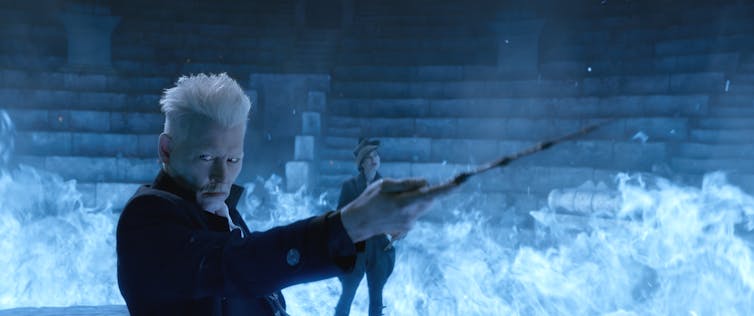
And so the words “witch” and “wizard” make a rather unequal pair. How Rowling’s Harry Potter and Fantastic Beasts series shift and question the meaning of these words for today’s children is really quite remarkable. She makes some witches (such as Hermione in the Harry Potter films) good, and some wizards, such as Grindelwald (played by Johnny Depp in the latest film) bad, subverting the old stereotypes. At the same time, it is interesting to see how our real world gender inequalities are mirrored in Rowling’s world of magic.
Are there real life Fantastic Beasts?
Dr Stephan Lautenschlager, Lecturer in Palaeobiology
In the Fantastic Beasts series, the audience is introduced to a range of weird and wonderful magical creatures: from winged horses and thunderbirds to demons and mischievous furry animals, which look like a cross between a mole and a platypus. While some of them might have been inspired by living animals, many of the beasts in the movies would seem to be too fantastic to be true if we encountered them in the wild. However, this might also be the case for many of the real-life fantastic beasts which inhabited this planet long before humans.
The evolutionary origins of modern animals date back more than 500m years, while the first traces of life itself go back as far as 3.5 billion years. Over that period of hundreds of millions of years, many animals which can only be described as fantastic beasts have evolved, conquered the water, land or air, and eventually become extinct again.
But proof for their existence is documented by their fossilised remains. In fact, the fossil record is full of fossil fantastic beasts and, as palaeontologists, we attempt to revive some of them. Not in real life, but by studying their fossilised skeletons to reconstruct their appearance, their biology and their behaviour.
What role do we play in the wizarding world?
Dr James R Walters, Reader in Film and Television Studies
The wizarding communities in the Harry Potter and Fantastic Beasts films live among ordinary people – the muggles, no-majs and non-magiques. These lives are sometimes intertwined as magical incidents spill over from one society to the next.
But who are these ordinary people? The monstrous Dursley family who abuse their magical nephew, Harry Potter? The childlike Jacob Kowalski, who cannot be trusted with the secrets of the wizarding world and must have his memory erased? Or the oblivious masses who feel only the effects of magic without seeing their causes? In these films, non-magical humans are often peripheral, inconvenient or even negative elements.
As ordinary humans, we are the muggles. In these worlds, we would be background details or minor complications. And yet the films allow us to become part of the magical world, as we move through its landscapes and share its secrets. We shake off our ordinariness and become temporary members of a society more spectacular, but less human. So, the Harry Potter and Fantastic Beasts films possess a magic common to all of cinema. As we watch the films – something I discuss further in this podcast – we are not ourselves. There, in the darkness, these films cast their spell of invisibility over us.
Will we ever be able to ‘apparate’?
Dr Nikk Effingham, Reader in Philosophy
In the world of Harry Potter, the wizards can magically move around, vanishing from one place and appearing in another. They might use “floo powder” or “portkeys”, or “apparate” away. And they can also move through time! Using a “Time Turner”, a witch or wizard can travel back into the past. But doing so is risky – who wants to end up like Madam Mintumble who travelled back to the 15th century and ended up ageing five centuries?
But if you’re careful, the skilled magician can manage to pull it off, as we know from when Hermione Grainger, from the Harry Potter stories, managed to regularly travel back in time to fit in her studies. Or when the protagonists of the books managed to push the boundaries of safety when they went back to save Sirius Black and Buckbeak the Hippogriff.
But does this make any sense? What does teleportation involve? Does being careful when we’re back in the past make a difference? And is time travel even possible? I can’t say whether time travel is physically possible (you’ll have to ask a physicist) but in my latest research, I argue that it is at least theoretically possible – like many things, we can’t rule out its possibility without first learning more about the physical world around us.
It’s hard to imagine a more literary or successful author than William Shakespeare, formerly of Stratford-upon-Avon. Around the world his plays are widely taught and expensively performed. Journalists and scholars look to him for social and political insights. In Washington DC, notionally the capital of the free world, the Folger Shakespeare Library stands near the Capitol building and the Library of Congress as a grand memorial to the Immortal Bard.
Is there another author whose reputation could ever rival Shakespeare’s? Certainly not from the 16th century, nor the 17th. Perhaps Johnson or Swift from the 18th? Austen or a Brontë from the 19th? Woolf, Joyce or Hemingway from the 20th? There are contenders, to be sure, but no one has put Shakespeare in the shade.
And yet there is a problem with Shakespeare.
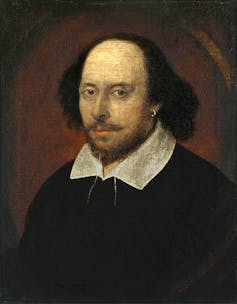
Thought to be the most authentic portrait of William Shakespeare. Wiki Commons
Johnson, Austen, the Brontës, Woolf, Hemingway and Joyce all left behind evidence of their authorial lives. We can study diaries, letters, manuscripts, even juvenilia – a fulsome literary paper trail. With Shakespeare, though, the trail is meagre. Most of what we know of his life has come to us from arid official records, or via cryptic comments from contemporaries who hint at something mysterious or disreputable in the background.
What we notice most starkly is a documentary gap, one that people have attempted to fill in all manner of ways – by contacting Shakespeare through seances, or searching tombs and riverbeds for hidden manuscripts, or probing for secret messages in the plays, or positing all manner of “secret author” theories. According to those theories, William Shakespeare of Stratford was just a frontman for the true author of the Shakespeare oeuvre.
Many credible writers and scholars have embraced Shakespearean heresy. Disraeli, Emerson, Freud, William James, Mark Twain, Orson Welles and Walt Whitman all doubted Shakespearean authorship. Henry James was “haunted by the conviction that the divine William is the biggest and most successful fraud ever practised on a patient world”.
The heretics are right to be sceptical. Apart from the documentary gaps, there are good reasons to doubt Shakespearean authorship of at least some of the plays. They were published by men with a track record of fraud, and the printed versions conceal much about how they were produced, including the role of collaborators.
Fundamentally, though, the heretics are wrong. Thanks to four centuries of scholarship, we know William Shakespeare was an author. And we know a great deal about what kind of author he was.
Gerard Langbaine’s Dramatick Poets includes this anecdote about Titus Andronicus:
…the Play was not originally Shakespear’s, but brought by a private Author to be acted, and [Shakespeare] only gave some Master touches to one or two of the principal Parts or Characters: afterwards he boasts his own pains; and says, That if the Reader compare the Old Play with his Copy, he will find that none in all that Author’s Works ever receiv’d greater Alterations, or Additions; the Language not only refined, but many scenes entirely new: Besides most of the principal Characters heightened, and the Plot much increased.
The first significant reference to Shakespeare as a dramatist – Robert Greene’s famous “Shake-scene” attack – is a complaint about him taking credit, as an “upstart crow”, for the writings of others. There is other evidence, too, that much of his work consisted of revising and retouching plays by other people.
What did it mean for a play to undergo the Shakespeare treatment? We know the answer to that, too. It seems a lot of the treatment involved sexing things up.
Today, William Shakespeare’s surname is utterly respectable. In the 16th century, however, the name had very different connotations. It was an old and earthy name, even a rustic one, akin to “Sheepshanks” and “Silcock” and “Wetherhogg”. His peers were always making fun of his provincial origins. People spoke of his “killcow conceit” – simultaneously an allusion to his father’s humble position in the Warwickshire leather trade, and a suggestion that Shakespeare’s cobbled-together plays were heavy with crude imagery.
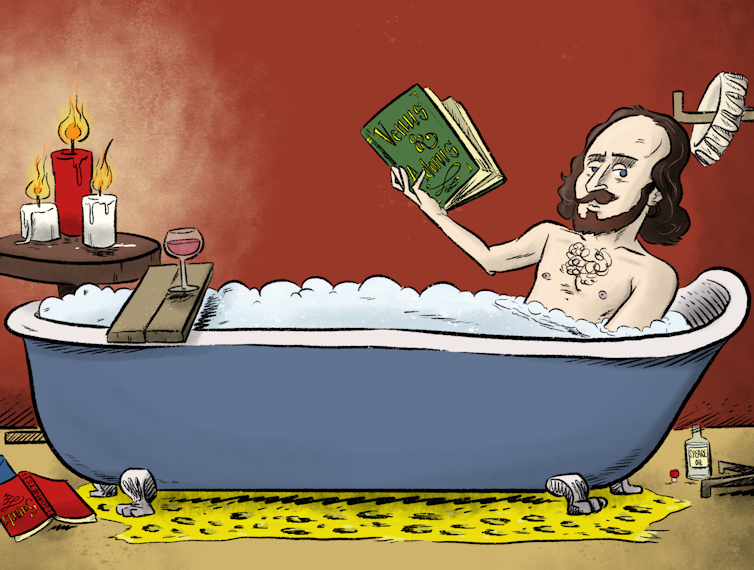
The name “Shakespeare” had another connotation as well. Shakespeare’s first reputation was as a poet, and particularly as a sex poet. In his three main books of poetry – Venus and Adonis, Lucrece, and the Sonnets – bawdy and erotic content is paramount.
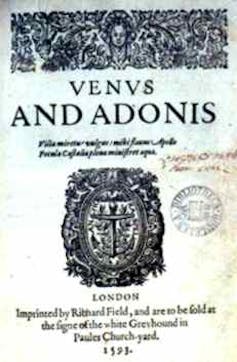
Shakespeare made his first appearance in print with Venus and Adonis. Published in 1593, that book immediately earned a salacious reputation as an aid to what Michael Schoenfeldt called “solitary pleasure”. It is referred to in the anonymous Parnassus plays (1598–1602), in which the character Judico expresses love for the poem and its sweet, “hart throbbing” lines, and the character Gullio promises to “worship sweet Mr Shakespeare, and to honour him will lay his Venus and Adonis under my pillow”.
John Davies’ 1625 A Scourge for Paper Persecutors also mentions the poem, and suggests another way to enjoy it:
Making lewd Venus with eternall lines
To tye Adonis to her loves designes:
Fine wit is shown therein, but finer ’t were
If not attired in such bawdy geer:–
But be it as it will, the coyest dames
In private reade it for their closet-games.
Samuel Johnson would later list Venus and Adonis as one of the most scandalous and corrupting poems of the late 16th century.
He sex and she sex
William Shakespeare was very much alive above the ears and below the waist. A surprisingly high proportion of the documentary trail concerns his racy and bawdy exploits.
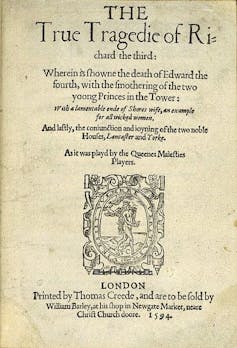
An important anecdote, from John Manningham’s 1601 diary, concerns a performance of the play we now call Richard III. Richard Burbage played the king and caught the attention of a beauty in the audience. The lady was so impressed by Burbage’s performance that she invited him to her home that evening — as long as he promised to stay in costume and character. Shakespeare got wind of the assignation and went first to the lady’s residence. Burbage arrived at the appointed time but Shakespeare was already inside, being “entertained and at his game”.
Copy of the anonymous history play Richard III. Wiki Commons
When the lovers were informed that Burbage was at the door, a triumphant Shakespeare sent his colleague a mischievous reply that contained a sharp lesson in English history. “William the Conqueror,” he said, “was before Richard the Third.”
Jane Davenant, mistress of the Crown Tavern in Oxford, is rumoured to have been another of Shakespeare’s lovers. Her son William, the future poet laureate, inferred on multiple occasions that Shakespeare was his father in more than just a poetical sense.
By the time Shakespeare’s Sonnets were published in 1609, they were somewhat old-fashioned and enjoyed little success. But an earlier manuscript version had circulated in the 1590s. According to the clergyman Francis Meres, Shakespeare’s “private friends” had devoured these “sugared sonnets” with relish.
Today, no copies of the Sonnets manuscript are known to exist. An enduring fantasy for bibliophiles and book-hunters, the manuscript is also a puzzle. The printed edition is a fascinating shandy of hetero- and homosexual flavours. Apart from being more raw and racy, the manuscript Sonnets may have been differently organised, perhaps into sections according to whose appetites were being served. The manuscript may also have included more prefatory matter – such as a letter from the author – that explained what he was up to.
Willy Shake-Spear
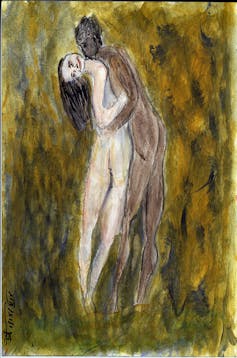
A painting of the intimate relationship between Desdemona and Othello in Shakespeare’s play Othello. Daniel Harris/flickr
Printed versions of Shakespeare’s plays started appearing in the mid-1590s, but not until 1598 did they carry his name on their title pages. The men and women who bought these thin quarto editions knew exactly what to expect. They had already been conditioned by the outputs of William Shakespeare, sex poet.
Like those of his closest peers – men such as Greene and Christopher Marlowe – Shakespeare’s plays are noteworthy for their bawdy and disreputable content. Everyone knows the scene from Othello in which Desdemona and Othello make “the beast with two backs”. There are hundreds of comparable examples. In Hamlet, the prince and Ophelia trade spicy banter:
Hamlet: That’s a fair thought to lie between maids’ legs.
Ophelia: What is, my lord?
Hamlet: Nothing.
Falstaff’s speech in Henry IV Part 2 speaks of Justice Shallow in terms such as these:
…the whores called him mandrake: [he] came ever in the rearward of the fashion, and sung those tunes to the overscutched huswives that he heard the carmen whistle.
In Love’s Labour’s Lost, Adriano de Armado makes a striking confession about the king:
…it will please his grace, by the world, sometime to lean upon my poor shoulder, and with his royal finger, thus, dally with my excrement, with my mustachio; but, sweet heart, let that pass.
OK let’s not get too carried away: “excrement” probably meant “beard”, but the contact is still intimate.
Passages of this flavour are what Shakespeare’s contemporaries meant when they said he wrote in a raw manner, “from nature”. And they are what Thomas and Henrietta Bowdler removed to make their 19th century Family Shakespeare. (They excised, for example, the “beast with two backs”.) Johnson wasn’t far from the Bowdlers in his views about the raw parts of Shakespeare. “There are many passages mean, childish, and vulgar; and some which ought not to have been exhibited, as we are told they were, to a maiden Queen.”
Shakespeare’s Hamlet was probably more vital and bawdy than its predecessor version, possibly written by Thomas Kyd and now lost. Certainly Shakespeare’s King Lear is racier and more involving than the anonymously authored prior play, King Leir, which was registered in 1594.
The Bard had good reason to rev things up. Playwrights sometimes shared in the extra profits from the performance of successful plays. Writers were smart to add spicy content that would appeal to audiences from all classes.
Saucy sources
Apart from adapting earlier plays, Shakespeare took material from histories and poems and novels. His extensive use of sources shows there was no “secret author” behind the scenes who reliably fed him texts. His own library of sources performed that role.
Shakespeare’s personal collection of books and manuscripts has never been found, but one conception of it is compelling: an erotic library rich with imported Dutch and Italian smut along with English works such as Thomas Cutwode’s scandalous The Bumble-Bee (1599) and Giles Fletcher’s equally disreputable Licia, or Poemes of Love (1593).
The field of Shakespeare studies is all about mystery and discovery. There are many uncertainties about Shakespeare, but his achievement as a libidinous “sexer upper” allows us to put one precious stake in the ground.
Although sex is the unlikely key to understanding Shakespeare’s achievement as an author, for a long time the academy shunned his racy side. That side was not, however, wholly overlooked.
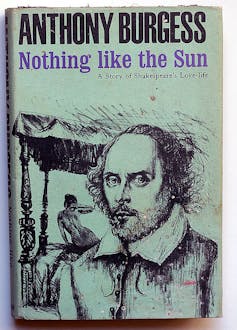
Nothing like the Sun, a story of Shakespeare’s life by Anthony Burgess. Alexis Orloff/flickr
The New Zealand-born lexicographer Eric Partridge compiled the remarkable Shakespeare’s Bawdy (1947), which presents, among other things, scores of Shakespearean synonyms and euphemisms for vagina. Nothing Like the Sun (1964) by the novelist Anthony Burgess is “A Story of Shakespeare’s Love Life”; the covers of the Heinemann hardback and the 1966 Penguin softback show Shakespeare with his mistress, the mysterious “dark lady” of the sonnets.
Still, the Shakespeare of Partridge and Burgess is very different to the respectable, mainstream one. How did Shakespeare pull off the transformation from sex poet to literary monument?
Even in his lifetime he was shape-shifting, from boisterous lyricist and tearaway playwright to old-fashioned sonneteer and retired bookman. In the decade after his death, men tidied up his authorial legacy – and possibly added to it – but Shakespeare was still one writer among many, his reputation on a par with those of Marlowe and Middleton, and behind those of Jonson, Milton and Spenser.
But Shakespeare was tailor-made for the Romantic and Victorian eras, whose actors, scholars and hacks embraced and refashioned the Bard. Bowdlerising editors cut many of the ruder bits and added happier endings. By the 20th century, Shakespeare’s preeminence was immutable, his works as sublime and respectable as Beethoven’s symphonies or Mona Lisa’s smile. Things, though, could have been very different.
Professor Stuart Kells is the author of Shakespeare’s Library: Unlocking the Greatest Mystery in Literature (Text Publishing).
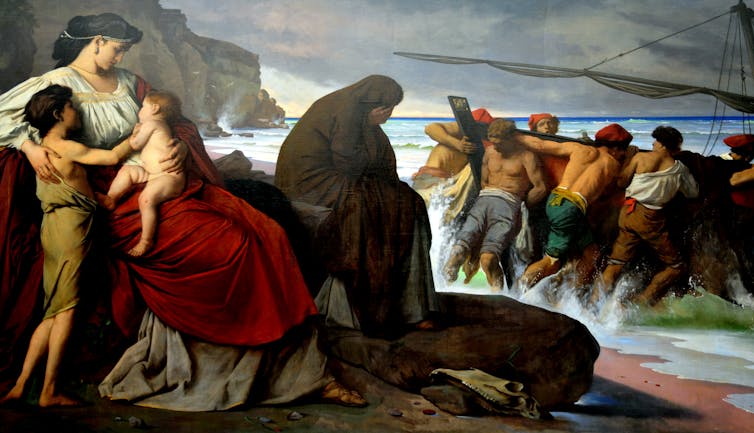
Anselm Feuerbach’s depiction of Medea, circa 1870: the play is particularly cogent today in the context of the #MeToo movement’s assault on patriarchal power. Wikimedia Commons
The Athenian poet Euripides was the last of the three great Greek tragedians (after Aeschylus and Sophocles) and also the least successful.
Greek tragedies were performed competitively at religious festivals in Athens in honour of the god Dionysus. While 18 of his 90-odd plays have survived, Euripides claimed only four festival victories. One prize was awarded posthumously, indicating that at the Dionysia, as with the Oscars, death could be a handy avenue to success.
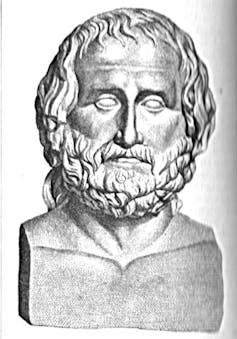
Sculpture of Euripides. Wikimedia
It’s not difficult to see how Euripides estranged the festival judges. Unlike the intricate plotting of Sophocles, exemplified by the intriguing whodunit devices employed in Oedipus The King, Euripides’ interest lay in the psychological motivations of his characters. Some scholars accordingly describe his plays as more modern than his contemporaries.
Euripides challenged conventions by depicting strong, passionate female characters and cynical, often weak male mythological heroes. He was considered more of a social critic than his contemporaries, who disparaged his emphasis on clever women.
In Aristophanes’ comedy The Thesmophoriazusae, the women of Athens use an annual fertility festival to plot secret revenge on Euripides for his depiction of them as crazed, sex-addicted killers. The central joke is not that Euripides is defaming women in his plays, but rather that he is onto them and must be stopped before he reveals more.
Euripides’ dismissal by some as a misogynist sits uncomfortably alongside his complex and sympathetic female characters. Medea is a case in point: a sorceress and former princess of the “barbarian” kingdom of Colchis, she mourns the loss of her husband’s love, the hero Jason. To further his political ambitions, Jason abandons Medea in order to marry a Corinthian princess.
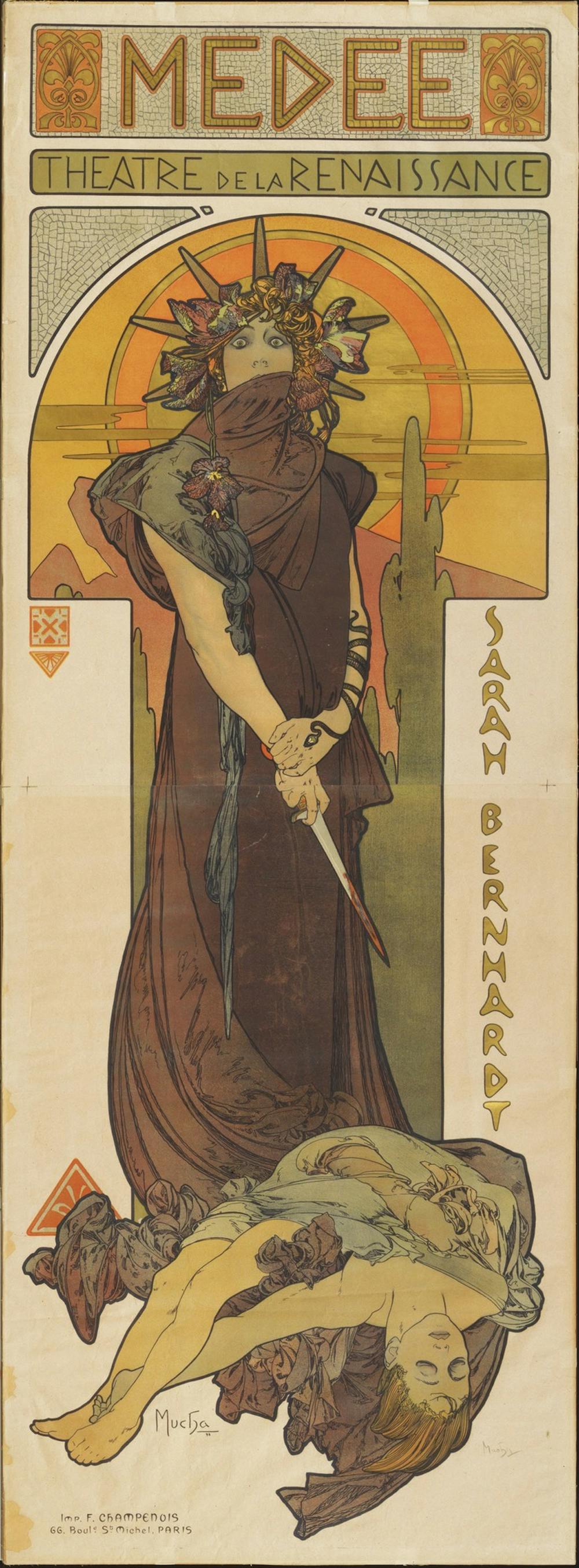
An 1898 poster for the play.
Medea confides her grief to her nurse and the Chorus of Corinthian women who sympathise, but fear her response; and these fears are well-founded. Medea takes horrible vengeance on Jason by murdering his new wife then slaughtering their own children.
The play ends like a brutal thunderclap as Medea escapes to Athens in a dragon-drawn chariot, flanked by the corpses of her sons, mocking Jason’s agony and revelling in her victory.
Jason predicts justice will pursue Medea (“The curse of children’s blood be on you! Avenging justice blast your being!”) but so complete is his defeat, this threat seems empty. Medea has inflicted savage sacrifices to wreak her revenge and now, revealed in all her supernatural splendour, no one can touch her.
The Athenians don’t seem to have responded particularly well to Medea in so far as the festival judges placed it third. This might in part be attributable to poor timing. Medea was performed first in the spring of 431 BC, a few weeks before the Spartan king Archidamus invaded Attica – initiating the 27-year Peloponnesian War that proved catastrophic for Athens. War had been brewing for a decade and in their state of profound anxiety perhaps Athenians were simply in no mood for the horrors Euripides was offering.
But there are other reasons for Medea’s failure. As a barbarian from the wild realm of Colchis (in modern Georgia) Medea would be inherently untrustworthy to an Athenian audience. They might sympathise with her feelings of isolation and homesickness (“Of all pains and hardships none is worse than to be deprived of your native land”) but she remained associated with the Eastern “other” that marched into Greece under the Persian king Xerxes and sacked Athens 50 years previously.
Traditionalists might also have objected to Medea’s sexual politics. In Medea more than his other plays (The Trojan Women excepted) Euripides depicts a world where the steadfastness and bravery of women count for nothing amid the machinations of men (“we women are the most wretched…I’d rather stand three times in the front line than bear one child”).
Artemisia Gentileschi, Medea, circa 1620. Wikimedia Commons
Medea’s lament may seem admirably subversive to a modern audience but it appears that the festival judges had little appetite for the gender conflict that so fascinated Euripides. It’s worth noting that Euripides’ plays grew in popularity after his death, so it’s likely their “salacious” content enjoyed a better reception outside the formal competition environment.
Despite Euripides’ popularity with modern audiences Medea remains a challenging play. Although scenarios of fathers “avenging” themselves on their wives through killing their children are depressingly familiar to us, the resolve of a mother to destroy her enemies through sacrificing her children is fundamentally distancing.
Medea may be a prisoner to her passion (“Oh, what an evil power love has in people’s lives!”) but she plans her vengeance with cold brutality. Only her female confidants sense with dread what she is up to and who can they tell?
Adaption of the classic
That said, Medea’s remorseless depiction of a woman forced to strike against an oppressive patriarchy did see it embraced by the 1960s counterculture. Pasolini adapted the play in his polarising style in 1969, but Medea’s themes were not borrowed to the extent of other Greek works during the American cinematic Renaissance of the 1970s (Roman Polanski, for instance, used Sophocles’ Oedipus as his canvas for 1974’s Chinatown).
A sympathetic depiction of a grieving mother killing her children to ruin her husband seemed too great a hurdle for filmmakers. Decades later, however, Ridley Scott channeled Medea’s denouement in having Thelma and Louise take violent revenge against the patriarchy and refuse to be taken – “escaping” in their airborne chariot, their male pursuers looking on impotently.
Thelma and Louise take violent revenge against the patriarchy and refuse to be taken – “escaping” in their airborne chariot.
Medea is particularly cogent today in the context of the #MeToo movement’s assault on patriarchal power. Euripides’ fascination with women outscheming their “masters” and striking back lethally springs from an anxiety at the heart of Athenian society.
Medea, Hippolytus and Aristophanes’ comedies seemingly demonstrate that the cloistering of Athenian women did not result from a male assumption they were unintelligent or weak. On the contrary, it reflects a belief in a vicious cycle where the subjugation of women made them intent on revenge, making it a social necessity to oppress them further.
As a modern articulation of Medea’s themes, the play’s central message was distilled to its essence in Clint Eastwood’s 1992 revisionist Western Unforgiven. A “chorus” of prostitutes commission bloody revenge on men who mutilated one of their sisterhood.
When townsmen gather angrily outside the brothel after one of the murders, the group matriarch screams from above “He had it coming! They all have it coming!” To Medea, truer words were never spoken.








 At the BookShelf


You must be logged in to post a comment.