
Unknown's avatar

Books are delightful as they are – don’t fall in the trap of competitive reading


File 20190305 48423 13b4no8.jpg?ixlib=rb 1.1

arek_malang/Shutterstock

Sally O’Reilly, The Open University

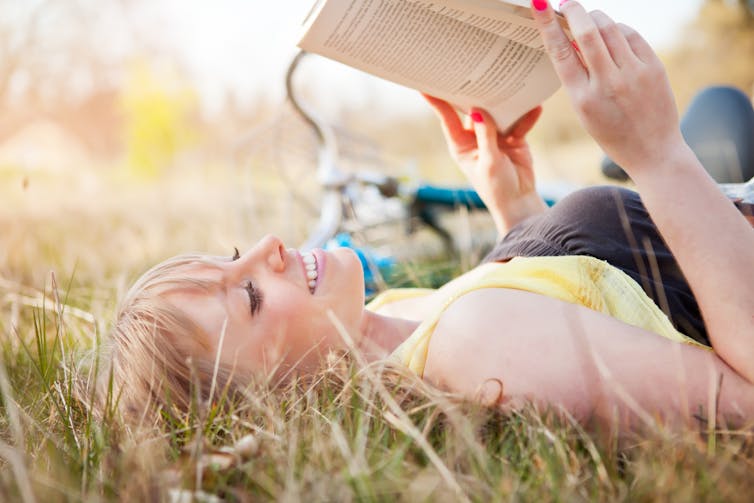
My happiest times in childhood were spent reading the books of E. Nesbit, C.S. Lewis and Joan Aiken. Preferring to read in hidden corners where nobody could find me, I immersed myself completely in these stories and believed utterly in their magic, even attempting to enter Narnia via the portal of my grandmother’s wardrobe. As an adult, I still call myself a passionate reader, but sometimes feel as if I’ve lost my way compared to my childhood self. I buy vast quantities of books, talk about books, read as many as possible, sometimes even write them – but it’s not often I find that same pure immersion in an imagined world which has been such a lasting inspiration.

Celebrations like World Book day promote children’s reading and remind us all of the pleasures of a good book. Many of us make resolutions to read more, but these days there’s increasing pressure to read the “right” thing. The adult world presents a constant temptation to turn every activity into a competitive sport, and reading is no exception: it is beset with targets, hierarchies and categorisations. We guilt-read chick-lit and crime, skim-read for book groups and improvement-read from book prize shortlists.

Underpinning this is a relentless quest for self-improvement, demonstrated by the popularity of reading challenges, in which readers set themselves individual book consumption targets. On Good Reads, some participants have modest goals, others aim for as many as 190 in the year, which translates to 15.8 books a month, 3.6 a week or just over half a book each day. Impressive? Maybe, but others are reading even faster. One journalist recently embarked on a seven day social media detox and read a dozen books in that time. It’s a far cry from my days with Mr Tumnus.

A profound joy

This raises a fundamental question: why do we read at all? Do we want to enjoy books, or download them into our brains? Are we so obsessed with being able to tick a book title off a check-list that we risk forgetting that reading is a physical and emotional activity as well as an intellectual one? The perceived benefits of reading are often given more attention than the experience itself: campaigners tend to stress its utilitarian value and research findings that it increases empathy and even life expectancy.

But the reading experience is important. A sure sign of loving a book is slowing down when you come to the final pages, reluctant to leave the world it creates behind. As the UK reading agency puts it, “in addition to its substantial practical benefits, reading is one of life’s profound joys”. Children seem to know this intuitively, and engage fully with a story, often to the exclusion of all else. They are demanding, honest readers, more interested in what happens in a tale and where it takes them than whether it’s a Carnegie prize-winner.

When was the last time you truly got lost in a book?
Amanda Carden/Shutterstock

Slow reading

As an adult, it is possible to recapture that immersive involvement with a book. What we need is the opportunity to focus entirely on the words, and a willingness to ignore stress-inducing challenges and targets. When I was writing my second novel I lived in Barcelona for a year, day-job free. During that time I read just six books, one of them Joseph Conrad’s The Secret Agent. At a recent writing retreat, I spent two hours a day reading Michel Faber’s The Crimson Petal and the White. I engaged completely with these novels, forgetting the outside world, and they have stayed with me, their characters and plot twists vivid and familiar when other books, read hurriedly in snatches amid distractions, have faded from my mind.

I’m not alone in seeing the value of immersive, non-competitive reading. In a recent Guardian article, author Sarah Waters admitted to feeling out of the loop when current writing is discussed. Asked which book she is “most ashamed not to have read” (a telling phrase), she responded, “Anything people are currently raving about. I’m a slow reader, and I read old books as often as new ones, so I always feel like a hopeless failure when it comes to keeping up with brand new titles”.

There are already advocates of slow living, and a cultural shift toward slowing down life’s pace, savouring experience and rediscovering human connection. Perhaps it is time for this to encompass reading too. 184,000 books are published each year in the UK alone, and we’re not going to make much of a dent in that pile even if we read 12 books a week. Indeed, no matter how fast we read, the vast majority of books will remain unknown to us. If there is one skill that adult readers can usefully learn from children, it is that of reading purely for pleasure.The Conversation

Sally O’Reilly, Lecturer in Creative Writing, The Open University

This article is republished from The Conversation under a Creative Commons license. Read the original article.
Unknown's avatar

Why are Australian authors obsessed with killing off kangaroos?


File 20190228 106350 pht809.jpg?ixlib=rb 1.1
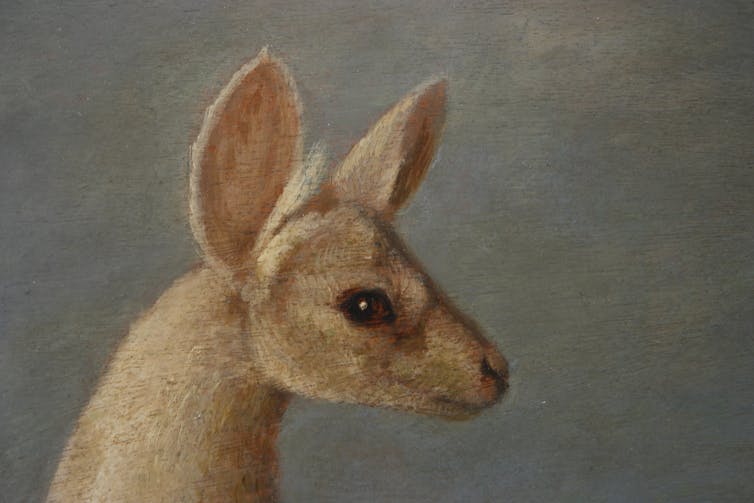
George Stubbs, ‘The Kongouro from New Holland’ (1772), oil painting, detail of head.
Ashley Van Haeften/Wikimedia Commons, CC BY

Donna Mazza, Edith Cowan University

Kangaroos are the most visible of Australia’s unique animals, but despite their charm and national icon status, Australian writers perpetually kill them off.

A kangaroo appears struggling in a rabbit trap, doomed and dying in Charlotte Wood’s The Natural Way of Things, while Tim Winton has one killed on the road, dissected and fed to dogs in Breath. These are just two of many Australian authors who have represented the kangaroo as a victim.

Kangaroos were a creature of wonder for early European explorers such as Dampier and Banks, but it didn’t take long for their public image to descend to that of a pest. Early settlers considered them competition, nibbling all the best pasture quicker than their sheep and cows, and they soon took up arms against the bounding menace.

The wild kangaroo population of Australia is still commercially slaughtered for dog food. In New South Wales, landholders and volunteers can be simply licensed to kill them for reasons of damage control, and some parts of Western Australia have an open permit system for non-commercial shooting. On any given day, there are usually several being mashed into the blue metal of highways, surrounded by crows and in various states of decomposition.

The expendable nature of the kangaroo may be a widely held view in Australia, but it’s a bitter irony that the creature which defines us to the rest of the world is perpetually under siege, in life and in literature.

Fiction’s dead roos

Coming Rain by Stephen Daisley (2015).
Goodreads

In Stephen Daisley’s 2016 novel Coming Rain, the author kills off a kangaroo with “a great thump” against the side of a truck, giving a gruesome description of the sweetening of the tail for stew.

The live joey almost has its head smashed against a tree but, owing to its “cuteness” it becomes a pet, wearing a straw hat. The stereotype of the cute joey is alive and well in children’s fiction too, but in adult fiction the kangaroo is dead.

In Tim Winton’s Breath, narrator Pikelet comes across surf guru, Sando, who has hit a kangaroo with his Kombi ute. Sando finishes it off with the jack handle from the car, pounded a couple of times into its head. His response to this act is very matter-of-fact: “This is what happens. And it isn’t lovely.”

Sando drags the “roadkill” into the tray of his ute and takes it home to butcher it. He is prepared for this, with a meat hook hanging from a tree, and he skins and guts the kangaroo. Pikelet observes this with some emotional discomfort, “shrinking from him a little” but accepts the flourbag of meat to take home to his parents who “wouldn’t eat roo meat in a million years”. He “hoiks” the meat into the bushes on the ride home.

Charlotte Wood considers the horror of roadkill in The Children, where Australian animals are killed by passing traffic and compared to contaminated “cushions”. Wood also kills a kangaroo (and a lot of rabbits) in The Natural Way of Things. Central character Yolanda snares a “large grey kangaroo” in a rabbit trap and finds it still alive:

Vainly, the kangaroo shifts and scuffles again. Then it lowers its head and lengthens its mighty neck, black eyes fixed on them, and lets out three long, hoarse snarls. Its snout fattens, nostrils flared.

Fearful of the sharp claws on its “delicate forefeet” they sit beside it, wondering how to set it free and instead bring it water and leave it to die slowly.

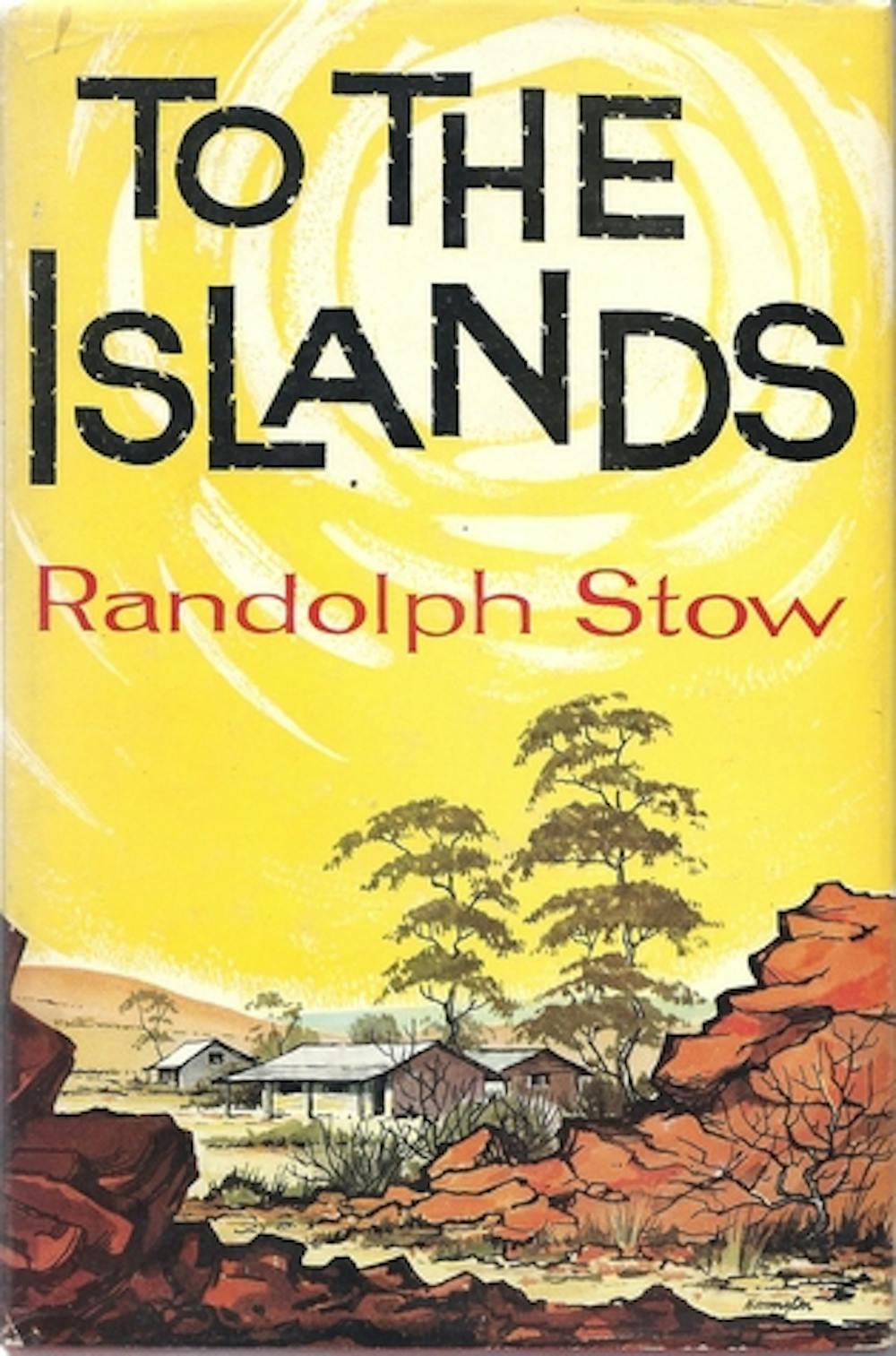
To the Islands by Randolph Stow (1958).
Goodreads

The image of the kangaroo is linked to death through earlier works from Australian authors too. The iconic 1940 poem, Native-Born by Eve Langley presents a detailed account of a dead kangaroo, while Randolph Stow’s 1958 novel To the Islands features kangaroos and wallabies being shot and eaten.

Australian fiction is, so often, deeply entangled with nature. Anxiety around the bush, as described in D.H. Lawrence’s novel Kangaroo back in the 1920s, is a feature of settler Australian fiction, tied together with violence, trauma and a sense of the uncanny.

Docile and violent all at once, the watchful gaze and twitching ears of kangaroos are, perhaps, reminders of that uneasiness the settlers felt.

The fact that Australian literature seems intent on killing off this national icon is deeply disturbing – but it is also deeply ingrained.

In contrast with kangaroos, thylacines are well and truly alive in Australian literature despite being extinct since 1936. They appear in over 250 works listed in the AustLit database of Australian literature, including 18 novels since 1988.

Among these are Julia Leigh’s The Hunter, Sonya Hartnett’s Stripes of the Sidestep Wolf and Louis Nowra’s Into That Forest, as well as children’s fiction, drama, film, short fiction and poetry. These thylacines often meet with violent ends, but their aliveness in fiction is astounding compared to the kangaroo.

Contemporary Australia is sentimental about the thylacine as a strange creature lost because of “ignorance”. They are now a thing of wonder, destroyed by misguided colonial settlers who are long gone. But if they weren’t extinct, would we treat them any better? Would we protect them? Often that is the point writers are trying to make by invoking the extinct “tiger” in the first place.

Our relationship with kangaroos (and thylacines), both in fiction and in reality, is symptomatic of what Stow called our “bitter heritage”. So perhaps it is unsurprising, given the violence of colonisation, that it has had (and is still having) an impact on the way writers represent the Australian landscape and all who inhabit it.

This article is based on research published in a forthcoming article for Antipodes.The Conversation

Donna Mazza, Senior Lecturer in Creative Arts, Edith Cowan University

This article is republished from The Conversation under a Creative Commons license. Read the original article.
Unknown's avatar

Books and Relationships


The link below is to an article that reports on books, women and relationships. It is one of those articles I regard as nonsense, still, make up your own mind.

For more visit:
https://www.theguardian.com/books/booksblog/2019/feb/11/shelf-policing-how-books-and-cacti-make-women-too-spiky-for-men

Unknown's avatar

The Sheikh Zayed Book Award


The link below is to an article that reports on the shortlists for the 2019 Sheikh Zayed Book Award program.

For more visit:
https://publishingperspectives.com/2019/02/sheikh-zayed-book-award-program-announces-three-2019-shortlists/

Unknown's avatar

Books Still A Thing


The link below is to an article that concludes that books are not yet dead.

For more visit:
http://time.com/5520570/books-are-not-dead/

Unknown's avatar

Free Books and Comics


The link below is to an article that takes a look at where to find free books and comics.

For more visit:
https://bookriot.com/2019/02/11/free-books-and-comics/

Unknown's avatar

Using Bookmarks?


The link below is to an article that looks at using bookmarks – or not?

For more visit:
https://bookriot.com/2019/02/14/should-i-use-a-bookmark/

Unknown's avatar

Shortlist for the 2019 London Book Fair International Excellence Awards


The link below is to an article reporting on the shortlist for the 2019 London Book Fair International Excellence Awards.

For more visit:
https://publishingperspectives.com/2019/02/london-book-fair-2019-international-excellence-awards-shortlists/

Unknown's avatar

Google Books Broken?


The link below is to an article that takes a look at the problems with Google Books.

For more visit:
http://sappingattention.blogspot.com/2019/02/how-badly-is-google-books-search-broken.html

Unknown's avatar

Early 2019 Book Scandals


The link below is to an article that looks at early books scandals of 2019.

For more visit:
https://www.bustle.com/p/the-major-book-scandals-of-2019-so-far-are-indicative-of-bigger-problems-in-the-world-of-publishing-15934182