Unknown's avatar

Guide to the classics: Walt Whitman’s Leaves of Grass and the complex life of the ‘poet of America’


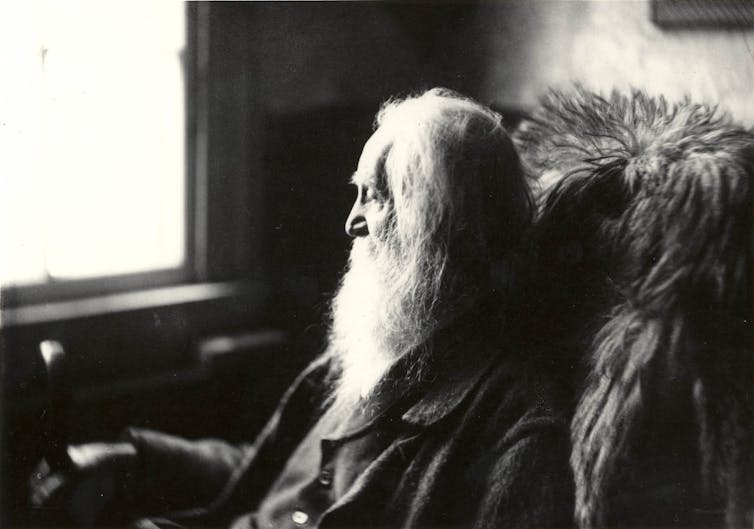
Poet Walt Whitman in his home in New Jersey in 1891. Born 200 years ago this week, Whitman is celebrated in America for his daring poetry collection Leaves of Grass.
Samuel Murray/Wikimedia Commons

Carolyn Masel, Australian Catholic University

This is a longer read. Enjoy!

This year marks the 200th anniversary of the birth of Walt Whitman, America’s most admired poet. Celebrations will be especially joyful around his birthday on May 31 and in New York City, whose citizens were often depicted in his poems. But the poetry many people now love won him notoriety before it won him fame.

Whitman’s life was interesting and varied. He was born in 1819 and grew up in and around Brooklyn, moving often as his family tried to make money from farming and real estate. His formal education ended when he was 11. He worked by turns in Manhattan and Brooklyn as a printer’s apprentice, a schoolteacher and a newspaper publisher, before resolving to become a writer.

Having had some success – a novel and newspaper pieces – he became chief editor of the Brooklyn Eagle, but lost this position when his opposition to the spread of slavery clashed with the views of the newspaper’s owner. Luckily, an opportunity arose to work on a newspaper in New Orleans. Whitman enjoyed this different culture, but never lost his horror of slave auctions.

Thomas Eakins, Portrait of Walt Whitman, oil on canvas, 1887.
Thomas Eakins/Wikimedia Commons

On learning his brother George might have been injured during the Civil War, Whitman travelled to Washington DC and Fredericksburg, Virginia, to look for him. Fortunately, George’s wound was only superficial, but Whitman stayed on in Washington as a nurse, where he attended to sick, maimed and dying soldiers.

Working in field hospitals, Whitman’s health deteriorated, and at the age of 53 he suffered a stroke. Although he made a partial recovery, he was cared for by friends until he died almost 20 years later in March 1892. By then, he was admired for his writing in England, but the thousands who lined the streets in New Jersey for his funeral procession were probably more curious about his enormous tomb, which he had designed himself, than his writing.

Walt Whitman’s tomb in Camden, New Jersey.
Bart E/flickr, CC BY

Whitman’s innovation

We don’t know how or why Whitman began to invent his extraordinary poetry. In 1842 he listened to “The Poet”, a lecture in which philosopher Ralph Waldo Emerson called for a national bard who could write about the US in all its diversity. But Whitman’s daring originality seems more than a mere response to Emerson’s demands.

It is clear he thought of his book of poems, Leaves of Grass, as an experimental project. He took the opportunity of having the best compositors, the Rome brothers, typeset his poems, and he supervised the work closely, revising his poetry to fit the page. He even set about ten pages of the type himself.

The book’s long non-rhyming lines are reminiscent of bible verses. Each seems to correspond with a single breath or a single gesture. Words or phrases are often repeated at the beginning of a series of lines, building up a rhythmical pattern. However, Whitman is careful to break the pattern before it can become mere rhetoric. The reader is constantly being called to attention:

Smile O voluptuous cool-breath’d earth!

Earth of the slumbering and liquid trees!

Earth of departed sunset – earth of the mountains misty-topt!

Earth of the vitreous pour of the full moon just tinged with blue!

Earth of shine and dark mottling the tide of the river!

Earth of the limpid grey of clouds brighter and clearer for my sake!

Far-swooping elbow’d earth – rich apple-blossom’d earth!

Smile, for your lover comes. (“Song of Myself”, canto 21)

Leaves of Grass was Whitman’s sole book of poetry. Rather than publish several collections containing new poems, he revised and expanded this single volume, so that the first edition of 12 poems eventually became a thick book of close to 400 poems.

There are six editions of the book (nine, if you count different type-settings). As soon as one was published Whitman would revise, regroup and add to the poems, treating the published book as a manuscript to be edited and republished.

The overall result of this practice is that Whitman’s poetry is seen always to flow from a single being; it is as unified and as singular as the man who made it.

The first edition of Leaves of Grass did not even contain the author’s name on the title page, but he was instantly recognisable from his picture on the frontispiece – a working man in his prime, open-shirted, hat on the back of his head, hand on hip, looking straight out at the reader.
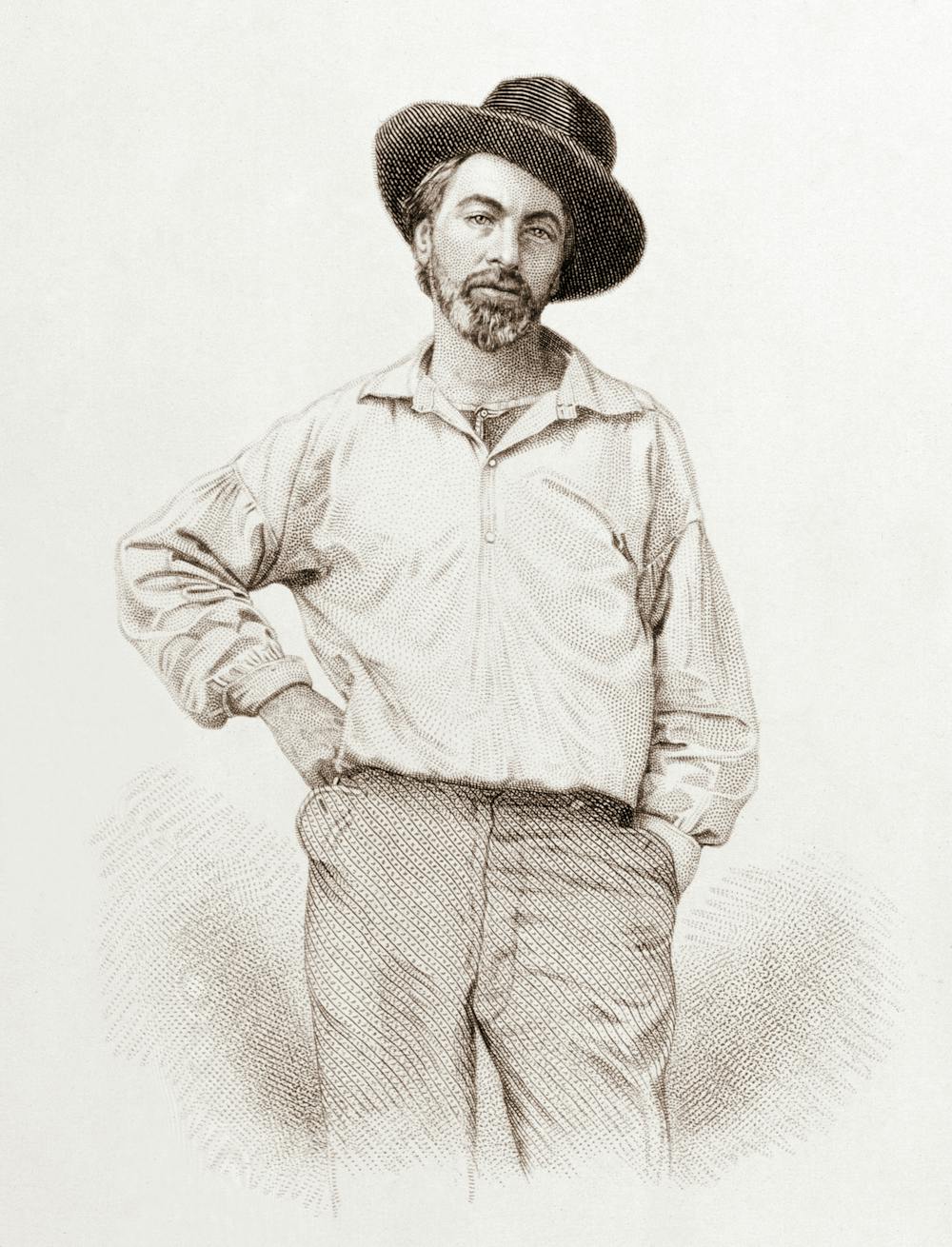
Walt Whitman, 1854, frontispiece to Leaves of grass, Fulton St., Brooklyn, N.Y., 1855, steel engraving by Samuel Hollyer from a lost daguerreotype by Gabriel Harrison.
Wikimedia Commons

The poet of democracy

Emerson’s influence – or Whitman’s agreement with Emerson – can be seen in Whitman’s insistence on democracy as a central value of American society. People are equal, according to Whitman, because we are all mortal; moreover, we all have immortal souls.

In “Song of Myself”, we can see the connection between democracy, equality and immortality in the symbolic use of grass, which grows everywhere:

[…] I guess it is a uniform hieroglyphic,
And it means, Sprouting alike in broad zones and narrow zones,
Growing among black folks as among white,
Kanuck, Tuckahoe, Congressman, Cuff, I give them the same, I receive them the same. […]

Tenderly will I use you curling grass,
It may be you transpire from the breasts of young men,
It may be if I had known them I would have loved them,
It may be you are from old people, or from offspring taken soon out of their mothers’ laps,
And here you are the mothers’ laps. […]

What do you think has become of the young and old men?
And what do you think has become of the women and children?

They are alive and well somewhere,
The smallest sprout shows there is really no death […]

All goes onward and outward, nothing collapses,
And to die is different from what any one supposed, and luckier.

In this passage the grass signifies equality, by making no distinction where it grows. A “hieroglyphic” symbol might need an expert – such as Whitman – to translate it, but it grows “uniform[ly]”, giving everyone the same rights and the same chances to mean something in the great poem that is America, as Whitman saw it.

Poet of the soul

As a result of Whitman’s habit of revision, we can witness the growth of many poems. The Sleepers, generally agreed to be among his finest, was worked on over the course of his career.

It is one of his most ambitious poems, with a triumphant ending that seems genuinely earned. It poses questions about the limitations of a single human life. How can one life, or one death, or one gender, be enough for a man, a poet, consumed by curiosity?
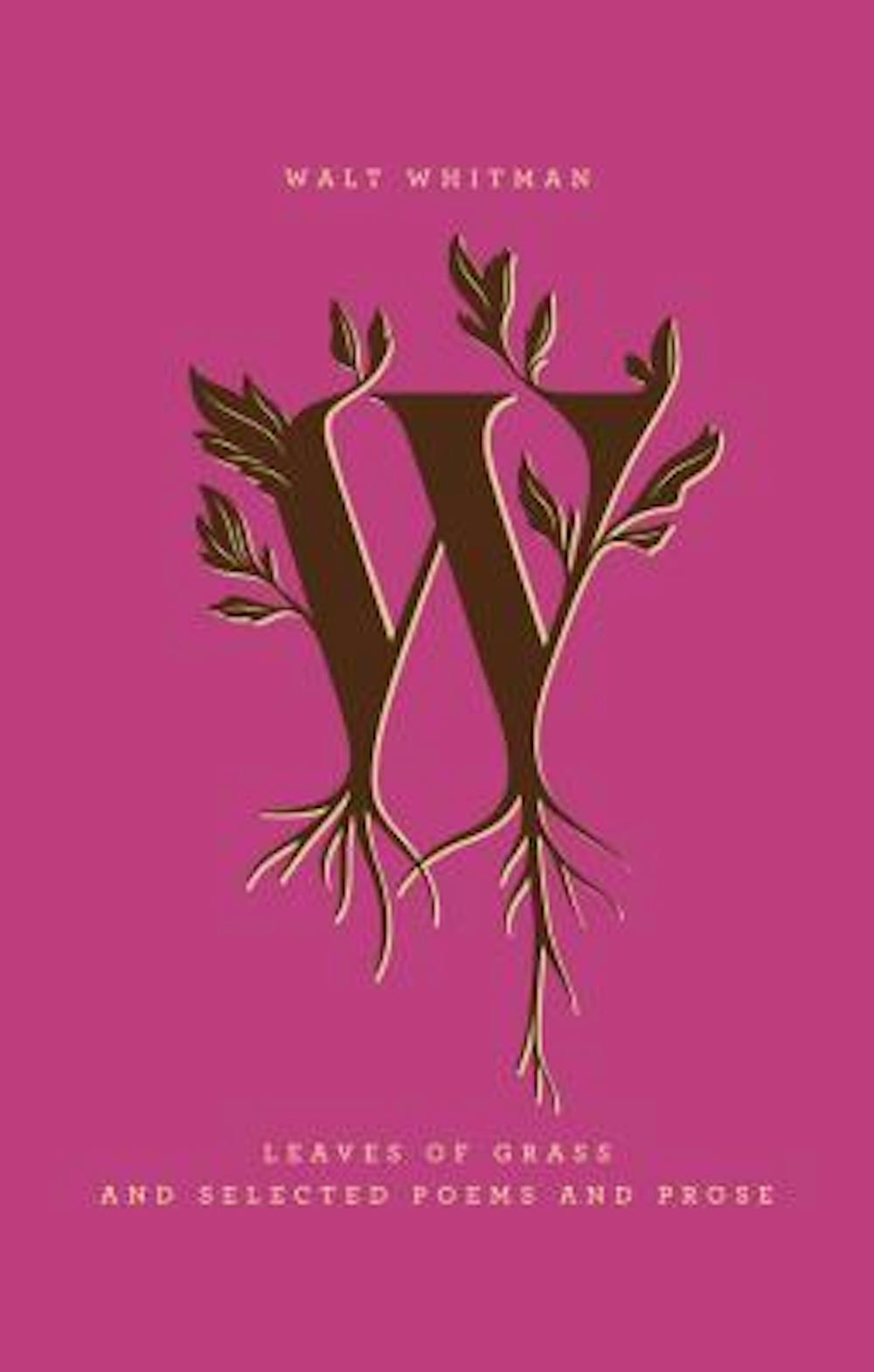

Goodreads

Whitman wants to dream every sleeper’s dream, be every sleeper’s lover, know every person’s meaning in the larger scheme, live everyone’s life and die everyone’s death.

In the third section of the poem, he envisages a beautiful swimmer, who comes to grief on rocks and dies. His body is then retrieved and laid out in a barn, with others, to be mourned just as the slain soldiers in the Revolutionary War (1775-83) were mourned by General Washington.

A Native American woman comes to visit the man’s mother, and then goes on her mysterious way, before everyone else returns to their rightful place: immigrants return home, colonial masters return to their countries of origin, the dead (including the beautiful swimmer), those waiting to be born, the sick, the disabled, the criminal are all likened to one another and restored in sleep.

At the end of the poem, all of the restored sleepers begin to awaken, an event described in terms of reconciliation and resurrection:

The sleepers are very beautiful as they lie unclothed,
They flow hand in hand over the whole earth from east to west as they lie unclothed,
The Asiatic and African are hand in hand, the European and American are hand in hand […]

The felon steps forth from the prison, the insane becomes sane, the suffering of sick persons is reliev’d,
The sweatings and fevers stop, the throat that was unsound is sound the lungs of the consumptive are resumed, the poor distress’d head is free […]
Stiflings and passages open, the paralyzed become supple,
The swell’d and convuls’d and congested awake to themselves in condition,
They pass the invigoration of the night and the chemistry of the night, and awake. (Canto 8)

Only at the end of the poem does Whitman state that he has been previously afraid to trust himself to the night, but that now he is at peace with the rhythm of night and day, sleeping and waking, which governs the world.

Poet of the body

Whitman’s poetry was initially unpopular. Not only was his new verse form considered outlandish, but his insistence on the worthiness of the body put him beyond respectability. Emerson originally endorsed him, “greet[ing him] at the beginning of a great career”, but when Whitman published Emerson’s approving letter without permission in the next edition of the book, he put Emerson in an awkward position.

Emerson tried to dissuade Whitman from publishing explicit poems about sex and sexuality, but Whitman did so anyway. The 1860 edition of Leaves of Grass introduced a Children of Adam section, depicting robust heterosexual love, and a Calamus section, which celebrated love between men:

Not heat flames up and consumes,

Not sea-waves hurry in and out,

Not the air delicious and dry, the air of ripe summer, bears lightly along white down-balls of myriads of seeds,

Wafted, sailing gracefully, to drop where they may,

Not these, O none of these more than the flames of me, consuming, burning for his love whom I love […]

There were a few enthusiastic anonymous reviews for Leaves of Grass, but they were written by Whitman. His friends William Douglas O’Connor and John Burroughs allowed Whitman to make bold claims for his poetic achievements under their names. One pamphlet, ostensibly by O’Connor, was called The Good Grey Poet, an image of wholesomeness that went some way toward transforming and boosting Whitman’s image. Eventually, in 1881, Whitman had the opportunity to publish an edition of his book with a major publisher, Osgood.

However, no sooner had 1,500 copies of this definitive edition been printed than the publisher had to withdraw it, under threat of litigation for promoting obscenity. Then, in 1882, Leaves of Grass was banned in Boston. Fortunately, he was taken up by another publisher, and made more than $1000 in royalties on this edition.

Whitman’s overtly homoerotic poems won him friends as well as enemies. The English socialist writer and reformer Edward Carpenter visited him twice, and Oscar Wilde was also pleased to meet him. John Addington Symonds, an English poet and critic, wrote to Whitman over many years, urging him to state explicitly what he meant by the love of comrades.

At last Whitman emphatically disavowed any claim made by Symonds about the possibly sexual nature of the Calamus poems and stated that he had fathered six children. No evidence has been found to substantiate this claim.

Only after his death were Whitman’s romantic letters to streetcar conductor Peter Doyle published. Today Whitman is claimed as a champion of same-sex love, although whether or not it was consummated is still a matter of debate and probably unknowable.

Lines from Leaves of Grass inscribed on the paving in Walt Whitman Park, Brooklyn.
Charley Lhasa/flickr, CC BY-NC-SA

Whitman today

In one of the appraisals that Whitman ghost-wrote, he claimed to be better appreciated across the Atlantic than he was in America. There is truth in this: a censored English edition had found its way to a band of fervent supporters in industrial Bolton, near Manchester. They sent him a birthday message and ten pounds, and eventually two of them, J. W. Wallace and Dr John Johnson, went to visit the poet, by then gravely ill.

A lively transatlantic correspondence ensued that lasted long beyond the death of the poet and the two leaders of the Bolton Whitman reading group. Whitman’s birthday is still celebrated with a walk led by Bolton Socialist Club members.

The transformation of Whitman from shunned outsider to national poet-hero happened in fits and starts. Whitman’s own critical efforts and those of his transatlantic disciples began it. Then Whitman’s “spiritual son”, Horace Traubel, wrote a nine-volume work called With Walt Whitman in Camden, published between 1906 and 1996, designed to make Whitman’s thought more generally known.

Wealthy collectors of Americana began to exhibit the various editions of Whitman’s books. Readers began to appreciate Whitman’s insistence on the body and the value he placed on manly love. Whitman’s poetry began to be studied wherever American literature was taught, and he was taken up by popular culture.

Whitman’s birthplace in Huntington, New York, is now a museum, close to the Walt Whitman Shops on Walt Whitman Road. You can take a tour through his last residence – the only house he ever owned – in Camden, New Jersey.

He is now considered the father of free verse (although he was not the first poet to use it), the father of modern poetry, and, according to one critic, the “imaginative father and mother” of every American, whether a poet or not.

Whitman is also recognised with parks in Washington DC and New York. Among the most moving tributes is the Dupont Circle train station in Washington DC, which contains an inscription from his poem “The Wound Dresser”.

Originally written about the Civil War, these lines in their new context become a tribute to those who cared for sufferers during the AIDS crisis. One senses that the poet would be gratified at last to be given the recognition craved by this generous, embracing imaginative personality.The Conversation

Carolyn Masel, Lecturer in Literature, Australian Catholic University

This article is republished from The Conversation under a Creative Commons license. Read the original article.
Unknown's avatar

How to write a novel – four fiction writers on Danielle Steel’s insane working day


Romance is officially dead.
Featureflash Photo Agency

Sarah Corbett, Lancaster University; David Bishop, Edinburgh Napier University; Edward Hogan, The Open University, and Liam Murray Bell, University of Stirling

She might be the world’s most famous romance writer, nay the highest selling living author bar none, but there’s little room for flowers and chocolates in Danielle Steel’s writing regime. In a recent interview she laughed at the idea of young people insisting on a work-life balance, and has claimed she regularly writes for 20 to 22 hours a day, and sometimes 24. The result: 179 books in under 50 years, selling about 800m copies.

Some aspiring novelists might just have cancelled their entire lives to get on the Steel plan, but many more are probably wondering if it’s time to try something less demanding. We asked four creative writing teachers for their perspective:

Liam Murray Bell, University of Stirling

Steel’s claim reminds me of the thriller writer Edgar Wallace, who was known to write a novel over the course of a long weekend. He’d retire to his study on a Friday evening and not emerge until the Monday morning, dictating his words to a secretary and stopping only for half-hourly cups of tea. Poor secretary.

The only thing I recognise from that brutal regime is the need for copious amounts of tea. For me, a productive day is four hours of writing. Four hours of focused, uninterrupted time at the keyboard. This morning, I wrote for two hours and managed just shy of 1,000 words. Even that is a decent day; a steady day. To wrestle those hours of writing time free, I’m postponing teaching preparation, leaving my marking until the evening, relying on childcare. Most of all, I’m doing my damnedest to ignore emails. When does Steel answer her emails, is what I want to know.

Going blank again.
AVA Bitter

There have been times, on writing retreats or under threat of impending deadline, when I’ve been known to stretch to six or seven hours. No more, though, because then the words stop making sense and the delete key takes a hammering. I start explaining my plot to the mantelpiece and rehearsing lines of dialogue with the cat. Instead, I go and do something else. It’s amazing how often clarity about your writing comes while washing the dishes, trimming the hedge, taking the dog for a walk. The writers I know are full of anecdotes of story ideas scribbled on bus tickets, or pulling over the car to jot down a poem opening by the side of the road.

It’s often when I’m out for a lunchtime run that I find myself reflecting on what I wrote that morning or find the thread for a scene to write the next day. Haruki Murakami talks about the similar feats of concentration and endurance required for long-distance running and for writing a novel; each endeavour requiring the person to turn up day after day for months or even years. At the University of Stirling, we’ve actually formed a research group to look at the links between creative writing and physical activity because so many writers are also keen runners or cyclists or swimmers.

The appeal of Steel’s process, then, seems to be that every day is race day. But you can’t sustain that. Little and often is my mantra, with every day building momentum. If you manage 200 words today then those are 200 words you didn’t have yesterday. That might take you 15 minutes or it might take six hours; either way, it’s progress. The aim isn’t to get as many words on the page as quickly as possible; the aim is to get the right words on the page, however long it takes.

Sarah Corbett, University of Lancaster

I’m sorry to say there isn’t a formula for how to write a novel (so don’t buy those “how to” books) – only hard graft, staying power, blinding self belief (rescued every morning from the teeth of doubt), and the willingness to meet the devil at the crossroads and outwit him. And to write, rewrite, write, rewrite, write, rewrite …

Perhaps this isn’t very helpful to the beginner; and I have to admit that I’m just finishing my own first novel – after five years. But having taught creative writing for almost 20 years across all genres, here are some things I can say from experience:

1) Read other novels. There’s no getting round this: you have to do a lot of reading – passionate, engaged and risky – but also the kind where you start to notice, and then investigate how the writer does things. Read lots of different types of books too: be curious, endlessly;

2) Practice, practice, practice. Write regularly even if you can only spare an hour in the evening or an afternoon at the weekend. Most writers have other jobs, families, pets, households, and you’d be surprised how much writing gets done in the gaps between other things;

3) Work at your technique at every level of detail from sentencing and phrasing to word choice, creating believable characters, immersive settings, dynamic scenes and authentic dialogue;

4) Write what saddens/moves/frightens/turns you on; write with the whole of your self and the whole of your senses;

5) Join a course, start a group;

6) Write because you enjoy it, and you enjoy a challenge;

7) Be prepared to tear it up and start again;

8) Remember that writing is work, the best kind, that transports and enchants you;

9) Keep going…;

10) Write your own rules.

So how did I write my novel? Slowly – I published two poetry collections in the same period, did a lot of teaching and saw my son through his GCSEs and A-levels – and with a lot of gutting and rewriting; begging more experienced friends to read it and give me their toughest, most honest advice, and then acting on it, even when it meant radical cuts and changes.

Mine is a literary novel – about family, home and shame – but with a psychological twist. The character and her story came to me all in one go on the train home from Manchester after an unsettling encounter in Waterstones, and since then it’s been a process of excavation, as if the novel already existed somewhere in the world, and I just had to keep uncovering it, slowly, layer by layer. I’m still adding scenes, taking others away, fine tuning every line. I’m still working out the best way to tell the story, but I know I’m nearly ready to let it go because the next one has already arrived.

Edward Hogan, Open University

For his 2016 book Rest, the writer and Silicon Valley consultant Alex Soojung-Kim Pang collected the routines of creative people throughout history. From the habits of writers such as Charles Dickens, Anthony Trollope, and Alice Munro, he concluded that four hours a day is optimum, and you need to wake up early. Trollope rose at 5am each morning (a servant brought him coffee at half past), and wrote until 8.30am, before going to his job at the post office. On that schedule, he published over 40 novels.

As a writer with a family and a full-time job, I currently follow the 5am method, though I make my own coffee. In theory, this “little and often” approach seems straightforward: if you write 500 words a day, you’ll have a first draft in months. But it isn’t that simple. My first novel took eight years, but my third was pretty much done in 40 days. Writing requires two states of mind: you need the researcher’s brain, the clear-thinking editor’s, but you must be open to the dark mess of creation, too. My routine changes, because I haven’t figured out how to do it yet. When I do, I’ll probably quit.

Kazuo Ishiguro.
Wikimedia

I’m interested in Steel’s way of working. That sort of immersion, favoured by Kasuo Ishiguro, and Jesse Ball – who claims to write his novels in as little as six days – allows them to retain the vitality of the initial idea.

Paul Sheldon, the author and narrator of Stephen King’s Misery, describes “falling through a hole in the page” when writing. Maybe that’s the sort of compulsion that Steel experiences, and it’s refreshing to hear her address the physicality of the process. Writers are reluctant to talk about the (rare) sensation of extreme focus that results when they become possessed by their work. Rambling about raised heart-rates, losing track of time, and being “in the zone”, can make writing sound like a cross between yoga and golf.

The writer’s routine is where practical concerns meet the more ephemeral subject of inspiration. You have to decide what kind of writer you want to be. Jenny Colgan produces two books a year, and this involves hitting deadlines so that her novels appear around Mother’s Day and the Christmas season. Writing is work, the daily pursuit of a word count. For Hilary Mantel, that sort of regularity is alien. She talks about “flow days” when she has no idea what she’s written until she reads it back. But both writers are at their desks, daily.

The act of writing can be exhilarating, but it’s mostly quite difficult. Then again, it’s not like going down the pit. So if you want to write a novel, and find Steel’s method unappealing, let me refer you to the celebrated and prolific children’s author Jacqueline Wilson, who writes for about half-an-hour a day. In bed.

David Bishop, Edinburgh Napier University

Steel’s regime sounds extreme, but if that works for her – so be it. Every writer has their own unique sweet spot, a time and place where they can produce words that will be ready for reading one day. The trick is finding your personal approach, and also recognising it might not suit every project.

Some people say you must write every day to be a writer. Perhaps, but writing is not simply the act of typing words on paper or screen. There is so much more that goes into creating narratives from your imagination. Reading widely is often the sign of a voracious writer, though there is always the danger of a project being infected by the style or substance of whatever you happen to be reading at the time.

It’s also a myth that you need to write a certain number of words in a session. Some writers do benefit from a daily or weekly target, but others prefer to devote a fixed amount of time to writing, and trust that the words will come. Feeling guilty for not matching another writer’s productivity is certainly not good for your mental health. Besides, quantity is no measure of quality. I once had 600,000 words published in one calendar year, but they certainly weren’t my best work.

The act of not writing is just as important as writing. Never underestimate the importance of staring out of a window or going for a walk. All too often the knottiest story problems can only be untangled by getting away from the desk. If all else fails, try going to sleep and letting your subconscious do the heavy lifting. It’s amazing how often the resting mind can resolve a problem your active thoughts couldn’t fix.

‘Where did I put that dog?’
Everett Collection

For most writers, finding the best way to write a novel is trial and error: experimenting with different systems until they discover one that chimes. Some writers craft detailed plot outlines as a narrative safety net; others prefer a journey of discovery that could mean wholesale rewrites later. Some work in total silence; others needs background sounds such as music. An idea to spark your imagination is necessary, along with a trajectory to follow – but what happens next is up to you.

Steel has a sign in her office that reads: “There are no miracles. There is only discipline.” To be a writer does not require 22 hours at a desk each day, but Steel is right that there are no miracles, either. If you want to be a writer, you have to write – however you do it. That much is inescapable.The Conversation

Sarah Corbett, Lecturer in Creative Writing, Lancaster University; David Bishop, Programme Leader in Creative Writing, Edinburgh Napier University; Edward Hogan, Associate Lecturer in Creative Writing, The Open University, and Liam Murray Bell, Lecturer in Creative Writing, University of Stirling

This article is republished from The Conversation under a Creative Commons license. Read the original article.

Unknown's avatar

Inside the story: writing trauma in Cynthia Banham’s A Certain Light


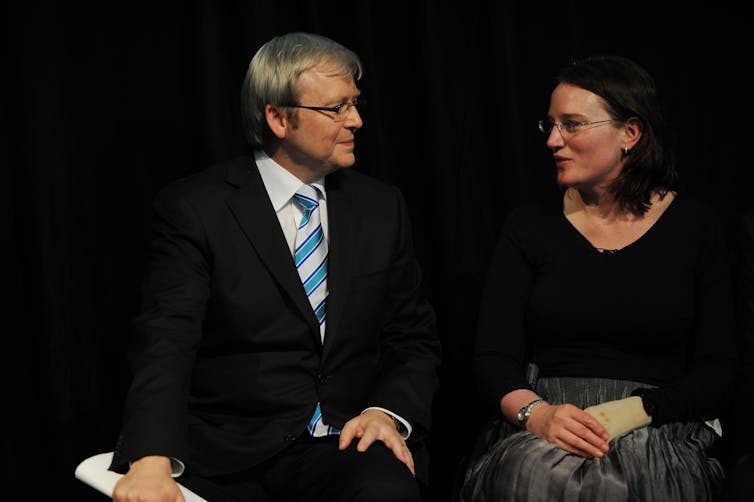
Cynthia Banham with Kevin Rudd in 2008. Banham’s memoir explores both the trauma she experienced during a plane crash in 2007 and her family’s history.
Dean Lewins/AAP

Tess Scholfield-Peters, University of Technology Sydney

Why do we tell stories, and how are they crafted? In a new series, we unpick the work of the writer on both page and screen.


Former Fairfax journalist and lawyer Cynthia Banham voices the silenced pain of generations in A Certain Light, her evocative, hybrid work of docu-memoir.

In an effort to process the trauma she experienced while on assignment more than ten years ago – a plane crash over Indonesia claimed both her legs and left 60% of her body covered in full thickness burns – Banham locates her own experience within her wider family’s narrative.

Banham’s memoir was released in 2018. Her story was once again in the news earlier this year, when Eddie McGuire mocked her pre-match coin toss at an AFL game (McGuire later apologised and said his comments were not about Banham).

In the book, Banham confronts the impact of the accident on her identity, and the ways in which her own resilience can be traced backwards through her heritage. She writes of her family: “We were shaped by each other’s trauma, just like we were shaped by each other’s love.”

Her voice shifts between the investigative (she incorporates historiography, images, documents, footnotes and parentheses) and the insightful and emotional first person. Yet her journalistic attention to detail is constant. Woven together, these voices comprise her fragmentary memoir, an arduous journey into the past and ultimately, resolution.


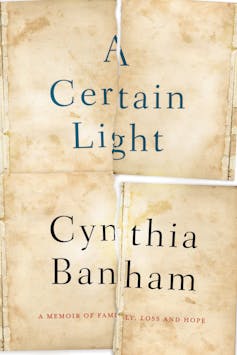
Allen & Unwin

Banham says A Certain Light is written for her young son, so he will one day know about his family’s history. The book begins with an epistolary prologue that speaks directly to him, predominantly through first person but sometimes in second.

We are invited by Banham into the intensely personal space of the text. She reveals to us her maternal indecision – the desire for her son to know, yet be shielded from, her trauma’s painful excesses.

Banham writes: “Will you, my son, grow up with memories of your mother’s suffering, feeling that you are somehow my compensation?” The first of many rhetorical questions throughout the text reminds us of her vulnerability, and the fraught task of communicating trauma through generations.

Connected narratives

Banham’s painful telling of her rehabilitation after the crash is threaded through other, broader stories of the past, an act of deflection perhaps signifying the difficulty endured in writing about the crash itself.

She retraces the trauma narratives of her grandfather, Alfredo; Alfredo’s sister, Amelia; and Banham’s mother, Loredana. She collects memories from family members across Europe, and artefacts and documents she has chosen to incorporate into the text, reflective of her own pieced-together family narrative.

The images are haunting at times and lend an immense gravity to Banham’s storytelling. Connecting stories of suffering to a face or a real artefact allows the reader to explore her own empathic ties with the story.

Banham finds a connection between the experiences of these relatives and her own. While her grandfather’s plight as an Italian prisoner of war in Nazi Germany is of course different to her own experience, Banham draws effective comparisons.

For example, she likens her thirst immediately after the plane crash as she waited, unable to move, in a foreign hospital hallway, to the excruciating thirst felt by victims of war.

In her research she encounters an image of German soldiers who had lost their legs. “War wounds”, she writes, “how did I end up with war wounds?” These comparisons show a lingering resonance of war in her mind, of the shared, transcendental suffering that connects generations.

Through her mother’s story as an Italian immigrant to Australia during the 1950s, Banham connects to a deep feeling of shame – the shame of difference, of abnormality. Shame was so innate that her mother was reluctant to let the surgeons amputate Banham’s legs in life-saving surgery, for fear of what her daughter’s life might be like without a “normal” body.

Banham leans painfully into her trauma in the final chapter of the book, titled Crashing. She revisits the site of the plane crash, and the days immediately before and after – the most distressing moments.

Cynthia Banham is evacuated from Sardjito hospital, in Yogyakarta, Wednesday, 07 March 2007.
Weda/EPA

Tension builds as she recalls a handful of details: the description of her hotel room; the clothes she chose to wear that morning (might her life be different now if she had worn pants instead of a skirt?); the trivial pre-flight conversation she had with fellow journalists about Indonesia’s air crash record.

The actual recount of the crash is surreal. Banham writes: “Shit, I was thinking. Is this really happening? Then: Oh God.” On the next page: “Shit, actually, this could be it, this could be the end, maybe this is how I am going to die.”

The terror Banham experienced in those moments is beyond comprehension, and yet the incredibly human, common thoughts of panic incite an immense sense of empathy in the reader. It reminds us this could happen to anyone.

This is Banham’s second book – her first, Liberal Democracies and the Torture of Their Citizens, was derived from her PhD undertaken at the Australian National University several years after her accident.

A Certain Light reconciles the woman she was before the plane crash with the woman who writes this text. Banham explores the fragility of memory and the shared longing to know the stories of family members who can no longer speak, or perhaps do not want to.

“Memory is fluid, malleable, untrustworthy”, Banham writes, yet ultimately it’s memory that has created her narrative, her identity reclaimed from trauma. A Certain Light is a reminder that despite even the greatest tragedy, time moves on and there is light in the darkness – if we choose to see it.The Conversation

Tess Scholfield-Peters, PhD candidate in Creative Arts, University of Technology Sydney

This article is republished from The Conversation under a Creative Commons license. Read the original article.
Unknown's avatar

Judith Kerr: read her autobiographies to understand The Tiger Who Came to Tea


Judith Kerr, author of the Tiger Who Came to Tea, at the International Literature Festival Berlin in 2016.
Christoph Rieger, CC BY-SA

Eleanor Byrne, Manchester Metropolitan University

Judith Kerr’s death at the age of 95 was met with an avalanche of tributes from readers, writers and publishers alike. Her illustrated books such as the Mog series and her first book, The Tiger Who Came to Tea (1968) have endured as children’s classics, with illustrations that bear witness to the domestic spaces of the 1960s suburban British home, carrying a focus on children and their pets and the security of a loving family life. The loving depiction of a safe and stable childhood that Kerr created in her books for stands in sharp contrast to her experience of childhood as one involving a sudden cataclysmic destruction of the life she knew in Berlin under the Nazis.

This history speaks to her place in the children’s literary canon as one of its most loved writers but also part of a transnational group of writers who bore witness to the Holocaust and contributed to a distinctive and significant migrant vision and storying of London and Britain.

Both Kerr and her brother made their homes in Britain and all her family took British citizenship after the end of the war. Her London settings can seem quintessentially British, offering an intimate portrait of 1960s London. But her own childhood was marked by constant movement and upheaval, as well as a need to learn new languages, fleeing Germany for Switzerland, France and finally England, where her family lived in impoverished conditions for a number of years in cheap London hotels, often relying on the kindness of friends and connections to survive from week to week.

Her books describing these years show she was conscious of being an outsider —- a “clever refugee girl” as the fellow pupils in her school dismissively referred to her. Visibly different, she was poorly dressed in hand-me-down clothes from the two daughters of a London friend. She sometimes “passed” as English because of her command of the language, but left school at 16 out of desperation to earn money to help her parents survive in London lodgings.

Security destroyed

Kerr’s trilogy of less well-known largely autobiographical books about this period sheds light on her illustrated work in perhaps unexpected ways and are testimony to survival after an experience of the almost total destruction of her own security and stability.

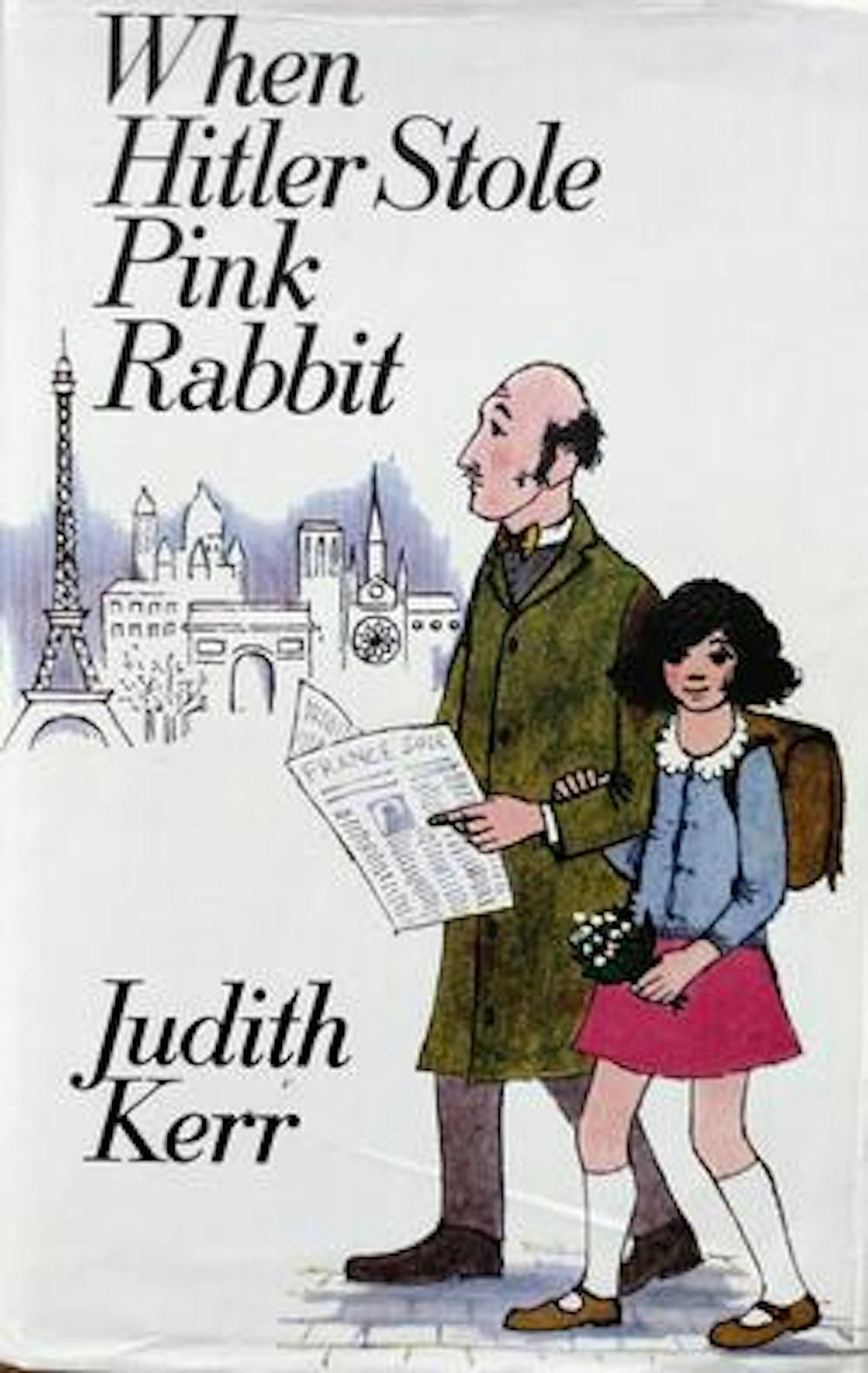
When Hitler Stole Pink Rabbit: first edition cover.
Wikipedia

Collectively called Out of the Hitler Time, When Hitler Stole Pink Rabbit (1971), Bombs on Auntie Dainty (1975) and A Small Person Far Away (1978), the trilogy loosely followed her own experiences as a Jewish refugee from Nazi Germany. Her father, Alfred Kerr, a well-established and respected German-Jewish theatre critic was a vocal opponent of the Nazis (his books were burned by them after he fled Germany in 1933).

The first and most well-known is a memoir of leaving Germany and living in exile in Switzerland and France, told through her eyes as a nine-year-old child. The second speaks to her earliest experiences of living in England. It tells of her family’s move to London to escape German advances into France, depicting life among the international refugee population of the hotels in Bloomsbury, with her parents in severely reduced circumstances and her father struggling to cope in a foreign language or to find paid writing jobs. It also recounts her experience of the Blitz and of her brother’s sudden internment on the Isle of Man, as an enemy alien, two weeks before he was set to take his finals at Cambridge University. The last portrays her return to Berlin as an adult, now married to an English scriptwriter, to visit her sick mother after her father’s death.

A much loved children’s classic: The Tiger Who Came to Tea.
Wikipedia

Literary critics have offered readings of The Tiger Who Came to Tea, reflecting on the tensions between pleasure and fear surrounding the arrival of a tiger with unlimited appetite into the protagonist Sophie’s home. Louise Sylvester offered a reading of the book juxtaposed with extracts from When Hitler Stole Pink Rabbit, in order to construct an argument about how the story might reflect the radical instability of Jewish households during WWII.

Tim Beasley-Murray read the book as a space of carnival, but one which is resolved when it appears to threaten the continuation of normal life, once the father returns from work. Beasley-Murray argued, however, that the father is an ambiguous figure of safety who never meets the tiger but instead resolves the situation by taking the family out for dinner.

Alongside Kerr’s second book in her trilogy another reading might emerge. Her father was truly the centre of their lives in Berlin in the 1930s, his life in London was as series of hard reversals, speaking poor English and finding little written work as a journalist or novelist he underwent a catastrophic collapse of fortunes. And while he was briefly rehabilitated in Germany after the war he died soon afterwards.

This contradictory status of her father is painfully witnessed by Kerr as she comes to grasp the great respect he is held in by the German Jewish émigré community and the frustrating powerlessness of the position he finds himself in. When Kerr narrates going to visit her parents from free lodging she has been given, to their hotel room in central London where evening meals are included in the price paid for the room, her mother argues with the waitress that she should not have to pay for her daughter’s meal as she missed her own the previous day due to illness.

The pain and precarity of the scene are keenly felt. During the war years in London the family had no private home, no kitchen and no food supplies apart from those that were served in the hotel restaurant. Kerr lived apart from her parents when they could no longer afford two rooms, and they all relied on charity and the goodwill of friends. Like the tiger, the war swallowed up not just all the food in the house and the water in the taps but the kitchen itself, the table, the chairs, the bathroom and the parenting that might have taken place in all those domestic spaces. The family did eat in a restaurant every night as lodgers in a hotel because they had no home of their own.

Kerr’s illustrated books were written for her own children and featured thinly disguised family members and pets, but her autobiographical trilogy was also written with her children in mind to try to portray how different her childhood had been to theirs. Reading them together is to bear witness to her immense artistic achievements and to her important accounts of the German-Jewish refugee experience in Britain.The Conversation

Eleanor Byrne, Senior Lecturer in English, Manchester Metropolitan University

This article is republished from The Conversation under a Creative Commons license. Read the original article.

Unknown's avatar

Celestial Bodies: Booker International Prize highlights rich literary tradition among Arab women


Shadya Radhi, King’s College London

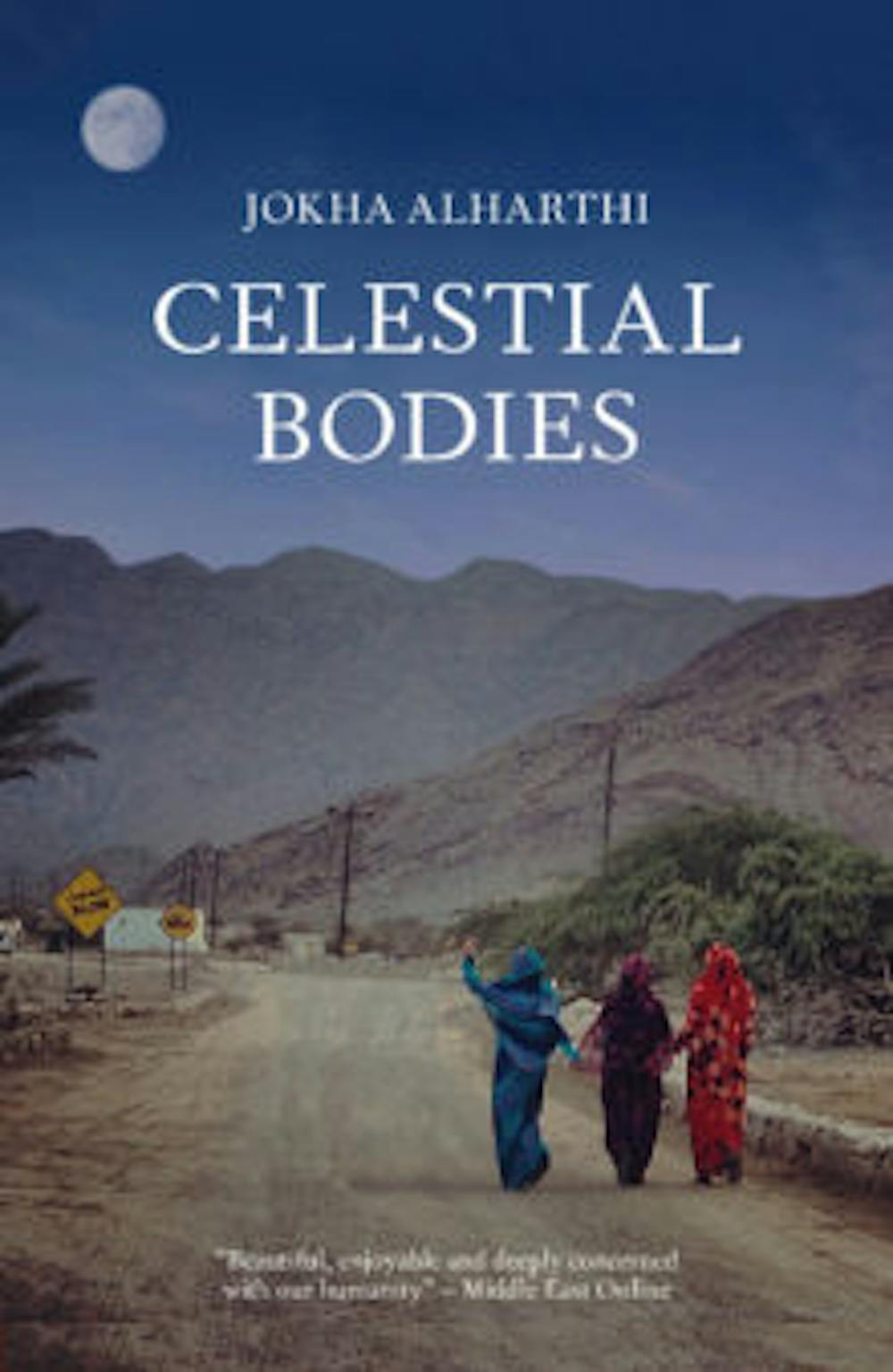
It says something that the winner of the 2019 Man Booker International prize for Literature, Jokha Alharthi, is the first woman from her country to have a novel translated into English. Alharthi – from the Arabian Gulf state of Oman – who won for her novel Celestial Bodies, shares the £50,000 prize with her translator Marilyn Booth. The book has the distinction of also being the first novel translated from Arabic to win the award.

“I am thrilled that a window has been opened to the rich Arabic culture,” Alharthi told journalists after the ceremony in London in May. “Oman inspired me but I think international readers can relate to the human values in the book – freedom and love.”

Celestial Bodies revolves around three sisters from a middle-class background in the small Omani village of al-Awafi. The novel is a fragmented collection of past and present events in Oman as they pertain to particular characters in this small village. These intricate storylines come together to shape the broader narrative of the novel, of a village going through remarkable change.

Celestial Bodies gives the reader a glimpse into a society that isn’t often spoken about in terms of its literature, culture and traditions. And a woman’s perspective is particularly rare – Arab Gulf women only really began publishing their writings in the second half of the 20th century. It’s a trend that is intimately connected to the introduction of girls’ education – spanning half a century between 1928 and 1970 in different Gulf states.

But this doesn’t mean that Arab Gulf women weren’t producing literature before then – they were particularly well known for the tradition of oral storytelling and were especially esteemed for their poetry – the works of Kuwaiti poet Suad al-Sabah and Bahraini poet Hamda Khamis are particularly worth checking out.

But it was the explosion of oil wealth, which forced the Arabian Gulf out of isolation and into the international arena – leading to the establishment of schools and newspapers and media outlets that allowed for literary creativity. Since the 1970s, Arab Gulf women’s writing has evolved – now Arab Gulf women write in a whole range of genres that reflect different themes and issues through their storylines, especially those issues which pertain to the specific experience of women in Arab Gulf society. But the novel is still something of a recent genre for Gulf women.

Modernity and nostalgia

One common theme in Arab Gulf writings is nostalgia for a simpler past, which is often used in contrast to the remarkably fast growth these countries have undergone with the discovery of oil. The narrative of Celestial Bodies draws a connection between the slave trade in Oman – the backdrop of the story – with the way Omani society started to change with the introduction of oil wealth into the region.

Although Alharthi positions her story within this narrative of tradition versus social change, she does so in a way that offers an objective outlook to the practices and history portrayed in the novel. She does this by portraying neither a romanticising of the past nor an overly optimistic focus on the positive aspects of oil revenue in the present. Instead, Celestial Bodies presents an honest portrayal of change and how it has affected different members of the village she is writing about.

The first novel by an Omani woman to be translated into English.
Sandstone Press

A defining feature of Omani literature is that Oman, in particular out of the Arab Gulf, has remained a traditional society in many aspects, which is oftentimes reflected in the writings produced in the region. The novel makes use of specific cultural and religious features of Oman and the Arab Gulf region, such as references to supernatural spirits – or jinn – as well as the all-important date harvest – as well as allusions to classical Middle Eastern literature and poetry such as Iraqi poets al-Mutanabbi (915-965AD) and Ibn al-Rumi (836-396AD).

You don’t need to be intimately familiar with Arab Gulf customs, literature and traditions to appreciate Celestial Bodies – but to fully grasp the impact of these references and the beauty they add to the text, it’s worth doing some background reading. This literary technique invites the reader to become immersed into Omani culture – and, in turn, play a role in the interpretation of the text itself.

Rich literary tradition

Celestial Bodies is emblematic of the fact that Arab Gulf women are actively producing remarkable works of literature that are very much worth exploring. Worthwhile, not only to offer a glimpse into this society, but also in order to discover a rich literary tradition that has not been accessible to a wider audience beforehand.

In an interview published on the Man Booker International Prize website Alharthi says this about her book:

I hope this helps international readers discover that Oman has an active and talented writing community who live and work for their art … They take on sacrifices and struggles and find joy in writing, or in art, much the same way as anywhere else. This is something the whole world has in common.

Alharthi’s novel offers a glimpse of the world being experienced by women in the Arabian Gulf. I hope that Celestial Bodies will encourage more translations of works from the region, encouraging readers to experience for themselves the cultural riches on offer.The Conversation

Shadya Radhi, PhD Researcher, King’s College London

This article is republished from The Conversation under a Creative Commons license. Read the original article.
Unknown's avatar

Inside the story: Leigh Sales, ordinary days and crafting empathy ‘between the lines’


Sue Joseph, University of Technology Sydney

Why do we tell stories, and how are they crafted? In a new series, we unpick the work of the writer on both page and screen.


Decades ago, American journalist and screenwriter Dan Wakefield published Between the Lines: A reporter’s personal journey through public events. In terms of reflection and consideration, Wakefield was years ahead of his time. He writes of the “shadows that lurk behind the printed word … We journalists are trained by the custom and conventions of our craft to remain out of sight, pretending not to be there but simply to know”.

He then returns to many of his own pieces of journalism, and fills in the gaps – what he was feeling, seeing, doing, behind the scenes. What actually happened, as opposed to what was reported. This does not take away from the integrity of the original report but bolsters it in terms of completeness; they are now deeper, richer stories. Possibly “truer”.


Penguin Random House

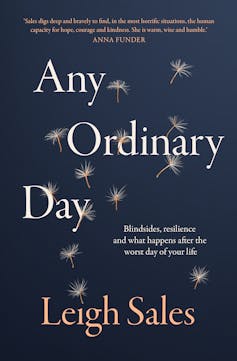
Leigh Sales does this “between the lines” of the individual narratives in her latest (and third) book Any Ordinary Day: Blindsides, resilience and what happens after the worst day of your life.

Sales recounts the stories of seven ordinary Australians whose lives, in a heartbeat, became extraordinary and visible through traumatic incident; Stuart Diver, Louisa Hope, Walter Mikac, Hannah Richell, Michael Spence, James Scott and Juliet Darling.

What makes this book so valuable is that she interweaves discussion of some of her more dubious decision-making processes as a journalist, recognising the depth of her questionable actions. This is courageous writing, particularly from such a high profile professional.

But rather than framing Sales as untrustworthy, her self-effacement pertaining to ethical breaches helps us to see how decisions are made in the field, in the heat of reporting. How mistakes are made, in the name of getting the “story”. She writes shamefully of some of these decisions, but not necessarily regretfully; all were made as part of her own learning curve, manifesting as the skilled anchor we turn to nightly on our screens.


Read more:
Journalism needs to practice transparency in a different way to rebuild credibility


Stuart Diver, survivor of the Thredbo landslide, one of the Australians whose stories are explored in Sales’s book.
David Moir/AAP

The power of disclosure

Sales’s book performs as part memoir/part trauma narrative/s/part investigation/part meta; and it is on page 99 that she begins her craft mea culpa. She writes:

When I look back at the mistakes I’ve made as a reporter including experiences that to this day make me feel ashamed, I can see that they were usually due to a failure of empathy […]

Authentic empathic journalistic disclosure is a means to garner more public trust, potentially portraying journalists as robust yet feeling professionals; as mortals with flaws; as fallible, but with a genuine belief in the integrity of their mission – informing the people, for the people.

Shining from the pages of Sales’ text is a self-effacing honesty, rarely accessed, around this type of journalistic thinking, craft and process. Included is not just a discussion of empathy, but demonstration of embodied empathic, on-the-ground interviewing.

The text is framed by trauma. Sales begins this hybrid narrative with her own: the breath-taking story of her near-death experience in 2014, during the emergency delivery of her second child; not only her near-death, but that of her tiny son, as well; and with his survival, the lingering probability of brain damage.

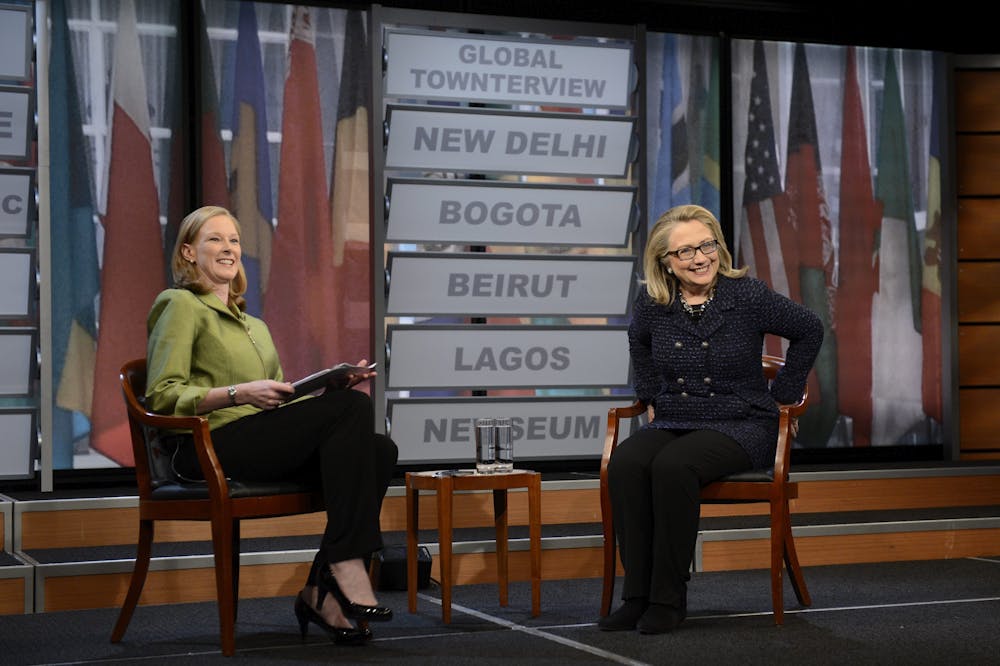
Leigh Sales moderates a town-hall with Hillary Clinton in 2013.
Michael Reynolds/AAP

She then launches into well-formed and intimate discussions with the seven people whose stories form the basis of the book. This is Sales’ attempt at dealing with her own brush with death; a gathering of tales about resilience, fears and vulnerability.

The dominant craft on display here is her interviewing skills, and her ability to elicit authentic responses from her subjects. She writes:

I know how to craft a good line of questioning that helps [people] open up. I’m a strong listener and I follow up what people are saying.

These are the two most essential techniques a young journalist or writer can acquire – crafting the right questions and listening – and it takes practise and time to develop and evolve.

Intimate narration

What Sales also does supremely well is narrate – intimately and closely, as if she is whispering in your ear. She begins the text with second person point of view (you), unusual from a journalist and difficult to sustain.

But she gets away with it as it helps convey her main theme – ordinary days turning extraordinary in a heartbeat – and she places us in her metaphoric shoes. She switches to singular third person narration (he); then to plural first person (we), before launching into her first person voice. This technique only works when it is apt – and it is apt here.

Sales narrates her book intimately and closely.
Daniel Boud

Her research into the neuroscience around trauma is in depth but accessible; and her quest to discover more about growth following traumatic pain is insightful and (dare I write without sounding mawkish) hopeful.

“What we see about shocking blindsides doesn’t tell us anything remotely like the whole story,” she writes. “Being struck by something awful is not the end of every good part of life”. For everyone, this is knowledge worth having.

The final chapter bookends the text with more of Sales’ own story – the breakdown of her marriage (succinctly and unsentimentally narrated) and an undiagnosed illness of her eldest son (we also learn that her youngest son has shown no sign of damage from his birth ordeal).

Teaching empathy

Sales tells us of callow mistakes made starting out as a journalist. It is with this hindsight and insight – a glimpse behind the maturing practice – where we sense both her ambition and elation for her assignments. Some she executes well, sometimes fluking it; in undertaking others, she clearly believes she made unethical choices.

But she does not lend herself the freedom of simply hiding behind youth, as she writes: “ … sadly, I can identify similar mistakes when I was a senior reporter”. It is in the candid telling of these fraught back stories that the humanity of Sales is made whole.

Not just the resolute grip of the interviewer on 7.30; nor fellow journalist Annabel Crabb’s best friend – clever, funny, playful – on their podcast Chat 10 Looks 3. But the woman, in love with story and storytelling, growing into her profession.

It is easy to write that empathy must be taught to our young journalists and writers; that it may be the key to subverting the disparaging distrust the public embraces towards industry.

But how to “teach” empathy? It has to be a discussion framed by ethics – the almighty notion of swapping shoes and walking in them. Stopping in the field, just stopping for a moment, and thinking about the person or story you are pursuing. Feeling what it must feel like to be them.


Read more:
Do art and literature cultivate empathy?


Now we have an idiosyncratically Australian text, written by one of the most respected Australian journalists, to teach with; one that expounds honesty about poor ethical choices, and evidence of embodied empathic interviewing. Sales’ deep enmeshing with her interviewees does not undermine the rigour of her interrogation – she still asks the hard questions and mines deeply – and the interviewees always answer, with grace.

We hear and read the back and forth of the interview with her subjects; her reflections and asides set out in print. Would she be asking these questions in this way, if she had not suffered her own cataclysmic trauma with the birth of her second son? Perhaps – I think she was getting there.

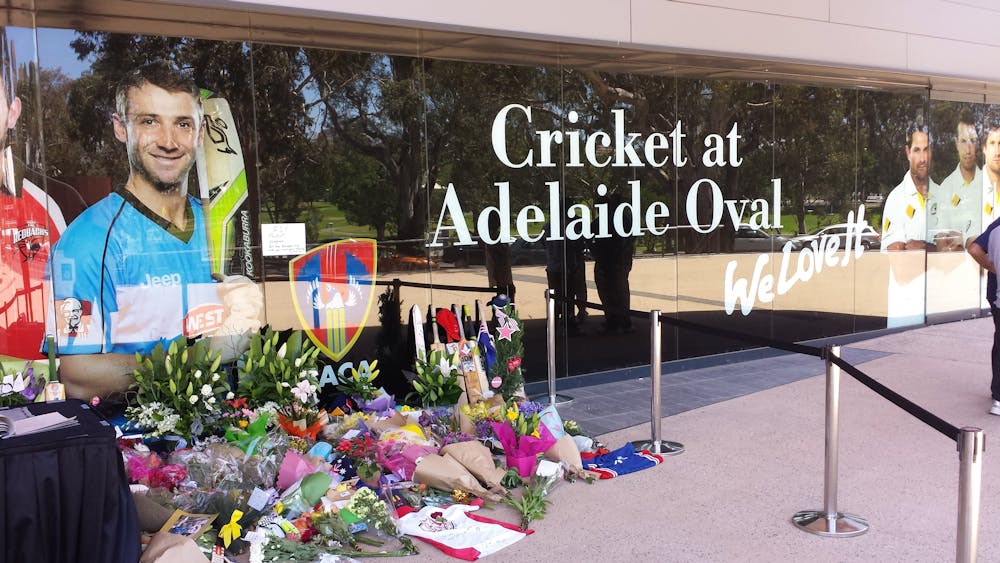
Tributes for cricketer Phillip Hughes at the Adelaide Oval in November 2014. His death was one of the traumatic stories Sales covered in that year.
Robert Forsaith/AAP

Sales writes of the end of that year, 2014, and broadcasting the coverage of two incidents that vibrated throughout the nation, binding us collectively in their thrall: the public death of cricketer Phillip Hughes and the Lindt Cafe siege in Sydney.

It was all getting a little too much, on the back of her son’s traumatic birth. There was just too much palpable pain adrift, and she no longer felt safe. So she imagined this book, and by using the tools of her trade, she interviewed and wrote until it was done.

Perhaps it is journalistic therapy – conceptually, it definitely began that way, Sales admits. She was looking to write her way out of aggregated pain and sorrow. But I believe the denouement of this text is her greatest gift – the demonstration of empathy not as antithesis to good story re-telling, but as integral.The Conversation

Sue Joseph, Senior Lecturer, Writing and Journalism, FASS, University of Technology Sydney

This article is republished from The Conversation under a Creative Commons license. Read the original article.
Unknown's avatar

David Gillespie’s ‘Teen Brain’: a valid argument let down by selective science and over-the-top claims


File 20190430 194637 1fxpz67.jpg?ixlib=rb 1.1
David Gillespie’s new book is full of exaggerated claims that are often not backed up by science.
from shutterstock.com

Sarah Loughran, University of Wollongong

Screen time has arguably become the most concerning aspect of development for modern-day parents. A 2015 poll identified children’s excessive screen time as the number one concern for parents, overtaking more traditional concerns such as obesity and not getting enough physical activity.

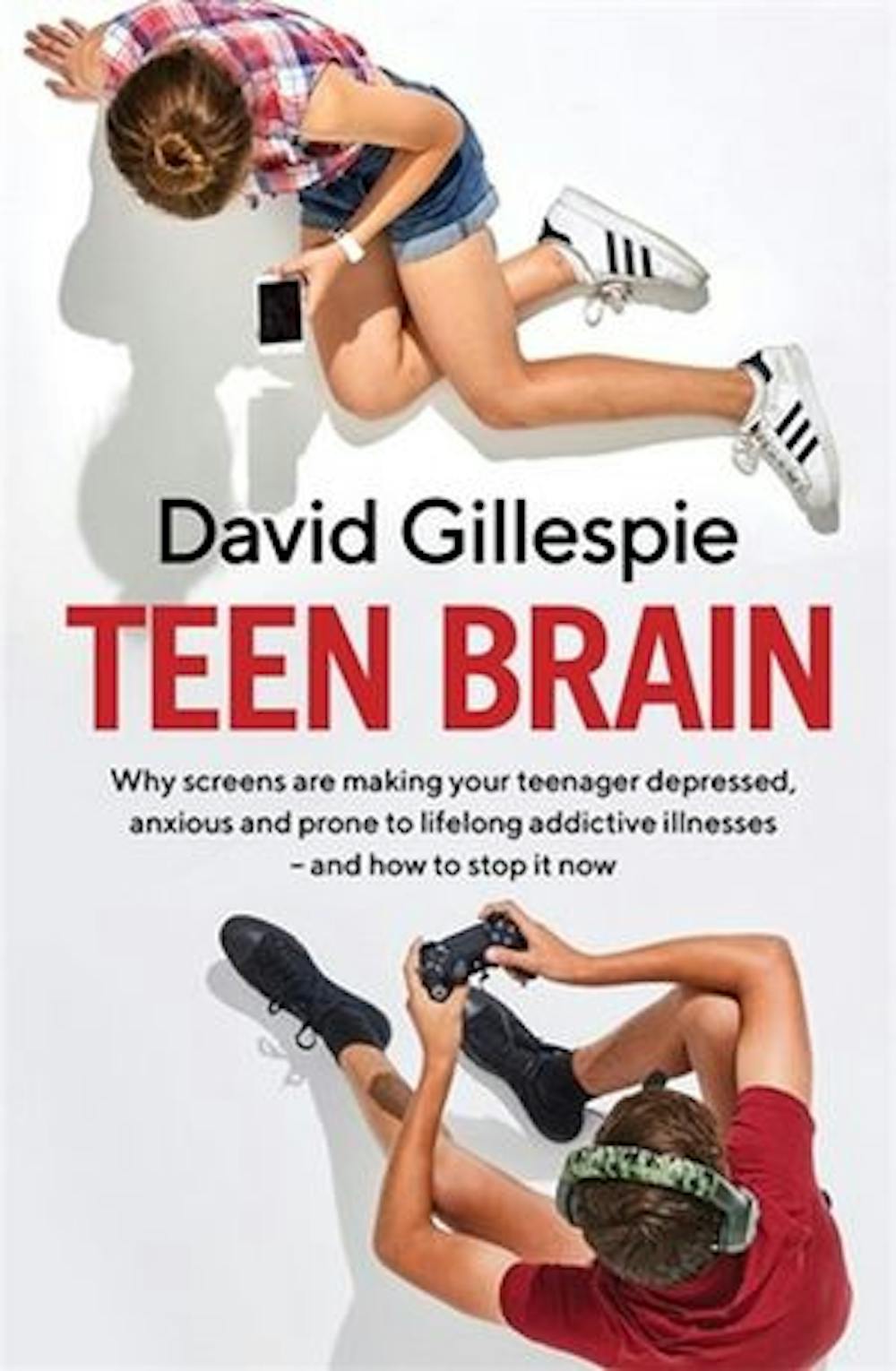
This is the issue explored in David Gillespie’s new book, Teen Brain. The tagline explains that the book delves into

why screens are making your teenager depressed, anxious, and prone to lifelong addictive illnesses – and how to stop it now.

This provides some idea of the emotive and provocative way the book’s content is delivered.

Given smartphones and tablets are everywhere, a message on limiting their use could not be more timely. The Australian government recently released guidelines recommending a maximum two hours per day of recreational sedentary screen time for teens.

It also recommended parents establish consistent boundaries around the duration, content and quality of such screen use.


Read more:
Eight things that should be included in screen guidelines for students


However, Gillespie has missed an important opportunity to communicate this with his book. In the introduction Gillespie says he’s “made some pretty outrageous claims” but they will all be backed up by solid science. He delivers on the first part, but too often the solid science is lacking.

Gillespie misses a good opportunity to talk about the effects of screen time.
Pan Macmillan

Dodgy science

After what can only be described as a controversial introduction – in which puberty is referred to as a period when all “males turn into large, hairy, smelly beasts with no impulse control and a desire for danger and sex” – Gillespie attempts to explain some basics of the workings of the human brain.

But this explanation is simplified and selective, which is problematic because it is then used as a basis for many of the arguments throughout the book. And the brain, and associated human behaviour, is far more complex than Gillespie’s seeming understanding.

The second section largely focuses on teen issues intertwined with parenting tips, with reference back to the brain basics. This information is aimed at managing, and ultimately avoiding, negative outcomes in teens – such as risk-taking behaviours, addiction and adverse mental-health issues.

According to Gillespie, such consequences are largely attributable to screen-based electronic devices.

This section contains statements that aren’t referenced at all, such as:

the stimulant effect of caffeine is identical to the stimulant effect of the dopamine-stimulating apps installed on your child’s device

Those that are – such as those under the heading “Teen depression and anxiety are on the rise” – often have selective references that fit the author’s narrative rather than reflecting the current state of the science.

In regards to anxiety, the book only presented parts of the research paper that it noted suggested anxiety had alarmingly tripled between 2003 and 2011. What had tripled were the presentations of anxiety symptoms. The overall diagnosis of anxiety actually remained stable.

The paper’s authors themselves state that what the results mean remains unclear. They could reflect a genuine increase in anxiety, but could also be attributed to an increased awareness by GPs or increased help-seeking behaviour of teens.

Then there are statements that are actually just plain wrong. For instance, Gillespie suggests

something else must lie at the heart of the epidemic of teen anxiety and depression, and there’s good evidence that this something is being home-delivered by the modern equivalent of a textbook – the tablet device.

Not surprisingly, this so-called “good evidence” is not provided.

In several places throughout the book, Gillespie links smartphones and electronic devices with dramatic decreases in teen pregnancy, alcohol consumption, illicit drugs and violent crime.

Gillespie writes that smartphones are responsible for the decline in teen pregnancies.
from shutterstock.com

While it’s true there have been declines in teen pregnancy, substance use, and crime, this is not necessarily true for all countries.

For example, a recent study showed although substance use, unprotected sex, crime, and hazardous driving were reducing in US adolescents, the same trends did not apply consistently across other developed countries.

And although the study noted smartphones and social media were one possibility behind these declines, the way in which they might do this, and if in fact they actually do, is yet to be investigated.


Read more:
Australian teens doing well, but some still at high risk of suicide and self-harm


Declines in risk-taking and addictive behaviours in teens can only be seen as a good thing, but Gillespie manages to use this to fit his narrative. That is, that smartphones and electronic devices are indeed responsible for these positive changes, but at a cost.

That cost is that the use of such devices is replacing these teen problems with a whole set of new ones: dramatic increases in teen anxiety, depression, self-harm and suicide. But again, this is done with the use of misleading, or completely absent, evidence.

Teenagers aren’t all the same

Gillespie presents a one-size-fits-all kind of approach throughout his book, which is also problematic, because not all teenagers are the same. There are large differences among individuals and how they are able to manage things such as anxiety, drug or alcohol use.

Genetics, as well as our environment, influence our behaviour. So what may work for one teenager, may not necessarily work for another.

The book places a large emphasis on the role hormones play in our reward pathways and addiction. One example is oxytocin. Gillespie says that “teenagers are uniquely susceptible to the power of oxytocin” and that “adolescence is a phase when the addictive power of oxytocin is magnified enormously”.

But there are substantial differences in oxytocin levels between individuals, and how each person’s system reacts to these, which the book completely ignores.


Read more:
How childhood trauma changes our hormones, and thus our mental health, into adulthood


The book culminates with five key points for how parents should “harden up to save their kids”. These include parents making the rules, and breaches of the rules being punished consistently.

Gillespie also advises that “all teens need eight hours’ sleep a night”. This recommendation falls outside the amount of sleep those under 14 years old need (9-11 hours for 5-13 year olds), and only represents the bare minimum recommended for those 14 years and older (8-11 hours for those aged 14-17).

The real shame overall is that the key message, that we should limit our teens’ screen time, is actually a good one. Although research remains scarce, there are some initial reports suggesting excessive screen use may have an impact on teens’ well-being, particularly sleep, anxiety and depression.

But Gillespie has reported it all in a way that is grossly over the top and overstated, and at times incorrect or just plain offensive.

This kind of communication only serves to perpetuate fear and create anxiety – the exact things that the author claims his book will fix.The Conversation

Sarah Loughran, Research Fellow, University of Wollongong

This article is republished from The Conversation under a Creative Commons license. Read the original article.

Unknown's avatar

Guide to the classics: Orwell’s 1984 and how it helps us understand tyrannical power today


File 20190326 36256 lkfv0v.jpg?ixlib=rb 1.1
Written as the Cold War became entrenched, 1984 was meant as a warning on the nature of state power. Understanding this power is even more important today.
Shutterstock

Robert Hassan, University of Melbourne

It was a bright cold day in April, and the clocks were striking thirteen. Winston Smith, his chin nuzzled into his breast in an effort to escape the vile wind, slipped quickly through the glass doors of Victory Mansions, though not quickly enough to prevent a swirl of gritty dust from entering along with him.

As novel-openers go, they don’t come much better than this one in George Orwell’s Nineteen Eighty-Four. See how the unexpected “striking thirteen” runs powerfully into the beginnings of characterisation and world-building in just two arresting sentences.

Orwell knew that words could both grip the attention and change the mind. He wrote the book as the Cold War was becoming entrenched, and it was meant as an explicit warning on the nature of state power at that time.

The book still sells by the thousands, and is read by students who are compelled to do so. But it can be read voluntarily and profitably, and it can tell us a lot about contemporary politics and power, from Donald Trump to Facebook.

A world of ‘doublespeak’

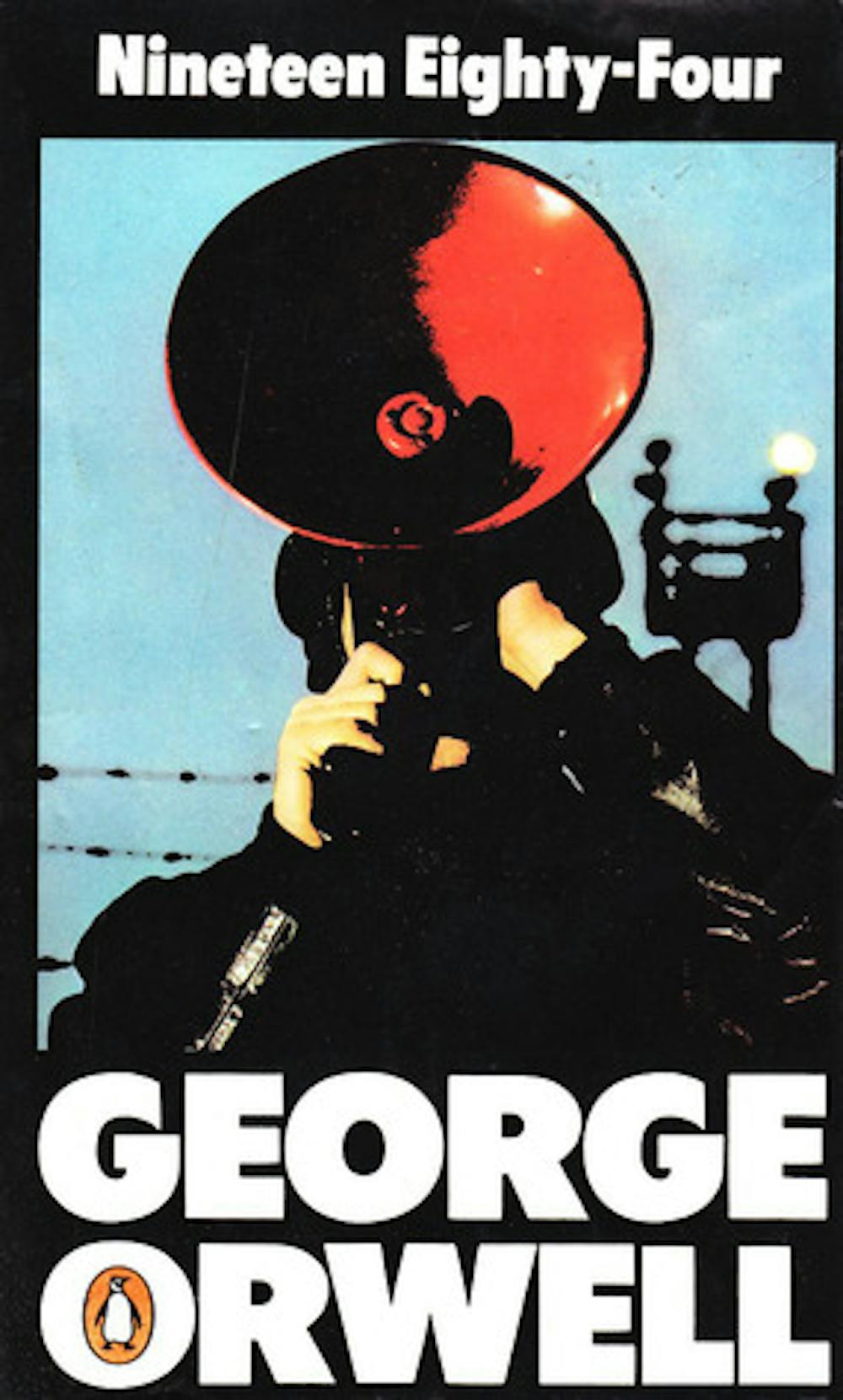
George Orwell’s Nineteen Eighty-Four.
Goodreads

Nineteen Eighty-Four became an instant classic when published in 1949. People could see in it a world that could easily become a reality. The memory of Nazi dictatorship was still fresh, the Soviet Union had erected the Iron Curtain, and the USA had the atomic bomb.

The novel’s setting is a dystopian Britain, which has become a part of Oceania, a region in perpetual war with the other super-regions of Eurasia and Eastasia. Oppression, surveillance and control are facts of life in a society ruled by the Party and its four Ministries of Truth, Peace, Plenty and Love.

It is a world of “doublespeak” where things are the opposite of what they appear; there is no truth, only lies – only war and only privation.


Read more:
What does ‘Orwellian’ mean, anyway?


One of Orwell’s innovations is to introduce us to a new political lexicon, a “Newspeak” where he shows how words can be used and abused as a form of power. Words like “Thoughtcrime”, where it is illegal to have thoughts that are in opposition to the Party; or “unperson”, meaning someone who has been executed by the Party (e.g. for Thoughtcrime) will have all record of his or her existence erased.

Not only do we use many of these words today, but the manipulative function that Orwell described is still intact. For example, when Kellyanne Conway, advisor to US president Donald Trump, stated in 2017 that the Administration has its own “alternative facts”, she was indulging in “doublethink”: an attempted psychological control of reality through words.

Nineteen Eighty-Four became an Amazon bestseller following the election of Trump and the airing of this interview.

Kellyanne Conway explains the Trump adminstration’s ‘alternative facts’.

Within the corridors of Orwell’s Ministry of Truth, though, there’s a tiny flickering of real love that develops between protagonist Winston and co-worker Julia. They share unlawful thoughts about other possible ways of living and thinking, based upon vague and unreliable memories of a time before world wars and Big Brother and the Party.

But through its immense powers of surveillance and the efforts of the Thought Police, Big Brother knows everything, and soon the lovers are suspects. Winston is arrested and brought before O’Brien, the novel’s antagonist and a Party heavyweight who is openly cynical about the power structure of society. For him power is a zero-sum equation: if you don’t use it to keep others down, they will use it similarly against you.

There is much drama, suspense and even horror in Orwell’s book. He wrote about what he saw around him, but filtered it with an acute sensitivity to the innate fragility of civilisation. In 1943, when the plot-lines of Nineteen Eighty-Four were probably gestating in his head, Orwell wrote:

Either power politics must yield to common decency, or the world must go spiralling down into a nightmare into which we can already catch some dim glimpses.

1984 goes digital

These days, a lot of power politics circulates online. Orwell, who worked for the BBC during the war, was sensitive to the power of communications. What he calls the “telescreen” is essentially a surveillance device that “received and transmitted simultaneously”.

He writes of the device that “any sound that Winston made, above the level of a very low whisper, would be picked up by it; moreover […] he could be seen as well as heard”. Remind you of anything? Alexa or Siri and their ilk may be fads, but the technology now exists; and so then does a new kind of power.

Such power is contingent and shifting and does not always reside with governments.

Donald Trump wields a new digital power through Twitter and Facebook and can “speak to his base” whenever he’s angry, bored or overcome by impulse. But through ownership of new digital technologies, new actors – data corporations – have acquired old powers. These are the powers to manipulate, surveil, and influence millions of people through access to their data.

And their power in turn can be leeched by hackers, state-sponsored or independent. The complexity of political power today means we need to be more attuned to its changing forms, to more effectively strategise and resist.

Orwell’s “common decency” reference may now sound rather quaint. But its very absence in social media is a problem.

The algorithms that Twitter, Facebook and Google insert into our communications act essentially as “manipulation engines” that can cause division, favour extreme views, and set groups of people against each other.

Divide-and-rule is not their intention – getting you online in order to sell your data to advertisers is – but that is the effect, and democratic politics is the worse for it.


Read more:
How political engagement on social media can drive people to extremes


Understanding the nature of political power is even more important today than when Orwell wrote. Oppression and manipulation were “simpler” and more brutal then; today, social control and its sources are more opaque.

George Orwell in 1943.
Wikimedia Commons

Orwell’s imperishable value as a writer is that he provides a template on the character of political power that tells us that we cannot be complacent, cannot leave it to government to fix, and cannot leave it to fate and hope for the best.

Things did not turn out so well for Winston Smith. Pushed to the limit by torture and brainwashing, he betrays Julia. And in his abject state he convinces himself, finally, of the rightness of the Party: “He had won the victory over himself. He loved Big Brother.”

The story ends there. But for Orwell the writer and activist, the struggle for Truth, Peace, Plenty and Love was only beginning.

Today, Nineteen Eighty-Four comes across not as a warning that the actual world of Winston and Julia and O’Brien is in danger of becoming reality. Rather, its true value is that it teaches us that power and tyranny are made possible through the use of words and how they are mediated.

If we understand power in this way, especially in our digital world, then unlike Winston, we will have a better chance to fight it.The Conversation

Robert Hassan, Professor, School of Culture and Communication, University of Melbourne

This article is republished from The Conversation under a Creative Commons license. Read the original article.

Unknown's avatar

Do we really own our digital possessions?


File 20190405 180052 1xszr3j.jpg?ixlib=rb 1.1

tommaso79/Shutterstock

Rebecca Mardon, Cardiff University

Microsoft has announced that it will close the books category of its digital store. While other software and apps will still be available via the virtual shop front, and on purchasers’ consoles and devices, the closure of the eBook store takes with it customers’ eBook libraries. Any digital books bought through the service – even those bought many years ago – will no longer be readable after July 2019. While the company has promised to provide a full refund for all eBook purchases, this decision raises important questions of ownership.

Digital products such as eBooks and digital music are often seen to liberate consumers from the burdens of ownership. Some academics have heralded the “age of access”, where ownership is no longer important to consumers and will soon become irrelevant.

Recent years have seen the emergence of an array of access-based models in the digital realm. For Spotify and Netflix users, owning films and music has become unimportant as these subscription based services provide greater convenience and increased choice. But while these platforms present themselves clearly as services, with the consumer under no illusion of ownership, for many digital goods this is not the case. So to what extent do we own the digital possessions that we “buy”?

Fragmented ownership rights

The popularity of access-based consumption has obscured the rise of a range of fragmented ownership configurations in the digital realm. These provide the customer with an illusion of ownership while restricting their ownership rights. Companies such as Microsoft and Apple present consumers with the option to “buy” digital products such as eBooks. Consumers often make the understandable assumption that they will have full ownership rights over the products that they pay for, just as they have full ownership rights over the physical books that they buy from their local bookstore.

We buy eBooks just as we do paperbacks, and yet the former are subject to very different terms of ownership.
Oleksiy Mark/Shutterstock

However, many of these products are subject to end user licence agreements which set out a more complex distribution of ownership rights. These long legal agreements are rarely read by consumers when it comes to products and services online. And even if they do read them, they are unlikely to fully understand the terms.

When purchasing eBooks, the consumer often actually purchases a non-transferable licence to consume the eBook in restricted ways. For instance, they may not be permitted to pass the eBook on to a friend once they have finished reading, as they might do with a physical book. In addition, as we have seen in the case of Microsoft, the company retains the right to revoke access at a later date. These restrictions on consumer ownership are often encoded into digital goods themselves as automated forms of enforcement, meaning that access can be easily withdrawn or modified by the company.

This is not a one-off occurrence. There have been many similar instances that raise questions of ownership. Just last month, social media site MySpace admitted to losing all content uploaded before 2016. Blaming a faulty server migration, the loss includes many years’ worth of music, photos and videos created by consumers.

Last year, after customers complained of films disappearing from Apple iTunes, the company revealed that the only way to guarantee continued access was to download a local copy – which, some opined, goes against the convenience of streaming. Amazon hit the headlines way back in 2009 for remotely erasing “illegally uploaded” copies of George Orwell’s 1984 from consumers’ Kindle e-reading devices, much to consumers’ dismay and anger.

Illusions of ownership

Once you purchase a physical book, you own it entirely.
LStockStudio/Shutterstock

My research has found that many consumers do not consider these possibilities, because they make sense of their digital possessions based on their previous experiences of possessing tangible, physical objects. If our local bookstore closed down, the owner wouldn’t knock on our door demanding to remove previously purchased books from our shelves. So we do not anticipate this scenario in the context of our eBooks. Yet the digital realm presents new threats to ownership that our physical possessions haven’t prepared us for.

Consumers need to become more sensitised to the restrictions on digital ownership. They must be made aware that the “full ownership” they have experienced over most of their physical possessions cannot be taken for granted when purchasing digital products. However, companies also have a responsibility to make these fragmented ownership forms more transparent.

Often there is a logical business reason for such restrictions. For instance, since digital objects are infinitely reproducible – they can be duplicated quickly and easily at negligible costs – restrictions on sharing are a means to protect the profits of both distribution companies (Microsoft or Apple, for example) and media producers (including the authors and publishers of an eBook). However, these restrictions must be stated clearly and in simple terms at the point of purchase, rather than hidden away in the complex legal jargon of end user licence agreements, obscured by the familiar terminology of “buying”.The Conversation

Rebecca Mardon, Lecturer in Marketing, Cardiff University

This article is republished from The Conversation under a Creative Commons license. Read the original article.
Unknown's avatar

Friedrich Ulfers Prize


The link below is to an article reporting on the winner of the 2019 Friedrich Ulfers Prize, Susan Bernofsky.

For more visit”
https://publishingperspectives.com/2019/03/festivan-neue-literatur-ulfers-prize-susan-bernofsky-gifted-attentive-exceptional-rivka-galchen/