
The link below is to an article that takes a look at 2018 National Book Award finalist Sarah Smarsh.
For more visit:
https://lithub.com/meet-national-book-award-finalist-sarah-smarsh/

The link below is to an article that takes a look at 2018 National Book Award finalist Sarah Smarsh.
For more visit:
https://lithub.com/meet-national-book-award-finalist-sarah-smarsh/
The link below is to an article that takes a look at 2018 National Book Award finalist Victoria Johnson.
For more visit:
https://lithub.com/meet-national-book-award-finalist-victoria-johnson/
The link below is to an article that takes a look at National Book Award finalist Jamel Brinkley.
For more visit:
https://lithub.com/meet-national-book-award-finalist-jamel-brinkley/
The link below is to an article that looks at the winner of the 2018 Rebekah Johnson Bobbitt National Prize for Poetry, Jorie Graham.
For more visit:
https://www.nytimes.com/2018/11/01/arts/jorie-graham-bobbitt-poetry-prize.html
The link below is to an article that takes a look at India’s 2018 JCB Prize for Literature.
For more visit:
https://publishingperspectives.com/2018/10/jcb-prize-literature-2018-inaugural-india-benyamin-jasmine-days/
For more on the JCB Prize for Literature visit:
https://thejcbprize.org/
Martin Goodman, University of Hull
Novelists are used to staring out of windows, not out at audiences. We write in solitude, and expect our readers to read in solitude. And then, for a few, the phone rings. A publicist has struck lucky with your book. It’s been shortlisted for a literary award. You can no longer be private. You have to perform live.
This year a leading independent publisher told me how he takes on a maximum of two new fiction writers a year. He knows that literary festivals and ever slimmer book review pages won’t want to hear about them. His sole hope for these books is that they win a literary prize. The big one, of course, is the Man Booker Prize.
Just one independent publisher made it to this year’s shortlist: Faber & Faber with Anna Burns’ Milkman. Faber has a kitty it can raid for the £5,000 charged to shortlisted publishers for promotional costs. And there has been plenty of promotion. As Burns admitted recently: “I can’t say anything more about my book … I’m talked out. My brain has pulled over the curtains.”
The Man Booker is something of a winner-takes-all contest. Check the current Top 20 bestsellers for original fiction and not a single shortlisted title reaches the chart. But the winner pretty much always leaps to the top. So how are the current shortlisted writers coping with this brief spell in the limelight?
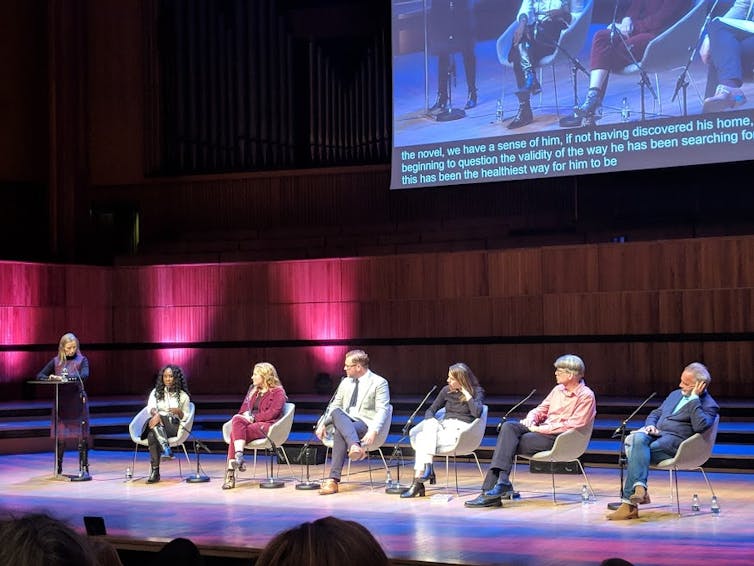
Two days before the winner was due to be announced the writers encountered each other for the first time for a Sunday night appearance at London’s Royal Festival Hall. The audience paid up to £35 a ticket to hear these writers read and talk. Take this Man Booker reading as its own performance contest, and which writer would win?
I settled in my seat with mixed expectations. In Britain, you can coax the occasional creative writing student into a soft-voiced reading, but most hate the prospect. On the other hand, writing classes in the US have spoken delivery and response at their core. In 2014, the Man Booker opened entry to US writers, so I expected the two shortlisted American writers, Rachel Kushner and Richard Powers, to leap out of the blocks.
Kushner obliged. “I recently started to wear these glasses”, she tells us, “because they’ve started to shrink all the texts in all the books.” For her excerpt from The Mars Room she pops in and out of dialogue for a tale of hotwiring a cement mixer, and laughter trills around the auditorium. Yes, she did do her own audio book, she tells the host. “I read out loud while I’m writing so I felt I’d been practising to do that.” Her big interest is in voices, their “formal syncopation – the first person is traditionally a confessional tone, a challenging voice”.
Robin Robertson’s voice is more than challenging. The Long Take is a noir novel in verse, in which a World War II veteran finds himself among the denizens of Skid Row in 1940s Los Angeles. Robertson grips hold of the perspex lectern and delivers his reading with measured threat in every line. In conversation, he tells the London audience how the book reflects the “sense of urban paranoia and panic” that gripped him on first reaching London, and the “deep sense of existential dread” felt by German filmmakers in their post-war Hollywood exile.
For Burns, her characters are nameless and appear as voices in her head. She reads in the shock of a character’s short sentences. We find ourselves shocked. We find ourselves laughing. Anna reads on. It’s tough stuff.
Esi Edugyan smiles, thanks us, tells us she’s pleased to be with us. We warm to her and recognise her nerves – but something gets stuck. The voice of the protagonist in Washington Black is of a young 19th-century boy, a slave – and his first-person past tense narrative is literary. It belongs not so much in the author’s voice, but on paper.
Richard Powers read from his novel, The Overstory, as though in awe of it, his voice close to breaking. At 502 pages, The Overstory is the longest book on the shortlist, and the five-minute reading somehow gave a sense of its length. As fellow shortlister, Daisy Johnson, noted: “There’s something treelike in the way it’s written” – and it’s true: his reading accrued detail like growth rings.
And so to the two “Writer in Performance” awards I took it upon myself to present for the evening. Every writer gets a special award for taking the stage yet staying true to themselves – but, for the most constant laughter and spontaneous applause, the Audience Award goes to Rachel Kushner.
I had other award categories, which Daisy Johnson nailed in reading from her Everything Under – including eye contact with audience and an urgent clarity in her reading. But ironically what clinched the Judge’s Performance Award for Daisy Johnson is the writing. She spoke as an “I” talking to a “you”. She stripped away the literary and delivered the directness of raw speech.
We all applauded, the writers walked off to sign books – and soon one Man Booker winner will be hurtled into months of celebrity. The others, surely, will step from the public gaze and return to the journey Kushner spoke of, going “deeper in myself and trying to form a rich dialogue with my own consciousness”.
Martin Goodman, Professor of Creative Writing, University of Hull
This article is republished from The Conversation under a Creative Commons license. Read the original article.
Leigh WIlson, University of Westminster
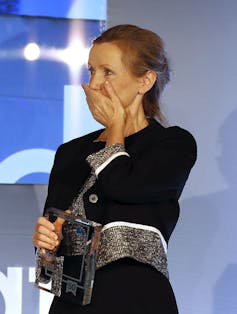
In the literary world and among those for whom fiction is an interest beyond simply reading books, a great deal of attention will be given to the winner of 2018’s Man Booker Prize, Milkman, by Anna Burns. The chair of the judges, philosopher Kwame Anthony Appiah, said Burns’ novel, about a young woman being sexually harassed by a menacing older man and set in Northern Ireland, “is a story of brutality, sexual encroachment and resistance threaded with mordant humour”.
Of course, each year, following the announcement of the longlist in July, the shortlist in September and finally the winner in October, a discussion takes place as to what each announcement might mean. As the Man Booker is the most prestigious, remunerative and talked about literary prize in the UK, this “what does it mean?” can be made to reach into just about every crevice of contemporary culture.
This year has been no exception – discussion of the longlist was dominated by the inclusion of a graphic novel, Nick Drnaso’s Sabrina, and discussion of the shortlist by the presence or absence of millennial writers. Discussion of Milkman will no doubt be dominated by the history of Northern Ireland, by #MeToo and by the fact that Burns is the first UK-born winner for six years.
In these accounts, the significance of the prize is restricted to thinking about those novels that reach the long or shortlist or the one that is declared the final winner. But a range of work from various wings of literary studies over the past few years can help us to answer the question of what winning means in other, perhaps more challenging, ways.
The underlying claim of James F. English’s pioneering 2009 work in the sociology of literature, The Economy of Prestige: Prizes, Awards and the Circulation of Cultural Value, is that both the power of and the problem with prizes consists in the way they equate “the artist with the boxer or discus thrower”. Prizes are competitions.
But while the publicity might go to the winning writers, the real winners are the publishers, who need not just the increased sales and chances of film and TV adaptations that are likely to follow, but also the less tangible boost to their authority and prestige given by a prize. The real winners are also more likely to be not just any publishers, but those that have already been successful. As the novelist Joanna Walsh, among others, has noted, the Man Booker rules make submissions from small publishers very tricky because of the size of the print run required and the amount of money that involves. Because of this, a win can be a drain rather than a boost, and costs can outstrip sales if you don’t win.
It’s not just that the competition is hard for small presses to enter – the big publishers have an near monopoly. In the 50 years that the prize has existed, literary publishing in English has been transformed from being made up of numerous independent companies, often family run, to being almost entirely dominated by the “big five”. These are Penguin Random House, Hachette, HarperCollins, Macmillan and Simon & Schuster. And, further, each of these is itself owned by a multinational media conglomerate.
As the sociologist John Thompson noted in his book, Merchants of Culture: The Publishing Business in the Twenty-First Century, the economies of scale made possible through mergers and acquisitions have created this almost complete monopoly. But through publishing via supposedly “separate” imprints, the big five have maintained an aura of smallness which is more conducive to the “creativity” on which their profits are ostensibly based.
Over the past 20 years, while 12 different publishers appear to have published the novels which were awarded the Prize, six of these wins were for imprints belonging to Penguin Random House. This monopoly is maintained through the prize’s rules for submissions – the number of novels a publisher can submit is directly tied to the number of longlisted novels they have had over the past few years. An imprint already marked as prestigious is more likely to win again.
In his article about Amazon and its relation to contemporary literary fiction, US literary scholar Mark McGurl suggests the extent to which reading of material normally scorned by the literary critic can deliver new insights.
And close reading of the Man Booker’s rules of eligibility – while perhaps dry in comparison to reading the winner on the bus or with a reading group – is also revealing. It shows that it is not just a competition for a small number of large publishers, but that the prize is largely about the maintenance of a certain idea of publishing, too.
The rules of eligibility are almost entirely now about the publisher, rather than the novel or novelist – and key to them is the exclusion of anything with a whiff of self-publishing about it. In order to be eligible, a publisher has to prove that they are based in the UK or Ireland, but the only way of proving this is by having the accoutrements of the conventional publisher. Eligible submissions must come from publishers with ISBNs and head offices who use retail outlets for print books and who publish at least two literary novels a year. Rule 1g, through its strange, uncomfortable tautology, betrays something of just what is at stake in this: “Self-published novels are not eligible where the author is the publisher.”
What the various methods of literary studies can suggest, then, is that, contrary to nearly everything written elsewhere about the Man Booker Prize, it arguably doesn’t really matter which novel wins. Whichever wins, I’d suggest that the real winner is an intensely conventional notion of publishing. It’s an idea of publishing where sales and prestige are the most important consequences of winning prizes and where a few very large publishers dominate.
And, to continue that domination, the most novel uses of contemporary technology, which can open up spaces for the most innovative aesthetic forms become illegitimate. If you want to see examples of this kind of work, look to the recently published novel, Gaudy Bauble, by Isabel Waidner (published by Dostoyevsky Wannabe) – a book of experimental writing published in an innovative way. Under the current rules, such novels could never gain the coverage and attention offered by the Booker. And that’s a great pity.
Leigh WIlson, Professor of English Literature, University of Westminster
This article is republished from The Conversation under a Creative Commons license. Read the original article.
The links below are to articles and posts relating to the 2018 US National Book Awards.
For more visit:
– http://www.nationalbook.org/awards-prizes/national-book-awards-2018/
– https://publishingperspectives.com/2018/10/usa-national-book-awards-nnounces-2018-finalists-including-translations-frankfurt/
– https://bookriot.com/2018/10/10/2018-national-book-award-finalists/
The link below is to an article that takes a look at the 2018 Thurber Prize for American Humor.
For more visit:
http://www.thurberhouse.org/current-finalists/
 At the BookShelf
You must be logged in to post a comment.