
The link below is to an article that takes a look at managing Kindle ebooks with Calibre.
For more visit:
https://www.makeuseof.com/tag/how-to-manage-your-ebook-collection-for-the-amazon-kindle-with-calibre/

The link below is to an article that takes a look at managing Kindle ebooks with Calibre.
For more visit:
https://www.makeuseof.com/tag/how-to-manage-your-ebook-collection-for-the-amazon-kindle-with-calibre/
The links below are to articles reporting on the dropping of the Laura Ingalls Wilder name from a children’s book award over racism concerns – the prize was changed from the Laura Ingalls Wilder Medal to the Children’s Literature Legacy Award.
For more visit:
– https://www.theguardian.com/books/2018/jun/24/laura-ingalls-wilders-name-removed-from-book-award-over-racial-concerns
– https://the-digital-reader.com/2018/06/24/little-house-on-the-prarie-authors-name-removed-from-book-award/
Ana Puchau de Lecea, University of Melbourne and Vicente Pérez de León, University of Melbourne
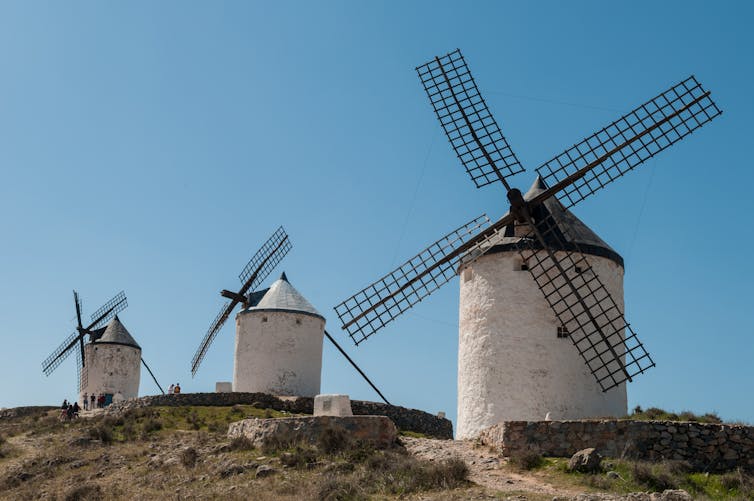
Somewhere in La Mancha, in a place whose name I do not care to remember…
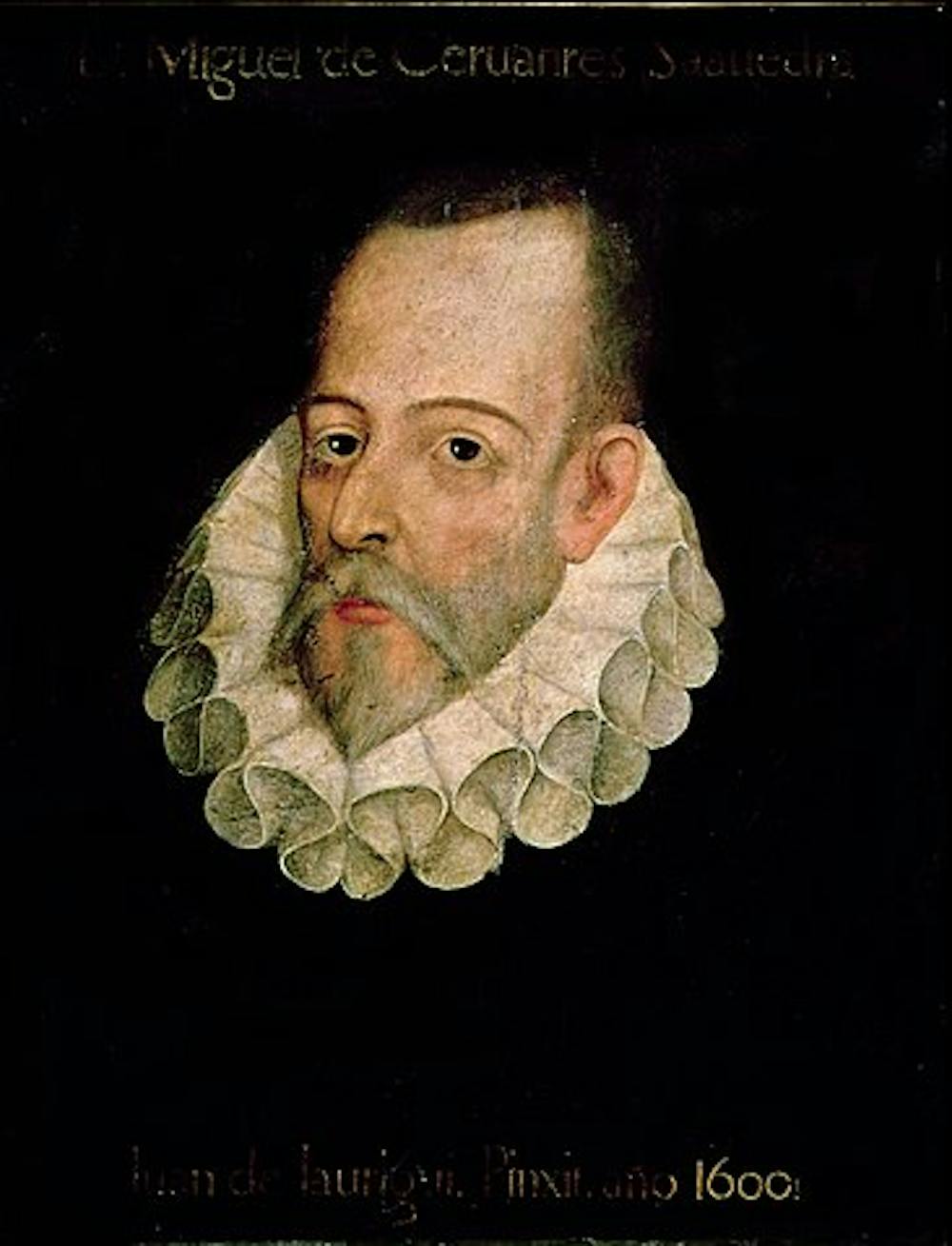
This line, arguably the most famous in the history of Spanish literature, is the opening of The Ingenious Nobleman Don Quixote of La Mancha by Miguel de Cervantes, the first modern novel.
Published in two parts in 1605 and 1615, this is the story of Alonso Quijano, a 16th-century Spanish hidalgo, a noble, who is so passionate about reading that he leaves home in search of his own chivalrous adventures. He becomes a knight-errant himself: Don Quixote de la Mancha. By imitating his admired literary heroes, he finds new meaning in his life: aiding damsels in distress, battling giants and righting wrongs… mostly in his own head.
But Don Quixote is much more. It is a book about books, reading, writing, idealism vs. materialism, life … and death. Don Quixote is mad. “His brain’s dried up” due to his reading, and he is unable to separate reality from fiction, a trait that was appreciated at the time as funny. However, Cervantes was also using Don Quixote’s insanity to probe the eternal debate between free will and fate. The misguided hero is actually a man fighting against his own limitations to become who he dreams to be.
Open-minded, well-travelled, and very well-educated, Cervantes was, like Don Quixote himself, an avid reader. He also served the Spanish crown in adventures that he would later include in the novel. After defeating the Ottoman Empire in the battle of Lepanto (and losing the use of his left hand, becoming “the one-handed of Lepanto”), Cervantes was captured and held for ransom in Algiers.
This autobiographical episode and his escape attempts are depicted in “The Captive’s Tale” (in Don Quixote Part I), where the character recalls “a Spanish soldier named something de Saavedra”, referring to Cervantes’s second last name. Years later, back in Spain, he completed Don Quixote in prison, due to irregularities in his accounts while he worked for the government.
In Part I, Quijano with his new name, Don Quixote, gathers other indispensable accessories to any knight-errant: his armour; a horse, Rocinante; and a lady, an unwitting peasant girl he calls Dulcinea of Toboso, in whose name he will perform great deeds of chivalry.
While Don Quixote recovers from a disastrous first campaign as a knight, his close friends, the priest and the barber, decide to examine the books in his library. Their comments about his chivalric books combine literary criticism with a parody of the Inquisition’s practices of burning texts associated with the devil. Although a few volumes are saved (Cervantes’s own La Galatea among them), most books are burned for their responsibility in Don Quixote’s madness.
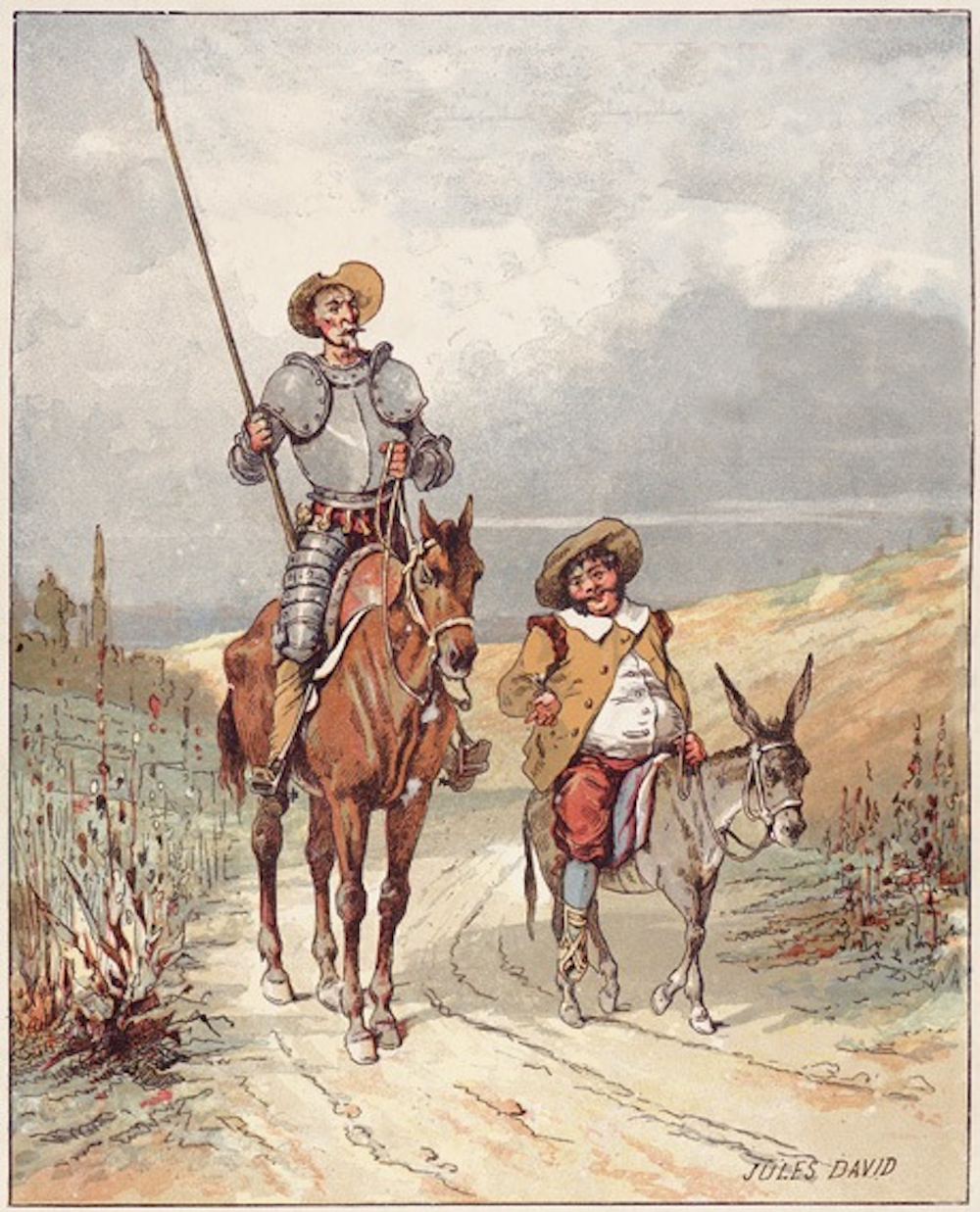
In Don Quixote’s second expedition, the peasant Sancho Panza joins him as his faithful squire, with the hopes of becoming the governor of his own island one day. The duo diverges in every aspect. Don Quixote is tall and thin, Sancho is short and fat (panza means “pot belly”). Sancho is an illiterate commoner and responds to Don Quixote’s elaborate speeches with popular proverbs. The mismatched couple has remained as a key literary archetype since then.
In perhaps the most famous scene from the novel, Don Quixote sees three windmills as fearful giants that he must combat, which is where the phrase “tilting at windmills” comes from. At the end of Part I, Don Quixote and Sancho are tricked into returning to their village. Sancho has become “quixotized”, now increasingly obsessed with becoming rich by ruling his own island.
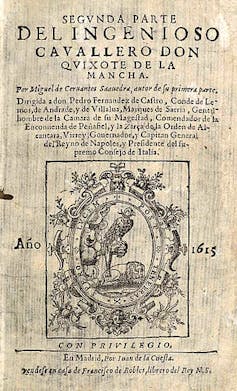
Don Quixote was an enormous success, being translated from Spanish into the main European languages and even reaching North America. In 1614 an unknown author, Alonso Fernández de Avellaneda, published an apocryphal second part. Cervantes incorporated this spurious Don Quixote and its characters into his own Part II, adding yet another chapter to the history of modern narrative.
Whereas Part I was a reaction to chivalric romances, Part II is a reaction to Part I. The book is set only one month after Don Quixote and Sancho’s return from their first literary quest, after they are notified that a book retelling their story has been published (Part I).
The rest of Part II operates as a game of mirrors, recalling and rewriting episodes. New characters, such as aristocrats who have also read Part I, use their knowledge to play tricks on Don Quixote and Sancho for their own amusement. Deceived by the rest of the characters, Sancho and a badly wounded Don Quixote finally return again to their village.
After being in bed for several days, Don Quixote’s final hour arrives. He decides to abandon his existence as Don Quixote for good, giving up his literary identity and physically dying. He leaves Sancho – his best and most faithful reader – in tears, and avoids further additions by any future imitators by dying.
The narrator of Part I’s prologue claims to write a sincere and uncomplicated story. Nothing is further from reality. Distancing himself from textual authority, the narrator declares that he merely compiled a manuscript translated by some Arab historian – an untrustworthy source at the time. The reader has to decide what’s real and what’s not.
Don Quixote is also a book made of preexisting books. Don Quixote is obsessed with chivalric romances, and includes episodes parodying other narrative subgenres such as pastoral romances, picaresque novels and Italian novellas (of which Cervantes himself wrote a few).
Don Quixote’s transformation from nobleman to knight-errant is particularly profound given the events in Europe at the time the novel was published. Spain had been reconquered by Christian royals after centuries of Islamic presence. Social status, ethnicity and religion were seen as determining a person’s future, but Don Quixote defied this. “I know who I am,” he answered roundly to whoever tried to convince him of his
“true” and original identity.
Many writers have been inspired by Don Quixote: from Goethe, Stendhal, Melville, Flaubert and Dickens, to Borges, Faulkner and Nabokov.
In fact, for many critics, the whole history of the novel could justifiably be considered “a variation of the theme of Don Quixote”. Since its early success, there have also been many valuable English translations of the novel. John Rutherford and more recently Edith Grossman have been praised for their versions.
Apart from literature, Don Quixote has inspired many creative works. Based on the episode of the wedding of Camacho in Part II, Marius Petipa choreographed a ballet in 1896. Also created for the stage, Man of La Mancha, the 1960s’ Broadway musical, is one of the most popular reimaginings. In 1992, the State Spanish TV launched a highly successful adaptation of Part I. Terry Gilliam’s much-awaited The Man Who Killed Don Quixote is only the most recent addition to a long list of films inspired by Don Quixote.
 More than 400 years after its publication and great success, Don Quixote is widely considered the world’s best book by other celebrated authors. In our own times, full of windmills and giants, Don Quixote’s still-valuable message is that the way we filter reality through any ideology affects our perception of the world.
Ana Puchau de Lecea, PhD Candidate and Teaching Associate, University of Melbourne and Vicente Pérez de León, Honorary Fellow, University of Melbourne
This article was originally published on The Conversation. Read the original article.
The link below is to an article that takes a look at ‘book stuffing.’
For more visit:
https://goodereader.com/blog/indie-author-news/whats-all-this-stuff-about-book-stuffing
The link below is to an article that takes a look at curating the home library.
For more visit:
https://www.readitforward.com/authors/ultimate-home-library/
 The Barbarians: The Collapse Of – The Roman Empire: The Goths, The Vandals & The Sack Of Rome by Michael Hector
My rating: 2 of 5 stars
This book provides a good introduction to Rome, its rise, and fall. However, the book should have been edited to a greater degree than it was, for it is poor throughout in this respect. The editing fails what would otherwise have been a good (though brief) introduction to Rome.
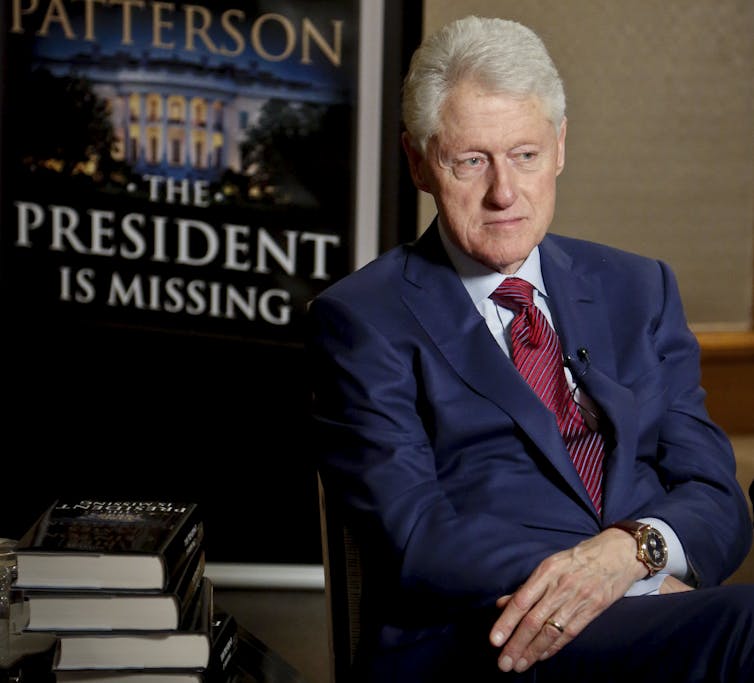
Stacy A. Cordery, Iowa State University
“The President is Missing,” Bill Clinton’s new suspense novel that he co-wrote with James Patterson, was swiftly panned. It spills no secrets, the prose is leaden, the story predictable.
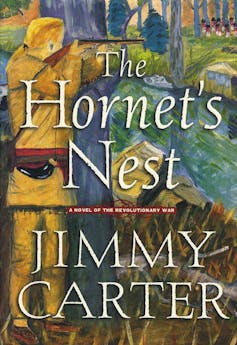
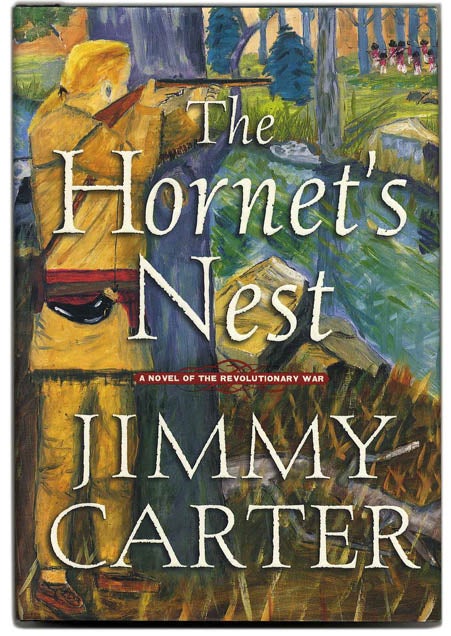
Clinton isn’t the first former president to try his hand at fiction. Jimmy Carter took seven years to write “The Hornet’s Nest: A Novel of the Revolutionary War,” which suffered a similarly unenthusiastic response.
When it came to their literary ambitions, both Clinton and Carter proved John Quincy Adams prescient.
“There is nothing more pathetic in life than a former president,” the sixth president once opined.
What happens to motivated, determined, duty-driven men when they are forced to abandon the White House? When the global spotlight dims? When, as Barack Obama put it, life begins to move in slow motion?
As a scholar of presidential families, my research suggests that while presidents have many more options open to them in their “retirement” than the rest of us, they find the transition difficult and their choices have run the gamut from the decent to the disastrous, from altruistic to avaricious.
After the daily grind and chaos of being president, it’s no surprise that many presidents, upon leaving office, immerse themselves in quiet activities like writing, painting and farming.
Writing is probably the most common pastime of ex-presidents, who can seldom resist the urge to rehash major events of their tenure, justify their decisions and seek to influence their place in history.
Knowing he was about to die, Ulysses Grant penned his memoir to provide a financial cushion for his family. Bedridden, tormented by pain, and writing on his back in pencil in a desperate race to finish before throat cancer killed him, he completed his manuscript and died days later. It earned nearly half a million dollars for his widow, thanks to the extremely generous royalties granted to him by his friend and publisher, Samuel Clemens.
Theodore Roosevelt’s hunting books, Herbert Hoover’s “Fishing for Fun: And to Wash Your Soul” and Gerald Ford’s “Humor and the Presidency” stand in contrast to the many books written by former presidents analyzing foreign and domestic policy, chronicling past eras, providing civic and spiritual advice and showcasing public and private correspondence.
John Adams grimly rebutted the by then deceased Alexander Hamilton in protracted letters to the Boston Patriot. Even “Silent Cal” found he had a lot to say post presidency, churning out 300 syndicated newspaper columns under the title “Calvin Coolidge Says.”
Painting, meanwhile, acted as a solitary, post-presidential pursuit for at least three former presidents.
Dwight Eisenhower’s landscapes and portraits occupied his last two decades and were exhibited widely. An oil painting of Carter’s netted US$750,000 for charitable works last year, and George W. Bush professes to be both “challenged” and made “happy” by his artwork.
Farming also places high on the agenda of ex-presidents. Like Cincinnatus, the powerful fifth-century B.C. Roman leader, George Washington resisted the temptation to remain in power and instead returned to his plow. James Madison, James Monroe, Andrew Jackson, Martin Van Buren, John Tyler, Andrew Johnson, Franklin Pierce, Lyndon B. Johnson and Ronald Reagan, among others, all found solace in going home to their fields and ranches. Eisenhower earned a place in the Angus Heritage Foundation for the prize-winning cattle he raised on his farm near Gettysburg.

But as John Quincy Adams well knew, the glamours and thrills of the old life always beckon.
Theodore Roosevelt may have once written with his customary certainty that “when [the president] goes out of office he takes up his regular round of duties like any other citizen, or if he is of advanced age retires from active life to rest.”
Yet once his term was up, Roosevelt undertook an African safari, started a third party, charted an unexplored river in Brazil, and tried but failed to recreate the Rough Riders for the World War I trenches. George H. W. Bush, who celebrated his 90th birthday by skydiving, recalls this level of derring-do.
Some former presidents turn into elder statesmen, dispensing advice to all who will listen, especially presidential hopefuls. They are called upon to attend state funerals, put in appearances, unveil their portraits and accept awards.
Not everyone complies. Millard Fillmore resisted an honorary degree from Oxford University because he felt he did not deserve it. Harry Truman knew he didn’t merit the proffered Congressional Medal of Honor.
Then there are the politicians who simply cannot stop being politicians.
In 1799, Washington set a precedent for inserting himself into future elections, when, with the elections of 1800 looming, he persuaded fellow Federalists to run for office and made sure he was solidly apprised of political machinations.
Fillmore, Grant, Grover Cleveland and Theodore Roosevelt all ran for president after leaving the White House. John Quincy Adams was elected nine times to the House of Representatives, doing such good work that he – like Carter – was considered a better former president than president. Seven years after he was impeached, Tennessee sent Andrew Johnson back to the U.S Congress.
“Thank God for the vindication,” he gloated – although his Senate colleagues largely snubbed him.
Many presidents have devoted hours to charitable works, including voluntary military service. Others have tarnished their reputations with exorbitant speaking fees or by vilifying their successors.
But only one was truly a traitor. John Tyler became a secessionist and an elected member of the Confederate Congress.
In the end, the desire to reward and punish, to analyze the past, to promote an agenda, to be part of the nation’s business, and to remain in the spotlight proves overwhelming.
Some former presidents may eventually come across as pathetic, but none is ever missing from public view for too long. Ambitious men accustomed to prominence and power find it difficult to “retire from active life to rest.”
 Presidents who preceded him have provided Donald Trump several options for his eventual retirement. It is, however, nearly impossible to imagine his Twitter account truly going dark.
Stacy A. Cordery, Professor of History, Iowa State University
This article was originally published on The Conversation. Read the original article.
The link below is to an article that looks at how to turn on and off Kindle’s Whispersync/Syncing feature.
For more visit:
https://blog.the-ebook-reader.com/2018/06/17/how-to-turn-on-and-off-kindle-book-syncing-whispersync/
 At the BookShelf
You must be logged in to post a comment.