
If you’re into Harry Potter, then you’re going to love the bookends in the article linked to below.
For more visit:
https://bookriot.com/2018/07/09/harry-potter-bookends/

If you’re into Harry Potter, then you’re going to love the bookends in the article linked to below.
For more visit:
https://bookriot.com/2018/07/09/harry-potter-bookends/
The links below are to articles reporting on the renaming of the Laura Ingalls Wilder Award to the Children’s Literature Legacy Award.
For more visit:
– https://bookriot.com/2018/07/05/laura-ingalls-wilder-award-name-change/
– https://www.theguardian.com/books/2018/jul/10/renaming-the-laura-ingalls-wilder-award-isnt-disturbing-william-shatner-its-necessary
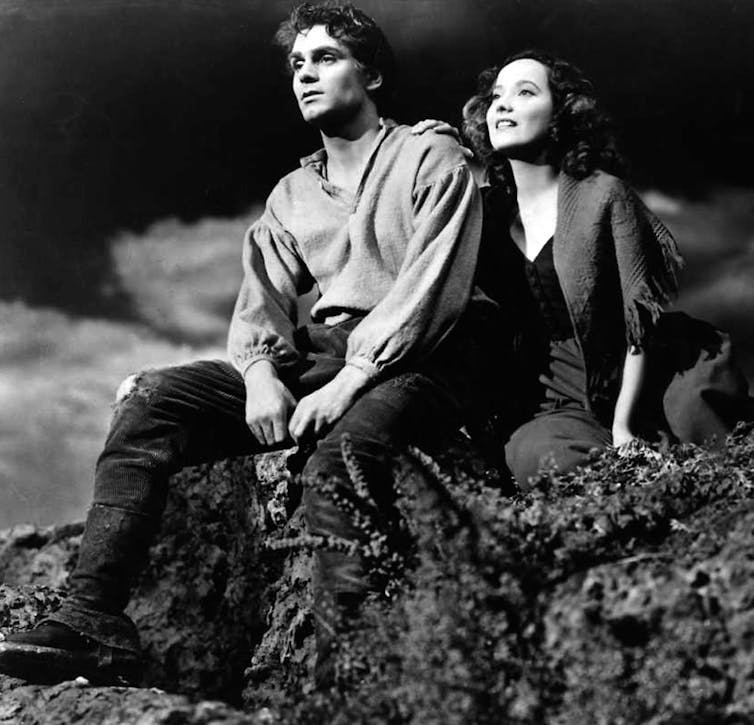
Catherine Han, Cardiff University
Though she is famed as one of England’s greatest writers, Emily Brontë – whose 200th birthday would have fallen on July 30, 2018 – probably only ever wrote one novel, Wuthering Heights, first published in 1847.
Wuthering Heights might now be synonymous with Cathy and Heathcliff, but their love affair is not the whole story. They exist within an elaborate web of semi-incestous relationships between the Earnshaw, Linton and Heathcliff families. Through its multigenerational story, the book examines whether grand but destructive passion is preferable to companionship and domesticity.
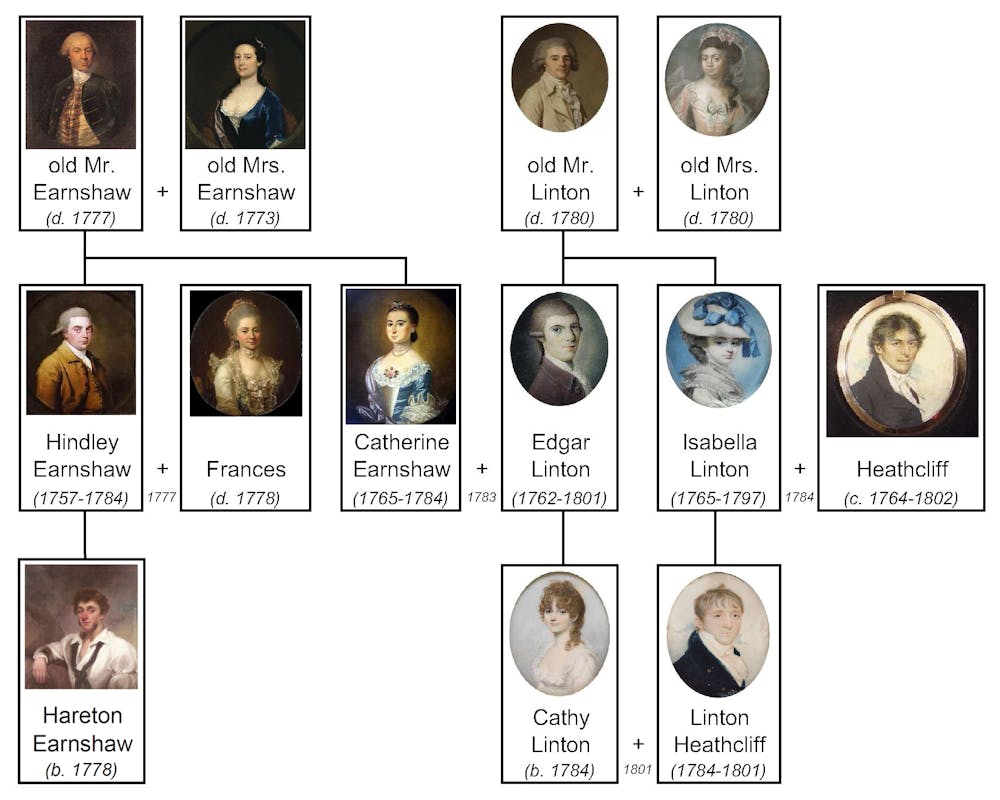
The novel’s first half relates the love between Cathy and Heathcliff, but the latter part is devoted to their descendants, especially Cathy’s daughter, Catherine Linton, and her nephew, Hareton Earnshaw. Ever since Wuthering Heights was first printed, the contrast between the two generations has prompted readers to ask the same questions. Does Brontë ultimately critique Cathy and Heathcliff’s exciting but tortured affair by comparing them with Catherine and Hareton? Or do the younger couple, after their transgressive predecessors, represent the restoration of boring convention?
From the very start, Wuthering Heights encourages readers to look at the generations in relation to one other. Brontë employs an intricate pattern of repeating names, a pattern made explicit by the bumbling narrator Lockwood. In an early chapter, Lockwood spends a night at the gothic Heights where he discovers those names graffitied onto a window ledge. He recounts:
This writing, however, was nothing but a name repeated in all kinds of characters, large and small – Catherine Earnshaw, here and there varied to Catherine Heathcliff, and then again to Catherine Linton.
In vapid listlessness I leant my head against the window, and continued spelling over Catherine Earnshaw—Heathcliff—Linton, till my eyes closed; but they had not rested five minutes when a glare of white letters started from the dark, as vivid as spectres – the air swarmed with Catherines…
This Catherine soup foreshadows major events to come. The first Catherine, Cathy, begins the novel as “Catherine Earnshaw” before taking the surname Linton after marrying Edgar. Her daughter is born “Catherine Linton” then becomes “Catherine Heathcliff” through a forced marriage to Linton Heathcliff, Heathcliff’s son. In the final chapter, the second Catherine is engaged to Hareton and is on the verge of being renamed “Catherine Earnshaw”. As the names reveal, the novel gives one version of the story and then tells the same tale in reverse.
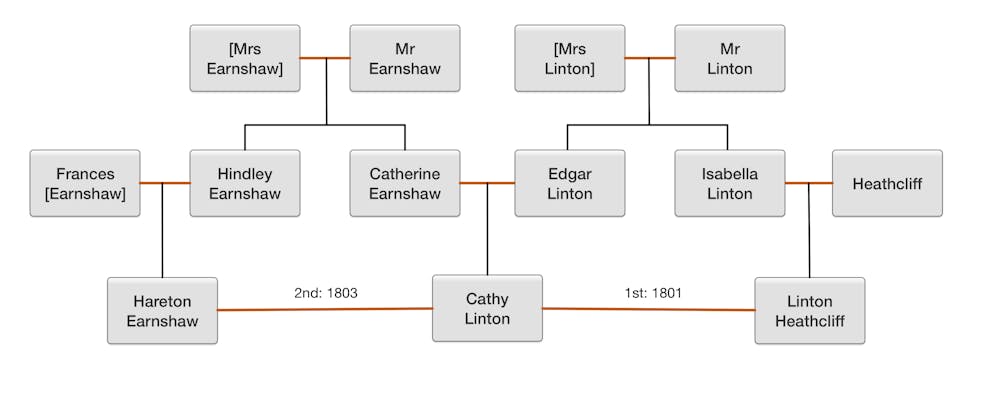
Lockwood’s visions suggest that these names and their attached identities are floating free, ready to be claimed or disregarded at will. Indeed, names and identities within Wuthering Heights appear interchangeable. The novel keeps swapping the characters and their names around in order to imagine them in new combinations. In the process, the distinctions between the generations and their attached symbolism start to dissolve.
The pattern of names also suggest that Wuthering Heights is a cyclical tale rather than a linear one. The repetitions introduce all sorts of complications into how we read the two halves of the narrative in relation to each other. From one perspective, the circular structure prevents us from assuming that Wuthering Heights is a tale of doomed passion being eventually superseded and replaced by mature love. From another, the first generation can be interpreted as triumphantly returning. We start with a Catherine Earnshaw and end up looping back to a Catherine Earnshaw.
Of course, Wuthering Heights is too sophisticated to give us an either/or answer as to whether passion or companionship is preferable. On closer inspection, Catherine and Hareton possess many of the same qualities as their forebears but in less extreme and more domesticated forms. In the final chapter, the pair is described as reading together in a recently replanted garden, a detail that suggests the violence and chaos of the Heights has been tamed. They symbolise a harmonious synthesis of the many oppositions – especially nature/culture and passion/companionship – that abound in the novel. In this hybrid setting, the younger Catherine’s taking of her mother’s maiden name creates the impression of a simultaneous return and renewal.
 The novel’s recurring names and its overall design suggests other possibilities. In particular, that Brontë was more interested in weaving a complex narrative than answering the very questions raised by her own novel. In so doing, she crafted a literary and philosophical puzzle that continues to ignite the imaginations of many authors, filmmakers and artists to this day.
Catherine Han, Teacher, Cardiff University
This article was originally published on The Conversation. Read the original article.
The link below is to an article reporting on the finalists for the 2018 World Fantasy Awards.
For more visit:
https://bookriot.com/2018/07/25/world-fantasy-awards-finalists/
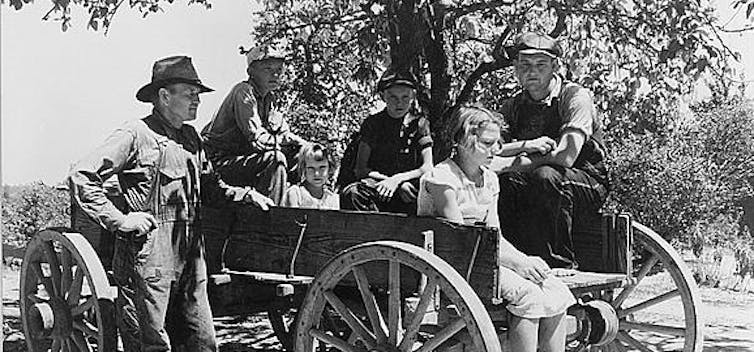
Sarah Gleeson-White, University of Sydney
In our series, Guide to the classics, experts explain key works of literature.
To hear William Faulkner tell it, to write As I Lay Dying he “took this family and subjected them to the two greatest catastrophes which man can suffer – flood and fire, that’s all”. That’s all. And yet his 1930 tour de force, which he began the day after Wall Street crashed on October 24 1929, remains one of the most perplexing novels of the modernist canon.
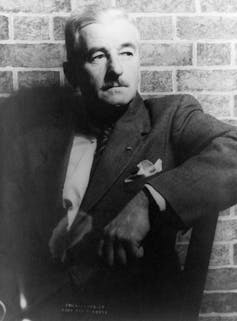
As I Lay Dying is the third novel Faulkner set in his imagined Yoknapatawpha County, which is based on north-eastern Mississippi, where he spent most of his life. To some extent, the novel’s raw story is indeed simple. It narrates the cursed 10-day journey of the poor white Bundren family from their hill-country farm to the county seat of Jefferson to bury Addie, their wife and mother, in accordance with her wishes.
The novel is pervaded by the sweat, hunger and poverty that characterised the Depression-era South – and indeed much of the nation at this time. It also conjures the dialect, customs, characters and landscape of rural Mississippi as it deploys the region’s vernacular narrative forms such as the tall tale. We know, for instance, that Faulkner read and loved George Washington Harris’s 1867 collection of humorous tales concerning Sut Lovingood, that dialect-speaking “nat’ral born durn’d fool” whose influence we can trace forward to Anse, the Bundren patriarch.
Read more:
Guide to the classics: Don Quixote, the world’s first novel – and one of the best
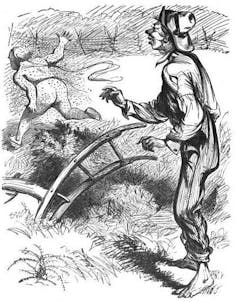
When Cash, the oldest of the five Bundren children, breaks his leg in the disastrous river crossing, Anse decides to pour concrete over the damaged leg to form a cast. “Why didn’t Anse carry you to the nearest saw mill and stick your leg in the saw?” the local doctor asks Cash in stunned amazement. “That would have cured it. Then you could have stuck his head into the saw and cured a whole family.”
Perhaps the most remarkable feature of As I Lay Dying – and this is a feature that has caught the attention of so many readers and critics – is the frequent mismatch between character and speech. That is to say, the language – the diction, syntax and register – of the monologues is often incommensurate with the character who is doing the speaking or thinking.
Take, for example, eight-year-old Vardaman’s first monologue, in which he describes his brother Jewel’s horse:
It is as though the dark were resolving him out of his integrity, into an unrelated scattering of components – snuffings and stampings; smells of cooling flesh and ammoniac hair; an illusion of a co-ordinated whole of splotched hide and strong bones within which, detached and secret and familiar, an is different from my is. I see him dissolve – legs, a rolling eye, a gaudy splotching like cold flames and float upon the dark in fading solution; all one yet neither; all either yet none.
These are surely not the words and thoughts of an uneducated farm boy. What is Faulkner up to here? Early critics faulted him for this apparent rupture in voice and character. They simply could not abide that his poor whites did not sound like poor whites. Had he, they wondered, simply made a mistake?
I would suggest that it is this very problem of narrative, language and representation – how to represent the interior life of someone like Vardaman? – that Faulkner is interested in, not only in As I Lay Dying but in so much of his fiction.
As the scholar Dorothy Hale has argued, Faulkner endeavoured to find ways to represent the private self – that is, a self radically removed from a public self bound by convention and common sense. So, because in Faulkner’s universe the deeply private self looks and sounds radically different from the public self, Vardaman can then talk or think about “the dark … resolving him out of his integrity, into an unrelated scattering of components” – this is how his deeply private self just might style it.
Read more:
How Conrad’s imperial horror story Heart of Darkness resonates with our globalised times
The family finally reaches Jefferson towards the end of the novel, ostensibly to bury Addie but in reality – or additionally – to fulfil their respective desires: for Anse, the procurement of a new set of teeth; for Addie and Anse’s daughter, Dewey Dell, an abortion; for the youngest child, Vardaman, a toy train.
It is at this point that modernity irrupts into the story. There in Jefferson the family encounters advertising billboards, telephone lines, a courthouse clock, automobiles, a graphophone (precursor to the record player), a train, electric lights, drugstores and imported bananas. While the Bundrens negotiate their “little postage stamp of native soil”, as Faulkner once described Yoknapatawpha, “with a motion so soporific, so dreamlike as to be uninferant of progress”, the world they now experience is characterised by speed.
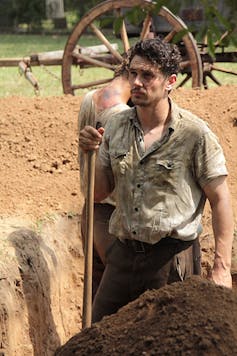
Indeed, there was nothing faster than electricity or the transactions that the telephone now enabled. Medical practitioners came to blame the accelerated motion of modern life for the reported increase in nervous illnesses, something that may well account for the breakdown of Darl Bundren – the second of the five children – at the end of the novel.
Darl, the wretched victim of modernity, is unable to seclude from the public domain his deepest, most private self, something signalled by the increased fragmentation of his monologues over the course of the novel. And so the family has him committed to an asylum in Jackson. Intriguingly, we read right near the end of the novel, “Darl had a little spy-glass he got in France at the war.” Are Darl’s symptoms perhaps those of the returned WWI soldier, what we would today call post-traumatic stress disorder?
Like Darl, the narrative also breaks down. Indeed, Darl’s trauma seems embodied in the very manner of the novel’s fractured, fragmented telling.
To begin with, As I Lay Dying is collaboratively narrated – by no less than 15 different narrators – across no less than 59 interior monologues. Events are also narrated out of order. Addie’s sole monologue, which appears about halfway through the narrative, actually occurs after her death, and so she would seem to speak from the afterlife. And Darl sometimes tells of events that have not yet occurred or that he cannot possibly know about – for example, his narration of Addie’s death.
What is particularly breathtaking about Faulkner’s novel is the way it fuses – somehow – regional forms (such as the tall tale) and at times really quite startling techniques we might more readily associate with an experimental modernism.
And it does so as it narrates the anguished emergence of a family of poor whites into a thoroughly modern nation, described most hauntingly through Darl’s fate:
Our brother Darl in a cage in Jackson where, his grimed hands lying light in the quiet interstices, looking out he foams.
Sarah Gleeson-White, Associate Professor in American Literature, University of Sydney
This article was originally published on The Conversation. Read the original article.
The link below is to an article that reports on criticism of the Man Booker for allowing the entrance of USA writers.
For more visit:
https://www.theguardian.com/books/2018/jul/08/man-booker-peter-carey-julian-barnes
The link below is to an article that takes a look at the rise of the audiobook.
For more visit:
https://www.theguardian.com/books/2018/jul/09/easy-listening-rise-of-audiobooks-alex-clark
The link below is to an article reporting on the 2018 Will Eisner Comic Book Awards.
For more visit:
https://bookriot.com/2018/07/23/2018-eisner-awards-winners/

Emily Troscianko, University of Oxford
Why do you read? Maybe you read to relax after a long day, to learn about unfamiliar people or places, to make you laugh or to let you dream. Maybe you never really ask yourself why, but turn to books out of some vague instinct that they’re what you want or need.
The question of why humans invest such a lot of time and other resources in reading is an interesting one for researchers of both minds and texts, especially when it comes to fiction and poetry, where the answer doesn’t seem as obviously pragmatic as just learning useful facts. Whatever the answer is, it promises to tell us as much about human nature as it does about literature.
For decades now, researchers in cognitive literary studies have been suggesting reasons for why we read fiction. The dominant thinking is some variant on the idea that reading (especially reading narratives, often fictional) is pleasurable because it serves some evolutionarily adaptive purpose, in particular by giving us the chance to hone cognitive skills of one kind or another, free of real world risks. One strand of the general idea that narrative reading may increase our “fitness” is that it may quite literally help us be healthier.
Self-help books are an obvious place to start. There’s a growing body of research on “self-help bibliotherapy” (reading a self-help book, with or without some kind of formal guidance) which indicates that self-help books can sometimes be effective alternatives or supplements to other kinds of therapy.
But very little is known about whether readers respond in clinically relevant ways to poetry, fiction, or other narrative genres, such as memoir. The lack of evidence has not prevented a range of claims and theories from being proposed, and small-scale clinical uses of fiction and poetry by psychiatrists and psychotherapists seem to be fairly widespread.
So is the belief in art’s healing power just wishful thinking, or is there something to it?
The focus of my work is eating disorders. To find out more about the effects of fiction-reading in this context, I set up a partnership with the leading UK eating disorder charity, Beat. We designed a detailed online questionnaire to ask respondents about the links they perceive between their reading habits and their mental health (with a focus on eating disorders). The survey attracted 885 responses (773 from people with personal experience of an eating disorder).
We found that 69% of those with personal experience reported seeking out both fiction and nonfiction to help with their eating disorder, and that 36% had found the fiction or nonfiction they tried helpful. We asked people to rate the helpfulness and harmfulness of different types of text in relation to their eating disorder, and 15% rated fiction about subjects other than eating disorders as more helpful than any other text type. At the same time, memoirs featuring an eating disorder were rated the most harmful text type, with fiction about eating disorders in second place. This suggests a complex set of effects.
https://datawrapper.dwcdn.net/E2QcA/3/
But how does reading fiction actually affect health, positively or negatively? The dominant theoretical view holds that therapeutic effects arise out of a process involving identification (with the character or situation in the text) followed by insight (into the nature of one’s condition). This is perhaps accompanied by some kind of strong cathartic emotional response, followed by a problem-solving stage in which the insights are converted into intentions for personal change. This type of model usually requires that texts should portray situations as similar as possible to the reader’s own, and that they should provide happy but realistic endings.
There are many reasons to question this model. If reading about someone the same as yourself is meant to be therapeutic, what makes it different from, say, rereading your own diary entries? Does the concept of similarity become self-limiting at a certain point, and if so, at what point? And on what dimensions (nature of illness, age, sex, socioeconomic status) is similarity most relevant?
There are also reasons to wonder whether insight is necessarily the main driving force for therapeutic change. In the case of chronic eating disorders, extremely high levels of insight are often coupled with a paralysed inability to act on that insight. So at least among long term sufferers, there may be a more important role for reading experiences that increase motivation or self belief for recovery, rather than providing yet more confirmation of the awfulness of the illness.
https://datawrapper.dwcdn.net/s48tW/1/
The survey findings also direct our attention forcefully to the power of reading to do harm as well as good: one 18-year-old female respondent in recovery from multiple eating disorders described harmful reading matter as “reminding me of why I wanted to starve myself and reinforcing my irrational thoughts”. The testimony on the effects of fiction about eating disorders was overwhelmingly negative; 18 respondents also spontaneously mentioned deliberately “self-triggering”, or choosing to read books they knew would exacerbate their disorder.
Many respondents reported that their eating disorder encourages them to read in such a highly selective way that anything and everything can end up supporting the disordered mindset. Self-perpetuating feedback loops also seem to play a powerful role. If you’re feeling trapped by some aspect of an eating disorder (like low self-esteem), you might be more likely to read a certain type of text, or to read in a particular way (like zooming in on every association of thinness with something positive). This then makes you feel worse (maybe feeling instantly fatter or more determined to lose weight), which in turn encourages more unhealthy reading patterns. These vicious circles can be hard to break.
https://datawrapper.dwcdn.net/prna7/2/
But fiction-reading seems to be one of the things that can break them. Fiction about something entirely unrelated to disordered eating can be stabilising and therapeutic in numerous ways. This can be pragmatic and embodied (allowing regular eating to happen, for example) or broadly existential: exploring alternative worlds, or reminding yourself that your life really could be different. A 27-year-old male in recovery from anorexia described how:
After reading sci-fi my mood is raised and I tend to feel more at peace with the universe, cognitively and imaginatively stimulated and inspired.
 So, next time you pick up a book, reflect for a while on your reasons for doing so. And think about whether, when you’re tired or stressed out or indeed more seriously unwell, you find forms of solace, healing, or inspiration in the apparently simple black marks on a white background.
Emily Troscianko, Knowledge Exchange Fellow at The Oxford Research Centre in the Humanities (TORCH), University of Oxford
This article was originally published on The Conversation. Read the original article.
 At the BookShelf


_(photo_by_Carl_van_Vechten).jpg)

You must be logged in to post a comment.