
 Queen of Shadows by Sarah J. Maas
My rating: 4 of 5 stars

Jeanne Britton, University of South Carolina
As a rare books curator, I get to interact with first editions of novels I love, illustrated versions of my favorite poets’ works, and lavish editions of historical engravings.
In 2015, I started using the University of South Carolina’s first edition of “Lyrical Ballads” in my survey of British literature courses. Written by William Wordsworth and Samuel Taylor Coleridge, this collection of poems is commonly thought to have launched British Romanticism.
I would bring the volume to class to discuss its visual appearance as a printed text. But each time I shared the volume with a new group of students, we found ourselves drawn to the comments written in the book’s margins by its early owner, John Peace.
Peace was, I learned, an acquaintance of Wordsworth. And some of his comments in the margins of one of the volume’s most well-known poems, “Tintern Abbey,” explore the poem’s themes of memory, place and return.
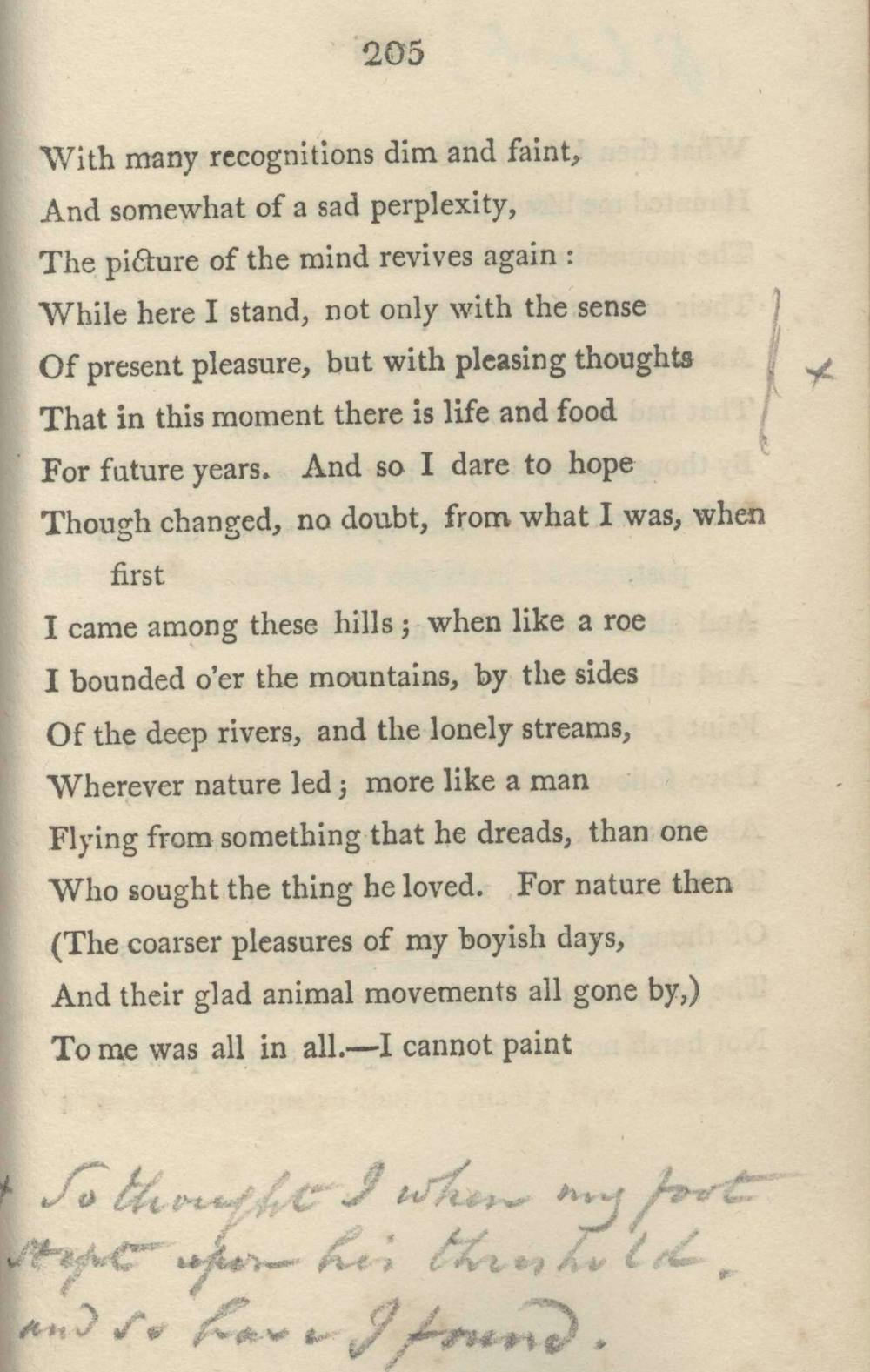
In this poem, Wordsworth describes his return to the Wye River valley after an absence of five years. He also recalls his memories of his first visit to the valley and looks forward to the memories this second visit will create.
“In this moment,” he writes, “there is life and food / For future years.”
When Peace responds to these lines, he describes a different kind of experience – visiting the poet in his home – in a similar way: “So thought I when my foot first step’t upon his threshold, and so have I found.”
It is a singular piece of literary history, and it’s one example of how the study of words written in the margins of historic texts – called “marginalia” – can illuminate the history of reading in new ways.
As prominent book historian Roger Chartier has noted, marginalia can reconstruct past reading experiences through the “sparse and multiple traces” ordinary readers left behind.
One particularly vivid example that is far from ordinary is Sylvia Plath’s copy of “The Great Gatsby.”
Acquired by the University of South Carolina in 1994 from a former professor, the Matthew J. & Arlyn Bruccoli Collection of F. Scott Fitzgerald includes Fitzgerald’s personal ledger, a flask from his wife Zelda, and early drafts of his works.
It also includes an inexpensive 1949 edition of “The Great Gatsby.” Compared to other items in this collection, it might not seem like anything special.
But the book’s owner – and the words she wrote in its margins – are quite noteworthy.
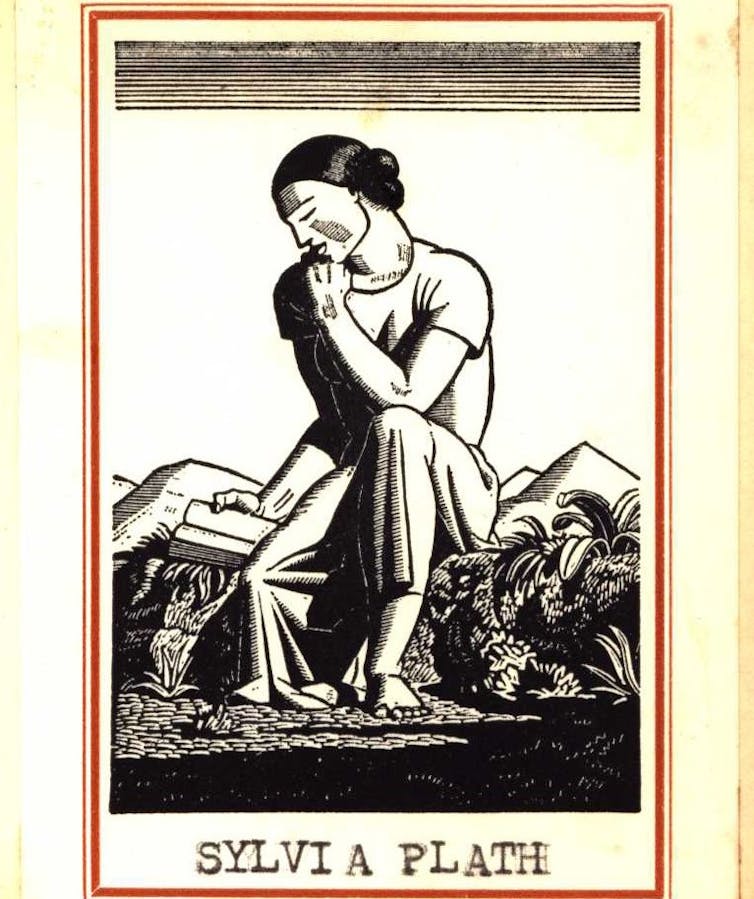
The bookplate identifies Sylvia Plath as the owner of this copy, which she most likely read as an undergraduate at Smith College. Some marginal comments were probably notes she took during lectures about the novel. But others show the way Fitzgerald’s novel sparked her imagination and inspired her own work.
She wrote on almost every page, underlining passages in black and blue ink, drawing stars beside her favorites and occasionally writing notes – some quite arresting – in the margins.
Plath wrote “L’Ennui” – a French word that describes a feeling of listlessness and boredom – next to a description of the character Daisy’s world-weary view of life: “I’ve been everywhere and seen everything and done everything.” “L’Ennui” would become the title of a poem Plath is thought to have written shortly after reading this novel.
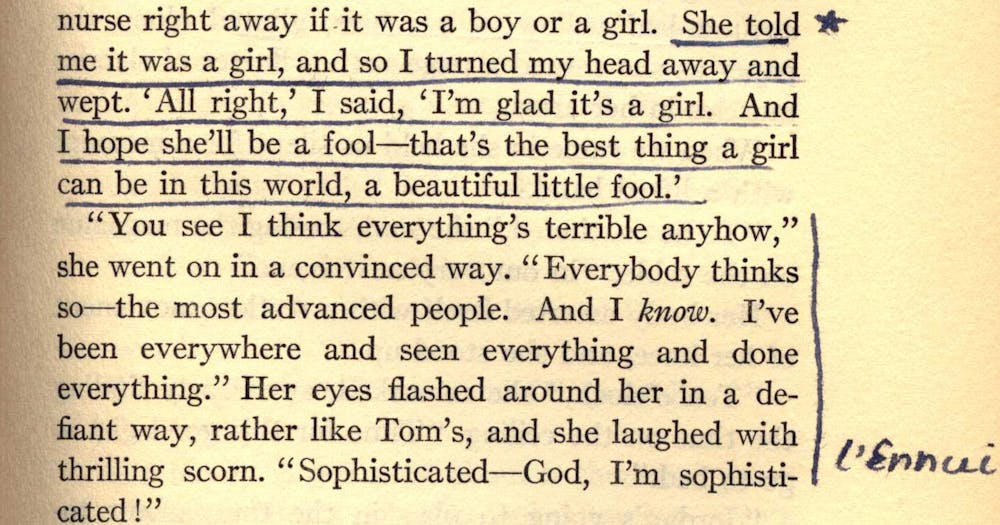
Other notes are, in the context of Plath’s painful life and tragic suicide, haunting.
She writes that Daisy shows a “desire for a secure future” – a longing that seems to have struck a chord for Plath.
On another page, she hints at masculine aggression when she comments, as Gatsby watches the Buchanans from outside their home, “knight waiting outside – dragon goes to bed with the princess.” This was a motif that would reappear in her own life: In her recently published letters, Plath details the physical and emotional abuse her husband, the poet Ted Hughes, inflicted upon her in the months before her death.
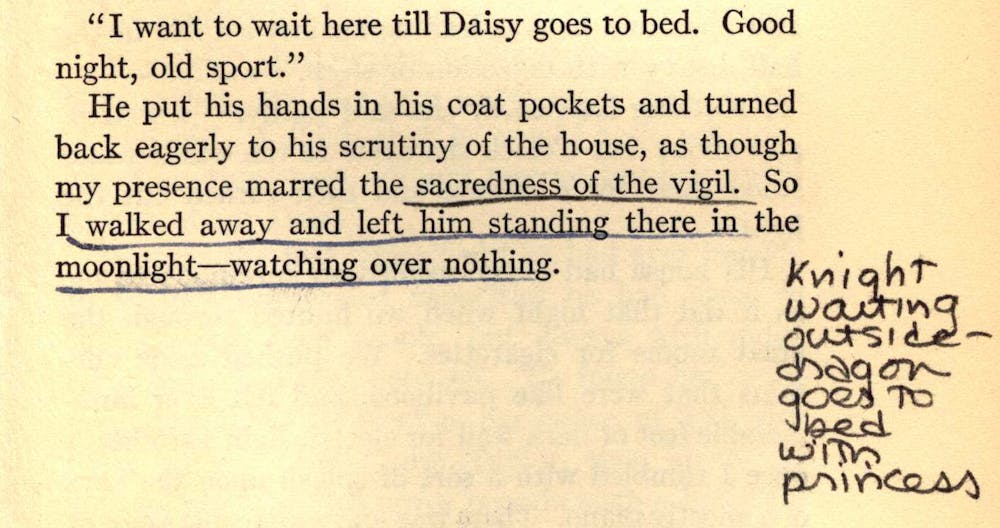
Sylvia Plath’s copy of “The Great Gatsby” speaks to the value of marginalia. As Makenzie Logue, a student of mine who is currently studying the volume, put it, preserving these notes means that you can “read The Great Gatsby with Sylvia Plath.”
In recent years, marginalia left by ordinary readers has become a subject of large-scale data collection efforts.
At the University of Virginia, English professor Andrew Stauffer leads a team that has made a book’s annotations, inscriptions and insertions discoverable as part of UVA’s online library catalog. Any user will be able to find such markings through a simple online search.
At the University of California, Los Angeles, librarians are developing ways to discover marginalia digitally – and quickly – across large digital collections.
Using the methods developed at the University of Virginia, my colleague Michael Weisenburg and I have organized searches for historical markings in library books at the University of South Carolina. Student workers and library staff have enhanced records for annotated volumes in the school’s online catalog.
While digital technology has made marginalia more accessible, digital reading has made the actual habit of writing in books much less common.
What would Sylvia Plath and John Peace have done if they had a Kindle? Would they have still left traces of their reactions to the texts – so valuable to scholars today – behind?
Jeanne Britton, Curator, Irvin Department of Rare Books and Special Collections, University of South Carolina
This article is republished from The Conversation under a Creative Commons license. Read the original article.
Jonathan Alexander, University of California, Irvine and Rebecca Black, University of California, Irvine
In one Harry Potter fan fiction story, Hermione Granger anxiously awaits the results from a recent test.
It isn’t her performance on an exam in a potions course that she’s concerned about. Instead, the higher-ups at Hogwarts had ordered she undergo some psychological tests. They had noticed how quickly she talked, along with her nervous tics.
Hermione eventually sees the results: “I stared at my parents, blinking my eyes. I knew the results would be here today, but I didn’t think the outcome would be like this. Asperger, the paper said.”
In this piece of fan fiction, Hermione Granger has been diagnosed with autism spectrum disorder.
As scholars of fan fiction and young adult literature, we started noticing how some fan fiction authors were incorporating autism into their stories – sometimes through new characters and other times by rewriting existing ones.
Since then we’ve been collecting and analyzing fan fictions in which young writers have created characters with autism.
These amateur writers seem to be eager to create the kinds of characters they aren’t regularly seeing in the media. The Harry Potter universe, in particular, has emerged as a popular setting.
According to the Centers for Disease Control and Prevention, approximately 1 in 59 children is diagnosed with autism, a word that covers a spectrum of conditions that psychologists refer to as autism spectrum disorder.
How autism manifests can vary greatly from person to person. Some experience significant disability, while others experience milder forms of cognitive difference and social discomfort.
But one thing is clear: Diagnoses have increased in the past 20 years, with the National Autism Association identifying autism as the “fastest growing development disorder.”
At the same time – outside of a couple of notable examples, like Dustin Hoffman’s character in “Rain Man” and Julia from “Sesame Street” – there continues to be a dearth of autistic characters in books, television shows and films.
Yet these media portrayals are extremely important: Accurate portrayals of autism can help people understand the complexities of this condition. Nonexistent depictions – not to mention misleading ones – foster misinformation and bias.
In 2015, Sonya Freeman Loftis, an assistant professor of English at Morehouse College, published “Imagining Autism: Fiction and Stereotypes on the Spectrum,” one of the few academic studies to take up the representation of autism in fiction.
Loftis critiques stereotypical depictions of autism in a range of fictional narratives, such as the character of Lennie in Steinbeck’s “Of Mice and Men,” a figure whose disability is linked to sexual violence.
But she also points out that positive representations of autism spectrum disorder can actually highlight some of the strengths that those with autism possess: attention to detail, high levels of concentration, forthrightness, dedication and strong memory skills.
Activists and scholars like Loftis have argued that people diagnosed with autism spectrum disorder should be more justly and accurately understood as “neurodiverse”: If neurological faculties exist on a continuum, theirs could simply be thought of as “different” from the statistical norm.
If major studios and publishing companies express little interest in telling stories about people with autism, who can fill the void?
Fan fictions and other forms of do-it-yourself media-making are an outlet for people to explore issues that are often missing from mass market and popular entertainment.
Some of the most famous examples from fan fiction take place in the Star Trek universe, particularly those that imagine a gay relationship between Captain Kirk and Mr. Spock. In doing so, fans were able to integrate queer plots and themes into Gene Roddenberry’s science fiction universe at a time when few gay relationships were appearing on TV.
Given the paucity of mass media representation of autism, we wondered if young people might be using fan fiction to explore this complex topic.
Beginning in 2016 – and working with University of California, Irvine graduate student Vicky Chen – we started analyzing the writings that have appeared on a hugely popular fan fiction clearinghouse.
After selecting for categories such as “neurodiverse” and “differabilities,” we noticed that a number of stories set in the Harry Potter universe seemed to have autistic or neurodiverse characters. We collected and coded these stories, and are set to publish our findings in a forthcoming essay in the Journal of Literacy Research.
Most of the stories were written by young people who have siblings, relatives or friends with autism spectrum disorder. We concluded that, while some of these characters occasionally slip into stereotypes, most of them affirm the ability of people with autism spectrum disorder to confront bigotry and speak about their own conditions.
By extension, the stories promote an understanding of autism as something that isn’t scary or horrific.
In one story, for instance, the writer creates a new character, Albus Potter, the son of Harry Potter, who is autistic and newly enrolled in Hogwarts. In the story, Albus initially has difficulty forming relationships. But he ultimately finds friends in houses as diverse as Gryffindor and Slytherin.
His overprotective mother tries to shield him from ridicule by students and even some biased faculty. But she’s challenged by others, including her husband, who suggests that “Albus can do a great many things that people have said he couldn’t.”
Why the Harry Potter universe?
We reasoned that many of these young writers are still in school and likely huge fans of Harry Potter, so the choice of Hogwarts as a common setting isn’t surprising.
But many of the young authors also linked autism to a kind of “magic” or ability that could be understood at Hogwarts as special – even advantageous – in ways that “muggles,” or normal people, wouldn’t see. In all of the stories we analyzed, everyone with autism also has magical abilities.
In other cases, autism isn’t depicted as an impairment or a challenge to overcome. Instead, it simply appears as a “difference” – a portrayal that’s aligned with the goals of those who argue that autism should be thought of as a form of neurodiversity, not as an illness or disability.
Perhaps most significantly, this research points to the ways in which young people can craft complex representations of autism that the media shies away from.
We can’t say when positive representations of autism will move from fandom to the mainstream.
But until then, these young writers are quietly doing the work to help dispel stereotypes and generate understanding – perhaps even appreciation.
Jonathan Alexander, Chancellor’s Professor of English and Gender & Sexuality Studies, University of California, Irvine and Rebecca Black, Associate Professor of Education, University of California, Irvine
This article is republished from The Conversation under a Creative Commons license. Read the original article.



 At the BookShelf
You must be logged in to post a comment.