William Shakespeare is widely regarded as one of the greatest authors of all time and one of the most important and influential people who has ever lived. His written works (plays, sonnets and poems) have been translated into more than 100 languages and these are performed around the world.
There is also an enduring desire to learn more about the man himself. Countless books and articles have been written about Shakespeare’s life. These have been based primarily on the scholarly analysis of his works and the official record associated with him and his family. Shakespeare’s popularity and legacy endures, despite uncertainties in his life story and debate surrounding his authorship and identity.
The life and times of William Shakespeare and his family have also recently been informed by cutting-edge archaeological methods and interdisciplinary technologies at both New Place (his long-since demolished family home) and his burial place at Holy Trinity Church, Stratford-upon-Avon. The evidence gathered from these investigations by the Centre of Archaeology at Staffordshire University provides new insights into his interests, attitudes and motivations – and those of his family – and shows how archaeology can provide further tangible evidence. These complement traditional Shakespearean research methods that have been limited to sparse documentary evidence and the study of his works.
Archaeology has the ability to provide a direct connection to an individual through the places and objects associated with them. Past excavations of the Shakespearean-era theatres in London have provided evidence of the places he worked and spent much of his time.
Attributing objects to Shakespeare is difficult, we have his written work of course, his portrait(s) and memorial bust – but all of his known possessions, like those mentioned in his will, no longer exist. A single gold signet ring, inscribed with the initials W S, is thought by some to be the most significant object owned and used by the poet, despite its questionable provenance.
Shakespeare’s house
Shakespeare’s greatest and most expensive possession was his house, New Place. Evidence, obtained through recent archaeological investigations of its foundations, give us quantifiable insights into Shakespeare’s thought processes, personal life and business success.
The building itself was lost in the 18th century, but the site and its remains were preserved beneath a garden. Erected in the centre of Stratford-upon-Avon more than a century prior to Shakespeare’s purchase in 1597, from its inception, it was architecturally striking. One of the largest domestic residences in Stratford, it was the only courtyard-style, open-hall house within the town.
This type of house typified the merchant and elite classes and in purchasing and renovating it to his own vision, Shakespeare inherited the traditions of his ancestors while embracing the latest fashions. The building materials used, its primary structure and later redevelopment can all be used as evidence of the deliberate and carefully considered choices made by him and his family.
Shakespeare focused on the outward appearance of the house, installing a long gallery and other fashionable architectural embellishments as was expected of a well-to-do, aspiring gentleman of the time. Many other medieval features were retained and the hall was likely retained as the showpiece of his home, a place to announce his prosperity, and his rise in status.
It provided a place for him and his immediate and extended family to live, work and entertain. But it was also a place which held local significance and symbolic associations. Intriguingly, its appearance also resembled the courtyard inn theatres of London and elsewhere with which Shakespeare was so familiar, presenting the opportunity to host private performances.
In search of the Bard
Extensive evidence of the personal possessions, diet and the leisure activities of Shakespeare, his family and the inhabitants of New Place were recovered during the archaeological investigations, revolutionising what we understand about his day-to-day life.
An online exhibition, due to be made available in early May 2020, presents 3D-scanned artefacts recovered at the site of New Place. These objects, some of which may have belonged to Shakespeare, have been chosen to characterise the chronological development and activities undertaken at the site.
Open access to these virtual objects will enable the dissemination of these important results and the potential for others to continue the research.
Here lies …
Archaeological evidence recovered from non-invasive investigations at Shakespeare’s burial place has also been used to provide further evidence of his personal and family belief. Multi-frequency Ground Penetrating Radar (GPR) was used to investigate the Shakespeare family graves below the chancel of Holy Trinity Church.
A number of legends surrounded Shakespeare’s burial place. Among these were doubts over the presence of a grave, its contents, tales of grave robbing and suggestions of a large family crypt. The work confirmed that individual shallow graves exist beneath the tombstones and that the various members of Shakespeare’s family were not buried in coffins, but in simple shrouds. Analysis concluded that Shakespeare’s grave had been disturbed in the past and that it was likely that his skull had been removed, confirming recorded stories.
These family graves occupy a significant (and expensive) location in Holy Trinity Church. Despite this, the simple nature of Shakespeare’s grave, with no elite trappings or finery and no large family crypt, coupled with his belief that he should not be disturbed, confirm a simple regional practice based on pious religious observance and an affinity with his hometown.
There is still so much we don’t know about Shakespeare’s life, so it’s a safe bet that researchers will continue to investigate what evidence there is. Archaeological techniques can provide quantifiable information that isn’t available through traditional Shakespearean research. But just like other disciplines, interpretation – based on the evidence – will be key to unlocking the mysteries surrounding the life (and death) of the English language’s greatest writer.
In recent years the orthodoxy that Shakespeare can only be truly appreciated on stage has become widespread. But, as with many of our habits and assumptions, lockdown gives us a chance to think differently. Now could be the time to dust off the old collected works, and read some Shakespeare, just as people have been doing for more than 400 years.
Many people have said they find reading Shakespeare a bit daunting, so here are five tips for how to make it simpler and more pleasurable.
1. Ignore the footnotes
If your edition has footnotes, pay no attention to them. They distract you from your reading and de-skill you, so that you begin to check everything even when you actually know what it means.
It’s useful to remember that nobody ever understood all this stuff – have a look at Macbeth’s knotty “If it were done when ‘tis done” speech in Act 1 Scene 7 for an example (and nobody ever spoke in these long, fancy speeches either – Macbeth’s speech is again a case in point). Footnotes are just the editor’s attempt to deny this.
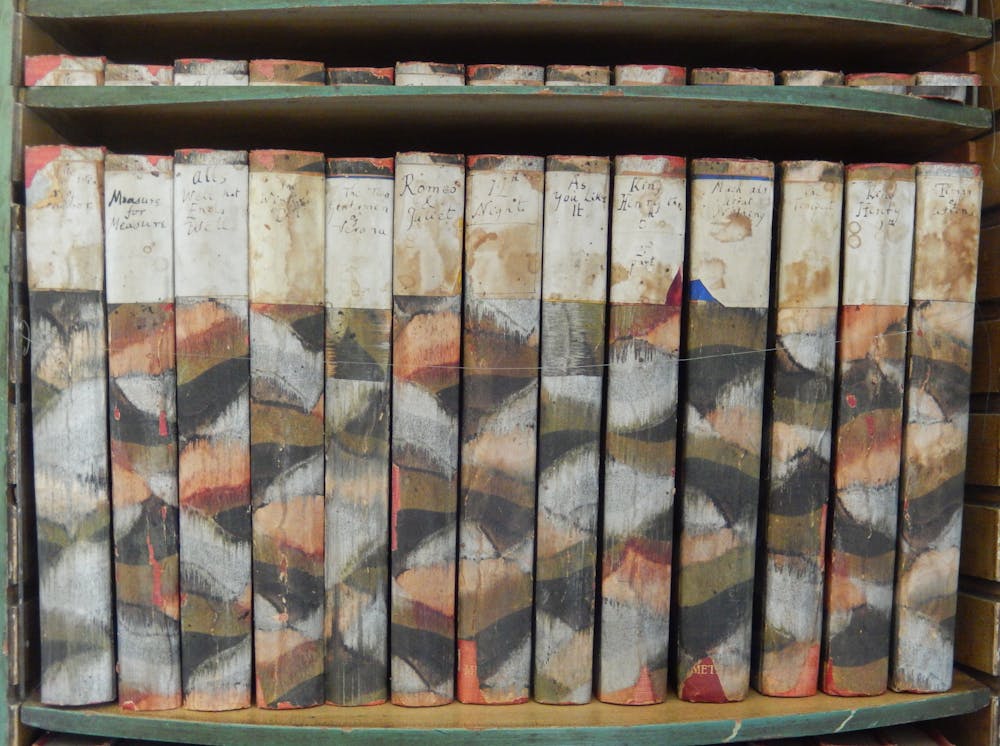
Shakespeare plays hand bound by Virginia Woolf in her bedroom at Monk’s House, Rodmell, Sussex, UK. Ian Alexanber/Wikimedia Commons, CC BY-NC-SA
Try to keep going and get the gist – and remember, when Shakespeare uses very long or esoteric words, or highly involved sentences, it’s often a deliberate sign that the character is trying to deceive himself or others (the psychotic jealousy of Leontes in The Winter’s Tale, for instance, expresses itself in unusual vocabulary and contorted syntax).
2. Pay attention to the shape of the lines
The layout of speeches on the page is like a kind of musical notation or choreography. Long speeches slow things down – and, if all the speeches end at the end of a complete line, that gives proceedings a stately, hierarchical feel – as if the characters are all giving speeches rather than interacting.
Short speeches quicken the pace and enmesh characters in relationships, particularly when they start to share lines (you can see this when one line is indented so it completes the half line above), a sign of real intimacy in Shakespeare’s soundscape.
Blank verse, the unrhymed ten-beat iambic pentamenter structure of the Shakespearean line, varies across his career. Early plays – the histories and comedies – tend to end each line with a piece of punctuation, so that the shape of the verse is audible. John of Gaunt’s famous speech from Richard II is a good example.
This royal throne of kings, this sceptered isle,
This earth of majesty, this seat of Mars.
Later plays – the tragedies and the romances – tend towards a more flexible form of blank verse, with the sense of the phrase often running over the line break. What tends to be significant is contrast, between and within the speech rhythms of scenes or characters (have a look at Henry IV Part 1 and you’ll see what I mean).
3. Read small sections
Shakespeare’s plays aren’t novels and – let’s face it – we’re not usually in much doubt about how things will work out. Reading for the plot, or reading from start to finish, isn’t necessarily the way to get the most out of the experience. Theatre performances are linear and in real time, but reading allows you the freedom to pace yourself, to flick back and forwards, to give some passages more attention and some less.
Shakespeare’s first readers probably did exactly this, zeroing in on the bits they liked best, or reading selectively for the passages that caught their eye or that they remembered from performance, and we should do the same. Look up where a famous quotation comes: “All the world’s a stage”, “To be or not to be”, “I was adored once too” – and read either side of that. Read the ending, look at one long speech or at a piece of dialogue – cherry pick.
One great liberation of reading Shakespeare for fun is just that: skip the bits that don’t work, or move on to another play. Nobody is going to set you an exam.
4. Think like a director
On the other hand, thinking about how these plays might work on stage can be engaging and creative for some readers. Shakespeare’s plays tended to have minimal stage directions, so most indications of action in modern editions of the plays have been added in by editors.
Most directors begin work on the play by throwing all these instructions away and working them out afresh by asking questions about what’s happening and why. Stage directions – whether original or editorial – are rarely descriptive, so adding in your chosen adverbs or adjectives to flesh out what’s happening on your paper stage can help clarify your interpretations of character and action.
One good tip is to try to remember characters who are not speaking. What’s happening on the faces of the other characters while Katherine delivers her long, controversial speech of apparent wifely subjugation at the end of The Taming of the Shrew?
5. Don’t worry
The biggest obstacle to enjoying Shakespeare is that niggling sense that understanding the works is a kind of literary IQ test. But understanding Shakespeare means accepting his open-endedness and ambiguity. It’s not that there’s a right meaning hidden away as a reward for intelligence or tenacity – these plays prompt questions rather than supplying answers.
Would Macbeth have killed the king without the witches’ prophecy? Exactly – that’s the question the play wants us to debate, and it gives us evidence to argue on both sides. Was it right for the conspirators to assassinate Julius Caesar? Good question, the play says: I’ve been wondering that myself.
Returning to Shakespeare outside the dutiful contexts of the classroom and the theatre can liberate something you might not immediately associate with his works: pleasure.
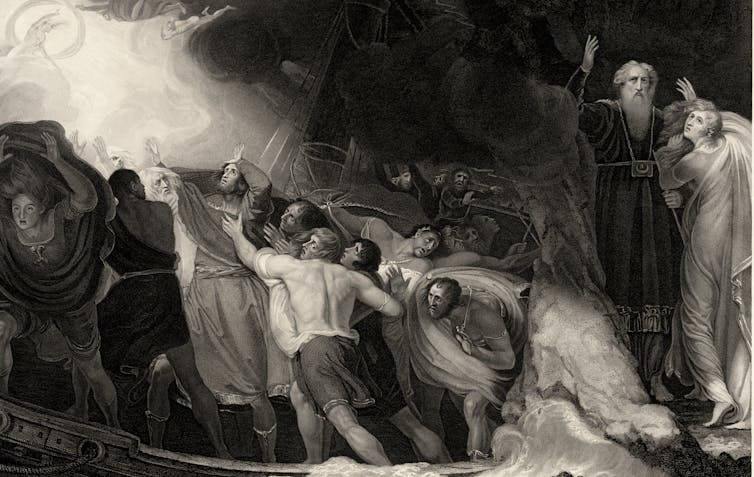
Shakespeare’s ‘The Tempest’ contains timeless themes around resistance and colonialism. Here in an engraving by Benjamin Smith based on a painting by George Romney of Act I, Scene 1 of ‘The Tempest’ by William Shakespeare. (Benjamin Smith/George Romney/ Library of Congress’s Prints and Photographs division /pga.03317)
Last winter, at the Studio Theatre at Ryerson University in downtown Toronto, Canadian actor Antoine Yared played Caliban in The Tempest. He stood, centre stage, looking out over the audience as he reassured his companions that the magic music of the island should not frighten them. He said:
“The isle is full of noises … that give delight and hurt not.”
But his face told the audience a different story — the story of a man heartbroken for what had been taken from him.
In this NYC 2016 production of Shakespeare’s ‘The Tempest,’ Reanna Roane, as ‘Ariel,’ perches on a rock in Central Park during the Outdoor Co-Ed Topless Pulp Fiction Appreciation Society theatre company’s performance. (AP Photo/Kathy Willens)
The Tempest tells the story of the Duke of Milan, Prospero, who many years before had come to the island with his infant daughter. Upon arriving, Prospero enslaved two of its inhabitants, Caliban and the spirit Ariel. The play follows three interconnecting plotlines: Prospero’s revenge plan against his enemies; how his daughter, Miranda, falls in love with the son of his chief enemy; and how Caliban plans to destroy Prospero and take back the island.
The Tempest has also been interpreted as an allegory of liberation. The 20th-century writer Roberto Fernández Retamar declared that the insurgent Caliban spoke for the colonized peoples of the Americas. In 1993, a production by Robert Lepage in Montréal portrayed Caliban as a working-class punk-rocker in open rebellion against the elite Prospero.
The Tempest and religious conversion
In our workshop, we wanted to blend theatre and scholarship to understand how The Tempest could have been used by both European colonialists and also by advocates of resistance. We also wanted to understand how the play might still be relevant.
The workshop brought together four Stratford Festival actors, three student actors from the Ryerson Performance Program and Renaissance scholars from an international initiative dedicated to understanding how Shakespeare’s work helped create the world we live in now.
The artists and scholars worked for a day and a half toward the performance. We talked about the history of slavery and freedom, primarily by thinking about how Christian conversion had served colonization. Indeed conversion has been an instrument of domination in the Americas from 1492 and onwardsinto recent times.
Forced conversion haunts the play. But there is another kind of conversion in the play where characters achieve the freedom to be true to themselves.
Caliban: Searching for the Other
Prospero attempts to strip away Caliban’s dignity. Prospero forces him to remain “stied” in a hard rock. In the Ryerson performance, Antoine Yared playing Caliban chose his first moments on stage carefully. Rather than obeying Prospero’s commands to “come,” he walked past Prospero, his back turned in a sign of his rebellion. For Caliban, even the act of walking around the Island, his home, was now charged with submission or defiance.
When Caliban encountered the shipwrecked servants he would recruit as co-conspirators against Prospero and when one of them fed him liquor, Caliban thought he had at last come face to face with God. He said to the drunken servant:
“Hath thou not dropped from heaven? … I prithee be my god.”
But when the invisible Ariel began to make her magical music, the two servants quaked in terror. They knelt at Caliban’s feet. Caliban rose up — straight and fine like a young tree. He stood triumphantly over the two trembling servants. The music was something he knew well. It was nothing to be afraid of.
“Be not afeard; the isle is full of noises,
Sounds, and sweet airs, that give delight and hurt not.
Sometimes a thousand twangling instruments
Will hum about mine ears; and sometime voices,
That if I then had waked after long sleep,
Will make me sleep again: and then in dreaming,
The clouds methought would open and show riches
Ready to drop upon me, that when I waked
I cried to dream again.”
At the Ryerson performance in Toronto, Antoine Yared as Caliban chose his first moments on stage carefully. He walked past Ben Carlson as Prospero, his back turned in a sign of his rebellion. Author provided
That was in rehearsal. But when Yared played Caliban in front of the audience, he changed the way he did the speech. His lines about the music of the island were no longer triumphant. They were something that could break your heart.
Yared’s Caliban was a man who had once been at one with the natural world, but who had been cast out and could only recapture some sense of the beauty of nature by dreaming. When he said, “I cried to dream again,” it was as if he were a man turning and turning, trying to find the beloved he had lost.
The workshop taught the actors, the scholars and the members of the audience how the play The Tempest, with its depiction of slavery, resistance and love might have challenged people of the past to see Caliban’s humanity and might also speak to audiences in the 21st century.
Yared’s Caliban left us with this urgent question. It was as if he were echoing Ariel and asking the audience:
“If you have eyes to see this suffering one, if you are human, your affections would become tender.”
When you imagine the setting for Macbeth, misty heaths, battlefields, and the brooding highlands spring to mind. Teaching the play in the midst of a tropical summer in Townsville, far north Queensland, highlights disjunctions and surprising correlations between play and place.
In their 2011 book Ecocritical Shakespeare, Lynne Bruckner and Dan Brayton consider this relationship between our environment and our practices of reading, writing about, and teaching Shakespeare:
What does the study of literature have to do with the environment? … What is the connection between the literary and the real when it comes to ecological conduct, both in Shakespeare’s era and now?
One way of answering these questions is through the use of place-based education. Educational theorists Amanda Hagood and Carmel E. Price reason that “student learning is enhanced when course content is grounded in a particular place of meaning”.
This approach is neither new nor (on the surface) complex. Educational philosopher John Dewey prioritised experiential learning such as nature studies. More recently, Swansea University educators have published research on the benefits of curriculum-based outdoor learning for primary school students.
But preliminary research on outdoor Shakespeare education conducted with Townsville secondary school students shows contradictory responses: some students found the location “calming” and “less stressful” than classrooms. Others believed that learning did not “rely on location”.
Christopher Gaze founded Vancouver’s Bard on the Beach Shakespeare Festivalin 1990. Attendance at the beachside performances has since topped 91,000.
Students’ sense of place
In 2019, 60 first-year English students at James Cook University were asked to rate the importance of setting in Shakespeare plays, and the importance of their own place to the study of Shakespeare.
Of those surveyed, 85% felt that the setting was important to the play, while 96% believed that Shakespeare had little or no relevance to their local area. Few felt that their real life location was important in their study of the playwright’s work.
These results show a contrast between the perceived value of literary and of lived place. This is problematic: how do students engage with fictional, imagined literary places if their own lived experience of place is devalued?
When asked to explain their ratings, students said:
I believe the setting plays a big part in the play as it allows the audience to understand why the characters are doing what they are doing. Shakespeare isn’t important in Townsville.
I live in a rural area. There is not a lot of room for Shakespeare – though given small town conflicts you would see his plots acted out in real life.
There is slippage here between the student’s reference to physical place and their conceptual space, which does not have a lot of cultural room for Shakespeare.
A third student wrote:
My family doesn’t really care about Shakespeare, but I do enjoy some of his works personally.
Here, place was understood to refer to relationships, not environment – an understanding backed by British social scientist and geographer Doreen Massey’s theories.
The disparity between students’ conceptualisations of place and their devaluation of their own location as relevant to their studies may be symptomatic of what Alice Ball and Eric Lai identify as “an ethos of placelessness in education”. In Canada, David Gruenewald has argued that the curriculum is largely “placeless”, with educational reforms and high stakes testing increasingly disconnected from our places.
Shakespeare’s shipwrecks
One approach to teaching Shakespeare through place-based education could centre on shared spaces in lived place and text. As a Shakespeare scholar living near the Great Barrier Reef, I’m interested in what Steve Mentz identifies as the “blue ecology” of Macbeth; the play’s many references to the ocean, liquids, and bodily fluids.
One blue image common to both Shakespeare and Townsville is that of the shipwreck – a favourite trope of Shakespeare’s, essential to plays including The Comedy of Errors, Twelfth Night, The Tempest, The Winter’s Tale, and Pericles.
Macbeth invokes shipwreck imagery with a tale of changed fortune after Macbeth’s victory over the traitor Macdonald:
As whence the sun ‘gins his reflection,
Shipwrecking storms and direful thunders break,
So from that spring, whence comfort seemed to come,
Discomfort swells.
The Witches offer a literal description of a ship or “bark”:
1 WITCH
Though his bark cannot be lost,
Yet it shall be tempest-tossed.
2 WITCH
Show me, show me.
1 WITCH
Here I have a pilot’s thumb,
Wrecked as homeward he did come.
Shipwreck is something that Shakespeare and Townsville have in common. Two of the most famous shipwrecks off Townsville’s coast are the SS Yongala (which sank in 1911 and is now a popular diving site) and the HMS Pandora (hulled on the Great Barrier Reef in 1791 after capturing some of the Bounty mutineers; remnants of the wreckage are on display at the Museum of Tropical Queensland in Townsville).
Our students could both explore Shakespeare through the shipwreck and engage more with the history and culture of their own local places. This approach requires us to think about place as real and imagined; fitting for Macbeth, a play defined as a “tragedy of imagination”.
When you think of inner-city teenagers, what springs to mind? For many, it’s hoodies, video games – and probably hating Shakespeare. But my research proves that this stereotype is far from the truth.
Shakespeare holds a contested place in the English national curriculum as the only compulsory writer to be studied between the ages of 11 and 16. This imposed curriculum attempts to situate Shakespeare’s plays as part of national culture, rather than purely as an exemplar of high art. But teens are rarely asked directly about their experiences of education, and about its relevance to them.
Instead, they are often represented as a homogenous group who are bored and resistant to studying Shakespeare, particularly when it comes to struggling with the language he used.
However, my research with over 800 students in four London secondary schools offers a very different picture. I asked these 13 to 14-year-olds what they think and/or feel when they hear the word “Shakespeare” – and some of their answers defied expectations.
What students say
Many students told me that they actually enjoy studying Shakespeare in school. From comments such as “I feel happy because I like most of his plays”, to “I feel excited because Shakespeare was the best writer ever […] a legend or genius”, they expressed levels of interest in Shakespeare that are rarely acknowledged.
These students also did not see the language as a barrier, but as a challenge to be embraced. One commented: “I also get quite happy because we do not often look at texts with old English.”
In this large cohort of students, some comments stand out, showing how varied and individual their responses are. One described Shakespeare as “one of my inspirations for writing poetry”, while another said that “although I don’t really like English, I like his plays a lot”.
Teachers seem to play a key role in developing a positive attitude in some of their students. One student said that “all the work I’ve done on Shakespeare has been interesting and fun”, while another said she “really enjoyed the last play that we did”.
This study did not look in detail at what actually happens in the classroom, but many of the students’ comments suggest that having the confidence to approach a Shakespeare text with a positive attitude partly comes from the teacher’s attitude to him and his work.
‘Be not afraid of greatness …’
In addition to the wholly positive comments, some students demonstrated a more mixed response to the subject. One student told me that “sometimes it’s interesting and sometimes it’s just boring ‘cause in Year 7 I remember we did this one play for a very long time and it was just kind of the same thing every lesson for a double lesson”.
Here, the lessons were clearly not varied enough to hold this student’s attention all the time, although the comment suggests that the student knew that studying Shakespeare could be interesting and fun, even if it isn’t always like that in practice.
For others, the choice of play is key: “Some Shakespeare plays are more interesting than others, in my opinion.” One of the students I interviewed also articulated a clear tension in her attitudes towards studying Shakespeare. She said:
The good part is because everyone goes through different stuff, some people can relate and they can feel like they’re not alone or like this has happened before and studying Shakespeare makes you see the world differently, […] and the bad thing about it [is] learning how to write in the Shakespeare kind of structure when it won’t be useful in the future.
For a number of students, there are perhaps inevitable negative connotations attached to the word “Shakespeare”. Some did describe Shakespeare simply as “boring”, but others explained their reservations in more detail. One said: “I feel like I’ve heard the word Shakespeare too much and that I don’t want to talk about him.” Another thought “about long complicated language that no one understands”, while further complaints were about how “it is unnecessary to learn about as I don’t understand what’s beneficial for us as students”.
Overall, the students involved in this research demonstrated a breadth and depth of response to Shakespeare that counters the generalised belief that teenagers respond poorly to his work. Indeed, used as an introductory question to establish students’ attitudes to Shakespeare before attending a production at Shakespeare’s Globe theatre, in London, I have been fascinated by the variety and subtlety of thought they have demonstrated.
As one said: “I feel honoured that I’ve covered Shakespeare in school, because telling people you have read his plays makes you sound smart.” The sense of privilege inherent in this comment, despite the fact that everyone studies Shakespeare at school, is clearly something to cherish.
It’s hard to imagine a more literary or successful author than William Shakespeare, formerly of Stratford-upon-Avon. Around the world his plays are widely taught and expensively performed. Journalists and scholars look to him for social and political insights. In Washington DC, notionally the capital of the free world, the Folger Shakespeare Library stands near the Capitol building and the Library of Congress as a grand memorial to the Immortal Bard.
Is there another author whose reputation could ever rival Shakespeare’s? Certainly not from the 16th century, nor the 17th. Perhaps Johnson or Swift from the 18th? Austen or a Brontë from the 19th? Woolf, Joyce or Hemingway from the 20th? There are contenders, to be sure, but no one has put Shakespeare in the shade.
And yet there is a problem with Shakespeare.
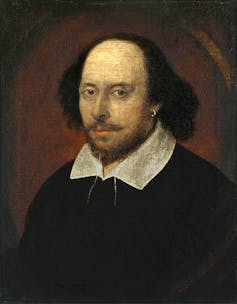
Thought to be the most authentic portrait of William Shakespeare. Wiki Commons
Johnson, Austen, the Brontës, Woolf, Hemingway and Joyce all left behind evidence of their authorial lives. We can study diaries, letters, manuscripts, even juvenilia – a fulsome literary paper trail. With Shakespeare, though, the trail is meagre. Most of what we know of his life has come to us from arid official records, or via cryptic comments from contemporaries who hint at something mysterious or disreputable in the background.
What we notice most starkly is a documentary gap, one that people have attempted to fill in all manner of ways – by contacting Shakespeare through seances, or searching tombs and riverbeds for hidden manuscripts, or probing for secret messages in the plays, or positing all manner of “secret author” theories. According to those theories, William Shakespeare of Stratford was just a frontman for the true author of the Shakespeare oeuvre.
Many credible writers and scholars have embraced Shakespearean heresy. Disraeli, Emerson, Freud, William James, Mark Twain, Orson Welles and Walt Whitman all doubted Shakespearean authorship. Henry James was “haunted by the conviction that the divine William is the biggest and most successful fraud ever practised on a patient world”.
The heretics are right to be sceptical. Apart from the documentary gaps, there are good reasons to doubt Shakespearean authorship of at least some of the plays. They were published by men with a track record of fraud, and the printed versions conceal much about how they were produced, including the role of collaborators.
Fundamentally, though, the heretics are wrong. Thanks to four centuries of scholarship, we know William Shakespeare was an author. And we know a great deal about what kind of author he was.
Gerard Langbaine’s Dramatick Poets includes this anecdote about Titus Andronicus:
…the Play was not originally Shakespear’s, but brought by a private Author to be acted, and [Shakespeare] only gave some Master touches to one or two of the principal Parts or Characters: afterwards he boasts his own pains; and says, That if the Reader compare the Old Play with his Copy, he will find that none in all that Author’s Works ever receiv’d greater Alterations, or Additions; the Language not only refined, but many scenes entirely new: Besides most of the principal Characters heightened, and the Plot much increased.
The first significant reference to Shakespeare as a dramatist – Robert Greene’s famous “Shake-scene” attack – is a complaint about him taking credit, as an “upstart crow”, for the writings of others. There is other evidence, too, that much of his work consisted of revising and retouching plays by other people.
What did it mean for a play to undergo the Shakespeare treatment? We know the answer to that, too. It seems a lot of the treatment involved sexing things up.
Today, William Shakespeare’s surname is utterly respectable. In the 16th century, however, the name had very different connotations. It was an old and earthy name, even a rustic one, akin to “Sheepshanks” and “Silcock” and “Wetherhogg”. His peers were always making fun of his provincial origins. People spoke of his “killcow conceit” – simultaneously an allusion to his father’s humble position in the Warwickshire leather trade, and a suggestion that Shakespeare’s cobbled-together plays were heavy with crude imagery.
The name “Shakespeare” had another connotation as well. Shakespeare’s first reputation was as a poet, and particularly as a sex poet. In his three main books of poetry – Venus and Adonis, Lucrece, and the Sonnets – bawdy and erotic content is paramount.
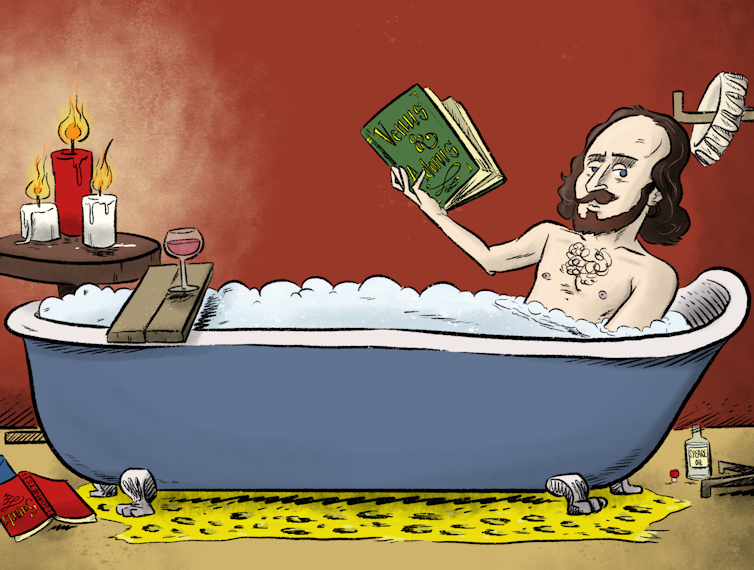
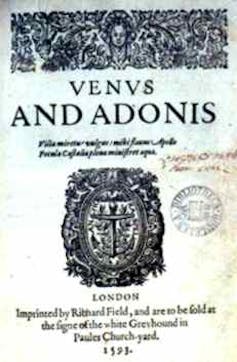
Shakespeare made his first appearance in print with Venus and Adonis. Published in 1593, that book immediately earned a salacious reputation as an aid to what Michael Schoenfeldt called “solitary pleasure”. It is referred to in the anonymous Parnassus plays (1598–1602), in which the character Judico expresses love for the poem and its sweet, “hart throbbing” lines, and the character Gullio promises to “worship sweet Mr Shakespeare, and to honour him will lay his Venus and Adonis under my pillow”.
John Davies’ 1625 A Scourge for Paper Persecutors also mentions the poem, and suggests another way to enjoy it:
Making lewd Venus with eternall lines
To tye Adonis to her loves designes:
Fine wit is shown therein, but finer ’t were
If not attired in such bawdy geer:–
But be it as it will, the coyest dames
In private reade it for their closet-games.
Samuel Johnson would later list Venus and Adonis as one of the most scandalous and corrupting poems of the late 16th century.
He sex and she sex
William Shakespeare was very much alive above the ears and below the waist. A surprisingly high proportion of the documentary trail concerns his racy and bawdy exploits.
An important anecdote, from John Manningham’s 1601 diary, concerns a performance of the play we now call Richard III. Richard Burbage played the king and caught the attention of a beauty in the audience. The lady was so impressed by Burbage’s performance that she invited him to her home that evening — as long as he promised to stay in costume and character. Shakespeare got wind of the assignation and went first to the lady’s residence. Burbage arrived at the appointed time but Shakespeare was already inside, being “entertained and at his game”.
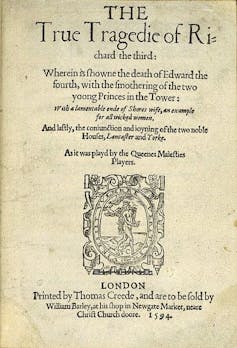
Copy of the anonymous history play Richard III. Wiki Commons
When the lovers were informed that Burbage was at the door, a triumphant Shakespeare sent his colleague a mischievous reply that contained a sharp lesson in English history. “William the Conqueror,” he said, “was before Richard the Third.”
Jane Davenant, mistress of the Crown Tavern in Oxford, is rumoured to have been another of Shakespeare’s lovers. Her son William, the future poet laureate, inferred on multiple occasions that Shakespeare was his father in more than just a poetical sense.
By the time Shakespeare’s Sonnets were published in 1609, they were somewhat old-fashioned and enjoyed little success. But an earlier manuscript version had circulated in the 1590s. According to the clergyman Francis Meres, Shakespeare’s “private friends” had devoured these “sugared sonnets” with relish.
Today, no copies of the Sonnets manuscript are known to exist. An enduring fantasy for bibliophiles and book-hunters, the manuscript is also a puzzle. The printed edition is a fascinating shandy of hetero- and homosexual flavours. Apart from being more raw and racy, the manuscript Sonnets may have been differently organised, perhaps into sections according to whose appetites were being served. The manuscript may also have included more prefatory matter – such as a letter from the author – that explained what he was up to.
Willy Shake-Spear
A painting of the intimate relationship between Desdemona and Othello in Shakespeare’s play Othello. Daniel Harris/flickr
Printed versions of Shakespeare’s plays started appearing in the mid-1590s, but not until 1598 did they carry his name on their title pages. The men and women who bought these thin quarto editions knew exactly what to expect. They had already been conditioned by the outputs of William Shakespeare, sex poet.
Like those of his closest peers – men such as Greene and Christopher Marlowe – Shakespeare’s plays are noteworthy for their bawdy and disreputable content. Everyone knows the scene from Othello in which Desdemona and Othello make “the beast with two backs”. There are hundreds of comparable examples. In Hamlet, the prince and Ophelia trade spicy banter:
Hamlet: That’s a fair thought to lie between maids’ legs.
Ophelia: What is, my lord?
Hamlet: Nothing.
Falstaff’s speech in Henry IV Part 2 speaks of Justice Shallow in terms such as these:
…the whores called him mandrake: [he] came ever in the rearward of the fashion, and sung those tunes to the overscutched huswives that he heard the carmen whistle.
In Love’s Labour’s Lost, Adriano de Armado makes a striking confession about the king:
…it will please his grace, by the world, sometime to lean upon my poor shoulder, and with his royal finger, thus, dally with my excrement, with my mustachio; but, sweet heart, let that pass.
OK let’s not get too carried away: “excrement” probably meant “beard”, but the contact is still intimate.
Passages of this flavour are what Shakespeare’s contemporaries meant when they said he wrote in a raw manner, “from nature”. And they are what Thomas and Henrietta Bowdler removed to make their 19th century Family Shakespeare. (They excised, for example, the “beast with two backs”.) Johnson wasn’t far from the Bowdlers in his views about the raw parts of Shakespeare. “There are many passages mean, childish, and vulgar; and some which ought not to have been exhibited, as we are told they were, to a maiden Queen.”
Shakespeare’s Hamlet was probably more vital and bawdy than its predecessor version, possibly written by Thomas Kyd and now lost. Certainly Shakespeare’s King Lear is racier and more involving than the anonymously authored prior play, King Leir, which was registered in 1594.
The Bard had good reason to rev things up. Playwrights sometimes shared in the extra profits from the performance of successful plays. Writers were smart to add spicy content that would appeal to audiences from all classes.
Saucy sources
Apart from adapting earlier plays, Shakespeare took material from histories and poems and novels. His extensive use of sources shows there was no “secret author” behind the scenes who reliably fed him texts. His own library of sources performed that role.
Shakespeare’s personal collection of books and manuscripts has never been found, but one conception of it is compelling: an erotic library rich with imported Dutch and Italian smut along with English works such as Thomas Cutwode’s scandalous The Bumble-Bee (1599) and Giles Fletcher’s equally disreputable Licia, or Poemes of Love (1593).
The field of Shakespeare studies is all about mystery and discovery. There are many uncertainties about Shakespeare, but his achievement as a libidinous “sexer upper” allows us to put one precious stake in the ground.
Although sex is the unlikely key to understanding Shakespeare’s achievement as an author, for a long time the academy shunned his racy side. That side was not, however, wholly overlooked.
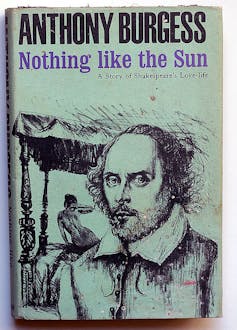
Nothing like the Sun, a story of Shakespeare’s life by Anthony Burgess. Alexis Orloff/flickr
The New Zealand-born lexicographer Eric Partridge compiled the remarkable Shakespeare’s Bawdy (1947), which presents, among other things, scores of Shakespearean synonyms and euphemisms for vagina. Nothing Like the Sun (1964) by the novelist Anthony Burgess is “A Story of Shakespeare’s Love Life”; the covers of the Heinemann hardback and the 1966 Penguin softback show Shakespeare with his mistress, the mysterious “dark lady” of the sonnets.
Still, the Shakespeare of Partridge and Burgess is very different to the respectable, mainstream one. How did Shakespeare pull off the transformation from sex poet to literary monument?
Even in his lifetime he was shape-shifting, from boisterous lyricist and tearaway playwright to old-fashioned sonneteer and retired bookman. In the decade after his death, men tidied up his authorial legacy – and possibly added to it – but Shakespeare was still one writer among many, his reputation on a par with those of Marlowe and Middleton, and behind those of Jonson, Milton and Spenser.
But Shakespeare was tailor-made for the Romantic and Victorian eras, whose actors, scholars and hacks embraced and refashioned the Bard. Bowdlerising editors cut many of the ruder bits and added happier endings. By the 20th century, Shakespeare’s preeminence was immutable, his works as sublime and respectable as Beethoven’s symphonies or Mona Lisa’s smile. Things, though, could have been very different.
Professor Stuart Kells is the author of Shakespeare’s Library: Unlocking the Greatest Mystery in Literature (Text Publishing).
Gregg Henry portrays President Donald Trump in the role of Caesar in the Public Theater’s Free Shakespeare in the Park production of ‘Julius Caesar,’ in New York City. Joan Marcus/The Public Theater via AP
“All the world’s a stage,” Shakespeare once wrote.
In recent weeks, that Shakespearean adage has been particularly resonant, with the New York Public Theater’s production of “Julius Caesar” attracting worldwide scrutiny because of the staged likeness between Caesar and President Trump.
Extolling the play as a masterpiece about power and political violence, director Oskar Eustis persuasively defended his interpretation as a warning about “what happens when you try to preserve democracy by nondemocratic means.”
Others, however, questioned whether this production was in good taste – and denounced it for encouraging violence against President Trump, particularly the scene in which Caesar is stabbed to death. Due to the backlash, Delta Airlines and Bank of America withdrew their corporate sponsorship.
In some ways, the contention – even rancor – of these debates about the Public Theater production would have delighted, and perhaps bemused, Shakespeare. They articulate the richness and urgency of our own democratic struggles – similar to the rich political complexity reflected in Shakespeare’s text itself.
Caesar in Shakespeare’s times
As Shakespeare wrote the play, he drew on Roman history, a popular topic in 16th-century England. But he was also commenting on the political conflicts of the era. The power struggles depicted in “Julius Caesar” mirrored ongoing concerns in England with legitimacy, tyranny and potential threats of rebellion and deposition against Queen Elizabeth I, who did not have an heir. These anxieties were also exacerbated by historical memories of the English Civil War, also called the War of the Roses, going far back as the deposition and death of Richard II.
Shakespeare’s Rome is a place of brutal struggles between democratic ideals and human ambition. The assassination of Caesar is one of the most important events in Roman history, and Shakespeare had inherited over 1,600 years of ambiguity, with little consensus over whether Caesar’s killing was justified. He incorporated these debates into his play, offering his viewers multiple perspectives on the characters. Caesar is either a heroic, benevolent ruler or tyrant; Brutus is either a patriot or assassin.
Shakespeare’s Caesar is clearly a leader and politician with power – including some vanity and propensity to flattery – but also with wide popular appeal. When he returns triumphant from wars, the conspirators fear he will become a tyrant, a “Colossus” whereby the “wide walls” of Republican Rome “encompass’d but one man.”
Yet he seems to love and trust his fellow Romans, warmly inviting Brutus and other conspirators to share wine. And we also learn he bequeaths to his people, on his death, his personal possessions: To every Roman citizen he gives “seventy-five drachmas” and “all his walks, His private arbours and new-planted orchards” for public use.
Shakespeare also gives Brutus, the leader of the assassination plot, a refined conscience throughout the play. It’s evident in the many discussions Brutus has with his fellow conspirators, and it’s summed up when he describes his motivation for killing Caesar: “If then [any] friend demand why Brutus rose against Caesar, then my answer: Not that I loved Caesar less but that I loved Rome more.”
“Julius Caesar” offers a complicated, even poignant vision at the end. It ends in civil war and the defeat of the conspirators, following their internal dissensions and accusations of betrayal. Brutus commits suicide, but Mark Antony and Octavius, Julius Caesar’s grandnephew, victorious at the end, acknowledge Brutus’s nobility and wish to bury him with honor. Toward the close of Shakespeare’s next Roman play, “Antony and Cleopatra,” we see Octavius Caesar emerge as the singular ruler of Rome. Importantly, then, the Republican, democratic ideal is defeated, both in the play and in the Western world (until the American Revolution).
A deeply democratic offering
Overall, this picture of a divided Rome – a mix of power politics, of stoic ideals giving way to ego – should give pause to modern audiences. From the shifting perspectives on competing ambitions we learn that all rigid value judgments of “good” and “evil” politicians can be relative – and problematic – in our contingent world.
Yet, the ideals of democracy – in Rome and in our own times – have to be constantly guarded against demagogues, who also may be idealists, of all political stripes. Productions of “Julius Caesar” have typically evoked topical political analogies. Even seemingly traditional, period productions, such as the current Royal Shakespeare Company’s version in Britain, resonate with topical relevance, enabling the audience to deduce connections to today’s political climate.
It may be true – as some have suggested – that the analogy between Julius Caesar and Donald Trump is a bit forced. Regardless, the production is, as one reviewer put it, “a deeply democratic offering, befitting both the Public and the public – and the times.”
As a researcher and teacher of Renaissance drama, I’ve studied Shakespeare’s role as a cultural icon across different societies, cultures and eras. It seems that no matter where (and when) his works are being performed, they provide us with a complex, poetic language for imagining and interpreting the intractable world in which we live.
During politically contentious times, it’s befitting that we turn more – rather then less – to Shakespeare.













 During politically contentious times, it’s befitting that we turn more – rather then less – to Shakespeare.
 At the BookShelf


You must be logged in to post a comment.