Unknown's avatar

In its portrayal of women, the classic South African novel Mhudi was ahead of its time


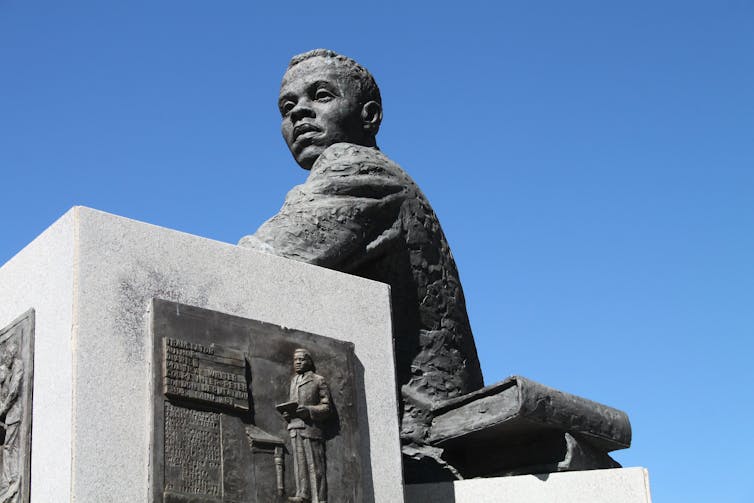
A statue of the author, Solomon T. Plaatje, in Kimberley, South Africa.
flowcomm/Flickr, CC BY-SA

Jenny Boźena du Preez, Nelson Mandela University

Solomon T. Plaatje was born in 1876 and was one of the founding members of South Africa’s current ruling party, the African National Congress.

He was a politician, intellectual, journalist and author of the seminal Native Life in South Africa. He was also a writer of fiction. His first and only novel, Mhudi, was written in 1920 and published a decade later.

Despite being the first novel by a Black South African in English, it had little impact on the literary landscape of the country at the time. However, over the past century, the novel has garnered great interest from scholars.

One notable aspect of the novel is that it centres a woman as its protagonist – the Mhudi of the title – and her role in resistance. Her proactive, adventurous, quick-witted character has led a number of scholars to consider the novel from a feminist perspective. In fact, it has been described as “ahead of its time” for its portrayal of women in an era when women had few rights, and Black women almost none.

When working on my chapter for the new book, Sol Plaatje’s Mhudi: History, Criticism, Celebration, I found that most feminist scholarship on the novel has focused on the individual character of Mhudi. So, I turned my attention to Mhudi’s solidarity with other women and what this might tell us about Plaatje’s view of the nature of political struggle.

What the novel’s about

Mhudi takes place against the backdrop of fictionalised versions of actual historical events in what is today called South Africa. The action of the novel is set off by King Mzilikazi’s massacre of the Barolong people at Kunana in 1832. Mzilikazi was king of the Matabele, a group of people today known as the Ndebele and living mostly in Zimbabwe. The Barolong, now called the Rolong, are a clan of the Tswana people living largely in Botswana.

Mhudi, a young Barolong woman, manages to escape the massacre with her life, but believes she is the only one of her people left alive. However, after wandering in the wilderness, she meets a young Barolong man, Ra-Thaga, and they get married. The story follows the couple on several perilous adventures, in which Mhudi frequently saves Ra-Thaga through common sense and uncommon bravery, until they are united with the other surviving Barolong.


Read more:
Anniversaries spark renewed readings of South Africa’s celebrated Sol Plaatje


Determined to defeat the Matabele, the Barolong form a coalition with the Boers, the white, Afrikaans-speaking farmers descended from Dutch settlers. Ra-Thaga takes part in the successful battle, but is wounded. Mhudi, seeing this in a dream, leaves her children with her cousin and travels to aid him. On her way, she befriends Hannetjie, a young Boer woman, and Umnandi, the favourite wife of Mzilikazi, who fled her home because of the scheming of her co-wives. The Matabele routed, Mhudi and Ra-Thaga happily return home.

Women’s solidarity

The most obvious of women’s solidarities in the novel are those with their husbands. The second most apparent are the friendships Mhudi forms across racial and ethnic boundaries with Umnandi and Hannetjie. While personal, these relationships also have political implications.
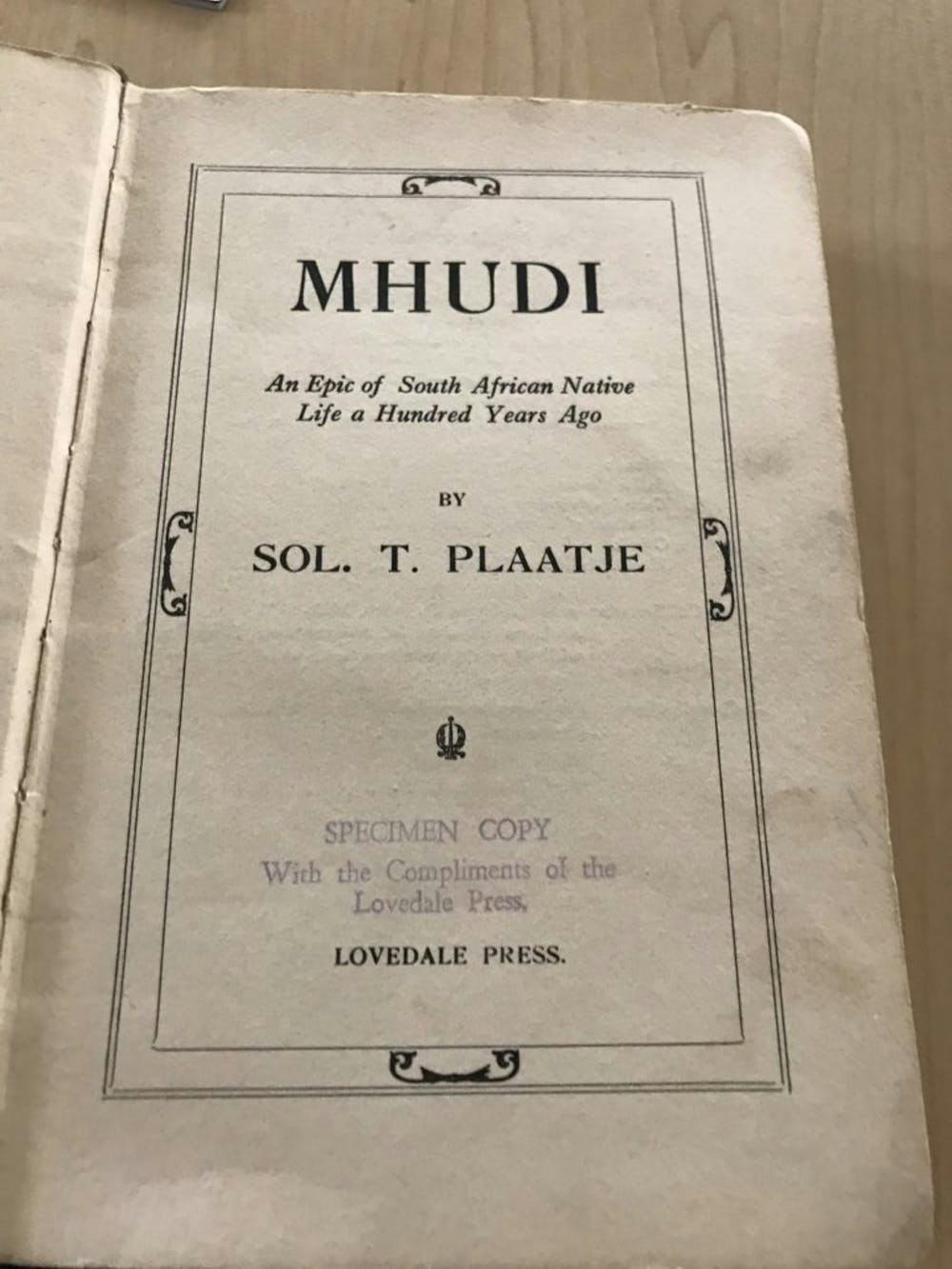
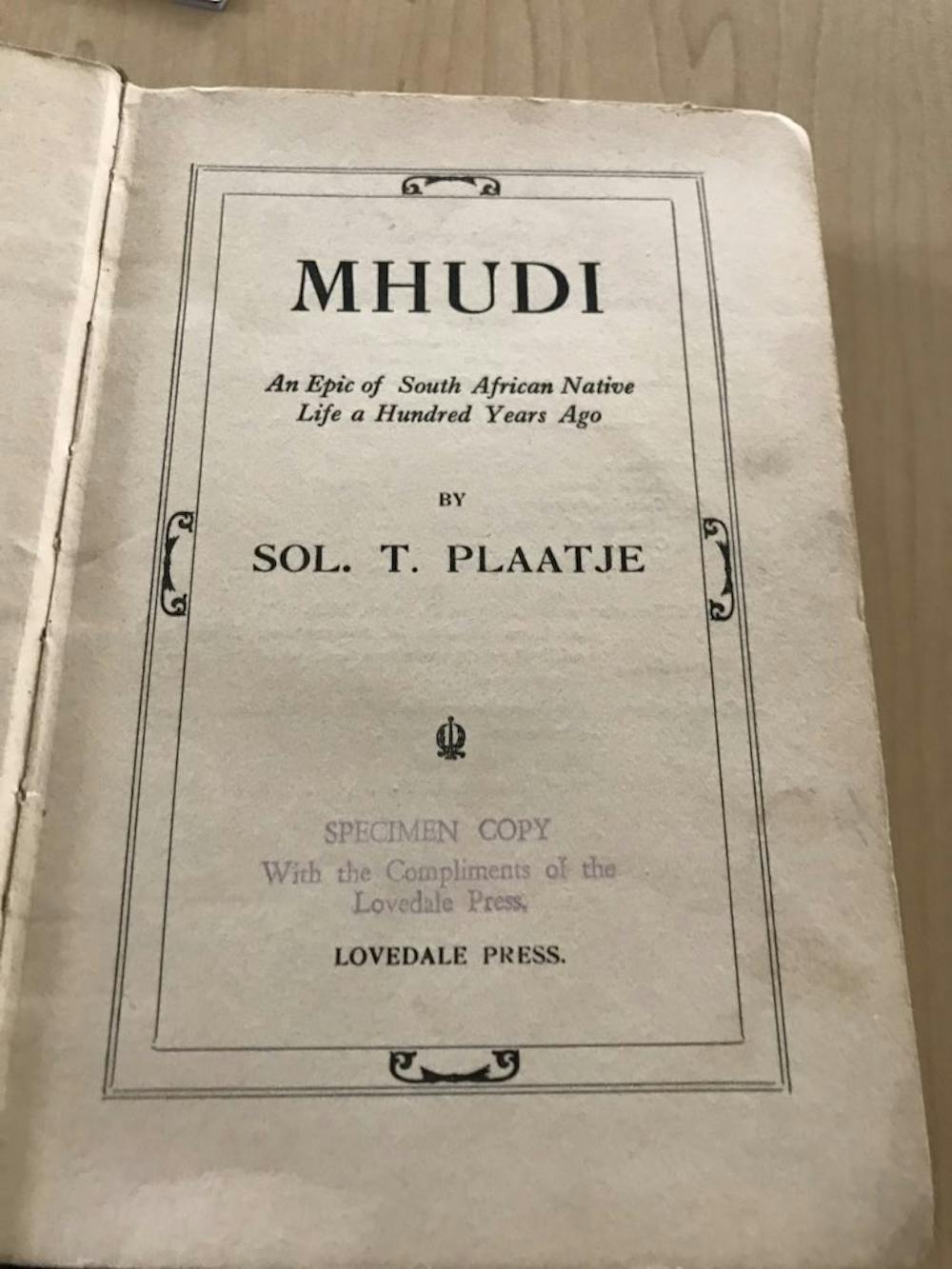
An old book open at the first page, with text in an illustrated frame reading, 'Mhudi - an epic of South African Native Life a Hundred Years Ago.'
First edition of Mhudi, Lovedale Press.
Blessing Kgasa/Kanye Records Centre/Twitter

Mhudi’s relationships with these two women allow her to see the humanity of the Matabele and the Boers, who she had, until this point, seen as inhumane and violent. This is because these two women also express their disapproval for unjust violence and suffering.

Mhudi’s friendships with these two exceptional women and their significance has been discussed in feminist analyses of the novel. However, the collective solidarity that Mhudi has with Barolong women has not really been considered. And yet, this is important in how we understand Plaatje’s view of resistance. We can see this idea of collective solidarity – standing together – in a story Mhudi tells Ra-Thaga about how she escaped being killed by a lion when she was a girl.

The story goes that Mhudi is out picking berries with a number of other Barolong girls and comes face-to-face with a lion. The other girls initially run away, but when they see Mhudi is paralysed with fright they run back and manage to scare off the lion. The fact that the girls are willing to return to Mhudi, even to die alongside her, suggests a deep sense of solidarity and commitment, the kind that arguably binds together successful political movements.

The individual and the collective

The reception of the lion story among the Barolong shows a tension between the collective and the individual. Ra-Thaga knows the story well. Mhudi’s bravery has been celebrated and she has even been called a heroine. However, the collective role of the girls in saving her has been lost in the story’s retelling.


Read more:
Conversing across a century with thinker, author and politician Sol T Plaatje


We might understand this as a critique of individual heroism in stories of resistance (especially if we read the lion as a symbol of British and other imperialism) to the exclusion of the recognition of the collective that makes resistance possible.

It’s significant that Mhudi’s most productive relationships are with Barolong women from her community. Her relationship with Hannetjie has no real political impact besides shifting Mhudi’s view of the Boers. Despite herself and Hannetjie sharing a horror over the treatment of the servants, their friendship does not result in any material resistance to injustice.

Her relationship with Umnandi creates a deeper solidarity, as they both promise to use their influence on men to promote peace. However, it is her cousin looking after her children that allows her to make the journey that leads to her relationships with Umnandi and Hannetjie and to assisting her husband.
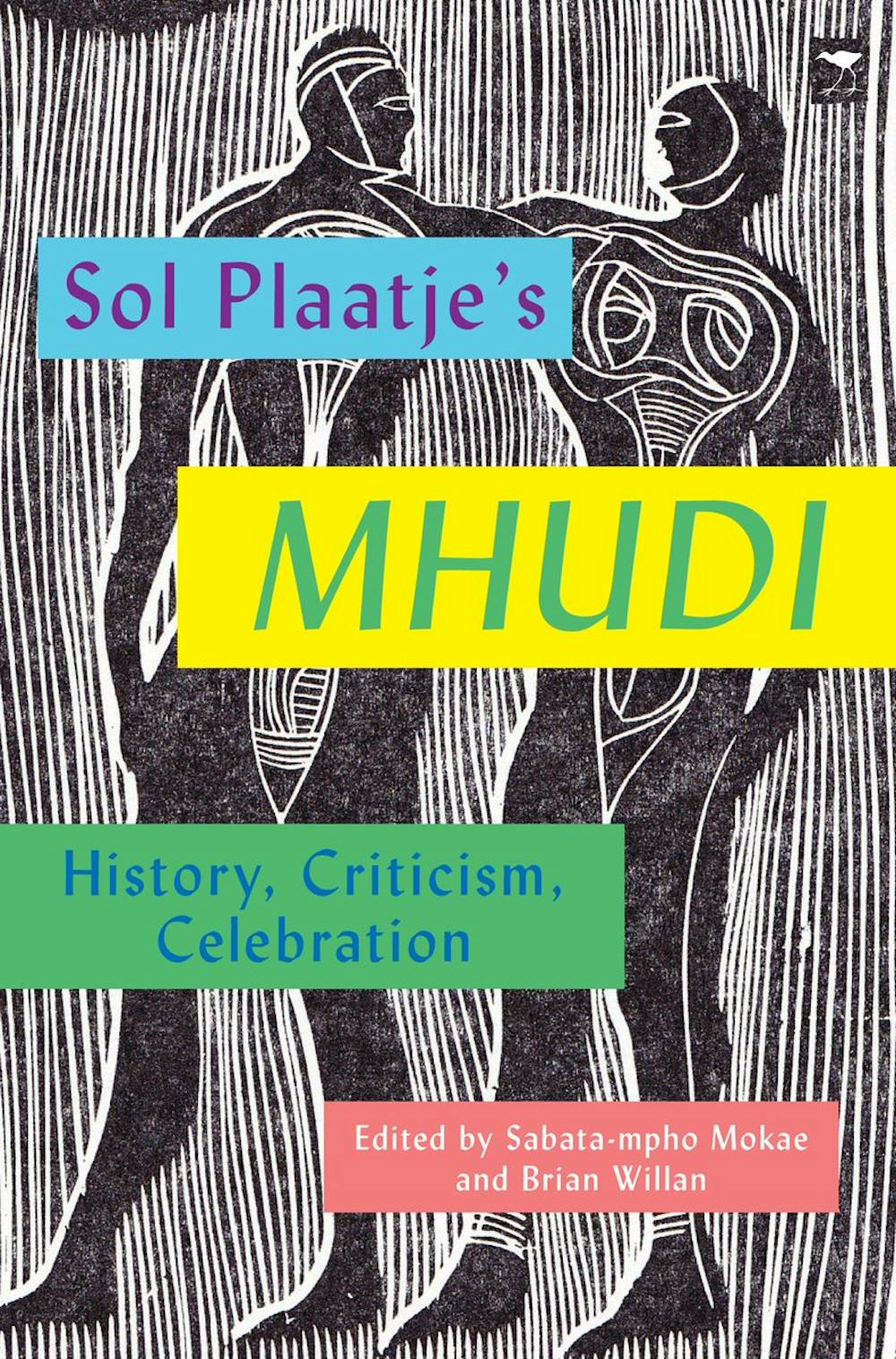
A book cover with a linocut-inspired illustration of a man and a woman, her arm around his shoulders.

Jacana Media

Therefore, I read in Mhudi a sense of the importance of collective, communal forms of solidarity. Even when resistance requires alliances across racial, ethnic and gender boundaries, it is the communal solidarities women form that allow for individual and boundary-crossing solidarities to exist.

This might serve as a reminder to consider how we intrepret Plaatje’s place in the history of struggle in South Africa. While Plaatje is a fascinating and notable figure, whatever legacy he has left us was created and preserved through solidarities with others.

This article is based on Jenny Boźena du Preez’s chapter in the book Sol Plaatje’s Mhudi: History, Criticism, Celebration published by Jacana Media.The Conversation

Jenny Boźena du Preez, Postdoctoral Fellow, Nelson Mandela University

This article is republished from The Conversation under a Creative Commons license. Read the original article.
Unknown's avatar

Anniversaries spark renewed readings of South Africa’s celebrated Sol Plaatje


Flowcomm/Flickr/Sol Plaatje House Museum

Chris Thurman, University of the Witwatersrand

Over the last decade, inquiry into the life and work of South African writer, intellectual and politician Solomon T. Plaatje has been spurred by a series of hundred-year anniversaries.

In 2010 it was the centenary of the formation of that dubious political and geographical structure, the Union of South Africa, which would shape the focus of Plaatje’s many projects until his death in 1932. It was also in 1910 that he founded his second Setswana-language newspaper, Tsala ea Becoana.

Two years later, Plaatje was one of the eminent group who formed the South African Native National Congress, which would later become the African National Congress (ANC). In 2012, when the ANC celebrated its centenary, Plaatje’s name was often cited, although he has been more readily associated with a cosmopolitan, erudite – “elitist”? – strand in the ANC that did not fit with the populist brand emphasised by the party in the shift from Thabo Mbeki’s presidency to Jacob Zuma’s.

There was another hundred-year anniversary in 2016, this time of the publication of Native Life in South Africa. The book was Plaatje’s seminal response to the passage of the Natives Land Act of 1913. This notorious piece of legislation set a traumatic tone for the dispossession, segregation and violent oppression that would characterise late-colonial and apartheid South Africa as the 20th century wore on.

Here was Plaatje in strident “Give back the land!” mode, an appealing figure to those advocating for more radical approaches to redressing the disenfranchisement of black South Africans.

The South African Native National Congress delegation to England, June 1914. Left to right: Thomas Mapike, Rev Walter Rubusana, Rev John Dube, Saul Msane, Sol Plaatjie.
Unknown photographer/Wikimedia Commons

The year 1916 is also significant in the field of Plaatje studies because it was when he contributed his short bilingual English-Setswana essay “A South African’s Homage” to the Book of Homage to Shakespeare.

Here again, we have the paradox of Plaatje writ large. The “Homage” signals his future undertaking as a translator of Shakespeare’s plays into Setswana. He saw this as complementary work to his wider promotion of the language. Yet his affinity for Shakespeare cannot be disconnected from his attachment to Britain and to its empire, his role indeed as an imperial apologist, which can seem difficult to reconcile with some of his other political and literary credentials.

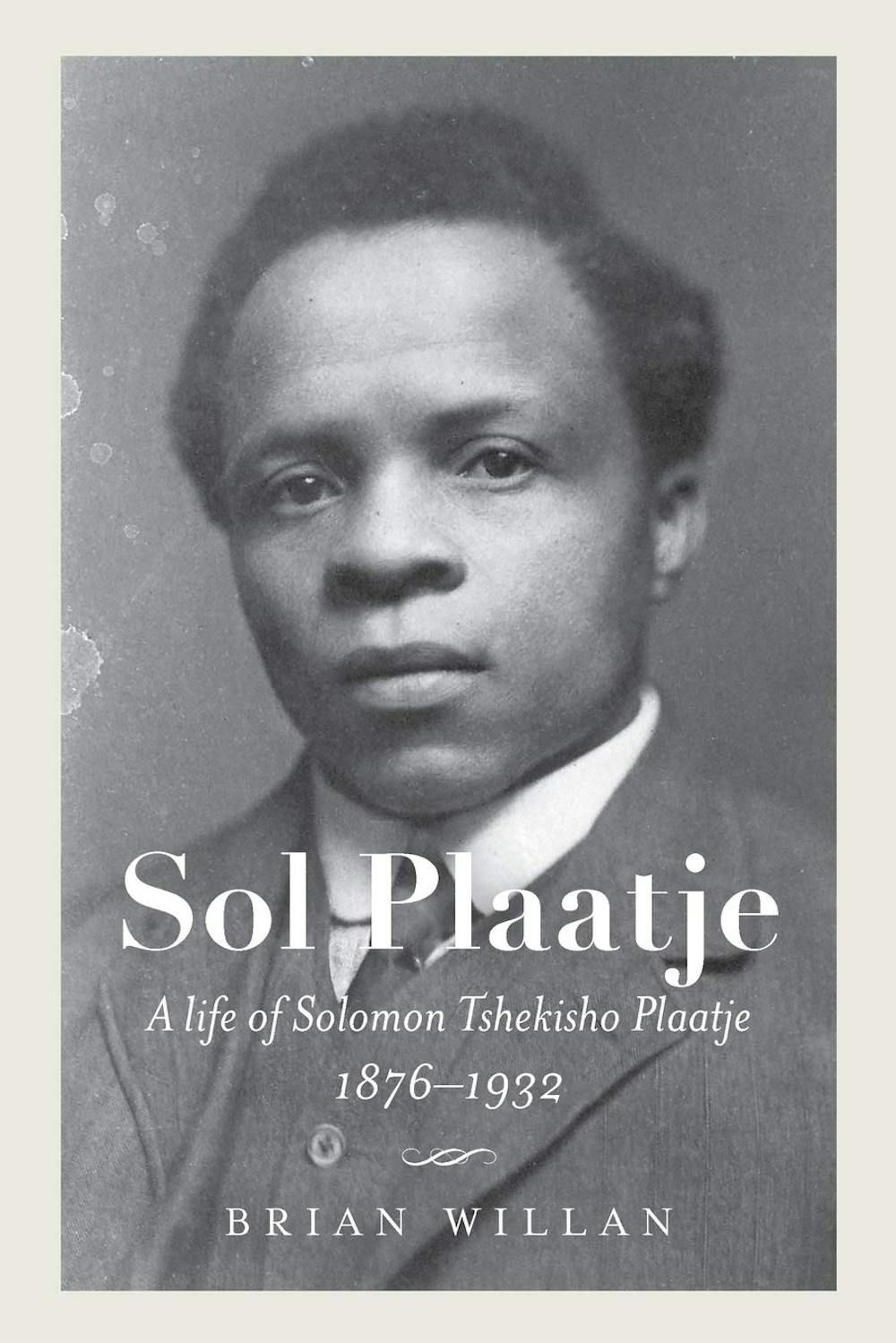
To make sense of this requires a deeper understanding of Plaatje’s historical context as well as his life’s trajectory, and the people, convictions, accidents and circumstances that shaped it. Happily, this is made possible by historian Brian Willan, who has chosen Plaatje as the main focus of his own life’s work and who knows his subject better than anyone else. Willan wrote a biography of Plaatje in 1984. The book seemed definitive until, in 2018, Jacana Media published his Sol Plaatje: A Life of Solomon Tshekisho Plaatje, 1876-1932.


Jacana Media

A magisterial biography

“Magisterial” is a word too often applied to biographies that don’t quite merit the moniker. But in the case of Willan’s book it is entirely apt. This may not be the final word on Plaatje. Nevertheless, it is a text to which all future scholars and researchers working on Plaatje will have to refer.

At almost 600 pages it is an encyclopaedic tome, documenting Plaatje’s life and times in rich detail. The true achievement of the book, however, is that it manages to do this in an engaging manner and with a prose style that – while never “chatty” – imagines a kind of conversation with the reader.

One can follow the chronological narrative, through 18 chapters marking out distinct periods in Plaatje’s astonishingly productive life. Alternatively one can dip into and out of its pages, navigating its riches via the index, or even flipping idly between phases and themes.

Fortunately, Willan is neither zealous nor jealous when it comes to his subject. His collaborations with other scholars have yielded fruit in various other Plaatje-oriented publications. In 2016, Wits Press published a collection of essays on Native Life co-edited by Willan, Bhekizizwe Peterson and Janet Remmington.

Mhudi gets a new collection

Later this year, Jacana will publish a similar collection, co-edited by Willan and fellow Plaatje biographer Sabata-mpho Mokae, focusing on Plaatje’s novel Mhudi. I am fortunate to be one of the contributors to this volume.

Mhudi appeared in 1930 after an exhausting 10-year battle to get it into print. So 2020 marks another centenary of sorts.

First edition of Mhudi, Lovedale Press.
Blessing Kgasa/Kanye Records Centre/Twitter

What are we to make of this novel, with its eponymous heroine and her husband Ra-Thaga, whose lives coincide with major colonial-era clashes in the first half of the 1800s?

It seems, by turns, to be an imperial romance and an allegory that is critical of empire; a naïve vision of interracial cooperation and a reminder that history is relentless in its cycles of violence.

Is it an affirmation of tribal tradition, or a feminist riposte to patriarchal culture? Is it a patchy experiment in need of an editor, or a genre-busting proto-postmodern pastiche influenced as much by oral narrative traditions as by the polyvocality of Shakespearean drama?

What is beyond question is the significance of Mhudi as the first novel in English by a black South African writer.

The next wave

Strandwolf’s new edition of Mhudi.

The novel’s original publisher, Lovedale Press, sadly faces the prospect of closure. But it is encouraging to note that other independent publishers have committed their resources to keeping Mhudi current. Blackman Roussouw’s Strandwolf imprint has brought out a new edition. Jacana also has plans to publish another edition alongside Willan and Mokae’s critical volume on the novel.

It is to be hoped that, by the time we reach the centennial celebration of Mhudi being published by Lovedale (1930) and the centennial commemoration of the author’s death in 2032, the new wave of scholarship on Plaatje will have challenged readers to grapple with this enigmatic, protean polymath anew.The Conversation

Chris Thurman, Associate professor, University of the Witwatersrand

This article is republished from The Conversation under a Creative Commons license. Read the original article.