In this time of pandemic, our authors nominate a work they turn to for solace or perspective.
Why do bad things happen to good people? It is a question that seems particularly pertinent during times of pandemic. Disease is no respecter of virtue. It is just as likely to strike down saint as sinner. Yet even in more normal times, this is a problem we confront with depressing regularity. All too easily one thinks of lives cut too short, of acts of kindness and generosity that go unrewarded. The world can be a cold and bleak place. Why does this happen?
Every culture develops its own answer to this question. For the Greeks and Romans, their solution was that tragedy occurred because the gods were at best indifferent to mankind, at worst downright cruel.
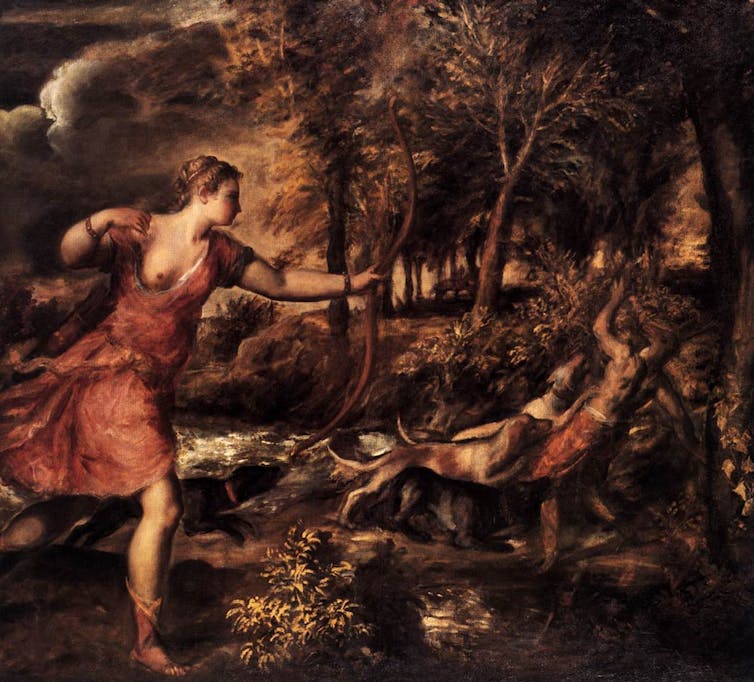
When I’m feeling my most pessimistic, I often think of this world view and, in particular, one story that the Greeks told. It is a story perfectly captured in one of treasures of the National Gallery in London, Titian’s The Death of Actaeon.
The story of Actaeon was one of the most popular of Greco-Roman myths. Its most famous retelling was undertaken by the Roman poet Ovid in his epic Metamorphoses. Titian had little Latin, so he almost certainly read about the myth in one of the many translations and abridged versions of Ovid that circulated in the 16th century.
It is a myth that shows well the sadism of the gods. Actaeon committed no crime. It was only an unfortunate coincidence that, one day while hunting, he happened to stumble across the goddess Diana (Greek: Artemis) as she and her retinue of nymphs were bathing in a forest pool.
Diana, who prized her virginity above all else, did not take kindly to being caught naked by this stranger and so she organised a terrible punishment. With a wave of her hand, she transformed Actaeon into a stag. The hunter now became the prey. To magnify the cruelty, Actaeon was still fully conscious, a man trapped in the body of a beast. Tears trickled down his now furry cheeks.
Instantly, Actaeon realised his danger. He had arrived with his pack of hunting dogs and they wasted no time turning upon their former master. The hounds seized his legs and dragged him to the ground. Their jaws bit deep into the shoulder, back, and throat. Actaeon died in agony torn apart by animals he had raised with such devotion.
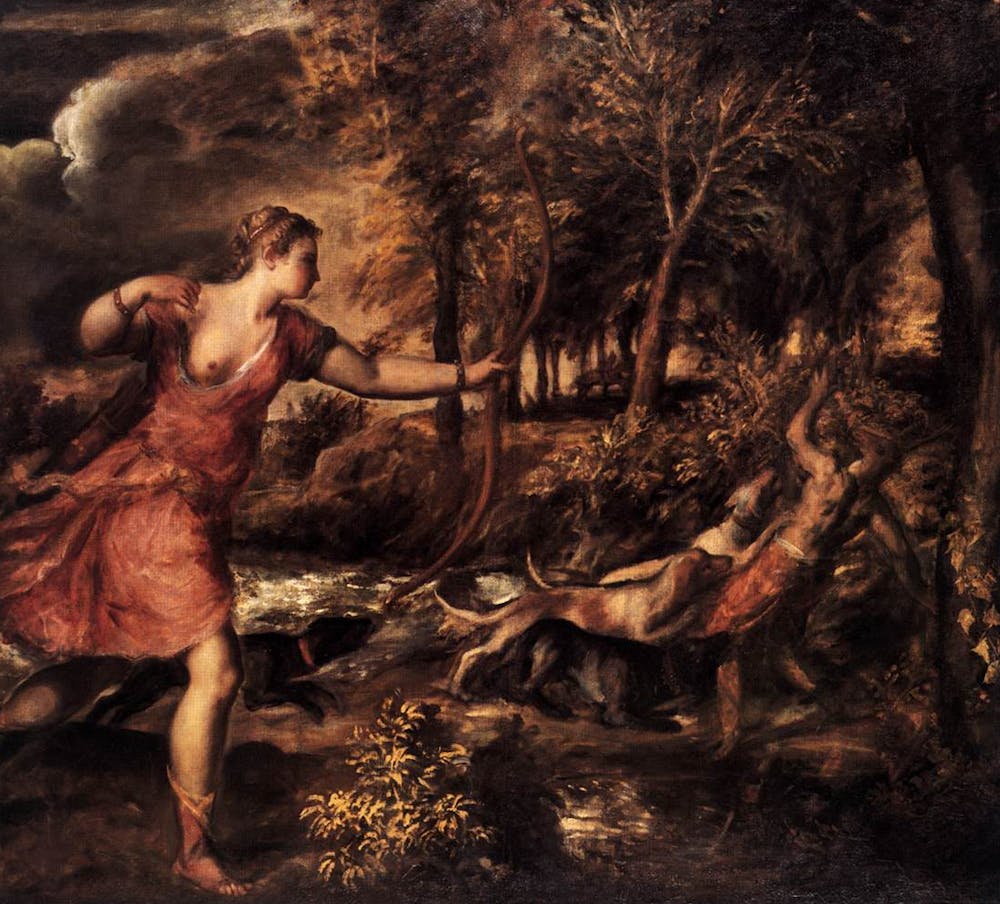
The Death of Actaeon depicts a world of unfair savagery. Wikimedia Commons
Titian’s version of this tale shows the final moments of Actaeon’s life. It is an extraordinary painting from the end of Titian’s career. Most paintings of this story prefer to focus on the moment when Actaeon encounters the bathing Diana. Unable to resist the voyeuristic potential of the scene, they indulge in a riot of naked female flesh.
There is an earlier Titian of precisely this moment which he painted for Philip II of Spain. Yet in The Death of Actaeon the voyeurism is limited to one exposed nipple, a visual allusion to Actaeon’s crime. Diana dominates the foreground, but the line of her arm draws the viewer’s eye to the figures on the right of the painting. Here we see Actaeon caught in mid-transformation. He still retains his human form, but his head is now that of a stag.
This is enough for the hounds, who have overwhelmed Actaeon. Man, deer, and dogs merge into one muddy, muddled heap, a confusion of forms so jumbled that many have wondered if the painting is actually finished – but in its commotion it perfectly captures the vicious vitality of the act. Against this chaos, Diana stands off to the side ready to administer the coup de grâce, the only form of kindness she is prepared to give.
How could the Greeks and Romans bear to live in a world in which such unfair savagery received divine approval?
Unpredictable forces
The death of Actaeon is emblematic of so much injustice. The ancient Greeks and Romans may not have really had to worry about the correct etiquette for dealing with naked divinities, but they did need to worry about equally unpredictable forces. Theirs was a world stalked by famine, disease, war, and natural disaster.
Yet, it was in facing up to the capriciousness of fate that the ancients found meaning in the world. When Ovid introduces the story of Actaeon, he reminds his readers that no man should be regarded happy until he is dead. The treasures that we possess today can all too quickly and easily be taken away tomorrow. In this we see the true value of Actaeon’s story.
The lesson is not that the world is cruel, but rather that the gifts that we possess need to be cherished for the hard-won, against-the-odds, bounties that they are. It is the absences and deprivations that give value to our lives.
Only the person who has been hungry can truly know what it is to be full. The child born into wealth will never appreciate the riches that they enjoy.
Disasters are inevitable. They should not make us give up on life, but rather we should celebrate the preciousness of that life all the more. To do otherwise is to let the gods and Fate win, to let them turn us into beasts.
Ovid’s Metamorphoses (AD 3-8) was not originally as controversial as his other poetic works. But as centuries have passed, its notoriety has increased. Recent calls to provide trigger-warnings to university students before they study the work tell us as much about modern Western attitudes towards sex, violence and censorship as the Metamorphoses tells us about the gender politics of ancient Rome.
Ovid’s 15-book epic, written in exquisite Latin hexameter, is a rollercoaster of a read. Beginning with the creation of the world, and ending with Rome in his own lifetime, the Metamorphoses drags the reader through time and space, from beginnings to endings, from life to death, from moments of delicious joy to episodes of depravity and abjection.
Such is life, Ovid would say.
The madness and chaos of some 250 stories, spanning around 700 lines of poetry per book, are woven together by the theme of metamorphosis or transformation. The artistic dexterity involved in pulling off this literary feat is testimony to Ovid’s skill and ambition as a poet. This accomplishment also goes a long way in explaining the rightful place the Metamorphoses holds within the canon of classical literature, placed as it is beside other great epics of Mediterranean antiquity such as the Iliad, Odyssey and Aeneid.
Kicking against the pricks
But for some, the Metamorphoses sits uneasily alongside its more morally and patriotically sound predecessors. Like a troublesome younger brother, an embarrassment to the family, Ovid’s epic “kicks against the pricks,” to paraphrase the paraphrase of Nick Cave.
Ovid’s Metamorphoses, translation David Raeburn (2004). Penguin
The Homeric Iliad (c. 850 BC) soars to the literary heights of the sublime, and shows us how to live and die, to meditate on mortality, to embrace sorrow, to grip and then release hate, to truly love.
The Odyssey (c. 800 BC) takes us on an epic voyage forever leading towards home, sometimes making us laugh, and occasionally letting down its high-brow hair with some sex and infidelity. Yet, appropriate to the gravitas of epic poetry, the Odyssey is also about the journey of a man determined to maintain his heroic stature as he navigates all sorts of dangers in strange lands.
Some 700 years later, when the Homeric verses were still regarded as the benchmark for epic poetry, Virgil composed the Aeneid (19 BC). This Latin epic casts a patriotic spell over its audience in its evocation of the foundation of Rome from the ashes of Troy to the glory of the Augustan Age. Unlike his poetic successor, however, Virgil is alert to literary censorship under the reign of Augustus (63 BC-AD 19), Rome’s first emperor, and carefully navigates its perilous terrain.
Rome is great according to Virgil. It always has been. It always will be. But Ovid is not convinced, and he seeks to capture an epic world of uncertainty and destabilisation instead of “drinking the Kool-Aid” that flows from Augustus’ fountains.
Ovid’s graphic tales of metamorphosis begin with the story of Primal Chaos; a messy lump of discordant atoms, and shapeless prototypes of land, sea and air. This unruly form floated about in nothingness until some unnamed being disentangled it. Voilà! The earth is fashioned in the form of a perfectly round ball. Oceans take shape and rise in waves spurred on by winds. Springs, pools and lakes appear and above the valleys and plains and mountains is the sky.
The Untangling of Chaos, or the Creation of the Four Elements, Hendrik Goltzius, published 1589.
Lastly, humankind is made and so begins the mythical Ages of Man. And, as each Age progresses – from Gold, to Silver, to Bronze and finally to Iron – humankind becomes increasingly corrupt.
Ovid’s gods and humans never really escape the Age of Iron in the Metamorphoses. Throughout the epic, the setting that emerges in Book I functions as a brilliantly appropriate dystopic stage on which the poet-cum-puppeteer orchestrates his spectacles.
Hundreds of hapless mortals, heroes, heroines, gods and goddesses rise victorious, experience defeat, endure rape, and inevitably metamorphose into something other than their original forms. Chaos begins the world, and so into Chaos we are born, live and die. As the offspring of the Age of Iron, we must endure and struggle against corruption, brutality and injustice.
The Phoenician woman Europa was abducted by Zeus in the shape of a bull; she later gave birth to their son, King Minos. The Rape of Europa, Titian, 1560-1562.
A poem and a mistake
Ovid experienced a world of chaos and iron firsthand when, in AD 8, he was banished by Augustus. His wrongdoings were, in his own words, carmen et error (“a poem and a mistake”).
The poem was the Ars Amatoria (The Art of Love), a three-volume lovers’ handbook that explains the dos and don’ts of personal grooming, how to organise trysts with married women (get her maid “on side”), repairing a broken heart (surprise your “ex” while she’s in the middle of her beauty routine – yuk!), names the best places for “hooking-up” (try the races or the theatre), and offers advice on keeping your girl (be attentive when she’s unwell). Interestingly, the third volume was written for women – quite a revolutionary move in view of the gender inequality in the twilight years of the 1st century BC.
The Art of Love, Ovid, translation by James Michie (2002). Modern Library
What irritated Augustus sufficiently enough to relegate the poet to the middle of nowhere was his perception that the Ars Amatoria made a mockery of his moral reforms. Not one for frolic, Augustus had spearheaded and implemented a series of legislative campaigns that raised the moral bar for the goodly citizens of Rome. Adultery, while always illegal in Rome, was made especially so under the watchful eye of the emperor and legal ramifications were more actively enforced than in previous decades.
The mistake that Ovid mentions is more difficult to identify – with scholarly opinions differing on what it was Ovid actually did to offend Augustus. Theories range from Ovid engaging in an affair with one of the imperial women – perhaps Augustus’ daughter (Julia the Elder) or granddaughter (Julia the Younger) – to his accidentally witnessing an imperial scandal.
Whatever the error, combined with the ill-themed Ars Amatoria, it was sufficiently serious to result in Ovid’s banishment to Tomis (Constanța in modern-day Romania). Tomis, at the very edges of the Roman Empire, was regarded as a barbaric, frightening and uncivilised place. Ovid certainly painted it this way in his poetic epistles, the Tristia (Sorrows) and Epistulae Ex Ponto (Letters from the Pontus).
Forced to exist in a place where his native Latin was scarcely heard, Ovid’s despair is evoked in one of his most memorable couplets: “writing a poem you can read to no one / is like dancing in the dark.”
For the optimal punishment of Ovid, Augustus chose his location well, and he never reneged on his decision. Nor did his successor, Tiberius (42 BC-AD 37).
Ovid died in Tomis in AD 17.
An epic about silencing
In one of the definitive pieces of scholarship on the Metamorphoses, Reading Ovid’s Rapes (1992) by classicist Amy Richlin, it is argued that the epic was completed during Ovid’s time in Tomis. This may not initially appear to have any bearing on its content or intent, yet Richlin suggests a profound relevance:
The silenced victims, the artists horribly punished by legalistic gods for bold expression … read like allegories of Ovid’s experience …
Accordingly, Tomis not only gave Ovid time to augment the poem in view of his own experiences but, equally as important, its composition was being finalised during the emperor’s inquisition into the carmen et error.
Arachne challenged the goddess Athena in weaving; Athena turns Arachne into a spider. Illustration for Dante’s Purgatorio 12 by Gustave Doré.
Indeed, Ovid’s own silencing by Augustus may be seen to be enacted over and over again in the Metamorphoses in the most grotesque of ways. Ovid’s tales describe tongues being wrenched out, humans barking out their sorrows instead of crying, women transformed into mute creatures by jealous gods, and desperate victims bearing witness to their abuse through non-verbal means.
The Metamorphoses is an epic about the act of silencing.
Jealousy, spite, lust and punishment are also consistently present in Ovid’s chaotic world.
So is rape.
Rape is undoubtedly the most controversial and confronting theme of the Metamorphoses. It is the ultimate manifestation of male power in the poem and the hundreds of transformations that occur are often the means of escaping it.
An early tale of attempted rape is narrated in Book I, involving the nymph, Daphne and the god, Apollo. Intent on raping Daphne, Apollo chases her through the forest until, utterly exhausted, she calls out to her father, the river god Peneus to rescue her:
“Help, father!” she called. “If your streams have divine powers!
Destroy the shape, which pleases too well, with transformation!
Peneus answers his daughter’s entreaty, and Daphne is transformed into a laurel tree:
… a heavy torpor seizes her limbs,
her soft breasts are encircled with thin bark,
her hair changes into leaves, her arms change into branches,
her feet once so swift become stuck with stubborn roots,
her face has a leafy cover; only her elegance remains.
The tale of Daphne and Apollo, like so many stories in the Metamorphoses, is classified as an aetiological myth; that is, a narrative that explains an origin. But, as the excerpt above testifies, it is so much more than that.
Peneus weeps as Daphne escapes Apollo by turning into a tree. Apollo and Daphne, Nicolas Poussin, 1625.
Reading Ovid now
Where does a modern audience begin with a story such as Daphne and Apollo?
How do we begin to unravel the hundreds of other such tales that follow it?
During the last few years, the Metamorphoses has been challenged as a legitimate text for tertiary Humanities students. Defying the hundreds of years of pedagogical tradition that has seen the poem set for both Latin students and, more recently, literary students who study it in translation, the Metamorphoses has not only been interrogated by scholars such as Richlin, but has also been the subject of increased student complaints and calls for trigger-warnings.
In response to the growing number of objections to the work, academic and university executives have been called on to take a position – not only in relation to the Metamorphoses, but in response to other materials that are perceived to render the tertiary experience unsafe.
Chris Patten: we can’t rewrite history. Suzanne/Plunkett
How close such responses to the Metamorphoses verge on literary censorship or, in the words of one journalist, Literature Fascism, does not only depend on one’s philosophical or educational viewpoint. Equally as important to the debate, and the decisions that may ultimately result from it, is the life-experience of every individual in the classroom. Amid a class of students taking notes from a lecture on the Metamorphoses, for example, may be a rape survivor.
Current statistics from the United States in particular suggest that the likelihood of this is exceptionally high. Emerging statistics from across Australia are painting a similar picture.
Such a situation requires alertness and sensitivity when handling texts such as the Metamorphoses. But should the work of Ovid be banned or placed among the shelves marked “Warning: Wicked Books”? What would such measures ultimately achieve? Would it augment safe spaces? Or, would it censor discussions around rape and shut down interrogations of sex, violence and female exploitation? Would it silence one of the means of opposition to the societal sickness of rape?
Barrie Kosky: Ovid helped inspire The Lost Echo. NewZulu/AAP
The Metamorphoses of Ovid has had a long and fascinating history. Its presence among the literary canon of the West has functioned as a strange but valuable mirror that has, for over two millennia, reflected social, moral and artistic customs.
From the time that Shakespeare read Arthur Golding’s 1567 translation and incorporated so many of the stories into his plays, to the thousands of artworks that have been inspired by the poem, to Barrie Kosky and Tom Wright’s 2006 extravaganza, The Lost Echo, to the production in the 2016 Sydney Fringe, to the student protests and the calls for trigger-warnings, the Metamorphoses – much like Ovid himself – simply refuses to go away.





 At the BookShelf