
Unknown's avatar

How the moral lessons of To Kill a Mockingbird endure today


File 20180803 41331 17gzzrr.jpg?ixlib=rb 1.1
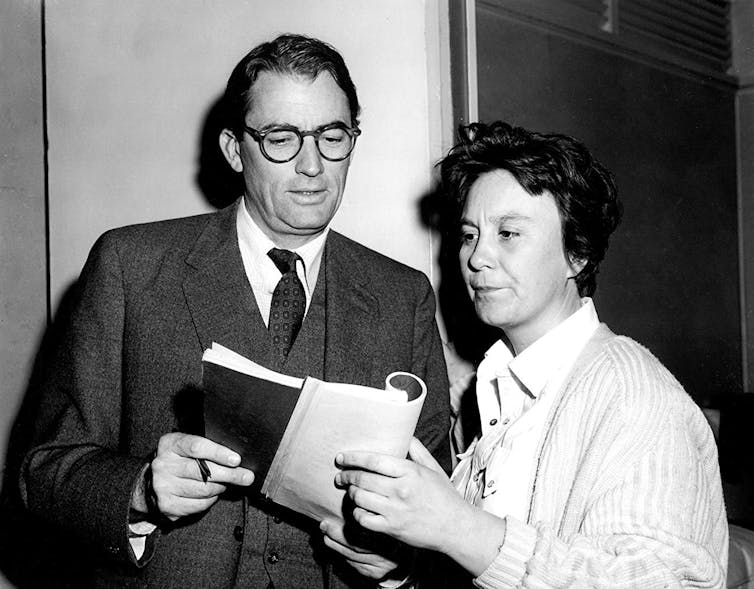
Gregory Peck and Harper Lee on the set of To Kill a Mockingbird.
Universal Pictures/IMDB

Anne Maxwell, University of Melbourne

In our series, Guide to the classics, experts explain key works of literature.


Harper Lee’s To Kill A Mockingbird is one of the classics of American literature. Never out of print, the novel has sold over 40 million copies since it was first published in 1960. It has been a staple of high school syllabuses, including in Australia, for several decades, and is often deemed the archetypal race and coming-of-age novel. For many of us, it is a formative read of our youth.


Read more:
‘Great books’, nationhood and teaching English literature


The story is set in the sleepy Alabama town of Maycomb in 1936 – 40 years after the Supreme Court’s notorious declaration of the races as being “separate but equal”, and 28 years before the enactment of the Civil Rights Act. Our narrator is nine-year-old tomboy, Scout Finch, who relays her observations of her family’s struggle to deal with the class and racial prejudice shown towards the local African American community.

At the centre of the family and the novel stands the highly principled lawyer Atticus Finch. A widower, he teaches Scout, her older brother Jem, and their imaginative friend Dill, how to live and behave honourably. In this he is aided by the family’s hardworking and sensible black housekeeper Calpurnia, and their kind and generous neighbour, Miss Maudie.

It is Miss Maudie, for example, who explains to Scout why it is a sin to kill a mockingbird: “Mockingbirds don’t do one thing but make music for us to enjoy. They don’t eat up people’s gardens, don’t nest in corncribs, they don’t do one thing but sing their hearts out for us.”

Throughout the novel, the children grow more aware of the community’s attitudes. When the book begins they are preoccupied with catching sight of the mysterious and much feared Boo Radley, who in his youth stabbed his father with a pair of scissors and who has never come out of the family house since. And when Atticus agrees to defend Tom Robinson, a black man who is falsely accused of raping a white woman, they too become the target of hatred.

A morality tale for modern America

One might expect a book that dispatches moral lessons to be dull reading. But To Kill a Mockingbird is no sermon. The lessons are presented in a seemingly effortless style, all the while tackling the complexity of race issues with startling clarity and a strong sense of reality.


Read more:
William Faulkner diagnosed modern ills in As I Lay Dying


As the Finches return from Robinson’s trial, Miss Maudie says: “as I waited I thought, Atticus Finch won’t win, he can’t win, but he’s the only man in these parts who can keep a jury out so long in a case like that.”

Despite the tragedy of Robinson’s conviction, Atticus succeeds in making the townspeople consider and struggle with their prejudice.

Atticus Finch delivers his closing statement in the trial of Tom Robinson in the 1962 film.

The effortlessness of the writing owes much to the way the story is told. The narrator is a grown Scout, looking back on her childhood. When she begins her story, she seems more interested in telling us about the people and incidents that occupied her six-year-old imagination. Only slowly does she come to the events that changed everything for her and Jem, which were set in motion long before their time. Even then, she tells these events in a way that shows she too young to always grasp their significance.

The lessons Lee sets out are encapsulated in episodes that are as funny as they are serious, much like Aesop’s Fables. A case in point is when the children return home from the school concert with Scout still dressed in her outlandish ham costume. In the dark they are chased and attacked by Bob Ewell the father of the woman whom Robinson allegedly raped. Ewell, armed with a knife, attempts to stab Scout, but the shapeless wire cage of the ham causes her to loose balance and the knife to go astray. In the struggle that ensues someone pulls Ewell off the teetering body of Scout and he falls on the knife. It was Boo Radley who saved her.

Another lesson about what it means to be truly brave is delivered in an enthralling episode where a local farmer’s dog suddenly becomes rabid and threatens to infect all the townsfolk with his deadly drool.

Scout and Jem are surprised when their bespectacled, bookish father turns out to have a “God-given talent” with a rifle; it is he who fires the single shot that will render the townsfolk safe. The children rejoice at what they consider an impressive display of courage. However, he tells them that what he did was not truly brave. The better example of courage, he tells them, is Mrs Dubose (the “mean” old lady who lived down the road), who managed to cure herself of a morphine addiction even as she was dying a horribly painful death from cancer.

He also teaches them the importance of behaving in a civilised manner, even when subjected to insults. Most of all Atticus teaches the children the importance of listening to one’s conscience even when everyone else holds a contrary view: “The one thing that doesn’t abide by majority rule”, he says, “is a person’s conscience.”

The continuing value in Atticus’ belief in the importance of principled thinking in the world of Black Lives Matter and the Australian government’s rhetoric of “African gangs”, is clear.

Atticus’ spiel on “conscience” and the other ethical principles he insists on living by, are key to the enduring influence of the novel. It conjures an ideal of moral standards and human behaviour that many people still aspire to today, even though the novel’s events and the characters belong to the past.

Lee herself was not one to shy away from principled displays: writing to a school that banned her novel, she summed up the source of the morality her book expounds. The novel, she said, “spells out in words of seldom more than two syllables a code of honor and conduct”.

Fame and obscurity

When first published the novel received rave reviews. A year later it won the Pulitzer Prize for Literature, followed by a movie version in 1962 starring Gregory Peck. Indeed, the novel was such a success that Lee, unable to cope with all the attention and publicity, retired into obscurity.

Interviewed late in life, Lee cited two reasons for her continued silence: “I wouldn’t go through the pressure and publicity I went through with To Kill a Mockingbird for any amount of money. Second, I have said what I wanted to say, and I will not say it again.”

The latter statement is doubtless a reference to the autobiographical nature of her book. Lee passed her childhood in the rural town of Monroeville in the deep south, where her attorney father defended two black men accused of killing a shopkeeper. The accused were convicted and hanged.

Undoubtedly influenced by these formative events, the biographical fiction Lee drew out of her family history became yet more complex upon the publication of her only other novel, Go Set a Watchman, in 2016. Critics panned it it for lacking the light touch and humour of the first novel. They also decried the fact that the character of Atticus Finch was this time around a racist bigot, a feature that had the potential to taint the author’s legacy.


Read more:
Review/ Has Go Set a Watchman helped topple the notion of the white saviour?


Subsequent biographical research revealed that Go Set A Watchman, was not a sequel, but the first draft of To Kill a Mockingbird. Following initial rejection by the publisher Lippincot, Lee reworked it into the superior novel many of us know and still love today.

<!– Below is The Conversation's page counter tag. Please DO NOT REMOVE. –>
The Conversation

Lee gave us the portrait of one small town in the south during the depression years. But it was so filled with lively detail, and unforgettable characters with unforgettable names like Atticus, Scout, Calpurnia and Boo Radley that a universal story emerged, and with it the novel’s continuing popularity.

Anne Maxwell, Assoc. Professor, School of Culture and Communication, University of Melbourne

This article was originally published on The Conversation. Read the original article.

Unknown's avatar

Harper Lee Estate Sues


The link below is to an article reporting on Harper Lee’s estate suing the Broadway production of ‘To Kill A Mockingbird.’

For more visit:
https://www.theguardian.com/books/2018/mar/15/harper-lee-estate-sues-over-broadway-version-of-to-kill-a-mockingbird

Unknown's avatar

Harper Lee, To Kill a Mockingbird author, led a life of great courage


Richard Gray, University of Essex

The death of Harper Lee is big news. Bigger than the deaths of most major writers.

Why? It isn’t because she made worldwide headlines last summer due to the controversy over the recent publication of Go Set A Watchman. That book was initially described as a sequel To Kill A Mockingbird, but is now generally regarded as a shoddy first draft of Lee’s 1960 Pulitzer Prize winning work. It is pretty disappointing.

But Go Set a Watchman does help to suggest why To Kill A Mockingbird made such an impact when it appeared and continues to do so. The 1960 novel, unlike the book published in 2015, is committed without being preachy. It makes serious points about race, class and the sheer delight and agony of growing up in the only way fiction can and should – by immersing its readers in the lives of its characters. And it tells a story that is simultaneously instructive, insightful and gripping. In short, it makes a difference – to the life, that is, of anyone who ever reads it.

Which brings me back to why the death of Harper Lee is such an event. Without question, To Kill A Mockingbird is one of the most important books written by an American in the latter half of the 20th century.

If that sounds like hype, just consider a few facts and figures. A 1991 survey of 5,000 Americans conducted by the Library of Congress to determine which book had made the greatest difference in their readers’ lives listed To Kill A Mockingbird as second only to the Bible. One of president Bill Clinton’s closest friends, James Carville, declared in his memoir that reading Lee’s novel when he was 16 “changed everything” for him. “When I got to the last page,” Carville said:

I closed it and said, ‘they’re right and we’re wrong’. The issue was literally black and white, and we [white southerners] were absolutely, positively on the wrong side.

So thoroughly has To Kill A Mockingbird permeated contemporary culture and popular discourse, and American culture in particular, that the battle over Clinton’s impeachment included a debate about the meaning of the novel. Special prosecutor Kenneth Starr attempted to co-opt the hero of To Kill A Mockingbird, lawyer Atticus Finch, for the prosecution. Clinton’s personal attorney, David E Kendall, retaliated with an opinion column in the New York Times titled “To Distort a Mockingbird”, in which he interpreted the moral values of the novel in defence of the president.

The point, both men knew, is that they could make such claims for and against a beleaguered president with the confidence that their audience – American voters, the general public at home and abroad – would know who and what they were talking about. After all, in the United States, To Kill A Mockingbird was, until this moment, the most widely assigned reading of any living author in US high schools; and, among all English language authors living or dead, she remains only below William Shakespeare, Nathaniel Hawthorne and Mark Twain. To Kill a Mockingbird has sold over 30m copies in English worldwide, and has been translated into 40 languages.

“Real courage” goes one of the most memorable quotes in To Kill A Mockingbird, “is … when you know when you’re licked before you begin, but you begin anyway and see it through no matter what”. Harper Lee showed real courage throughout her life – not least, by writing a book that went against the tide of majority white opinion in the American South at the time. Her reward for that courage is to be loved by generations of readers, who have discovered – and will continue to do so – that reading her work can change everything.

The Conversation

Richard Gray, Professor in English Literature, University of Essex

This article was originally published on The Conversation. Read the original article.

Unknown's avatar

More on the Death of Harper Lee


Unknown's avatar

Harper Lee Has Died


Unknown's avatar

Review/ Has Go Set a Watchman helped topple the notion of the white saviour?


Michelle Smith, Deakin University

Last week on Facebook, a friend declared she will now abandon plans to name any future son of hers Atticus. She is not alone among fans of Harper Lee’s To Kill a Mockingbird (1960), including thousands of parents of young Attici who are dismayed that the legacy of a heroic character who – so it goes – stood against the tide of racism in 1930s Alabama, is now revealed as a bigot in Go Set a Watchman, published last week, 55 years after its predecessor.

In newspaper reports, the draft that Lee allegedly wrote prior to her classic novel is described as potentially horrifying in its revision of a “literary saint”.

Go Set a Watchman’s Atticus Finch, now aged 72, keeps a lurid pamphlet – The Black Plague – among his reading material and once attended a Ku Klux Klan meeting. He welcomes racist, pro-segregation speakers at the Maycomb County Citizens’ Council meetings. In heated conversations with his daughter Jean Louise (the adult Scout, who was the child narrator of To Kill a Mockingbird), he warns about a future in which there might be “negroes by the carload in our schools and churches and theaters” and in which full civil rights might see white southerners politically “outnumbered”.

The anxiety about how this depiction of Atticus Finch might taint his saintly status, which was especially fostered by his filmic portrayal by Gregory Peck in 1962, is summed up by a New Yorker cartoon published last week. It shows a metallic Terminator lined up outside a book store with the caption:

I’ve been sent from the future to stop Harper Lee from complicating the legacy of a beloved fictional character.

Michigan bookseller Brilliant Books is offering “refunds and apologies” to customers who have bought Go Set a Watchman. The store has even published an opinion piece discouraging readers who are looking for a “nice summer novel” from purchasing it, and suggest the book is best suited for “academic insight”.

Though the novel has received a number of scathing reviews, it still has the potential to not only allow readers to encounter other facets of Jean Louise as an adult through her narration, but to be forced to rationalise a story in which there is no reassuring resolution to racial inequality.

In To Kill a Mockingbird, Atticus Finch explains that “Every mob in every little Southern town is always made up of people”. In Go Set a Watchman, Atticus loses his distinctive identity to become a member of the mob.

We might be shocked by an Atticus Finch who supports racial segregation, but the flawed Atticus might not be as fraught as his initial infallible depiction, or at least Scout’s – and most readers’– belief in it. The heroism of Atticus might never have issued from his being an exceptional man immune to the racism that permeated the American south.

To Kill a Mockingbird has always been a problematic novel with respect to race. While several generations have read Lee’s novel in high school as a way to discuss the history of racial prejudice, it does not mean that the story was not also influenced by the racist culture into which it was written.

This is not to charge Lee with racism, but to note that many people, including African-American author Toni Morrison consider Mockingbird to be a “white saviour narrative”. Such stories might be well-intentioned, but as Morrison pointed out, they sideline people of colour from playing any role in fighting for equal rights or defending themselves.

To Kill a Mockingbird presents racism from a white perspective and, like Atticus’s courtroom defence, gives little voice to and insight from its tragic victim, Tom Robinson.

Moreover, Atticus Finch never defends Tom because of his interest in civil rights or countering racial discrimination. He was assigned the case, rather than making a choice to represent Tom. He is largely motivated by the principle of equality and fairness before the law, noting that a man of “any color of the rainbow […] ought to get a square deal in the courtroom”.

In Go Set a Watchman, the focalising view of Scout Finch, a six-year-old child, is replaced by the adult perspective of Jean Louise, which necessarily brings with it a more sophisticated understanding of events and the potential for inner contradictions. After she has her illusions of her father shattered, Jean Louise is surprised to see that he still looks the same; she doesn’t know why “she expected him to be looking like Dorian Gray or somebody”.

Lee is thought to have based the character of Atticus upon her own lawyer father. Amasa Coleman Lee had comparatively liberal views on race. He defended two black men accused of murder, and had a verbal confrontation with members of the Ku Klux Klan. Yet he was also a segregationist and resisted integrated schools.


John Perivolaris

The Atticus Finch produced by the combined picture of To Kill a Mockingbird and Go Set a Watchman is a similar figure in his progressiveness, in some respects, and susceptibility to inherited views about racial hierarchy. Lee’s father and Atticus are also not unusual in being highly respected men, with a reputation for compassion, who also subscribed to racist ideology.

In To Kill a Mockingbird, Atticus Finch tells Scout’s brother Jem that there was once a Klan in Maycomb in 1920, but that it was “a political organization more than anything” and that they “couldn’t find anybody to scare”.

In Go Set a Watchman, Atticus Finch has attended one KKK meeting, ostensibly to discover the men behind the masks. As Jean Louise’s suitor, Henry, explains, the organisation was once “respectable, like the Masons” and the Wizard of the chapter was actually the Methodist preacher.

Atticus Finch’s disturbing views on race accord with the worldviews that enabled the founding of the United States and other British colonies. One of the most quoted examples so far of Atticus’ racist turn is his claim that “The negroes down here are still in their childhood as a people”. Derivatives of recapitulation theory held that civilisations passed through stages of development much as a child develops into an adult.

In his 1904 book Adolescence, American psychologist G Stanley Hall ranked races on an evolutionary chain. He placed Christians of the Western World at the adult pinnacle and regarded the “primitive” races as “adolescent”, among which he included Hawaiians, South and North American Indians, the Irish and Africans.

Hierarchical ideas about race, and the infantilisation of non-white races, underpinned the founding of white settler colonies and justified genocide and slavery.

Racial prejudice was embedded in every element of the world in which Atticus Finch would have been raised. Go Set a Watchman notes that the picnic grounds at the historical Finch family property, the Landing, was used for “negroes [who] played basketball there” and that “the Klan met there in its halcyon days”.

The dilemma that Go Set a Watchman confronts us with is that a “good”, educated man, committed to upholding the right for all people to be equal before the law could also hold racist views that are almost universally understood as abhorrent today. And he is not alone. The men Atticus Finch sits alongside while listening to racist speakers are “[m]en of substance and character, responsible men, good men”.

Historically, we know that the hagiographic account of Atticus Finch, narrated by Scout in To Kill a Mockingbird, describes a man who is very unlikely to have been produced by the society in which he lived. Yet as a character he was eminently reassuring.


MarioMancuso

The nature of Atticus Finch also relates to the questions being raised about the provenance of Go Set a Watchman. There has been enormous speculation about when the novel was actually written. The official account from publisher HarperCollins holds that the work is Lee’s long-lost first manuscript of what was to become To Kill a Mockingbird.

It is accepted that editor Tay Hohoff read Lee’s initial manuscript and worked with her to recast the original story to focus on Scout’s life as a child. Go Set a Watchman itself, however, does not read like it was written prior to To Kill a Mockingbird.

In Go Set a Watchman, the central plot point of Atticus Finch’s defence of a black man against false rape charges occupies only three paragraphs. As Jean Louise observes the racist discussion of the Citizens’ Council in the county courtroom, she fleetingly remembers Atticus’ defence of an innocent black boy, who is successfully acquitted. His past statement “equal rights for all, special privileges for none” springs into her mind to interrupt the hateful chorus of voices:

kinky woolly heads…still in the trees….greasy smelly…marry your daughters…mongrelize the race…mongrelize…mongrelize….save the South”.

While it is certainly possible that Hohoff recognised the potential that Lee’s three paragraphs held as the lynchpin for a publishable novel, Go Set a Watchman seems to rely on a reader who is already familiar with Atticus Finch.

As Adam Gopnik wrote recently for the New Yorker, “it’s difficult to credit that a first novel would so blithely assume so much familiarity with a cast of characters never before encountered.”

In particular, a reader who was not aware of To Kill a Mockingbird would be hard-pressed to share “color blind” Jean Louise’s heightened reaction to her father’s complicity with the overarching current of racism in the south in the face of organised movements for racial equality, such as the NAACP.

Go Set a Watchman has little plot movement and turns on Jean Louise’s realisation on one of her annual visits from New York that her father – and other respectable men in her hometown – have changed as race relations have deteriorated.

Atticus Finch’s brother, Dr Jack Finch, eventually tells Jean Louise that she confused her father “with God”, never seeing him “as a man with a man’s heart, and a man’s failings”. Her struggle to accept a multi-dimensional, flawed Atticus is now mirrored in the cultural and critical reaction to the less palatable aspects of his character.

Readers are struggling to integrate Atticus Finch’s heroism in his spirited defence of a black man with his support of segregation and belief in the “backwardness” of African Americans.

Can Atticus’ beloved status endure after a novel that acknowledges that racism is often cloaked by respectability, or has Go Set a Watchman helped to topple the notion of the white saviour?

We’ll have to check on the popularity of “Atticus”, which has shot to the top of baby name lists in 2015, in a few year’s time.

The Conversation

Michelle Smith is Research fellow in English Literature at Deakin University.

This article was originally published on The Conversation.
Read the original article.

Unknown's avatar

The third book – Harper Lee may indeed have another ace up her sleeve


Lynda Hawryluk

We all love a good mystery. So what are we to make of claims and counterclaims currently playing out in the media about a possible “third book” in Harper Lee’s body of work, a companion piece to her classic To Kill a Mockingbird (1960) and the newly-released Go Set A Watchman (2015)? Is a third book possible?

Well, yes, it is.

In 1966, the Hanover County School Board in Richmond, Virginia declared To Kill a Mockingbird “immoral literature” and sought to have it banned from all school library shelves in their county. Still riding high on the success of the Pulitzer Prize-winning novel, but becoming jaded with and tired of the demands of public life, Lee nevertheless provided a response to the heated discussion being played out in the local newspaper in that county, beginning by explaining the reports she’d heard from Richmond had made her wonder if any of “[the board] members can read”.

She continued:

I enclose a small contribution to the Beadle Bumble Fund that I hope will be used to enrol the Hanover County School Board in any first grade of its choice.

Lee’s rapier wit and somewhat dark humour is not unlike that of the young Scout Finch’s innate rebelliousness and deep sense of justice, which many readers have already have seen playing out again in Go Set A Watchman, through Jean-Louise’s (the now grown-up Scout) conflicted relationship with her father, Atticus Finch.

This relationship, and particularly the rendering of Atticus Finch as a rather more complex man with segregationist overtones, has created in would-be readers and fans somewhat of an ethical dilemma – read the book, and risk tarnishing the image of one of the most beloved characters in American letters.

Atticus Finch is a man exalted like no other, particularly for one who’s occupation is a lawyer, and oft-cited as the reason many join the legal profession.

Real-life influences

Lee’s father AC Lee was also a lawyer, and it is to him both To Kill A Mockingbird and Go Set A Watchman are dedicated, along with Lee’s sister Alice, a lawyer with the distinction of having been the oldest practising lawyer in Alabama, only retiring a year or so before her death at 103 in November 2014.

While a respect for the law and a keen sense of justice ran in the family, it was Harper Lee who backed away from practising, leaving university just shy of a law degree to move to New York City to focus on writing. There are obvious commonalities between the portrayal of Jean-Louise in Go Set A Watchman and what we think we know of the life of Harper Lee, and it is through these close readings that we are given our only real glimpse at the writer herself.

Choosing a life away from home and the family trade seems characteristic of the strong-willed woman who wrote that blistering retort to the school board, and is evident in the index of Charles J Shields’ unauthorised biography, Mockingbird: A Portrait of Harper Lee (2006).

Under “Lee, Nelle Harper”, we find entries for: “Athleticism” (p. 77, 78), “Drinking of” (22, 99, 129, 185, 270), “Foul mouth of” (76, 78), “Humor” (89, 97, 112) and, tellingly, “Nonconformism of” (33, 35, 39, 55, 61, 76-77, 84, and 237).

Lee’s carefully guarded private life is one of the few things over which she has retained a sense of ownership. One only has to witness the almost distressed and soul-searching reactions to the re-imagining of Atticus Finch being played out across social media and in news columns to understand that To Kill A Mockingbird is a book that in many ways belongs to us now, not Lee.

Competing versions

Charles J Shields’ biography contains many references to the previous versions of To Kill A Mockingbird, and they are revealing, especially in light of claims there may be one more version of this much-loved and revered text.

We learn much about the labour Lee performed under the watchful eye of editor Tay Hohoff. The descriptions in Shields’ book of the “drafts, titles and revisions” refer not only to the extensive editing and revision the manuscripts were subject to, but also the progressive titles, with Go Set A Watchman being first offered to editors in 1957.

Go Set A Watchman is recorded on index cards from the publisher’s office as being received, and Lippincott’s (the publisher) staff track the manuscript’s development over time.

There followed a series of suggestions to an uncommonly compliant Lee, and this resulted in the shift in perspective to what we now know is Jean-Louise as a 26-year-old in Go Set A Watchman, to Atticus in the next full manuscript submitted. Chapter 5 of Shields’ unauthorised biography describes the next iteration of the novel in the chapter title: Atticus becomes To Kill a Mockingbird.

Atticus, then, would be the mysterious “third” book (chronologically, it would be the middle book of three). Hohoff’s name should figure largely in the eventual discussion of the changes made to the manuscripts, especially given the furore over the depiction of Atticus in Go Set A Watchman, and claims from Hohoff’s granddaughter that the editor would not have approved of the publication of Go Set A Watchman.

The new Atticus Finch

It seems evident that Hohoff’s steady hand guided Lee to a more flattering and progressive portrayal of Atticus Finch, one that may sit somewhere in the more moderate middle, if the manuscript of Atticus ever comes to light.

This is, by all accounts, the man AC Lee became later in life, and one Harper Lee enjoyed a good relationship with, developing a deep admiration for her father, as evidence by the dedications of both her best-selling books to him.

Perhaps in this third version of the man – in Atticus – readers would find, as Jean-Louise does (and as Harper Lee seemed to), a sense of balance and an acceptance of their differences. In the last pages of Go Set A Watchman we see this, with Jean-Louise helping the increasingly frail Atticus Finch into a car, expressing her love to him in words and yet thinking of him as “her old enemy” (p. 178).

There’s a quiet, devastating reference to her brother there too but then the dark Lee humour rears up and bites the reader, lest the scene lull us into a false sense of sentimentality.

Where Lee may have once responded with fiery retorts to a perceived slight against her work, the once rebellious nonconformist has been able to settle into something resembling acceptance – of her fame, of her status as a writer, of her life away from the limelight, which has regardless led to further scrutiny.

Questions still remain about the discovery and publication of Go Set A Watchman, including Lee’s participation and the role of her lawyer. It’s all part of what long time friends have described as the “delicious mystery” of Miss Lee.

Lee may still have one more ace up her sleeve, but Go Set A Watchman has already achieved some of what To Kill A Mockingbird did, both polarising and uniting readers – and leaving us ultimately wanting for more.

See also:
A long-lost friend reborn: what we can expect from Go Set a Watchman

The Conversation

Lynda Hawryluk is Senior Lecturer in Writing at Southern Cross University.

This article was originally published on The Conversation.
Read the original article.

Unknown's avatar

Go Set a Watchman Released


https://www.youtube.com/watch?v=3dokFj9Lu3M

Unknown's avatar

Harper Lee’s Go Set a Watchman Debuts First Chapter Online


Unknown's avatar

A long-lost friend reborn: what we can expect from Go Set a Watchman


Lynda Hawryluk

The provenance of To Kill a Mockingbird (1960) is perhaps less well known than the novel itself, which has come to be even less remarked upon than the legal travails and self-imposed isolation of the author who penned the work.

Even those who haven’t read To Kill A Mockingbird know Harper Lee, now 89, has been labelled a recluse, dogged by legal troubles, and has the distinction of having written what is regarded an American masterpiece without peer.

The Pulitzer Prize-winning To Kill A Mockingbird outsold the Bible in its early days, and has been regularly voted the greatest novel of the century.

Lee herself has refused major interviews since 1964, and though active in her local community – Monroeville, Alabama – she still preserves a steadfast and tightly held grip on her privacy.

Then the publication of Go Set a Watchman (to be released in full on July 14), heralded as Lee’s “lost novel” and a sequel to To Kill A Mockingbird, was announced on February 3, this year.

The author – who had been almost as well known for publishing just the one book as it being that book – and who’d maintained she’d never publish another book, was releasing another, and the publishing world and fans reacted accordingly.

In the history of publishing it’s hard to think of a longer lead-in time to a second novel, or a more highly-anticipated publication. The book’s first chapter has appeared, in a coordinated, global publicity campaign, today. Think Salinger goes on The View, or ABBA reforming, in terms of Least Likely Events to Happen. That Lee would release a second novel is an incredible, stunning second act.

Go Set a Watchman, whose title derives from Isaiah 21:6, may be the most anticipated novel in the last 55 years of publishing, for that is how many years have passed between the publication of what will be Lee’s two books.

Go Set A Watchman (2015) cover, Random House, Australia.
Image courtesy of Random House

The novel, though, is not a sequel, and in fact is the first iteration of the classic story of Scout, her brother Jem and their father Atticus. Back in 1957, Lee’s agent and friend Maurice Crain was impressed with the Southern Gothic-infused story of Maycomb County, but suggested revising Go Set a Watchman from the adult Scout’s voice reflecting on her childhood, and rewrite the novel with the adult Atticus as the focus.

The resulting novel, Atticus, was completed and submitted for appraisal. Crain and his wife Annie Laurie Williams, also an agent, encouraged the novice writer to re-tell the story again, this time from the child’s perspective. The result was To Kill a Mockingbird, where the six-year-old Scout – who grows up to be the adult Jean-Louise – is our guide in a coming of age story that tracks through summers with brother Jem and friend Dill, and the winters at school in the Deep South of the United States, sometime after the Crash.

The process of writing To Kill A Mockingbird took Lee the better part of seven years to complete, and the resulting novel has been an established part of the American canon ever since.

To say the expectation on Go Set a Watchman is enormous is an understatement, but the interest in Lee’s work has not wavered over the years. Harper Collins agreement to release Go Set a Watchman unedited is testament to this, but the quality of To Kill A Mockingbird speaks to an underlying faith in Lee’s abilities as a writer.

This faith is borne out immediately from the opening lines of Go Set a Watchman:

Since Atlanta, she had looked out the dining-car window with a delight almost physical. Over her breakfast coffee, she watched the last of Georgia’s hills recede and the red earth appear, and with it tin-roofed houses set in the middle of swept yards, and in the yards the inevitable verbena grew, surrounded by whitewashed tires. She grinned when she saw her first TV antenna atop an unpainted Negro house; as they multiplied, her joy rose.

They have a familiar and comforting cadence, like the voice of a loved aunt after a long absence. The lyrical qualities of To Kill A Mockingbird are evident in the opening description, and bring us back to familiar territory, albeit from the viewpoint of the adult we may have hoped Scout would become.

That Jean-Louise, the adult narrator, existed before Scout told us To Kill a Mockingbird seems immaterial, with distinct echoes of Scout’s fierce independence and unique perspective on life. There’s a recognisable sense of child-like wonder in Jean-Louise’s description of her train ride home to Maycomb; it’s the voice of the truly glad to be alive, looking upon the world with much the same inquisitiveness Scout possessed in To Kill A Mockingbird.

Yet the almost immediate reference to the name Jean-Louise reminds us that Scout – the child – isn’t telling this story.

This is the voice and attitude of a grown woman, reflecting on entirely adult concerns like marriage and adultery. Jean-Louise’s reflections demonstrate she has the wisdom of age, and they read like the thoughts of a deep and pragmatic thinker.

The grown-up Scout is, however, still rebellious and defying convention, self-possessed and assured, rejecting offers of help and marriage alike with a grim humour. Jean-Louise is a woman with a strong moral conscience, echoing the fierce sense of justice we were introduced to in To Kill A Mockingbird. The adult that Scout became seems at ease; settled within herself, and accepting of her eccentricities, even acknowledging their effect on others.

It’s like Lee needed to know and understand the adult before she could provide a realistic depiction of the child in To Kill A Mockingbird.

Jean-Louise’s voice is strong, direct and delivers pragmatic homilies, much in the vein of To Kill A Mockingbird, which begins with:

There was no hurry, for there was nowhere to go, nothing to buy and no money to buy it with, nothing to see outside the boundaries of Maycomb County.

Go Set A Watchman’s narrative voice brings us the maxim: “If you did not want much, there was plenty”. From this, one can deduce Go Set A Watchman may yet deliver the kind of deep parable that made To Kill A Mockingbird such a classic.

Lee’s ability with description is evident in the excerpt published today, with long sentences beautifully rendered and evoking a world long lost to history, but welcoming all the same. The evocative imagery pulls the reader back to the world of To Kill A Mockingbird, although in the first pages we are abruptly introduced to the death of a much-loved character.

A friend’s immediate reaction to reading the first chapter was to comment about her relief Atticus was still alive. Such is the connection with and enduring affection for these characters.

These moments of recognition feel like a long-lost friend reborn. Jean-Louise is a woman of her era; at once independent and confident. She provides a glimpse to a kind of feminism that Scout could not have known the word for. Jean-Louise is as flawed as any human, quite proud and strident in her opinion.

When she tells her prospective fiancée in the opening chapter “Go to hell then”, she provides a link between Scout and what we think we know of Lee, who was quoted as being “happy as hell” at the publication of Go Set A Watchman.

As well she should be. Where Lee faced much discussion and debate about the origins and authorship of To Kill A Mockingbird, Go Set A Watchman – we can expect – will provide us with an impressive glimpse into the development of a novel and a writer.

The Conversation

Lynda Hawryluk is Senior Lecturer in Writing at Southern Cross University.

This article was originally published on The Conversation.
Read the original article.