
Unknown's avatar

The Haunting of Bly Manor: why Henry James’s eerie tale still inspires so many adaptations


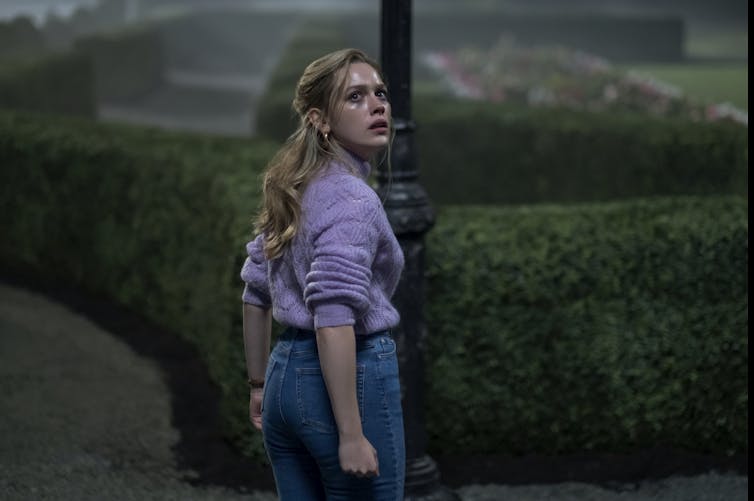
Dani, The Haunting of Bly Manor’s Governess.
EIKE SCHROTER/NETFLIX

Bethany Layne, De Montfort University

New on Netflix, The Haunting of Bly Manor is the latest in a long line of adaptations of Henry James’s The Turn of the Screw (1898) that began in 1954 with Benjamin Britten’s opera. Since then, there have been more than 25 others. Adaptors’ enduring fascination with James’s “irresponsible little fiction” can be summed up in a word: ambiguity.

It is the story of a young governess who comes to suspect that her deceased predecessor, Miss Jessel, and the late valet Peter Quint, are exerting a continued influence over her orphaned charges, Miles and Flora. This influence is not only spectral but quite possibly sexual in nature.

As James’s opening line predicted, “the story … held us”, and its readers quickly fell into two main camps. Metaphysical readers chose to “believe the governess” and believe in the ghosts, while psychological readers – most famously American writer Edmund Wilson in his 1934 essay – maintained that “the ghosts are not real ghosts … but merely the hallucinations of the governess”. She, in turn, was a “neurotic case of sex repression”, possibly acting out of a sublimated desire for her employer, the children’s uncle.

Yet neither metaphysical nor psychological readings proved able to contain this story, whose details stubbornly refuse to be explained away. If the valet Quint is a hallucination, how is the housekeeper able to identify him from the governess’s description? But equally, if he has an independent existence, why, as the literature academic Sheila Teahan has noted, does the governess associate him with the act of writing? The governess suggests that Quint is only as real as “the letters I form on this page”, implying that he is her creative construct.

James’s novella thus demands a third approach, of which literary critic Shoshana Felman’s Turning the Screw of Interpretation (1977) is among the finest examples. Rather than attempting to scare the tale into consistency, this reading recognises that its ambiguity is fundamental to its effect.

With this in mind, The Turn of the Screw’s appeal to adaptors might seem paradoxical. How can the ghosts’ objective reality remain uncertain when we see them walk, talk, and, in Britten’s case, sing a 12-tone opera? Yet adaptors have used a range of innovative strategies to maintain the text’s ambiguity. The term is usefully defined in a cinematic context by director Alexander Mackendrick, not as “a lack of clarity” but as a contrast between “alternative meanings, each of them clear”.

On-screen ambiguity

Director Jack Clayton recruited Stanley Kubrick to rework the original script for The Innocents (1961) with one clear remit: to maximise the tale’s ambiguity. In the resultant film, the scene at the lake offers at least two alternative meanings for the appearance of Miss Jessel.

We see the governess (Deborah Kerr) react to a figure standing among the rushes, but a few frames later, Jessel has vanished. Has she appeared and then disappeared, or has the governess simply imagined her? Flora’s troubled face is inconclusive, reacting as much to her governess’s agitation as to any apparition.

In The Others
(2001), an oblique adaptation, creator Alejandro Amenábar takes an innovative stance on the ghosts’ reality. Marooned in an isolated house in post-second-world-war Jersey, Grace (Nicole Kidman), a staunch Catholic, resists her children’s claims to hear ghosts. It transpires that they are actually hearing the house’s new owners and that it is the children and their mother who are the ghosts. Overwhelmed by grief at her husband’s death, Grace, we eventually learn, smothered the children before shooting herself.

The Others thus combines metaphysical and psychological readings of its source. The ghosts are, in a sense, “real” (though not what we are led to believe), while at the same time, the “governess” figure, Grace, is also established as untrustworthy.

In Tim Fywell’s 2009 BBC adaptation, the governess (Michelle Dockery) is a patient in a post-first-world-war mental institution, a frame narrative that invites viewers to question the legitimacy of her testimony. Yet when, having implicated herself in Miles’s death, she is taken away in a prison van to be executed, her psychologist briefly hallucinates that the guard is Peter Quint. Such details left me wondering, as the psychologist seemed to be, whether the governess was indeed guilty, or was being prematurely and irrevocably silenced.

The teaser for The Haunting of Bly Manor reprises the eerie O Willow Waly song from The Innocents, paying homage to this foundational adaptation. The line “we lay, my love and I, beneath the weeping willow”, sung in Flora’s (Amelia Bea Smith’s) treble, chillingly captures the novella’s preoccupation with childhood innocence exposed to adult sexuality. In many of the adaptations, these shivers are compounded by our inability to entirely trust what we see, generating unanswered questions that keep the adaptive wheel turning.

We are likely to see many more screen translations, and more of the literary appropriations I discuss in my book, of which AN Wilson’s A Jealous Ghost (2005) and John Harding’s Florence and Giles (2010) are examples. Viewers and readers will continue to find what Virginia Woolf found in 1921: this is a story that “can still make us afraid of the dark”.The Conversation

Bethany Layne, Senior Lecturer in English Literature, De Montfort University

This article is republished from The Conversation under a Creative Commons license. Read the original article.

Unknown's avatar

Henry James


The link below is to an article that takes a look at the life and work of Henry James.

For more visit:
https://blog.bookstellyouwhy.com/kicking-off-tombstones-henry-james-life-and-work

Unknown's avatar

The real Henry James will never stand up – that’s his greatest legacy


Hazel Hutchison, University of Aberdeen

On the evening of December 1 1915, Henry James collapsed with a stroke at his home in London. At first it seemed that he would recover, but over the following weeks the renowned American novelist’s condition was far from steady. On some days he would be cogent and conversational, on others he would call in his secretary and earnestly dictate letters in the persona of Napoleon. At times, his hand would move across the bedspread as through he imagined he was writing.

His brother’s widow Alice braved the hazardous war-time Atlantic crossing to be by his bedside. Devoted literary friends such as Edmund Gosse and Edith Wharton visited or kept in touch. In January 1916, James was awarded the Order of Merit for services to literature over a 50-year career, during which he had written some 20 novels and over 100 short stories. But he was 73 and his strength was fading. He had a history of heart trouble and depression, and he found the anxiety and grief of wartime exhausting. He died on February 28 the same year.

Vintage James.
Leo Boudreau, CC BY-SA

One hundred years later, James’s cultural standing is higher than ever. His work features in classic paperback series and university reading lists, and has been adapted for film, television and stage. His private life has been scrutinised and reinvented repeatedly in biography and bio-fiction – sometimes more creatively than accurately. His fiction and letters – over 10,000 still exist – are both in the process of being re-edited and republished. There are two international societies for scholars who are interested in studying his work.

This would all have been a surprise to James and his publishers, who never made as much profit from his work as they hoped. Many of his later novels failed to recoup their advances, and latterly he made more money from short stories placed in magazines. Even in his lifetime, James had a reputation as a difficult writer for clever readers. In fact, this reputation was part of his value in the magazine market, where his name on the contents page added a touch of literary class – whether his stories were read or not.

Yet in a world of cut-throat literary reputations, the author of The Portrait of a Lady, The Turn of the Screw and The Golden Bowl has survived while contemporaries like Sarah Grand, Hall Caine and Marie Corelli who outsold him spectacularly have all but vanished. James often explored this mismatch between popularity and lasting value in tales such as The Figure in the Carpet. Shrewdly, he also saw that what readers respond to is not the real writer, but a persona which they buy into or construct.

Henry James 1843-1916.
giuliaduepuntozero, CC BY-SA

James signs off

The last piece of writing James worked on before he fell ill was an essay about the young English soldier-poet Rupert Brooke. Brooke had died the previous April of blood poisoning on a troop ship in transit to Gallipoli, just weeks after the publication of his 1914 sonnets, including his best known poem, The Soldier. James knew him, and wrote to a mutual friend that this loss was so “stupid and hideous” that one could only “stare through one’s tears”.

James’s piece formed the introduction to Brooke’s travel essays, Letters From America, and was also a response to the mythology that sprang up around Brooke immediately after his death. In The Times, Winston Churchill had praised Brooke as the ideal of Englishness: “Joyous, fearless, versatile, deeply instructed, with classic symmetry of mind and body, ruled by high undoubting purpose.”

This obituary perhaps said more about Churchill and his agenda than about Brooke, however. Notably, it appeared alongside an appeal for more young men to enlist for military service. In contrast, James’s tribute focused on Brooke as a flawed human individual, while also making a strong claim that he be considered a “true poet” alongside Byron and Keats.

War-poet Rupert Brooke.

When Letters From America was published on March 8 1916, little more than a week after James’s death, this essay about the tension between a remembered person and a literary persona would have seemed even more poignant. Reviewing the book in the Times Literary Supplement the next day, James’s friend the biographer and critic Percy Lubbock said that the names of Rupert Brooke and Henry James were both “already a legend”, and “here run into one”.

Lubbock would later be appointed as James’s literary executor and given the tricky job of publishing his unfinished work and collecting his personal letters for publication. By editing and promoting his writing, Lubbock would play a major part in creating one of the most enduring versions of James, that of the serious literary craftsman and thoughtful, scrupulous student of human nature.

There are certainly many other versions of James, often contradictory: shy, self-assured, homosexual, heterosexual, altruistic, rapacious, self-aware and self-deluded. You might wonder where, a century on, we can ever find the real James. We can’t. Like his creation Hugh Vereker in The Figure in the Carpet, he has vanished, leaving us to puzzle endlessly over his rich and multi-layered work. That’s precisely the beauty of it, though. The fact that James’s work can be interpreted and reconfigured in so many different ways suggests that when we read his fiction, what we are really learning about is ourselves. And that, of course, is the hallmark of a great writer.

The Conversation

Hazel Hutchison, Senior Lecturer, University of Aberdeen

This article was originally published on The Conversation. Read the original article.

Unknown's avatar

Not My Review: The Golden Bowl by Henry James (1904)


The link below is to a book review of ‘The Golden Bowl,’ by Henry James.

For more visit:
http://www.theguardian.com/books/2014/may/26/100-best-novels-the-golden-bowl-henry-james