Unknown's avatar

From the Iliad to Circe: culture’s enduring fascination with the myths of Troy


Jan Haywood, The Open University

The story of the epic war fought over a woman has been told many times. It now lies at the heart of an exhibition at the British Museum opening on November 21. Troy: Myth and Reality introduces audiences to the history of the archaeological site of Troy (modern-day Hisarlik, Turkey), many of the different individuals caught up in the Trojan War, and various later responses to this powerful legend in drama and literature.

That the story of the Trojan War should be the subject of a blockbuster exhibition comes as little surprise. Ever since classical antiquity, audiences have been consistently telling and retelling stories about the site of Troy and the heroic war that was fought there between the Trojans and the Achaeans (later conflated with the Greeks). The most famous telling of all perhaps is the Iliad from the eighth century BCE, composed by Homer, a figure shrouded in mystery.

The Homeric poem captures the story of a dreadful, ten-year war fought between two nations. It shows the major influence of powerful men on the battlefield, such as the Trojan prince Hector and the commander of the Myrmidons, Achilles. For these individuals, deeds performed in war will secure them “everlasting fame” (κλέος ἄφθιτον in ancient Greek).

But the poem also illustrates the horrendous impact of the war far away from the battlefield. In one memorable passage, Briseis, the captive prisoner of Achilles, laments the slaughter of her husband and children. It is a heartbreaking account that shows acutely the universal misery brought on by the bloodshed of war.

Troy after Homer

Ever since Homer, people have looked to expand on and retell different aspects of the Trojan War in light of their own circumstances.

The fifth century BCE Athenian playwright Euripides produced several plays that depicted the aftermath of the conflict. In his Trojan Women, Euripides centres the widows of Troy and the hardships they endure at the hands of their Greek oppressors, who divide the women like booty between themselves. It is an uncompromising account that many have read as a biting commentary on the civil war fought between Athens and Sparta at the end of the fifth century BCE. The play does not glorify war and instead highlights its horrors through Troy’s displaced women.

Of course, the creation of refugees through warfare and the transportation of human bodies across geographic boundaries is a profound concern for audiences today. The ongoing Syrian civil war has created around 6.7m refugees, who have been dispersed across the globe. And the recent shocking discovery of 39 Vietnamese nationals’ bodies in a lorry in Grays, Essex on 23 October, 2019 is a ghastly reminder of the terrible conditions that many refugees have faced past and present.

Troy Today

In contemporary culture too, there has been a spate of interest in the stories and myths of Troy. The exhibition shows clearly the impact it has had on the visual arts. Highlights include a 1978 collage by the African-American artist Romare Bearden, titled The Sirens’ Song, which recasts Odysseus’ journey home after the war with African-American subjects. Bearden’s work employs the familiar story of Troy to give the African-American experience a universal and classical representation.

Another notable work is a print called Judgement of Paris (2007), pictured above, by the conceptual artist Eleanor Antin. The photo, which riffs on Peter Paul Ruben’s Judgement of Paris (1639), highlights the powerlessness of Helen who sits looking outwards, forced to the margins of the image. Antin’s work turns this on its head. Featured as part of a series called Helen’s Odyssey, the photo challenges a tradition that has often vilified the Spartan queen Helen for her involvement in the war.

A recent significant development has been the growing number of English-language fictional accounts about Troy written by women. These works retell and expand on various aspects of the Trojan War story from the perspective of the women involved. They range from Pat Barker’s The Silence of the Girls, which retells the Iliad from the perspective of the story’s women, to Madeline Miller’s bestseller Circe, a feminist exploration of certain events from the Odyssey. Such works offer a potent challenge to a tradition that has been wholly dominated by male authors and male-centred stories.

An especially impressive entry in this burgeoning group of women writers’ works on Troy is Alice Oswald’s 2011 poem Memorial, an idiosyncratic translation of the Iliad. The poem evokes various contemporary war memorials, such as the Vietnam Veterans Memorial in Washington DC, in its opening which lists the names of almost all the men whose deaths are reported in the Iliad.

What’s more, the poem records moments in which the soldiers of the Iliad die on the battlefield. In doing so, as in the Iliad, Oswald repeatedly draws attention to bereaved parents, widowed partners and fatherless children. In an age where technology has changed the methods and image of warfare, desensitising us to such violence, works like Memorial are a timely reminder of the human costs of deadly conflict.

It is clear, then, that Troy and the stories that surround it continue to shape culture thousands of years after the Trojan War ostensibly occurred. This is what makes the British Museum exhibition so relevant for audiences today. The story of the Trojan War is a story of universal suffering that stretches past the battlefield. It is a story that highlights the absurdity of war, which at its core holds sentiments that ring as true today as they did in antiquity.


Troy: Myth and Reality is on at The British Museum from November 21, 2019 – 8 March 8, 2020The Conversation

Jan Haywood, Lecturer in Classical Studies, The Open University

This article is republished from The Conversation under a Creative Commons license. Read the original article.

Unknown's avatar

Guide to the classics: Homer’s Iliad


File 20170720 24017 e3bjbj
The Greeks defend their ships from the Trojans in Alfred Churchill’s Story of the Iliad, 1911.
Wikimedia

Chris Mackie, La Trobe University

Homer’s Iliad is usually thought of as the first work of European literature, and many would say, the greatest. It tells part of the saga of the city of Troy and the war that took place there. In fact the Iliad takes its name from “Ilios”, an ancient Greek word for “Troy”, situated in what is Turkey today. This story had a central place in Greek mythology.

The poem deals with a very short period in the tenth year of the Trojan war. This sometimes surprises modern readers who expect the whole story of Troy (as, for instance, in Wolfgang Petersen’s 2004 film Troy). But Homer and other early epic poets confined their narratives to particular periods in the war, such as its origins, key martial encounters, the fall of the city, or the returns of the soldiers to Greece. There is no doubt that Homer and other early poets could rely on a very extensive knowledge of the Trojan war among their audiences.

Brad Pitt as Achilles in the film Troy.
Warner Brothers

The central figure in the Iliad is Achilles, the son of Peleus (a mortal aristocrat) and Thetis (a sea-goddess). He comes from the north of Greece, and is therefore something of an outsider, because most of the main Greek princes in the poem come from the south. Achilles is young and brash, a brilliant fighter, but not a great diplomat. When he gets into a dispute with Agamemnon, the leading Greek prince in the war, and loses his captive princess Briseis to him, he refuses to fight and remains in his camp.

He stays there for most of the poem, until his friend Patroclus is killed. He then explodes back on to the battlefield, kills the Trojan hero Hector, who had killed Patroclus, and mutilates his body.

The Iliad ends with the ransom of Hector’s body by his old father Priam, who embarks on a mission to Achilles’ camp in the gloom of night to get his son’s body back. It is worth noting that the actual fall of Troy, via the renowned stratagem of Greeks hidden within a Wooden Horse, is not described in the Iliad, although it was certainly dealt with in other poems.

All of this takes place under the watchful gaze of the Olympian gods, who are both actors and audience in the Iliad. The Olympians are divided over the fate of Troy, just as the mortals are – in the Iliad the Trojan war is a cosmic conflict, not just one played out at the human level between Greeks and non-Greeks. Ominously for Troy, the gods on the Greek side, notably Hera (queen of the gods), Athena (goddess of wisdom and war), and Poseidon (god of the land and sea), represent a much more powerful force than the divine supporters of Troy, of whom Apollo (the archer god and god of afar) is the main figure.

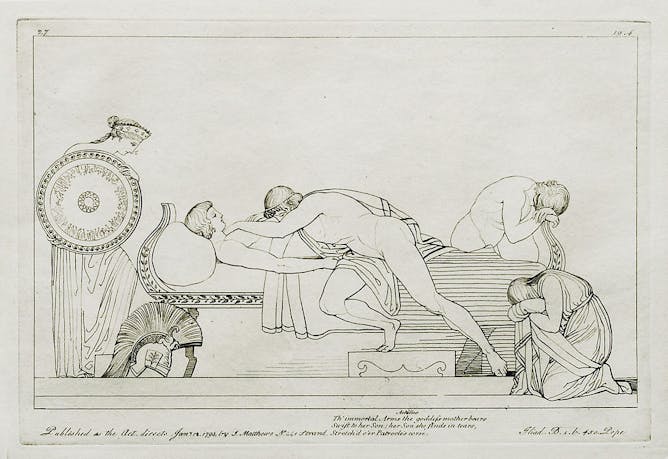
Achilles mourns the death of Patroclus.
John Flaxman, The Iliad, 1793

The many faces of Homer

The Iliad is only one poetic work focused on the war for Troy; many others have not survived. But such is its quality and depth that it had a special place in antiquity, and probably survived for that reason.

Achilles dragging the body of Hector behind his chariot. Vase circa 490 BC.

We know virtually nothing about Homer and whether he also created the other poem in his name, the Odyssey, which recounts the return journey of Odysseus from the Trojan war, to the island of Ithaca. The Iliad was probably put together around 700 BC, or a bit later, presumably by a brilliant poet immersed in traditional skills of oral composition (ie “Homer”). This tradition of oral composition probably reaches back hundreds of years before the Iliad.

Early epic poetry can be a way of maintaining the cultural memory of major conflicts. History and archaeology also teach us that there may have been a historical “Trojan war” at the end of the second millennium BC (at Hissarlik in western Turkey), although it was very unlike the one that Homer describes.

The Iliad was composed as one continuous poem. In its current arrangement (most likely after the establishment of the Alexandrian library in the early 3rd century BC), it is divided into 24 books corresponding to the 24 letters of the Greek alphabet.

It has a metrical form known as “dactylic hexameter” – a metre also associated with many other epic poems in antiquity (such as the Odyssey, and the Aeneid, the Roman epic by Virgil). In the Odyssey, a bard called Demodocus sings on request in an aristocratic context about the Wooden Horse at Troy, giving a sense of the kind of existence “Homer” might have led.

The language of the Iliad is a conflation of different regional dialects, which means that it doesn’t belong to a particular ancient city as most other ancient Greek texts do. It therefore had a strong resonance throughout the Greek world, and is often thought of as a “pan-Hellenic” poem, a possession of all the Greeks. Likewise the Greek attack on Troy was a collective quest drawing on forces from across the Greek world. Pan-Hellenism, therefore, is central to the Iliad.

Death and War

A central idea in the Iliad is the inevitability of death (as also with the earlier Epic of Gilgamesh). The poignancy of life and death is enhanced by the fact that the victims of war are usually young. Achilles is youthful and headstrong, and has a goddess for a mother, but even he has to die. We learn that he had been given a choice – a long life without heroic glory, or a short and glorious life in war. His choice of the latter marks him out as heroic, and gives him a kind of immortality. But the other warriors too, including the Trojan hero Hector, are prepared to die young.

The gods, by contrast, don’t have to worry about dying. But they can be affected by death. Zeus’s son Sarpedon dies within the Iliad, and Thetis has to deal with the imminent death of her son Achilles. After his death, she will lead an existence of perpetual mourning for him. Immortality in Greek mythology can be a mixed blessing.

The Iliad also has much to say about war. The atrocities in the war at Troy are committed by Greeks on Trojans. Achilles commits human sacrifice within the Iliad itself and mutilates the body of Hector, and there are other atrocities told in other poems.

The Trojan saga in the early Greek sources tells of the genocide of the Trojans, and the Greek poets explored some of the darkest impulses of human conduct in war. In the final book of the Iliad, Achilles and Priam, in the most poignant of settings, reflect upon the fate of human beings and the things they do to one another.

The archaeological site of Troy in western Turkey.
Jorge Láscar, CC BY

Postscripts and plagiarists

It was often said that the Iliad was a kind of “bible of the Greeks” in so far as its reception within the Greek world, and beyond, was nothing short of extraordinary. A knowledge of Homer became a standard part of Greek education, be it formal or informal.

Ancient writers after Homer, even the rather austere Greek historian Thucydides in the 5th century BC, assume the historicity of much of the subject-matter of the Iliad. Likewise, Alexander the Great (356-323BC) seems to have been driven by a quest to be the “new Achilles”. Plutarch tells a delightful story that Alexander slept with a dagger under his pillow at night, together with a copy of Homer’s Iliad. This particular copy had been annotated by Alexander’s former tutor, the philosopher Aristotle. One can only imagine its value today had it survived.

In the Roman world, the poet Virgil (70-19BC) set out to write an epic poem about the origins of Rome from the ashes of Troy. His poem, called the Aeneid (after Aeneas, a traditional Trojan founder of Rome), is written in Latin, but is heavily reliant on Homer’s Iliad and Odyssey.

The ConversationMy own view is that Virgil knew Homer off by heart, and he was probably criticised in his own life for the extent of his reliance on Homer. But tradition records his response that “it is easier to steal Heracles’ club than steal one line from Homer”. This response, be it factual or not, records the spell that Homer’s Iliad cast over antiquity, and most of the period since.

Chris Mackie, Professor of Greek Studies, La Trobe University

This article was originally published on The Conversation. Read the original article.