
Unknown's avatar

Book Review: Hidden Hand – Exposing How the Chinese Communist Party is Reshaping the World


ROMAN PILIPEY/EPA

Andrew Podger, Australian National University

In Hidden Hand, China scholars Clive Hamilton and Marieke Ohlberg examine the Chinese Communist Party’s influence in Europe and North America in a similar way to how Hamilton dissected the CCP’s influence in Australia in his 2018 book, Silent Invasion.

In my review of the 2018 book, I wrote

Perhaps Hamilton’s book is a useful reminder that we must not be naïve about our relationship with China. But his prescription, premised on China being our enemy and determined to achieve world domination, is precisely the wrong direction for addressing the genuine issues he raises.

The new book warrants a similar conclusion, though President Xi Jinping’s continued strengthening of CCP controls and pursuit of hegemony in our region add to the importance of not being naïve.
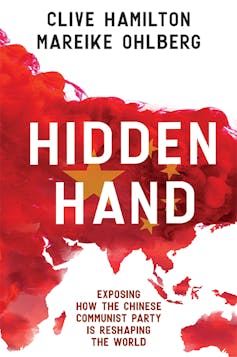
Hamilton and Ohlberg chronicle the various ways the CCP has attempted to wield influence in North America and Europe, from political and business elites to the Chinese diaspora, media, think tanks and academia, as well as through espionage and diplomacy.

Central to the book’s thesis is the diagram on pages 124-5 summarising most of the channels of influence from Chinese institutions (particularly party institutions) to various groups and organisations in Western nations. This is a one-direction diagram and assumes a totally coordinated strategy.

The book’s presentation is extremely detailed, including not just the names of Chinese institutions but the individuals said to be directing the strategies of influence. Similarly on the receiving end, the authors describe not only the groups and organisations in the West they claim are being influenced, but many of the individuals involved.

This level of detail is highlighted by the book’s 113 pages of footnotes and a 24-page index.


Read more:
Politics with Michelle Grattan: Clive Hamilton and Richard McGregor on Australia-China relations


Despite this, the book is not a balanced, scholarly document. The narrative centres on a single-minded Communist Party that has always sought a Leninist world and is now taking advantage of its increased economic power to advance that objective more effectively.

There is little recognition of the huge shifts in Chinese economic, social and strategic policies over the past 50 years, or of the scale of the changes to its institutional arrangements and the role of government.

The authors also do not allow those in the West who they claim have been successfully (and naively) influenced the opportunity to respond, let alone to present evidence of their influence in the other direction.

Containment vs. ‘engage and constrain’

Hidden Hand is right to remind people that:

  • China and the CCP are not one and the same

  • China has a party-state system of government that is authoritarian and not democratic

  • China does not have Western-style rule of law

  • it does not recognise universal human rights in the way we understand them.

What is missing is a balanced discussion of the central debate about the appropriate approach to be taken in the West’s relations with China.

As Peter Varghese, the former head of DFAT, recently put it, the choice for Australia is between trying to “contain” China or “engage and constrain”.

Containment, he argues, is gaining traction in the US and among cheerleaders in Australia, but risks dismantling the global economic system and the supply chains that support it. For Australia, Varghese says, decoupling from our largest trading partner would be “sheer folly” irrespective of legitimate complaints about China’s behaviour.

The “engage and constrain” approach he favours involves expanding areas of cooperation where mutual interests are served, while holding firm to our values and strengthening our capacity to resist Chinese coercion through increased investment in defence and diplomacy.

This would show Beijing that “leverage is a two-way street” and that, with others, we are willing to “push back” if China pursues its interests in ways that do not respect our sovereignty.

While increasing investment in defence may well be justified, boosting our spending in diplomacy is even more important.


Read more:
Why do we keep turning a blind eye to Chinese political interference?


In this light, viewing China as our “enemy” is counterproductive and ignores the mutual benefits and increased sharing of interests that have resulted from China’s opening up since 1978. (Hidden Hand does not repeat the explicit description of China as our enemy found in Hamilton’s earlier book, but it comes close, saying for the past 30 years China has viewed both sides of the Atlantic as its enemies).

Diplomacy may influence China’s perceptions of its national interests and, where significant differences remain, help to forge important alliances elsewhere.

Hamilton and Ohlberg seem to favour the “containment” strategy, warning on page 96 that “in fact, today it (the party-state) is more powerful than ever because of market forces” (emphasis in original).

Engagement can still have a positive effect

The implication, presumably, is that we should no longer contribute to China’s economic growth. This dismisses the remarkable benefits involved in China’s growth, including not only massive reductions in poverty, but also, for most Chinese, freedoms that were unimaginable in the Mao Zedong era. There have also been flow-on benefits for the rest of the world.

China’s opening up has of course not led to Western-style democracy, and is unlikely to do so in the foreseeable future. Indeed, under Xi, the CCP’s position has been consolidated and many of the reforms of the 1990s and 2000s have been wound back. Human rights have been seriously curbed, most recently in Hong Kong.

But Hidden Hand’s presentation of a single, continuous CCP Leninist agenda ignores the existence of different views among the leadership and elsewhere in China, including those who favour further liberal reform (as described in Richard McGregor’s 2019 book, Xi Jinping: The Backlash).

And it fails to appreciate the underlying contradictions of China’s “socialist market economy” and Xi’s “China Dream”, which offer avenues for Western leaders and academics to influence debates in China through engagement – as has happened over the past 30 years.

As the main coordinator of the Greater China Australia Dialogue on Public Administration, which organises annual workshops of scholars and practitioners from across the PRC (including Hong Kong and Macau) and Taiwan, I have witnessed some of the winding back of academic freedoms since Xi’s 2016 restrictions on social science teaching and research. This includes some of the specific CCP restrictions mentioned in Hidden Hand.


Read more:
The world has a hard time trusting China. But does it really care?


But this surely makes it even more important to continue the engagement while resisting the pressures involved.

Similarly, I am not at all convinced by the book’s attacks on any cooperation with the Belt and Road Initiative.

While the Asian Infrastructure Investment Bank has more sound governance, there are similar arguments for participation in BRI, providing support from the inside for transparency, proper cost-benefit analysis of projects and good understanding of debt obligations. It would also limit opportunities for China to pursue improper methods of influence.

How the West should respond to Chinese influence

The book’s afterword provides a slightly more moderate position on what should be done to counter Chinese influence moving forward. It still overplays its hand in promoting an “active pushback strategy” and its recommendation the Western

elites who acquiesce to or actively support Beijing deserve public scrutiny and robust criticism.

But the other recommendations have merit: defending democratic institutions through greater transparency and foreign interference laws, addressing the underfunding of universities and financial challenges facing our media, reducing vulnerability of our industries to CCP pressure and promoting more alliances, including with developing countries.

We cannot lose faith in liberal economics as Hamilton and Ohlberg seem to suggest, relying only on democratic forces to ensure freedom. The truth is, we need both.The Conversation

Andrew Podger, Honorary Professor of Public Policy, Australian National University

This article is republished from The Conversation under a Creative Commons license. Read the original article.
Unknown's avatar

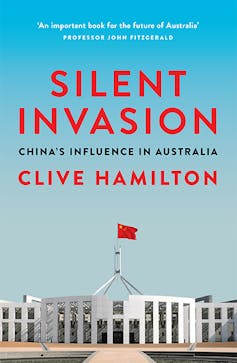
Book review – Clive Hamilton’s Silent Invasion: China’s Influence in Australia


File 20180320 31617 lafykl.jpg?ixlib=rb 1.1
Clive Hamilton paints a picture of China’s unrelenting determination not only to control those within the country, but also to dominate the world using whatever means at its disposal.
AAP/Wang Zhou

Andrew Podger, Australian National University

On page 132 of Clive Hamilton’s highly charged attack on China and Australian leaders’ encouragement of closer ties, he reports that our former ambassador to China, Geoff Raby, “lamented the influence of the defence/security establishment which … was placing too much emphasis on ‘values’ rather than economics”.

This idea of a conflict between a defence view that emphasises democratic values and human rights, and an economic view that does not, lies at the heart of the book. But is it right?

Influenced, it seems, by some in the defence establishment, Hamilton believes the Cold War never ended in Asia. Rather, China’s ideological war “fiercely” intensified after the collapse of communism in Eastern Europe, with its Leninist party consolidating its position, particularly under President Xi Jinping.

Hamilton paints a picture of unrelenting determination not only to control those within China but also to dominate the world using whatever means at its disposal. To Hamilton, China is “Australia’s enemy”.

Chapters in the book describe in detail the means Hamilton believes China is using. These include the international diaspora of Chinese people, “dark money” to buy influence, so-called China institutes, leveraging trade and investment, exploiting university linkages, controlling overseas Chinese students and, not least, old and new spying. He names names, listing the many Australian individuals and institutions he believes have been complicit, whether as “innocents” or “appeasers” (among other epithets).

He claims the Australian establishment has set the economy above everything, and we need to take a very different stand, accepting some cost from protecting our freedom from China’s incursions.

But Hamilton misrepresents the alternative approach he so denigrates. That approach looks to encourage China to build on its market-based reforms and the “opening up” agenda since 1978. This would continue China’s economic growth and alleviation of poverty, enhance Australia’s economic fortunes and build more shared interests, including in global stability and security. It would also promote increased freedoms within China.


Read more:
Asia is set for a difficult year in 2018 – much of it centred around China


The truth is that China’s opening-up has led not only to extraordinary reductions in poverty, but also to a dramatic shift in its own self-interests. From Chairman Mao’s support of revolutionaries around the globe, we now have a China supporting international governance frameworks from the World Trade Organisation to the United Nations. China’s self-interest is now in a stable international order that protects its trade and international investments.

This shift has led to more shared interests with Australia and the West generally. That’s a “win-win” worth recognising (“win-win” is a term Hamilton dismisses as “a favourite party slogan”).

In 2016, former World Bank president and US trade negotiator Robert Zoelleck presented a far more balanced view than Hamilton’s. He recognised that Xi’s number one priority is the preservation of the Chinese Communist Party’s monopoly of power. But Zoelleck was also persuaded that China’s skilled leaders recognised the need to change the country’s growth model and continue its economic reforms to address the “middle income trap”.

The US strategic defence/security policy, he said, was not to slow growth of China’s power, but to shape Chinese calculations of its interests as it expands its influence.

Zoelleck then made a comment that is apposite given Hamilton’s book:

It is increasingly difficult for those (in the US and China) who are knowledgeable about each other to clearly explain to their domestic audiences that the other side does not necessarily harbour ‘evil’ strategic intentions.

He went on to say we need to “suggest positive agendas with China, even while remaining clear and firm about Chinese actions that threaten security stability”.

This approach does not dispute many of the points Hamilton makes. Aspects of China’s view of the world are not benign and, under Xi, do risk conflict with our interests and our values. It is not China’s socialism that has succeeded in raising hundreds of millions above the poverty line, but its opening up to a market economy.

As Hamilton argues, Xi is rewriting history about such matters as Mao’s contribution in the second world war and omitting from history such events as the Great Leap Forward, which caused dreadful famine, and the 1989 Tiananmen Square tragedy.

Hamilton is also right to say Australia does need to tighten its political donations laws.

One area of concern to me, not included in Hamilton’s book, is the possible impact of Xi’s strengthening of Communist Party control of academic freedom in China.

One of the most positive aspects of the opening-up reforms over recent decades has been the opportunities provided to Chinese scholars and students to travel outside China for further education, and for Western scholars to visit Chinese universities to teach and participate in academic forums.

In my own experience, such engagement has generally been open and unconstrained. Chinese schools of public administration have existed only since the late 1990s, but most of the professors I engage with gained their PhDs from US universities. In turn, a large proportion of their PhD students have been able to visit overseas universities as part of their studies.

Chinese academics are keen to pursue public sector reform. While not emulating the sort of democracy we favour, this does involve more effective service delivery, greater accountability and transparency, and more citizen participation.

Xi’s recent actions may present a risk to continued open discussions. His speech on May 17, 2016, called for the development of a system of philosophy and social sciences with Chinese characteristics that incorporates the country’s socialist practices. Xi’s “Chinese characteristics” conflate the Communist Party leadership’s current thoughts and Chinese traditions and Marxist philosophy.

The speech was followed the next day by directions to the Chinese Academy of Social Sciences to strengthen supervision of university courses, seminars, journals and publishing generally. How far this might push back the openness of previous years is not yet clear.


Read more:
Stephen FitzGerald: Managing Australian foreign policy in a Chinese world


But Hamilton is wrong to suggest that those promoting continued engagement and strengthening of economic ties are undermining Australia’s security and abandoning our democratic and human rights values.

Indeed, those arguing from an economic perspective are trying to encourage Xi to extend the economic reforms of past decades, as he claims is his intention (including in last year’s 19th Party Congress). This should include, for example, greater transparency and firmer accountability of state-owned enterprises, and the One Belt One Road initiative being based upon proper and transparent cost-benefit analysis.

Xi, in fact, faces quite a dilemma. China’s economic growth has been achieved through market-based reforms and decentralisation. Strengthening Communist Party control risks reversing these developments. In time, it may also curb economic growth and upset community expectations.

So far, China’s leadership has managed an extraordinary transformation that has increased not only the real incomes of its people but their overall wellbeing, including freedoms to travel and communicate unheard of in the Mao era. For the most part, it has done so peacefully.

The next stage will require even greater dexterity, and the risks of an emphasis exclusively on Communist Party central control are considerable.

It may not be inevitable that further economic success will lead to democratic government along Western lines. But it will require both political and economic reforms consistent with greater political transparency and individual freedoms, if not in the short term then over the longer term.

Perhaps Hamilton’s book is a useful reminder that we must not be naïve about our relationship with China. But his prescription, premised on China being our enemy and determined to achieve world domination, is precisely the wrong direction for addressing the genuine issues he raises.

The ConversationWe should engage more, not less. And it does not help informed dialogue in Australia to trash the many people with whom Hamilton disagrees.

Andrew Podger, Honorary Professor of Public Policy, Australian National University

This article was originally published on The Conversation. Read the original article.