Unknown's avatar

Comics and graphic novels are examining refugee border-crossing experiences


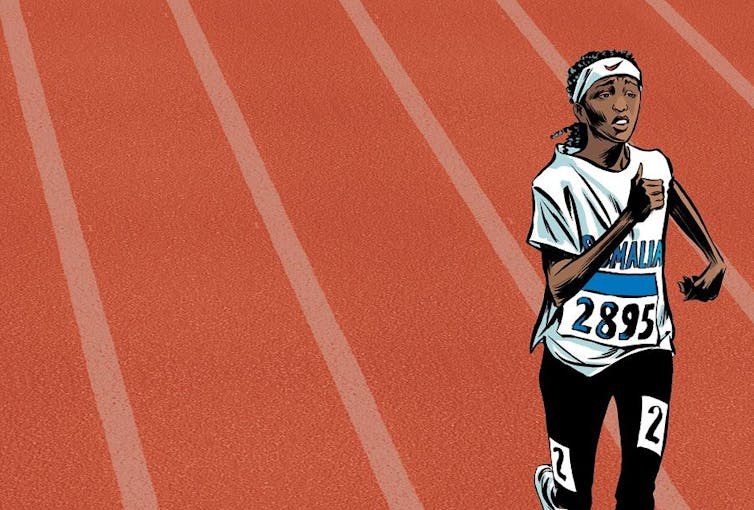
‘An Olympic Dream: The Story of Samia Yusuf Omar’ recounts how the Somali Olympic runner drowned while trying to reach Italy in 2012.
(From Reinhard Kleist’s ‘An Olympic Dream: The Story of Samia Yusuf Omar/SelfMadeHero)

Elizabeth “Biz” Nijdam, University of British Columbia

Comics about refugee experiences are not new. After all, even the superhero created by Jerry Siegel and Joe Shuster, Superman, is a refugee who landed on Earth after his flight from Krypton.

However, recently there has been renewed interest in comics representing migrant experience — namely, that of refugees and asylum-seekers. Since 2011, in particular, and the start of the civil war in Syria, comics and graphic novels have become an important forum for examining global forced migration.

These so-called “refugee comics” range from newspaper comic strips to webcomics and graphic novels that combine eyewitness reportage or journalistic collaboration with comic-book storytelling. These stories are written with the aim of incorporating the points of views of refugees, artists, volunteers or journalists working on-the-ground in displaced communities, war zones and along the migrant journey. They sometimes emerge in collaboration with human rights organizations.

In light of their subject matter, these comic artists contend with complex and distressing themes that are otherwise difficult to represent.

They draw on the traditional comics format, including the medium’s sequential nature, the use of panel walls and a combination of text and image to foster empathy and compassion for the migration journey. In so doing, they aim to give voice to asylum-seekers and refugees, part of 80 million individuals and families forcibly displaced worldwide, whose anonymous images often appear in western media.

Complex issues, narrator’s perspective

These comics are typically drawn by western cartoonists, based on direct testimonies by migrants and refugees or those who have worked with them or encountered them. They are typically not by refugees but about refugees. Scholar Candida Rifkind, who studies alternative comics and graphic narratives, explores how comics about migrant experience often emerge when witnesses to migrant stories grapple with feelings of “shame, guilt and responsibility” to make western society at large more aware of and responsive to refugee realities.

These narratives prompt ethical questions about what it means to tell a story and who has the right or responsibility to do so. While questions about the power relations embedded in how these texts are produced remain, comics on global forced migration are still an important avenue for interrogating the representation of migrants and the socio-political circumstances surrounding their journeys.

These comics also challenge what may otherwise be relayed in mainstream media as the story of a global migrant crisis that has no human face, with perilous effects for migrants who face xenophobia and hate. In Rifkind’s words, they are a kind of intervention into “the photographic regime of the migrant as Other that has emerged as the dominant visual record” of contemporary globalization.

In comics about forced migrant experiences, people experiencing life as refugees become centred as the subjects of their own stories. But cartooning can allow storytellers to represent individuals anonymously, making it easier for people “to give testimony fully and candidly,” while affording them the specificity of their humanity.

There can be consequences for refugees who testify about their circumstances and the oppression and violence they encounter. Photographic evidence of unlawful or undocumented residence in migrant encampments or someone’s journey to seek asylum could in fact jeopardize a person’s safety and end goal.
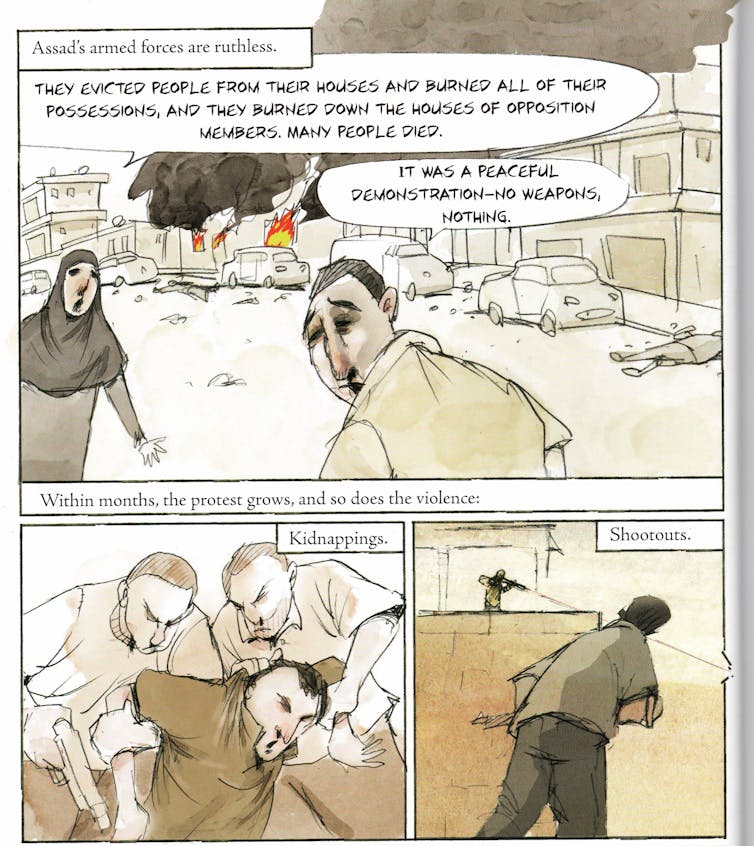
Cartoon panel showing smoke floating outside the panel and a bullet cutting through the edge.
The violence encountered by the refugees depicted in ‘The Unwanted: Stories of the Syrian Refugees,’ by Don Brown is the only graphic element that breaks through the panel frame.
(HMH Books)

New visual strategies

Notably, comics on forced migration are also inventing new visual strategies to recount refugee experiences. Artists use panel borders to add a layer of storytelling that typically vacillates between the creators’ ability to represent a specific experience, emotion or event and the very inability to portray some forms of trauma and lived experience.

In The Unwanted: Stories of the Syrian Refugees (2018), American author and illustrator Don Brown depicts moments of hardships and hope in the lives of the refugees that Brown met in three Greek refugee camps in Ritsona, in Thessaloniki and on Leros.

The violence encountered by the refugees of Brown’s graphic novel is the only graphic element that breaks through panels. Bullets fracture the panel edges, bombs explode out of the picture planes and toxic smoke rises through the frames.

Brown draws on the convention of exceeding and playing with borders in comics to demonstrate a relationship between violence and transgressing borders. Not only did violence in Syria force many of its citizens to journey in search of safety and freedom; fleeing Syrians also also faced violence and hostility beyond the borders of their homeland on their journeys and where they landed.
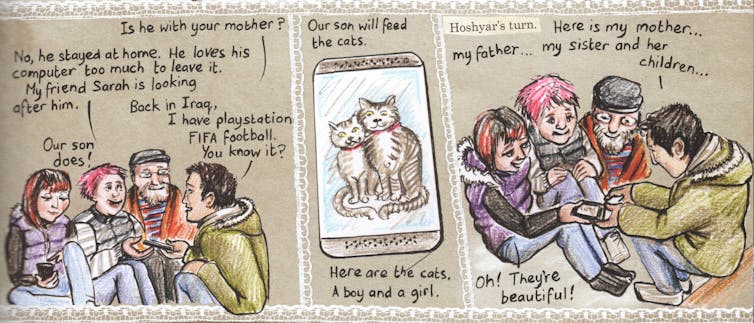
Cartoon panels that are bordered with white lace
Detail of a page shows how lace is used as a panel border in ‘Threads,’ by Kate Evans.
(Verso)

The panel borders in Threads: From the Refugee Crisis (2016) by British cartoonist, non-fiction author and graphic novelist Kate Evans are comprised of clippings of delicate lace. Threads is a socio-political and cultural critique rooted in the author’s experience volunteering in the largest though unofficial refugee encampment in Calais, France, which operated from January 2015 to October 2016.

My research has examined how this lace integrated into the comic is more than simply an analogy for the intertwining factors and complex relationships that emerged in Calais. The lacework is a fundamental structuring principle in Evans’ text that engages with the region’s history of lacemaking, Calais’ most essential industry and refugee experience simultaneously.

Frames within stories

The aesthetics of the smartphone have also begun to play a role in the representation of refugee experiences in comics. Smartphone screens and social media platforms function as frames within some stories.

German graphic designer and cartoonist Reinhard Kleist embeds social media into the comics grid in An Olympic Dream: The Story of Samia Yusuf Omar (2016). The story recounts how Omar, the Somali Olympic runner, died by drowning en route to Italy in 2012.

Some of the story is narrated through Facebook posts based on interviews conducted on that platform with Omar’s sister and a journalist who had interviewed and known Omar.
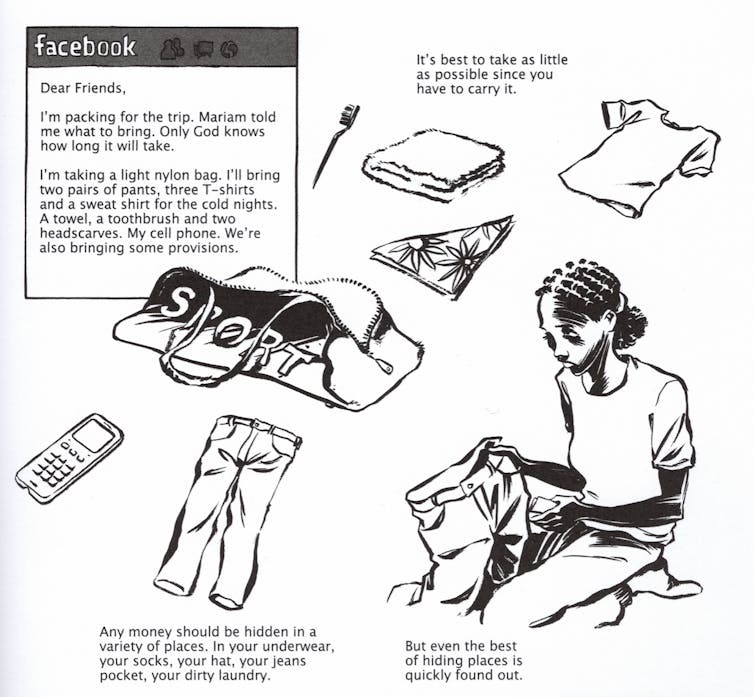
Illustrated borderless panel, in which Omar is packing for journey to Italy. A t-shirt, towel, scarf, pair of pants, toothbrush and a cell phone are spread across the floor. A Facebook post in the top left corner reads: I'm packing for my trip. Miriam told me what to bring. Only God knows how long it will take.
Panel from ‘An Olympic Dream: The Story of Samia Yusuf Omar,’ by Richard Kleist.
(SelfMadeHero)

Somalian athletes lifted up Omar’s story to draw attention to the Olympics as a venue to promote awareness about global conflict and peace. In Kleist’s introduction, he writes that too often, “abstract numbers represent human lives.”

This comic and others joins several examples of new media, such as viral videos, mobile games and documentary film that are highlighting the role mobile devices can play during the migration journey.

Through their personal stories, comics on forced migration humanize refugee experience. This category of graphic narrative also offers opportunities for articulating the complexity of refugee experience through the narrative techniques and visual strategies of comic art.The Conversation

Elizabeth “Biz” Nijdam, Assistant Professor (without review) of German, University of British Columbia

This article is republished from The Conversation under a Creative Commons license. Read the original article.
Unknown's avatar

Graphic novels are overlooked by book prizes, but that’s starting to change


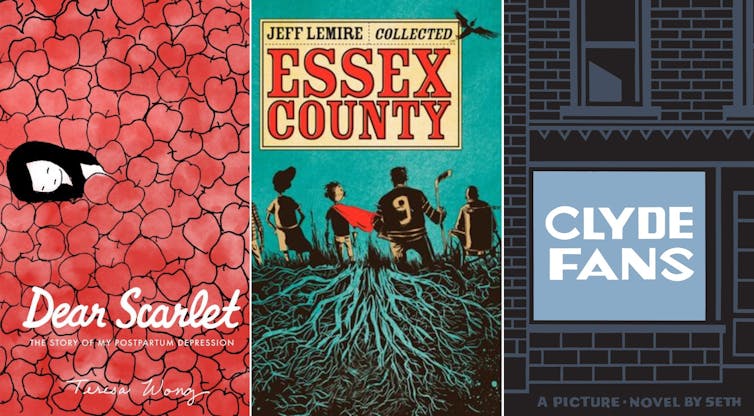
Teresa Wong’s ‘Dear Scarlet,’ Jeff Lemire’s ‘Essex County,’ and recently nominated for a 2020 Canadian literary prize, Seth’s ‘Clyde Fans.’
(Arsenal Pulp Press/Penguin Random House/Drawn&Quarterly)

Dessa Bayrock, Carleton University

In the midst of a global pandemic, almost nothing is proceeding as normal. And yet, on a dim October morning, the Scotiabank Giller Prize shortlist announcement went brightly, briefly and virtually streaming into homes and revealing the five books that had moved one step further towards winning Canada’s largest and arguably most prestigious literary award.

In some ways, however, this business as usual was a disappointment. After all, the Giller recently changed its submission guidelines to allow graphic novels to be submitted to the prize, and even more recently announced that a graphic novel was, indeed, included on the longlistClyde Fans, by highly acclaimed Canadian author and cartoonist Seth.

But after raking in praise and aplomb for featuring a graphic novel on its longlist for the first time, the Giller — like so many other book prizes — just couldn’t bring itself to put Clyde Fans on the shortlist. Business as usual, indeed.

And are we really surprised?

Prizes reflect readership

Book prizes have long overlooked and excluded graphic novels from their submissions: if not officially barred from entry (as with the Giller, which excluded graphic novels in its submission guidelines for a quarter of a century), then unofficially (as with Canada Reads, which does not specifically bar graphic novels from consideration but hasn’t shortlisted one since 2011). As a result, graphic novels are a kind of literary elephant in the room: a format of literary fiction which many, including book prizes, refuse to recognize as “literary” fiction.

This is, however, beginning to change. Increasingly, book prizes are beginning to reflect a reality many readers, professors, librarians and publishers have known for years: that graphic novels do, in fact, have serious literary value. Graphic novels span a wide variety of content, and they’re visual narratives with the same complexity and depth as purely textual novels. It’s taken decades, but public perception has changed. And now, too, so are prizes.

After all, “good literature” is not — and never has been — a static category, but rather an ever-shifting, nebulous definition built collaboratively by anyone who’s ever picked up a book. After decades of marginalization, graphic novels are now inarguably coming to be included in this mainstream definition of what is “literary.”

Furthermore, this process of acceptance is helped in no small part by book prizes’ increasing support of graphic novels; the connections between canonization and prizes are well studied. When literary institutions hold up a graphic novel as one of “the most powerful pieces of fiction published this year,” as the Giller did when it announced its longlist in September, the reading public begins to rethink their own biases against what they think is or isn’t literary — whether they know they hold those biases or not.

A troubling trend

When we start to look at the history of graphic novels and book prizes, however, a more troubling trend seems to spring up: that despite their increasing presence on book prize long- and shortlists, graphic novels don’t ever seem to win book prizes.

For instance, Sabrina, a graphic novel by Nick Drnaso about “the story of what happens when an intimate, ‘everyday’ tragedy collides with the appetites of the 24-hour news cycle,” was longlisted by The Booker Prize in 2018 — the first time a graphic novel had ever been longlisted by the Booker.

Like Clyde Fans, it too, failed to make the prize shortlist. Earlier this year, Canada Reads similarly longlisted — but didn’t shortlist — graphic memoir Dear Scarlet by Teresa Wong, which deals with post-partum depression.

Ironically, graphic novels seem to have had better chances in the book prize world the further back we look: Essex County, a graphic novel by Jeff Lemire about a rural community in Southwestern Ontario, made the Canada Reads shortlist in 2011 — making it further in the process than Clyde Fans, Sabrina and Dear Scarlet only to get knocked out on the first day of competition.

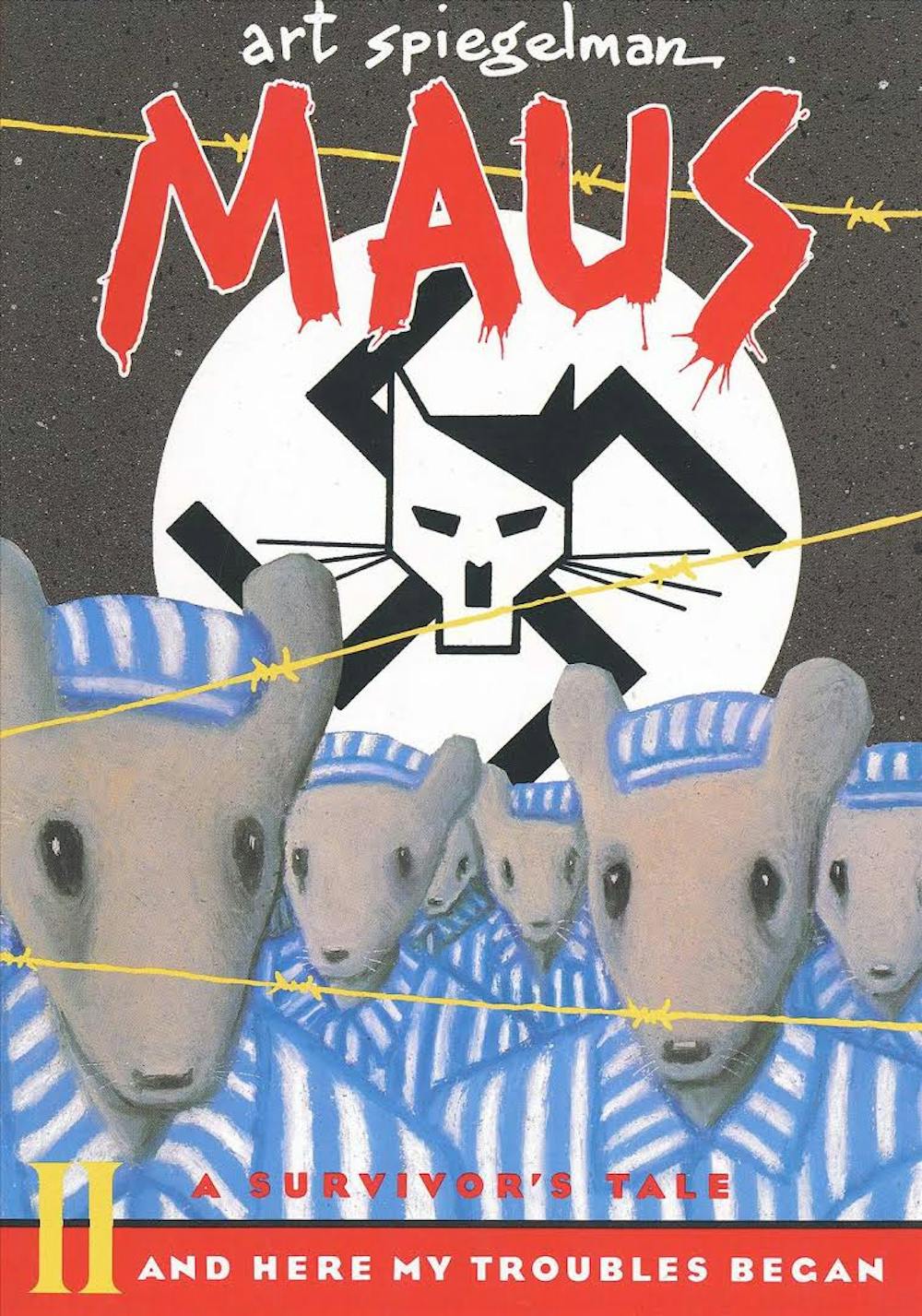
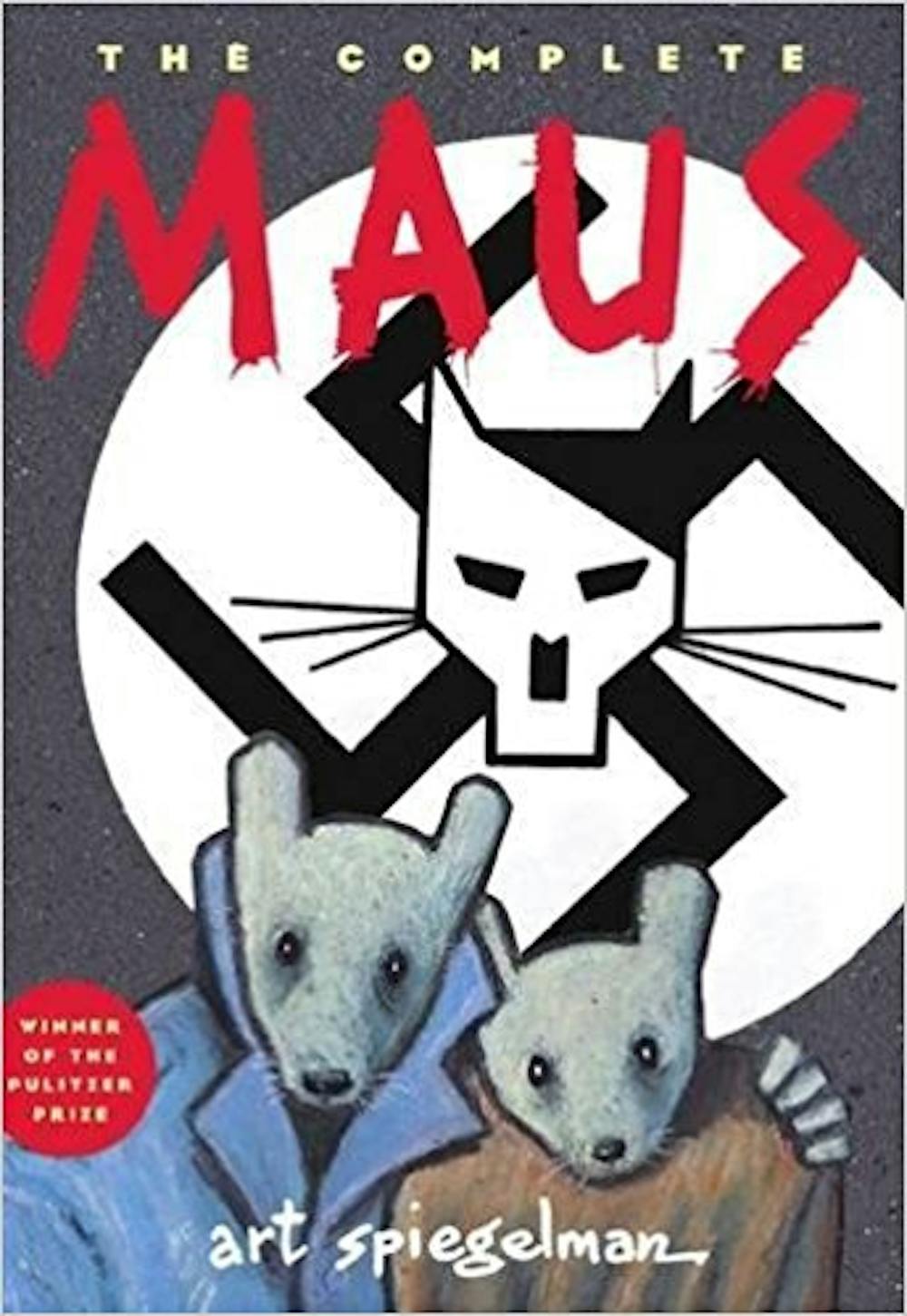
Going back even further, the highly-acclaimed Maus by American author and artist Art Speigelman won a Pulitzer in 1992. The book (full title: Maus: A Survivor’s Tale) shows Spiegelman interviewing his father, a Polish Jew, about his memories of surviving the Holocaust during the Second World War.

Even so, Maus didn’t win a Pulitzer for literature, but rather a Pulitzer Special Citation — which basically equates to a Pulitzer given by a jury when they’re not quite sure what category to put it in. Is it literature? Is it art? Is it memoir? Is it history? The answer: it’s a special citation.

Literary evolution remains slow

If these kinds of approaches to recognizing graphic novels seems like gatekeeping what we consider “serious literature,” that’s because it is.

These prizes have been slow to shift away from a European high-culture approach, demonstrating how infuriatingly slowly the western literary canon evolves, especially in any direction away from the exclusionary principles it was and is founded on.

It is, frustratingly, a sluggish and non-linear progression — both in the public perception of what is and is not “literary,” and the ways in which literary institutions such as prizes reflect those perceptions.

This is only underscored by the fact that a graphic novel won’t win the Giller this year, and a graphic novel probably won’t win it next year, either. But eventually, one day, it’ll happen — and if this new trend of graphic novels hitting prize longlists is any indication, it’s a future we’re moving closer to all the time.The Conversation

Dessa Bayrock, PhD Student, Department of English, Carleton University

This article is republished from The Conversation under a Creative Commons license. Read the original article.
Unknown's avatar

Five eye-catching graphic novels that define the genre


Michael via Flickr, CC BY-SA

David Brauner, University of Reading

For someone who teaches about the graphic novel, compiling an all-time top five list is challenging. It’s not just the way that such a list is compiled, making agonising decisions over which favourites to exclude, but also because it raises tricky questions of definition. That the term refers not just to fiction but to life-writing, as in all manner of memoirs, diaries and so on, is accepted – but beyond that there is little consensus.

If there are multiple volumes (as with Neil Gaiman’s The Sandman or the Hernandez brothers’ Love and Rockets series), should the whole series be counted as one epic graphic novel, or should only individual volumes be eligible?

And what about a book like Phoebe Gloeckner’s The Diary of a Teenage Girl(2002), which tells the story of an authorial alter-ego, Minnie, through a combination of prose diary entries, illustrations with captions, comic-strip narratives, letters, poems and photographs? Or Joe Sacco’s comic-strip documentary journalism?

I’ve chosen five books that I (and many others) regard as central to the graphic novel canon. They are all richly textured, powerful, nuanced books that are immediately arresting but also reward repeated re-reading.

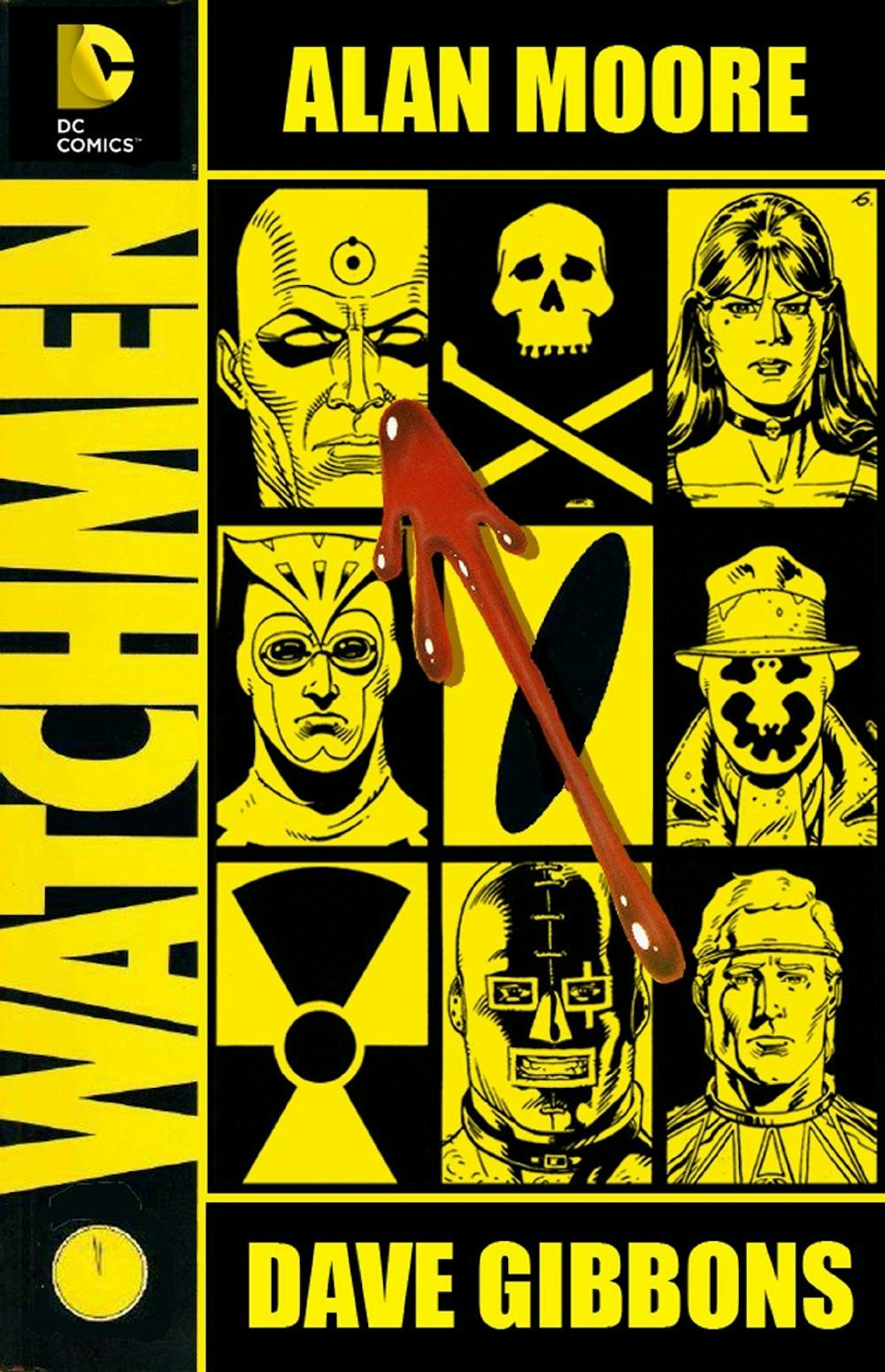
1. Watchmen (1987)

Alan Moore and Dave Gibbons’ Watchmen works on so many levels – it is, among other things, a whodunnit, a love story, a commentary on Cold War politics and an exploration of fundamental philosophical and ethical questions.

Wunderkind.
Amazon

Watchmen is an homage to – and a deconstruction of – the classic superhero comic-strip narrative, which in turn has inspired numerous subsequent revisions of the genre, from Pixar’s The Incredibles (2004) to the Marvel Comics (and later MCU’s) Avengers civil war storyline.

Shifting points of view, disrupting chronology, layering texts within texts, Watchmen is a hugely ambitious narrative that discloses new details with every fresh reading. It’s also a real page-turner.

2. Maus (1991)

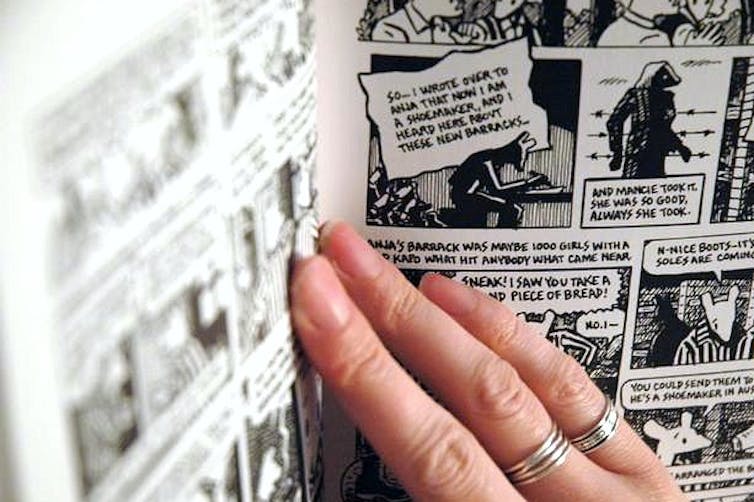
Art Spiegelman’s masterpiece, Maus, probably did more than any other graphic novel to make readers and critics take this genre seriously.

A Holocaust tale with a twist.
Google Books

It’s the story of the author’s father, Vladek, who survived Auschwitz, as well as the story of Spiegelman’s relationship with him. Controversially representing Jews as anthropomorphised mice, preyed upon by German cat-people and often betrayed by Polish pig-people, Maus nevertheless resists stereotypes. The novel represents both its author and his father as flawed, complex individuals who struggle in different ways to deal with the legacy of a trauma that makes itself felt in every aspect of their lives.

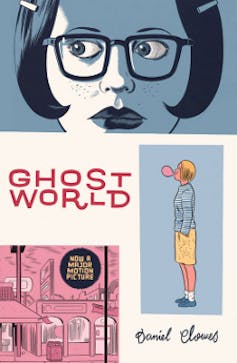
3. Ghost World (1997)

Daniel Clowes’ Ghost World is the shortest – and at first glance the most straightforward – of my choices. It’s a bittersweet tale of the friendship, and gradual estrangement, of recent high-school graduates Enid and Becky.

Coming of age story.
Amazon

Cynical and vulnerable, with a sardonic sense of humour and a nostalgic streak, Enid is, in part, a portrait of the artist as a young girl grappling with her sexuality, ethnicity and her conflicting expectations of herself.

But Ghost World is also a powerful evocation of what it is like to drift, ghost-like, through a nondescript, soulless urban environment that is itself ghostly. Full of quirky characters and memorable images, Ghost World manages, paradoxically, to represent boredom and ennui vividly and entertainingly.

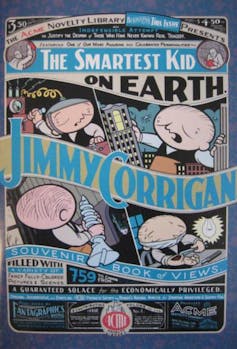
4. Jimmy Corrigan, the Smartest Kid on Earth (2000)

Chris Ware’s Jimmy Corrigan was the first graphic novel to be awarded major literary prizes on both sides of the Atlantic – the American Book Award and The Guardian First Book Award.

First graphic novel to win major literary prizes.
Amazon

Like Watchmen, Jimmy Corrigan has a complex, non-linear structure and subverts conventional notions of (super)heroism. Like Maus, it is a book about fathers and sons; and like Ghost World, it has a protagonist who is drifting aimlessly through life, alienated from the world around him.

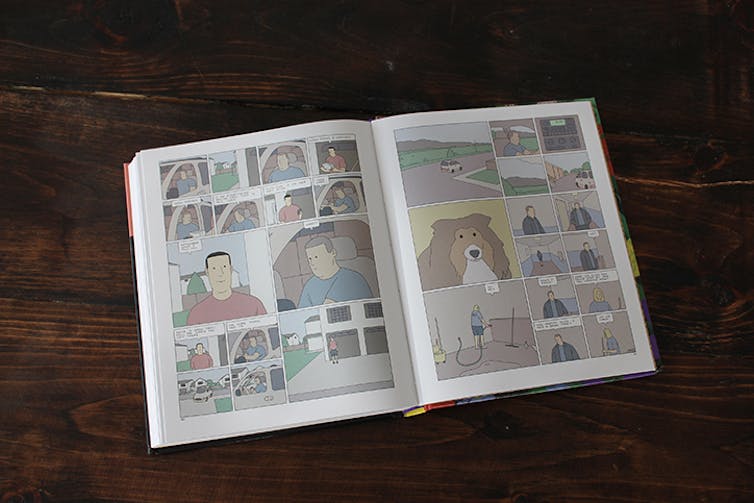
Yet it is visually and formally more radical than any of the other books on this list. Chris Ware’s dark palette and landscape format and his use of diagrams, instructions and definitions make the book, as an object and text, highly unusual. In terms of narrative, too, Ware is a great innovator – the absence of exposition and page numbering, the abrupt transitions between a historical narrative focusing on Jimmy’s grandfather and the present-day narrative focusing on Jimmy, the use of surreal dream sequences and the disruption of conventional panel sequencing all make Jimmy Corrigan challenging.

But it’s well worth the effort. It is a beautiful, heartbreaking story that has been much imitated but never bettered.

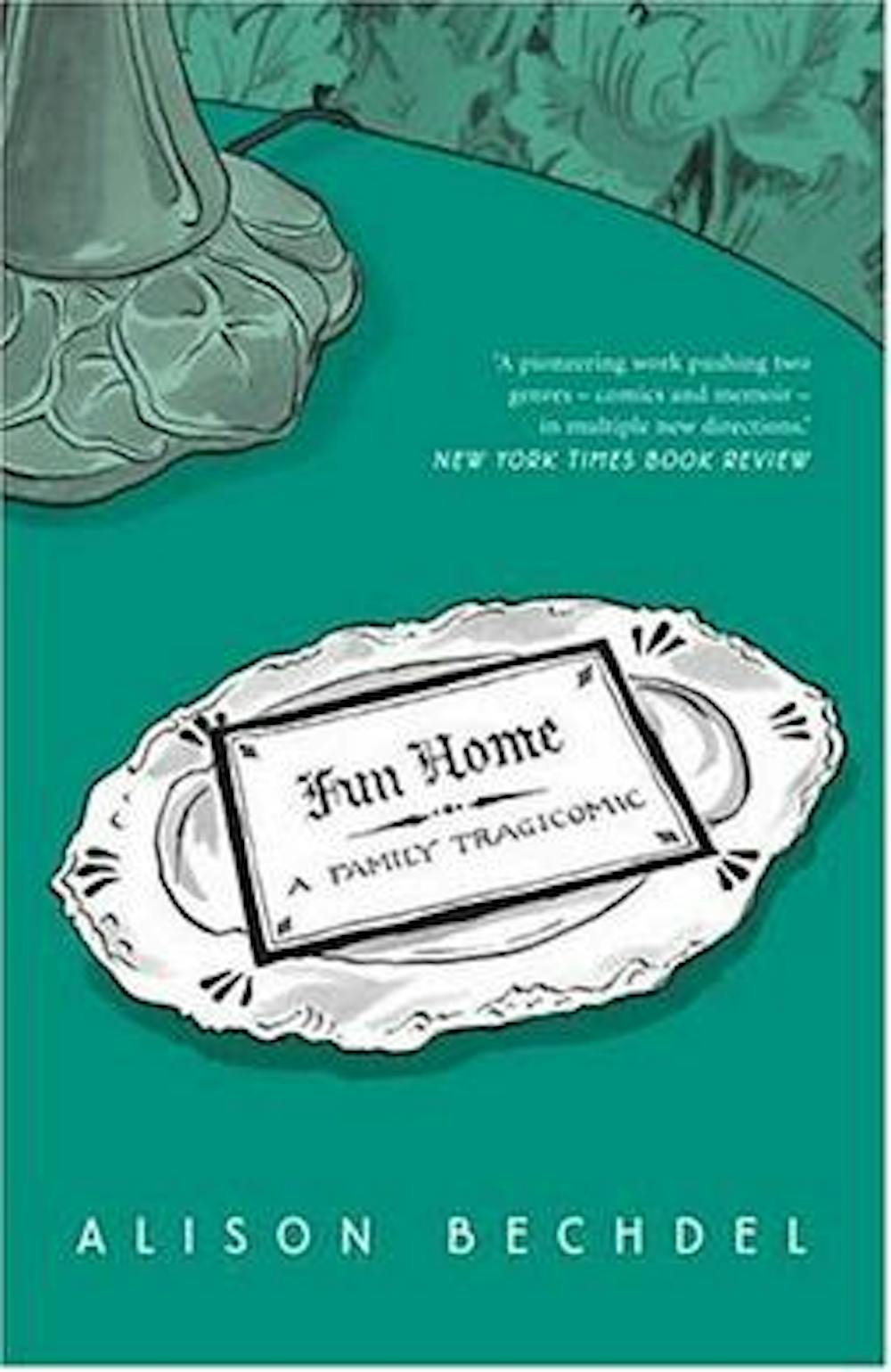
5. Fun Home (2006)

Alison Bechdel’s Fun Home is a self-consciously literary coming of age novel that pays homage to James Joyce, Marcel Proust and Oscar Wilde, among others.

Graphic novel became a musical.
Amazon

It is a moving memoir about the author’s relationship with her father, whose queer sexuality finds an echo in her lesbianism, and whose (possible) suicide haunts the book.

Adapted as an award-winning musical, Fun Home reached an audience that might never have encountered the bestselling graphic novel. Yet while Fun Home the musical is fun, just like the film adaptations of Watchmen and Ghost World, it can’t quite do justice to the complexity of the original.


Read more:
Guilty Pleasures: an English literature professor’s secret stash of graphic novels


What I hope a reading of these titles will demonstrate to any newcomers is that these are not just great graphic novels but great works of art. The term graphic novel was initially deployed in order to confer intellectual credibility on what had been previously seen as a trivial form of entertainment aimed primarily at children. But the works listed above rival anything done in the novel form over the same period – some of the most innovative and exciting work in fiction and life-writing is being done right now in the graphic novel form.The Conversation

David Brauner, Professor of Contemporary Literature, University of Reading

This article is republished from The Conversation under a Creative Commons license. Read the original article.
Unknown's avatar

Infographic: Benefits of Reading Graphic Novels


The link below is to an infographic that looks at the benefits of reading graphic novels.

For more visit:
https://ebookfriendly.com/benefits-reading-graphic-novels-infographic/

Unknown's avatar

‘Graphic novels are novels’: why the Booker Prize judges were right to choose one for its longlist


File 20180726 106517 614tnv.jpg?ixlib=rb 1.1
Illustration from NickDrnaso’s Sabrina.
ItsNiceThat

Claire Nally, Northumbria University, Newcastle

Following the announcement that Nick Drnaso’s Sabrina is the first graphic novel ever to be longlisted for the Man Booker Prize, Joanne Harris (the author of Chocolat) tweeted #TenThingsAboutGraphicNovels and stated simply: “graphic novels are novels”.

Once upon a time, graphic novels may have been viewed as disposable – and not especially literary – but such a value judgement has long since been challenged.

The graphic autobiography has become especially visible in recent years, with a noteworthy example being Persepolis by Marjane Satrapi (2000) – which details her experiences as a young woman during and after the Iranian revolution in 1979. The novel was adapted into a film in 2007.

A woman’s voice: Persepolis by Marjane Satrapi.
Pantheon Books

The comic book has a long and rich history, as Scott McCloud’s 1993 book Understanding Comics explains. He looks at a pre-Columbian text from the Codex Nuttall about 8-Deer “Tiger’s Claw”, discovered by the Spanish conquistador Hernan Cortés around 1519. McCloud argues we can think about such early texts as comics.

Terminology is important here, too. The word “comics” usually refers to serialised publications – whereas “graphic novels” are issued as books. That said, they share many artistic and literary characteristics. Author Alan Moore has rejected the term “graphic novel” (along with the film versions of his work), suggesting it is nothing more than a marketing term. So, in no particular order – and with that caveat in mind – here are my top five literary reads in graphic novel and comic book genres.

Grandville (2009)

Author Bryan Talbot is well-known to comic and graphic novel fans, having penned The Adventures of Luther Arkwright in the 1970s and 1980s. Grandville is the first volume in a series of five, which tells the investigative story of a badger detective, Detective Inspector LeBrock, accompanied by his trusty sidekick, Roderick the Rat.

In this anthropomorphic universe, humans feature in servile roles as an underclass, with some critical comparisons to post-9/11 racial stereotypes. The Grandville of the title is an alternative history Paris, lovingly characterised with steampunk details and Belle Époque style. The city of Grandville takes its name from the pseudonym of a French artist, Gérard Grandville, famed for his satire of French politics and society.

An illustration by celebrated 19th-century caricaturist Gérard Grandville.

The book wears its intellectualism lightly – but, for those with a keen eye, look out for cultural references to Édouard Manet, Augustus Egg, Sarah Bernhardt, and intertexts such as Conan Doyle’s Sherlock Holmes stories, as well as children’s classics including Wind in the Willows, Tintin and Rupert the Bear.

From Hell (1999)

Alan Moore needs little introduction to cult readers or the academic community. He has amassed a wealth of literary criticism about his work, including plenty of material about the title I have chosen, From Hell. This was originally issued in serial form and later published as a single-volume collected work – the version with which most readers will be familiar.

From Hell was made into a film with Johnny Depp and Heather Graham. The author disapproved.
Twentieth Century Fox

From Hell is not for the squeamish: it retells in gruesome detail the Whitechapel murders of the late 19th century, speculating Jack the Ripper was Sir William Gull, Queen Victoria’s royal physician. Gull’s murder spree, seeking to suppress an illegitimate heir to the throne and filtered through a lens of masonic imagery and misogyny, takes us through a psychogeographic tour of London.

Eddie Campbell’s exquisite illustrations contrast the privileged suburbs in which Gull lives with the poverty-stricken degradation of Whitechapel’s citizens.

Partly fictional and partly factual, the book is a wonderful parody of the dark tourist interest in the murders, with the careful reader becoming increasingly self-conscious of their own uncomfortable complicity in the narrative.

Maus (1991)

Like From Hell, Art Spiegelman’s Maus was originally published in serial form. Spiegelman began writing in 1978, telling the story of his father, Vladek Spiegelman, a Holocaust survivor.

In many ways, the text defeats simplistic categories and genres: it is a fiction, an autobiography and a history.

Powerful and moving: Art Spiegelman’s Maus.
Amazon

It is also another anthropomorphic story in which Nazis are cats and the Jewish community are characterised as mice. The reader is placed in the unenviable but important position of bearing after-witness to the trauma of the Nazi regime, a point enhanced by the use of literary devices such as the framing narrative.

Spiegelman uses the more recent moment of the late 1970s and interviews with his elderly, widowed father as a departure point to revisit the 1930s through to the end of the Holocaust in 1945.

Spiegelman’s book won a Pulitzer Prize in 1992.

The Thrilling Adventures of Lovelace and Babbage (2015)

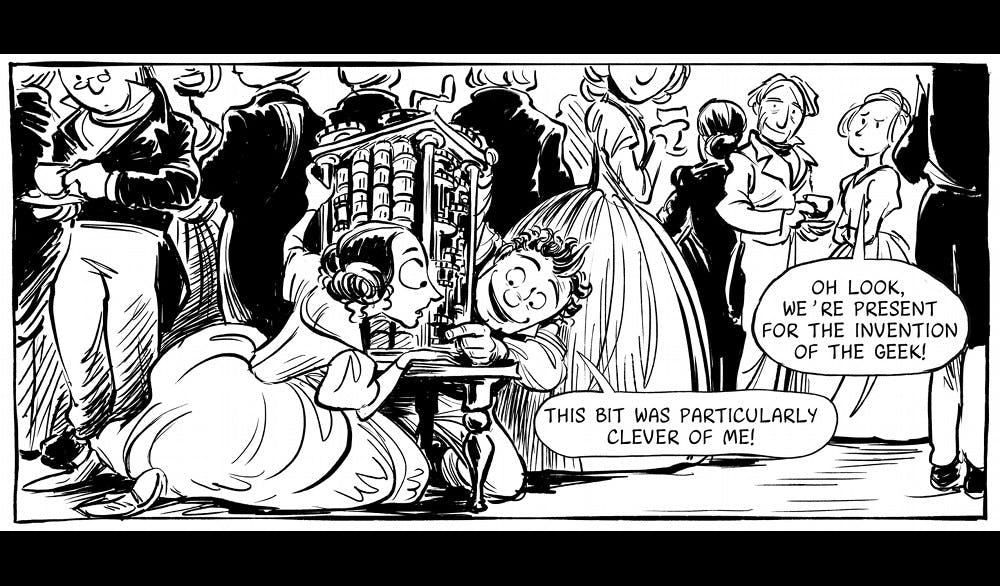
Sydney Padua’s witty black-and-white graphic novel describes itself as “an imaginary comic about an imaginary computer”. It foregrounds Ada Lovelace’s contribution to Charles Babbage’s Difference Engine, the herald of our modern computers.

Fun with history’s greatest geeks.
ScienceFriday.com

Like other examples here, the narrative is situated in an alternative universe, which offers a view of what would happen if the Difference Engine had been built. Along with an adventure plot, the graphic novel features references to a wealth of 19th–century characters such as Samuel Taylor Coleridge and the Duke of Wellington. It has elaborate pseudo-factual footnotes and endnotes of which writers such as Flann O’Brien or Mark Z. Danielewski would be proud.

Dotter of Her Father’s Eyes (2012)

It would be very remiss of me, as a longstanding aficionado of James Joyce, to omit reference to this Costa award-winning graphic memoir by Mary M. Talbot (with illustrations by Bryan Talbot, the writer’s husband), which follows Lucia Joyce’s troubled relationship with her father, and draws parallels with the author’s own relationship with her father, the eminent Joyce scholar James S. Atherton.


Read more:
Guilty Pleasures: an English literature professor’s secret stash of graphic novels


Lucia’s tragic love for Samuel Beckett – and her thwarted ambition to become a dancer – are beautifully juxtaposed with Talbot’s recollections of her upbringing, alongside the difficulties experienced by both talented women growing up with writerly fathers. Strategic use of colour, sepia tones and the frequent use of the Courier typeface (as well as Talbot’s own personal lettering font which features throughout his work), make this book an aesthetically delightful read.

So many masterpieces, so little time

Of course, there are many artists and writers I have omitted from this list – not least figures such as Neil Gaiman, whose work The Sandman (1989-) has been critically acclaimed, pushing as it does the Gothic tropes and metaphysical reflections of the genre.

For those of a humorous inclination, Kate Beaton’s webcomic Hark, A Vagrant (published as a book in 2011) is an affectionately irreverent look at literature and history, including the hilarious Dude Watchin’ With the Brontës.

The ConversationThere are also the recent works lauded in the Will Eisner Comic Awards, held earlier this month in San Diego as part of Comic-Con. Further reading can be found on that list.

Claire Nally, Senior Lecturer in Twentieth-Century English Literature, Northumbria University, Newcastle

This article was originally published on The Conversation. Read the original article.