
Unknown's avatar

Dostoevsky warned of the strain of nihilism that infects Donald Trump and his movement


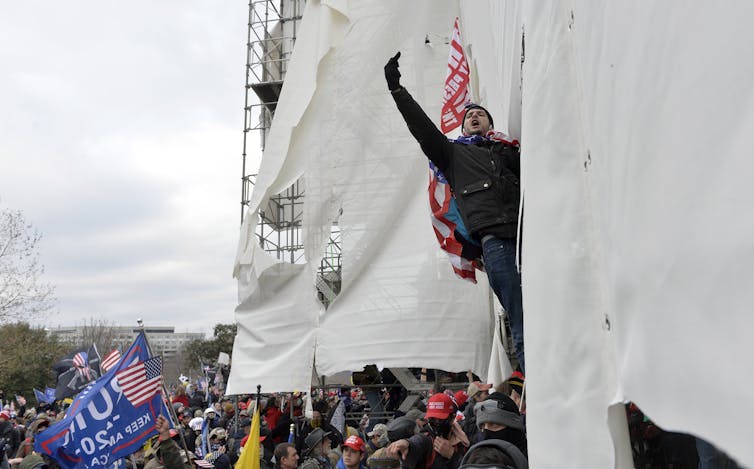
A Trump supporter climbs scaffolding in an effort to breach the U.S. Capitol.
Joseph Prezioso/AFP via Getty Images

Ani Kokobobo, University of Kansas

Nihilism was notably cited during U.S. Senate deliberations after rioting Trump supporters had been cleared from the Capitol.

“Don’t let nihilists become your drug dealers,” exhorted Nebraska Sen. Ben Sasse. “There are some who want to burn it all down. … Don’t let them be your prophets.”

How else to describe the incendiary rhetoric and grievances that Donald Trump has peddled since November? What else to call the denial of the electorate’s will and his deep disdain for American institutions and traditions?

In 2016, I wrote about how Russian novelist Fyodor Dostoevsky had, in his work, explored what happens to society when people who rise to power lack any semblance of ideological or moral convictions and view society as bereft of meaning. I saw eerie similarities with Trump’s actions and rhetoric on the campaign trail.

Fast-forward four years, and I believe the warnings of Dostoevsky – particularly in his most most political novel, “Demons,” published in 1872 – hold truer than ever.

Although set in a sleepy provincial Russian town, “Demons” serves as a broader allegory for how thirst for power in some people, combined with the indifference and disavowal of responsibility by others, amount to a devastating nihilism that consumes society, fostering chaos and costing lives.

Power for power’s sake

Before “Demons,” Dostoevsky had been writing a novel about faith, “The Life of a Great Sinner.”

But then a disturbing public trial spurred him in a more overtly political direction. A young student had been murdered by members of a revolutionary group, The Organization of the People’s Vengeance, at the behest of their leader, Sergei Nechaev.

Dostoevsky was appalled that politics could be dehumanizing to the point of murder. His focus turned not only to moral questions but also to political demagoguery, which, he argued, if left unchecked, could result in devastating loss of life.
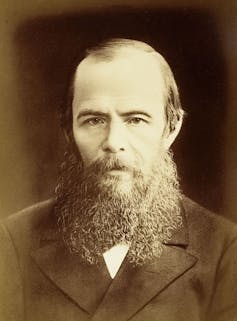
Sporting a beard, Dostoyevsky stares solemnly into the camera.
A portrait of Fyodor M. Dostoyevsky from around the time he wrote ‘Demons.’
adoc-photos/Corbis via Getty Images

The result was “Demons.” It featured two protagonists: Pyotr Verkhovensky, a former student with no political convictions beyond a lust for power, and Nikolai Stavrogin, a man so morally numb and emotionally detached that he is incapable of purposeful action and stands idly by as violence engulfs his society.

Through these two figures, Dostoevsky tells a broader story about the many flavors of nihilism. Pyotr infiltrates the town’s local social circles, recruits a group of disciples to a revolutionary group and spins lies to band them together so they may do his bidding. Pretending to lead a broad movement of international socialism, Pyotr manipulates those around him into committing violent acts and insurrection against the local government. As a result, one woman is crushed by a mob, a mother and her baby die from chaos and neglect and a fire breaks out that kills multiple others.

Different townspeople espouse multiple and contradictory ideologies; none translates into purposeful action. Instead, they merely leave characters whiplashed and susceptible to being instrumentalized by Pyotor, the master manipulator.

The allure of feeling something

But Pyotr would not prevail without the nihilism of Stavrogin, a local nobleman.

Many townspeople see him as a leader with a strong moral compass. Throughout the novel, Pyotr seeks to loop Stavrogin into his quest for power by either doing him favors that corrupt him or hinting that he will install him as dictator once he successfully carries out a revolution.

On some level, Stavrogin knows better: He should be protecting the town and its people. He ultimately fails to do so, out of sheer despondence and because of the emotional appeal of chaos and violence have for him; they seem to jolt him out of the ennui he often appears to feel.

When given the chance to restrain and turn in to the authorities the escaped convict who perpetrates most of the violence in town, Stavrogin captures him only to eventually let him go. “Steal more, kill more,” he says to a criminal who has already admitted to killing and stealing. Later, when the political climate gets so heated that it seems an insurrection is imminent, he flees town.
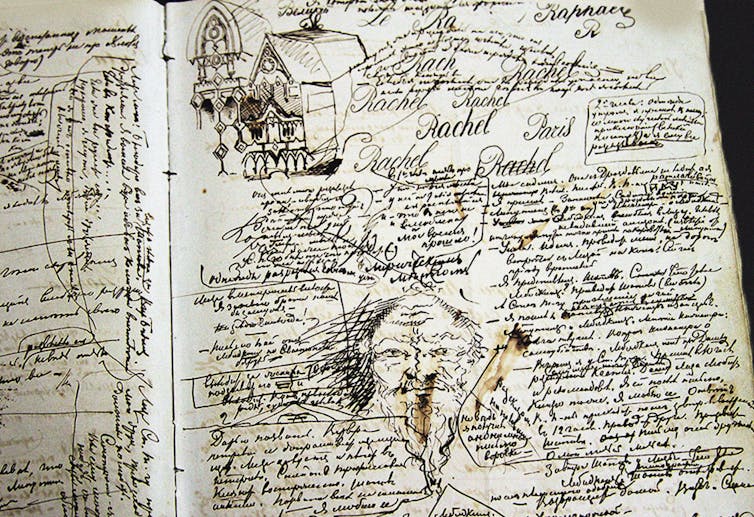
A page covered in Dostoevsky's handwritten script, doodles and drawings.
A page from Fyodor Dostoevsky’s manuscript for ‘Demons.’
Heritage Images via Getty Images

In surrendering his responsibility to serve as a moral guardian, Stavrogin becomes complicit in Pyotr’s schemes. He ultimately kills himself – perhaps, in part, out of guilt for his passivity and moral indifference.

Among the two men, Pyotr is the authoritarian figure. And he cleverly insists that members of the revolutionary group break the law together, cementing a loyal brotherhood of criminality.

By contrast, Stavrogin is the novel’s empty center, idly standing by while Pyotr incites violence.

He doesn’t help Pyotr. But he doesn’t stop him, either.

From nihilism to annihilation

A range of nihilistic justifications – each successively hollower than the rest – seems to have shaped the violence at the U.S. Capitol.

The homegrown American insurrection lacked any sort of ideological foundation. Most ideas fueling it are negations of persons or facts. The immediate rallying cry of the insurrection was the falsehood that the election was stolen. Beyond denying the will of over 80 million people who voted for Joe Biden, this lie also qualifies not as an ideology, but as an absolute denial of truth.

Other ideas fomenting the insurrection – such as “America first” or “MAGA” and even white supremacy itself – are quintessentially founded on the denial of others, whether they are immigrants, foreign nationals or persons of color.

From what we have learned since, some of Trump’s supporters were even imploring him to “cross the Rubicon,” a reference to Julius Caesar’s initiation of the civil war that eventually transformed Rome into a dictatorial empire, expressing a longing to smash American systems and eviscerate the republic.

The only real purpose that seems to have brought the group together was devotion to Donald Trump, who strikes me as the arch-nihilist in all this, the Pyotr Verkhovensky of this American tragedy. Then there are the other public figures who should have known better, who might have helped stop it all, but couldn’t and didn’t. Some, like Stavrogin, excused themselves and were silent for far too long, as the lie about the election grew bigger and bigger. And others seemed to outright encourage the lie through formalized objections in Congress last week.

Playacting at revolution at the behest of a man seeking to cling to power, the rioters ultimately only managed only to vandalize the building, though they left five people dead in their wake.

Nonetheless, to act violently on the basis of such fictions – and to transgress against the humanity of others for nothing at all – is perhaps the most nihilistic act of them all.The Conversation

Ani Kokobobo, Associate Professor of Russian Literature, University of Kansas

This article is republished from The Conversation under a Creative Commons license. Read the original article.

Unknown's avatar

How Dostoevsky predicted Trump’s America


Ani Kokobobo, University of Kansas

As a professor of Russian literature, I’ve come to realize that it’s never a good sign when real life resembles a Fyodor Dostoevsky novel.

Donald Trump’s presidential campaign, with its riotous rhetoric and steady stream of scandals, calls to mind Dostoevsky’s most political novel, “Demons,” written in 1872. In it, the writer wanted to warn readers about the destructive force of demagoguery and unchecked rhetoric, and his cautionary messages – largely influenced by 19th-century Russian political chaos – resonate in our present political climate.

To show his readers just how bad things could get if they didn’t pay attention, Dostoevsky linked his political nightmare to unhinged impulses and the breakdown of civility.

A passion for destruction

Dostoevsky was as addicted to newspapers as some of us are to social media, and he often plucked crises and violence right from the headlines, refashioning them for his fiction.

Russia during the 1860s and 1870s – the heyday of the author’s career – was experiencing massive socioeconomic instability. Tsar Alexander II’s Emancipation of the Serfs freed Russian peasants from a form of class bondage, while the subsequent Great Reforms aimed to restructure the executive and judidical branches, as well as the military, tax code and education system. The reforms were supposed to modernize the country by dragging it out of the caste-like system of estates and legal privilege. But it didn’t do much to improve the economic lot of the peasant.

It was a reversal of America’s present political landscape. While today there’s simmering discontent from the right, in 19th-century Russia it was leftists who were enraged. They were angered by the reforms for not going far enough and had lost hope in the government’s ability to produce meaningful change.

Sergei Nechaev influenced Dostoevsky’s Pyotr Verkhovensky.
Wikimedia Commons

One of the only unifying ideas among the more radical left-wing political factions of the period was the belief that the tsarist regime must be eliminated. Important public figures, like Russian anarchist Mikhail Bakunin, advocated for destruction of the status quo as an end greater than all ideologies. As Bakunin famously exhorted: “The passion for destruction is a creative passion, too.”

Bakunin’s conviction that a new world could rise only from the ashes of tsarism was actually put into practice by his one-time disciple, Sergei Nechaev, who was the inspiration for Dostoevsky’s protagonist in “Demons,” Pyotr Verkhovensky.

A slippery slope from incivility to violence

In 1869, Nechaev orchestrated the murder of a young student, an event that so shocked and angered Dostoevsky that it became the basis for “Demons.”

The novel begins in a boring provincial backwater inhabited by middle-aged people and ineffectual young liberals, all engrossed in their romantic lives. Pyotr Verkhovensky arrives and persuades many of these same characters to join his underground revolutionary society. Passions are stirred and the local order destabilized as the town enters a downward spiral that concludes with arson and several murders.

What’s most relevant to our time in “Demons” is not its ideologues but the anti-intellectual and impulse-driven nature of Pyotr’s rebellion. In Pyotr, Dostoevsky created a demagogue and pure nihilist, a political figure who appeals to people’s baser desires. Under his influence, the townspeople lose all impulse control and grow reckless, rebelling against all conventions of decency for a good laugh. At one point they desecrate a sacred icon; at another, they gleefully gather around the body of someone who has committed suicide and eat the food he’s left behind.

If their pranks, insults and disorder seem harmless, the decline in the level of public discourse act as a precursor to the violent and destructive acts at the novel’s conclusion. A skilled psychological writer, Dostoevsky never saw violence as divorced from normal human behavior. What’s most haunting about his works is just how close otherwise ordinary people are from doing extraordinarily awful things.

In “Demons,” narrative tensions escalate in a deliberately gradual way. What begins as minor impoliteness becomes scandal, arson, murder and suicide. Dostoevsky is essentially saying that criminal acts are rooted in social transgression; uncivil behavior facilitates scapegoating, dehumanization and, eventually, violence.

‘Make America Great Again!’

Donald Trump’s unconventional campaign for president powerfully evokes Dostoevsky’s novel. Aside from his pro-gun and anti-immigration positions, Trump doesn’t offer many concrete political plans. As we evaluate what motivated 14 million Americans to vote for him in the primaries, we might consider new research showing that his candidacy has a primarily emotion-based – rather than ideological or economical – appeal. There are notable anti-establishment sentiments among his supporters; many are disaffected, middle-aged white people who believe that American institutions aren’t working on their behalf.

And while his notorious campaign motto “Make America Great Again” is framed in a positive way, it actually advances a version of Bakunin’s creative destruction. It stands for purging the establishment, for recreating a nostalgia-tinged version of some lost, past America. We’ve already seen this destructive drive in its more Nechaevist, low-brow form at Trump rallies, where several people have been attacked.

A delegate at the Republican National Convention holds a ‘Lock Her Up!’ sign, referring to Hillary Clinton.
Mike Segar/Reuters

There’s another aspect of Trump’s popularity that ties him to Dostoevsky’s “Demons.” Trump, in the way he carries himself, embodies the complete disavowal of impulse control we see in the novel. Unlike most political candidates, he speaks off the cuff, simultaneously reflecting and stoking the anger and pessimism of his supporters.

For instance, he said he wanted to “hit” some of the speakers who criticized him at the Democratic National Convention; in his words, there’s anger, a need to provoke and deep-seated irreverence. His supporters feel empowered by this. Without weighing his policies, they’re viscerally drawn to the spectacle of his candidacy, like the townspeople following Pyotr Verkhovensky in “Demons” who delight in the gossip and scandals he creates.

To complete the parallel, we might turn to the novel’s ending, which could have a sobering effect. Basic incivility gives way to an anarchic vision of creative destruction; many die or lose their minds due to Pyotr’s machinations. At one point, seemingly without thinking, crowds crush a female character to death because they falsely believe she’s responsible for the violence in town.

When audiences at Trump rallies verbalize violence by screaming “Lock her up” and “Kill her,” or when Donald Trump – either wittingly or unwittingly – advocates Second Amendment violence, I wonder whether they aren’t coming dangerously close to the primal violence of “Demons.”

The Conversation

Ani Kokobobo, Assistant Professor of Russian Literature, University of Kansas

This article was originally published on The Conversation. Read the original article.