There’s a great moment in George Eliot’s 1861 classic Silas Marner, where a young woman bemoans how people with “neither ache nor pain” want to be “better than well”. Written more than a century before the rise of the “wellness industry” of exclusive gyms, self-help and endless supplements, the phrase is prophetic.
Now comes So you think you know what’s good for you?, a book promoted as the “ultimate health guide” from Australia’s highest profile doctor. A medical journalist with a global reputation, Dr Norman Swan has been a broadcaster with the ABC for almost 40 years.
Despite it’s smug title, and a few possible flaws we will get to later, the book has lots of welcome common sense and evidence-based tips for living healthier. And some surprises too, such as suggestions for how young queer people might best come out.
Perhaps this book’s greatest strength is its key message, often repeated, that with health, it’s better to focus on the bigger picture, the whole complex package, and not obsess too much on a few of the individual bits and pieces of the puzzle. Rise above the nutrients and think more about sharing a decent meal with loved ones, because, “social connectedness is the foundation of well-being.”
The wellness ‘bullshit’
One of the big myths busted early in the book is what Norman delicately calls the “bullshit” idea that wellness is some state of perpetual bliss we can all aspire to. “Wellness and well-being” he writes, “are intermittent phenomena”, appreciated because they stand out from the rest of our lives.
The odd bit of myth-busting aside, the book covers a lot of familiar ground. Sugar rots your teeth. Eating better, exercising more and drinking less booze will boost your chances of staying healthy longer. We’ve heard it before, but it doesn’t hurt to hear it again. And unsurprisingly, it’s convincing when it comes from this respected celebrity.
The idea that if we do all the right things, we’ll achieve a state of perpetual bliss is BS. Shutterstock
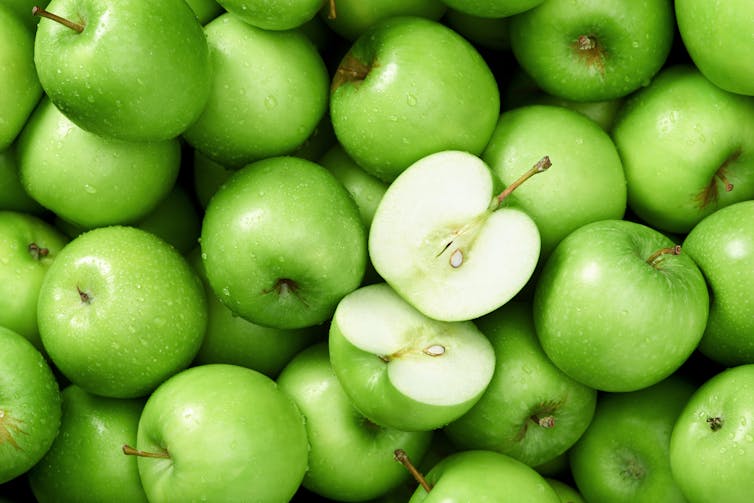
Just reading the book’s opening pages made me reach for a mandarin. By day two, I’d decided to get off the couch, stop reading so much George Eliot, and do some more vigorous exercise. By day three, our household was stocking up on extra garlic and discussing extra virgin olive oil around the dinner table with our seven year old.
Food, fads and fasting
The strongest section of the book is about food. Amid the analysis of different dietary fads, there’s some simple advice:
The more plants you eat as a proportion of your diet, the better.
The classic Mediterranean diet, with its olive oil and leafy greens, gets a very big tick. Vegan fasting, despite no strong evidence to support it, is deemed worth a go.
Additives and enhanced food are written off as more about marketing than nutrition. Vitamin and mineral supplements are a multi-billion dollar industry based on very little science. “Largely a con”, says Norman.
The elements of surprise
Despite an early promise in the book there’ll be no human interest stories, there are quite a few anecdotes about the author, which will no doubt please his fans. We learn that Norman almost never sleeps, loves a daily nap, hates almond lattes, is recovering from a salt-addiction and once consulted a dietician who suggested the reason he was hungry all the time was because he ate too much.
Much more seriously we hear stories from a grey Scottish childhood with a father who “hadn’t a clue about child rearing”, and see glimpses into a year-long episode of “stomach-churning anxiety” due to illness, separation, pain and loss.
One powerful story features the four-year old Norman, on a visit with his father to a Christmas carnival. Against his wishes the toddler was “plonked” alone on a fast-moving ride, and his resulting screams of terror were misread by his “gormless dad” as just being the normal fun of the fair.
He uses the anecdote to highlight the stress that can come from a loss of control. And that opens a great section on how society’s structures can undermine our sense of control on a mass scale, and how so much of our health is determined by government policies on housing, education and fairness.
One whole section is titled “The sex thing”, which like the rest of the book, contains a good dose of common-sense. There are musings on whether a rating system is needed for pornography, strong endorsement of the role of condoms, and caution about cosmetic genital surgery.
Particularly welcome was the celebration of the clitoris, whose role in the reality of sex is still stubbornly ignored by too much of the wider screen culture. “The vast majority of women do not orgasm with penetrative sex alone” writes Norman, because “the clitoris is usually the source of women’s orgasms.”
Swan’s book looks at the evidence around women’s orgasms. Shutterstock
And there’s a mention too of the push to label women’s common sexual challenges as a medical condition of low desire. “Call me a cynic,” he writes, “but creating a name for a problem is a prerequisitie for the pharmaceutical industry to find a treatment.”
He’s dead right. My book Sex, Lies and Pharmaceuticals documented how an alliance of sex researchers and drug companies have repeatedly tried to create new categories of illness, in order to build billion-dollar markets. And in my book with Alan Cassels, Selling Sickness, we expose how this problem of medicalising ordinary life is widespread across the medical landscape.
Some non-fatal flaws
One weakness, for me, was the book’s structure. There are lots of very short bites, sometimes not so coherently arranged, and a feeling now and again that words were written very quickly. The section on potential health impacts of screens and devices was just seven pages, compared to other sections that ran for more than 70 pages.
Another minor concern is the referencing. There’s a mountain of references at the end, but no use of endnotes, so it’s sometimes hard to tell which statements arise from evidence, and which are Norman’s analysis.
A deeper concern is that parts of the section on “Living Younger Longer” might feed unhealthy obsessions with constantly measuring all those individual risk factors, such as weight, waste, blood pressure and cholesterol.
The “worried well” are already the target of unbalanced promotion disguised as journalism that urges us to test more and more frequently for the early signs of heart disease, dementia and cancer, without any mention of potential downsides, such as unnecessary diagnosis and treatments that may bring us more harm than good.
The book has the occasional poke at drug or food industry marketing, but it doesn’t go into much detail. You won’t read, for instance, that medicine’s evidence-base has been distorted through commercial funding and influence, or about global campaigns, such as The BMJ’s, to forge more independence from industry, and produce more trustworthy evidence.
Similarly, the book has the occasional enthusiastic plug for the value of medications – for depression, high blood pressure or high cholesterol – but there’s no mention of the huge threat to your health from overdiagnosis and the overuse of tests and treatments.
But let’s not quibble. The book champions the value of context, cautions against getting too distracted by tiny details, and concludes with a warning that we’re all at risk of “knowing more and more about less and less”.
And as Norman Swan reminds us, when it comes to health, going for “good enough” may ultimately be much healthier for us, than trying desperately to be “better than well.”
So you think you know what’s good for you? is published by Hachette Australia
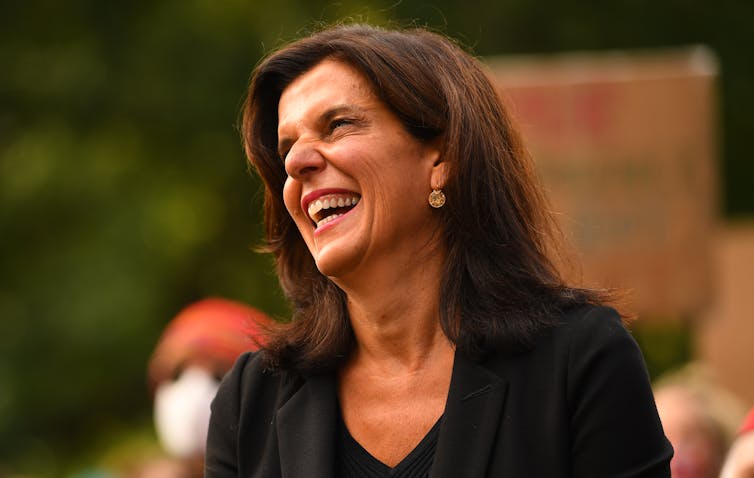
Political memoirs in Australia often create splashy headlines and controversy. But we should not dismiss the publication of former Liberal MP Julia Banks’ book, Power Play, as just the latest in a genre full of scandals and secrets.
There is a long tradition of female parliamentarians using memoirs to reshape the culture around them. Banks — whose book includes claims of bullying, sexism and harassment — is the latest to push for equality and understanding of what life is like for women in Canberra.
But there is something enduring about memoir. Sales figures aside, the political memoir can be a significant event. The inevitable round of media interviews, book tours and literary festivals can allow an author to stamp their broader ideas onto the public debate and shed light on the culture of our institutions.
They also have the advantage of usually being written when women have left parliament, and no longer need to place their party’s interests ahead of all others. Indeed, Banks tells us that her story is that of “an insider who’s now out”.
It started with Enid Lyons
In 1972, Dame Enid Lyons (the first woman elected to the House of Representatives and wife of former prime minister Joe Lyons) published Among the Carrion Crows.
In her memoir, she offered a compelling insight into how she dealt with the male-dominated environment of parliament house. She recalled feeling like a “risky political experiment”, as if the very “value of women in politics would be judged” by the virtue of her conduct. She joyfully described how her maiden speech had moved men to tears.
In that place of endless speaking … no one ever made men weep. Apparently I had done so.
She also recorded key moments when she had vigorously presented her views in the party room and the parliament. She asserted the right of women to stand — and more importantly, to be heard — in parliament.
Encouraging women, challenging men
Since Lyons, women have continued to use autobiographies to promote women’s participation in politics and challenge the masculine histories of political parties.
When the ALP celebrated its centenary in 1991, it was the male history that was celebrated. Senator Margaret Reynolds (Queensland’s first female senator) “decided that the record had to be corrected”.
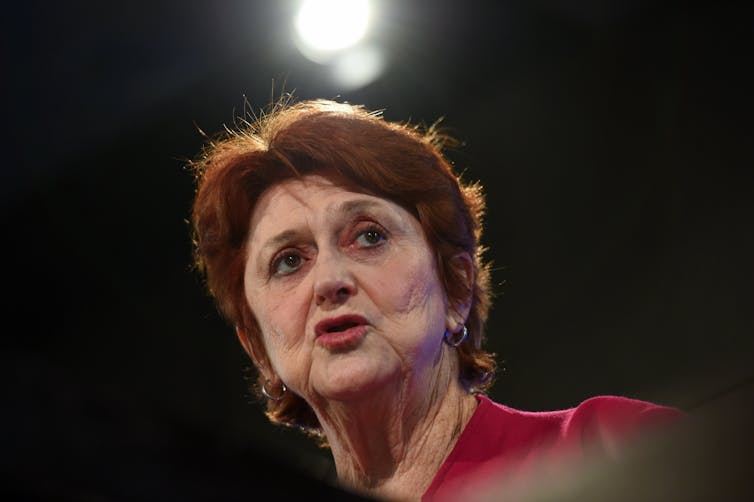
Former education minister Susan Ryan wanted to encourage other women to go into politics. Lukas Coch/AAP
Reynolds’ writings on Labor women occurred alongside the ALP’s moves toward affirmative action quotas in the early 1990s. As well as a memoir, she wrote a series of newsletters called Some of Them Sheilas, and a book about Labor’s women called The Last Bastion. In it, she recorded the experiences and achievements of ALP women over the past 100 years.
In her 1999 book, Catching the Waves, Labor’s first female cabinet minister Susan Ryan acknowledged there was “a lot of bad male behaviour in parliament”. But she argued this should not “dissuade women from seeking parliamentary careers”. Importantly, Ryan saw her autobiography as a collective story about the women’s movement and its “breakthrough into parliamentary politics” in the 1970s and 1980s.
While Labor women like Reynolds, Ryan and Cheryl Kernot were publishing their memoirs, few Liberal women put their stories on the public record. Former NSW Liberal leader Kerry Chikarovski’s 2004 memoir, Chika, was billed as the story of a woman who
learnt to cope with some of the toughest and nastiest politics any female has ever encountered in Australia’s political history.
In 2007 Pauline Hanson published an autobiography called Untamed and Unashamed, telling journalists, “I wanted to set the record straight”. But these were exceptions to the rule.
Julia Gillard’s story
Following the sexism and misogyny that disfigured her prime ministership, Julia Gillard’s 2014 memoir My Story helped revitalise the national conversation about women and power. Hoping to help Australia “work patiently and carefully through” the question of gender and politics, Gillard promised to “describe how I lived it and felt it” as prime minister.
Julia Gillard released her memoir in 2014, the year after she lost the prime ministership. David Moir/AAP
Importantly, she held not only her opponents but also the media to account for their gender bias. Critics like journalist Paul Kelly derided Gillard’s version of history as “nonsense”, but the success of her account suggests otherwise. My Story sold 72,000 copies in just three years.
In her 2020 book, Women and Leadership co-authored with former Nigerian finance minister, Ngozi Okonjo-Iweala, Gillard interviewed eight women leaders from around the world, further showing how gender continues to shape political lives.
The risks of writing
A political memoir can be fraught, however. After a decade in parliament, Democract-turned-Labor MP Cheryl Kernot published her memoir Speaking for Myself Again in 2002.
She had hoped it would argue the case for Australian women “participating fully” in politics to promote “their own values and interests and shift the underlying male agenda”.
Former MP Cheryl Kernot’s memoir release was overshadowed by controversy. Julian Ross/AAP
But the release was quickly overshadowed by revelations of an extra-marital affair with Labor’s Gareth Evans (which were not in the book). Her book tour was halted amid the fallout. Kernot later despaired journalist Laurie Oakes — who broke the story — had managed to “sabotage people’s interest in the book”.
Others, such as Labor’s Ros Kelly, have told their stories in private or semi-private ways. Kelly’s autobiography was privately published as a gift to her granddaughter, but she also gives copies to women in politics, many of whom “have read it, and sent me really nice notes”.
Power in numbers
In the past five years, several women from across the political spectrum have published life stories.
In her memoir, An Activist Life, former Greens leader Christine Milne argued that women should perform feminist leadership rather than being “co-opted into being one of the boys”. In Finding My Place, Labor MP Anne Aly, showed women of non-Anglo, non-Christian backgrounds belong in parliament too. Independents Jacqui Lambie and Cathy McGowan used their memoirs to show female MPs can thrive without the backing of the major parties.
Most recently, former Labor MP Kate Ellis published Sex, Lies and Question Time, which includes reflections on the experiences of nearly a dozen other women in parliament.
For fifty years, Australia’s female politicians have used their memoirs to assert the equal rights of women in parliament, party rooms, and the media. Drawing on that lineage, Banks is the latest to help reveal and disrupt the sexism and misogyny in political life.






 At the BookShelf
You must be logged in to post a comment.