
The link below is to a book review of ‘Rhapsody in Black – The Life and Music of Roy Orbison,’ by John Kruth.

The link below is to a book review of ‘Rhapsody in Black – The Life and Music of Roy Orbison,’ by John Kruth.
The link below is to an article that takes a look at book reviews in general.
For more visit:
http://indiereader.com/2013/06/the-shifting-landscape-of-book-reviews/
The link below is to a book review of ‘Killer Dads,’ by Mary Papenfuss.
For more visit:
http://blogcritics.org/book-review-killer-dads-by-mary-papenfuss/
The link below is to a book review of ‘Red Nile – A Biography of the World’s Greatest River,’ by Robert Twigger.
For more visit:
http://www.guardian.co.uk/books/2013/jun/16/red-nile-robert-twigger-review
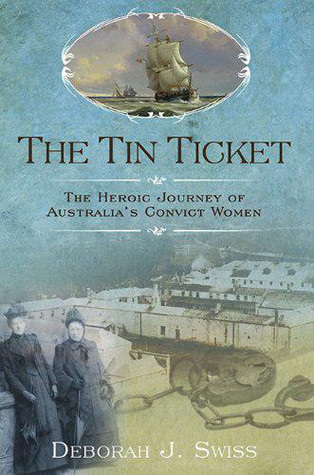
Chapter 8: The Yellow C
Chapter 8 of The Tin Ticket brings a mixture of news for the three main characters of The Tin Ticket to this point. The conclusion of the previous chapter recorded the birth of William, the son of Janet Houston. This chapter begins with the reunion of old friends in Agnes and Janet, along with Ludlow Tedder. Sadly it also delivers the terrible news of William’s death, not long after Janet’s return to Cascades, following the forced separation of mother and child. The heartbreaking scene of a convict child’s burial and the resulting depression is only broken when Janet and Agnes are again reunited, and soon after they in turn are reunited with Ludlow Tedder in the Crime Class at Cascades.
However, there is good news also, as all three are released from their servitude by the end of the chapter. Agnes and Janet complete their time, while Ludlow is granted a Ticket of Leave for good behaviour. The chapter ends with a reunited Ludlow Tedder and her daughter, before the final conclusion of the chapter with the marriage of Ludlow Tedder to a free settler, the widower William Manley Chambers. There is now the promise of a new beginning for all three women – Agnes, Janet and Ludlow (along with Arabella). What will the future hold?
Buy this book at Amazon:
http://www.amazon.com/gp/product/B0043RSIWI/
Chapter 7: Liverpool Street
Liverpool Street continues the story of Ludlow Tedder and her daughter Arabella, and the journey they embark upon as convicts to Van Dieman’s Land aboard the Hindostan. Once again the Tin Ticket enters the story, with Ludlow Tedder being assigned #151. Ludlow’s journey to Australia is softened somewhat for her and her daughter by being appointed the nurse aboard the Hindostan.
Woven into the account of Ludlow Tedder’s journey to Van Dieman’s Land are fascinating insights to what transportation meant to countless others, with snippets of information concerning other female convicts who were forced from the land of their birth to a country on the other side of the world. There is of course the description of Ludlow Tedder’s own experience aboard the Hindostan as well, with what she and her daughter endured during the crossing of the world’s oceans.
Upon arrival in Van Dieman’s Land, the accounts of other female convicts and their experiences of convict life continue to be interwoven into that of Ludlow Tedder’s experience, providing a much richer understanding of what being a female convict in Van Dieman’s Land during 1839 really meant. The horrific conditions endured by convicts at Cascades and by children who were housed at the Queen’s Orphanage, separated from their mothers who were only allowed a single monthly visit, were truly shocking. Conditions were atrocious at both facilities by the modern standards of today, but apparently were far better than those experienced in the slums of Britain. They were most certainly not easy times.
The chapter concludes with Ludlow Tedder serving as a nurse at the Liverpool Street Nursery and with her coming into contact with another of the books main characters, Janet Houston. Janet re-enters the narrative with a newly born son, William.
Buy this book at Amazon:
http://www.amazon.com/gp/product/B0043RSIWI/
The link below is to a book review of ‘The Unwinding,’ by George Packer.
For more visit:
http://www.bostonglobe.com/arts/2013/06/08/book-review-the-unwinding-george-packer/gwFnjzOc2qc8jRRIEZNfBO/story.html
The link below is to a book review of ‘The Shanghai Factor,’ by Charles McCarry.
Chapter 6: Ludlow’s Choice
Chapter 6 introduces a new character to the narrative of The Tin Ticket – Ludlow Tedder, a 45-year-old widow who is working hard to try and provide for her family. There is a very brief biographical description of her life to that point and a very good description of her then life as a servant in the home of a barrister, Fitzowen Skinner and his wife Laura. It is not an easy life and with so much work for not much pay – certainly not enough to provide all the necessaries for her family. And it is this that brings her into the story of The Tin Ticket. To try and get that little bit extra so she can purchase what she needs for her young daughter she pawns a few pieces of cutlery, but is found out in tragic circumstances for her family.
As a result she seeks to escape justice but her life on the run is cut short in very quick time and she is imprisoned at Newgate. There she awaits trial and is quickly condemned to be transported to Van Dieman’s Land for ten years, though tempered with the mercy of being able to take her youngest daughter with her. Yet again the injustice of the British law system can be seen in the sentence – 10 years transportation in appalling conditions for a very petty crime.
The chapter also provides a selection of other similar petty criminal cases and examples of the corruption that influenced the sentencing of prisoners at that time.
Buy this book at Amazon:
http://www.amazon.com/gp/product/B0043RSIWI/
 I usually like to own the books I read and these days I prefer to own them as ebooks. This particular book however I do not own. I did try and find a digital copy but was unable to do so. The book I have read was lent to me from a guy I work with and I believe he found it among some books that were being disposed of. So it has had something of a rough history I would say.
The edition I read was a hardcover book published in 2005 by Chamberlain Bros., a member of Penguin Group (USA) Inc. It is 169 pages in length, though the Forward and Introduction need to be added to that total. It took me less than a day to read, which demonstrates that the book is a very easy and interesting book to read.
Breaking Ships is a fascinating read, although I was familiar with the subject covered in the book, having seen a TV program on the very subject some months before. Indeed, the reason the book was lent to me was because the breaking up of ships in Bangladesh had been discussed during a meal break at work. We had been discussing the mammoth task of chopping up these ships and the recycling of everything contained therein – as well as the environmental damage caused and the poor wages of those that worked in the ship breaking yards.
However, the book has given me a better appreciation of conditions in the business, as well as conditions throughout Bangladesh and the massive impact this business has for the entire country. The book is a real eye opener for the entire process and all the people involved in breaking up a ship. The book’s main concern as far as the ships being recycled is the ‘Asian Tiger,’ a gigantic 38 000 ton oil tanker. The Asian Tiger’s dismemberment is traced right from the initial beaching of the ship until there is nothing left – including a look at all those involved in the work, the villages that provide the workers, how the material being recycled is sold and used thoughout Bangladesh, etc. It is a most fascinating read as I have already said. The book features many photos which I think adds greatly to the value of the work.
This book introduces the western reader to a different world, with a glimpse behind the scenes at industrial life in a third world country that has very little of that which we would expect in such an industry – good wages, work safety, environmental protection, etc. It’s well worth a read.
The video below is of footage taken from the beaches near Chittagong in Bangladesh, showing something of what it is like in the ship breaking business of Bangladesh.


You must be logged in to post a comment.