Unknown's avatar

A long fuse: ‘The Population Bomb’ is still ticking 50 years after its publication


File 20180709 122271 1ubedx.jpg?ixlib=rb 1.1
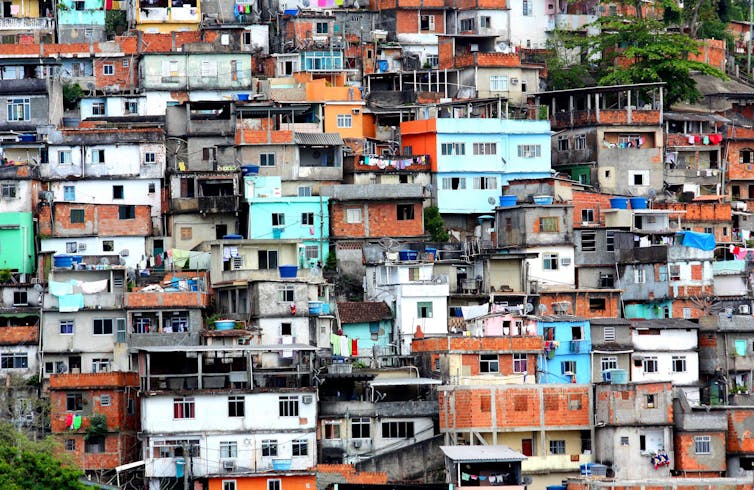
Slums like this one in Rio de Janeiro embody the problems Paul Ehrlich warned of in ‘The Population Bomb.’
dany13, CC BY

Derek Hoff, University of Utah

“The battle to feed all of humanity is over,” Stanford biologist and ecologist Paul Erhlich declared on the first page of his 1968 best-seller, “The Population Bomb.” Because the “stork had passed the plow,” he predicted, “hundreds of millions of people are going to starve to death.”

Ehrlich’s book identified dramatically accelerating world population growth as the central underlying cause of myriad problems, from a food crisis in India to the Vietnam War to smog and urban riots in the United States. It sold more than 2 million copies and went through 20 reprints by 1971. Ehrlich appeared more than 20 times on NBC’s “The Tonight Show Starring Johnny Carson”, and became the first president of Zero Population Growth, a Washington D.C.–based advocacy organization, while remaining a professor at Stanford.

“The Population Bomb” created more space to hold radical views on population matters, but its impact was fleeting, and maybe even harmful to the population movement. By the early 1970s, many critics were savaging Ehrlich and the larger goal of achieving zero population growth. And the politics of “morning in America” in the 1980s successfully marginalized Erhlich as a doomsdayer.

However, as a historian who has studied debates about population growth throughout U.S. history, I believe that Ehrlich’s warnings deserve a new and less hysterical hearing. While Ehrlich has acknowledged significant errors, he was correct that lowering birth rates was – and remains – a crucial plank in addressing global environmental crises.

Paul Ehrlich in 2010.
Paul R. Ehrlich, CC BY

A Malthusian warning

Ehrlich drew on nearly 200 years of thinking inspired by British pastor and political economist Robert Thomas Malthus. In his 1798 study, “An Essay on the Principle of Population,” Malthus famously predicted that “geometric” population growth would overwhelm “arithmetic” gains in agricultural production, leading to wars, famines and societal collapse.

Fears of the potentially dangerous social and ecological effects of population growth intensified after World War II. Global population surged as public health improved greatly in developing nations, increasing life expectancy. At the same time, the new science of ecology demonstrated the fragility of Earth’s interconnected systems. And the Cold War promoted worries that population-induced poverty would breed communism.

Mainstream advocates of arresting population growth emphasized better access to family planning and education, but Ehrlich had no use for such baby steps. “Well-spaced children will starve, vaporize in thermonuclear war, or die of plague just as well as unplanned children,” he wrote.

It took 200,000 years for Earth’s human population to reach 1 billion – and only 200 years to reach 7 billion. But growth has begun slowing as fertility rates decline.

Technological optimists pointed to the “Green Revolution” in agriculture, which had vastly increased crop yields up until the late 1960s. But Erhlich, echoing a growing chorus of farmers and agricultural scientists, warned that pesticides ruined the environment and would eventually backfire as weeds and pests developed resistance.

Erhlich never called population the only variable. With physicist John Holdren, he proposed the I = P x A x T formula, which describes human impact as the product of population, affluence (the effects of consumption) and technology.

Nonetheless, Ehrlich believed that population was the key multiplier and massive reductions in global population were critical for human survival. He hoped that a combination of policy carrots and sticks would reduce fertility sufficiently and preserve voluntary family planning. But he held out the possibility that coercive measures, including compulsory sterilizations, might be needed.

Backlash and a new population politics

Millions of Americans shared Ehrlich’s anxieties in 1968. Concerns about the ecological impact of global population growth had helped birth modern American environmentalism. Feminists cited overpopulation to buttress the case for reproductive and abortion rights. Politicians on both sides of the aisle urged action to lower birth rates, and Republican President Richard Nixon signed into law a Commission on Population Growth and the American Future.

But the “culture wars” of the 1970s subsumed and reconfigured population issues. On the right, the “pro-life” movement that crystallized in the wake of the Supreme Court’s 1973 Roe v. Wade decision considered any talk of population reduction anathema.

China’s one-child policy, launched around 1980, led to serious human rights abuses that allowed anti–family planning conservatives to paint all population programs in a negative light. Conservatives subsequently ignored China’s significant reforms to the policy, as well as research indicating that slowing population growth contributed to China’s economic miracle.

Moreover, newly ascendant anti-Keynesian economists rejected an older consensus that slowing population growth would yield economic benefits. These market-oriented economists asserted that denser populations created economies of scale, and that individual fertility decisions would adjust to any temporary population problems. President Ronald Reagan, who once had dabbled with Malthusianism, tellingly labeled advocates who worried about scarce resources “Doomsday prophets.”
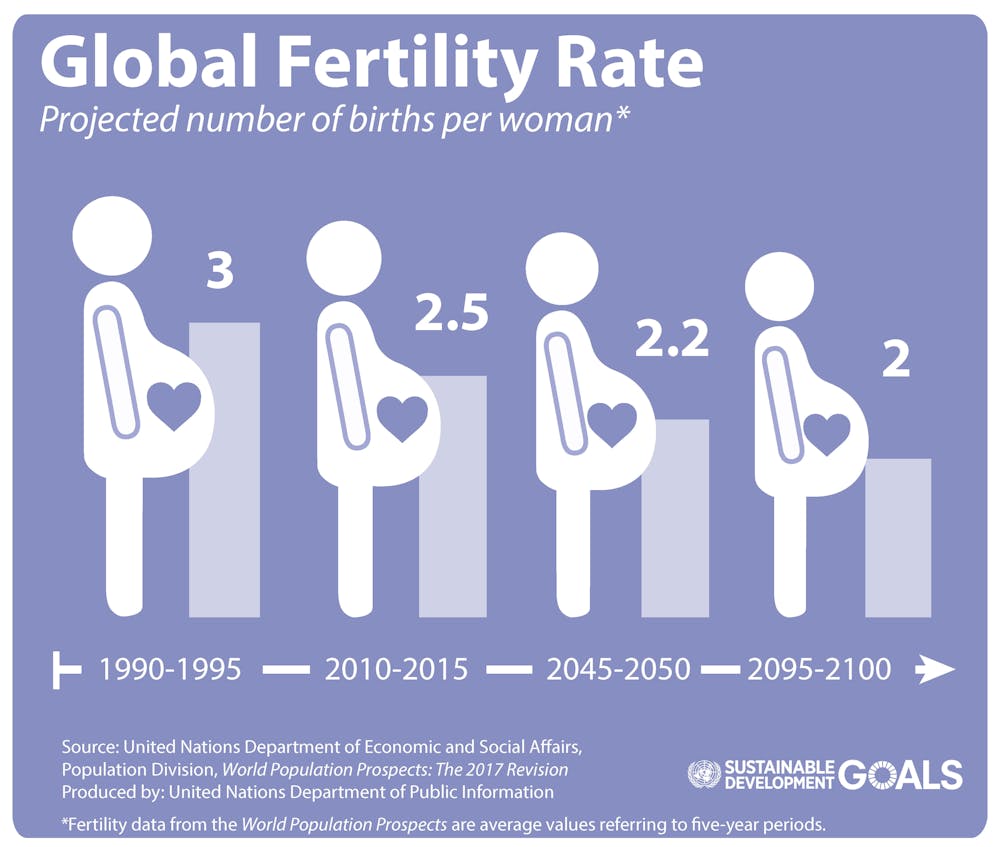
As nations develop economically, couples have fewer children and fertility rates decline.
CC BY-ND

After Congress eliminated national-origin immigration quotas in 1965, immigration rose steadily and accounted for a growing share of population growth in the U.S. In this context, white liberals increasingly risked being branded racist for supporting population reduction.

By the late 1970s, both liberals and conservatives had bought into exaggerated talk of an “aging crisis” – too few workers to pay for the bulge of baby boomers headed toward retirement. This perspective bolstered calls for higher birth rates and further reduced the sting of the overpopulation critique.

An unsolved equation

Today Ehrlich is a largely forgotten prophet, although some small population-centric organizations continue to tilt at windmills and the mainstream press occasionally dips its toes in the water. After some very public rifts over immigration policy, mainstream environmental groups generally avoid or downplay the issue. Meanwhile, the Right continues to dismiss talk of population problems.

Looking back with the benefit of time, it’s clear Ehrlich was wrong to view population as all-encompassing. In addition, the global total fertility rate has declined more than he anticipated – although the development and modernization that has helped lower birth rates, a process known as the demographic transition, comes at great environmental cost.

Ehrlich underestimated human ingenuity. And for now, one can reasonably argue that food insecurity remains primarily political rather than technological. In Ehrlich’s own words, the book’s weaknesses were “not [focusing] enough on overconsumption and equity issues.”
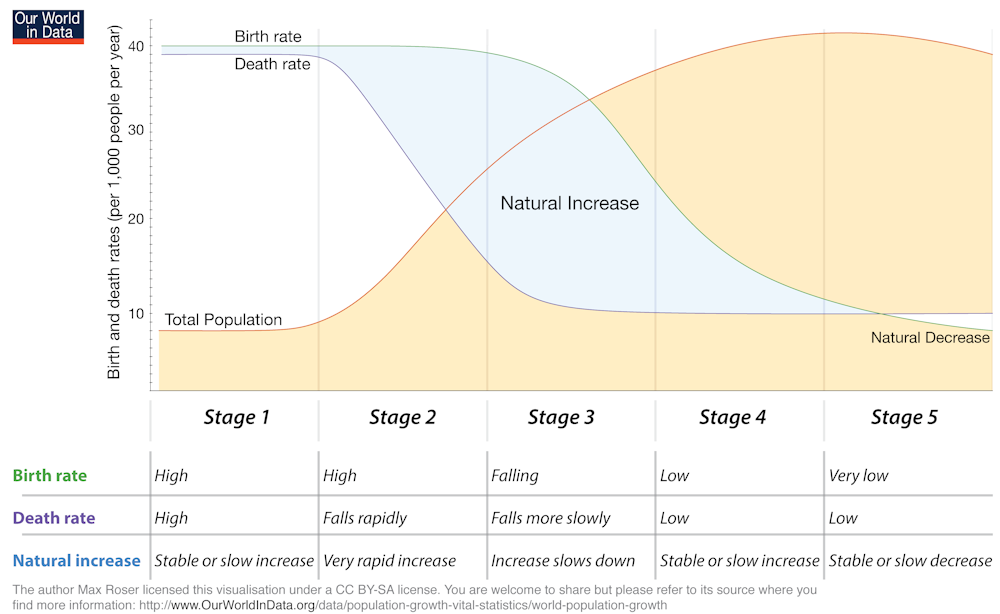
The demographic transition is a pattern in which countries tend to transition from high birth and death rates to lower birth and death rates as they industrialize.
Max Roser, CC BY-SA

But he got much right, even if many details and his timing were off. Global population has increased at a remarkably steady rate since 1968, and the United Nations projects that it will reach 9.8 billion by 2050 and 11.2 billion by 2100. Scientists continue to extend his prescient warnings that efforts to feed all these people through pesticide-intensive monoculture may backfire. And although Ehrlich exaggerated the threat of mass starvation, about 8,500 young children die from malnutrition every day.

Human-driven climate change is an overriding threat, and is unambiguously worsened by population growth. The Intergovernmental Panel on Climate Change estimates that limiting warming in this century to 3.6 degrees Fahrenheit (2 degrees Celsius) would require cutting global greenhouse gas emissions 40 to 70 percent by 2050 and nearly eliminating them by 2100. “Globally, economic and population growth continue to be the most important drivers of increases in CO2 emissions from fossil fuel combustion,” the panel observes.

The ConversationThere lies an enduring flaw in Ehrlich’s approach. If impact equals people times affluence times technology, then reducing population alone is not sufficient to solve our ecological crises. But reducing affluence is neither possible nor desirable, since it would condemn millions to lifelong poverty. Ultimately, “The Population Bomb” offered no road map for transitioning away from capitalism without causing human ruin as serious as the environmental ruin that seems to be our destiny.

Derek Hoff, Associate Professor, Lecturer in Business and Humanities, University of Utah

This article was originally published on The Conversation. Read the original article.

Unknown's avatar

In Rozanna Lilley’s memoir, a curious life gets even more curious


File 20180702 116135 8rghvw.jpg?ixlib=rb 1.1
Rozanna Lilley, the author of Do Oysters Get Bored? A curious life.
UWA Publishing

Katie Sutherland, Western Sydney University

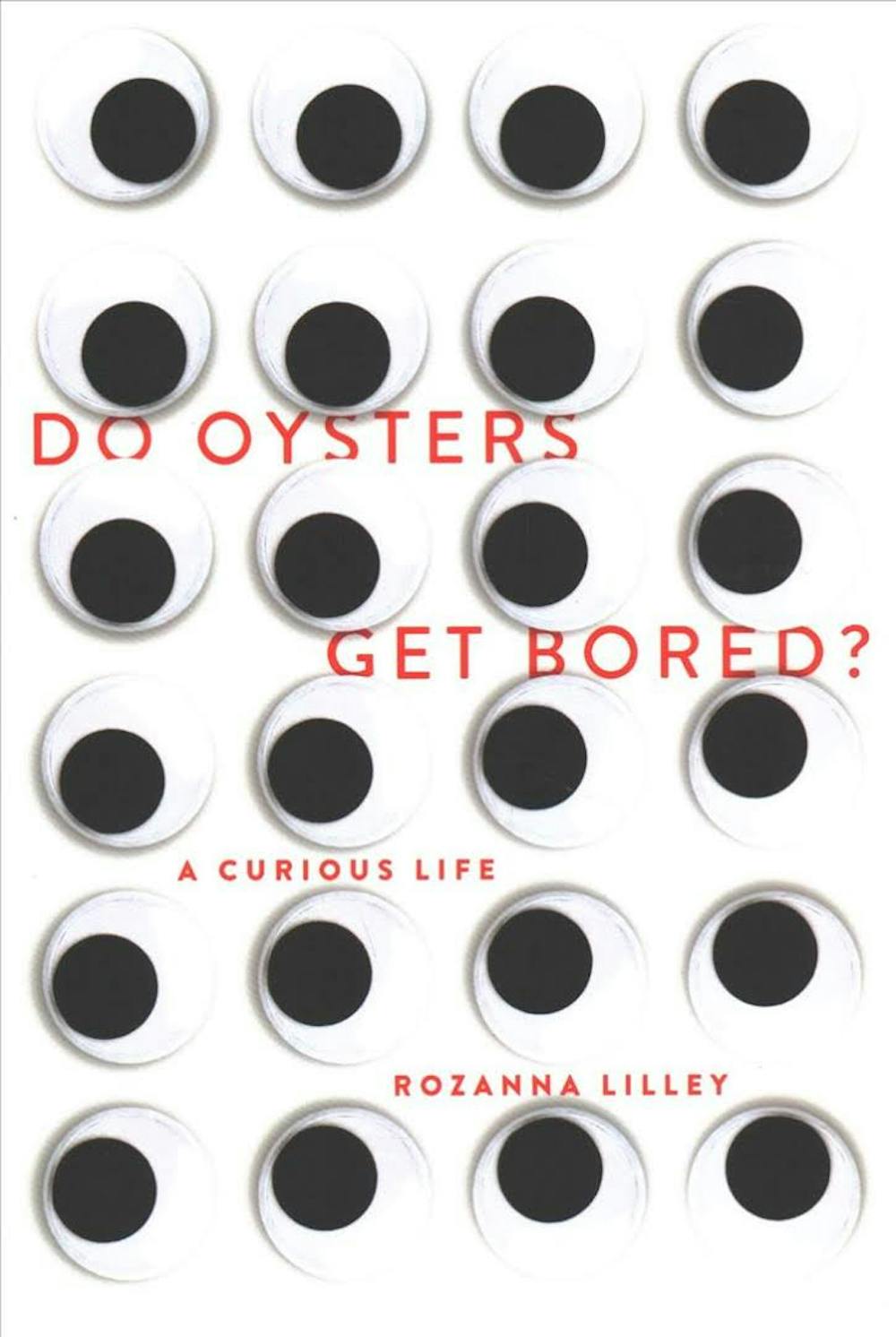
Review: Do Oysters Get Bored? by Rozanna Lilley


At the nucleus of Rozanna Lilley’s memoir, Do Oysters Get Bored? A curious life, is Lilley’s son Oscar, a funny and endearing 12-year-old with a penchant for cartoons, a fear of dogs and a dislike for crying babies. Oscar is autistic, diagnosed at the age of three. But autism is just one small piece in the puzzle of a complex family story, as Lilley unravels memories of her own fraught early years.

Lilley and her sister Kate are the daughters of the late and renowned writers Dorothy Hewett and Merv Lilley. Left wing radicals, the couple and their children lived at the centre of the 1970s arts scene in a bohemian terrace in Jersey Road, Woollahra — an open house frequented by painters, poets, actors and musicians.

Hewett believed in free love and encouraged her girls to have sex from an early age. However, many of Lilley’s sexual encounters as a teenager, and younger, were moments of molestation and predation by the older men who visited their family home that resonate in today’s #MeToo movement. She writes openly about these and also reflects on her mother’s role:

My mother did not intentionally hurt me. But neither did she protect me. She had a pretty good idea of what was going on in her own house and she imaginatively recast these predations as adventures, confirming our familial superiority to restrictive moral norms. Forty years later, I am still trying to come to terms with that carelessly broken girlhood.

At times, the book’s content is intensely confessional and confronting. But the themes of childhood and motherhood are intrinsically linked and it is only fitting that Lilley reflect on her own upbringing as she negotiates how to parent Oscar and his older sister.


UWA Publishing

While Lilley’s account of her parents’ failings is frank, she also writes of a fondness for her mother and the sense of grief she felt when Hewett died in 2002. Lilley also reflects on caring for her father in his final years with dementia until he died in 2016. As a reader, it is not difficult to empathise with her conflicted emotions around such responsibilities and life events.

Lilley does not sugarcoat the realities of autism either, but compared to some of the other gritty material in the book, her stories of Oscar come as sweet relief. It is in unlikely places, such as a caravan park in Berrara, NSW, that Lilley finds moments of tenderness:

From the ruffled comforts of my bed, I watch the world of the caravan park through the window. And I breathe my son in. Oscar’s round face, caught in the half-light of the summer’s morning, is beautiful beyond reproach.

Oscar is theatrical and Lilley relishes his sense of humour and unique perspective. She describes his attachment to certain objects, his inner fantasy world, his anxieties and fears, and how these traits impact on family life. But she also draws the reader’s attention to her son’s unique creativity and sensitivity, largely through his precocious vocabulary. “A cloud and a moon equal beauty”, he announces one evening on his way to bed, “It’s a once in a lifetime gift!”

The book’s title alludes to a question he asks on a family holiday in Patonga, where, writes Lilley, “fishing boats curtsy on the rolling tide, laden with lacy nets and old salt-encrusted promises”.

“Hey Mum”, asks Oscar, “if you were an oyster, what do you think you would be thinking? Dad, what do you think the life of an oyster would be? Do you think they would be bored?” He goes on to question, “If you were an oyster, would this entire place be the known universe?”

Like many parents of children on the autism spectrum, Lilley has turned to research to better understand her child. She is also a social anthropologist and her portrayal of autism is informed and sensitive. Autism diagnostics are ever evolving and Lilley has handled this well throughout.

She has also “learned to pick her battles” with unhelpful people who are all too quick to pass judgement, writing: “Autism is a shooting gallery, a passing parade occupied by stereotypical figures created through a heady mix of prejudice, ignorance and voyeuristic fascination”.

Lilley’s storytelling is eloquent and touching, with her talent for poetry evident in her writing style. Her prose is complemented by a selection of poems at the end of the book. As a whole, the memoir paints a nuanced picture of the complexity of family life and the dynamic between the individuals who make up this family’s story.

The Conversation“To paraphrase Henry James”, writes Lilley, “it would be fair to say that all of my family, both more and less eminent, have oddities and disparities that often force one, thinking them over, to wonder what they really quite rhyme to”. Indeed, it is a curious life.

Katie Sutherland, Doctor of Creative Arts Candidate, Western Sydney University

This article was originally published on The Conversation. Read the original article.
Unknown's avatar

Friday essay: Dark Emu and the blindness of Australian agriculture


File 20180614 32304 1e3jqkq.jpg?ixlib=rb 1.1
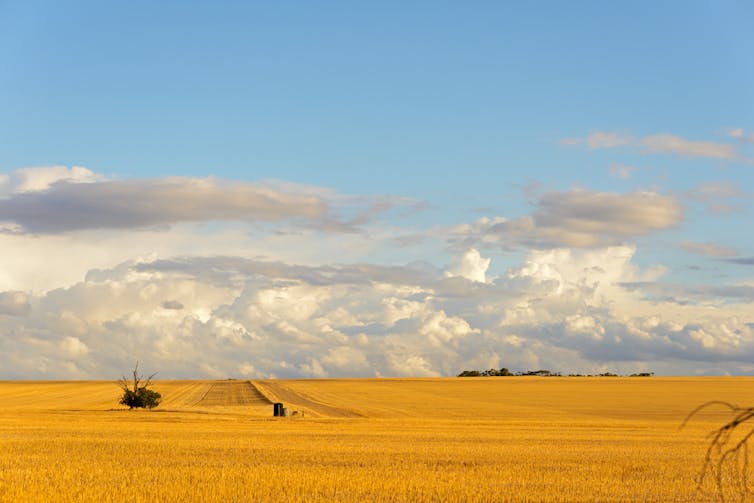
Australia’s romantic attitude to farming has done untold damage to the land.
Shutterstock.com

Tony Hughes-D’Aeth, University of Western Australia

What if Australia were to stop farming? At approximately 3% of gross domestic product, the removal of agriculture from the economy would be a significant hit. It would affect our balance of payments — 60% of agricultural produce is exported and it contributes 13% of Australia’s export revenue.

Towns that are slowly dying would collapse, jobs would go. But really the scandal of this thought goes beyond economics and into the very soul of the nation. The crucial insight to emerge from such a thought-experiment is that agriculture in Australia is a religion — it is as much a religion as it is an industry.

The powerful ideological connection between Australia and agriculture is being increasingly and diversely scrutinised and comes to the fore in Charles Massy’s iconoclastic epic, Call of the Reed Warbler: A New Agriculture, A New Earth (2017), which throws into question 200 years of assumptions about what it means to graze animals in Australia.

Massy’s joins a spate of recent books that seek to recast the basic assumptions on which Australian agriculture was built. They include Don Watson’s The Bush (2016), Bruce Pascoe’s Dark Emu, Black Seeds: Agriculture or Accident? (2014) (which has recently been turned into dance by Bangarra) and Bill Gammage’s The Biggest Estate on Earth: How Aborigines Made Australia (2012). If agriculture is a religion in Australia, these writers are its heresiarchs.

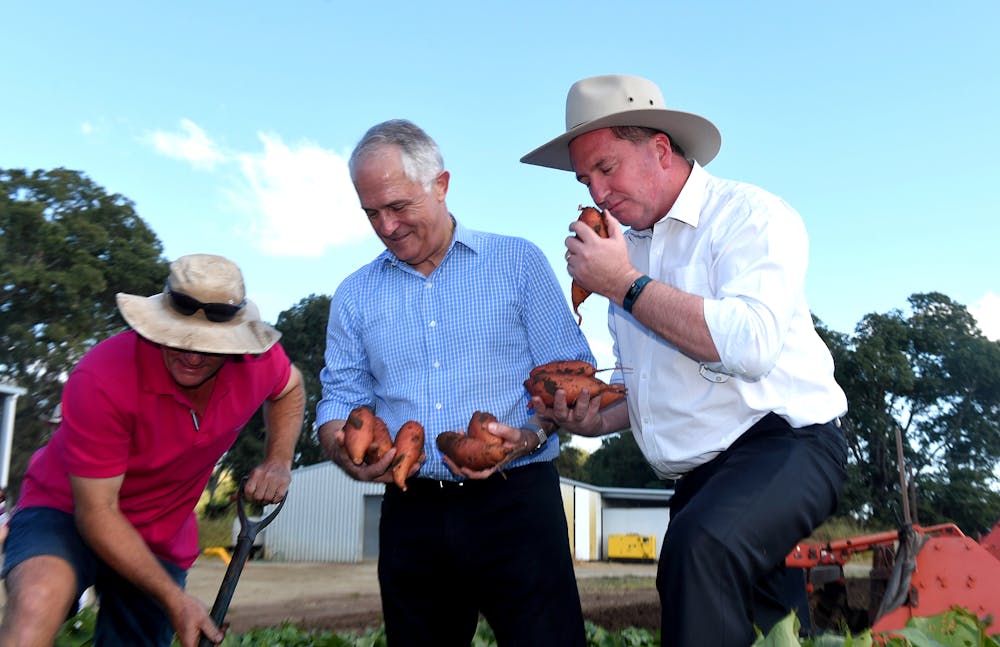
Prime minister Malcolm Turnbull with then-deputy prime minister Barnaby Joyce in 2016.
TRACEY NEARMY

It is a truism that Australia, overwhelmingly urban for most of its modern history, draws its identity disproportionately from “the land”. Those Qantas television advertisements with choirs of angelic children strewn elegantly in front of Uluru or the Twelve Apostles trade on the basic fact that Australians identify and want to be identified with the continent itself.

In this sense, Australia (the continent, the land, the soil, the bush) is imagined as a metaphysical substance which gives unity, meaning and destiny to what might otherwise seem like a collection of recently federated settler colonies, formed to extract resources for the benefit of a once powerful European nation state. The practice of agriculture is central to the belief that Australians as a people are expressive of Australia, the metaphysical ideal. Without this connection between agriculture and Australianness, we couldn’t make sense of such fashion icons as Akubra, Blundstone, Driza-Bone and R.M. Williams.

Serious questions


Shutterstock.com

Serious questions about the way that Australia sustains people through the plants and animals that are husbanded on its ancient soils are not, of course, confined to the past several years. The revision might be traced to Tim Flannery’s The Future Eaters (1994), or even earlier to such seminal works of environmental history as Eric Rolls’ A Million Wild Acres (1981), W.K. Hancock’s Discovering Monaro (1972), and Barbara York Main’s Between Wodjil and Tor (1967) and Twice Trodden Ground (1971).

What each of these writers did was to make the Australian environment, or some part of it, an actor rather than a stage. The environment for these writers was not some broadly passive, albeit resistant, thing out there that needed to be overcome, battled, tamed, brought into submission — it was a dynamic system of interrelated parts, where every action had cascading consequences and complex repercussions.

At the centre of, or just beneath, all of these books is the attempt to try and locate some kind of basic environmental baseline. There seems to be no dispute about the fact that the agricultural colonisation of Australia by Europeans has had far reaching consequences for the organisation of the continent’s biota.


Read more:
Queensland land clearing is undermining Australia’s environmental progress


In almost every possible way the land has undergone serious and widespread interventions. The introduction of new predators, notably cats and foxes, caused (and continues to cause) mass extinctions of species. The introduction of hooved animals, in addition to their utterly different patterns of grazing, also hardened the soil and changed the extent to which rain is absorbed or runs off the surface of the land, often carrying soil into rivers which now run faster but also then silt up and slow down.

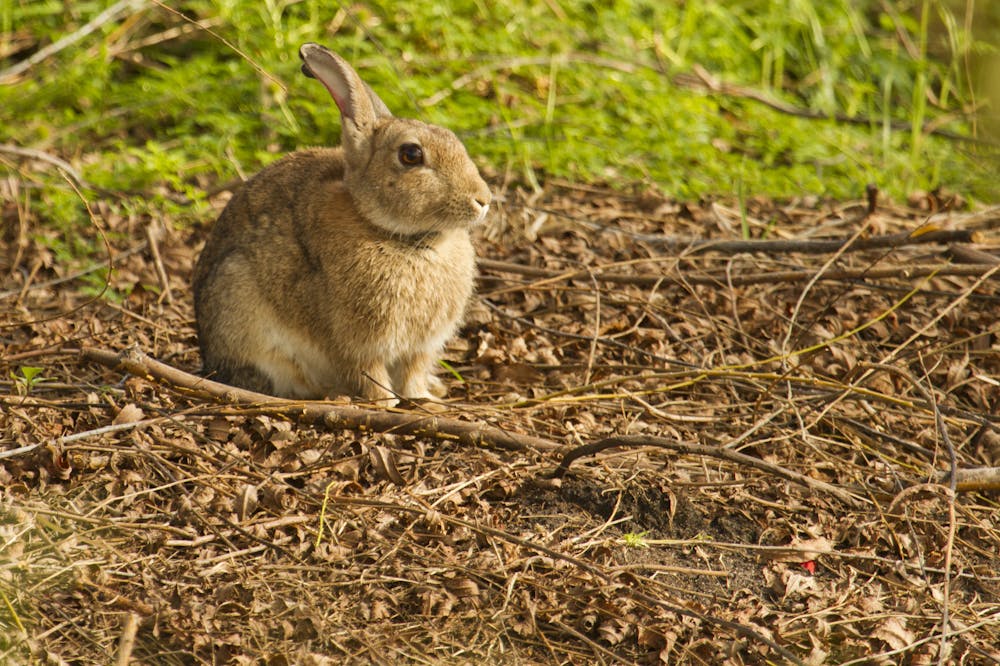
Rabbits and other rodents out-compete native herbivores.
Shutterstock.com

The removal of perennial, deep rooted vegetation for annual crops causes groundwater to rise and dissolves salt crystalised in the soil, resulting in soil salinity. Fire regimes have changed radically. Rabbits and other rodents out-compete native herbivores, while European carp have transformed the major river systems of the south east. The list goes on, and it is surprisingly familiar to all of us.

But as these things continue to run rampant, and as major questions begin to be asked about the sustainability of agriculture, we seem to be thrown backwards into the origins of these problems. And as we trace them back we come against the tantalising question of what it was all like before this. Before what? Before the arrival of Europeans. What did Australia look like in 1788, in fact? This is the question that each of these writers seems to be either answering, or at the least reacting against.

What it was like before

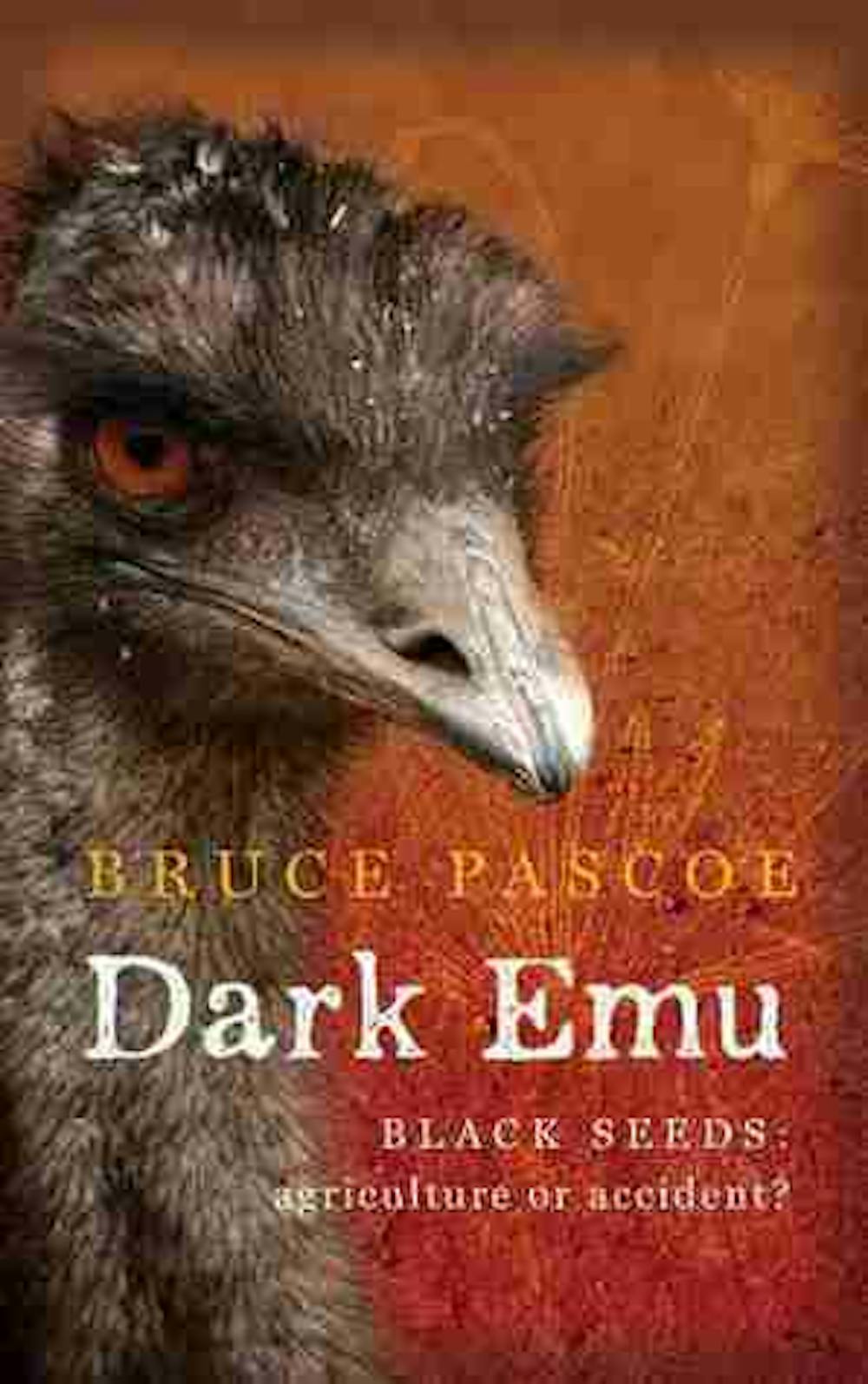
In this respect, Bruce Pascoe’s Dark Emu, which builds in important ways on Gammage’s earlier book, provides the most concerted attempt to answer the question about the quality of the country — in particular, the interface between human and nature — in the pre-colonial epoch. Because of the oral quality of Aboriginal societies, many of these questions have traditionally been considered to fall beyond the province of history proper, and into the study of pre-history (archaeology) and anthropology.

Dark Emu, Black Seeds by Bruce Pascoe, 2016.
Goodreads.

Indeed, there is something of a demarcation dispute around this crucial hinge between Aboriginal and European colonial lifeways. One of the strengths of Pascoe’s book is its ability to bridge archaeology, anthropology, archival history, Indigenous oral tradition and other more esoteric but highly revealing disciplines such as ethnobotany and paleoecology.

The key contention in Pascoe’s book is that the whole distinction between the farming colonist and the hunter-gatherer indigene is based on a radical, and frankly self-serving, misunderstanding of the way that the Indigenous peoples of Australia lived in their countries. Pascoe assembles a persuasive case that Indigenous Australians farmed their land, lived in villages, built houses, harvested cereals, built complex aquaculture systems — possibly the earliest stone structures in human history — and led the kind of sedentary agricultural lives that were meant only to have arrived with Europeans in 1788.


Read more:
The detective work behind the Budj Bim eel traps World Heritage bid


At Budj Bim in western Victoria, Indigenous Australians built extensive fish traps.
AAP Image/Budj Bim

Pascoe is an Indigenous historian and is clearly motivated by a desire to redress the serial denigration of Indigenous people. His cards are on the table, but this does not mean that he is not a rigorous and exacting judge of the historical record.

Massy, for his part, was born and bred on a sheep and cattle farm on the Monaro plain — a farm he has now run for over 40 years. By his own confession, he spent the majority of his farming life assiduously contributing to the problems he is now just as assiduously diagnosing in The Call of the Reed Warbler. The book is in many respect a conversion narrative, documenting the moment when the scales fell from his eyes and he saw truly the world as it was — not a land made efficient and productive by the application of agricultural science, but a land emptied of its relationships and webs of life by a kind of collective psychosis. Farming wasn’t sustaining the land, it was ruining it. It was an extractive industry that had gobbled up thousands of years of sustenance in a few generations of sustained plunder.

Don Watson’s book The Bush is the most literary of these recent contributions, and it moves effortlessly and elegiacally between science, history, reminiscence and anecdote. He has a writing style that is epigrammatic and sonorous, reminiscent of the way that, in an American context, Wallace Stegner treated the tumultuous history of the American Great Plains.

Against the bluff empiricism that underpins Gammage and Pascoe, and the ardour of the convert that galvanises Massy, Watson offers something more elliptical and rhapsodic. He moves from his native Gippsland to Australia at large through a sort of sly mimicry of the discourse of the Australian bush. The bush is both the object of Watson’s study and his linguistic mode, since he draws his wry sensibility directly from Joseph Furphy or Henry Lawson. The distinctive admixture of acerbic humour, dark melancholy and a poignant apprehension of the absurdity of life that was the hallmark of the Bulletin school of writers.

Something is broken

What all of these books are saying, and why they are in fact getting traction now, is that something is broken. These books are not announcing that the environment is broken — they merely mention this in passing, regarding this as beyond any reasonable doubt. Instead, what these books are announcing is that agriculture is broken.

This, in the context of our self-image, is something that is much more terrifying and it will be savagely resisted. But each book is also hopeful in its way. None more than Charles Massy, whose book’s subtitle “A New Agriculture, A New Earth” is openly salvationist and The Call of the Reed Warbler is a detailed plan for the regeneration of degraded pastoral country that allows for both agricultural production and environmental recovery.

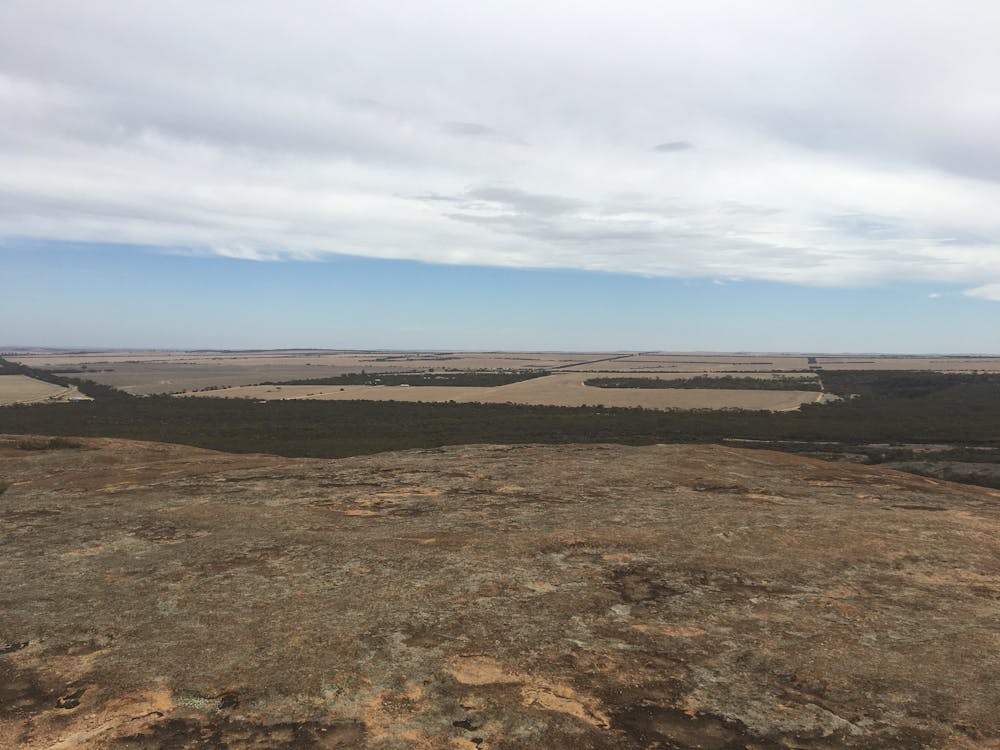
A few weeks ago, I was visiting the rock formation we whitefellas have called Wave Rock, in Western Australia’s southern wheatbelt. It is a stunningly beautiful granite outcrop and central to the lifeways of the Noongar people of this region.

The view from Wave Rock over Western Australia’s farm lands.
Tony Hughes-D’Aeth

What stands out now is the contrast between the cleared fields stretching to the horizon in every direction and this tiny oasis of bushland surrounding the rock. The paleo-river channels that shaped the landscape are now heavily waterlogged by a rising water-table and everywhere you see the signs of salinized soil—dead and dying shrubs and trees.

But as tourists we carefully avert our eyes and pose for photographs at the rock. This is in many ways a microcosm of the determined blindness that these recent books are trying to rectify.


The ConversationBangarra’s Dark Emu runs in Sydney at the Opera House until July 14 then will tour to Canberra, Perth, Brisbane and Melbourne.

Tony Hughes-D’Aeth, Associate Professor, English and Cultural Studies, University of Western Australia

This article was originally published on The Conversation. Read the original article.

Unknown's avatar

Guide to the classics: Don Quixote, the world’s first novel – and one of the best


File 20180419 163998 yzofvu.jpg?ixlib=rb 1.1
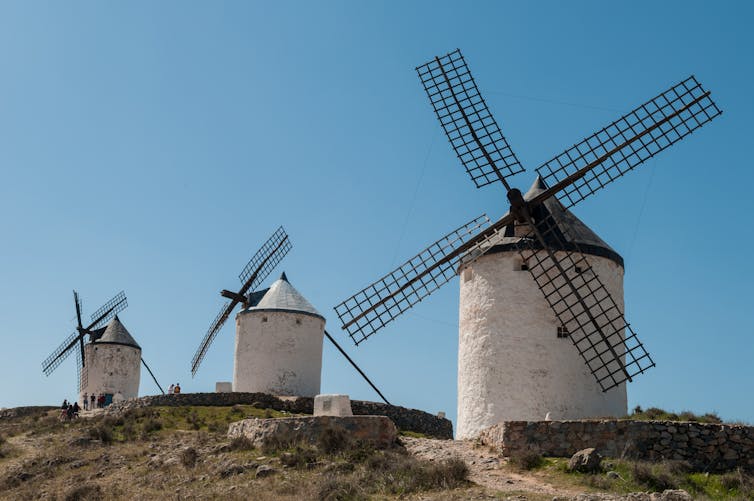
The “Don Quixote” windmills in Consuegra, Spain. They were made famous by the novel in the 16th century.
Wikimedia Commons, CC BY-NC-SA

Ana Puchau de Lecea, University of Melbourne and Vicente Pérez de León, University of Melbourne

Somewhere in La Mancha, in a place whose name I do not care to remember…

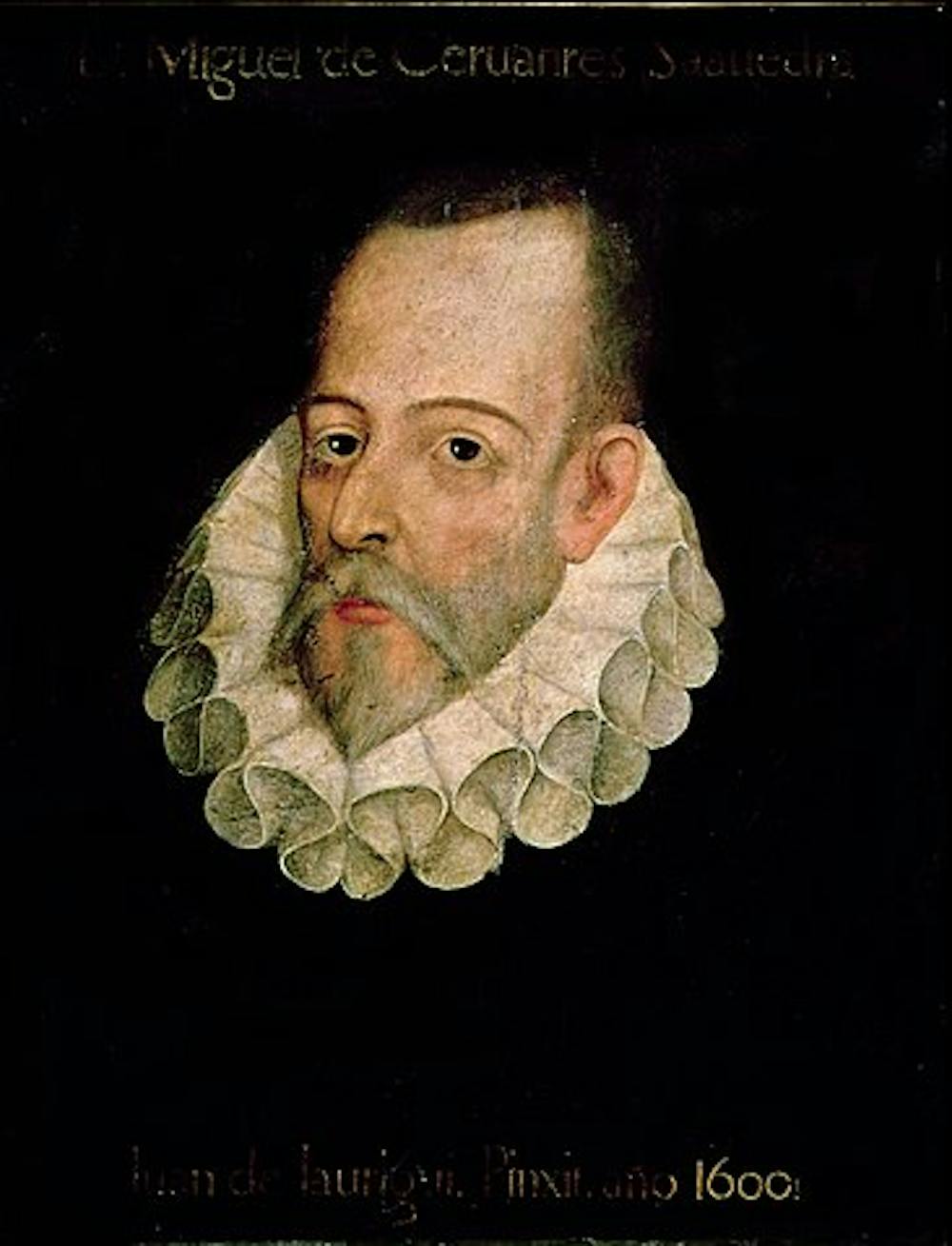
Portrait of Miguel de Cervantes y Saavedra (1547-1615) is commonly attributed to Juan de Jáuregui, yet no portrait of Cervantes has ever been authenticated.
Wikimedia Commons

This line, arguably the most famous in the history of Spanish literature, is the opening of The Ingenious Nobleman Don Quixote of La Mancha by Miguel de Cervantes, the first modern novel.

Published in two parts in 1605 and 1615, this is the story of Alonso Quijano, a 16th-century Spanish hidalgo, a noble, who is so passionate about reading that he leaves home in search of his own chivalrous adventures. He becomes a knight-errant himself: Don Quixote de la Mancha. By imitating his admired literary heroes, he finds new meaning in his life: aiding damsels in distress, battling giants and righting wrongs… mostly in his own head.

But Don Quixote is much more. It is a book about books, reading, writing, idealism vs. materialism, life … and death. Don Quixote is mad. “His brain’s dried up” due to his reading, and he is unable to separate reality from fiction, a trait that was appreciated at the time as funny. However, Cervantes was also using Don Quixote’s insanity to probe the eternal debate between free will and fate. The misguided hero is actually a man fighting against his own limitations to become who he dreams to be.

Open-minded, well-travelled, and very well-educated, Cervantes was, like Don Quixote himself, an avid reader. He also served the Spanish crown in adventures that he would later include in the novel. After defeating the Ottoman Empire in the battle of Lepanto (and losing the use of his left hand, becoming “the one-handed of Lepanto”), Cervantes was captured and held for ransom in Algiers.

This autobiographical episode and his escape attempts are depicted in “The Captive’s Tale” (in Don Quixote Part I), where the character recalls “a Spanish soldier named something de Saavedra”, referring to Cervantes’s second last name. Years later, back in Spain, he completed Don Quixote in prison, due to irregularities in his accounts while he worked for the government.

Tilting at windmills

In Part I, Quijano with his new name, Don Quixote, gathers other indispensable accessories to any knight-errant: his armour; a horse, Rocinante; and a lady, an unwitting peasant girl he calls Dulcinea of Toboso, in whose name he will perform great deeds of chivalry.

While Don Quixote recovers from a disastrous first campaign as a knight, his close friends, the priest and the barber, decide to examine the books in his library. Their comments about his chivalric books combine literary criticism with a parody of the Inquisition’s practices of burning texts associated with the devil. Although a few volumes are saved (Cervantes’s own La Galatea among them), most books are burned for their responsibility in Don Quixote’s madness.

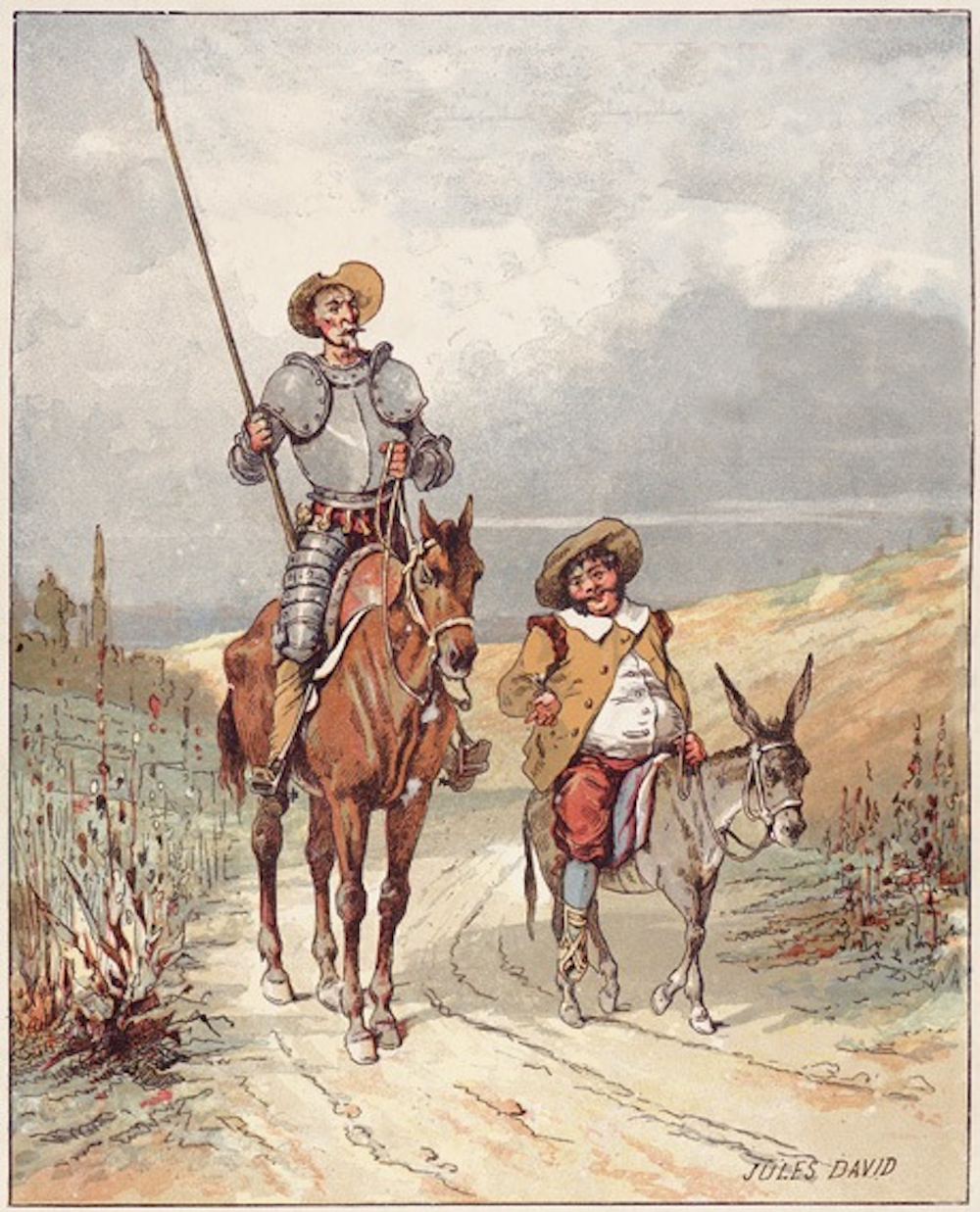
Jules David, ‘Don Quixote and Sancho Panza’, 1887.
Wikimedia Commons

In Don Quixote’s second expedition, the peasant Sancho Panza joins him as his faithful squire, with the hopes of becoming the governor of his own island one day. The duo diverges in every aspect. Don Quixote is tall and thin, Sancho is short and fat (panza means “pot belly”). Sancho is an illiterate commoner and responds to Don Quixote’s elaborate speeches with popular proverbs. The mismatched couple has remained as a key literary archetype since then.

In perhaps the most famous scene from the novel, Don Quixote sees three windmills as fearful giants that he must combat, which is where the phrase “tilting at windmills” comes from. At the end of Part I, Don Quixote and Sancho are tricked into returning to their village. Sancho has become “quixotized”, now increasingly obsessed with becoming rich by ruling his own island.

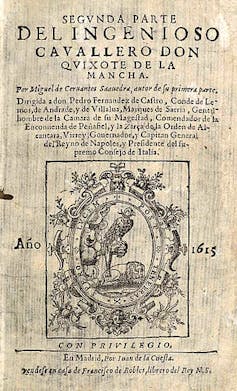
The cover of Don Quixote Part II (1615).
Wikimedia Commons

Don Quixote was an enormous success, being translated from Spanish into the main European languages and even reaching North America. In 1614 an unknown author, Alonso Fernández de Avellaneda, published an apocryphal second part. Cervantes incorporated this spurious Don Quixote and its characters into his own Part II, adding yet another chapter to the history of modern narrative.

Whereas Part I was a reaction to chivalric romances, Part II is a reaction to Part I. The book is set only one month after Don Quixote and Sancho’s return from their first literary quest, after they are notified that a book retelling their story has been published (Part I).

The rest of Part II operates as a game of mirrors, recalling and rewriting episodes. New characters, such as aristocrats who have also read Part I, use their knowledge to play tricks on Don Quixote and Sancho for their own amusement. Deceived by the rest of the characters, Sancho and a badly wounded Don Quixote finally return again to their village.

After being in bed for several days, Don Quixote’s final hour arrives. He decides to abandon his existence as Don Quixote for good, giving up his literary identity and physically dying. He leaves Sancho – his best and most faithful reader – in tears, and avoids further additions by any future imitators by dying.

The original unreliable narrator

The narrator of Part I’s prologue claims to write a sincere and uncomplicated story. Nothing is further from reality. Distancing himself from textual authority, the narrator declares that he merely compiled a manuscript translated by some Arab historian – an untrustworthy source at the time. The reader has to decide what’s real and what’s not.

Don Quixote is also a book made of preexisting books. Don Quixote is obsessed with chivalric romances, and includes episodes parodying other narrative subgenres such as pastoral romances, picaresque novels and Italian novellas (of which Cervantes himself wrote a few).

Don Quixote’s transformation from nobleman to knight-errant is particularly profound given the events in Europe at the time the novel was published. Spain had been reconquered by Christian royals after centuries of Islamic presence. Social status, ethnicity and religion were seen as determining a person’s future, but Don Quixote defied this. “I know who I am,” he answered roundly to whoever tried to convince him of his
“true” and original identity.

Don Quixote through the ages

Many writers have been inspired by Don Quixote: from Goethe, Stendhal, Melville, Flaubert and Dickens, to Borges, Faulkner and Nabokov.

In fact, for many critics, the whole history of the novel could justifiably be considered “a variation of the theme of Don Quixote”. Since its early success, there have also been many valuable English translations of the novel. John Rutherford and more recently Edith Grossman have been praised for their versions.

RTVE’s adaptation of Don Quixote for TV (1992).

Apart from literature, Don Quixote has inspired many creative works. Based on the episode of the wedding of Camacho in Part II, Marius Petipa choreographed a ballet in 1896. Also created for the stage, Man of La Mancha, the 1960s’ Broadway musical, is one of the most popular reimaginings. In 1992, the State Spanish TV launched a highly successful adaptation of Part I. Terry Gilliam’s much-awaited The Man Who Killed Don Quixote is only the most recent addition to a long list of films inspired by Don Quixote.

M. Petipa’s Don Quixote by the American Ballet Theatre.

The ConversationMore than 400 years after its publication and great success, Don Quixote is widely considered the world’s best book by other celebrated authors. In our own times, full of windmills and giants, Don Quixote’s still-valuable message is that the way we filter reality through any ideology affects our perception of the world.

Ana Puchau de Lecea, PhD Candidate and Teaching Associate, University of Melbourne and Vicente Pérez de León, Honorary Fellow, University of Melbourne

This article was originally published on The Conversation. Read the original article.

Unknown's avatar

Not My Review: H(A)PPY by Nicola Barker


Unknown's avatar

Not My Review: Biblical Theology – How the Church Faithfully Teaches the Gospel by Nick Roark and Robert Cline


The link below is to a book review of ‘Biblical Theology – How the Church Faithfully Teaches the Gospel,’ by Nick Roark and Robert Cline.

For more visit:
https://www.thegospelcoalition.org/reviews/biblical-theology-church-gospel/

Unknown's avatar

Not My Review: A Court of Thorns and Roses (Book 3.1) – A Court of Frost and Starlight by Sarah J. Maas


Unknown's avatar

Not My Review: A Boy in Winter by Rachel Seiffert


Unknown's avatar

Not My Review: Educated – A Memoir by Tara Westover


Unknown's avatar

Not My Review: Manhattan Beach by Jennifer Egan