The argument has dragged on long enough about who should take the credit for bringing South Africa’s apartheid regime to an end. Of course, some will immediately respond by saying that apartheid has not yet been defeated – it still lives on in innumerable ways. But at least the regime that promulgated the legislation and promoted the ideology has been defeated, whatever remnants remain.
So who, in fact, brought that regime to its knees? There is probably no single, or simple, answer. But one of the groups that certainly played a role was the faith community. Christian leaders like Beyers Naudé, Desmond Tutu and Allan Boesak, played a very significant role in fighting apartheid.
The flip side, though, is that some churches actively supported apartheid. Others, meanwhile, remained silent when they should have spoken out.
Still, the struggle of some churches – leaders and congregants – against apartheid was both profoundly non-racial and ecumenical. While black voices were predominant, white voices of protest and resistance could also be heard and observed. And while a large number were Methodists, as was Nelson Mandela himself, nobody involved in the church struggle was bothered about denominational affiliation or loyalty.
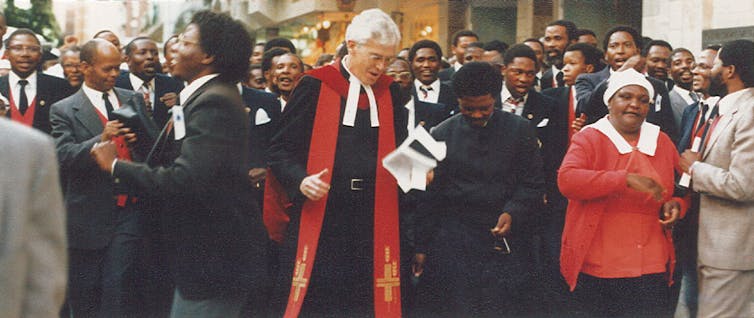
This, I suggest, is the framework within which to read Peter Storey’s very readable, absorbing, and at times, as the title suggests, provocative book, I Beg to Differ: Ministry Amidst Teargas. Storey, who eventually became the Presiding Bishop of the Methodist Church as well as president of the South African Council of Churches, was one of the white church leaders who played a very important role in the church struggle against apartheid.
Convictions
Who was Storey, what shaped his convictions, and what role did he play, are naturally questions we might ask. And we should ask them, not only out of interest, but in order to understand better how Christian moral and political convictions are nurtured. How did a young white South African brought up under apartheid, educated in a segregated school (all were), and an officer in the South African navy, become a leading opponent of the system?
Also, how did he maintain his faith and hope through many a crisis and challenge, often caught between different factions, and sometimes sidelined. How did he learn to say:
I beg to differ!
An autobiography often resembles an iceberg. We are introduced to what is on the surface, but we don’t always get to see what is beneath. Storey’s narrative certainly presents a public face: the face of a leader, a man of Christian conviction, compassion and commitment. He also takes his reader below that persona to his early upbringing as a son of the manse (his father was also a minister), and later as the devoted husband of Elizabeth – a remarkable person in her own right, and to whom his book is dedicated – and the father of four sons, some of whom followed him into the ministry.
Storey also writes about his personal struggles which are inevitably part of the life of a leader committed to truth. We also discover his interest in making furniture and his interest in sailing. I can speak about this from personal experience. Under his captaincy and along with Elizabeth, my wife and I successfully sailed off the Cape Town coast on a stormy afternoon in what seemed to us a rather small craft for such an occasion. But that is a parable of Storey’s leadership, steering a sometimes threatened ark through choppy seas, and doing so with a firm hand on the rudder.
Back to his public face, which perhaps first came to prominence when he became a student leader at Rhodes University, gaining a little notoriety in the process. Then as minister of the Methodist church in Cape Town’s District Six, where he was in the forefront of opposition to the shameful forced removals by the apartheid regime that reduced a vibrant community to a vacant, ghostly plot of land.
Next as a minister in Johannesburg, first in Braamfontein and then at the Central Methodist Mission in the heart of the city. Storey left a large imprint in all these places and contexts.
He spent some of his retirement years as a professor in the US teaching many an aspiring minister. On his return to South Africa he played a leading role in establishing the Seth Mokitimi Methodist Seminary in Pietermaritzburg.
There is so much more that could be said about Storey’s life and witness, from his brave participation in many a protest march, to his courageous standing up for the truth during the Truth and Reconciliation Commission process.
Not all will necessarily agree with him on all he said. I had a few quibbles here and there, but Storey always allowed others to differ just as he begged to do so himself. That is, after all, at the heart if democracy. So anyone interested in the role of the church not just in the struggle against apartheid, but also in the struggle to build a transformed democratic society, should take up this book and read. You won’t be disappointed.
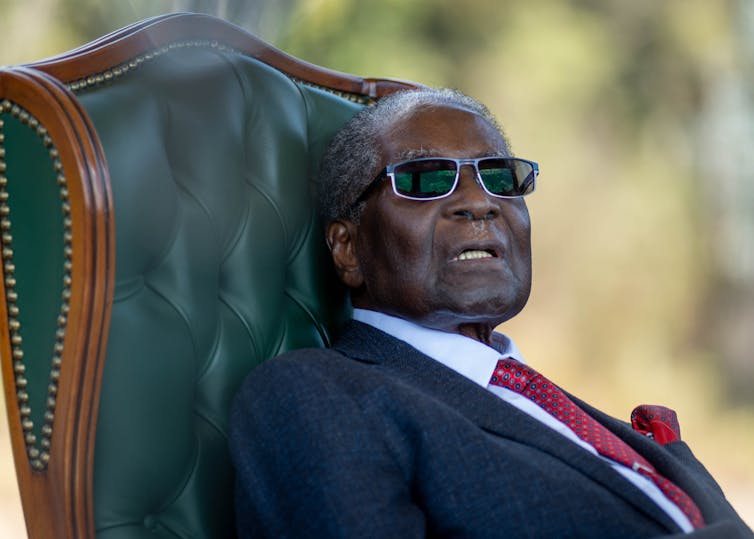
Penguin Books has released two books by Zimbabwean journalists in time to celebrate the first anniversary of the coup that finally put Robert Mugabe’s ruinous reign to an end. These are Ray Ndlovu’s In the Jaws of the Crocodile: Emmerson Mnangagwa’s Rise to Power in Zimbabwe and The Graceless Fall of Robert Mugabe: The End of a Dictator’s Reign by Geoffrey Nyarota.
The books, about the end of Mugabe’s nearly four decades of ruling Zimbabwe, arrive at a time when journalists have to constantly rush to beat tweets and Facebook posts. This haste can work against their claim to be offering something closer to truth’s complexities than can be rendered in 280 characters.
At the time of the coup the international community, the long-suffering urban unemployed and rural peasants, and the business players itching to embrace the graces of a régime “open for business”, hoped that a long-delayed nirvana was just over the horizon.
That vista remains distant: if there was a rainbow – President Emmerson Mnangagwa promised Zimbabwean whites their place back in Zanu-PF’s good books – the pot of gold keeps receding. The long lines of fuel-starved vehicles indicated more about the first birthday of Zimbabwe’s “Second Republic” than Zanu-PF’s comparatively muted celebrations.
‘Queuing after the coup’ seemed an alliteration appropriate to this review of the two books, neither of which does justice to the enormity both of events in Zimbabwe as well as the sheer scale of what’s required to rebuild the country.
The coup
‘Romancing the coup’ could also characterise such tales. Ndlovu’s chronicle of Mnangagwa’s adventures bears the hallmarks of a roller-coaster thriller. In the Jaws excurses excitedly through “The Crocodile’s” firing from the vice-presidency, forced exile and escape, his Pretoria-based saviour, corrupt police (contrasted with brave soldier-saints), and his triumphant return to the treasures surely to follow his presidential inauguration.
Nyarota’s more sober historical take characterises former First Lady Grace Mugabe as someone whose treasure map bore little relation to the route she and her fellow plotters in “Generation-40” – the faction conniving to rid their party and country of “Lacoste” (a play on Mnangagwa’s nickname) group – took when they persuaded then President Mugabe to fire his longtime lackey.
Could military commander Constantino Chiwenga save the day and grab the treasure? Now a Vice-President, many credit Chiwenga with organising the “militarily assisted transition” allowing Mnangagwa to cross the river. In The Jaws celebrates the bromance between Chiwenga and Mnangagwa. But circumspection regarding such claims is cautioned.
The real gold lies under Zimbabwe’s putrid piles of economic ruin. Thus hopes are pinned on Mthuli Ncube, Zimbabwe’s new finance minister. These hopes are tied tightly to Zanu-PF’s factional fights for pieces of a Zimbabwean pie as ethereal as the electronic “money” used in the absence of real currency.
Ncube’s fantastical neo-liberal solutions are eerily reminiscent of the economic structural adjustment policies that during the 1990s’ precipitated Zimbabwe’s nosedive. Even the International Monetary Fund had to restrain Ncube’s exuberant “Austerity for Prosperity”plans. Matched with the ruling party’s scrambles and the poor’s impatience, roiling ensues.
Keynesians and neo-liberals alike have little to which they can look forward, although the Confederation of Zimbabwean Industry proclaims that industrial capacity rose by 5% in early 2018. Yet just after mid-year, the little electoral legitimacy on which the global citadels of finance and investment banked slid away. The military killed at least six demonstrators while, as many say, its intelligence corps took over counting the election’s votes.
Neither of the two books portend much of the coup’s consequences. They improve on an unhappy catalogue of books on Zimbabwean politics. But the bar is low. The best that can be said of them is that they are good in parts.
Map still missing
Nyarota’s enthusiasm for the new régime is muted, but he’s very happy to see the back of Mugabe and his unruly wife.
Graceless is more about their drawn-out fall than the coup per se. The elder Nyarota’s world-weary schadenfreude contrasts vividly with Ndlovu’s youthful exuberance. Nyarota’s historical depth, if meandering, gives necessary context to last year’s events. His insight into the near-coups in the 1970s that Ndlovu misses completely – when not misconstruing history – are valuable indeed.
Graceless has no interviews: Mugabe’s minders refused Nyarota’s requests. Yet Ndlovu’s one-on-ones are mostly with the victors.
Of course, purported “Generation-40” leader and former cabinet minister Jonathan Moyo’s unstoppable stream of tweets and interviews from wherever resides his physical self, features prominently. But since they are accessible to anyone with internet they need deconstruction, not replication.
One would expect journalists to criticise Moyo’s nefarious role in his information portfolio (and many others). The elder and the younger don’t disappoint. Unsurprisingly, when the born-again constitutionalist Moyo was interviewed recently he judged Ndlovu’s work as a hagiography for Mnangagwa. Unfortunately, Nyarota’s unpacking of Moyo’s past looks too much like Wikipedia to satisfy.
Moyo’s criticism of In the Jaws goes too far. But both books suggest more questions than answers. Even given publishers’ and the media rushes to keep up with insubstantial and fake news circulating via billions of clicks, this is not enough. Zimbabwe’s treasures haven’t been dug up yet, and these journalists-cum-authors haven’t drawn the map.
If you are looking forward to curling up with a heartwarming story this Christmas, you might not necessarily choose anything by Thomas Hardy – you’d be more likely to turn to the seasonal staples of Charles Dickens or Raymond Briggs. While Hardy is renowned for his tragic tales of Wessex life, his brief foray into the world of children’s Christmas fiction is largely unknown.
Published in the Christmas annual Father Christmas: Our little Ones’ Budget, Hardy’s story The Thieves Who Couldn’t Help Sneezing is a tale for children which also has much to delight adult enthusiasts of his work.
Hardy’s story made its appearance in the first edition of the annual in December 1877. By this time, he was working on The Return of the Native (1878), having already published five novels – including Far From The Madding Crowd (1874), which first appeared anonymously and established his career as a successful novelist.
Nonetheless, his contribution to the annual could easily be overlooked. In this extract from the Illustrated London News (December 12, 1877) Hardy’s name is sandwiched between lesser-known literary figures:
A new claimant, entitled “Father Christmas: Our Little Ones’ Budget”, is announced to appear shortly. It comes with weighty claims on the favour of the rising generation, being crowded with amusing tales, songs, riddles and acrostics, by its fair editor, Miss N. Danvers, Austin Dobson, Thomas Hardy, W.H.G. Kingston, Reginald Gatty, and other writers of note in this special field of literature.
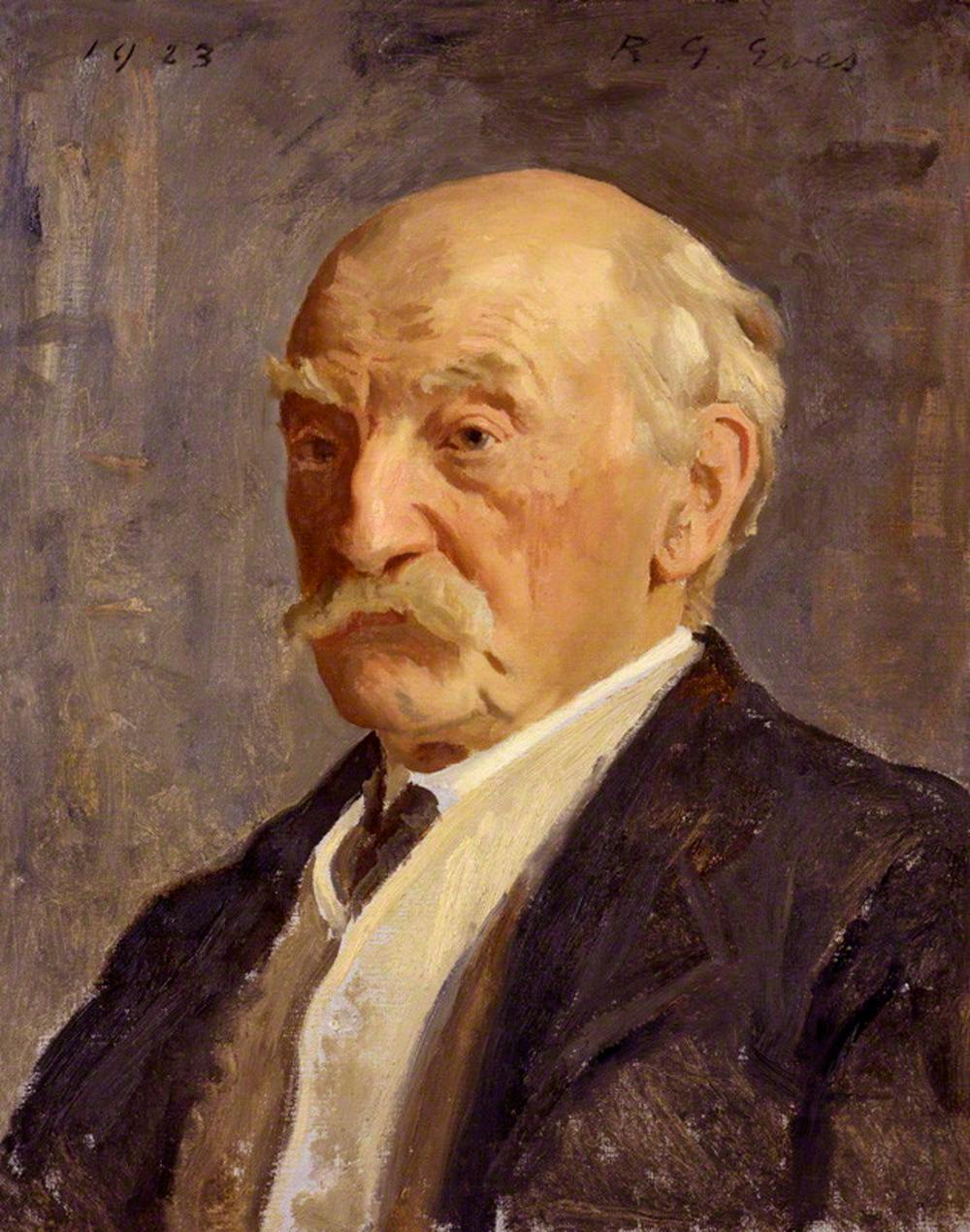
Thomas Hardy (1923) by Reginald Eves. National Portrait Gallery
The story has received scant critical attention, despite the wealth of Hardy scholarship that exists. Hardy himself does not mention it in his autobiography, although it is included in a list of works compiled by his wife Emma in 1880 (which is available at Dorset County Museum) and categorised as a “Child’s story”.
Unlike Dickens’ A Christmas Carol (1843) where social commentary is cosily bound up within a supernatural fantasy world, Hardy does not spare the reader his trademark realism. The action takes place in the “Vale of Blackmore”, which was described as “a fertile and somewhat lonely district” later to become the famous backdrop for the tragic events of Tess of the D’Urbevilles.
‘Twas the night before Christmas
It is Christmas Eve and the 14-year-old protagonist, Hubert, courageous but “a little vain”, is making his way home on “his stout-legged cob Jerry and singing a Christmas carol”. There is barely time for the reader to reach for a mince pie before Hubert is attacked by robbers with “artificially blackened” faces, tied up and thrown into a ditch.
Disorientated and upset that his horse has been stolen, Hubert extricates his legs from their bonds and wanders on until he chances on “a large mansion with flanking wings, gables, and towers, the battlements and chimneys showing their shapes against the stars”.
He enters the house, hoping to find assistance there but – like a scene from a modern-day thriller – suddenly hears the familiar voices of his attackers. Hubert quickly dives under the dining room table and listens as the thieves discuss their plans. It seems they have created a “false alarm” to get the wealthy occupants briefly “out of the house”, giving them time to find a hiding place where they can wait until everyone is in bed before robbing the mansion.
Before long, the “ladies and gentlemen” return to continue their festive celebrations, unaware of the thieves biding their time in a disused closet. Hubert then makes his appearance and starts to tell his story. However, it is met with disbelief – and he is even accused of being a robber himself as there is “a curiously wild wicked look about him…” So the resourceful lad hatches a plan to expose the thieves by pretending to be a magician with the power to “conjure up a tempest in a cupboard”.
While lacking the seasonal sumptuousness of Dickens, Hardy’s tale serves up its own socially subversive Christmas punch. Hubert, a yeoman’s son, manages to singlehandedly outsmart the upper-class family he encounters residing in the mansion. Though the reader is told he feels shame at their mistrust of his story, he accepts their hospitality. Hardy evokes a child’s sense of triumph at being a part of a privileged adult world:
Hubert, in spite of his hurt feelings at their doubts of his honesty, could not help being warmed both in mind and in body by the good cheer, the scene, and the example of hilarity set by his neighbours. At last he laughed as heartily at their stories and repartees as the old Baronet, Sir Simon, himself.
Class conflict
Although the story’s main action concerns a none-too festive attack on a young boy, the tale deals with wider social issues. Born into a working-class family, Hardy did not attend university and felt himself to be an outsider to London’s literary elite. An acute awareness of the divisions between rich and poor colours his work and The Thieves is no exception.
Hubert, outsider to the wealthy party he encounters, not only exposes the thieves through filling their hiding place with sneeze-inducing snuff, he manages to persuade Sir Simon and his guests that he is a magician. Ultimately, it is a child’s successful navigation of an exclusive adult world that is at the heart of Hardy’s narrative.
The Thieves is not Hardy’s only children’s story. Our Exploits in West Poley: A Story For Boys (1883), serialised in The Household ( November 1892-April 1893) lay in obscurity until its discovery in 1952. While Hardy is certainly not known for his children’s fiction, it can provide valuable insights into his career, as writer and poet, which had a foot in both the 19th and 20th centuries.
Writing for children in 1877, Hardy gives us a message, as relevant now as it was in his own time: however young, poor or seemingly unimportant a person is, they are still capable of doing great things.
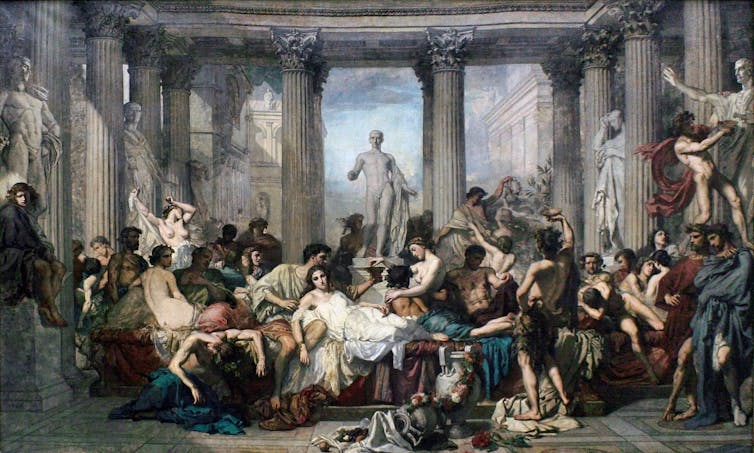
An angry man stands at the crossroads and rails against the moral cesspit around him, teeming with sexual deviants and jumped-up immigrants. This is the image which the Roman poet Juvenal paints of the satirist castigating the vices of contemporary Rome.
Juvenal’s Satires provide a fascinating window onto the social melting-pot that was early second century CE Rome. But they also hold up a mirror to those whose feelings of alienation and disempowerment produce a bitter distortion of that society.
Juvenal wrote 16 satires, divided into five books. Most are between 150 and 300 lines in length, except for the monstrous sixth satire attacking women and marriage, which rants on for over 650 lines and takes up a whole book on its own. Each satire has its own theme or target, ranging from decadent aristocrats and hypocritical moralists to giant turbots (a fish) and Egyptian cannibals, but this theme only loosely constrains a free-flowing structure which follows the satirist’s fulminating stream of consciousness.
Contradiction is the essence of these poems. The satirist indignantly condemns Rome’s vices as he pruriently lingers on their salacious details. The sheer force of his outrage and the vigour of his rhetoric sweep the reader along at the same time as she recoils from his bigotry. In Juvenal’s own words, it’s difficult not to write satire, and once you are sucked into its twisted world, it is difficult not to read it. But working out what to make of it is really difficult.
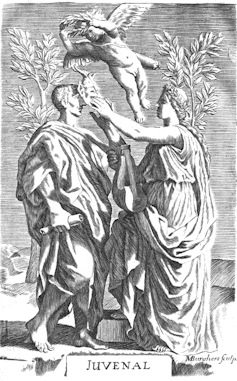
Frontispiece from the 1711 publication of Juvenal’s Satires. Wiki Commons
The beginning of Roman satire
Roman satire bears only a distant family resemblance to the modern idea of satire. Instead of John Clarke parodically impersonating an incompetent politician, Juvenal and his predecessors take direct aim at the follies and vices of their day, lambasting any who deviate from social norms with moralizing fervour, scathing mockery, and stomach-turning obscenity.
The Romans admitted that they inherited all other genres of poetry — epic, tragedy, comedy, pastoral, and the rest — from the Greeks, but they proudly declared that satire was “totally ours”. It was written in hexameters, the lofty metre of epic poetry, but it always sets itself up as epic’s “evil twin”. Instead of heroes, noble deeds, and city-foundations recounted in elevated language, satire presents a hodgepodge of scumbags, orgies, and the breakdown of urban society, spat out in words as filthy as the vices they describe.
The first great Roman satirist was Lucilius, writing in the latter half of the second century BCE at the height of the free Republic. Only tantalising fragments of his work remain, but his reputation among later generations was unambiguous: a fearless exponent of extreme free speech who would lay into the powerful, stripping away the skin of respectability to reveal the foulness beneath.
Every later satirist lamented his inability to live up to Lucilius’ freedom and aggression. During the rise of the first emperor Augustus, as the free Republic gives way to the monarchical Empire, the poet Horace wrote satire whose buzzword was moderation, a contradiction in terms if ever there was one. Self-consciously playing it safe, his satirist chooses not to see — he even blames conjunctivitis — and not to talk about the death of political freedom.
Ninety years later, under Nero, the reclusive poet Persius turned satire inwards, boiling it down to dense, almost unreadable Latin which he doesn’t care if anyone reads. His image of the satirist is the barber whispering into a hole in the ground, “Midas has ass’s ears!” You can tell the truth, as long as you don’t need let anyone hear it.
Chariots of ire
With Juvenal, another half-century later, satire seemed to get its balls back. He dismisses epic and tragedy as tedious and irrelevant. Satire is the only possible response to the swamp that is Rome. Indignation is his Muse and the vices of Rome flow unmediated from the crossroads into his notebook. This is barely poetry at all. It is the unvarnished truth about Rome there on the page in front of you.
What folks have done ever since — their hopes and fears and anger,
their pleasures, joys, and toing and froing — is my volume’s hotch-potch.
Was there, at any time, a richer harvest of evil?
Except, of course, it isn’t. Juvenal goes through the same crisis as Horace and Persius. This isn’t the Republic and he isn’t Lucilius. It isn’t safe to tell it like it is when the rich and powerful can silence you. Juvenal’s solution is that he will only criticise the dead. The fearless satirist is compromised before he has even begun.
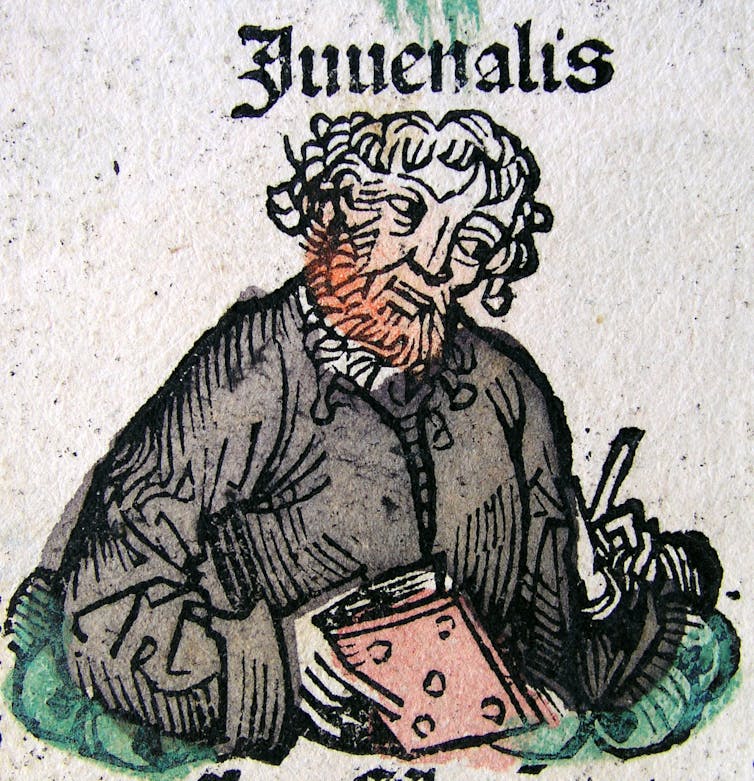
A depiction of Juvenal in the Nuremberg Chronicle, late 1400s. Wiki Commons
Yet it isn’t just his caginess about causing offence which problematises the satirist’s voice. His strident attacks on women, on homosexuals, on Greek and Egyptian immigrants are often put in the mouths of characters who sound remarkably like the satirist himself.
Satire 3’s panoramic view of a decadent Rome is presented through the skewed vision of Umbricius, “Mr Shady”, about to abandon the city because Greek immigrants take all the jobs.
I now proceed to speak of the nation specially favoured
by our wealthy compatriots, one that I shun above all others.
I shan’t mince words. My fellow Romans, I cannot put up with
a city of Greeks; yet how much of the dregs is truly Achaean?
The Syrian Orontes has long been discharging into the Tiber,
carrying with it its language and morals and slanting strings,
complete with piper, not to speak of its native timbrels.
But his main complaint is that they get away with the same things he tries.
We, of course, can pay identical compliments; yes, but
they are believed.
This isn’t moralising, or even simple bigotry, but sour grapes.
Readers take the first-person voice of the satires as reflecting Juvenal’s personal opinion in a sort of autobiographical confession. Indeed, we know nothing about him except what we can try to deduce from his poems. More recently, the satirist’s voice has been seen as a persona, a mask, a character just like Umbricius.
Is Juvenal satirising immigrants or the bigots who rail against them? The latter is certainly the more comfortable reading, but we need to be careful not to make the Romans too like us. Satire is meant to be uncomfortable.
Juvenal’s satirist doesn’t only “punch down” against easy targets. He also “punches up” and fights the corner of the little guy oppressed by the rich and powerful. Satire 5 condemns a rich patron for the humiliation he heaps on his poor client, though he acutely criticises the client for his complicity. Throughout, Juvenal’s main targets are hypocrites from all levels of society. The satirist stands outside and inveighs against what is wrong with Rome, but he has few suggestions on how to improve it.
In his later satires, Juvenal moves away from indignation altogether and adopts a new model. He will not be the philosopher Heraclitus, weeping at the state of the world, but another philosopher, Democritus, ironically laughing at it with a sense of detachment.
This is the spirit of satire 10, on the dangers of getting what we wish for. The satirist is not angry, but mockingly – and sometimes pityingly – amused by Sejanus, who got the power he wanted but was dragged through the streets on a meat-hook.
Now the flames are hissing; bellows and furnace are bringing
a glow to the head revered by the people. The mighty Sejanus
is crackling. Then, from the face regarded as number two
in the whole of the world, come pitchers, basins, saucepans, and piss-pots.
Frame your door with laurels; drag a magnificent bull,
whitened with chalk, to the Capitol. They’re dragging Sejanus along
by a hook for all to see.
Or the man whose prayer for long life is answered with impotent, incontinent senility.
The poor old fellow must mumble his bread with toothless gums.
He is so repellent to all (wife, children, and himself),
that he even turns the stomach of Cossus the legacy-hunter.
He loses his former zest for food and wine as his palate
grows numb. He has long forgotten what sex was like; if one tries
to remind him, his shrunken tool, with its vein enlarged, just lies there,
and, though caressed all night, it will continue to lie there.
The angry satirist hurls unconstructive abuse, but this new version has a suggestion for self-improvement:
Pray for a healthy mind in a healthy body.
Juvenal unbound
Juvenal is the greatest Roman satirist. He, far more than Horace or Persius, defined what satire meant for most of the early modern period and it is translations and imitations of him by Pope, Dryden, Jonson, and others – not to mention Hogarth’s paintings – which dominate the great era of English Augustan satire.
His satires give us a ground-level view of a Rome we could barely guess at from the heroism of the Aeneid, the drinking-parties of Horace’s Odes, or even the histories of Tacitus. We cannot trust satire, but we can allow ourselves to enjoy it.
Recommended translation: Juvenal, The Satires, Oxford World’s Classics translation by Niall Rudd with introduction and notes by William Barr (1992).







 At the BookShelf


You must be logged in to post a comment.