In the novel Coach Fitz, the narrator is seemingly unaware of his humorous voice. This device is one way that the novel subverts expectations. Shutterstock
Why do we tell stories, and how are they crafted? In this series, we unpick the work of the writer on both page and screen.
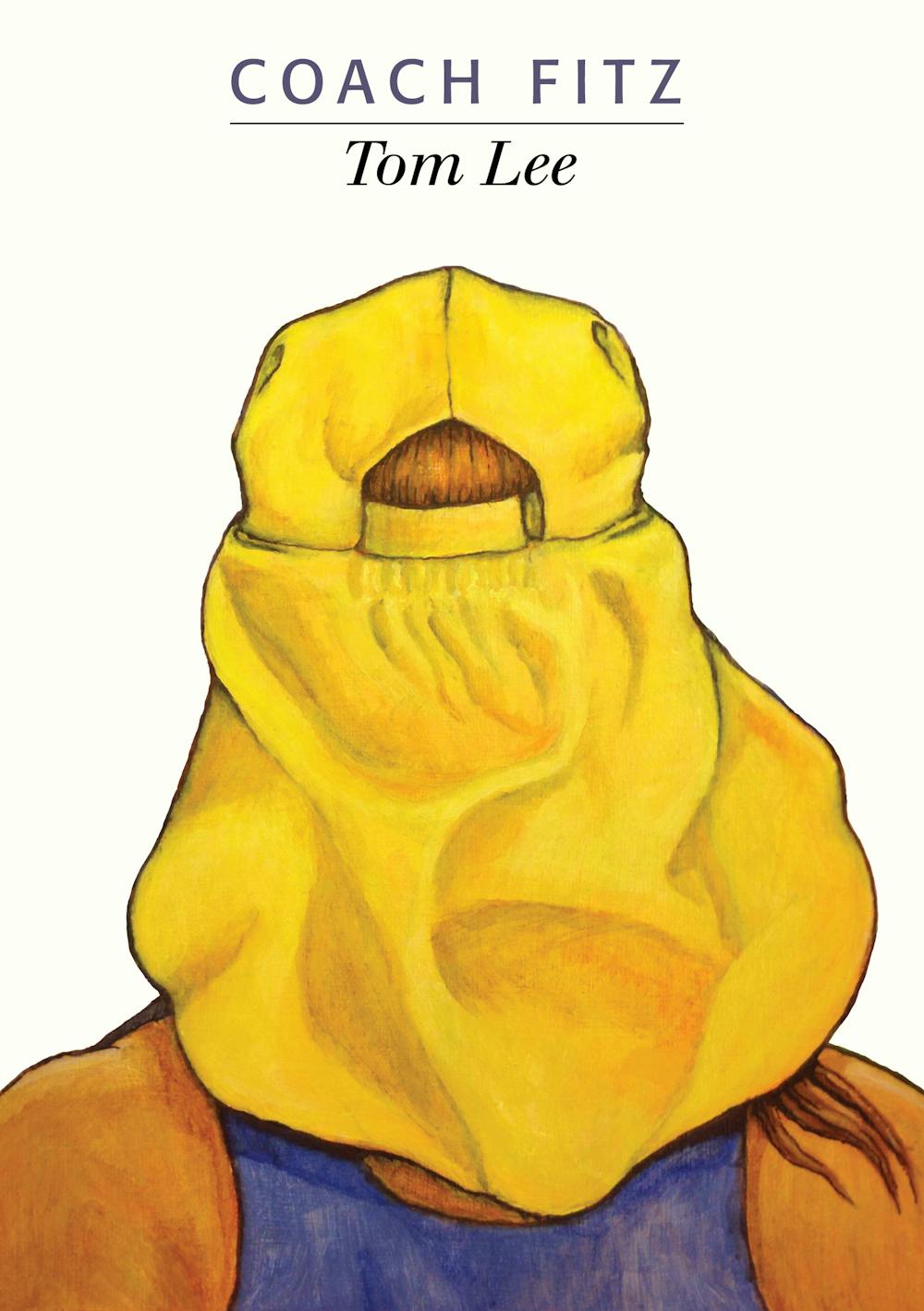
Early in Tom Lee’s debut novel, Coach Fitz, the narrator declares his intention to pay for an intensive program of training as a runner by saving money. He proposes to take on several menial jobs – window washing, school playground supervision, cocktail bartending – but also to adopt personal austerity, which includes “fulfilling the long-held dream of living in my car, an early model maroon Honda Odyssey”.
This is just one example of the book’s humour, a technique that is a vital aspect of its intriguing, multilayered appeal. This humour is much more than a device: it is an intrinsic part of a narrative that seeks to disrupt conventions of the novel by inverting reader expectations of the form.
At the same time, however, its anti-hero narrator, Tom, is cast in the mould of time-honoured tradition: Tom is an awkward everyman, a naïve Don Quixote, a digressive Tristam Shandy.
Giramondo
The story is a simple one: Tom has returned to Sydney after some time away – which has involved a failed relationship – and decides to focus solely on improving his physical fitness.
This is matched with a desire to strip down his life, as well as open it up: at the same time that Tom is living in his car and using outdoor beach showers, he is traversing and exploring the Sydney terrain, and absorbing lessons from his new coach on architecture, philosophy, the environment, and psychology, particularly tht of young males.
There is perhaps no immediate comic effect of the line about Tom living in his Honda, but the fact is the more I re-read it the funnier it seems. It is typical of the humour that ripples through every page: measured, grave, almost sober.
This humour relies entirely on the personality and thus voice of the narrator, and yet this narrator at first glance is far from comical: indeed, his voice is fussy, pedantic, and endlessly self-regarding.
It is not surprising to learn that two authors for whom voice is paramount have influenced this novel: W. G. Sebald, in particular his 1995 novel The Rings of Saturn, and closer to home the fictions or “reports” of Gerald Murnane, such as Barley Patch.
Comedy is possibly not the first quality that springs to a reader’s mind when considering these two authors either, however in both Sebald and Murnane we also hear voices of pedantic precision and obsessive reflection that at times strike comic notes.
Like Tom, the narrators of these texts seem entirely unaware of the humour of their utterances. For instance, in Murnane’s 1982 novel, The Plains, the narrator at one point confides in great detail to the reader his plans for seducing his patron and host’s wife, but without any apparent understanding of how preposterous these plans are.
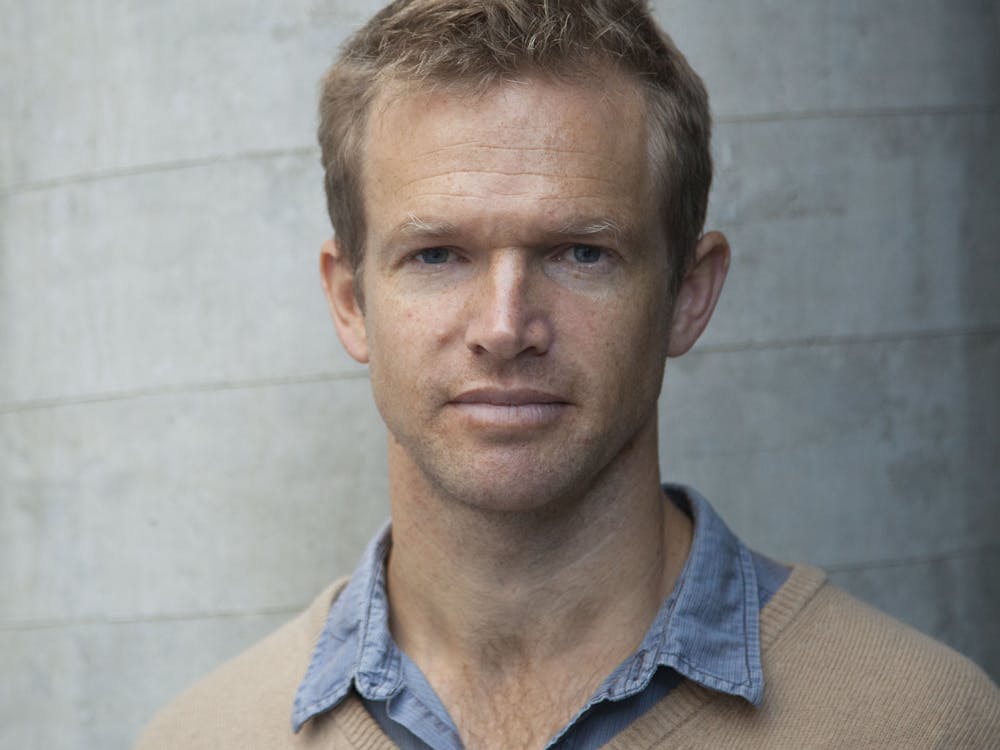
Coach Fitz author Tom Lee has been influenced by authors Gerald Murnane and WG Sebald, for whom voice is paramount. Aaron Seymour
To claim that comedy is not content-driven, but relies entirely on voice, is of course hardly new: voice is also essential for any stand-up comedian, however this is expected – it’s the object of a comic routine. The narrative of Coach Fitz is not a routine, and the comedy is part of the journey, not the destination.
Although there is this innocence, or lack of self-consciousness, paradoxically, the narrator is also consciously considering every aspect of his existence. Nothing is left unexamined in his pared-back running and training life: sourdough bread, outdoor exercise gyms, internet cafes, muscle tone, horse racing, domestic architecture, urban native vegetation, the Six Foot Track in NSW, and the eccentric eponymous coach herself, an endless source of scrutiny who eludes ultimate comprehension.
Context is also vital in this comic effect. It is possible to open the novel almost at random and extract a sentence that chimes harmoniously and delivers this measured, sober comedy, but I suspect if I were to select another line as I have above, it would not sound funny out of context.
The narrator is profoundly contradictory. He is pompous but his earnestness makes that forgivable. He is well-informed, indeed over-informed, passing on to the reader his knowledge of everything from topography and birdwatching, to the best breakfast to be found in the eastern suburbs’ cafes, and yet knowledge does not necessarily deliver understanding. For example, Tom is unable to anticipate or deal with the main crisis thrust upon him when Coach Fitz makes a drunken lecherous move on him.
Indeed, for all this knowledge, Tom remains an innocent. Having cast off Coach Fitz he decides to become a trainer himself, and selects as his first pupil the brother of the woman he hopes to get back together with: the reader can see how that will go down a mile off, but he cannot.
Lee’s narrator strikes the reader as someone with whom you would happily spend a day with, exploring an urban track before sharing a picnic of bread, cheese, figs and olives, but whose singular charm would wear thin soon enough. Despite that I yearn to hear this voice again.
View from a highway rest stop east of Ravensthorpe, Western Australia. In Kim Scott’s Taboo, the landscape becomes a narrator. Chris Fithall/flickr, CC BY
Why do we tell stories, and how are they crafted? In this series, we unpick the work of the writer on both page and screen.
The omniscient narrator – an all-knowing, third-person voice – is making a return to contemporary fiction. Indigenous Australian author Kim Scott, in choosing this technique for his latest award-winning novel, Taboo, is not alone: we can also find it in recent fiction by Zadie Smith (White Teeth; On Beauty) and Richard Powers (The Overstory).
Readers might be surprised by this trend. Isn’t the penchant to narrate in this way – like a kind of god – long dead? Curiously, the answer is no.
Along with several of his peers, Kim Scott is playing with a mode of omniscience deeply informed by the legacy of postmodernism in literature, a movement characterised by, among other things, a critique of the unreliable narrator. As with all of Kim Scott’s fiction, it matters deeply who it is that is speaking.
Literary scholar Paul Dawson has argued that the reappearance of the omniscient narrator in recent fiction can be read as “a performance of narrative authority”. He suggests one reason omniscience has returned is the anxiety many writers now feel about the role and place of storytelling in contemporary culture, where freely available digital media stories, peppered with fake news, produce and reproduce endlessly. As a result, there is very little about in the way of the consistently reliable narrative authority.
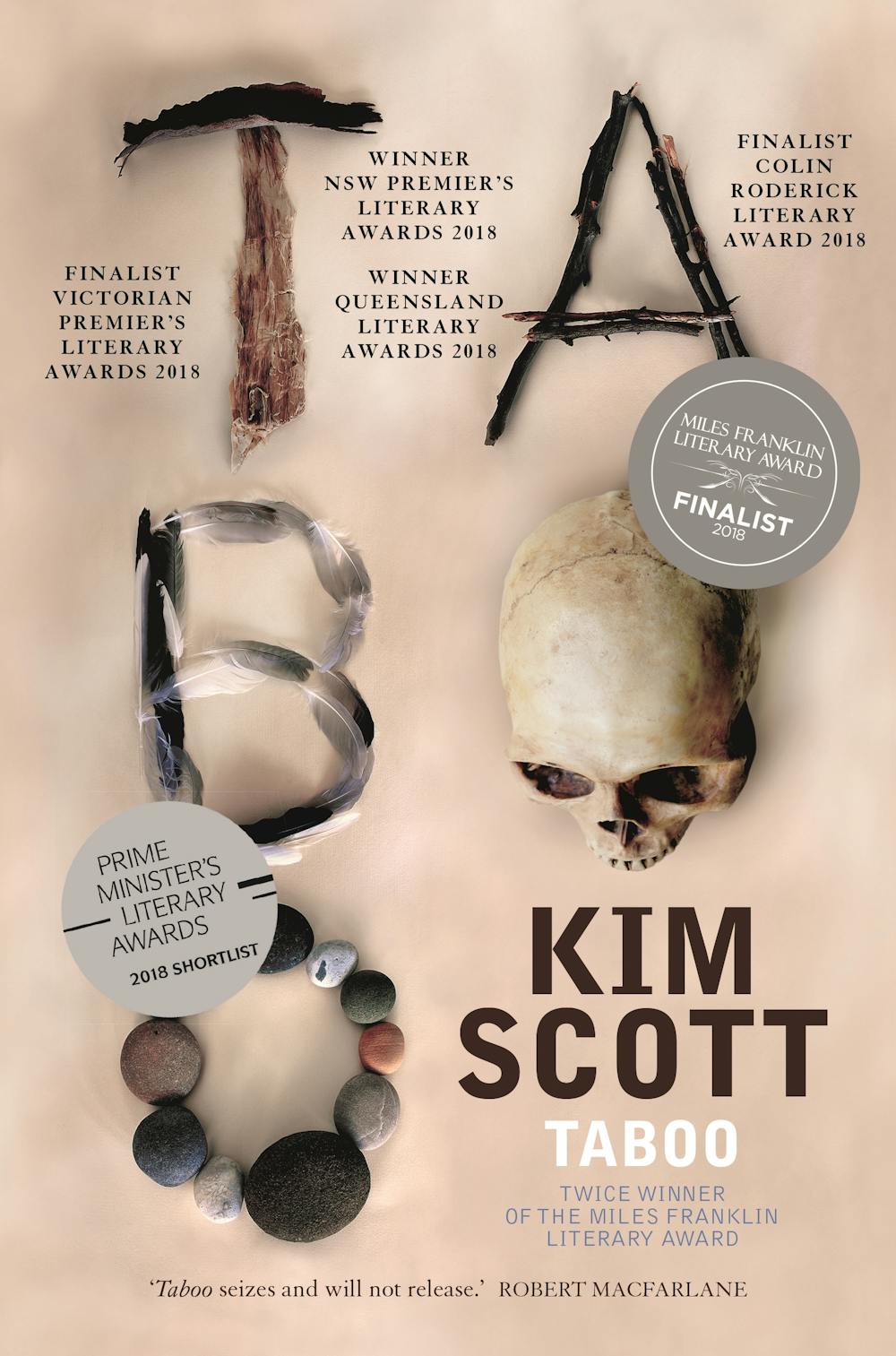
Pan Macmillan
Enter Kim Scott’s omniscient narration in Taboo. Here is a narration that is playfully performative, in part to acknowledge and perhaps counter the many problems with narrative authority in contemporary life, but also to approach a very difficult topic.
This is a novel about a massacre site, and the question of how to adequately acknowledge what such a site means for both Indigenous and non-Indigenous Australians in the present.
Questions around power and narration are entirely pertinent in this context. Whose history is this? And who can tell it adequately? Who has the authority? Who, even, has an adequate handle on the story?
The sense of the flesh-and-blood Indigenous Australian author, Kim Scott, is ever present behind the text. Curiously, he even inserts an Afterword, a non-fiction commentary on his intentions with the novel, directly following the final page. It is an exegesis, or explanation, of sorts. But in and through the novel itself, the omniscient voice is not the implied voice of the author. It is something else entirely.
Reviewing Taboo for the Sydney Morning Herald, literary critic Peter Pierce describes the novel as having an “oracular” voice. Pierce may simply mean that the voice of the novel is enigmatic, but Scott’s narration is also oracular in the sense of employing a voice that claims the authority of an oracle – a source of wisdom from some higher, more ancient order of meaning.
Sometimes this makes the book feel like a work of magic realism, where the magical creeps into the real world, as in the opening pages:
We thought to tell a story with such momentum; a truck careering down a hillside, thunder in a rocky riverbed, a skeleton tumbling to the ground. There must be at least one brave and resilient character at its centre (one of us), and the story will speak of magic in an empirical age; of how our dead will return, transformed, to support us again and from within.
Reviewer Jane Gleeson-White has described the voice of the book as belonging to “‘undead’ Noongar ancestors who rise from the riverbed to narrate”. This is functionally correct, but Scott’s text is not a conventional ghost story, nor is the first-person plural, with its sense of a haunting presence, heavily laboured.
Author Kim Scott employs an omniscient voice in his latest novel. Pan Macmillan
For much of the novel, we are focused upon the key protagonist, Tilly, in a way that could easily be mistaken for conventional realism. Except that it isn’t. Scott regularly disrupts that notion through shifts of perspective, a regular pulling back to the bigger picture. Here is one example, where the reader’s “sitting” on Tilly’s shoulder as she looks out the window of her group’s tour bus is interrupted by another viewpoint, one she cannot be simultaneously aware of:
Seen through the insect-smeared windscreen: scarcely undulating, dry and bleached ground; fence lines beside the road and dividing, at wide intervals, a mostly bare landscape. A fence is just the posts holding hands, thought Tilly, and such long arms in between them … “This place, Tilly, where we’re going” Gerry began, but Tilly was not listening and he let the words die. No one took up the conversation.
Taboo’s omniscient narration is gently provocative. It prods us to think about being or existence, for the novel’s unseen collective voice is more-than-human. As an ancestral voice, it is possible to understand our narrator(s) as a life expanded beyond the human form to encompass land, water, fire and curlew. We are encouraged to shift our thinking beyond the human-centric and towards the relation between human and other forms, especially ecological ones.
Consider, for example, this passage from the end of the novel, when an elderly Tilly is pictured at some point in the future, contemplating a pile of tree branches in a forest:
[She] would see not timber limbs but the bones of something new and ancient, something recreated and invigorated, and would think of when she first heard a voice rumbling from a riverbed, and how something reached out to her.
Did Scott just suggest that a riverbed might have a voice? That an energy without form might have reach?
To some extent, the meaning we take from Taboo depends upon how we think about the whole notion of omniscience. In my view, Scott’s choice of narrative technique works to ask of us as humans an increasingly important question: where are our limits? His use of omniscient narration might therefore be understood as a not just a literary choice, but a philosophical and ethical one.







 At the BookShelf
You must be logged in to post a comment.