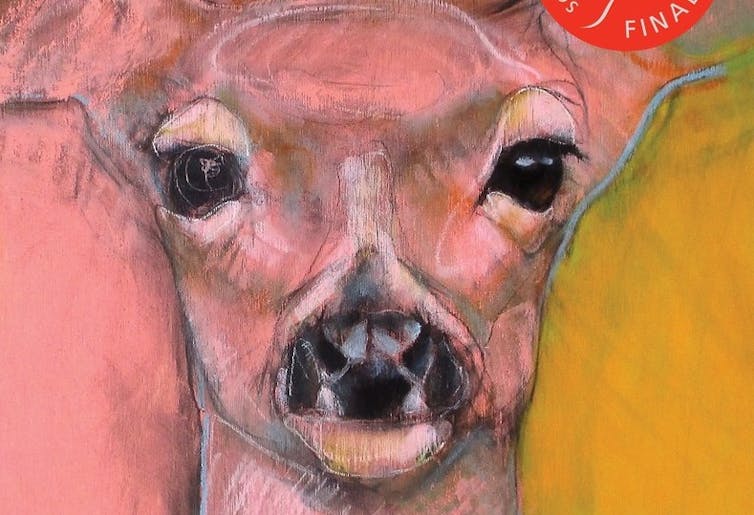
‘Small Game Hunting at the Local Coward Gun Club,’ is an extraordinary debut novel set on Valentine’s Day in St. John’s during a blizzard. (House of Anansi Press)
If there are different kinds of love, then there are different kinds of novels too — and Megan Gail Coles’s Small Game Hunting at the Local Coward Gun Club, shortlisted for CBC’s annual battle of books, Canada Reads 2020, is the kind that’s best read as a tough-love pre-Valentine warning.
It’s just not a feel-good, heart-warming, Eat, Pray, Love kind of book, the type some reach for when in need of romantic inspiration.
Structured around three courses served, appropriately, on Valentine’s Day at a restaurant in St. John’s, N.L., this book is divided into three acts, during which time it introduces — then makes plain the logic of connection between — several characters. The book then shows how their lives slowly and painfully unravel throughout the day.
If you bear in mind that Valentine’s Day originated in the Roman festival Lupercalia, when women were paired off with men by way of a lottery, you will be closer to the mark in terms of what Coles’s novel is about and what it attempts to achieve.
She assumes an “uncomfortable” approach to her subject, to call to attention what it means to be a disempowered subject — as a woman often is.
In my research, I’ve examined how public institutions and regulatory bodies approached the archival materials of different women writers in Canada: E. Pauline Johnson, Emily Carr, Sheila Watson, Jane Rule and M. NourbeSe Philip, as examples. Their interactions show how early 20th-century women’s voices were often suppressed because of sexist, racist or heteronormative tendencies, and their narratives susceptible to disappearing.
And because, to be frank, it is often uncomfortable to hear what women’s lives have to say.
Megan Gail Coles arrives on the red carpet before the Giller Awards gala ceremony in Toronto in November 2019. THE CANADIAN PRESS/Chris Young
Coles’s extraordinary debut novel, however, moves well past discomfort, tentative attempts at self-scrutiny and accountability, and calls for forgiveness. Forget discomfort: depending on how you identify and on your experiences, this novel could elicit either deep mortification or an invigorating anger that blazes, at moments, into real rage.
Before I explain the logic for my own emotional response, allow me also to add that this novel, a 2019 Scotiabank Giller finalist, is not for the faint of heart. Anyone who thinks their heart (or moral courage) is feeble should probably move along. Go on, find an Elizabeth Gilbert book to curl up with instead.
Or train your heart to be prepared for the emotional wreckage.
Charged blizzard
The novel’s narrative shifts from one point of view to another, revealing intersections between characters and carefully mapping the place, its social networks and divides, manifested in class, urban-rural and racialized identities that converge and then clash in the restaurant’s highly charged atmosphere.
In its evocations of Newfoundland, Coles has located herself among a vibrant tradition of writers, including Michael Crummey, Lisa Moore, Michael Winter and Donna Morrissey. Each of these writers takes on the people and sense of place in unique ways, and Coles adds a dazzling new voice.
In the novel, a blizzard is also a form of pathetic fallacy. St. John’s is seen here in January 2020. THE CANADIAN PRESS/Andrew Vaughan
The conflict is set against a blizzard — a nod to the St. John’s climate, but also a form of pathetic fallacy, mirroring the internal strife of several characters. Their growing bitterness and trauma mean they make decisions, usually bad ones, that give rise to the novel’s mounting tensions.
The novel opens with the warning that “this might hurt a little” (thank you, Megan), but this is polite understatement. The first few pages belie the warning and read as deliciously irreverent, as if someone pushed the Maritimes’ Anne of Green Gables into a mud puddle.
Increasingly, however, the tone shifts, ultimately transforming into a thorny, visceral, unrelenting narrative, somewhat reminiscent of Moore’s writing — one that does not shirk from disclosing the brutal realities of what it means to be a vulnerable woman in contemporary western society.
‘ACES’
Being a “vulnerable woman” in this book is a redundancy, since it really is a question of degree; however, there are women who are more vulnerable and suffer more than others.
Take Iris, the central female character. She works at the restaurant to overcome obstacles, particularly financial ones, that prevent her from pursuing her studies as an artist — but those obstacles also include familial traumas. Mulling over scientific data about “Adverse Childhood Experiences,” or “ACES,” she dryly notes that she “has a pocket full” of them and later that the existing moment is “the worst hand she has ever been dealt.”
That “pocket full” does not portend a good outcome; rather, she is “snarled” by John Fisher, the chef and her boss, a predator who, “like an angry rival fisher,” “reels” her in “hand over fist over hand over fist.” His apparent emotional offerings are a pretence, just out of reach of Iris’s grasping hands.“
Coles’ compassion and scathing judgement often vie for centre stage, never quite cancelling the other out. You may wish, for example, to judge George, whose class, racialized white privilege and protective father shield her (yes, her) from those who prey on the vulnerabilities of women like Iris, and whose selfish, self-absorbed tendencies are less than charming.
But the moment you may feel tempted to judge her too far — and she does warrant some — Coles reminds you that George too wrestles with being identified as a “pathetic childless woman” who does “the backbreaking emotional labour of two humans:” her own and her husband’s, incidentally a member of the metaphorical “local coward gun club” to which the title alludes.
These characters may be flawed, but the writing is not. The polyphony of voices is animated and remarkable. The prose is fresh, street-smart and savvy — taking clichés and even mashing these back into proper service as poetry.
Critical conversations
The narrative is timely, in view of the recent debacles and critical conversations that have surfaced in relation to the #MeToo movement, what it means to #BelieveWomen or those that inform the field of CanLit.
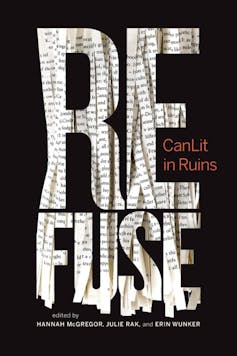
‘Refuse: Canlit in Ruins,’ edited by Hannah McGregor, Julie Rak and Erin Wunker. (Book*hug Press)
As an example, Refuse: CanLit in Ruins addresses the controversies that have animated the literary scene, and tackles gritty issues like rape culture and forms of domination and exploitation. Increasingly, we are all being invited to consider the responsibilities and connections we need to assume in the face of disclosures women make about their life stories.
One character, Olive, a young Indigenous woman, is directly asked at the novel’s outset: “So who are your relations?” Even as she comes to embody the resilience of women — their agency in times of chaos — the novel suggests readers consider that question, over and over again.
The Local Coward Gun Club fearlessly counters assumptions about sex, gender, class and racialized privilege about intersectional narratives, and demands that we look full in the face at the ways and number of times women and others have been injured; the number of times they have been disavowed when they have asked for help; the number of times they have been ignored, victimized or blamed instead of being supported.
The novel will demand that you, the reader, be accountable.
‘Small Game Hunting at the Local Coward Gun Club,’ is an extraordinary debut novel set on Valentine’s Day in St. John’s during a blizzard. (House of Anansi Press)
If there are different kinds of love, then there are different kinds of novels too — and Megan Gail Coles’s Small Game Hunting at the Local Coward Gun Club, shortlisted for CBC’s annual battle of books, Canada Reads 2020, is the kind that’s best read as a tough-love pre-Valentine warning.
It’s just not a feel-good, heart-warming, Eat, Pray, Love kind of book, the type some reach for when in need of romantic inspiration.
Structured around three courses served, appropriately, on Valentine’s Day at a restaurant in St. John’s, NL, this book is divided into three acts, during which time it introduces — then makes plain the logic of connection between — several characters. The book then shows how their lives slowly and painfully unravel throughout the day.
If you bear in mind that Valentine’s Day originated in the Roman festival Lupercalia, when women were paired off with men by way of a lottery, you will be closer to the mark in terms of what Coles’s novel is about and what it attempts to achieve.
She assumes an “uncomfortable” approach to her subject, to call to attention what it means to be a disempowered subject — as a woman often is.
In my research, I’ve examined how public institutions and regulatory bodies approached the archival materials of different women writers in Canada: E. Pauline Johnson, Emily Carr, Sheila Watson, Jane Rule and M. NourbeSe Philip, as examples. Their interactions show how early 20th-century women’s voices were often suppressed because of sexist, racist or heteronormative tendencies, and their narratives susceptible to disappearing.
And because, to be frank, it is often uncomfortable to hear what women’s lives have to say.
Megan Gail Coles arrives on the red carpet before the Giller Awards gala ceremony in Toronto in November 2019. THE CANADIAN PRESS/Chris Young
Coles’s extraordinary debut novel, however, moves well past discomfort, tentative attempts at self-scrutiny and accountability, and calls for forgiveness. Forget discomfort: depending on how you identify and on your experiences, this novel could elicit either deep mortification or an invigorating anger that blazes, at moments, into real rage.
Before I explain the logic for my own emotional response, allow me also to add that this novel, a 2019 Scotiabank Giller finalist, is not for the faint of heart. Anyone who thinks their heart (or moral courage) is feeble should probably move along. Go on, find an Elizabeth Gilbert book to curl up with instead.
Or train your heart to be prepared for the emotional wreckage.
Charged blizzard
The novel’s narrative shifts from one point of view to another, revealing intersections between characters and carefully mapping the place, its social networks and divides, manifested in class, urban-rural and racialized identities that converge and then clash in the restaurant’s highly charged atmosphere.
In its evocations of Newfoundland, Coles has located herself among a vibrant tradition of writers, including Michael Crummey, Lisa Moore, Michael Winter and Donna Morrissey. Each of these writers takes on the people and sense of place in unique ways, and Coles adds a dazzling new voice.
In the novel, a blizzard is also a form of pathetic fallacy. St. John’s is seen here in January 2020. THE CANADIAN PRESS/Andrew Vaughan
The conflict is set against a blizzard — a nod to the St. John’s climate, but also a form of pathetic fallacy, mirroring the internal strife of several characters. Their growing bitterness and trauma mean they make decisions, usually bad ones, that give rise to the novel’s mounting tensions.
The novel opens with the warning that “this might hurt a little” (thank you, Megan), but this is polite understatement. The first few pages belie the warning and read as deliciously irreverent, as if someone pushed the Maritimes’ Anne of Green Gables into a mud puddle.
Increasingly, however, the tone shifts, ultimately transforming into a thorny, visceral, unrelenting narrative, somewhat reminiscent of Moore’s writing — one that does not shirk from disclosing the brutal realities of what it means to be a vulnerable woman in contemporary western society.
‘ACES’
Being a “vulnerable woman” in this book is a redundancy, since it really is a question of degree; however, there are women who are more vulnerable and suffer more than others.
Take Iris, the central female character. She works at the restaurant to overcome obstacles, particularly financial ones, that prevent her from pursuing her studies as an artist — but those obstacles also include familial traumas. Mulling over scientific data about “Adverse Childhood Experiences,” or “ACES,” she dryly notes that she “has a pocket full” of them and later that the existing moment is “the worst hand she has ever been dealt.”
That “pocket full” does not portend a good outcome; rather, she is “snarled” by John Fisher, the chef and her boss, a predator who, “like an angry rival fisher,” “reels” her in “hand over fist over hand over fist.” His apparent emotional offerings are a pretence, just out of reach of Iris’s grasping hands.“
Coles’ compassion and scathing judgement often vie for centre stage, never quite cancelling the other out. You may wish, for example, to judge George, whose class, racialized white privilege and protective father shield her (yes, her) from those who prey on the vulnerabilities of women like Iris, and whose selfish, self-absorbed tendencies are less than charming.
But the moment you may feel tempted to judge her too far — and she does warrant some — Coles reminds you that George too wrestles with being identified as a “pathetic childless woman” who does “the backbreaking emotional labour of two humans:” her own and her husband’s, incidentally a member of the metaphorical “local coward gun club” to which the title alludes.
These characters may be flawed, but the writing is not. The polyphony of voices is animated and remarkable. The prose is fresh, street-smart and savvy — taking clichés and even mashing these back into proper service as poetry.
Critical conversations
The narrative is timely, in view of the recent debacles and critical conversations that have surfaced in relation to the #MeToo movement, what it means to #BelieveWomen or those that inform the field of CanLit.
‘Refuse: Canlit in Ruins,’ edited by Hannah McGregor, Julie Rak and Erin Wunker. (Book*hug Press)
As an example, Refuse: CanLit in Ruins addresses the controversies that have animated the literary scene, and tackles gritty issues like rape culture and forms of domination and exploitation. Increasingly, we are all being invited to consider the responsibilities and connections we need to assume in the face of disclosures women make about their life stories.
One character, Olive, a young Indigenous woman, is directly asked at the novel’s outset: “So who are your relations?” Even as she comes to embody the resilience of women — their agency in times of chaos — the novel suggests readers consider that question, over and over again.
The Local Coward Gun Club fearlessly counters assumptions about sex, gender, class and racialized privilege about intersectional narratives, and demands that we look full in the face at the ways and number of times women and others have been injured; the number of times they have been disavowed when they have asked for help; the number of times they have been ignored, victimized or blamed instead of being supported.
The novel will demand that you, the reader, be accountable.
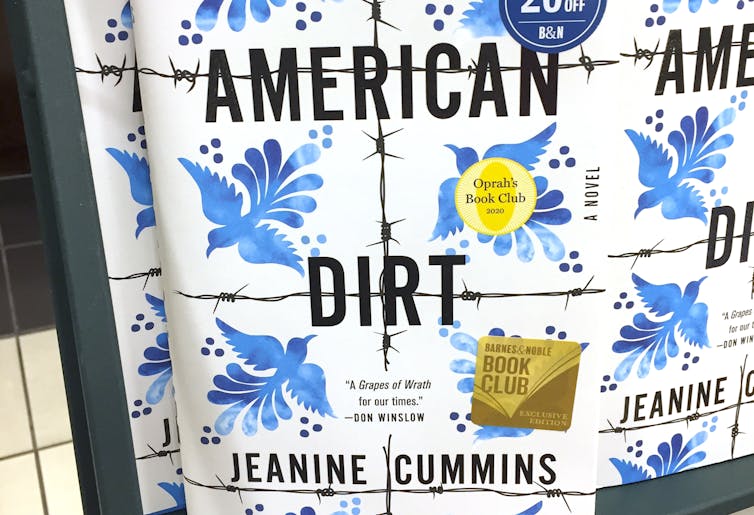
In an early chapter of “American Dirt,” the much-hyped novel now at the center of a racial controversy, the protagonist, Lydia, fills her Acapulco, Mexico, bookstore with her favorite literary classics. Because these don’t sell very well, she also stocks all “the splashy bestsellers that made her shop profitable.”
Ironically, it’s this lopsided business model that has, in part, fueled the backlash to the book.
In the book, Lydia’s favorite customer, a would-be poet turned ruthless drug lord, orders the massacre of Lydia’s entire family after her journalist husband writes a scathing expose. Lydia and her 8-year-old son must flee for their lives, joining the wave of migrants seeking safety in the U.S.
With the border crisis as its backdrop, the book was anointed by the publishing industry as one of those rare blockbusters that Lydia might have stocked in her fictional bookstore. Its publisher called it “one of the most important books of our time,” while Oprah chose it for her book club.
As someone who studies the publishing business, I see this ordeal as a symptom of an industry that relies far too heavily on a handful of predetermined “big books,” and whose gatekeepers remain predominantly white.
Sadly, this model has become only more powerful in the digital era.
A high-stakes poker game
Today’s publishing industry is driven by three truths.
First, people don’t buy many books. The typical American read four last year.
Third, nobody – not even big publishers – can predict hits.
As a result, the business can sometimes seem like one big, high-stakes poker game. Like any savvy gambler, editors know that most bets are losers: People don’t buy nearly enough books to make every title profitable. In fact, only about 70% of books even earn back their advances.
Luckily for publishers, a single hit, like Michelle Obama’s “Becoming,” can subsidize the vast majority of titles that don’t make money.
So when publishers think they have a winning hand, they’ll bet the house. To them, “American Dirt” seemed to have all the cards, and the book sold at auction for seven figures.
With that much money on the table, publishers will do everything they can to ensure a payoff, channeling massive marketing resources into those select titles, often at the expense of their others.
Big firms seek big profits, and, as Harvard Business School professor Anita Elberse has pointed out, it’s cheaper and easier to launch one enormous promotional effort for a single “big book” than to spread resources across those smaller bets.
With each publishing house releasing just one or two big books a season, few authors can hope to produce one of those splashy bestsellers.
That’s even more true for marginalized authors, because every step in the publishing and publicity process depends on gatekeepers who are largely white – to the tune of 85% of editors, 80% of agents, 78% of publishing executives and 75% of marketing and publicity staff.
Nevertheless, the book world does occasionally publish blockbusters by authors of color, whether it’s “Becoming” or Tayari Jones’ “An American Marriage.” As black author Zora Neale Hurston wrote in 1950, editors “will publish anything they believe will sell” – regardless of the author’s race.
But those editor beliefs about what would sell, she noted, were extremely limited when it came to authors of color. Stories about racial struggle, discrimination, oppression and hardship – those would sell. But books about marginalized people living everyday lives, raising kids or falling in love? Publishers had no interest in those stories.
Of course, well-told stories of struggle are important. But when they’re the only stories that the industry aggressively promotes, then readers suffer from what novelist Chimamanda Adichie calls “the danger of a single story.” When a single story gets told repeatedly about a culture that readers haven’t experienced themselves, stereotypes become more and more deeply engraved in popular culture. In a self-perpetuating cycle, publishers become even more committed to promoting that one story.
Much of the criticisms around “American Dirt” centered on Cummins’ lack of first-hand experience – the book, for instance, was peppered with inaccurate Spanish expressions and off-key notes about the middle-class heroine’s actions and choices.
While a vast network of publishing insiders would have likely looked at “American Dirt” before it was published, they all missed elements that were glaringly evident to informed readers. For the mostly white publishing world, Cummins’ book simply fit the narrative of the “single story” and aligned with pop culture stereotypes.
Its failings easily slipped past the blind spots of the gatekeepers.
The internet’s unfulfilled promise
The internet was supposed to have upended this system. Just 10 years ago, pundits and scholars heralded the end of gatekeepers – a world where anyone could be a successful author. And indeed, with the digital self-publishing revolution in the late 2000s, hundreds of thousands of authors, previously excluded from the marketplace, were able to release their books online.
Some even made money: My research has found that romance writers doubled their median income from 2009 to 2014, largely due to self-publishing. Romance authors of color, in particular, found new outlets for books excluded by white publishers. Back in 2009, before self-publishing took off, the Book Industry Study Group identified just six categories of romance novels; by 2015, it tracked 33 categories, largely driven by self-publishing. New categories included African American, multicultural, interracial and LGBT.
Meanwhile, many grassroots outlets that could push a midlist book – industry jargon for one not heavily promoted by publishers – to moderate levels of success have receded. Local media outlets that could create buzz for a local author are hollowed out or have vanished altogether. In 1991, there were some 5,100 indie booksellers; now there are half that many.
The onus is now on authors to promote their own work. They’re spending a full day a week doing so, according to a forthcoming paper I wrote for the Authors’ Guild. In that same paper, I find that authors of color earn less from their books than white authors; in addition to other serious problems, this indicates they may have fewer resources to promote themselves.
It’s clear the internet has not delivered the democratization it promised.
But it has helped authors in at least one important way. Social media has offered a powerful outlet for marginalized voices to hold the publishing industry accountable. We’ve seen this twice already this year – with “American Dirt” and with the Romance Writers of America, which lost sponsors after it penalized an author of color for condemning racial stereotypes.
Such outcries are an important start. But real progress will require structural change from within – beginning with a more diverse set of editors.
‘I want to produce such an impression of utter weariness and ennui that my readers will imagine the book could only have been written by a cretin,’ Flaubert wrote. Photo by Nadar / ullstein bild via Getty Images
Each burst of accusations and justifications has elicited a flood of public responses, expert opinions and efforts to correct a record full of hostilities and absurdities.
Many might feel bewildered and demoralized. But fans of the 19th-century French novel have seen this before.
In a 1852 letter, French author Gustave Flaubert mused, “When will we write the facts from the point of view of a cosmic joke, that is as God sees them from on high?”
He answered his own question in his 1857 novel, “Madame Bovary,” which he published during the regime of Napoleon III – the French president whose autocratic ambitions were aided by a swirl of misinformation and warring political factions.
When language loses all meaning
As I’ve previously written, “Madame Bovary” traffics in deliberate meaninglessness, or, as literary critic Leo Bersani put it, the “arbitrary, insignificant, inexpressive nature of language.”
The main character, Emma Bovary, has devoured romantic novels and is disillusioned by a provincial existence that has proven dull. Her search for excitement and escape leads to adulterous disasters and financial ruin.
That’s a common enough premise, but what makes “Madame Bovary” unique is its insistence on the unreliability of narratives, phrases, descriptions and words. All the characters, from the callow manipulators to the well-meaning dullards, are awash in cliché. Emma and her future lover, Léon, declare that they love sunsets by the seaside, though neither has been to the ocean. The pharmacist Homais counsels prudence to others, though no one listens, and he himself is ruthlessly ambitious; the novel ends with him receiving the cross of the Legion of Honor. Léon tells Emma that he wanted to be buried in a rug she gave him, though the narrator reveals that this is false.
It isn’t even that everyone in the novel lies; some earnest characters really mean what they say. The problem is that language itself has had the meaning drained out of it by a combination of insincerity, repetition and bombast. In a famous scene at an agricultural fair, the audience of attentive townspeople hangs on every word of a mind-numbing, meandering speech about crops: “Here we have the vine, there we have the cider apple, further on we have cheese, and flax!”
When the fireworks planned for the event’s grand finale sputter out, the newspaper nonetheless reports that they went off without a hitch, describing them as a “veritable kaleidoscope, a true stage-setting for an opera.” No one cares that the description is made up.
The ultimate punchline of Flaubert’s cosmic joke is that the narrator himself is a master of subtle confusion. He starts the story in the first person, positioning himself as a schoolmate of Emma’s husband, before changing abruptly to the third person. Some of his accounts are straightforward and dispassionate. Others are entirely confounding. Descriptions of a boy’s cap, a wedding cake and a medical device are so detailed – and yet so baffling – that readers find themselves unable to even imagine what they might look like.
“I want to produce such an impression of utter weariness and ennui,” Flaubert later wrote in the plans for a subsequent literary project, “that my readers will imagine the book could only have been written by a cretin.”
France in political turmoil
Flaubert didn’t write “Madame Bovary” in a vacuum. As he was starting the novel in 1851, elected President Louis-Napoléon Bonaparte was staging the coup d’état that would transform him from president to emperor.
French citizens found themselves bewildered and disoriented. Journalist and politician Eugène Ténot, writing an account of the coup in 1868, warned readers that “no truthful narrative of that event has been published in France.” He also remarked that “narratives written in troubled times are always imbued with partiality, exaggeration, injustice, even bad faith.”
In an open letter published in December 1851, Bonaparte announced the dissolution of the National Assembly, which he called a “hotbed of conspiracies.” In January 1852 he put in place a new constitution, all the while accusing “démagogues” of spreading “fausses nouvelles” (“fake news”). In December 1852, Louis-Napoléon Bonaparte became Napoléon III. France’s Second Empire commenced.
France’s political upheaval, misinformation wars, sporadic uprisings and public confusion likely left a deep impression on Flaubert.
Americans today might sympathize with his characters, who exist in an endless vortex of repetition, insincerity and stupidity.
Recent technological advances are partially to blame.
Over the past decade, abundant research has emerged on media oversaturation, narrative overload and the deluge of digital images – and what this does to the brain. Incessant stimuli and distractions lead to memory impairment, confusion and troubles with retention.
These conditions are ripe for political warfare.
In his 2014 book “The Contradictions of Media Power,” media studies professor Das Freedman wrote that, in times of political instability, “existing narratives are under stress and audiences themselves are actively seeking out new perspectives.” Information wars and fake news seem to be endemic during times of political upheaval.
In many ways, we’re living out an extreme version of the cosmic joke Flaubert envisioned.
With the assassination of Soleimani, disregard for truth and reality – and examples of Madame Bovary-esque word salad – remains as blatant as ever. Mike Pence’s reference to Soleimani’s involvement in 9/11 is as detached from reality as Emma’s vision of Roman ruins bordering a forest of tigers, camels, swans, sultans and English ladies.
The flood of narrative confusion continues unabated. Only time will tell if Iran becomes the Prussia of 21st-century America.










 At the BookShelf

You must be logged in to post a comment.