
The link below is to an article/book review concerning lessons from the book by Albert Camus, ‘The Plague.’
For more visit:
https://lithub.com/what-we-can-learn-and-should-unlearn-from-albert-camuss-the-plague/

The link below is to an article/book review concerning lessons from the book by Albert Camus, ‘The Plague.’
For more visit:
https://lithub.com/what-we-can-learn-and-should-unlearn-from-albert-camuss-the-plague/
David Roberts, Birmingham City University
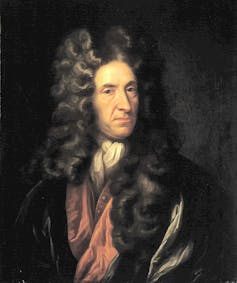
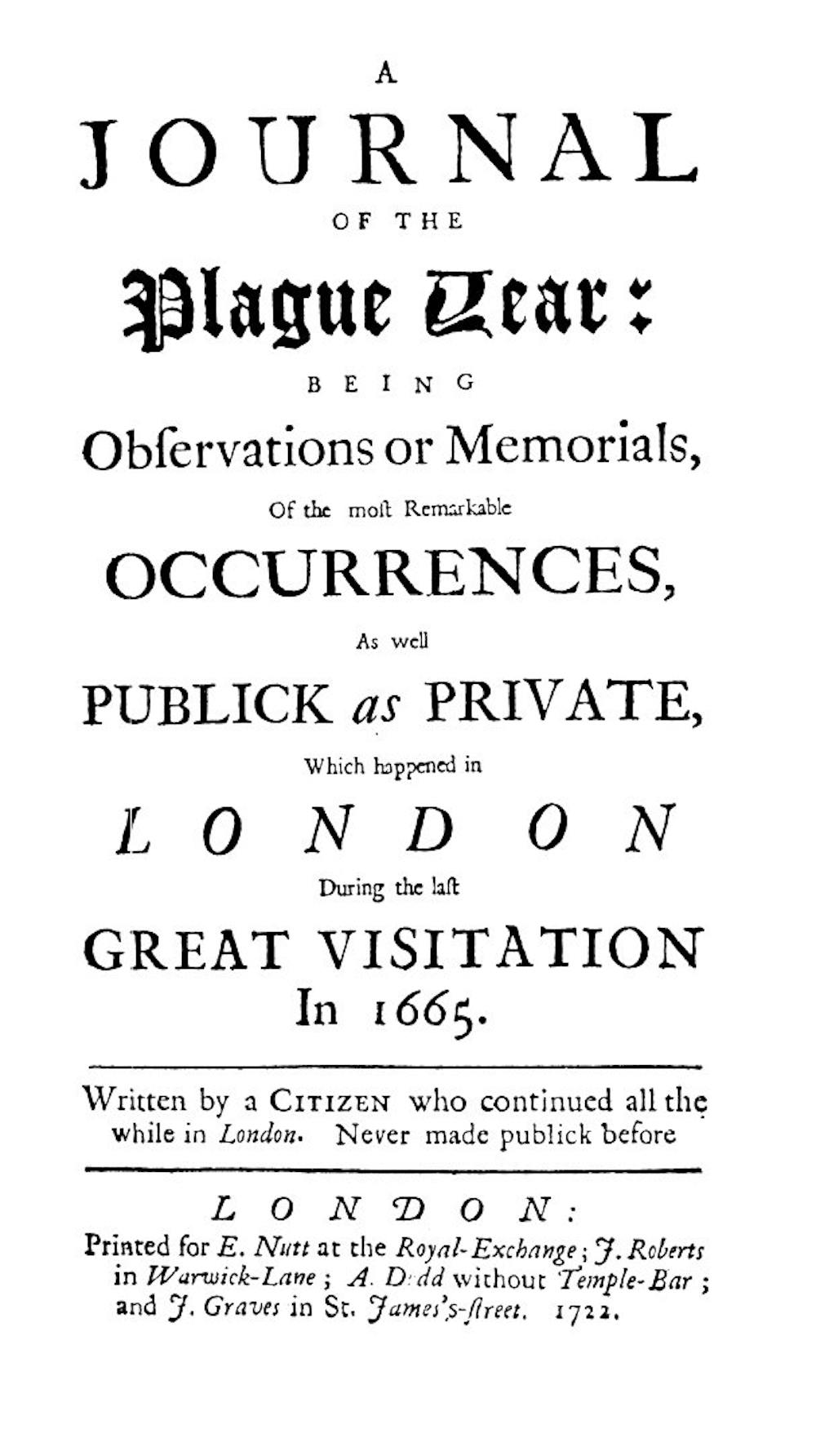
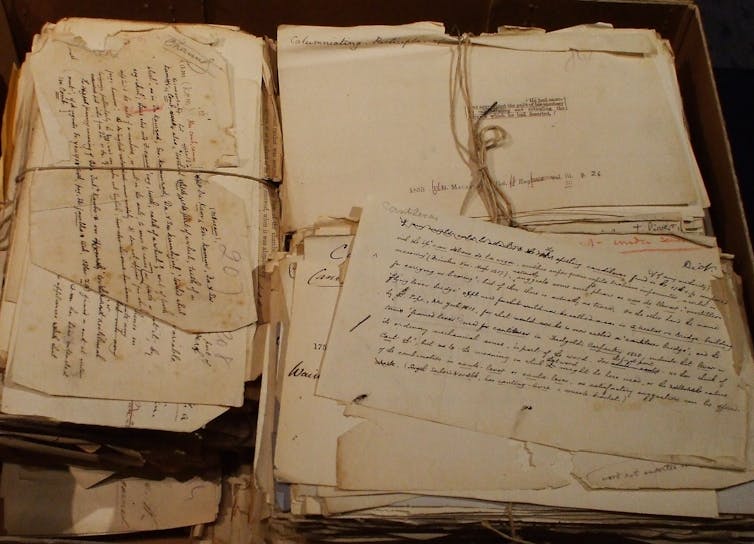
In 1722, Daniel Defoe pulled off one of the great literary hoaxes of all time. A Journal of the Plague Year, he called his latest book. The title page promises “Observations of the most remarkable occurrences” during the Great Plague of 1665, and claims it was “written by a citizen who continued all the while” in London – Defoe’s own name is nowhere to be found.
It was 60 years before anyone twigged. From oral testimonies, mortality bills, lord mayor’s proclamations, medical books and literature inspired by the 1603 plague, Defoe had cooked the whole thing up.
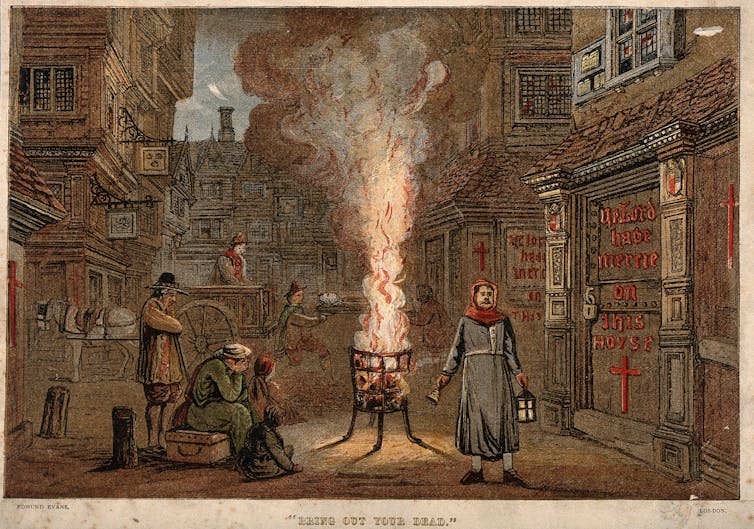
And yet this extraordinary book lies like the truth. It’s the most harrowing account of an epidemic ever published – and it really leaps off the page now in the era of COVID-19. We feel what it was like to walk up a main thoroughfare with no one else about. We read of the containment orders published by the government, and how people got round them. We share the distress of families denied proper funerals for their loved ones.
We learn of the mass panic as people tried to understand where the disease came from, how it was transmitted, how it could be avoided, what chance you had if you caught it, and – most modern of all – how fake news and fake practitioners multiplied answers to all those questions.
Bubonic plague was, of course, far nastier than coronavirus. In its ordinary form – transmitted by fleabites – it was around 75% fatal, while in its lung-to-lung form, that figure went up to 95%. But in the way it was managed – and the effect it had on people’s emotions and behaviour – there are eerie similarities amid the differences. Defoe captured them all.
His narrator, identified only as HF, is fascinated by what happened after the lord mayor ordered victims to be locked in their homes. Watchmen were posted outside front doors. They could be sent on errands to fetch food or medicine and took the keys with them, so people contrived to get more keys cut. Some watchmen were bribed, assaulted or murdered. Defoe describes one who was “blown up” with gunpowder.
HF becomes obsessed with the weekly mortality figures. They charted deaths by parish, giving a picture of how the plague was moving around the city. Still, it was impossible to be sure who had died directly of the disease, just as in the BBC news today we hear people have died “with” rather than “of” COVID-19. Reporting was difficult, partly because people were reluctant to admit there was an infection in the family. After all, they might be locked in their homes to catch the disease and die.
HF is appalled by those who opened up taverns and spent their days and nights drinking, mocking anyone who objected. At one point he confronts a group of rowdies and gets a torrent of abuse in return. Later, exhibiting one of his less appealing traits, he is gratified to hear that they all caught the plague and died.
He is a devout Christian, but the stories that worry him most are the ones that still shock everyone today, regardless of their beliefs. Is it possible, he asks, that there are some people so wicked that they deliberately infect others? He just can’t square the idea with his more kindly view of human nature. Yet he hears plenty of stories about victims breathing into the faces of passers by, or infected men randomly hugging and kissing women in the street.
When Prince Charles and Boris Johnson fell ill recently, we were told the virus “does not discriminate”. HF has something to say about that. For all his uncertainties, he is adamant about one thing. Plague affected the poor disproportionately. They lived, as they do now, in more cramped conditions, and were more susceptible to taking bad advice.
They were more likely to suffer ill health in the first place, as now, and they had no means of escape. Near the start of the outbreak in 1665, the court and those with money or homes in the country fled London in droves. By the time the idea had occurred to the rest of the population, you couldn’t find a horse for love or money.
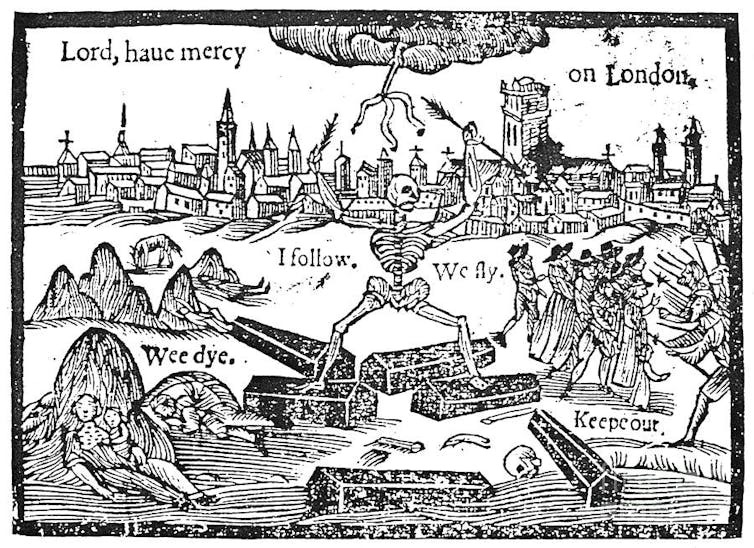
Throughout the journal, HF tells us he hopes his experiences and advice might be useful to us. There’s one thing in particular governments might learn from the book – and it’s tough. The most dangerous time, he reports, was when people thought it was safe to go out. That was when the plague flared up all over again.
Plague literature is a genre in its own right. So what draws writers and readers to such a grisly subject? Something not entirely wholesome, perhaps. For writers, it’s the chance to explore a world in which fantasy and reality have swapped places. We depend on the writer as heroic narrator, charting the horror like the best news reporter.
For readers, it’s the feeling that you might sneak with him to the very edge of the plague pit and live to tell the tale. For his closing words, HF hands us a doggerel poem that sums up his feelings and ours:
A dreadful plague in London was
In the year sixty five,
Which swept an hundred thousand souls
Away: yet I alive!
David Roberts, Professor of English and National Teaching Fellow, Birmingham City University
This article is republished from The Conversation under a Creative Commons license. Read the original article.
Roslyn Petelin, The University of Queensland
When a literary luminary such as Thomas Kenneally declares so early in 2020 that he is certain a “more original” novel “will not be published this year”, the reviewer faces a challenge. The book in question is The Dictionary of Lost Words, the debut novel by South Australian writer Pip Williams.
Occasionally, I finish a book that I want to immediately read again, such as Alan Bennett’s delectably quirky book, The Uncommon Reader, which I have re-read several times.
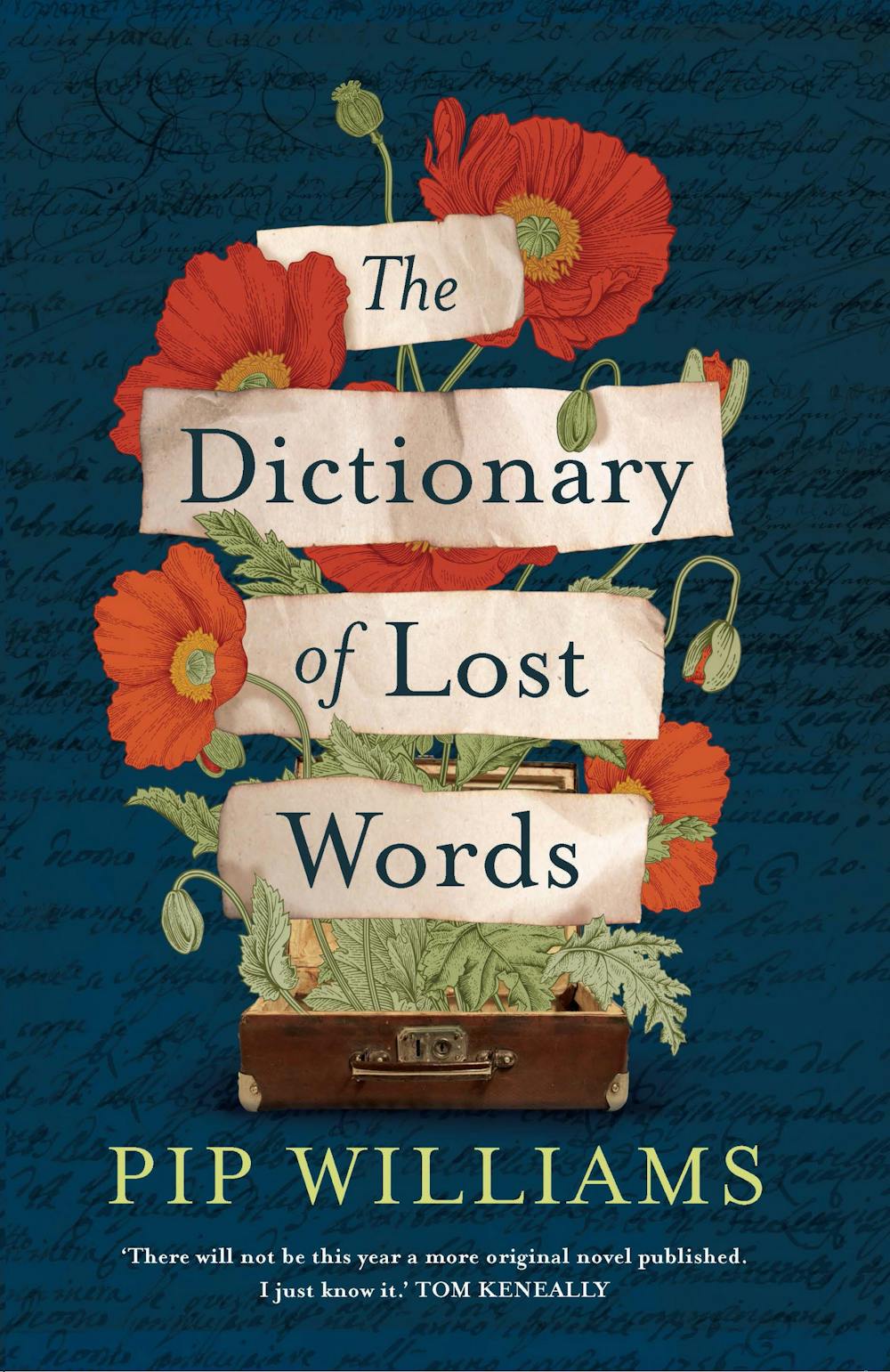
I have now read Williams’s book twice. I raced through it the first time to see how it would turn out and needed to read it a second time to pick up what I had missed the first time round. In its 383 pages it covers a timespan of more than 100 years: 1882–1989.
The novel is set mainly in Oxford, but events occur in Bath, Shropshire, and Adelaide, Australia.
It is based on true events, the central one being the compilation of Oxford University Press’s New English Dictionary (now the Oxford English Dictionary) by a team of lexicographers led by Sir James Murray, and helped by all of his 11 children.
Murray began compiling the dictionary in 1879. It was unfinished at his death in 1915 and completed by his fellow editors in 1928. The second edition appeared in 1989; it is currently being completely revised.
Other historical figures who play key roles in the novel are printer Horace Hart and lexicographer Henry Bradley, who succeeded Murray.
Williams’s fictional central character, Esme Nicoll, born in 1882, lives with her father Harry, a lexicographer who works on the dictionary in a corrugated iron shed, grandly called the Scriptorium. It sits in the garden of Murray’s house, Sunnyside, at 78 Banbury Road in Oxford. Esme has lost her mother at a very young age.
She spends her days beneath the sorting table in the “scrippy”, where the lexicographers sort and assess the potential contributions sent to Murray by volunteers following his worldwide appeal for words to be included in the new dictionary.

One day, a lexicographer drops off a slip of paper. It falls under the table and Esme rescues it. She places it inside a small wooden suitcase kept under the bed of the Murrays’ housemaid Lizzie. The word is “bondmaid”, which is exactly what Lizzie is. Lizzie supplies her own entry: “Bonded for life by love, devotion or obligation. I’ve been a bondmaid to you since you were small, Essymay, and I’ve been glad for every day of it”. The word is not discovered to be missing until 1901.
Over several years, Esme secretes a trunkful of words:
My case is like the Dictionary, I thought. Except it’s full of words that no one wants or understands, words that would be lost if I hadn’t found them.
Esme and Lizzie also collect words from stallholders in Oxford’s Covered Market, many of them “vulgar”.
Esme‘s gathered words comprise the book published many years later, titled in the novel as Women’s Words and Their Meanings, after Lizzie passes Esme’s collection on to a compositor at the Press. However, when Esme subsequently presents a copy of the volume to an editor who takes over after Murray’s death, he rejects it as unscholarly and not a “topic of importance”, confirming Esme’s experience that “all words are not equal”.
She responds to him: “you are not the arbiter of knowledge, sir. It is not for you to judge the importance of these words, simply allow others to do so”.
Williams grafts an emotional story onto other historical figures and interweaves the themes of women’s equality and the suffrage movement. The suffragist-suffragette divide is layered into the narrative when Esme’s actor friend, Tilda, heeds Emmeline Pankhurst’s “deeds, not words” call to action and ends up committing arson.
A minor character is Esme’s godmother Edith, whose earnest epistles to Esme and her Dad move the plot along, including a painful episode when Esme is treated harshly at a Scottish boarding school. Esme undergoes many changes in fortune, finding some happiness as the story unfolds.
Reviewing this book, I’m reminded of a quote in Putnam’s Monthly magazine of American literature, science and art from April 1855:
I proclaim to all the inhabitants of the land that they cannot trust to what our periodicals say of a new book. Instead of being able by reading the criticism to judge the book, it is now necessary to read the book in order to judge the criticism.
My advice to readers is similar: experience The Dictionary of Lost Words for yourselves rather than getting swept away by the hype. Don’t gobble it, as I did the first time round – savour its heart-wrenching detail.
Unfortunately, a close read does reveal the need for a tighter copy edit. “Radcliffe” is spelt two different ways on opposite pages; “braille” is misspelt; the main street in Oxford is known as “the High” rather than “High Street”. I circled (in pencil) dozens of instances of my pet peeve “different to”.
Regardless, it has had an astonishing pickup by international publishers, who clearly expect it to be a commercial success. It will certainly be a popular book-club choice. Time will tell whether it takes its place beside literary classics.
The Conversation has been contacted by Affirm Press who assure us one of the typing errors mentioned did not go to final printing of the book and appeared only in the advance copies. Another error mentioned will be fixed in subsequent printings.
Roslyn Petelin, Course coordinator, The University of Queensland
This article is republished from The Conversation under a Creative Commons license. Read the original article.
Matthew Sharpe, Deakin University
Some weeks ago, I got an email from a student who had returned to Northern Italy over Christmas to see family.
Unable to return to Australia, they were in lockdown. The hospitals were filling up fast, as COVID-19 began to spiral out of control. Sales of Albert Camus’ 1947 novel The Plague (La Peste) were spiking. Everyone was buying it.
Rereading The Plague over these past weeks has been an uncanny experience. Its fictive chronicle of the measures taken in the city of Oran against a death-dealing disease that strikes in 1940 sometimes seemed to blur into the government announcements reshaping our lives.
Oran is a city like anywhere else, Camus’ narrator tells us:
Our citizens work hard, but solely with the object of getting rich. Their chief interest is in commerce, and their chief aim in life is, as they call it, ‘doing business’.
Like people anywhere else, the Oranians are completely unprepared when rats begin emerging from the sewers to die in droves in streets and laneways. Then, men, women and children start to fall ill with high fever, difficulties breathing and fatal buboes.
The people of Oran initially “disbelieved in pestilences”, outside of the pages of history books. So, like many nations in 2020, they are slow to accept the enormity of what is occurring. As our narrator comments drily: “In this respect they were wrong, and their views obviously called for revision.”
The numbers of afflicted rise. First slowly, then exponentially. By the time the plague-bearing spring gives way to a sweltering summer, over 100 deaths daily is the new normal.
Read more:
Coronavirus weekly: as the world stays at home, where is the pandemic heading?
Emergency measures are rushed in. The city gates are shut, and martial law declared. Oran’s commercial harbour is closed to sea traffic. Sporting competitions cease. Beach bathing is prohibited.
Soon, food shortages emerge (toilet paper, thankfully, is not mentioned). Some Oranians turn plague-profiteers, preying on the desperation of their fellows. Rationing is brought in for basic necessities, including petrol.
Meanwhile, anyone showing symptoms of the disease is isolated. Houses, then entire suburbs, are locked down. The hospitals become overwhelmed. Schools and public buildings are converted into makeshift plague hospitals.
Our key protagonists, Dr Rieux and his friends Tarrou, Grand and Rambert, set up teams of voluntary workers to administer serums and ensure the sick are quickly diagnosed and hospitalised, often amongst harrowing scenes.
In these circumstances, fear and suspicion descend “dewlike, from the greyly shining sky” on the population. Everyone realises that anyone – even those they love – could be a carrier.
Come to think of it, so could each person themselves.
The failure of the governors to consistently impose “social distancing” is shown up spectacularly in the novel’s most picturesque scene. The lead actor in a rendition of Gluck’s Orpheus and Eurydice collapses onstage, “his arms and legs splayed out under his antique robe”.
Terrified patrons flee the darkened underworld of the opera house, “wedged together in the bottlenecks, and pouring out into the street in a confused mass, with shrill cries of dismay”.
Arguably the most telling passages in The Plague today are Camus’ beautifully crafted meditative observations of the social and psychological effects of the epidemic on the townspeople.
Epidemics make exiles of people in their own countries, our narrator stresses. Separation, isolation, loneliness, boredom and repetition become the shared fate of all.
In Oran, as in Australia, places of worship go empty. Funerals are banned for fear of contagion. The living can no longer even farewell the many dead.
Camus’ narrator pays especial attention to the damages visited by the plague upon separated lovers. Outsiders like the journalist Rambert who, by chance, are marooned inside Oran when the gates shut are “in the general exile […] the most exiled”.
Today’s world knows many such “travellers caught by the plague and forced to stay where they were, […] cut off both from the person(s) with whom they wanted to be and from their homes as well”.
Camus’ prescient account of life under conditions of an epidemic works on different levels. The Plague is a transparent allegory of the Nazi occupation of France beginning in spring 1940. The sanitary teams reflect Camus’ experiences in, and admiration for, the resistance against the “brown plague” of fascism.
Camus’ title also evokes the ways the Nazis characterised those they targeted for extermination as a pestilence. The shadow of the then-still-recent Holocaust darkens The Plague’s pages.
When death rates become so great that individual burials are no longer possible – as in scenes we are already seeing – the Oranaise dig collective graves into which:
the naked, somewhat contorted bodies were slid into a pit almost side by side, then covered with a layer of quicklime and another of earth […] so as to leave space for subsequent consignments.
When this measure fails to keep up with the weight of these “consignments”, as with the genocidal actions of the Einzatsgruppen, “the old crematorium east of the town” is repurposed. Closed streetcars filled with the dead are soon rattling along the old coastal tramline:
Thereafter, […] when a strong wind was blowing […] a faint, sickly odour coming from the east remind[ed] them that they were living under a new order and that the plague fires were taking their nightly toll.
Camus’ plague is also a metaphor for the force of what Dr Rieux calls “abstraction” in our lives: all those impersonal rules and processes which can make human beings statistics to be treated by governments with all the inhumanity characterising epidemics.
For this reason, the enigmatic character Tarrou identifies the plague with people’s propensity to rationalise killing others for philosophical, religious or ideological causes. It is with this sense of plague in mind that the final words of the novel warn:
that the plague bacillus never dies or disappears for good; that it can lie dormant for years and years in furniture and linen-chests; that it bides its time in bedrooms, cellars, trunks, and bookshelves; and that perhaps the day would come when, for the bane and the enlightening of men, it would rouse up its rats again and send them forth to die in a happy city.
There is nevertheless truth in the description of Camus’ masterwork as a “sermon of hope”. In the end, the plague dissipates as unaccountably as it had begun. Quarantine is lifted. Oran’s gates are reopened. Families and lovers reunite. The chronicle closes amid scenes of festival and jubilation.
Camus’ narrator concludes that confronting the plague has taught him that, for all of the horrors he has witnessed, “there are more things to admire in men than to despise”.
Unlike some philosophers, Camus became increasingly sceptical about glorious ideals of superhumanity, heroism or sainthood. It is the capacity of ordinary people to do extraordinary things that The Plague lauds. “There’s one thing I must tell you,” Dr Rieux at one point specifies:
there’s no question of heroism in all this. It’s a matter of common decency. That’s an idea which may make some people smile, but the only means of fighting a plague is common decency.
It is such ordinary virtue, people each doing what they can to serve and look after each other, that Camus’ novel suggests alone preserves peoples from the worst ravages of epidemics, whether visited upon them by natural causes or tyrannical governments.
It is therefore worth underlining that the unheroic heroes of Camus’ novel are people we call healthcare workers. Men and women, in many cases volunteers, who despite great risks step up, simply because “plague is here and we’ve got to make a stand”.
It is also to these people’s examples, The Plague suggests, that we should look when we consider what kind of world we want to rebuild after the gates of our cities are again thrown open and COVID-19 has become a troubled memory.
Matthew Sharpe, Associate Professor in Philosophy, Deakin University
This article is republished from The Conversation under a Creative Commons license. Read the original article.
Janet Dickinson, University of Oxford
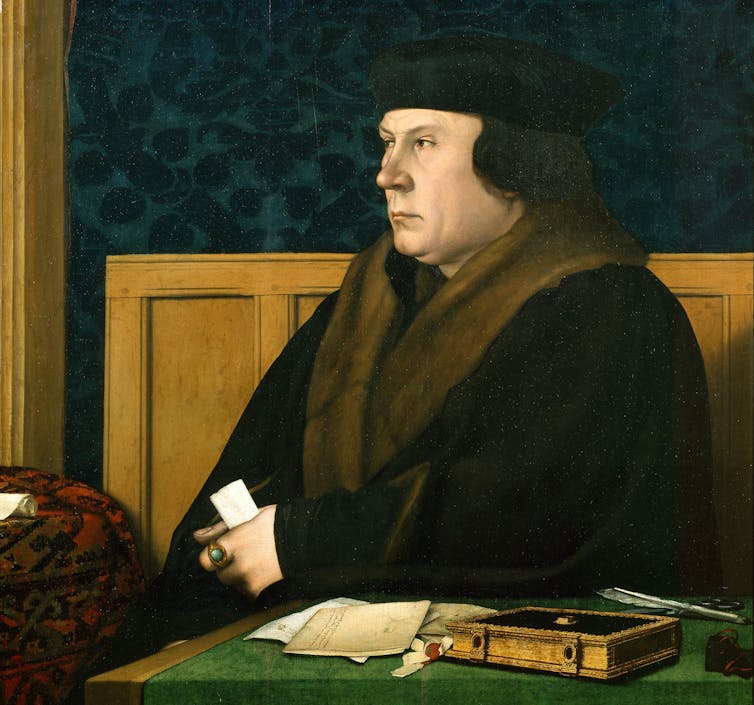
Thomas Cromwell has had a remarkable and lasting impact on English history. The role that Henry VIII’s chief minister played in the country’s break with Rome and Catholicism and the focusing of power in the hands of the king’s government continues to have repercussions today as modern states debate their place in the world.
The question of Cromwell’s influence on the king and his role as backroom mastermind continues to fascinate modern audiences, holding up a mirror to more recent discussions over the role in today’s political sphere of special advisers such as Dominic Cummings or Alastair Campbell and their influence on modern-day leaders.
Cromwell’s life was lived largely in the shadows, so what can we make of his character and what is the truth of his existence? Historical evidence is limited and we catch only glimpses of Cromwell’s inner life in his own letters and the words that others said and wrote about him.
The basic skeleton of the historical record gives us a remarkable life, and yet it is a life that has – until relatively recently – been little discussed beyond the historical arena. Historians never anticipated that they would be able to capture a richer sense of Cromwell as a human being, so the publication of Hilary Mantel’s Booker prize-winning Wolf Hall in 2009 came as something of a shock to the world of Tudor history.
To suddenly encounter a fully realised individual, reliving the experiences of his childhood and violent father and grieving the shocking and sudden loss of his wife and daughters, formed a remarkable intervention in our understanding of a man who was described by Geoffrey Elton, the historian who admired him most, as being “unbiographical”.
The subsequent publication by Bring up the Bodies, which won Mantel a second Booker prize, and Diarmaid MacCulloch’s 2018 biography completed Cromwell’s rehabilitation as someone we can make sense of when placed within his time and the events in which he took such a central role. But it has taken until now – more than seven years after volume two – for Mantel to tell the final phase of the story that she has transformed.
Mantel has firmly stated that it was not her aim to write a history. Yet her Cromwell is so real, so compellingly lifelike, that it has become very difficult to think about him without her interpretation coming into mind. For historians it is an important reminder that the figures we study were real people who lived and died – often in painful, even horrific, circumstances.
It is easy, of course, for historians to find problems with Mantel’s account. Mantel telescopes some events and adds to others for dramatic effect, providing Cromwell with motivations and a rich emotional inner life, all of which remains within the fictional realm.
What she really gives us is a version of what may have been possible. Just as historians disagree over the reading of a particular letter or incident, so we are free to engage with Mantel’s version of Cromwell. Her books are – and will continue to be – vital to the teaching of the subject and to the development of our understanding of Cromwell and his world.
Historians have been increasingly drawn to thinking of the past not only in terms of the textual, material and visual records that survive, but also in terms of the architectural and geographical worlds in which people operated. The Tudor court was a small world of confined spaces and intimate relationships – an intense environment in which remarkable events took place. We can now add an imaginative reconstruction of that world, grounded in careful detail accrued from the years of research carried out by Mantel.
It is about as realistic a depiction as we could hope for and it provides a valuable frame for understanding how a whispered exchange might carry vital information or how Henry VIII’s sudden anger might terrify his subjects into compliance. While we can never be certain of the precise nature of Cromwell’s relationship with the king, we can now offer a range of possible interpretations, from shared memories of early military campaigns to a monarch requiring effective service of his subject, finding him wanting and therefore disposable.
The question of Cromwell’s fall is one that has troubled historians. How did a man so immersed in the Tudor court, who had witnessed the destructions of Thomas Wolsey and of Anne Boleyn, miscalculate badly enough to end up on the scaffold?
Mantel offers us some possible routes into making sense of Cromwell’s miscalculation. The courtly world that Mantel depicts is acutely dangerous. From the start of The Mirror and the Light we see Cromwell surrounded by rumours of his fate in the aftermath of the fall of Boleyn – someone to whom he had been so close. Later on he squabbles with her uncle the Duke of Norfolk and the Archbishop of Canterbury, Thomas Cranmer – ignoring the latter’s warning not to get too deeply involved in the matter of the king’s marriage after the death of Jane Seymour.
Cromwell’s trust in Henry, and his belief that the king will stand by his assertions of loyalty and the signs of warmth that Henry gives, prove to be his downfall. In the face of the warnings from those around him, Cromwell follows his role to its natural end. Elevated to become Earl of Essex, Cromwell holds “the shining bowl of possibility … all is mended” – a final cruel miscalculation.
When it comes, Cromwell’s enemies physically closing in on him to strip him of rank and title, this provides a fundamental truth about power and about the reality of being a king’s councillor or special advisor: in the end, everyone falls.
Janet Dickinson, Senior Associate Tutor in History, University of Oxford
This article is republished from The Conversation under a Creative Commons license. Read the original article.
Musée d’Orsay
Tom Stevenson, The University of Queensland
The Satyricon by Petronius is an unusual surviving text from the ancient world. It is not a work of history, nor a work of soaring epic poetry like Homer’s Iliad or Virgil’s Aeneid, and for various reasons it is hard to get a handle on.
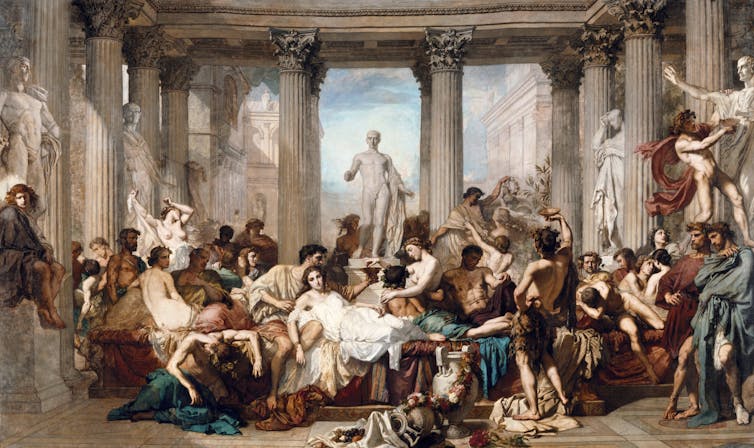
Its contents are pretty grubby because it is about lowlifes and lowlife behaviour. It depicts petty theft, casual violence, opportunistic sex, prostitution, vulgar gluttony, crass displays of wealth by the most ridiculous social climber and gross disrespect for a range of gods, goddesses and hallowed religious rituals, like funerals and proper treatment of the dead. All the good sleazy stuff for when you’re in the mood for that sort of thing.
Rather than a work about heroes or kings or queens or uplifting examples of how to live a virtuous life, the Satyricon is almost a how-to manual for the opposite.
It is the earliest surviving novel in Latin literature, but it is not even close to being intact. We appear to have bits of three books out of an original 16 or possibly more. So we run into problems trying to understand what the plot of the whole work might have been and whether the bits that survive are representative of it.
As far as we can tell, it’s a tale about the misadventures and love triangle of three young men – the narrator Encolpius, Ascyltus and the younger Gitōn.
They all behave disreputably, all know hunger and poverty, all hurt people, and all get hurt in return.
Encolpius arguably suffers the most when he upsets Priapus, a god of fertility, who renders him impotent. Priapus is normally represented in Roman art sporting an enormous, erect phallus – even weighing it in one famous example. He is a minor deity in comparison to Jupiter or Hercules, but he has one outstanding trait, which means a great deal to the “heroes” of this novel.

When Priapus deprives Encolpius of his virility, he strikes at the core of Encolpius’s identity, causing him much distress and forcing him in panic to seek a succession of absurd remedies.
The main characters are not good boys. They are jealous, perpetually randy, violent, unfaithful and capricious. They separate and come back together. They lack depth. And they meet a series of characters who complement their deficiencies with flaws of their own.
They look for food, shelter, sex and sexual restoration. Charlatans abound. Everyone is selfish and untrustworthy. Religion is flouted and abused, even though it plainly has power.
The attitude to religion seems to be “whatever works”, but no one is exactly sure what works, so they indulge themselves in equal amounts of devotion and derision – with predictable results.
Read more:
Friday essay: the erotic art of Ancient Greece and Rome
Our youths seem to be travelling between locations around the Bay of Naples – a notorious region of excess and extravagance, heavily influenced by Greek culture and less constrained by traditional Roman discipline than other parts of Italy.
There is little certainty about this, as with so many features of the tale, but the easy movement between city dives and country villas makes sense in this region.
The most outrageous character they run across is the nouveau-riche pretender Trimalchio, whom they meet through an acquaintance, Eumolpus, who is said to be a poet but is more like a sleaze with intellectual pretensions.
Together they end up at a sumptuous feast at Trimalchio’s villa – the famous Cena Trimalchionis or “Banquet of Trimalchio”.
The feast is a riot of nonsense. Trimalchio, an ex-slave who has bought his freedom, tries to prove he is a man of culture as well as wealth like his free-born counterparts in neighbouring villas and regions. In doing so, of course, he proves only that he completely lacks class or sophistication of any kind and emerges as a self-loving ignoramus.
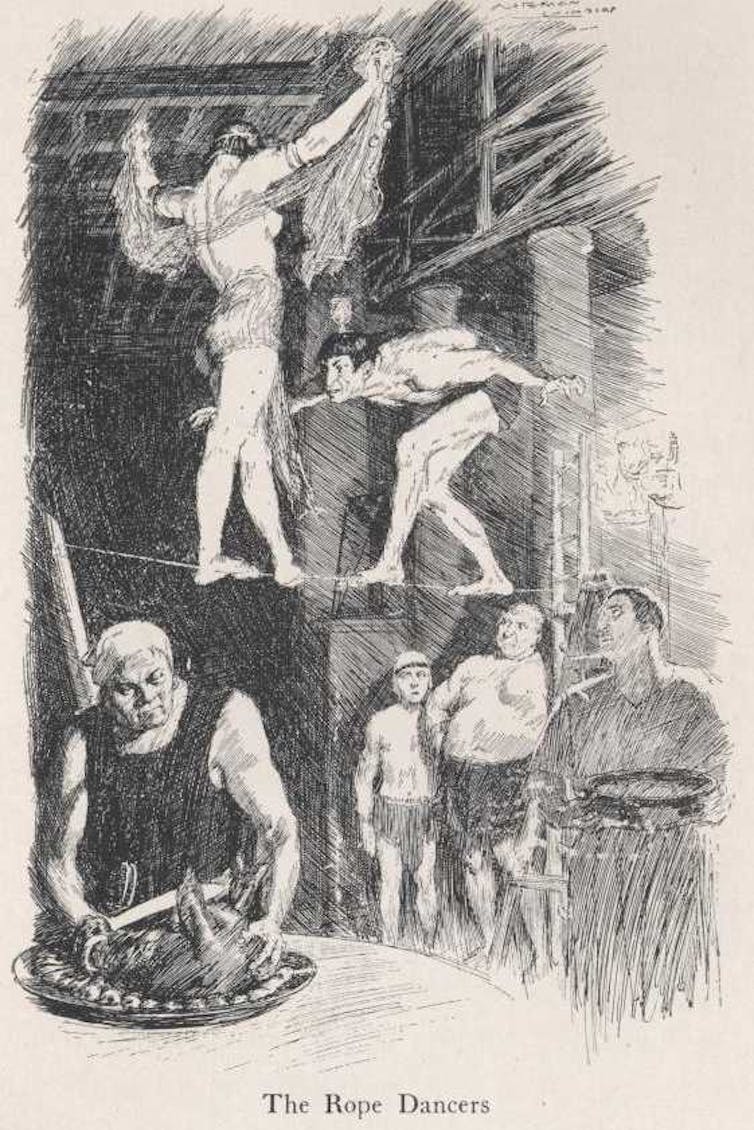
There is way too much food, especially the meats and sweets. The dishes are too exotic and difficult, especially the tiny birds. They are served in ostentatiously absurd ways by a bizarre collection of slaves and other functionaries. The guests grab greedily and unappreciatively, upsetting plates, cups and each other. The talk is gross and unedifying.
Trimalchio ends up inviting his cronies to a rehearsal of his funeral, which he has planned meticulously on the model of a noble’s or emperor’s funeral. He fails to see how far he falls short. Clothes, and other props, do not make the man.
But there is more to the feast than meets the eye. The vulgarity of the subject matter is especially memorable because it is conveyed by a master satirist or comic genius.
Trimalchio is described with great attention to detail and inventiveness, and with a certain sympathy rather than vindictiveness. Trimalchio and his hangers-on are acquainted with high literature, though they mangle it terribly, sometimes speaking in vulgar Latin and in language rendered comic by its malapropisms and other features. The writer is a virtuoso for pulling off these effects so cleverly.
The key to interpretation is that the text is a satire, as its name implies. It is inspired by the deeds of satyrs: lecherous, half-human creatures of myth, obsessed with sex. They were symbols of the outrageous, the destabilising and the violent.
The youths of our tale are plainly modelled on them. And the text is comic in approach, designed for a festival atmosphere, when it’s okay to release the irrational, the absurd and the bottled-up frustrations that go along with daily commitment to civilised straightness.
The comic silliness of it all is important to consider when pondering the author and purpose of the work. The author, according to the name that has survived with the text, was Titus Petronius Arbiter.
He is generally identified with the prominent courtier of Nero, the senator Gaius Petronius, who was forced to commit suicide in AD 66 for his part in a conspiracy against the emperor. In a famous passage (Annals 16.17-20), Tacitus says Nero looked to this man as his “arbiter of elegance”, as though his judgment of culture and pleasure was admired.
Read more:
Mythbusting Ancient Rome – the emperor Nero
This identification between the author of the Satyricon and the Petronius of Tacitus might be right. Roman nobles were highly educated in literature and philosophy. Intellectual attainment was one of the myriad ways they competed with one another for social pre-eminence. Such a man might well have been capable of the literary virtuosity and wit that is on display in the text as we have it.
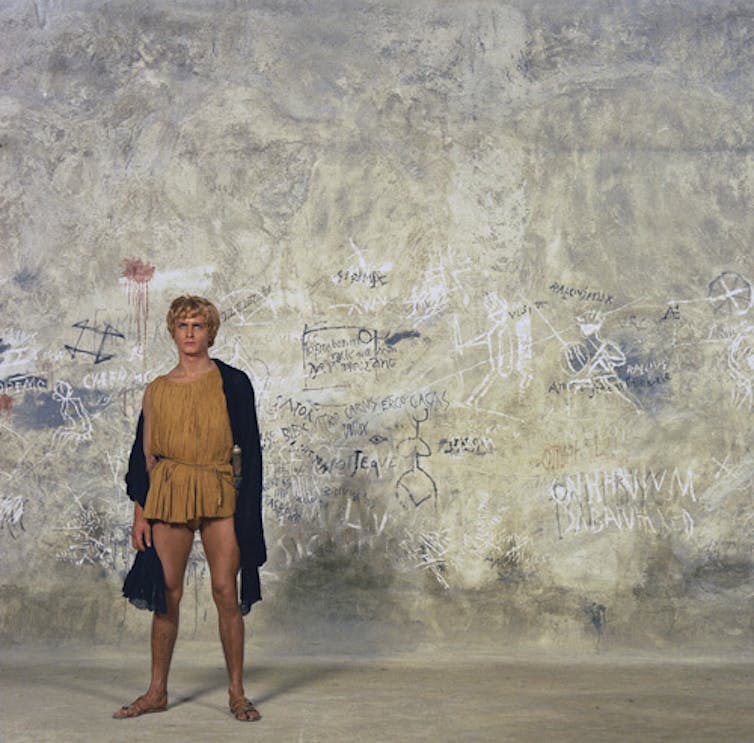
What is slightly worrying about this identification, however, is that Tacitus gives an appreciative portrayal of a man who sends up and resists a tyrant. Nero was certainly this, as the paranoia and murders of his reign indicate. Yet he was also a great sponsor of culture, especially literature and drama.
Even if the identifications with Tacitus’s Petronius and the reign of Nero are correct, we don’t need to adopt Tacitus’s tone and perspective. The Satyricon does not have to be a work with subversive intent against Nero, and Nero does not have to be read into the story in place of Trimalchio. Petronius does not have to be a social critic who was appalled by the corruption and depravity of Nero’s court.
It’s much more fun if he wasn’t any of these things in this work, but was instead a man who was excellent at satire in a spirit that was fundamentally light and frivolous.
Suggested translations: J.P. Sullivan, The Satyricon and the Fragments, translated with an introduction by J.P. Sullivan, Harmondsworth: Penguin Books, 1965. P.G. Walsh, Petronius: The Satyricon, translated with an introduction and explanatory notes, Oxford: Clarendon Press, 1996.
Tom Stevenson, Associate Professor of Classics and Ancient History, UQ, The University of Queensland
This article is republished from The Conversation under a Creative Commons license. Read the original article.

Cassandra Pybus, University of Tasmania
Aboriginal and Torres Strait Islander readers are advised this article contains images and names of deceased people.
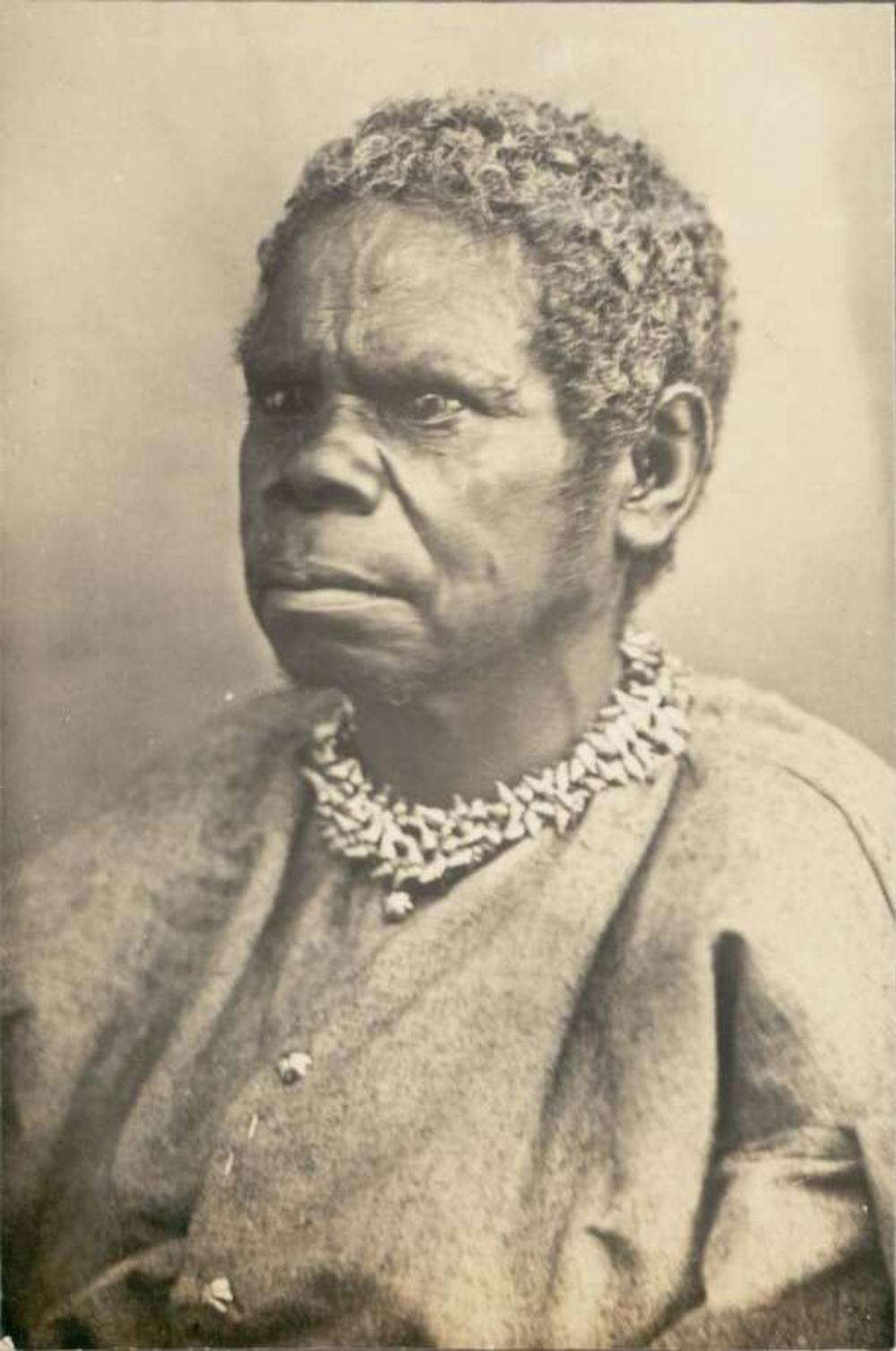
In 1839, George Augustus Robinson arrived in Melbourne as Chief Protector of Aborigines for the Port Phillip District, bringing with him a select group of Aboriginal guides from Tasmania, including a woman called Truganini. He could never have foreseen the dramatic and tragic consequence.
Sometime in August 1841, Truganini left Melbourne with her new husband Maulboyheener travelling toward Westernport, working for food and shelter at stations along the way.
On September 4, they were on James Horsfall’s Ballymarang station, where they were joined by their companions, Peevay, his wife Plorenernoopner, and Maytepueminer, wife of their friend Lacklay who had gone missing. All five were on a mission to find out what had happened to Lacklay, last heard of heading into Lower Westernport in May 1840.

Negotiating the mangroves at the top of Westernport was torturous. The Koo-Wee-Rup Swamp spread for miles to the north and east making it near impossible to find a way through. Truganini and her companions were obliged to make a wide detour around it to find higher ground, where they followed the course of the Lang Lang River to the coast, where massive tide fluctuations had created an extensive inter-tidal zone providing a rich harvest of scallops, mussels, oysters, abalone, limpets, marine worms, crabs and burrowing shrimp.
Despite the evidence of long-standing occupation in the exposed shell middens, the place was empty. When Samuel Anderson and Robert Massie first sailed from Launceston to the eastern shores of Westernport in 1835, they had found the Boonwurrung owners had been extinguished by the cumulative effect of encroachments from Van Diemen’s Land, endemic warfare with the Kurnai from Gippsland and attacks by sealers who “stole” women, all compounded by epidemic disease.
On September 15, Anderson and Massie became aware that Truganini, Maulboyheener, Peevay, Plorenernoopner and Maytepueminer had established camp on their pastoral lease on the Bass River. The two squatters knew members of the group very well from their time working for the Van Diemen’s Land Company, where Anderson had been a bookkeeper and Massie the engineer. If anyone in Lower Westernport knew what had happened to Lacklay, it would be these two squatters.
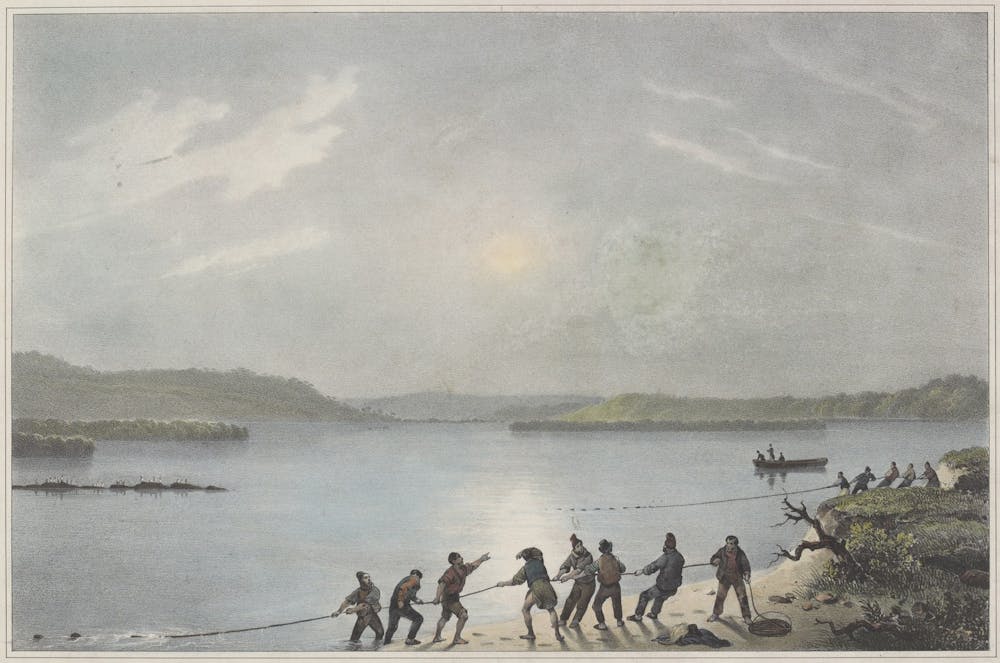
While at Anderson and Massie’s station, the five almost certainly heard the same information they’d given to Assistant Protector William Thomas when he had come looking for Lacklay — known to him as Isaac — in the previous year: that he was last seen in the company of settler who lived at the end of Westernport Bay. Further inquiries by Thomas established the man in question was the skipper of a cutter that had sailed away from the far eastern tip of Westernport Bay. On board where a woman and her three children, plus Lacklay and an unnamed German man as the crew.
The night they sailed, a heavy squall had swept in from the Tasman Sea and the boat was presumed to have capsized, with everyone drowned, though no bodies or pieces of wreckage had been recovered. Thomas was not convinced, noting in the margin of his journal “the death of Isaac supposed”.
Thomas was right to have reservations about this narrative of death by drowning. The truth, only established 176 years later, was that the cutter did not capsize, but sailed all the way to the remote whaling port of Kororareka in New Zealand. At the time, there was no conceivable way that anyone in Port Phillip could have known the boat had managed to sail across the Tasman Sea.
Lacklay’s disappearance was left to speculation. A story that made much more sense than drowning was that he had been shot by a settler, a narrative everyone in Port Phillip was familiar with. Truganini and Maulboyheener had heard that version of the story too, and now were in Lower Westernport to investigate.
After a leisurely stay at Anderson and Massie’s run, the five moved off on September 29. They crossed the Powlett River and made camp close to the home of William Watson. He was the sole settler below the Bass River, having very recently arrived with his wife, daughter and son-in-law, Walter Ginman, in May 1841. Watson was employed by a consortium of investors to work the seam of coal that Anderson had discovered. He had sunk a shaft into the coal seam near the mouth of the Powlett River, where he built a rudimentary hut just above the high-water mark.
Watson welcomed Truganini and her friends, giving them tea and sugar and even lending them a kettle. On October 2, the fourth day of their visit, Watson and Ginman departed for the mine, and the five approached the hut and lingered in the yard until Mrs Watson came out to give them some more tea and sugar.
Some time later, the women began to scatter the bark from their shelters and pack up their belongings, while the men went to the hut to return the kettle.
Once the men gained entrance to the hut, the tone of their interactions suddenly shifted. The reasons why would only become clear much later.
Peevay went to look for Watson’s guns, while Maulboyheener took Mrs Watson and her daughter by the shoulders to propel them outside. There Truganini and Maytepueminer pulled them into the bush and pointed them in the direction of safety at Anderson and Massie’s station. Meanwhile, Peevay and Maulboyheener systematically stripped the hut of food staples, blankets, clothing, an axe, two guns and a supply of buckshot. After setting fire to the hut, the five loaded up their plunder and followed the river towards the coast.
Early that evening, Peevay and Maulboyheener lay concealed in the low coastal heath watching Watson and his son-in-law returning from the mine. When the two men came into range, they fired a volley of shots from several guns, hitting Ginman in the calf and slightly wounding Watson in the foot and elbow. Hobbling towards their hut, the two men saw their home was a smouldering ruin and their wives had vanished. It was well after dark when they reached Anderson and Massie’s station and found their wives unharmed. The next day, Massie supplied Watson with a brace of firearms and two of his workers for a search party.
Peevay and Maulboyheener must have known that Watson would come looking for them, and that he would likely shoot them on sight, yet they lingered at the Powlett River mouth for another four days.
Staying low, with the heath to provide cover, the five kept careful watch for Watson’s search party. From a high point on the sand dunes, they had an excellent view of the flat country to the north and east, the direction they knew danger would come from. They managed to avoid detection until the evening of October 5, when Watson caught a glimpse of Maulboyheener standing on a high dune. Several shots were fired, failing to wound Maulboyheener, although a bullet came close enough to make a neat hole in the coat he was wearing.
Alert to the danger from Watson’s party, Truganini’s group failed to notice six unarmed men approaching from the south, walking along the beach to Watson’s mine in the late afternoon on October 6. The six men had walked overland from the whaling station at Lady’s Bay, on Wilson’s Promontory, more than 50 miles away. Two of the whalers, known as Yankee and Cook, had set out to locate the miners while their companions entered the hut to rest. Minutes later, two shots rang out in quick succession.
Maulboyheener and Peevay had each fired, first one then the other, in such quick succession there was no time between to reload with powder and shot. Having seen the two men fall, Maulboyheener kept watch from the top of the dune while Peevay, Truganini, Plorenernoopner and Maytepueminer went down to the beach to check the fallen. Lying on the beach were two men they had never seen before: a shot had hit one in the head, killing him instantly, while the other had entered the second man’s side, leaving him grievously wounded and in agony.
The four returned with this terrible information to Maulboyheener, who pulled up a couple of strong tree roots and went alone to the beach to dispatch the wounded stranger with heavy blows to the back of his head. Watching from above, the three women cried in distress.
They were not the only ones watching. Having been woken by the gunshots, two more whalers, Robbins and Evans, stepped outside the hut to look about. They saw a party of four or five people, with what looked like two guns visible on a high dune some 200 yards away. The whalers could not distinguish whether these figures were male or female, but they observed some of the group going down to the beach, leaving a person with a gun watching from above. When they returned, the one who had been watching went down to the beach alone.
Believing they had seen a group of miners hunting birds or kangaroos, Robbins and Evans concluded there was no reason to be alarmed and went back inside to sleep. Waking about an hour later, Evans was disturbed to see his companions Yankee and Cook had not returned. This time he went to search for them. He was a few yards from the hut when Watson’s search party materialised, with their guns aimed right at him. Evans talked quickly and established that none of these men had fired the shots he’d heard earlier.
Alarmed, he enlisted Watson’s party to help search for Yankee and Cook and found their bodies on the beach, their blood staining the sand. Yankee was already cold, with a bullet wound behind his ear. Cook had a deep wound in his side and had been bludgeoned on the back of his head.
It was another six weeks before the five were captured before dawn on November 20, in the coastal heath just south of the murder site. The search party was led by Land Commissioner Frederick Armand Powlett, after whom the river was named. It was comprised of 18 soldiers and policemen, reinforced by four settler volunteers with seven Kulin men as trackers.
Once caught, Truganini, Peevay and Maulboyheener were taken by Powlett to point out the exact place of the murders. On locating the spot, Truganini explained only one shot had been fatal and Maulboyheener had used sticks to beat the wounded man’s head.
“What could make you do it?” Powlett demanded. “We thought it was Watson,” Maulboyheener volunteered, and then fell silent.
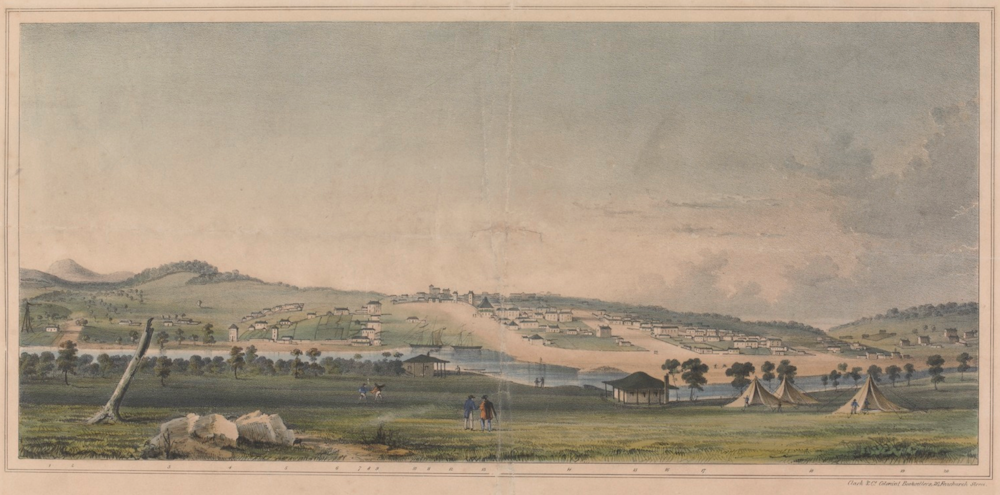
Truganini and her companions arrived in Melbourne in chains on November 26. They were taken to the watchhouse, where committal proceedings commenced almost straightaway. Statements were taken from the whaler Evans, from Watson and his wife, from Powlett and members of the search party.
When the display of damning evidence concluded, Maulboyheener made a garbled attempt at a defence. Watson had tried to kill him, he explained, and when he saw the whalers he thought it was Watson and had fired his gun.
On December 2, Robinson and the Methodist minister Reverend Joseph Orton went to speak with the accused men. Peevay remained silent, but Maulboyheener gave an explanation for their otherwise inexplicable actions. Both Robinson and Orton separately recorded in their journals how Maulboyheener explained that James Horsfall of Ballymarang station had told them Watson had in fact killed their friend Lacklay. The men were sentenced and publicly hanged on January 20, 1842.
Edited extract from Truganini: journey through the apocalypse by Cassandra Pybus, published by Allen & Unwin.
Cassandra Pybus, Adjunct Professor in History, University of Tasmania
This article is republished from The Conversation under a Creative Commons license. Read the original article.

 At the BookShelf

You must be logged in to post a comment.