Review: Richard Flanagan, The Living Sea of Waking Dreams (Penguin Random House, 2020)
The Living Sea of Waking Dreams, Richard Flanagan’s eighth novel, is one of a slew of novels one expects to emerge from the shadow of the 2019–2020 bushfire season that darkened the skies of eastern Australia for weeks on end, scorching forests from Byron Bay to Kangaroo Island.
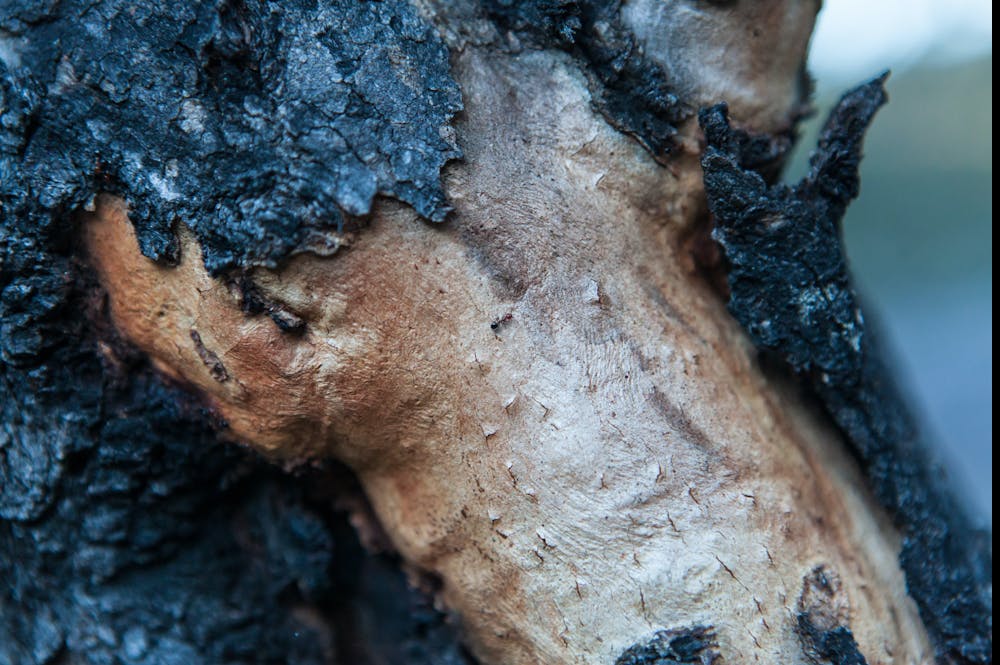
A rolling incineration of large swathes of the continent, the sky itself seemed to have been on fire, from the uncanny pink-disk sun of smoke-choked Sydney in November and December to the apocalyptic scenes at Mallacoota on New Year’s Eve.
In Flanagan’s novel the collapse of the planet’s ecosystems happens in the background. The story itself is mainly occupied with something which must be trivial by comparison: the dying of 87-year-old Francie in a Hobart hospital.
Francie’s three children have come together to deal with the demands of the situation. While Anna and Terzo have long left Tasmania behind them (or so they thought) for high-flying careers on the mainland, Tommy has remained. Tommy is a failed artist and speaks with a stutter that appeared when a fourth child, Ronnie, died by suicide following abuse suffered at a Marist boys’ school.
The novel mainly follows Anna. A successful architect living in Sydney, she reluctantly answers Tommy’s call to return to Tasmania when their mother’s health turns for the worse. The novel traces the breaking down of all the things Anna has put up to convince herself she was no longer in that place.
In the face of a scarred country, Anna must return home and face the scars of her family. Photoholgic/Unsplash
What place? Not Tasmania, but the invisible, traumatic centre of family life — all the failures, evasions, dirty compromises swept under the carpet only to reappear with surprising exactitude each Christmas.
While Succession, with its ageing mogul patriarch Logan Roy, is loosely based on the Murdoch dynasty, it does not really depend on a media empire at stake. Its heart is the tawdry machinations of the infantilised children as they jockey for advantage, trying to win the game of imaginary approval driving sibling rivalry.
In The Living Sea of Waking Dreams it is a matriarch rather than a patriarch slowly, messily and unevenly passing out of the world. Yet, while Logan Roy is a monster and Francie a saint, the effect in the adult children is exactly the same.
The brilliance of Flanagan’s story and the deep power of this novel is in our witnessing of the end of the world. The death of Francie opens up a black hole in the family drawing Anna, Terzo and Tommy into its implacable singularity.
What does it mean to face personal grief when the world is ending? Charles G/Unsplash
At the same time as this family’s little world is collapsing, the world itself is in its own end times. Ash rains down from the sky and one ecological catastrophe after another interrupts Anna’s social media feed. This conjunction presents a new form of what is called the pathetic fallacy, in which we project the world of our inner emotions and moods onto the natural world.
A sullen sky, a bright morning, a funereal forest — some basic animism in us takes the world to be the sounding board of our affects. It is a symptom of the Anthropocene these affinities have become planetary.
Is Flanagan’s novel an ecological novel? The luxury of choosing has now all but gone.
We no longer have to turn our minds to an ecology forcing itself into our lungs and washing up on our every shore. The novel has a dimension of allegory, but it is no longer clear which direction it is flowing.
Our missing parts
The pathetic fallacy was thought to serve the psychic needs of people by offering them a consoling mirror in the natural world, but what if its true point was to turn our subjective misery into ethical environmental action?
Certainly, the moribund Francie seems an emblem of a dying maternal nature. The ever greater efforts her children expend on keeping her alive evoke the desperate rear-guard actions to prevent this or that catastrophe.
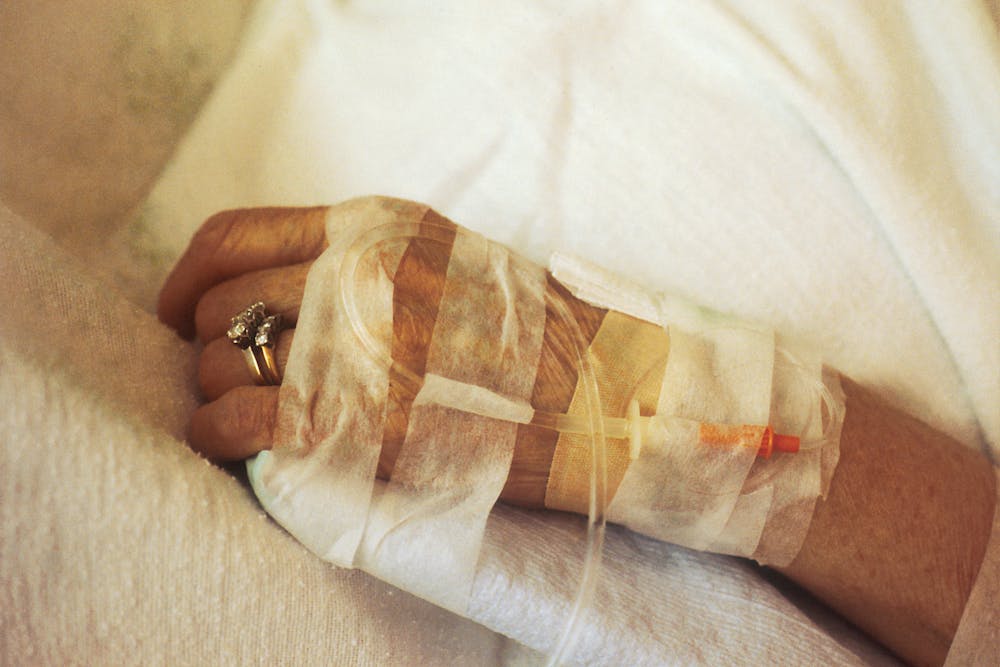
The children attempt ever greater efforts to keep their mother with them. National Cancer Institute/Unsplash
But the novel’s most persuasive ploy is not based on the redeployment of sympathy. At regular intervals, Anna realises she is missing a body part. It begins with a missing finger. Later her knee, then a breast, an eye. Others, too, start to lose body parts.
These “vanishings”, as they come to be known, are entirely painless and seem to go almost unnoticed. It is as if, we are told, they have simply been photoshopped away.
The uncanny part is not the loss of the limb, but the fact the phenomenon is going unremarked. This is what extinction feels like. Something is gone that was once there. We are briefly confused, but then we reassemble the picture and push on.
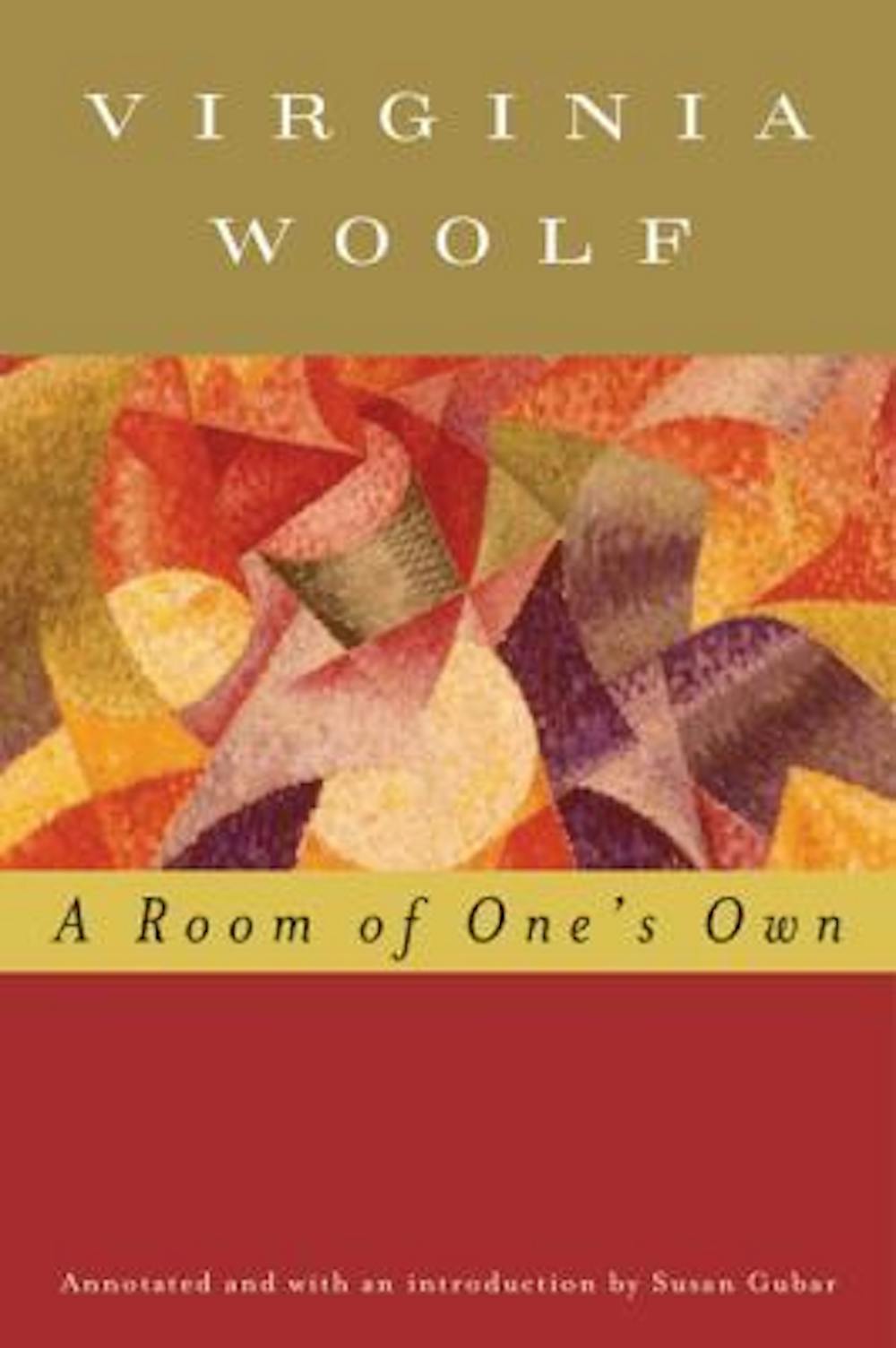
I sit at my kitchen table to write this essay, as hundreds of thousands of women have done before me. It is not my own room, but such things are still a luxury for most women today. The table will do. I am fortunate I can make a living “by my wits,” as Virginia Woolf puts it in her famous feminist treatise, A Room of One’s Own (1929).
That living enabled me to buy not only the room, but the house in which I sit at this table. It also enables me to pay for safe, reliable childcare so I can have time to write.
It is as true today, therefore, as it was almost a century ago when Woolf wrote it, that “a woman must have money and a room of her own if she is to write fiction” — indeed, write anything at all.
Still, Woolf’s argument, as powerful and influential as it was then — and continues to be — is limited by certain assumptions when considered from a contemporary feminist perspective.
Woolf’s book-length essay began as a series of lectures delivered to female students at the University of Cambridge in 1928. Its central feminist premise — that women writer’s voices have been silenced through history and they need to fight for economic equality to be fully heard — has become so culturally pervasive as to enter the popular lexicon.
Julia Gillard: the title of her new podcast references Woolf’s book. Brendan Esposito
Even the Bechdel-Wallace test, measuring the success of a narrative according to whether it features at least two named women conversing about something other than a man, can be seen to descend from the “Chloe liked Olivia” section of Woolf’s book. In this section, the hypothetical characters of Chloe and Olivia share a laboratory, care for their children, and have conversations about their work, rather than about a man.
Woolf’s identification of women as a poorly paid underclass still holds relevance today, given the gender pay gap. As does her emphasis on the hierarchy of value placed on men’s writing compared to women’s (which has led to the establishment of awards such as the Stella Prize).
In her book, Woolf surveys the history of literature, identifying a range of important and forgotten women writers, including novelists Jane Austen, George Eliot and the Brontes, and playwright Aphra Behn.
In doing so, she establishes a new model of literary heritage that acknowledges not only those women who succeeded, but those who were made invisible: either prevented from working due to their sex, or simply cast aside by the value systems of patriarchal culture.
To illustrate her point, she creates Judith, an imaginary sister of the playwright Shakespeare.
What if such a woman had shared her brother’s talents and was as adventurous, “as agog to see the world” as he was? Would she have had the freedom, support and confidence to write plays? Tragically, she argues, such a woman would likely have been silenced — ultimately choosing suicide over an unfulfilled life of domestic servitude and abuse.
In her short, passionate book, Woolf examines women’s letter writing, showing how it can illustrate women’s aptitude for writing, yet also the way in which women were cramped and suppressed by social expectations.
She also makes clear that the lack of an identifiable matrilineal literary heritage works to impede women’s ability to write.
Indeed, the establishment of those major women writers in the 18th and 19th centuries (George Eliot, the Brontes et al), when “the middle-class woman began to write” is, Woolf argues, a moment in history “of greater importance than the Crusades or the War of the Roses”.
Male critics such as T.S. Eliot and Harold Bloom have identified a (male) writer’s relation to his precursors as necessary for his own literary production. But how, Woolf asks, is a woman to write if she has no model to look back on or respond to?
If we are women, she wrote, “we think back through our mothers”.
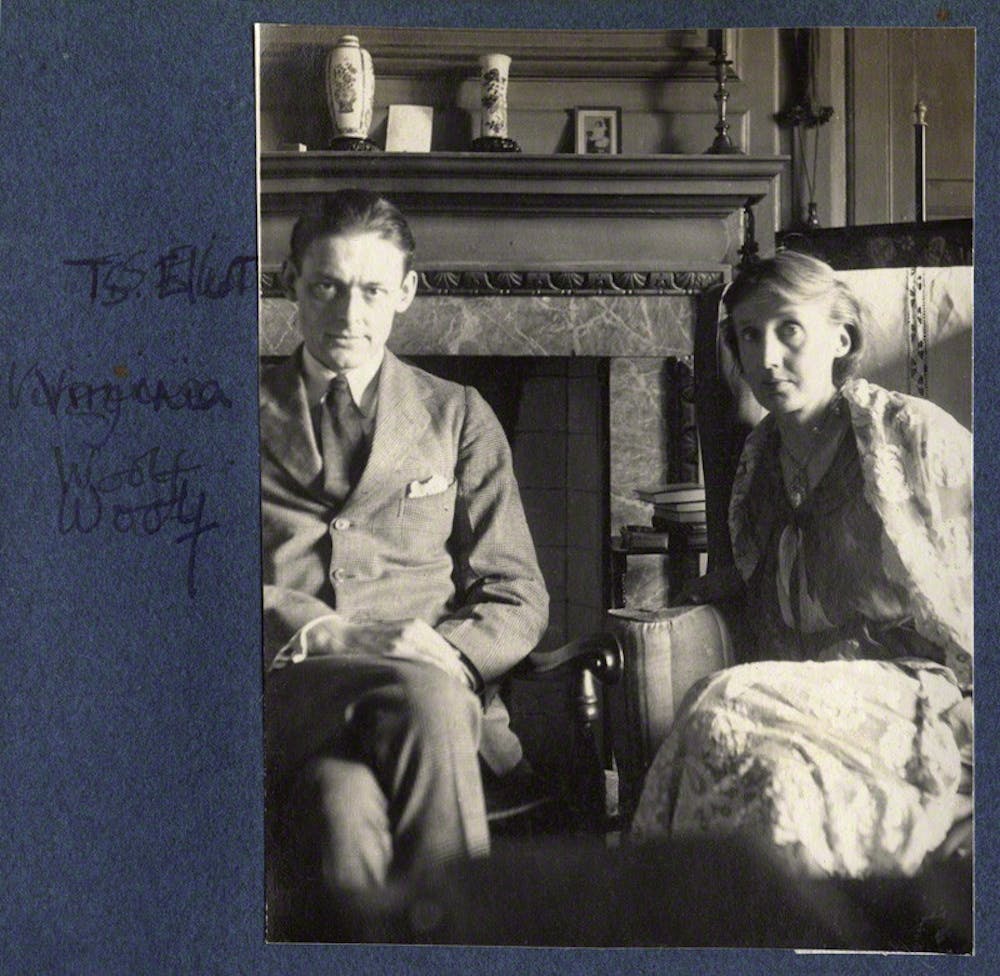
A vintage snapshot of T. S. Eliot and Virginia Woolf taken in 1924. Wikimedia Commons
Her argument inspired later feminist revisionist work of literary critics like Elaine Showalter, Sandra K. Gilbert and Susan Gubar who sought to restore the reputation of forgotten women writers and turn critical attention to women’s writing as a field worthy of dedicated study.
All too often in history, Woolf asserts, “Woman” is simply the object of the literary text — either the adored, voiceless beauty to whom the sonnet is dedicated or reflecting back the glow of man himself.
Women have served all these centuries as looking-glasses possessing the magic and delicious power of reflecting the figure of man at twice its natural size.
A Room of One’s Own returns that authority to both the woman writer and the imagined female reader whom she addresses.
Stream of consciousness
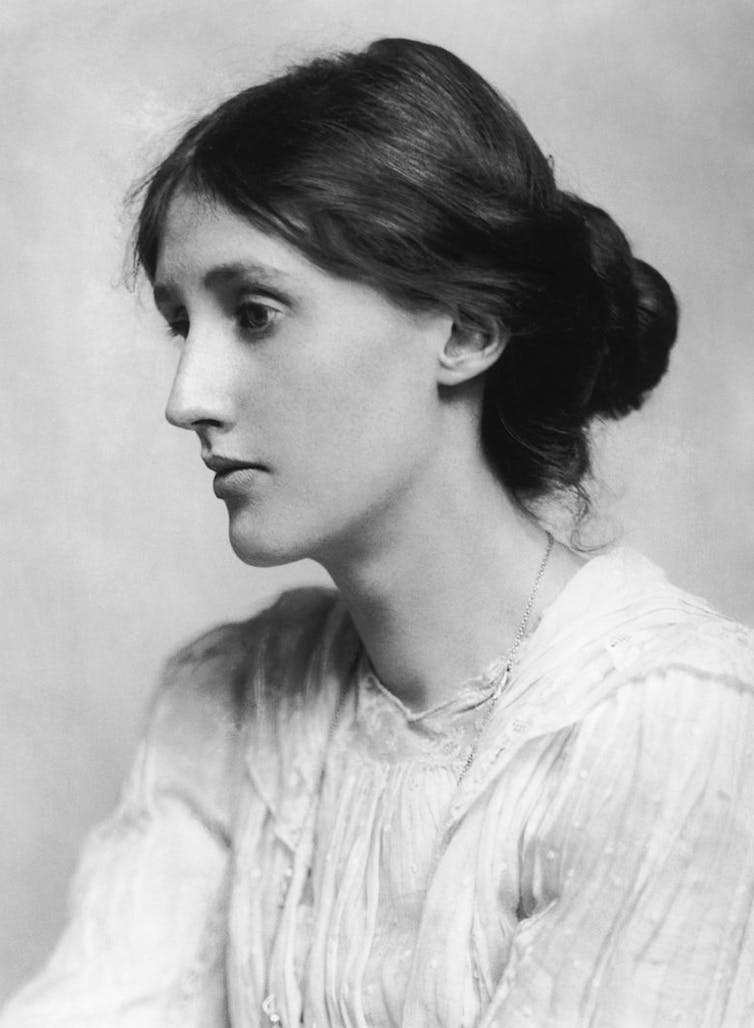
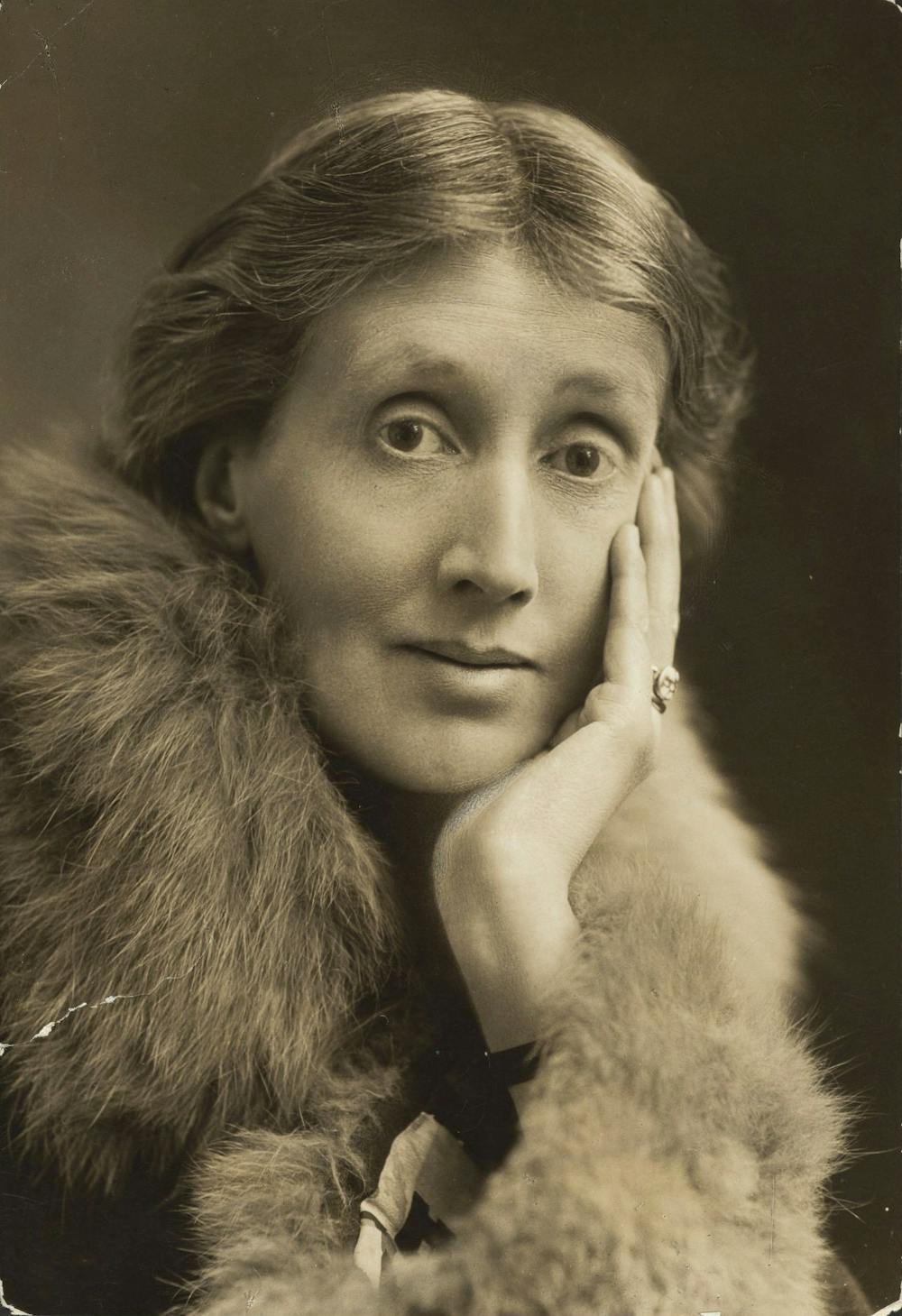
Virginia Woolf in 1927. Wikimedia Commons
A Room of One’s Own also demonstrates several aspects of Woolf’s modernism. The early sections demonstrate her virtuoso stream of consciousness technique. She ruminates on women’s position in, and relation to, fiction while wandering through the university campus, driving through country lanes, and dawdling over a leisurely, solo lunch.
Critically, she employs telling patriarchal interruptions to that flow of thought.
A beadle waves his arms in exasperation as she walks on a private patch of grass. A less-than-satisfactory dinner is served to the women’s college. A “deprecating, silvery, kindly gentleman” turns her away from the library. These interruptions show the frequent disruption to the work of a woman without a room.
This is the lesson also imparted in Woolf’s 1927 novel To the Lighthouse where artist Lily Briscoe must shed the overbearing influence of Mr and Mrs Ramsay, a couple who symbolise Victorian culture, if she is to “have her vision”. The flights and flow of modernist technique are not possible without the time and space to write and think for herself.
A Room of One’s Own has been crucial to the feminist movement and women’s literary studies. But it is not without problems. Woolf admits her good fortune in inheriting £500 a year from an aunt.
Indeed her purse now “breed(s) ten-shilling notes automatically”.
Woolf was lucky enough to possess a purse that bred ten-shilling notes. Wikimedia Commons
Part of the purpose of the essay is to encourage women to make their living through writing.
But Woolf seems to lack an awareness of her own privilege and how much harder it is for most women to fund their own artistic freedom. It is easy for her to advise against “doing work that one did not wish to do, and to do it like a slave, flattering and fawning”.
In her book, Woolf also criticises the “awkward break” in Charlotte Bronte’s Jane Eyre (1847), in which Bronte’s own voice interrupts the narrator’s in a passionate protest against the treatment of women.
Here, Woolf shows little tolerance for emotion, which has historically often been dismissed as hysteria when it comes to women discussing politics.
A Room of One’s Own ends with an injunction to work for the coming of Shakespeare’s sister, that woman forgotten by history. “So to work, even in poverty and obscurity, is worthwhile”.
Such a woman author must have her vision, even if her work will be “stored in attics” rather than publicly exhibited.
The room and the money are the ideal, we come to see, but even without them the woman writer must write, must think, in anticipation of a future for her daughter-artists to come.
An adaptation of A Room of One’s Own is currently at Sydney’s Belvoir Theatre.








 At the BookShelf
You must be logged in to post a comment.