The Booker Prize has been Britain’s most influential award since its inception in 1969. Following its original mission statement of awarding a prize to “the best novel in the opinion of the judges”, the prize has created headlines and controversy over five decades, including argument over the inclusion of American authors after 2014. But it has also, and surely most importantly, rewarded writers, brought them to increasing public attention, and ensured them both critical acclaim and higher sales.
Past Booker winners are now on both school and university curricula, enriching the traditional canon of literature that all too often focuses on male, white and (upper) middle class writing that is no longer in keeping with the times. The prize has also spawned some important spin-offs, most prominently the Man Booker International Prize, first awarded in 2005 that has, over the past few years, evolved into a prize that awards both international writers and, uniquely, their translators.
In February 2017, following on from the success of previous special anniversary prizes, the Man Booker foundation launched the Golden Man Booker Prize to celebrate the prize’s 50th anniversary. Rather than having to (re)read all 51 winners, the five appointed judges – writer Robert McCrum, poet Lemn Sissay, novelist Kamila Shamsie, broadcaster and writer Simon Mayo, and poet Hollie McNish – were each allocated one decade of prize winners and tasked with identifying what they thought was the outstanding winner of those particular years. The shortlist was announced at a special event at the Hay Festival on May 26. The winner of the Golden Booker will be announced on July 8. So who’s in the running?
1970s
For Robert McCrum, the outstanding text of the 1970s winners was V S Naipaul’s In a Free State. It tells the story of two British people, Bobby and Linda, travelling across an unnamed African country in the midst of an ethnic war that suggests the Uganda of the Idi Amin years. Despite their privileged position as members of the white colonial class, Bobby and Linda come to experience firsthand the escalating violence in the country.
McCrum, in his summary of why he chose the text, explained that it was:
Outstandingly the best novel to win the Booker Prize in the 1970s, a disturbing book about displaced people at the dangerous edge of a disrupted world that could have been written yesterday, a classic for all seasons.
1980s
Lemn Sissay chose Penelope Lively’s often overlooked 1987 winner Moon Tiger, surprisingly ignoring Booker heavyweights such as Rushdie’s Midnight’s Children (1981), Thomas Keneally’s Schindler’s List (1982) or Kazuo Ishiguro’s The Remains of the Day (1989).
Moon Tiger tells the story of Claudia Hampton, who recounts her colourful life as she lies dying, covering much of the 20th century in the process. Hampton is a fascinating heroine: not quite likeable, yet immensely intriguing and fascinating, and it was this that was most remarkable for Sissay.
1990s
The 1990s novel that stood out for Shamsie was Michael Ondaatje’s The English Patient (1992). Ondaatje shared the prize with Barry Unsworth’s slave narrative Sacred Hunger – one of only two cases of a divided jury in the prize’s history. Set in Florence at the end of World War II, the novel recounts the life of a badly burnt soldier, who relives his ill-fated love affair with the married Katherine Clifton for his three companions: the spy Caravaggio, who administers morphine to the patient; his nurse Hana; and the Sikh bomb disposal expert Kip.
Ondaatje’s novel, turned into an award-winning film starring Ralph Fiennes, has always been considered one of the most high-profile winners of the award. For Shamsie, this is entirely justified: it is “that rare novel which gets under your skin and insists you return to it time and again, always yielding a new surprise or delight.”
2000s
Mayo’s outstanding winner was Hilary Mantel’s Wolf Hall of 2009, the first in a planned trilogy of Tudor novels. It charts the rise to power of Thomas Cromwell at the court of Henry VIII. Its sequel, Bring Up the Bodies, won the Man Booker Prize in 2012, making Mantel one of only three authors – alongside Peter Carey and J M Coetzee – and to date the only woman to have won the award twice.
The final instalment of the trilogy – The Mirror and the Light – is highly anticipated and scheduled for publication in 2019. What stood out for Mayo in his choice was “its questioning of what England is” – a question that is, despite the novel’s historical setting, surely pertinent in the present.
2010s
It is the most recent Man Booker Prize winner, George Saunders’ Lincoln in the Bardo of 2017, that was the most outstanding recent novel for McNish. The novel covers a single night, set in a graveyard where a grieving Abraham Lincoln mourns the death of his young son Willie. Featuring a plethora of diverse voices, Lincoln in the Bardo explores ideas of life, death and mourning in a way that, according to McNish, was simultaneously “funny, imaginative and tragic” as well as “a piece of genius in its originality of form and structure”.
Narrowing down 51 Man Booker Prize winners from five decades to a shortlist of five is a herculean task. What makes this shortlist remarkable for me is its absence of the “big” winners, the ones that are most often associated with the prize: Ishiguro, Rushdie, Keneally, Coetzee, Martell. Maybe the judges tried to steer clear of them precisely because they have had so much coverage in the past.
2018’s shortlist is very varied – historical narratives, fictional biographies, explorations of war and genocide all feature. For the judges of each decade’s “best” winner, it was a very personal decision; as it will have been for the members of the public who have voted for their favourite of the five shortlisted texts.
What do I think will happen? I’m hesitant to say … but rather than truly judging “the best” of the Booker winners, perhaps 2018’s special award will reward that novel that still manages to best capture the public mood.
Is it a coincidence that J.K. Rowling studied French and Classics? Or that Shakespeare wrote passages of dialogue in Welsh and French, suggesting that he was conversant in both? To write successfully in your first language, it can help if you know a second – it is one way of seeing the world from another perspective and making comparisons, which is after all what literature is all about. But what of writers of contemporary literary fiction?
Researchers on the Open World Research Initiative at Swansea University have investigated the nearly 300 novels that have made the Booker shortlist since 1969 to find out. And as we await the announcement of the readers’ choice of the “Golden Booker” on July 8, which will name the winning novel from the history of the Man Booker prize that has “best stood the test of time”, their initial findings throw up a disturbing recent trend that language awareness is decreasing among British-born writers.
The ability of authors to understand another language gets ignored in surveys of the Booker Prize – multiple times. If a writer’s English is inflected by Australian, South African or Canadian roots, these origins are duly noted by literary journalists. Why not language background too? Language-switchers who grew up in the former British Empire are not the only multilinguals to watch out for on the Booker shortlists. Some of their British-born counterparts also learnt a second language, which influenced their writing in similar ways: their choice of subject matter and how they expressed themselves.
The second language of writers on the shortlists is nearly always European, with French firmly in first place (more than 20 speakers among the 200 writers who have been shortlisted for the prize). German, Italian, Spanish and Russian are also well represented, as is Japanese, albeit all in single figures. There is only one identifiable Czech speaker (Tom McCarthy, nominated in 2010 and 2015) but none with Polish.
Spawn of Flaubert
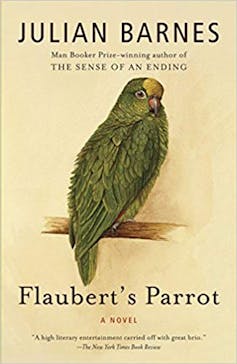
The most famous literary French speaker is probably Julian Barnes, winner in 2011 with The Sense of an Ending. His breakthrough novel Flaubert’s Parrot, which was nominated in 1984 presents a series of takes on the great French novelist assembled by a Francophile narrator. Knowing another language is after all one way to see the world from an alternative point of view. For this reason many writers cut their literary teeth, like Barnes, on foreign-language material or experiences.
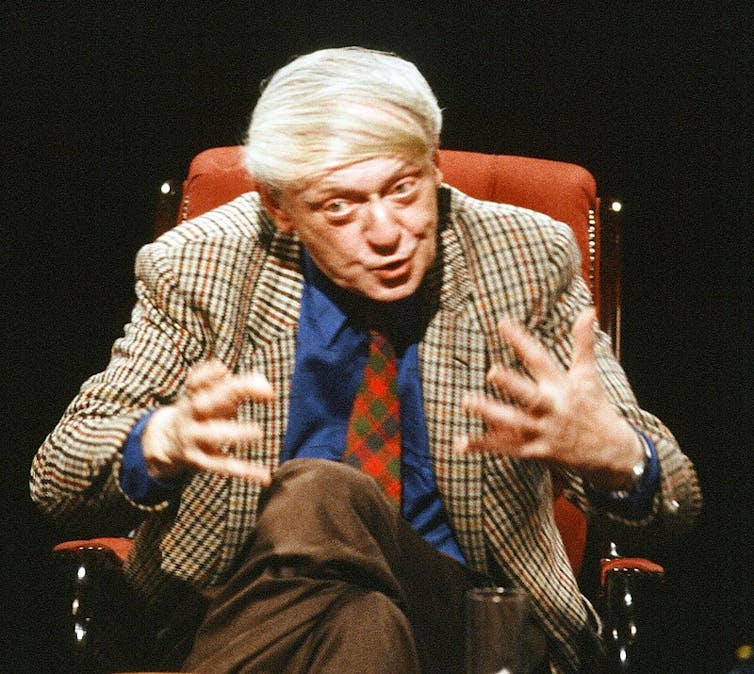
The author Julian Barnes was fluent in French. Amazon
The French Lieutenant’s Woman by John Fowles should have made it to the inaugural shortlist in 1969, but it was The Magus, the original “year-abroad novel” set in Greece, which launched Fowles’ writing career. J.G. Farrell, who studied French and Spanish at university, is famous for his “empire trilogy”, Troubles (named the “lost” Booker Prize winner in 2010), The Siege of Krishnapur (winner in 1973) and The Singapore Grip (1978), but his first novel A Man from Elsewhere (1963) is set in Paris.
In his debut South (1992), the Irish writer Colm Tóibín, who has subsequently been nominated for the Booker three times, was inspired by his own encounter with Barcelona as a young man – which he transfers to a female central character who narrates some of the novel. Switching languages for an author – or anyone – can change who you are in fundamental ways. Canadian author Yann Martel won in 2002 with The Life of Pi, but his first novel Self (1996) merges gender and language identity as the multilingual narrator metamorphoses from man to woman and back again, showing that language identity is bound up with other identities and can be part of the literary imagination.
Early days
The shortlists for the Booker throw up some amazing linguists – but, at least when the British are concerned, their heyday appears to have been in the first two decades of the prize’s existence, the 1970s and 1980s. First prize for language prowess in any era would have to go to Anthony Burgess, on the shortlist in 1980 for Earthly Powers, who invented a new language for the dystopian Clockwork Orange and read and spoke up to ten real ones.
The multilingual Anthony Burgess. Open Media Ltd, CC BY-SA
Burgess was born in 1917, a year after Penelope Fitzgerald, who won the in 1979 for the evocatively entitled Offshore. Three other novels are set in Italy (Innocence, 1986), Russia (The Beginning of Spring, 1988), and Germany (The Blue Flower, 1995), each written as if by a native speaker, except of course in English.
Jewish emigrés were a further force for the internationalisation of British fiction. Sybil Bedford (1911-2006) found herself on the shortlist at the age of 78 with Jigsaw in 1989. Ruth Prawer Jhabvala (1927-2013), who moved to India after the war, where her early fiction is set, won the Booker with Heat and Dust in 1975.
The Cold War also produced some high-profile language learners. Michael Frayn – who was shortlisted in 1999 for Headlong – was taught Russian during his national service, as was DM Thomas, whose White Hotel ran Midnight’s Children a close race for the prize in 1981. Thomas translates Russian poetry and has written a biography of Solzhenitsyn. Frayn’s novels include The Russian Interpreter (1966) – and his play Democracy (2003) was about the fall of Willy Brandt.
Their close contemporary John le Carré was recruited to the secret service on the basis of speaking fluent German, which he learned after running away to Switzerland as a teenager. He has called German his “muse”. But, sadly, genre fiction is not Booker material – and, in any case, le Carré is not keen on literary awards.
The young generation
But what of younger novelists, say those shortlisted since the turn of the millennium? If we limit the field to British writers, then it is getting narrower. Graeme Macrae Burnet made the shortlist in 2016 with His Bloody Project. The Accident on the A35 from 2017 is very much a linguists’ novel about translation and transcription, as is Men in Space – the 2007 novel by the twice-nominated Tom McCarthy which is set in Prague and includes a series of jokes on interlingual miscommunication. Both authors are still under 50.
Philip Hensher, nominated in 2008 for The Northern Clemency, is reticent about his proficiency in German, which came to the fore in his 1998 novel Pleasured which is about the fall of the Berlin wall. Simon Mawer, nominated in 2009 for The Glass Room, lives in Italy. That is more or less it.
People who visit the UK are sometimes struck by how few books are translated into the world’s lingua franca which in all its global variants can seem sufficient to itself. As a culture English monolinguals risk missing out on how near neighbours are representing their experiences to themselves and each other.
Translation takes many forms, however, and mother-tongue English novelists could make up the gap by getting abroad, whether in person or through books, as previous generations were doing up to quite recently.
Six books, six languages, two former winners and a bonanza for independent publishers: the Man Booker International Prize – the UK’s most prestigious prize for translated fiction – has announced its 2018 shortlist. Whittled down from a longlist of 13 titles spanning the globe, the six titles to make the cut are translated from Arabic, French, Hungarian, Korean, Spanish and Polish.
This year’s nominations have been selected by a panel of five judges, chaired by novelist Lisa Appignanesi with fellow writers Hari Kunzru and Helen Oyeyemi alongside poet and translator Michael Hofmann and journalist Tim Martin. The shortlist includes Han Kang and Deborah Smith – who won the prize in 2016 for The Vegetarian – and László Krasznahorkai – who won the prize in its former iteration in 2015 – when it was awarded for an achievement in fiction evident in a body of work.
The winner of the 2018 prize will be announced on May 22 at a formal dinner at the Victoria & Albert Museum in London – and the £50,000 prize will be divided equally between the author and the translator of the winning book.
The Booker Prize Foundation has rejigged the flagship award in recent years. An awful lot of handwringing has been devoted to the decision to include US authors as contenders for the “main” award, The Man Booker Prize. But very little attention has been paid to the decision to overhaul the group’s international prize. Originally introduced in 2005, the Man Booker International Prize was intended as a global-facing sister award – with a twist. The original version of the International prize was a biennial award honouring an entire body of work by a living writer of any nationality and in any language (as long as their work was available in English).
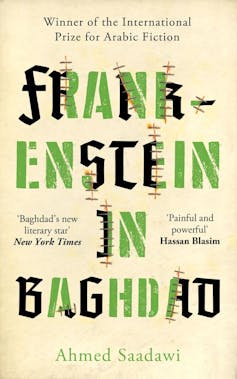
Ahmed Saadawi has been shortlisted for his award-winning book, Frankenstein in Baghdad. Man Booker International Prize
The original format was a noble pursuit, but the Man Booker International was inevitably overshadowed on the global literary stage by the Nobel Prize for Literature. As of 2016, the Man Booker International Prize now awards a single book – but one that has been originally written in a language other than English, then subsequently translated and published in the UK.
The International Prize’s unique selling point is the emphasis on collaboration between author and translator, even down to sharing the prize money. The focus on collaboration is what makes the International Prize, for me, a truly exciting event in the literary awards calendar.
Focus on translation
Arguably, the change has been for the better but the comparative lack of attention on the international award is still indicative of mainstream publishing’s general disinterest in translated fiction – bar the occasional bestselling “Scandi Noir” and international phenomenon such as Italy’s Elena Ferrante, of course, the latter shortlisted for the prize in 2016, along with translator Ann Goldstein.
Although we shouldn’t be tempted to see the commercial popularity of Jo Nesbø and the relative success of Ferrante as a sea change in translated fiction’s fortunes in UK publishing, there are reasons to be cautiously optimistic. Adam Freudenheim of Pushkin Press suggests that “there’s definitely greater and wider awareness of fiction in translation as a result of such successes”, pointing to the new format of the Man Booker International Prize as “doing a great deal to raise the profile of such books”.
Small publishers to the fore
Crucially, the prize is raising the profile of those small presses and independent publishers who are at the vanguard of translated literature. As well as the aforementioned Pushkin Press, notable small publishers specialising in translated literature include Tilted Axis Press and And Other Stories. This year’s shortlist is dominated by titles from independent presses, including two books from Tuskar Rock Press, and one each from MacLehose Press, Portobello Books, Oneworld and Fitzcarraldo Editions.
The role of independent publishers in supporting translated literature is not lost on the judges for the International Prize: announcing the longlist earlier this year, Appignanesi declared: “I think we have to raise our hats to independent publishers. It does cost money to translate, it’s harder to publish, harder to sell.”
The International Prize has even had a direct impact on the range of translated literature available in the UK: Kang and Smith’s inaugural win in 2016 for The Vegetarian meant that Smith had extra funds for her non-profit small press, Tilted Axis – which is “on a mission to shake up contemporary international literature”.
Translated fiction may be a small part of the British reading diet but it is one that is steadily growing. In 2015, The Bookseller reported that translated fiction only accounted for 1.5% overall and 3.5% of published literary fiction. Yet translated fiction provided 5% of total fiction sales in 2015.
Only time will tell if the appetite for translated fiction in the UK can continue. In the meantime, let’s toast the shortlisted authors and translators. If you’ve yet to enjoy translated fiction, this year’s shortlist is a good place to expand your global reading life.


 What do I think will happen? I’m hesitant to say … but rather than truly judging “the best” of the Booker winners, perhaps 2018’s special award will reward that novel that still manages to best capture the public mood.
 Translation takes many forms, however, and mother-tongue English novelists could make up the gap by getting abroad, whether in person or through books, as previous generations were doing up to quite recently.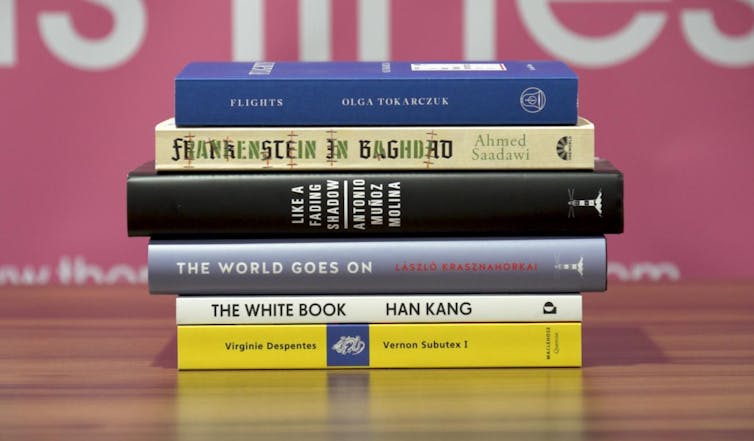
 Only time will tell if the appetite for translated fiction in the UK can continue. In the meantime, let’s toast the shortlisted authors and translators. If you’ve yet to enjoy translated fiction, this year’s shortlist is a good place to expand your global reading life.
 At the BookShelf
You must be logged in to post a comment.