
Unknown's avatar

Philip Ochieng: Kenyan editor and author who did it his way and inspired a generation


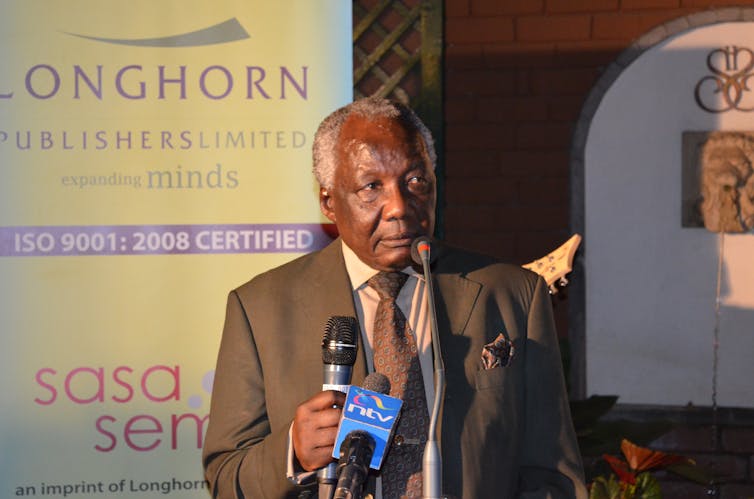
Philip Ochieng, the Kenyan journalist who made his mark across East Africa.
Author provided

Elizabeth Gitonga, Moi University

Philip Ochieng – who has died at the age of 83 – was a celebrated Kenyan editor, author and hard-hitting columnist who made his mark across East Africa. He was an East African par excellence who counted former Tanzanian president Benjamin Mkapa and revered Ugandan academic Mahmood Mamdani among his circle of friends.

Ochieng began his journalism career in 1966 when he joined the Nairobi-based Nation newspaper group, which was then only a few years old, at the invitation of then editor-in-chief George Githii. Within a year he was entrusted with a regular column debating the social, political and economic issues of a country that had gained independence from Britain only a few years earlier in 1963.

Mastering his environment in such a short space of time was typical of Ochieng. In Awendo, Migori County, close to Lake Victoria where he was born in 1938, his classmates remembered him as a genius who topped his class from the time he set foot in primary school. This fast-tracked him to the prestigious Alliance High School, a national school for high achievers near Nairobi.

Soon after he finished school, he joined the pre-independence airlift of young Kenyan students to the US. These students were being prepared to take over positions of leadership in anticipation of the country’s independence. The programme was organised by the former politician and trade unionist Tom Mboya and his colleague Julius Kiano.

In the US, Ochieng joined Roosevelt University but he did not complete his degree. He moved on to France and East Germany as well but he never graduated with a degree. On the eve of independence, Ochieng returned home, where he was employed as an English teacher in Migori. Later, he would be employed as a protocol officer in the ministry of External Affairs. While here, the letters he wrote to the editor of the Daily Nation caught the attention of Githii, who hired him as a cub reporter. This would mark the beginning of his life-long journey in journalism, which took him back and forth between Kenya, Tanzania and Uganda.

East Africa reach

Ochieng emerged as a towering figure in the three East African countries. His brilliance was matched only by his willingness to mentor young journalists in the profession, many of them untrained as he had been. Wherever he worked, he helped many improve their writing skills through constant drilling – but also straight in your face memos delivered in his stern newsroom manner.

In the course of this, Ochieng wrote two books. The first, The Kenyatta Succession, was co-authored with fellow journalist the late Joseph Karimi. The second was I Accuse the Press: An Insider’s View of the Media and Politics in Africa.

But he was dogged by controversy in his early years. In 1970 he was forced to resign his Nation job after poking a colleague with the burning end of a cigarette.

He was then already being wooed by the Tanganyika Standard after President Julius Nyerere had nationalised it from its private owners, Lonrho. The Standard Tanzania, as it was first renamed, was merged with The Nationalist, a party newspaper belonging to the ruling Tanzania African National Union party. The title was later changed to Daily News in 1972.

Ochieng made his presence felt as soon as he arrived in Dar es Salaam, beginning a column weekly soon after. He resigned and left Tanzania in 1973.

After another stint at the Nation in Nairobi, Ochieng appointed the editor of the Sunday Times of Uganda in 1981. But it was short-lived. After only three weeks he was incarcerated after one of his sharp, take-no-prisoners pieces.

Upon release from the cells, he was hosted by his friend Mamdani, who arranged his flight out to East Germany.

Mentor and confidante

Mamdani, who hosted him in Kampala after his release from prison in Uganda, told me of Ochieng’s contribution to journalism:

People who were literate and of age in the 1980s in Uganda certainly remember his role in Ugandan journalism and his writing. I have no doubt that Ochieng would have played a noteworthy role in advancing the cause of political journalism in Uganda had he been able to stay longer.

John Agunda, a Kenyan journalist who worked with Ochieng in Kenya for decades, remembers him too as the mentor of many.

He came across as a very meticulous and creative man and a workaholic. He was always at his typewriter either writing something to go into the following day’s paper or working on his manuscripts. He was also a very good teacher of up-and-coming journalists.

In the final years of his life – and with his poor health beginning to slow him down – Ochieng persisted in his love for teaching. His long running column, Mark My Word, was aimed at the general public as much as it was at journalists.The Conversation

Elizabeth Gitonga, PhD Candidate in Communication Studies, Moi University

This article is republished from The Conversation under a Creative Commons license. Read the original article.

Unknown's avatar

Tipped to win Nobel literature prize, Kenya’s Ngugi misses out — again


Peter Kimani, The Aga Khan University Graduate School of Media and Communications (GSMC)

Kenyan author Ngugi wa Thiong’o was the bookies’ favourite for the second year to win the Nobel prize in literature. But singer songwriter Bob Dylan won it for creating “new poetic expressions within the great American song tradition”. But, as Kenyan academic Peter Kimani tells The Conversation Africa’s Julius Maina, this doesn’t take the sheen off one of Africa’s greatest living writers.

Who is Ngugi wa Thiong’o?

Ngugi wa Thiong’o is regarded as one of Africa’s greatest living writers. He grew up in what became known as Kenya’s White Highlands at the height of British colonialism. Unsurprisingly, his writing examines the legacy of colonialism and the intricate relationships between locals seeking economic and cultural emancipation and the local elites serving as agents of neo-colonisers.

The great expectations for the new country, as captured in Ngugi’s seminal play, The Black Hermit, anticipated the disillusionment that followed. His fiction, from the foundational trilogy of Weep Not, Child, The River Between and A Grain of Wheat, amplify those expectations, before the optimism gives way in Petals of Blood, and is replaced by disillusionment.

What sets Ngugi above and apart from the hundreds of other African writers?

African fiction is fairly young. Ngugi stands in the continent’s pantheon of writers who started writing when Africa’s decolonisation gained momentum. In a certain sense, the writers were involved in constructing new narratives that would define their people. But Ngugi’s recognition goes beyond his pioneering role: his writing resonates with many across Kenya and Africa.

One could also recognise Ngugi’s consistency at churning out high-quality stories about Africa’s contemporary society. This he has done in a manner that illustrates his commitment to equality and social justice.

He has done much more in scholarship. His treatise, Decolonising the Mind, now a foundational text in post-colonial studies, illustrates his versatility. His ability to spin the yarns while commenting on the politics that goes into literary production of marginal literature is a very rare combination.

Finally, one could talk about Ngugi’s cultural and political activism. This precipitated his yearlong detention without trial in 1977. He attributes his detention to his rejection of English and embracing his Gikuyu language as his vehicle of expression.

Which work or works best illustrate his thinking?

It’s hard to pick a favourite from Ngugi’s over two dozen texts. But there is concurrence among critics that A Grain of Wheat, which was voted among Africa’s best 100 novels at the turn of the last century, stands out for its stylistic experimentation and complexity of characters.

Others consider the novel as the last signpost before Ngugi’s work became overly political. For other critics, it’s Wizard of the Crow – which came out in 2004, after nearly two decades of waiting – that encapsulates Ngugi’s creative finesse. It utilises many literary tropes, including magical realism, and addresses the politics of African development and the shenanigans by the political elite to maintain the status quo.

What are Ngugi’s lasting contributions to African literature?

Without a doubt, Africa would be poorer without the efforts of Ngugi and other pioneering writers to tell the African story. He is also an important figure in post-colonial studies. His constant questioning of the privileging of the English language and culture in Kenya’s national discourse saw him lead a movement that led to the scrapping of the Department of English at the University of Nairobi and replaced by the Department of Literature that placed African literature and its diasporas at the centre of scholarship.

Ngugi is still active in writing and his latest offering is the third instalment of his memoir, Birth of a Dreamweaver that looks back on his years at Makerere University in Uganda. This is the period when he published his novels, Weep Not, Child and The River Between, while still an undergraduate. Also at this time he wrote the play, The Black Hermit, which was performed as part of Uganda’s independence celebrations in 1962.

His work has been translated into more than 30 world languages.

Ngugi has appeared on the list of favourites to win the Literature Nobel for a number of years. This was yet another year.

Yes indeed, Ngugi has been among the bookies’ favourite for the past couple of years. But since the workings of the Nobel award committee remain secret —- the list of the committee’s deliberations are kept secret for 50 years —- its choice for this year, the American singer Bob Dylan raises interesting questions about the Nobel committee’s interpretation of artistic production as writing.

As one unimpressed pundit commented on Twitter,

“the idea that Dylan is a greater writer (rather than song versifier) than Philip Roth is, frankly, absurd.”

But author Salman Rushdie, who bookies listed among this year’s possible winners, commented:

“From Orpheus to Faiz, song & poetry have been closely linked. Dylan is the brilliant inheritor of the bardic tradition. Great choice.”

The Conversation

Peter Kimani, Lecturer, The Aga Khan University Graduate School of Media and Communications (GSMC)

This article was originally published on The Conversation. Read the original article.