
The link below is to an article that considers what data is collected from Kindles.
For more visit:
https://goodereader.com/blog/kindle/what-type-of-data-does-amazon-collect-from-kindles

The link below is to an article that considers what data is collected from Kindles.
For more visit:
https://goodereader.com/blog/kindle/what-type-of-data-does-amazon-collect-from-kindles
The link below is to an article that reports on the winner of the 2020 Victorian Prize for Literature.
For more visit:
https://www.booksandpublishing.com.au/articles/2020/01/31/144840/play-counting-and-cracking-wins-100k-victorian-prize-for-literature/
The links below are to articles reporting on the death of author Clive Cussler.
For more visit:
– https://lithub.com/bestselling-author-and-real-life-hemingway-hero-clive-cussler-has-died/
– https://www.theguardian.com/books/2020/feb/26/clive-cussler-novelist-dies-88
The link below is to an article that looks at book collecting and asks, ‘is book collecting a dying art?’
For more visit:
https://blog.bookstellyouwhy.com/is-book-collecting-a-dying-art
Andy Simionato, RMIT University and Karen ann Donnachie, RMIT University
Books are always transforming. The book we hold today has arrived through a number of materials (clay, papyrus, parchment, paper, pixels) and forms (tablet, scroll, codex, kindle).
The book can be a tool for communication, reading, entertainment, or learning; an object and a status symbol.
The most recent shift, from print media to digital technology, began around the middle of the 20th century. It culminated in two of the most ambitious projects in the history of the book (at least if we believe the corporate hype): the mass-digitisation of books by Google and the mass-distribution of electronic books by Amazon.
The survival of bookshops and flourishing of libraries (in real life) defies predictions that the “end of the book” is near. But even the most militant bibliophile will acknowledge how digital technology has called the “idea” of the book into question, once again.
To explore the potential for human-machine collaboration in reading and writing, we built a machine that makes poetry from the pages of any printed book. Ultimately, this project attempts to imagine the future of the book itself.
Our custom-coded reading-machine reads and interprets real book pages, to create a new “illuminated” book of poetry.
The reading-machine uses Computer Vision and Optical Character Recognition to identify the text on any open book placed under its dual cameras. It then uses Machine Learning and Natural Language Processing technology to “read” the text for meaning, in order to select a short poetic combination of words on the page which it saves by digitally erasing all other words on the page.
Armed with this generated verse, the reading-machine searches the internet for an image – often a doodle or meme, which someone has shared and which has been stored in Google Images – to illustrate the poem.
Once every page in the book has been read, interpreted, and illustrated, the system publishes the results using an online printing service. The resulting volume is then added to a growing archive we call The Library of Nonhuman Books.
From the moment our machine completes its reading until the delivery of the book, our automated-art-system proceeds algorithmically – from interpreting and illuminating the poems, to pagination, cover design and finally adding the endmatter. This is all done without human intervention. The algorithm can generate a seemingly infinite number of readings of any book.
The following poems were produced by the reading-machine from popular texts:
deep down men try there
he’s large naked she’s even
while facing anything.
from E.L. James’ Fifty Shades of Grey
how parties popcorn
jukebox bathrooms depressed
shrug, yeah? all.
from Bret Easton Ellis’ The Rules of Attraction
Oh and her bedroom
bathroom brushing sending it
garter too face hell.
from Truman Capote’s Breakfast at Tiffany’s
So what does all this have to do with the mass-digitisation of books?
Faced with growing resistance from authors and publishers concerned with Google’s management of copyright, the infoglomerate pivoted away from its primary goal of providing a free corpus of books (a kind of modern day Library of Alexandria) and towards a more modest index system used for searching inside the books Google had scanned. Google would now serve only short “snippets” of words highlighted on the original page.
Behind the scenes, Google had identified a different use for the texts. Millions of scanned books could be used in a field called Natural Language Processing. NLP allows computers to communicate with people using everyday language rather than code. The books originally scanned for humans were made available to machines for learning, and later imitating, human language.
Algorithmic processes like NLP and Machine Learning hold the promise (or threat) of deferring much of our everyday reading to machines. History has shown that once machines know how to do something, we generally leave them to it. The extent to which we do this will depend on how much we value reading.
If we continue to defer our reading (and writing) to machines, we might make literature with our artificially intelligent counterparts. What will poetry become, with an algorithm as our muse?
We already have clues to this: from the almost obligatory use of emojis or Japanese Kaomoji (顔文字) as visual shorthand for the emotional intent of our digital communication, to the layered meanings of internet memes, to the auto-generation of “fake news” stories. These are the image-word hybrids we find in post-literate social media.
Take the book, my friend, and read your eyes out, you will never find there what I find.
Ralph Waldo Emerson’s Spiritual Laws
Emerson’s challenge highlights the subjectivity we bring to reading. When we started working on the reading-machine we focused on discovering patterns of words within larger bodies of texts that have always been there, but have remained “hidden in plain sight”. Every attempt by the reading-machine generated new poems, all of them made from words that remained in their original positions on the pages of books.
The notion of a single book consisting of infinite readings is not new. We originally conceived our reading-machine as a way of making a mythical Book of Sand, described by Jorge Luis Borges in his 1975 parable.
Borges’ story is about the narrator’s encounter with an endless book which continuously recombines its words and images. Many have compared this impossible book to the internet of today. Our reading-machine, with the turn of each page of any physical book, calculates combinations of words on that page which, until that moment, have been seen, but not consciously perceived by the reader.
The title of our early version of the work was To Hide a Leaf. It was generated by chance when a prototype of the reading-machine was presented with a page from a book of Borges’ stories. The complete sentence from which the words were taken is:
Somewhere I recalled reading that the best place to hide a leaf is in a forest.
The latent verse our machine attempts to reveal in books also hides in plain sight, like a leaf in a forest; and the idea is also a play on a page being generally referred to as a “leaf of a book”.
Like the Book of Sand, perhaps all books can be seen as combinatorial machines. We believed we could write an algorithm that could unlock new meanings in existing books, using only the text within that book as the key.
Philosopher Boris Groys described the result of the mass-digitisation of the book as Words Without Grammar, suggesting clouds of disconnected words.
Our reading-machine, and the Library of Nonhuman Books it is generating, is an attempt to imagine the book to come after these clouds of “words without grammar”. We have found the results are sometimes comical, often nonsensical, occasionally infuriating and, every now and then, even poetic.
The reading-machine will be on display at the Melbourne Art Book Fair in March and will collect a Tokyo Type Directors Club Award in April. Nonhuman Books are available via Atomic Activity Books.
Andy Simionato, Lecturer, RMIT University and Karen ann Donnachie, Independent artist / Lecturer (adjunct), RMIT University
This article is republished from The Conversation under a Creative Commons license. Read the original article.
Readow is a service that recommends books to read via Messenger.
For more visit:
https://betalist.com/startups/readow
readow.ai/
Ok, this link is to a site that claims it is Goodreads for 2020 and apparently can be used alongside Goodreads. What do you think?
For more visit:
https://betalist.com/startups/borges
https://borges.ai
Michelle Coupal, University of Regina
There is a growing body of literature — novels, memoirs, poetry, graphic novels, picture books — through which Indigenous writers are giving voice and agency to the experiences and histories of Indian residential schooling in Canada.
The ethical teaching of residential school narratives can be thought of as a relational process that requires consultation and accountability.
Rather than view residential school literature as primarily concerned with past history, I want to advocate for the importance of teaching these narratives as stories that probe our colonial present and the possibility of a more just future.

Former prime minister Stephen Harper, in his 2008 apology on behalf of Canadians for the Indian residential schools system, put residential schooling firmly in the past by calling it a “sad chapter in our history.” This narrative of pastness allowed Harper to swagger to the aspirational conclusion that “there is no place in Canada for the attitudes that inspired the Indian residential schools system to ever again prevail.”
The policies of assimilation that governed the schools in the past, however, remain in operation today, although in different forms. Gitksan professor Cindy Blackstock, for example, asks of residential schools: “Did they really close or just morph into child welfare?”
Read more:
Canada guilty of forging crisis in Indigenous foster care
And Mi’kmaq lawyer and professor Pam Palmater suggests that “the abuse did not end with the closing of the last residential school in 1996. Today, there are more Indigenous children forcibly removed from their parents and placed into foster care than at the height of the residential school era.”
Following the release in 2015 of 94 Calls to Action by the Truth and Reconciliation Commission of Canada, educators across the country — most of whom are not Indigenous — were tasked with the urgent imperative to bring the history and legacies of residential schooling into the classroom. Many teachers chose to respond through story by teaching residential school literature.
To teach residential school literature (fiction or memoir) is to bring deeply felt, personal stories of capture, imprisonment and cultural erasure into largely non-Indigenous classrooms.
In this context, it’s important to ask:
How can we teach residential school literature in culturally responsive ways?
What do we owe the survivors of residential schooling who have gifted their stories to us?
How do we bring our hearts, minds, bodies and spirits into dialogue with genocide?
In a nutshell, it’s all about relationships: between the reader and the story being told, and between the reader and the Indigenous writers and communities to which we are all accountable.
Building accountability into the practice of reading and teaching these often intensely personal and traumatic stories can be fostered through consultation and engagement with Indigenous communities.
Accountability also requires that we immerse ourselves fully in the material on its own sovereign terms and in all of its depth and complexity. We need to be ethical witnesses, and we need to ask what the stories teach us about our present.
My students created and contributed to a Facebook page, Indian Residential Schools in Canada: Literature, Art, Media over the past years. This page is an example of how to engage students in the material in meaningful ways that promote an ongoing dialogue about truth, reconciliation and colonialism in Canada.
This dialogue is critical, and key to it is that we keep thinking and reading about residential schools in the present day and for the future. These are in many ways stories of our time. It’s the guise that has changed. And without radical decolonization in this country, these are stories of our future.
Last February, one day after the acquittal of Gerald Stanley for the murder of Colten Boushie, Métis writer and author of The Marrow Thieves, Cherie Dimaline, tweeted:
“I wrote a book about Indigenous people being considered not human, being considered ‘things’ at the hands of a colonial Canada. I thought I was writing about a potential future. #justiceforcolten #themarrowthieves @canadareads.”
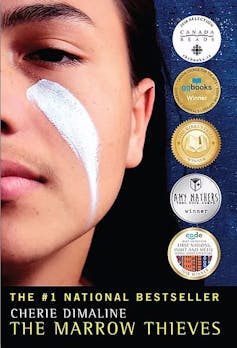
The Marrow Thieves is a young-adult novel set forty years into the future. In the wake of environmental disaster, Indigenous peoples are being captured and sent to residential schools. They are being hunted and killed for their bone marrow, which allows non-Indigenous people, who have all lost their ability to dream, to dream again and, thus, to imagine again.
Cree poet Billy-Ray Belcourt asks, “What is an NDN if not the ceiling of a country’s political imagination?” In The Marrow Thieves, the political ceiling is high.
The limit of the colonial imagination is the cannibalistic harvesting of Indigenous bodies to support non-Indigenous nation-state survival.
There is an inevitability to the narrative arc of the novel that suggests that it is as realistic to imagine a future of ecological devastation as it is to imagine a future of residential schools — a future where Indigenous peoples continue to be hunted down, like Colten Boushie, because they are considered somehow less than human by colonial Canada.
Tanya Talaga’s Seven Fallen Feathers focuses on seven Indigenous young people who went missing and ultimately died in Thunder Bay, Ont.
An inquest into the seven youths’ deaths found that First Nations people in Thunder Bay “are often treated as less than worthy victims” and exposed systemic problems surrounding supports for the youth and responses to their deaths.
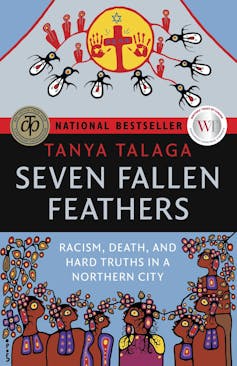
A civilian police review body found in December 2018 that police failed to adequately investigate the deaths of nine Indigenous people in Thunder Bay, including four youths discussed in Talaga’s book, at least in part because of racist attitudes and stereotyping.
The seven fallen feathers were all from communities in northern Ontario. Because of the refusal of the government to adequately fund on-reserve education, Indigenous young people are frequently unable to complete a high-school education in their communities. They must go south, far from their homes, to what is often a hostile and culturally unfamiliar place.
Remember that Thunder Bay is where a young white man, Brayden Bushby, stands accused of second degree murder for allegedly throwing a metal trailer hitch from a moving vehicle at an Indigenous woman, Barbara Kentner, who was simply walking by. She was hospitalized and died from her injuries about six months after being attacked.
The violent deaths of Barbara Kentner and Colten Boushie remind us that in present-day Canada, it’s threatening and even perilous for Indigenous people to walk around.
Talaga’s book reveals the many comparisons between students from remote Northern reserves boarding and attending school in Thunder Bay — far from their communities, far from their families, far from their languages and far from their cultural traditions — and the Indian residential school system.
Talaga thus draws important connections to the assimilative system that stole generations of children to obliterate any traces of their identities as self-determining and self-sustaining peoples with a wealth of languages, knowledge systems and cultural traditions.
Dimaline’s and Talaga’s books teach us that versions of residential schooling exist not only in the present, but also in the future if Canada does not take seriously and implement the United Nations Declaration on the Rights of Indigenous Peoples.
Memoirs and fictions about residential school experiences and legacies are thus necessary readings in neo-colonial Canada. Teaching and reading residential school literature foster richer understandings of present and future colonialisms.
To understand the colonial past is to open the door to understanding the colonial present and future. This understanding is a crucial part of the pathway to real change.
Michelle Coupal, Canada Research Chair in Truth, Reconciliation and Indigenous Literatures and Associate Professor, Department of English, University of Regina
This article is republished from The Conversation under a Creative Commons license. Read the original article.
 At the BookShelf
You must be logged in to post a comment.