In 2018, there were 143,518 library workers in the United States, according to data collected by the Institute of Museum and Library Services. While newer data isn’t available, the number is probably lower now, and recent history suggests more library jobs may be on the chopping block in the near future.
During the Great Recession, the economic downturn between late 2007 and mid-2009, thousands of librarians and other library staff lost their jobs. As local governments cut spending on libraries, the size of that workforce shrank to 137,369 in 2012 from 145,499 in 2008.
Unfortunately, many of the Great Recession’s job losses were never completely overcome. There were about 2,000 fewer library workers in 2018 than in 2008, at the height of the crisis.
Library workers are again losing their jobs despite the important roles that libraries are playing today. According to preliminary data and news coverage collected by the Tracking Library Layoffs initiative, it’s clear that not all of the library workers furloughed since March 2020, when virtually all U.S. libraries were closed amid lockdowns, have been brought back on staff.
There are steps the federal government could take to protect the nation’s libraries.
For example, after Hurricane Katrina in 2005 and Hurricane Sandy in 2012, the Federal Emergency Management Agency recognized libraries among essential services. The federal government has not taken this step so far during the coronavirus pandemic.
Among other things, lacking this designation may have made it more difficult for librarians and other library staff members to get COVID-19 vaccines.
To date, the federal coronavirus relief packages have included a total of about US$250 million to support public libraries. These funds, distributed to state library agencies, amount to approximately $14,304 – about 1.7% of their annual revenue – for each of the nation’s 17,478 library branches and bookmobiles. We suspect that this infusion of cash will fall short of what’s needed to help public libraries and their workers recover from the tumult caused by the COVID-19 pandemic.
[Over 100,000 readers rely on The Conversation’s newsletter to understand the world.Sign up today.]
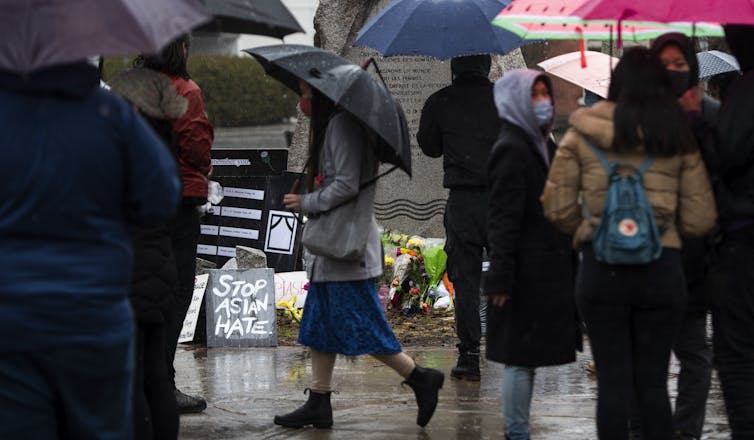
Community members gather for a vigil in memory of the victims of the Atlanta shootings and to rally against anti-Asian racism in Ottawa. THE CANADIAN PRESS/Justin Tang
In Eaton’s memoir Leaves from the Mental Portfolio of an Eurasian, she recalls being called “Chinky, Chinky, Chinaman, yellow-face, pig-tail, rat-eater,” after moving to North America with her family — a white father, Chinese mother and five siblings — in 1872.
Soon after the family’s arrival in Montréal, locals would call out “Chinese!” “Chinoise!” as they walked down the street. Classmates would pull Eaton’s hair, pinch her and refuse to sit beside her.
These taunts and torments were felt deeply by Eaton throughout her life. She wrote:
“I have come from a race on my mother’s side which is said to be the most stolid and insensible to feeling of all races. Yet I look back over the years and see myself so keenly alive to every shade of sorrow and suffering that it is almost a pain to live.”
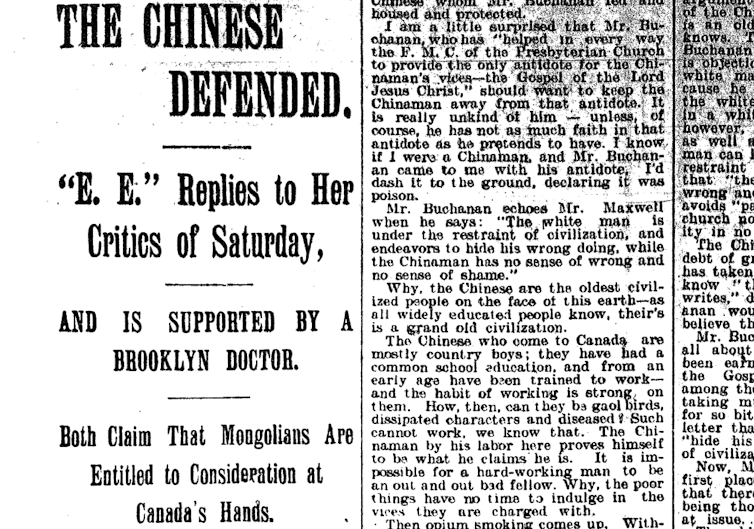
In a signed letter to the editor, Edith Eaton defends Chinese people in Montréal who have been the target of hate. Montréal Daily Star
1890s headlines interchangeable with today’s
Eaton also documented anti-Chinese violence and championed the rights of Chinese immigrants in stories published in the Montréal Star and the Montréal Witness throughout the 1890s.
In the Montréal Star, Eaton published A Plea for the Chinaman, in which she called out politicians for mistreating Chinese men in Canada:
“Every just person must feel his or her sense of justice outraged by the attacks which are being made by public men upon the Chinese who come to this country.… It makes one’s cheeks burn to read about men of high office standing up and abusing a lot of poor foreigners behind their backs and calling them all the bad names their tongues can utter.”
Anti-Chinese violence was so common in 1890s Montréal that Chinese men carried police whistles in their pockets. In an 1895 article, titled Beaten to Death, Eaton noted that even when they blew their whistles, no one would come to Chinese men’s aid. Bystanders often refused to identify their assailants and police told the men who had been assaulted that they should be arrested for bothering them.
Looking at literature and journalism of the past such as Eaton’s can help illuminate the challenges of today. Her observations about people’s motivations — ignorance, jealousy, suspicion, competition — invite us to reflect on the motivations of today’s perpetrators of anti-Asian violence and conclude that not much has changed.





 At the BookShelf