Unknown's avatar

The chattering classes got the ‘Hillbilly Elegy’ book wrong – and they’re getting the movie wrong, too


Lisa R. Pruitt, University of California, Davis

Film critics have had nary a good word to say about Netflix’s new movie “Hillbilly Elegy.”

Reviewers varyingly called it “Oscar-Season B.S.,” “woefully misguided,” “Yokel Hokum,” “laughably bad” and simply “awful.”

I admit to delight when I read professional critics trashing the film, which is
based on J.D. Vance’s widely praised memoir detailing his dramatic class migration from a midsize city in Ohio to the hallowed halls of Yale Law School. I was expecting the worst based on my dislike of the book, and these reviews confirmed my expectations.

But once I saw the film, I felt it had been harshly judged by the chattering classes – the folks who write the reviews and seek to create meaning for the rest of us. In fact, the film is an earnest depiction of the most dramatic parts of the book: a lower-middle-class family caught in the throes of addiction.

Everyday viewers seem to find the film enjoyable enough – it has solid audience reviews on IMDB and Rotten Tomatoes.

So why the big gap between the critical response and audience reaction? Could it be yet another sign of the country’s steadily growing class divide?

A bootstrap manifesto

The film’s negative reviews are an about-face from critics’ warm embrace of the book, which was published in 2016, when Vance was just 31.

In telling his story of overcoming his mother’s addiction and attendant familial and economic precarity, Vance credits his Mamaw and Papaw, along with luck and hard work.

Fair enough. But he gives no nod to the government structures – K-12 schools, the military and the GI bill, the public university where he earned his B.A – that greased the skids of his sharp ascension into the ruling class. Worse still, Vance expressly blames laziness as the culprit of those left behind, with only cursory attention to the impact of policies that encouraged the offshoring of manufacturing jobs and weakening of the social safety net.

The book is not subtle in its message: Working-class grunts are to blame for their own struggles. If they’d just get off their duffs, go to church and stay married, everything would be OK.

J.D. Vance talks on a cell phone.
J.D. Vance’s memoir was a sensation when it was published.
Drew Angerer/Getty Images

Yet commentators from across the political spectrum greeted the book with a big wet kiss. Published months before Donald Trump’s election, it was perfectly timed for the zeitgeist, and Vance’s extended personal anecdote suddenly became the authoritative text about enigmatic working-class whites, all presumptive Trump supporters. The New York Times fawned over its “discerning sociological analysis,” overlooking Vance’s one-sided invocation of data and scholarly literature, while prestigious think tanks like the Brookings Institution elevated Vance to expert status.

I was one of few progressive elites to push back against the media’s early, broad embrace of the book. Admittedly, I was moved by Vance’s compelling biography, which featured many of the hallmarks of my own: hillbilly roots, addicted parent, family violence and – ultimately – a dramatic class leap into elite legal circles.

But I was put off by Vance’s singular focus on personal responsibility and use of his story to advance an agenda antagonistic to the social safety net. Many of Vance’s positions run contrary to my own scholarly work about the white working class and rural America.

Vance also suggests that his family – in both its best and worst manifestations – is representative of Appalachia. Yet like all families, Vance’s is typical in some ways but not in others. And that’s what got so many Appalachians up in arms when the book came out. Not all of them are drug addicted any more than they’re all coal miners. Further, not all Appalachians are white. Many lead boring lives.

From curiosity to disdain

I wasn’t happy when Ron Howard and Netflix paid US$45 million for the movie rights, because I didn’t want the book to get an even wider audience. But the film leaves Vance’s politics aside and instead focuses on three generations worth of Vance family saga. That means the positive potential I saw in the book is at the heart of the film.

For one, working-class white people can see themselves on screen. When I read the book, I initially laughed out loud – but also cried – over the ways Vance’s hillbilly grandparents reminded me of my own extended family. I also related to his “fish out of water” experiences in elite law firms.

Second, the story is a reminder that white skin is no magic bullet. Folks where I live and work in California often use “white privilege” as synonymous with “you’re white, you’ll be all right.” Members of the Vance family are white, but they are clearly not all right. The movie has the potential to foster empathy between the two worlds J.D. Vance straddles – the ones I also straddle – between working class and professional class.

Yet to some critics, the film amounted to no more than “poverty porn.” They lamented a lack of complexity, nuance, motivation and internal conflict in the film’s characters.

Really? Those reviewers must have looked right past the trauma both Mamaw and Bev experienced in their early lives – the former as a child bride, the latter as a child raised in the violent home of that child bride. J.D. is a product of both.

There are surely other reasons, too, that the film world has turned a cold shoulder to this cinematic packaging of Vance’s book. I suspect that it has something to do with the fact that the four-year span between the book and the film neatly coincided with the beginning and end of Trump’s presidency. During that same period, what started as progressive elites’ curiosity about the white working class gave way to bald disdain and fury.

Nowadays, my Twitter feed is awash with resentment every time “mainstream media” run a story about white Trump supporters.

The woke whine that such coverage implies that these are the “real Americans” who we should try to understand, while overlooking other marginalized subsets of the population. Film critic negativity about “Hillbilly Elegy” may reflect similar attitudes – a mix of exasperation and boredom with a pet topic for media outlets since the 2016 election.

[Deep knowledge, daily. Sign up for The Conversation’s newsletter.]

Audiences have a different response

To me, the real pity is that so many coastal elites know so few working-class folks of any color, let alone the hillbilly subset of them. Indeed, studies show that, increasingly, people from different socioeconomic strata no longer mix even within the same metro areas.

The crummy reviews ultimately evince this profound and persistent disconnect between those who write the reviews and “regular” folks.

A week after its release, the film’s critic score on Rotten Tomatoes was 27, while its audience score was 82. That’s a massive spread, and one that may align with the yawning chasm cutting across our national electorate.

The cosmopolitan set can’t believe viewers would want to watch “those people” – and may even be able to relate to them – any more than we can believe so many people voted for Donald Trump.

When critic Sarah Jones, an Appalachian by upbringing, argues that “Hillbilly Elegy” wasn’t made for hillbilly viewers, I’m not convinced. Jones places “Hillbilly Elegy” among “an old and ignoble genre” that “caricatures the hillbilly for an audience’s titillation.”

Maybe. But there are far worse depictions of rural folks and other hillbilly types. Look no further than this appalling scene from “Planes, Trains and Automobiles” or the 1972 classic “Deliverance.”

Howard and screenwriter Vanessa Taylor certainly took liberties in condensing and dramatizing decades of Vance family dysfunction, but we shouldn’t pretend that families like these don’t exist. I know people like them – heck, I’m even related to some.

Many viewers will relate to “Hillbilly Elegy” simply because addiction is such a shockingly common phenomenon, one that touches many families and every community. Others will appreciate the film because it presents J.D. Vance achieving the “American dream.” It’s an ideal many find irresistible in spite of the fact that – or, indeed, because – upward mobility is more elusive than ever.

With Vance’s politics tucked out of sight, can we simply judge the film for its entertainment value? Can we acknowledge that we don’t all like the same things?

After all, there may be a few things elites don’t “get.” And that could be because the movie wasn’t made for them in the first place.The Conversation

Lisa R. Pruitt, Martin Luther King, Jr., Professor of Law, University of California, Davis

This article is republished from The Conversation under a Creative Commons license. Read the original article.
Unknown's avatar

John Keats: how his poems of death and lost youth are resonating during COVID-19


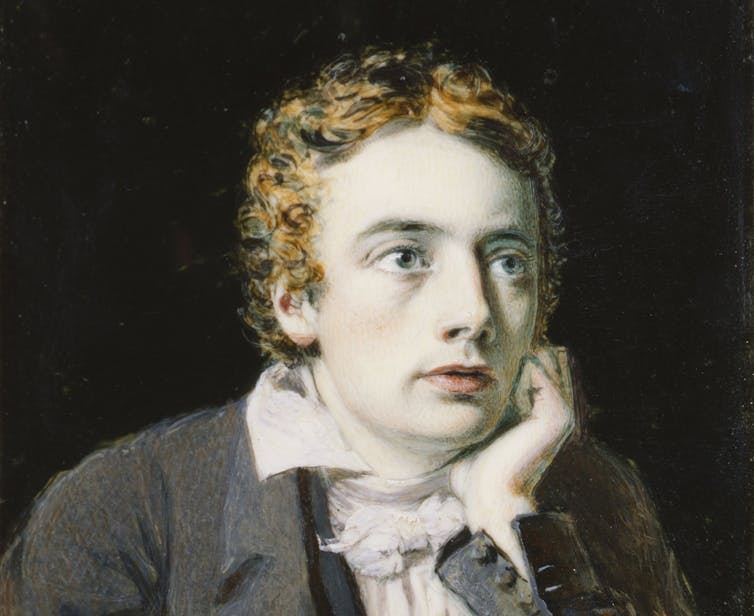
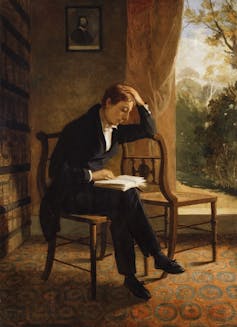
John Keats by Joseph Severn (1819).
National Portrait Gallery

Richard Marggraf-Turley, Aberystwyth University

In John Keats’ poems, death crops up 100 times more than the future, a word that appears just once in the entirety of his work. This might seem appropriate on the 200th anniversary of the death of Keats, who was popularly viewed as the young Romantic poet “half in love with easeful death”.

Death certainly touched Keats and his family. At the age of 14, he lost his mother to tuberculosis. In 1818, he nursed his younger brother Tom as he lay dying of the same disease.

After such experiences, when Ludolph, the hero of Keats’ tragedy, Otho the Great, imagines succumbing to “a bitter death, a suffocating death”, Keats knew what he was writing about. And then, aged just 25, on February 23 1821, Keats himself died of tuberculosis in Rome.

Life sliding by

His preoccupation with death doesn’t tell the whole story, however. In life, Keats was vivacious, funny, bawdy, pugnacious, poetically experimental, politically active, and above all forward-looking.

He was a young man in a hurry, eager to make a mark on the literary world; even if – as a trained doctor – he was all too conscious of the body’s vulnerability to mortal shocks. These two very different energies coalesce in one of his best loved poems, written in January 1818 when the poet was in the bloom of health:

When I Have Fears That I May Cease to Be is a poem of personal worry, according to biographer Nicholas Roe. In it, Keats is anxious that he won’t have time to achieve poetic fame or fall in “unreflecting love”, and these fears and self-doubts take him to the brink.

But as brinks go, this one doesn’t seem all that bad. The poem is romantic with a small “r” – wide-eyed, dramatic, sentimental – its vision of finality, of nothingness, gorgeous in its desolation, and all-importantly painless. Who can read those final lines without themselves feeling a pull to swooning death, half in love with it, as Keats professed to be?

That’s what I used to think, at any rate. Lately, in the pandemic, I’ve begun to read this poem rather differently. Lensed through long months of lockdown, the sonnet’s existential anxieties seem less abstract, grand and performative, and more, well, human.

It’s a poem that will resonate with the youth who are cooped up indoors, physically isolated, unable to meet and mingle, agonisingly aware of weeks slipping by, opportunities missed, disappointments mounting. This poem has made me almost painfully empathetic towards their plight.

Painting of a young John Keats reading a book.
John Keats by Joseph Severn, painted posthumously (1821-1823).
National Portrait Gallery, London

The sonnet’s fears of a future laid to waste are shared by whole generations whose collective mental health is under siege. In his last surviving letter, written two years after the sonnet while dying in Rome, Keats records a “feeling of my real life having past”, a conviction that he was “leading a posthumous existence”. How many of us are experiencing similar thoughts at the moment?

Illness and isolation

Of all the Romantics, Keats perhaps knew most about mental suffering. He grew up in Moorgate, just across from Bethlem Hospital, which was known to London and the world as Bedlam. Before he turned to poetry, Keats trained at Guy’s hospital, London, where he not only witnessed first-hand the horrors of surgery in a pre-anaesthetic age but also tended to patients on what was called the lunatic ward.

It was all too much for him. Traumatised by the misery and pain he felt he could do little to alleviate, in 1816 he threw medicine in for the pen. His experiences at Guy’s, though, and the empathy he developed there, found their way into his writing. For instance, in Hyperion, his medical knowledge helps him to inhabit the catatonic state of “gray-hair’d Saturn”, who sits in solitude, “deep in the shady sadness of a vale”, despairing after being deposed by the Olympian gods. The vignette is a moving image of isolation and enervation that speaks to us today:


https://www.poetryfoundation.org/poems/44473/hyperion

As for lockdown, Keats was no stranger to its pressures and deprivations. During periods of illness in Hampstead in 1819 – precursor symptoms of tuberculosis – he was reluctant to venture out, isolating himself. In October 1820, he set sail for Italy in the hope warmer climes would save his lungs. On arrival, his ship was put into strict quarantine for ten days. In letters to his friends, Keats described being “in a sort of desperation”, adding, “we cannot be created for this sort of suffering”.

Keats was a poet of his age, his own social, cultural and medical milieu. And yet, on the bicentenary of his death, he’s also – more than ever, perhaps – a poet of ours. A poet of lockdown, frustration, disappointment, fears … and even hope.

Because even in those last, scarcely imaginable weeks in Rome, 200 years ago, holed up in a little apartment at the foot of the Spanish Steps, he never quite gave up on the future, never relinquished his dreams of love and fame.The Conversation

Richard Marggraf-Turley, Professor of English Literature, Aberystwyth University

This article is republished from The Conversation under a Creative Commons license. Read the original article.
Unknown's avatar

Aliens in Lagos: sci-fi novel Lagoon offers a bold new future


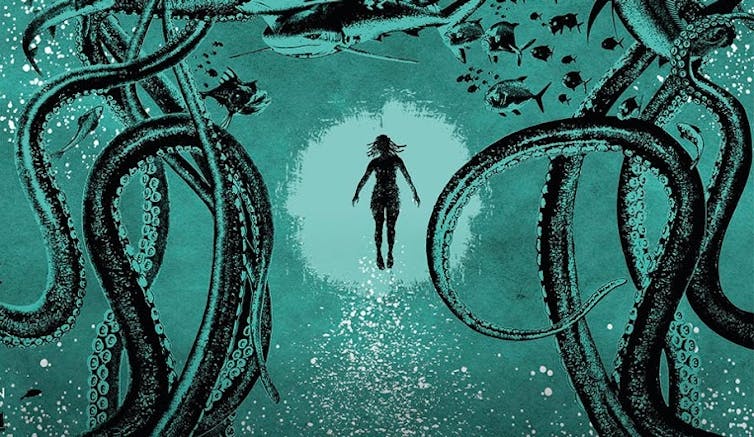
Detail from the cover of Lagoon, a novel by Nnedi Okorafor.
© Joey Hi-Fi/Hodder & Stoughton

Gibson Ncube, University of Zimbabwe

In his satirical essay How to Write About Africa, the late Kenyan writer and journalist Binyavanga Wainaina advocated for a rethinking of clichéd and stereotypical representations of the continent. Wainaina was in favour of looking beyond the despair that has plagued and continues to plague Africa.

African science fiction is a literary genre which tries to imagine utopic futures of the continent. Nigerian-American novelist Nnedi Okorafor calls her brand of sci-fi “Africanfuturism”. She explains in her blog that Africanfuturism is “concerned with visions of the future” and that “it’s less concerned with ‘what could have been’ and more concerned with what can/will be.”

Okorafor is on an upward global sci-fi trajectory, especially with the adaption of her acclaimed novella Binti into a major TV series – among several proposed projects involving her African protagonists. Considered especially against the background of the phenomenal success of the sci-fi blockbuster movie Black Panther, Okorafor’s rich body of work matters when it comes to the representation of black lives.

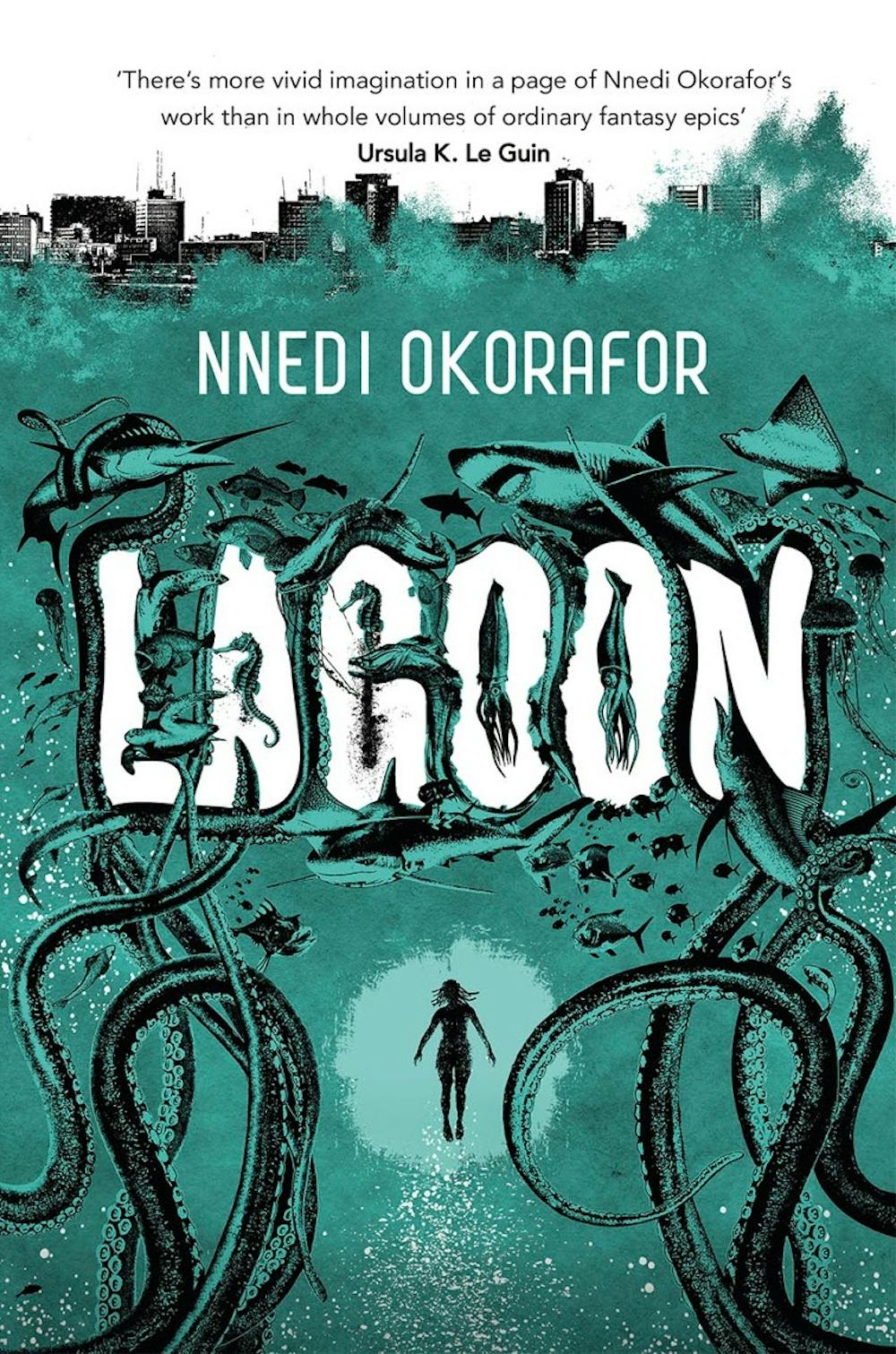
A book cover in green, black and white reading, 'Nnedi Okorafor Lagoon' with a quote from Ursula la Guin and an illustration of a human form swimming through sea creatures and tentacles towards the light.

Joey Hi-Fi/Hodder & Stoughton

Her 2014 novel Lagoon recounts the story of the arrival of aliens in Nigeria. The aliens make their landing in the ocean, in the lagoon close to the city of Lagos. The novel focuses on Ayodele, the alien ambassador, and her interactions with three humans: a marine biologist named Adaora, a musician from Ghana named Anthony and a military man named Agu. Ayodele has shapeshifting capabilities that allow her to change her form. She transforms fluidly between human, animal and inanimate forms.

As I have observed in my analysis, Lagoon, through its shapeshifting alien protagonist, challenges long held ideas of how gender and sexual identities are considered in Africa.

That which does not resemble us

Lagoon cheerfully disregards many literary norms. A mythical spider called Udide Okwanka, for example, recounts the story – which is also told from multiple perspectives. But particularly innovative is how Lagoon imagines a bold alternative future in which there is a liberation of identities and desires from rigid norms.

In Ayodele’s interactions with humans, she questions how they live and think. Through her shapeshifting capabilities, she defies what humans consider the “normal” ways of being.

Ayodele is portrayed as queer. By queer I mean that her identity defies established gender identity categories. In the novel, she is referred to as “a woman … man … whatever” and as a “woman, thing, whatever she was”. This fluid identity blurs the boundaries of what has been normalised as “correct”.

The narrator of Lagoon explains that Ayodele’s fluid identity makes her dangerous. The danger lies in that Ayodele dismantles a well established system that denigrates ways of being that are different or stray from what is considered normal. Ayodele’s identity makes humans uncomfortable. In the novel, Ayodele states

Human beings have a hard time relating to that which does not resemble them.

It is when humans are made uncomfortable that it becomes possible to start imagining different futures. The familiar is defamiliarised and stereotypes are disregarded.

Becoming visible

In Lagoon, Ayodele’s difference compels a queer student organisation called Black Nexus to come out of hiding and to confront societal stereotypes. Before the arrival of Ayodele and the aliens, Black Nexus only met clandestinely once a month. Ayodele’s presence emboldens them to come out of the closet and confront their own insecurities.

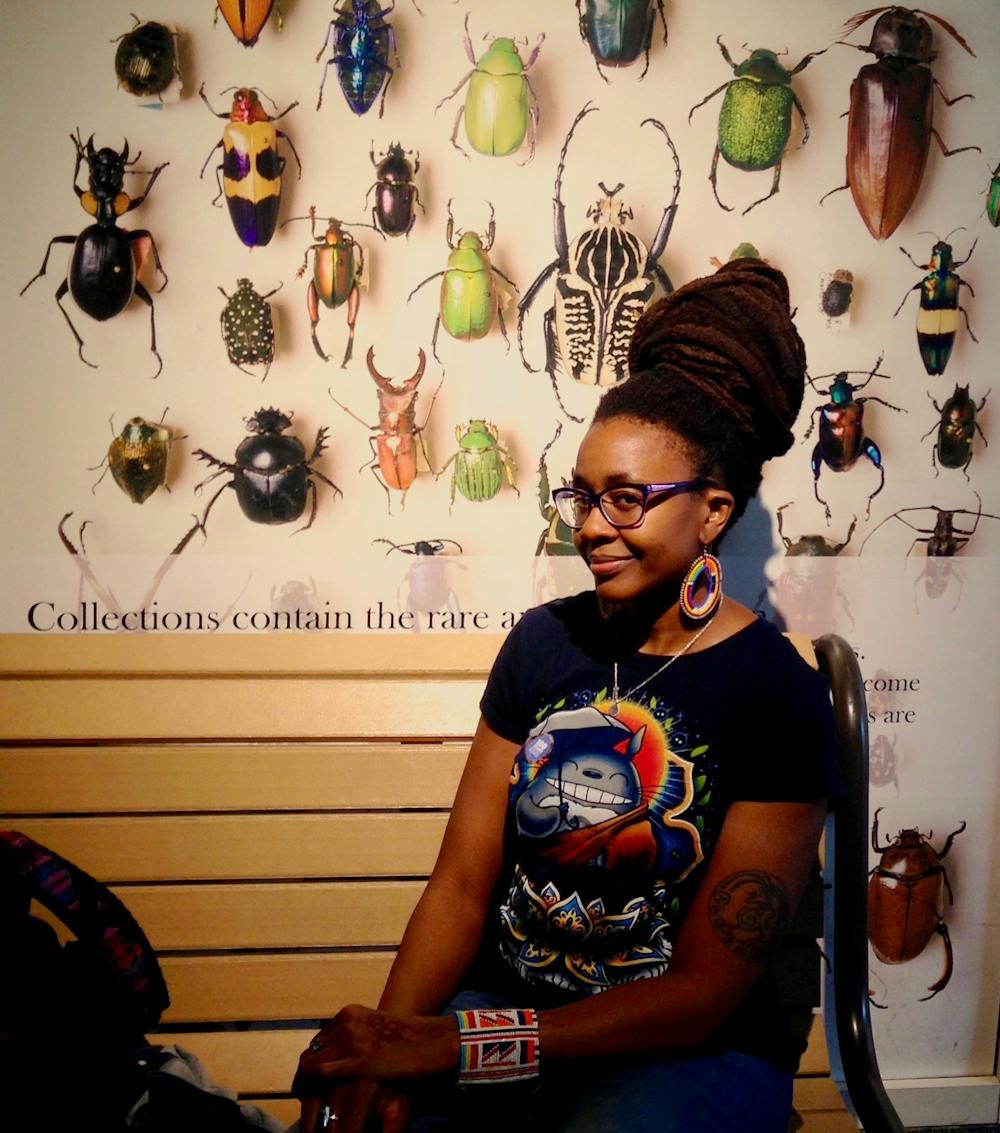
A woman with a wry smile and large hairstyle sits in front of a museum display of insects.
Portrait of Nnedi Okorafor with insects.
Cheetah Witch/Wikimedia Commons, CC BY-SA

Of particular interest, the group is encouraged by how Ayodele challenges Father Oke, a bishop in a local diocese. Father Oke is known to speak out against queer individuals and for equating queer relations to bestiality. The Black Nexus group see in Ayodele a possible ally and a radical force that could change how they are viewed in Nigeria – a country where same-sex relations are criminalised.

By becoming visible, the members of Black Nexus defy the ways of thinking that marginalise them and render them invisible in Nigeria.

What if?

In my reading, Ayodele’s shapeshifting capabilities represent a need to rethink identities so that they are liberated from the limiting ways in which humans consider them. The novel imagines a future in which different forms of otherness are granted space to be and to flourish. Ayodele hints at this future, saying:

Last night, Lagos burned. But like a phoenix, it will rise from the ashes – a greater creature than before.

Lagoon’s Africanfuturist vision requires a reader who is actively engaged in co-creating the alternative future that the novel is constructing: one in which identities are freed from restrictive thinking that refuses to recognise difference and diversity.

The reader is a central participant in this process because the writer, the reader and the text are engaged in a creative conversation. This conversation involves challenging the present and past misrepresentations of Africa. And it involves striving to envision counter-futures that contrast the present and past. The reader is required to be an active participant in meaning making.

I conclude by quoting Okorafor, who explains in a 2017 talk that sci-fi plays an important role in imagining possible futures. She tells her audience:

So much of science fiction speculates about technologies, societies, social issues, what’s beyond our planet, what’s within our planet. Science fiction is one of the greatest and most effective forms of political writing. It’s all about the question, “What if?”.The Conversation

Gibson Ncube, Associate Professor, University of Zimbabwe

This article is republished from The Conversation under a Creative Commons license. Read the original article.

Unknown's avatar

Humour in poetry should be taken seriously


Vectorium/Shutterstock

Christina Thatcher, Cardiff Metropolitan University

As a child, I remember laughing out loud while reading Shel Silverstein’s poetry book A Light in the Attic (1981). I loved it so much that I started reciting the poem Skin Stealer every day, to the great annoyance of my little brother. Even now, these lines still come knocking:

This evening I unzipped my skin

And carefully unscrewed my head,

Exactly as I always do

When I prepare myself for bed.

As a teenager, I was taught that poetry should be more serious. It was art – and art took itself seriously. Even now, poems designed to make us laugh are often dismissed as frivolous. This seems strange given that many of our earliest poems are comic ones. The limerick, for instance, is thought to have originated during the Middle Ages and has been used to great humorous effect by thousands, from Shakespeare to Roald Dahl.

Perhaps the crime here isn’t that funny poems have been sidelined in favour of serious ones, but that funny poems are not also considered to be serious. Humour, after all, has the power to disarm us and promote reflective thinking.

Although there are innumerable ways in which poets can be funny in their work, I have chosen pieces here which employ three different types of humour to demonstrate how poetry can make us both laugh and think.

Sexy humour

Sometimes called dirty, naughty, rude or cheeky, this type of humour works because it violates social norms. After all, it is not polite to talk about sex. But, poetry which pokes fun at bodies and desire is centuries old.

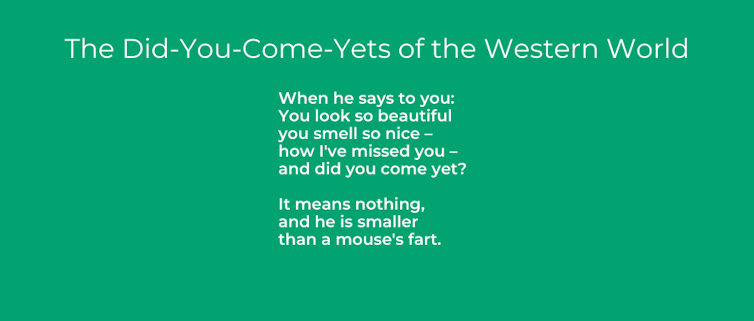
Poems in this category can range from titillating to obscene. But, beyond the tee-hees, these pieces can reveal deeper truths about sex and relationships. Take a look at the opening of The Did-You-Come-Yets of the Western World by Rita Ann Higgins:

Absurdist humour

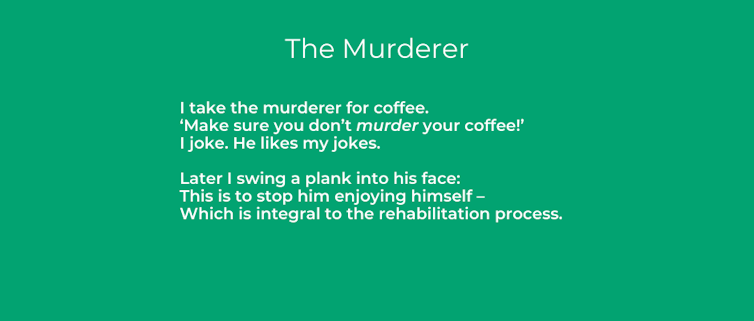
Poets who use absurdity in their work tend to operate under the assumption that implausibility is essential to comedy. Absurd humour highlights the ridiculousness of life, pushing normally accepted realities to extremes to give the audience a fresh perspective. This can be seen in Luke Kennard’s darkly funny poem The Murderer, which opens:

In his correspondence with writer Paul McDonald, Kennard discussed how this poem works to reveal the shortcomings of both characters, opening up a chance for readers to reflect on moral relativism.

Satirical humour

Satire is an excellent way for poets to respond to social trends and current events. Often, this type of humour relies on ridicule and exaggeration to expose and criticise people’s stupidity or vices. Satirical poems play an important role when it comes to challenging political, cultural and aesthetic oppression. According to the poet Matthew Rohrer, satire is a tool by which the oppressed get to make fun of their oppressors.

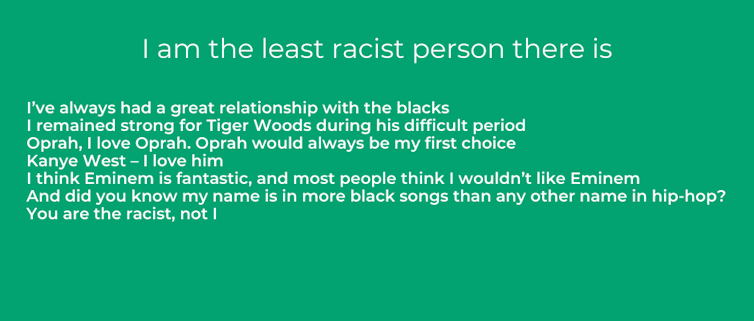
Satirical poetry takes many forms but one of my personal favourites is the cento – a patchwork poem made up of words or phrases directly from the person at the butt of the joke. Rob Sears’ The Beautiful Poetry of Donald Trump does this brilliantly, particularly this piece:

There are, of course, huge swathes of humour that I haven’t even touched on here. For instance, surrealism, dark humour and observational humour can provoke important discussions, launch taboos into the light and straddle the fine line between “haha” and “oh no”.

Because humour is also highly personal, you may not find any of the poems I’ve chosen to be funny. To remedy this, I also asked poets on Twitter to share the pieces which made them laugh and, wow, did they deliver. In this thread alone, the power of humour in poetry is self-evident.The Conversation

Christina Thatcher, Creative Writing Lecturer, Cardiff Metropolitan University

This article is republished from The Conversation under a Creative Commons license. Read the original article.