
The link below is to a book review of ‘Law and Liberty,’ by R.J. Rushdoony.
For more visit:
https://www.9marks.org/review/book-review-law-and-liberty-by-r-j-rushdoony/

The link below is to a book review of ‘Law and Liberty,’ by R.J. Rushdoony.
For more visit:
https://www.9marks.org/review/book-review-law-and-liberty-by-r-j-rushdoony/
The link below is to an article reporting on the 2020 winner of the Gordon Burn Prize, Peter Pomerantsev, for ‘This Is Not Propaganda.’
For more visit:
https://www.theguardian.com/books/2020/oct/15/peter-pomerantsev-gordon-burn-prize-this-is-not-propaganda
The link below is to an article that takes a look at the diary trade – people who love to get into other people’s diaries.
For more visit:
https://www.theguardian.com/books/2020/oct/18/secret-world-of-diary-hunters-buying-and-selling
The link below is to a book review of ‘The Heart of the Preacher – Preparing Your Soul to Proclaim the Word,’ by Rick Reed.
For more visit:
https://www.9marks.org/review/book-review-the-heart-of-the-preacher-by-rick-reed/
The link below is to a smartphone app that has been developed to make audiobook streaming easy.
For more visit:
https://www.bookcamp.app
Claudine van Hensbergen, Northumbria University, Newcastle
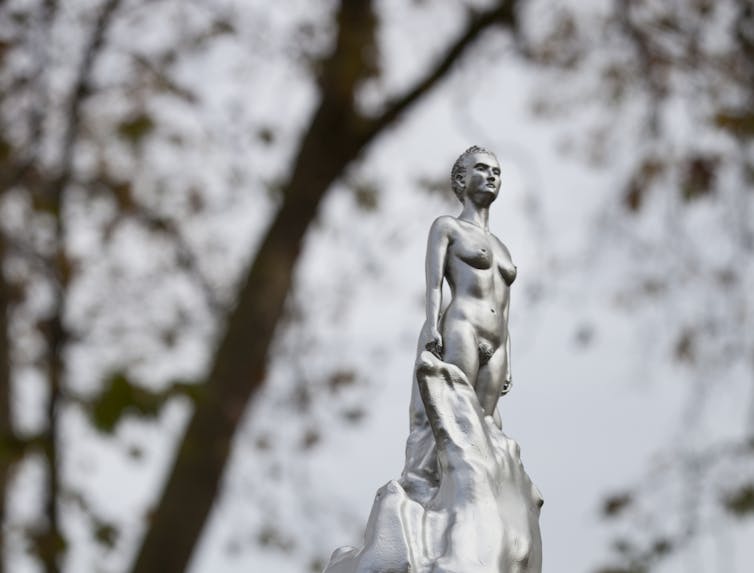
A small naked female figure in silvered bronze emerges out of a swirling mass of organic matter. There is something excitingly unexpected about it all. Although not everyone shares this opinion of the recently unveiled memorial in north London to the feminist writer Mary Wollstonecraft (1759-1797) by the artist Maggi Hambling CBE.
The statue is a project ten years in the making – but centuries overdue. Wollstonecraft was one of the most defiant and intelligent voices in the period of our nation’s history which is often termed the Enlightenment (1715 – 1789). The arguments she advanced for women’s equality feel familiar today, but they were radical in her age.
Wollstonecraft paid a high personal cost for making her voice heard. Vilified in society as an adulteress and for conceiving a child out of wedlock, her unorthodoxy was condemned by the very society she worked to improve. But her political writings are extraordinary documents, including letters in close dialogue with the leading thinkers and events of the day.
In her new monument, Hambling does not give us a figure of Wollstonecraft, but a vision of “everywoman”. The work feels more of an intervention in debates about monuments, than a monument for a specific person. The sculpture rejects a male tradition of public sculpture, in which the likeness of celebrated men is cast in bronze or carved in marble.
A statement on behalf of the campaign to raise the statue, which took a decade to source the necessary £143,300, described the work’s design:
As opposed to traditional male heroic statuary, the freestanding woman has evolved organically from, is supported by, and does not forget, all her predecessors who advocated, campaigned and sacrificed themselves for women’s emancipation.
Hambling should be praised for her attempt to break with this tradition but whether this statue is a fitting tribute to Wollstonecraft can be questioned.
Ultimately, statues don’t represent people, they represent ideas. Ideas of how we choose to see the world. Hambling’s more abstract and representative form perhaps tries to do too much: to celebrate the life and contribution of one woman, whilst celebrating the life and possibilities of all women.
Is such a feat even possible? In attempting to represent every woman, perhaps the statue stands testament to the impossibility of such a task.
The statue’s unveiling saw a swift response of female commentators who question the decision to present womankind, and Wollstonecraft’s contribution to our history, through an idealised naked form. Novelist Jojo Moyes said:
I think it would have been nice to commemorate Mary Wollstonecraft with her clothes on […] You don’t see a lot of statues commemorating male political figures without their pants on.
Fellow writer Imogen Hermes Gowar also rejected the “sexy toned female” figure, saying:
Nameless, nude and conventionally attractive is the only way women have ever been acceptable in public sculpture.
While such assessments misconstrue Hambling’s intention for her design, the statue is – in this early moment of its life – too provocative to please every woman. But then again, the same was true of Wollstonecraft’s own reception with her contemporaries.
It is impossible to know what Wollstonecraft would have made of the statue. She might have experienced sheer shock, perhaps, that the establishment would view her as a fitting subject for such a thing.
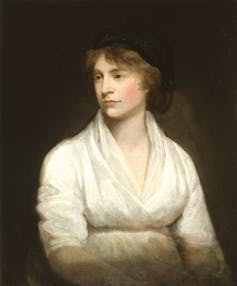
Hambling’s silvery creation is certainly a far cry from John Opie’s portrait of Wollstonecraft that hangs on the walls of the National Portrait Gallery in London.
A woman of elegant simplicity, you would barely believe you were looking at one of Britain’s most radical writers. Painted when Wollstonecraft was pregnant with her second daughter, Mary, the portrait is a poignant reminder of tragedy around the corner. Wollstonecraft died of septicaemia following the birth. Her daughter would grow up to become a formidable figure in her own right, writing her own monumental work, Frankenstein.
Wollstonecraft was not “every woman”. She was far more outspoken, more rebellious and braver than the average woman of her day. Upon her death, Wollstonecraft’s grieving husband, the author William Godwin, wrote to his friend, the writer Thomas Holcroft, that “there does not exist her equal in the world”. Hugely individual and brilliantly intellectual, Wollstonecraft was a rarity. It could be fair to say, then, that we are still in need of a statue to capture this.
Critics of Hambling’s monument should be reminded that this does not need to be our only statue for Wollstonecraft. True, it has been a long time coming. But Wollstonecraft is a shining beacon in British women’s history – a figure due many statues and acts of remembrance.
Hambling’s statue should remind us rather than distract from the fact that Wollstonecraft made her own final monument in the form of her writings. They are well worth reading.
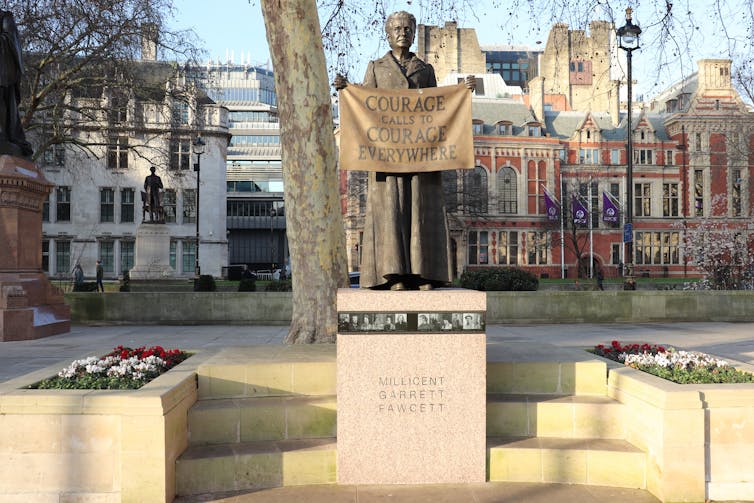
So, too, are new statistics emerging from the nation’s newfound interest in its public sculpture. Women make up more than 50% of the UK’s population but are the subject of only 10% of the statues on London’s streets.
Whatever we may make of Hambling’s statue, today we have one more statue of, and for, women. It is a fact well worth celebrating.
Claudine van Hensbergen, Associate Professor, Eighteenth-Century English Literature, Northumbria University, Newcastle
This article is republished from The Conversation under a Creative Commons license. Read the original article.
Daniel Cook, University of Dundee
England is facing a second lockdown and with days getting shorter and colder we are spending more time than ever inside. A recent survey of how reading habits changed during the first lockdown found that people were reading more – and that trend is sure to continue this time round.
While you hunker down in the seeming safety of your home, how about picking up a book about houses that aren’t quite as safe? We’re talking about places where the floorboards creak, the staff are creepy and there’s something not quite right about the children.
The haunted house has been making a comeback on the screen, as we’ve seen with the recent successes of the BBC comedy series Ghosts and Netflix’s adaptations of The Haunting of Bly Manor and Rebecca. It seems our fascination with unsettling places continues to grow.
Many of these stories started in books so here are five classic examples to keep you company this lockdown:
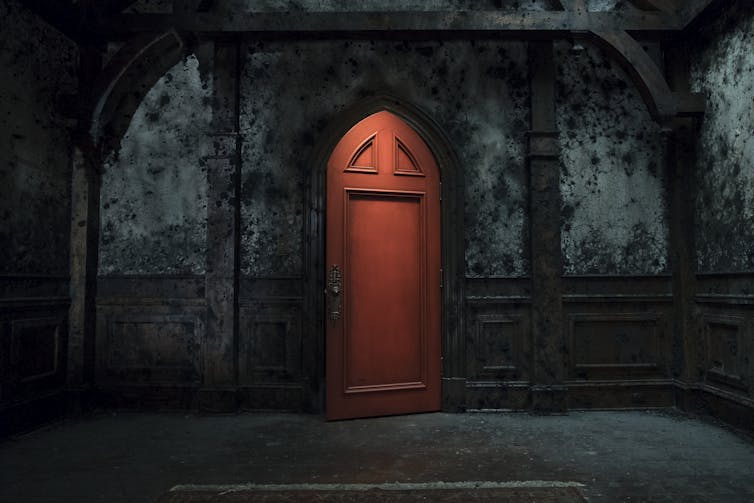
Presented as a found document, this is a unique book featuring copious footnotes on some pages while others contain hardly anything at all. This story follows a family as they move into a new house on Ash Tree Lane. As they enter the property they discover that it is somehow bigger on the inside than it is on the outside.
The children, as they tend to in these stories, begin talking of a creature and soon they all hear a growl coming from deep within the house.
Desperate to get away from their apartment in Queens, the cash-strapped Rolfe family rents a summer home in upstate New York.
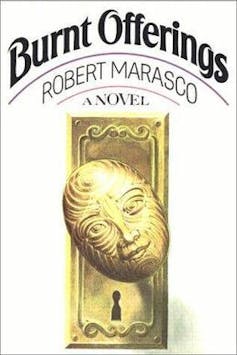
The place is a secluded haven, with a pool and private beach. This seemingly perfect summer home, however, comes with a curious stipulation in the rental agreement, which insists that the elderly mother of the homeowners stays with them.
Bizarre, catastrophic events ensue. Burnt Offerings is known to have been model for Stephen King’s 1977 bestselling novel The Shining as both narratives deal with abrupt personality changes.
If you’ve watched the Netflix series you should read the book that inspired it – they’re pretty different. The short novel is considered one of the finest examples of horror writing and Jackson a master of the haunted tale.
The story follows Dr Montague who wants to prove the existence of the supernatural. Renting Hill House one summer, he invites various people who have reported paranormal experiences. The house has been the site of many violent deaths and suicides so there’s hope one of those unhappy souls will make themselves known.
Unsurprisingly, when you go looking for ghosts in a novel, you will find them. There are bumps in the night, cryptic writings on the wall and a whole load of unexplained coincidence, what more could you want?
The unnamed young woman who narrates the novel falls in love with an older, wealthy man, Maxim de Winter, and moves into his isolated estate in south-west England, Manderley.
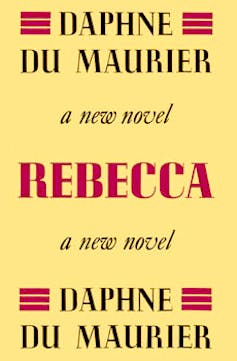
The house is practically a shrine to the memory of his first wife, Rebecca, who died the year before in mysterious circumstances.
Malevolent forces are at work in this house as the young bride’s attempts to start a new life with her husband are foiled at every turn by the housekeeper and Rebecca’s confidante Mrs Danvers.
The book is far more spooky than recent Netflix adaptation, which presents viewers with a thoroughly modern and far more empowered protagonist.
This is an agonising first-person tale of creeping mental and physical decline.
Summering at a colonial mansion, the narrator is confined to an upstairs nursery with ominously barred windows and scratched-up floors. She becomed fixated on the sickly yellow wallpaper covered in “”an interminable string of toadstools, budding and sprouting in endless convolutions”.
The longer she stays in the room the more the walls seems to move and the more it seems like there might be someone moving it from within.
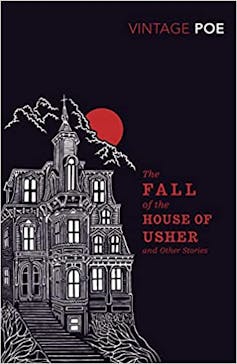
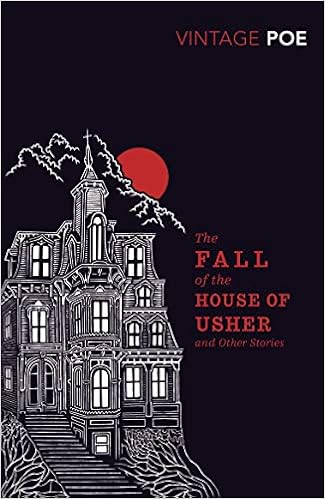
This short story recounts the terrible events that befall the last remaining members of the once-illustrious Usher clan and the house’s last visitors.
Arriving at the home of his reclusive friend Roderick Usher, our narrator is intrigued by the decaying house, particularly a thin crack extending down the front of the building and into the adjacent lake.
Usher’s mind is disintegrating and he is falling deeper into a madness. Things are not as they seem in the suspenseful tale of horror.
Daniel Cook, Senior Lecturer in English, University of Dundee
This article is republished from The Conversation under a Creative Commons license. Read the original article.
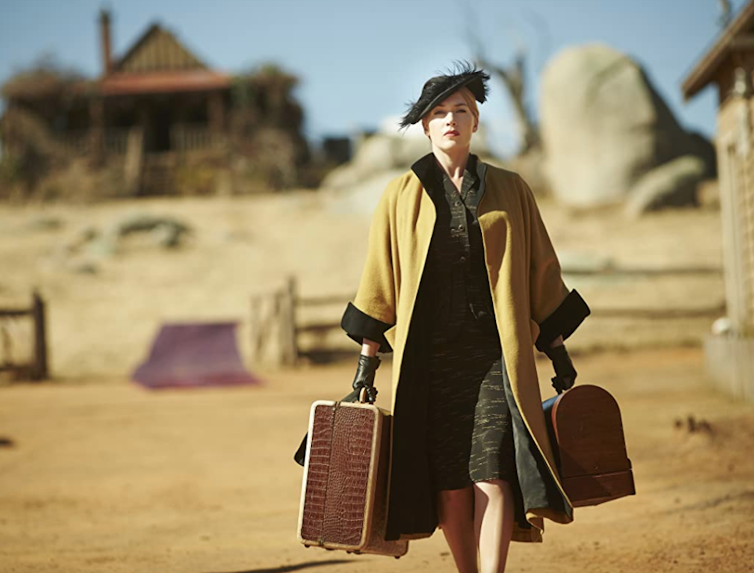
Gail Jones, Western Sydney University
This is an edited version of author Gail Jones’ submission to the parliamentary inquiry into the creative industries.
Literary culture carries profound social value. In general terms it is essential to employment, cultural literacy and understanding of community, as well as to Australia’s post-pandemic recovery and growth. It is also radically underfunded and in urgent need of new support.
I am particularly concerned with the low level of investment in literature through state and federal funding agencies compared with other art forms.
Literature is a mainstay of the creative and cultural industries, which contributed $63.5 billion to the Australian economy in 2016-17. Creative arts employ 645,000 Australians and those numbers were increasing before the pandemic. Literature operates in the economy in many and complicated ways, since writers are “primary producers” of creative content.
Books form an often invisible bedrock of robust resources for the wider economy. They provide creative content in areas such as film, television, theatre and opera; moreover they contribute fundamentally to the educational sector, to libraries, events and what might be called our forms of cultural conversation.
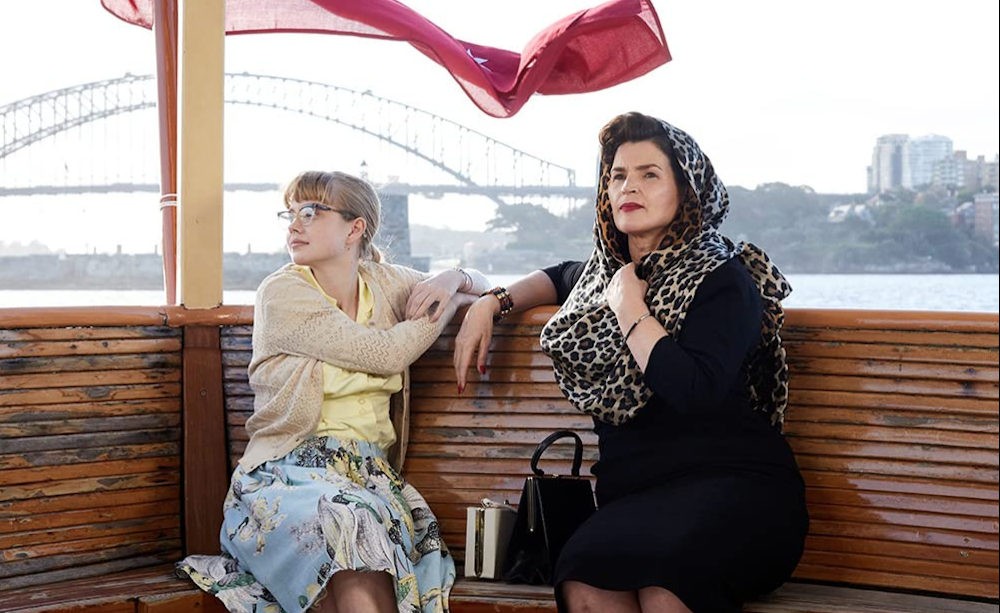
The most conspicuous areas of economic benefit and employment are libraries, universities, schools, festivals, bookshops and publishing.
Indirect benefits, such as to tourism and cross-cultural understanding, are often overlooked in reference to the economic benefits of literature. Our books carry implicit, prestigious reference to a national culture and place; they attract interest, visitors and students and arguably establish a presence of ideas above and beyond more direct mechanisms of cultural exchange.
Cross-cultural exchange and understanding are crucial to the literary industries and of inestimable benefit in “recommending” Australia and its stories.
However, writers’ incomes are disastrously low, $12,900 on average; and COVID-19 has eliminated other forms of supplementary income. It has always been difficult to live as a writer in Australia (which is why most of us have “day jobs”) and it is clear writers are disproportionately disadvantaged. Although essential to the economic benefits of a healthy arts sector overall, writers are less supported by our institutions and infrastructure.
Read more:
Five ways to boost Australian writers’ earnings
Total literature funding at the Australia Council has decreased by 44% over the past six years from $9 million in 2013-14 to $5.1 million in 2018-19. The abolition of specific literature programs such as Get Reading, Books Alive and the Book Council has been responsible for much of this decrease.
We need additional government-directed support such as the funding delivered to visual arts through the Visual Arts and Craft Strategy ($6.6 million in 2018-19), regional touring delivered through Playing Australia ($7.4 million 2018-19) and the Major Festivals Initiative ($1.5 million 2018-19).
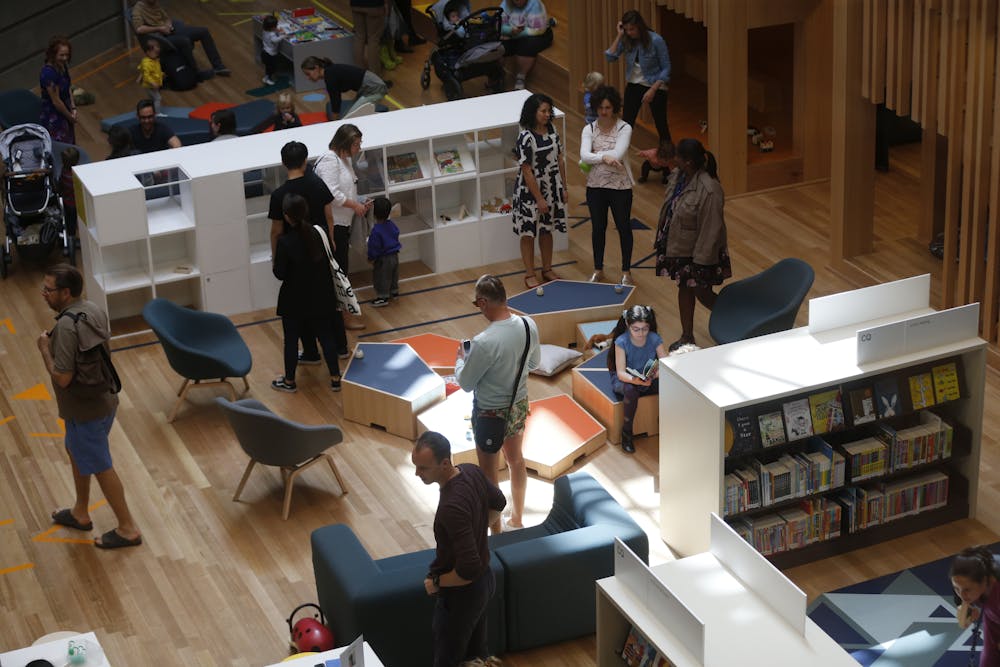
The literary culture in Australia is chronically underfunded, but its benefits are persistent, precious and immense. “Social well-being” requires social literacy, a sense of connection to one’s history, community and self: these are generated and nourished through narrative, conversation and reflection.
The literary arts create a sense of pride, community and solidarity. A single library in a country town can offer astonishing opportunities of learning and self-knowledge: how do we calculate value like this?
Read more:
Friday essay: the library – humanist ideal, social glue and now, tourism hotspot
As someone who grew up in remote and regional areas, I’m aware of how crucial libraries and book culture are to a sense of connection with the nation. Moreover, reading is an indicator of mental health, especially among young people.
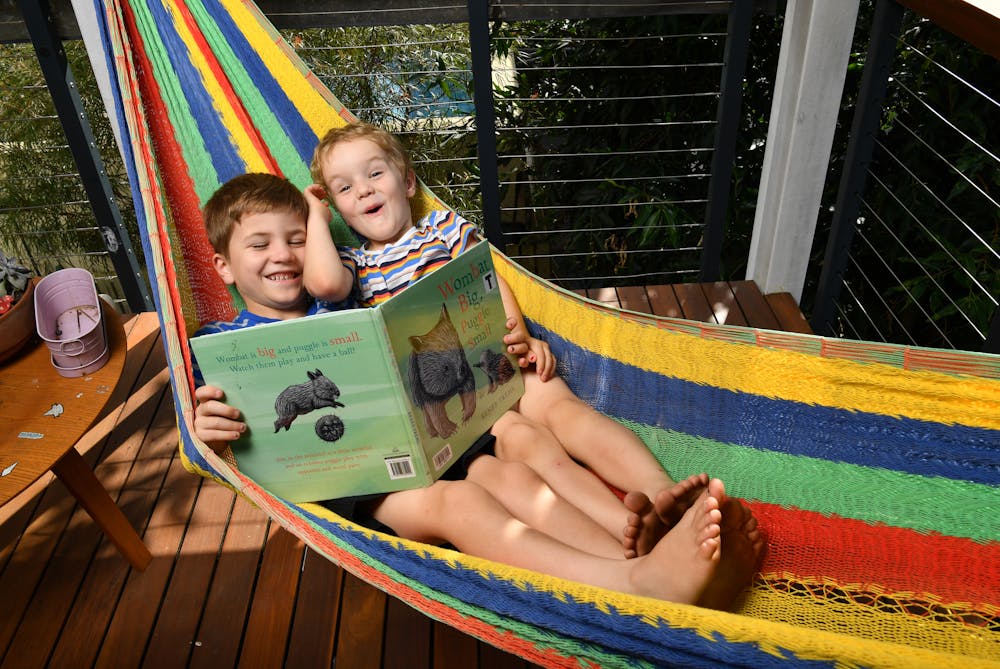
“National identity” also requires reflexive literacy: social understanding and agency derive from reading and writing; a nation that neglects its literary culture risks losing the skills that contribute to creative thinking in other areas — including in industry and innovative manufacturing. Local reading and writing initiatives have had remarkable success in areas like Aboriginal literacy and aged care mental support.
More Australians are reading, writing and attending festival events than ever before. Reading is the second most popular way Australians engage with arts and culture.
Writers’ festivals are flourishing and attendances growing. Libraries remain crucial to our urban and regional communities. It is no overstatement to claim that literature has shaped and reflected our complex national identity.
The formulation of a Creative Economy Taskforce by Arts Minister Paul Fletcher is a positive step in establishing better understanding of this crucial economy. I would draw attention, however, to the lack of literary expertise on the taskforce. The appointment of a publisher or a high-profile Indigenous writer, for example, would give more diversity to the collective voice of our literary community.
The additional appointment of an academic concerned with Australian literature, such as the current director of the Association for the Study of Australian Literature, would further enhance the claims of literature.
The education sector will have a role in implementing creative arts initiatives. There has been a deplorable lack of support for Australian literature within the academy.
Under the current wish to renovate the jobs sector through the creative arts there is an opportunity to direct dedicated funds within the education budget to establishing a Chair of Australian Literature in each university (or at least in the Group of Eight).
There is currently one Chair at the University of Western Australia and a privately endowed one at the University of Melbourne. Postgraduate scholarships could also be offered specifically in the area of Australian literary studies.
For a comparatively small outlay in budget terms, such a move would signal direct support for Australian reading, writing and research and would be widely celebrated in the education and library sectors.
It is embarrassing to discover that some European universities (in my experience Belgium, Germany and Italy, in particular) study more Australian literature than is offered in our own nation.
The case for increased Australia Council funding in the neglected area of literature has already been made. Writers’ incomes are, as attested, direly low and I worry in particular about diminishing funding for new and emerging writers.
An injection of funds into the literature sector of the Australia Council is another efficient and speedy way in which to signal understanding of the fundamental role of literature to our cultural enterprises and economic growth.
Cuts to publishing, festivals, journals, individual writers’ grants and programs generally, have had a disastrous effect on the incomes and opportunities for writers in this nation. Notwithstanding a few highly publicised commercial successes, most writers truly struggle to make ends meet. The “trickle down effects” — from a sustaining grant, say, to a literary journal — have direct economic benefits to writers and therefore to the wider economy.
Read more:
Literary magazines are often the first place new authors are published. We can’t lose them
Most writers’ work is not recognised as a “job”; if it were, if there were a definition of “writer” as a category of honourable labour (such as it is, for example, in Germany and France), writers would be eligible for Jobmaker and Jobseeker benefits.
This may be blue-sky thinking, but I look forward to a future in which forms of precarious labour, like writing, are recognised and honoured as legitimate jobs.
Another area that may work well with literature is foreign aid. The government of Canada, for example, donates entire libraries of Canadian literature as part of its aid program. (I’ve seen one installed on the campus of the University of New Delhi.)

This works as a stimulus to the host economy (benefiting publishers and writers) and also the receiving community, for whom access to books and education may be difficult. It also encourages study of the host culture’s writings and has benevolent “soft power” effects of inestimable worth.
The government has indicated physical infrastructure (buildings and so on) will be necessary to the renovation of the domestic economy post-COVID. This is a wonderful opportunity to consider funding “literature houses”, purpose-built sites for readings, writer accommodation for local and overseas residencies, places for book-launches, discussion and the general support of literature.
The Literaturhaus system in Germany, in which all major cities have funded buildings for writer events, and in which, crucially, writers are paid for readings and appearances, is a wonderful success and helps writers’ incomes enormously.
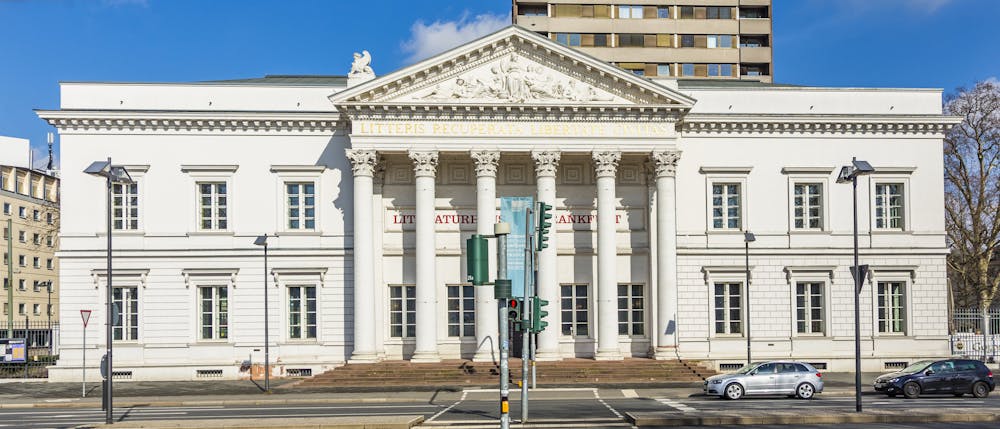
The inclusion of Indigenous, regional, rural and community organisations in proposals for “literature houses” would stimulate local building economies and generate community recognition of Australian literature.
The Regional Australia Institute considers creative arts as a potentially productive area of regional economies. However its 2016 map of Australia has a tiny space allocated to creative industries (situated around Alice Springs and linked to the Indigenous art industry). This strikes me as a radical imbalance and a missed opportunity.
A priority for this inquiry could be support for initiatives in literature, perhaps through existing library or schools infrastructure, to address creatively matters of both rural innovation and disadvantage.
Encouraging workshops in writing, including visiting writers, addressing reading and writing as a creative enterprise for the community as a whole: these could form the basis for an enlivening cultural participation and skills. Dedicated funds in literature for regional, remote and rural communities are urgently required.
Literature, in all its forms, is crucial to our nation — to the imaginations of our children, to the mental health and development of our adolescents, to the adult multicultural community more generally — in affirming identity, purpose and meaning.
Gail Jones, Professor, Writing and Society Research Centre, Western Sydney University
This article is republished from The Conversation under a Creative Commons license. Read the original article.


 At the BookShelf

#/media/File:Burnt_Offerings_Robert_Marasco.jpg)
#/media/File:Rebecca-FE.jpg)
You must be logged in to post a comment.