The links below are to articles reporting on some recent updates regarding the new ebooks embargo put in place for libraries by publishers such as Macmillan and Random House.
As the world waits for George R. R. Martin to complete his epic fantasy series, the ink below is to an article that seeks to reassure readers that he is well (for the moment) in the midst of the coronavirus pandemic and continuing to write.
Over at the Amazon bestsellers list, you’ll often find a number of books reflective of the times or some event/s currently taking place, whether that is a death of a celebrity, an historical moment remembered or even a current crisis unfolding. The link below is to an article pointing out that now is probably not the time to write and release that coronavirus novel you have pieced together.
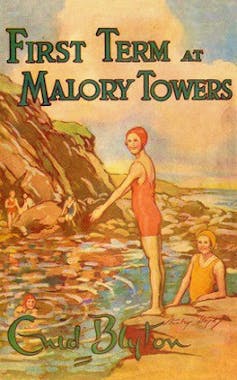
While UK schools are closed for the majority of children, Malory Towers has opened its doors in a new adaptation on BBC iPlayer. Its source text, Enid Blyton’s First Term at Malory Towers (1946), was the first in a series of six, and very much a product of its time.
The clifftop setting was inspired by Benenden School, which Blyton’s daughters attended, and which temporarily relocated from Kent to a hotel in Cornwall during the Blitz. This idyllic landscape sets the mood for the novel, which is steeped in ginger beer and post-war optimism. Now, in a time of national emergency, the series promises both nostalgia and escapism, a welcome distraction from the pandemic.
The title sequence fulfils these promises: bathed in the rose-tinted glow of retrospect, it features a world of pillow-fights, lacrosse matches, and friendship. Yet this saccharine opening belies the series’ revisionist impulse, which is as concerned with diversity, neurodiversity and gender equality as it is with hoodwinking Matron for extra tuck.
It’s widely accepted that adaptations reveal as much about their contemporary contexts as their literary sources, but this is more than a simple updating. Rather, the BBC’s Malory Towers reveals aspects of the historical context that were glossed over in Blyton’s novel, finding its inspiration in the gaps and silences of the original.
Diversifying the cast
The first change is evident in the girls themselves. The first form is a mix of white and BAME (black and minority ethnic) girls. There is also body diversity, with girls of all sizes and one with facial disfigurement. This upholds the standard set by Emma Rice’s 2019 stage adaptation, which cast a non-binary trans actor and one with restricted growth, as well as two women of colour.
The first edition of the novel, illustrated by Stanley Lloyd. Wikimedia
The same year, a four-novel reboot, New Class at Malory Towers, introduced black, Asian, introverted and working-class characters to the school.
The series puts that right, reflecting how, in the words of adaptor Sasha Hailes, 1940s “Britain [was] more diverse than it’s often accounted for”.
Learning differences
The book’s homogeneity also extends to learning differences, of which there are none: only girls who don’t try, and “stupid ones”. “If you are brainless and near the bottom, we shan’t blame you, of course,” says housemistress Miss Potts, in a pep talk bordering on disciplinary offence. “But if you’ve got good brains and are down at the bottom, I shall have a lot to say.”
Two girls fall into the latter category: governess-reared Gwendoline, who phones it in for half the term before discovering the existence of school reports, and heroine Darrell Rivers. Darrell is able but struggles with arithmetic. Being distracted by the class clown causes her to fall in the class order before she hoists her socks with military enthusiasm and finishes fifth from the top.
In the series, however, Darrell has a genuine struggle with spelling and presentation, rising hours before the others to make clean copies of her jumbled prep. Devastated when her class position fails to reflect her hard work, she volunteers to be put in the “dreaded remedial” class. There, tutor and head-girl Pamela diagnoses “word-blindness”, or modern-day dyslexia. As a representative of the countless children with learning differences throughout history, Darrell is a role model for neurodiverse viewers. Her coping strategies, and a renewed commitment to becoming a doctor, also model an admirable growth mindset.
Choice above all
Darrell’s interest in STEM (science, technology, engineering, and mathematics) subjects, and her belief that “girls [can] do everything boys can do”, shows how the series amplifies the feminism of the book. This is largely a product of its single-sex environment, which offers a safe space for the girls to develop, free from the need to conform. The book’s feminism is, however, offset by Blyton’s tendency to downplay academic achievement.
For Miss Potts, the most successful old girls are not “those who have won scholarships and passed exams” but those who have become, more nebulously, “good, sound women the world can lean on”. This bodes ill for “clever Irene”, who is “a marvel at maths. and music, usually top of the form – but oh, how stupid in the ordinary things of life”. Darrell, by contrast, is said to have “the makings of a first-rate person”, combining academics with games prowess and lashings of common sense.
The series inserts several narratives that champion academic achievement, the pursuit of a career and above all a girl’s right to choose her own path. Sally is sent to Malory Towers, not so her mother can focus on her delicate sister, as in the book, but to prevent her from becoming an unpaid carer and wasting her academic potential. Emily, whom Blyton describes as “a quiet studious girl”, has her education funded in the series by her mother’s work in the school’s sanatorium. Meanwhile Pamela chooses in a new storyline to debut in society, instead of pursuing a teaching career, in the hopes of safeguarding her family’s estate. “Maybe [teaching] isn’t my dream,” she tells an incredulous Darrell, “we can’t all be pioneers”. The message is confirmed by Miss Potts when Gwen suggests that she, too, would prefer society to college: “You’re lucky to have a choice”.
The latest film adaptation of Jane Austen’s classic “Emma” is a visual feast of color, pattern and texture.
It’s also a bit too perfect.
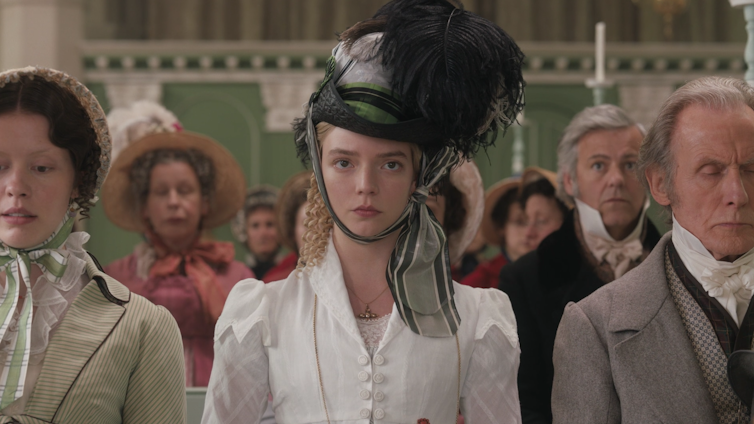
The colors are too vibrant, the skin too clear, the homes too opulent, the landscapes too gorgeous, the fabrics without any stain or wear. Every frame of director Autumn de Wilde’s version feels like a still-life painting or Instagram-ready photograph.
Perfection features explicitly in both de Wilde’s film, which has been given an early digital release as theaters close due to coronavirus concerns, and Austen’s novel. In making Emma too perfect, the film becomes Emma’s fantasy of her own life rather than Austen’s more balanced portrayal of her heroine’s many faults.
And, in truth, readers often find Emma’s general snobbery and cruel treatment of her friend Harriet difficult to forgive.
Trailer for Emma.
Fearful symmetry
Emma’s social superiority in de Wilde’s film is conveyed visually. Hardly a scene passes where Emma does not claim center stage. She is generally framed by perfectly symmetrical glittering candelabras or colorfully fringed symmetrical curtains, if not actually by the two halves of her name as in the opening titles.
Her perfect mastery of the family estate Hartfield expresses itself everywhere. Servants enter and leave in pairs, puppet-like, moving in choreographed synchrony. Emma’s invisible hand extends with tyrannical accuracy over the domestic scenes, and there is little relief from the perfection that she craves. Even her matchmaking stems from her own contrivances: “There is such symmetry between us,” she remarks about herself and potential suitor Frank, suggesting that her decisions are guided by aesthetics rather than feeling.
The perfection built up to surround Emma in the film is external. It evokes the worshipful, cowed sense that her friend Harriet feels on her first visit to Hartfield. The viewer of Emma remains an outsider, like Harriet, a spectator of the sumptuous visual displays.
An imperfect insult
In the novel, Emma’s failings are plentiful.
In one scene in both film and book, Emma insults her old and impoverished friend Miss Bates at a picnic. In the awkward moment after the insult, a fellow guest offers a riddle: What two letters spell perfection? The answer, as any Austen reader knows, is M.A. – pronounced “Emm-a” – an ill-timed compliment to the heroine, who has just demonstrated how imperfect she can be. The script stays remarkably true to the novel in this scene, but the response by Emma’s suitor, George Knightley is different. In the novel, he remarks that “perfection should not have come so soon.” In the film he says, “Who can improve upon perfection?” The distinction is subtle, but important: The film’s Mr. Knightley seems more disposed than Austen’s to attribute perfection to Emma.
Likewise de Wilde’s film minimizes Emma’s reckless toying with her friend’s heart. Emma still browbeats Harriet into rejecting the suitor she loves. Yet in the film, their friendship is stronger and persists in a way not possible in the novel. By the end, de Wilde’s Emma cares enough about Harriet to reject Mr. Knightley’s proposal. The novel’s Emma could not indulge in such “generosity run mad,” and the friendship subsequently subsides.
Morals or macaroons
The film constantly distracts us from moral lessons or deeper human connections, focusing instead on macaroons, hair ornaments, waistcoats and other tokens of superficial beauty. De Wilde’s Emma sacrifices complex personality and playfulness of spirit to the subtle tyranny of synchrony, symmetry and surface order, which Emma uses to her advantage.
Even when given the chance to explore Emma’s failings, the film version hesitates. The novel provides a potent rival for Emma in Jane Fairfax. In the book, when the two face off in dueling piano performances, Jane’s playing and singing are “infinitely superior” to Emma’s. Yet the film translates this superiority into harsh, virtuoso piano skills that startle the audience out of their pleasant somnolescence. Jane’s skill at Mozart’s Sonata in F shocks and amuses but isn’t pleasing enough in the film to mortify us on Emma’s account. De Wilde allows Emma to reign supreme.
Given the way Emma has been developed to embody soft tyranny and perfection, it is all the more striking when at the climax — the moment of Mr. Knightley’s proposal — de Wilde disrupts Emma’s visual and external perfection. When Mr. Knightley asks Emma to marry him, we all hold our breath. In the book, Austen doesn’t allow us to hear Emma’s acceptance. “What did she say?” taunts the narrator, “Just what she ought, of course. A lady always does.” At the moment when we readers most crave sincerity and direct expression from Emma, when we want her to just be a rational creature speaking the truth from her heart, she remains “a lady” and seems to conform to social conventions in superficially perfect expressions.
De Wilde uses a striking visual choice to humanize this moment. We’re all curious – waiting to hear Emma say “just what she ought.” Instead, we’re greeted by an exceedingly ill-timed nosebleed.
Nosebleeds and nudity
The brilliance of the proposal scene nosebleed is that it highlights the relationship between Emma as “lady” and Emma as “woman.” In this key moment, Emma’s humanity bleeds through her perfectly coiffed, ironed and embroidered facade. The brilliant red trail of blood stands out in remarkable contrast to the virginal, delicate white fabrics and blossoms surrounding her and Mr. Knightley. Their intimacy does not advance through words but instead through physical contact. A closeup of a gloved hand gives way in a subsequent scene to a thinly laced glove and skin on skin at the marriage altar.
De Wilde’s other bold move is to include nudity in the film. Mr. Knightley is introduced in the buff, and we also see Emma’s bare bottom warming at the hearth. De Wilde uses nudity and nosebleeds to create chinks in Emma’s armor.
Austen informs us that Emma “was not loth to be first.” De Wilde indulges Emma in her wish for preeminence. The film begins as Emma, head lying on a silk-trimmed pillow, just opens her eyes; the film ends as her lace-covered eyes close upon the audience. Emma’s vision literally brackets the film itself.
As the period in the title suggests, Emma is a sentence unto herself. She is alpha and omega to this film adaptation. None may question her absolute dominion. And yet, perhaps, perfection should not have come quite so soon or quite as completely. With such perfections, only broad visual strokes, such as nosebleeds and nudity, can bring her down to human proportions.




 At the BookShelf

You must be logged in to post a comment.