
Unknown's avatar

Gerald Murnane’s Prime Minister’s Literary award is long overdue


File 20181205 186064 2dy2nk.jpg?ixlib=rb 1.1
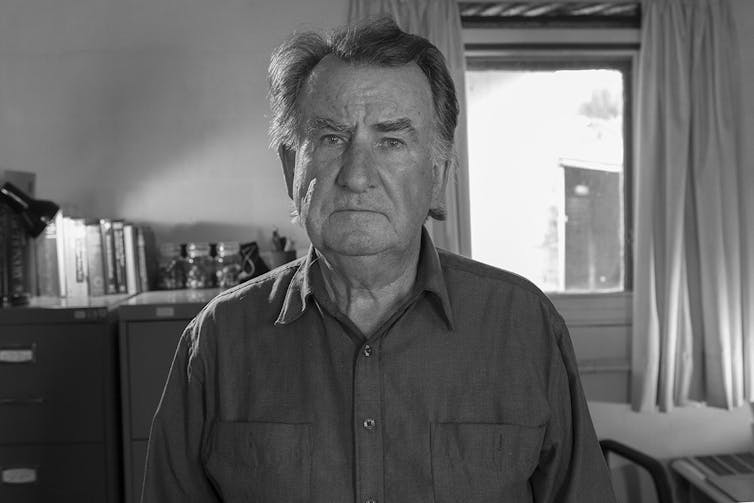
Gerald Murnane has long been recognised as one of Australia’s finest writers.
Ben Denham

Anthony Uhlmann, Western Sydney University

I first came to Border Districts through a brief description of it given to me by Gerald Murnane when I first met him three years ago. I thought he had told me that he did not think it was as complex as another work he wrote around the same time, A Million Windows.
I clearly misunderstood the insight Murnane was offering into this book, which he also claimed would be his last. The more I read and reflect on Border Districts, the more profound and difficult it becomes.

Murnane, who has long been recognised as one of Australia’s finest writers, has also long been neglected. The Prime Minister’s Literary Award is the first major award a book of his has received. The recognition is long overdue and just in time. It shows that there is still a place in Australian life for works of art that challenge us to think; that unapologetically ask us to think about what things, the things we live among and perceive, mean.

The novel is situated within a framing setting much like present day Goroke in the border districts of Victoria and South Australia where Murnane now lives. Within this frame, the narrator moves between scenes of a remembered life, using motifs and images to draw these fragments together.

In Border Districts, the narrator claims that the work he is writing is not a work of fiction; rather it is “a report of actual events and no sort of work of fiction”.

He continues:

As I understand the matter, a writer of fiction reports events that he or she considers imaginary. The reader of fiction considers, or pretends to consider, the events actual. This piece of writing is a report of actual events only, even though many of the reported events may seem to an undiscerning reader fictional.

What comprise actual events, however, are the images that occur within the mind of the writer. In the passage just cited the narrator is imagining what it might be like to be within the mind of a long dead maiden “aunt” or cousin of a friend at whose house he stays when visiting the capital city of his state.

He imagines he might be sleeping in the room she slept in. He knows certain things about her, most tellingly, that she was being courted by a young man who went to fight in world war one and never returned. He pictures her associating images that concern a narrative of a possible life she might have led if her suitor had not died, if she had instead married him and moved with him to a farming district to work for a landowner.

The story he imagines would, in anyone else’s terminology, be called a fictional story, and yet the narrator insists that all of these image-events are actual. The heart of the matter is the feeling of understanding, or meaning, that is given to the reader. The narrator questions whether “feeling” is adequate to this process, and so uses the word “essence”.

Fragments into patterns

The narrator of Border Districts speaks of the images with which meaning is created as fragments that are drawn together as a kaleidoscope draws together its fragments of colour.

The narrator sees his mind as drawing together these fragments into patterns, which then become meaningful to him, and this includes beliefs that once gave his life meaning, which he no longer believes in:

He might have begun to understand that even the images that he claimed no longer to believe in — even these were necessary for his salvation, even if they were not more than evidence of his need for saving imagery.

“Saving imagery” might mean “imagery that relates to salvation” or it might mean “imagery that is preserved”.

While unfashionable to do so, then, Murnane charges fiction with a heavy responsibility and claims immense value for it. Fiction needs to preserve or guard images that give our lives a sense of meaning.The Conversation

Anthony Uhlmann, Director, Writing and Society Research Centre, Western Sydney University

This article is republished from The Conversation under a Creative Commons license. Read the original article.
Unknown's avatar

Not My Review: The Expanse (Book 2) – Caliban’s War by James S. A. Corey


Unknown's avatar

Children Reading Children’s Classics?


The link below is to an article that questions the ‘need’ for children to read classic children’s books.

For more visit:
https://bookriot.com/2018/11/13/do-we-have-to-read-childrens-classics/

Unknown's avatar

Free Design Tools for Writers


The link below is to an article that takes a look at 5 free design tools for writers.

For more visit:
https://indiereader.com/2018/11/5-free-and-awesome-design-tools-for-writers/

Unknown's avatar

2018 Goldsmiths Prize for Fiction


The links below are to articles reporting on the 2018 Goldsmiths Prize for Fiction, including the shortlist and winner. The chronology of articles runs from top to bottom.

For more visit:
https://www.theguardian.com/books/booksblog/2018/sep/26/novel-senses-of-new-the-2018-goldsmiths-prize-for-fiction-shortlist
https://www.theguardian.com/books/2018/nov/14/robin-robertson-wins-goldsmiths-prize-innovative-fiction-long-take
https://www.gold.ac.uk/goldsmiths-prize/

Unknown's avatar

Ebooks Are Done!


The link below is to an article that predicts/announces the demise of the ebook (what nonsense).

For more visit:
https://observer.com/2018/11/ebook-sales-decline-independent-bookstores/

Unknown's avatar

Reading Big/Long Books


The link below is to an article that takes a look at how to read big/long books.

For more visit:>br>https://bookriot.com/2018/11/14/reading-big-books/

Unknown's avatar

Harlequin Changes


The link below is to an article that reports on changes to ebooks published by Harlequin.

For more visit:
https://goodereader.com/blog/electronic-readers/harlequin-ebooks-will-no-longer-work-on-e-readers

Unknown's avatar

What big data can tell us about how a book becomes a best-seller


File 20181119 76163 9bhvg8.jpg?ixlib=rb 1.1
Factors ranging from the timing of a book’s release to its subject matter can determine whether it will crack the vaunted list.
Billion Photos/Shutterstock.com

Albert-László Barabási, Northeastern University

The average American reads 12 or 13 books a year, but with over 3 million books in print, the choices they face are staggering.

Despite the introduction of 100,000 new titles each year, only a tiny fraction of these attract a large enough readership to make The New York Times best-seller list.

Which raises the questions: How does a book become a best-seller, and which types of books are more likely to make the list?

I’m a data scientist. Recently, with help of Burcu Yucesoy, a postdoc in my lab, I put the reading habits of Americans under our data microscope.

We did so by analyzing the sales patterns of the 2,468 fiction and 2,025 nonfiction titles that made The New York Times best-seller list for hardcovers during the last decade.

Real lives, imaginary action

The first thing the data reminded me is just how few books in my favorite category, science, become best-sellers – a paltry 1.1 percent. Science books compete for a spot on the nonfiction list with everything from business to history, sports to religion.

Yet, on the whole, hardcovers in these categories don’t fly off the shelves, either.

Which nonfiction titles do? Memoir and biographies, with almost half of the 2,025 nonfiction best-sellers falling into this category.

Then we examined the fiction list. Much of the press focuses on literary fiction – books we see debated by critics, lauded as important and culturally relevant, and eventually taught in schools.

But in the past decade, only 800 books categorized as literary fiction made the best-seller list. Most best-sellers – 67 percent of all fiction titles – represent plot-driven genres like mystery or romance or the kind of thrillers that Danielle Steel and Clive Cussler write.

Action sells – there’s no surprise there.

But it was unexpected the degree to which only a handful of authors repeatedly appear: Eight-five percent of best-selling novelists have landed multiple books on the list. Mystery and thriller novelist James Patterson, for example, had 51 books on the best-seller list in the period we explored.

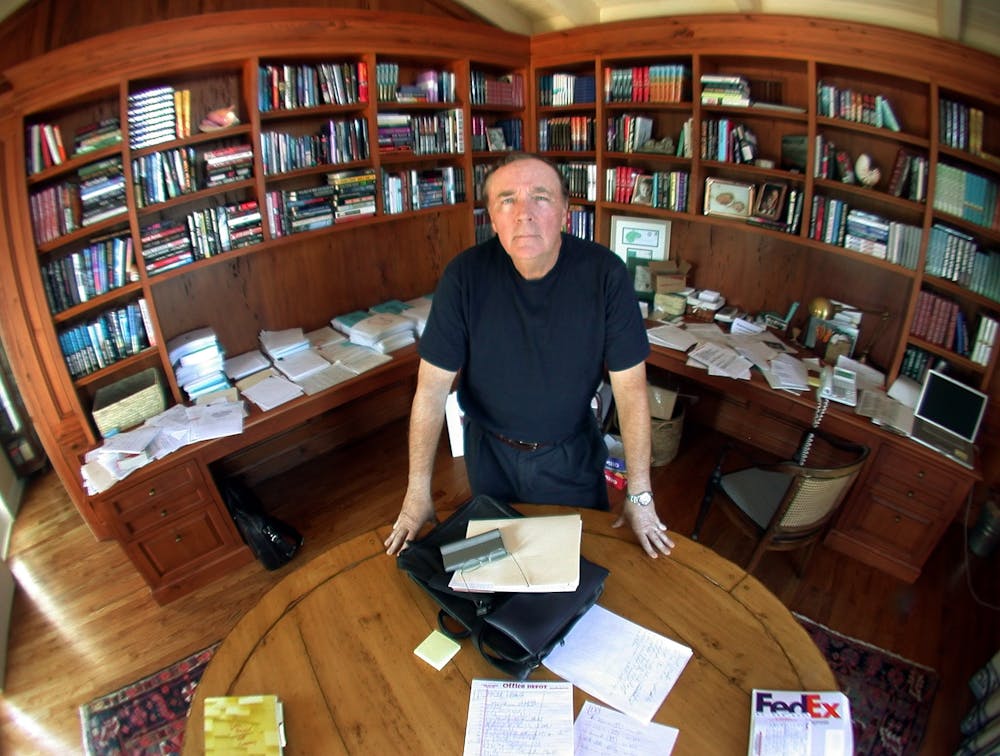
James Patterson has sold over 100 million copies of his book, grossing more than US$1 billion in sales.
AP Photo/Wilfredo Lee

By contrast, only 14 percent of nonfiction authors had more than one best-selling book. Perhaps this is because the genre often requires expertise on a specific subject matter. If an author primarily writes about football, or neuroscience, or even her own life, it’s difficult to generate 10 books on the topic.

A universal sales curve

Publishers eagerly slap “New York Times Bestseller” stickers on each book that appears on the list’s 15 slots.

A quarter of those, however, have only a cameo appearance, briefly grabbing a spot at the bottom of the list and dropping out after a single week. Only 37 percent have some staying power and spend more than four weeks on the best-seller list. Even fewer – 8 percent – attain the number one spot.

Some rare exceptions can lease out a spot for years: “The Help” by Kathryn Stockett lingered on the fiction list for an astonishing 131 weeks, while Laura Hillenbrand’s “Unbroken” stayed on the nonfiction list for a record 203 weeks.

One big misconception is that you have to write a mega-seller to make the list. The majority of titles on The New York Times best-seller list only sell between 10,000 and 100,000 copies in their first year. “The Slippery Year,” a 2009 memoir by Melanie Gideon, made the list with a yearly sale of fewer than 5,000 copies.

How is this possible?

Our data set shows that just about your only chance of making the list is right after your publication date.

That’s because book sales, we discovered, follow a universal sales curve – there’s a single mathematical formula that captures the weekly sales of all books. And that sales curve has a prominent peak right after the release, meaning you sell the most copies during the first weeks after your book’s release. Fiction sales almost always peak within the first two to six weeks; for nonfiction, the peak can come any time during the first 15 weeks.

https://datawrapper.dwcdn.net/A6uG3/1/

While you might assume that there would be overlooked books that build their audiences slowly and eventually make it onto the hallowed list, there really aren’t.

It’s all about the timing

In other words, what happens during a brief window of time can foretell a book’s success.

For this reason, the timing of the release matters a great deal, especially since the threshold to reach the list varies throughout the year.

In February or March, selling a few thousand copies can land a book on the best-seller list; in December – when sales skyrocket during the holidays – selling 10,000 copies a week might not guarantee a book a spot.

So when should authors publish?

It depends on their circumstances. If they lack a strong fan base, and their hope is to simply make it onto the best-seller list, it’s best to aim for February or March.

At the same time, appearing on The New York Times best-seller list doesn’t necessarily guarantee that a book will sell more copies. Research shows that appearing on the list tends to boost sales only for unknown authors, and the effect disappears after one to three weeks.

So for well-known authors or celebrities who already have built-in fan bases, appearing on the best-seller list might not matter as much. Instead, they’ll likely want to maximize sales – in which case, it’s best to publish in late October: The release will coincide with peak sales in December, when bookstores are packed with Christmas shoppers.

The good news is that if you’re like me – and have written several books that didn’t end up as best-sellers – you still have a chance to break through: Our analysis shows that only 14 percent of novelists made the list with their first book.The Conversation

Albert-László Barabási, Robert Gray Dodge Professor of Network Science, Northeastern University

This article is republished from The Conversation under a Creative Commons license. Read the original article.

Unknown's avatar

Little Free Libraries


The links below are to articles on Little Free Libraries.

For more visit:
https://www.goodreads.com/blog/show/1419-do-good-how-to-help-the-little-free-libraries
https://bookriot.com/2018/11/12/maintain-a-little-free-library/