Unknown's avatar

In the 1600s Hester Pulter wondered, ‘Why must I forever be confined?’ – now her poems are online for all to see


File 20181120 161627 mneb7m.png?ixlib=rb 1.1
For centuries, Pulter’s manuscript lay untouched at the University of Leeds’ Brotherton Library.
University of Leeds Library, Brotherton Collection, MS Lt q 32, CC BY-NC-SA

Samantha Snively, University of California, Davis

In 1996, a graduate student named Mark Robson was creating a digital catalog of the University of Leeds’ Brotherton Library when he discovered a small manuscript on the shelf. The elegantly titled “Poems Breathed Forth by the Noble Hadassas” contained 120 poems and a half-finished prose romance.

As far as Robson could tell, the manuscript hadn’t been read in over 250 years. He hadn’t heard of the “Noble Hadassas” – nor had anyone he asked.

But a riddle scribbled in the manuscript offered a hint about her true name: “Marvel not my name’s concealed / In being hid it is revealed.”
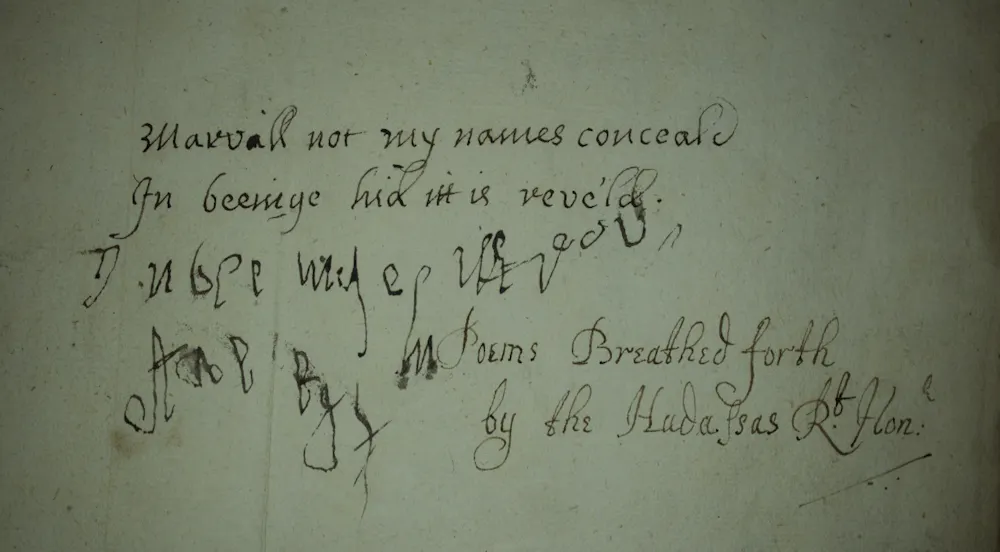
The clue written in the manuscript.
University of Leeds Library, Brotherton Collection, MS Lt q 32., CC BY-NC-SA

In the Biblical story of Esther, “Hadassah” is Esther’s Jewish name. In early modern England, “Hester” and “Esther” were versions of the same name. They’re also anagrams. That allusion to “Esther” – in addition to a couple of references to an estate named Broadfield – gave scholars just enough evidence to search public records for possible authors.

The mystery manuscript turned out to be a collection of poems by a 17th-century English woman named Hester Pulter.

At first glance, the verses of a self-taught, unpublished poet might not seem remarkable. But Pulter was writing in an era of chaos and change in England. She was eager to explore some of the most exciting scientific ideas of the time. And in a time when women were expected to be silent and chaste, she took risks in her poetry and confidently expressed her ideas.

Now, a collaboration between literary scholars across the globe is bringing Hester Pulter’s poems to the public, in the form of an open-access digital edition called The Pulter Project, which launched on Nov. 15, 2018.

Who was Hester Pulter?

Pulter was born into the aristocratic Ley family in 1605 and married Arthur Pulter when she was relatively young. After marrying, she spent much of her life at the isolated Pulter estate, which was over a day’s journey from London. She wrote most of her poems at home and would occasionally travel to London to visit other family members.

Since Pulter mainly kept to herself and rarely left her home, most of what we know about Hester comes from public records. She gave birth to 15 children, only two of which survived to adulthood, and lived through the English Civil War, which lasted from 1642 to 1651.
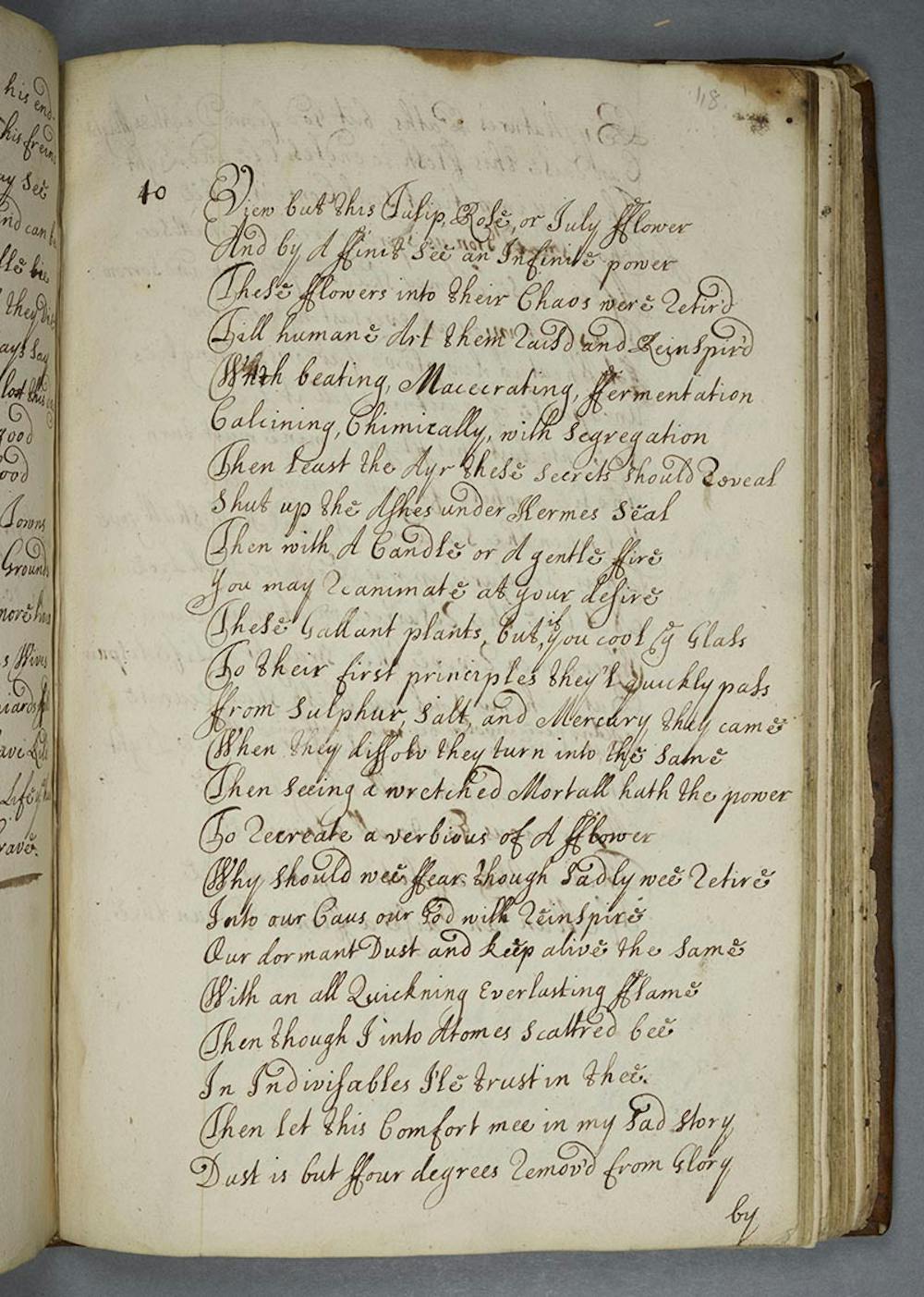
The original manuscript of Hester Pulter’s ‘View But This Tulip.’
University of Leeds Library, Brotherton Collection, MS Lt q 32

Literary scholar Alice Eardley, who produced the first scholarly edition of Pulter’s works in 2014, has suggested that Pulter’s relative isolation inoculated her from pressure by readers or literary society to conform to a certain style or subject matter. It gave her the freedom to write innovative, opinionated, emotionally complex poetry.

Pulter’s poems, which range from the political to the autobiographical, appear to have been written throughout the 1640s and 1650s. In the 1660s, Hester worked with a scribe to create a presentation copy of her draft poems, making notes and annotations on the manuscript.

It’s likely she never intended to publish her poems, however. In 17th-century England, women who published risked being seen as vulgar and sexually suspect. In order to avoid slander, the few women who did publish usually wrote about topics more aligned with proper womanly values: household guides, devotional books and diaries or memoirs of their husbands.

An aristocratic woman like Hester would have been expected to behave modestly, keep quiet and focus on her household rather than write about political conflicts and scientific experimentation. Pulter’s small family may have read her work, but it seems that her poems sat untouched after her death until they were rediscovered in 1996.

Poetry that’s observant, personal and political

Although Pulter lived a relatively isolated existence, her poems reveal a deep intellectual engagement with the most pressing issues and ideas of the mid-1600s. From the references she makes in her work, it’s clear that she had read works of natural history, alchemy and descriptions of America like William Wood’s “New England’s Prospect.”

She also appears to have kept up with major scientific discoveries, including Galilean astronomy and the microscope. In “Universal Dissolution,” she acknowledges Galileo’s discoveries, describing the sun as the “front and center of all light,” the star around which all other “orbs perpetually do run.”

Pulter was also a keen observer of nature. In “The Pismire,” she describes watching an ant colony at work for an afternoon. “View But This Tulip” shows off her familiarity with alchemy and early experimental practices, and in it she begins to think about the human body as composed of recyclable atoms. These poems place her within a culture of experimental observation that was part of the rise of modern science.

And she certainly didn’t shy away from expressing her political views.

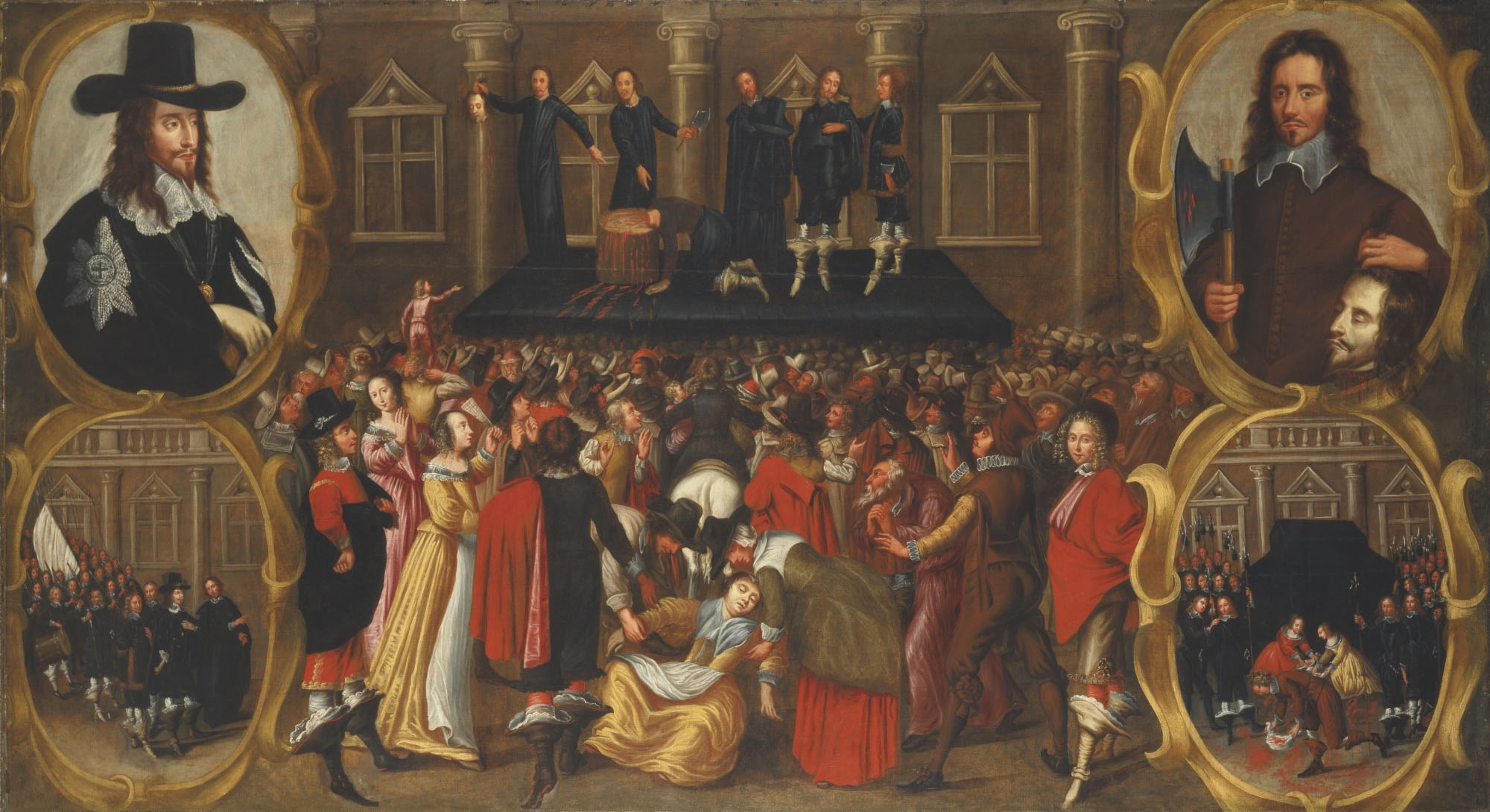
Hester’s parents were Royalists – supporters of Charles I – and she remained a Royalist even when many of her extended family and neighbors supported Parliament instead. Many of her poems express grief at the havoc the civil war caused in England, and mourn a breakdown of religious and social hierarchy.
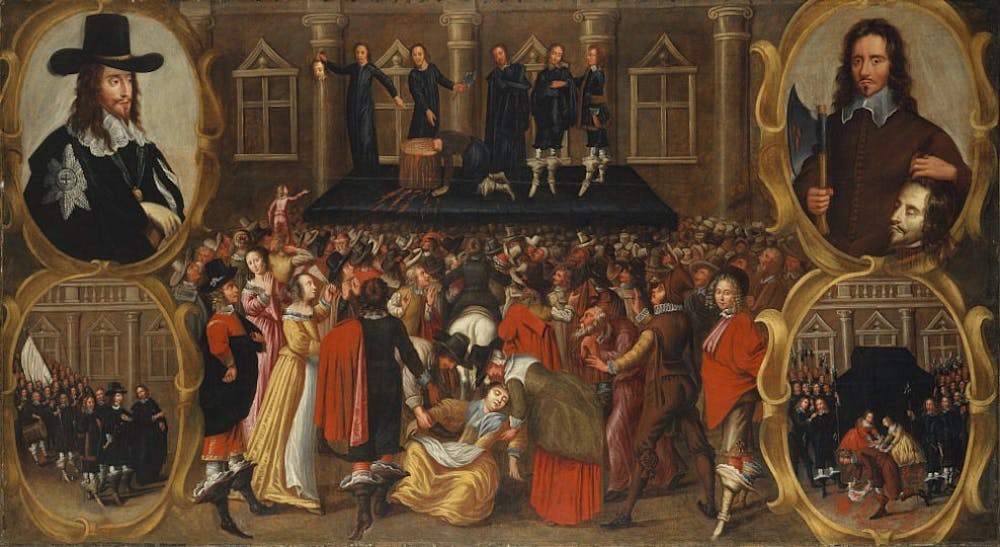
A 17th-century oil painting depicts the execution of Charles I.
Scottish National Gallery

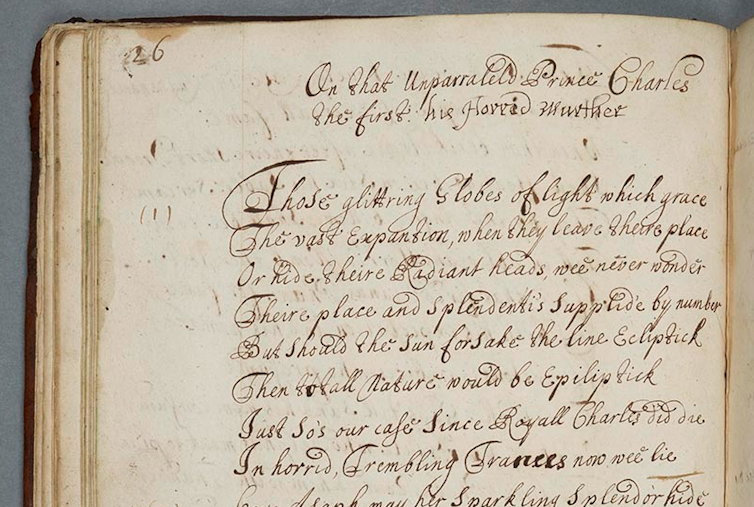
In “On that Unparalleled Prince Charles, His Horrid Murder,” she compares a country without a king to the universe without a sun, both of which fall into chaos.

But her political poems avoid outright tribalism. Instead, they’re nuanced and well-informed, and they critique the ruling class for their role in social collapse.

Pulter is equally comfortable writing about personal experiences like her illnesses or a child’s death. She surveys the effects of time on her body in “Made When I Was Sick, 1647,” and in “Upon the Death of My Dear and Lovely Daughter, Jane Pulter,” deals with the grief of losing yet another child. It’s tinged with envy of parents with healthy children:

    All you that have indulgent parents been,
    And have your children in perfection seen
    Of youth and beauty: lend one tear to me,
    And trust me, I will do as much for thee,
    Unless my own grief do exhaust my store;
    Then will I sigh till I suspire no more.

She also expresses early feminist ideas, and addresses, in complex ways, how society constricts women’s behavior, devalues their work and diminishes their intellectual value.

From “Why Must I Thus Forever Be Confined?”:

    Why must I thus forever be confined 
    Against the noble freedom of my mind?
    Whenas each hoary moth, and gaudy fly 
    Within their spheres enjoy their liberty.

Reaching new readers

Hester Pulter is clearly worth knowing. Her works speak to the major issues of 17th-century England and provide a rare lens on English culture.

In an effort to bring Pulter’s poems to the public, early modern literature professors Wendy Wall and Leah Knight created The Pulter Project. They collaborated with a host of other scholars from the U.S., Canada, Australia and England to create a free, digital edition of Pulter’s works.

The Pulter Project allows readers to toggle between scans of the manuscript, basic and annotated editions of poems, and explanatory notes. Readers can also explore “curations” for each poem, which are images and selections from texts relevant to the content of a given Pulter poem.

Editors draw on their expertise of 17th-century English culture to contextualize the poems and also make connections to modern culture. The curated materials for “Made When I Was Not Well,” for example, discuss “invisible woman syndrome,” the social phenomenon of women disappearing from public view when they reach middle age, or are ridiculed and criticized for attracting public attention.

Curations for “My Love is Fair” explore racialized beauty standards, topics just as relevant for 17th-century readers as they are for today’s intersectional feminists.

The Pulter Project shows what’s possible when the literary canon is expanded to include new writers and more women. Poets like Hester Pulter change our understanding about who could – and did – participate in the scientific, political and intellectual debates of centuries ago.The Conversation

Samantha Snively, PhD Candidate in Early Modern Literature, University of California, Davis

This article is republished from The Conversation under a Creative Commons license. Read the original article.
Unknown's avatar

A view of Johannesburg through lenses from a different era


File 20181102 83632 1eg4s21.png?ixlib=rb 1.1
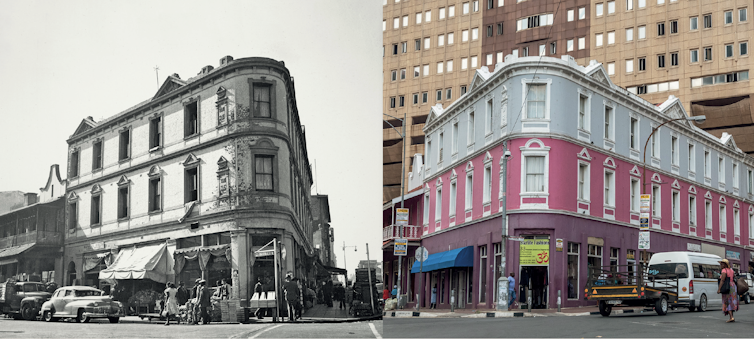
Carmel Building in Diagonal Street, Johannesburg.
Museum Africa (left) Yeshiel Panchia (right)

Kathy Munro, University of the Witwatersrand

Johannesburg was always a much photographed place from its earliest days. It was a city that grew up with photographers and their cameras. As a town of migrants and immigrants, people wanted to send postcards and photographic souvenirs back home.

Some proof is in a new book, Johannesburg Then and Now, by history blogger, Marc Latilla. It is a series of photographic juxtapositions of early photographs of the city – dating from the 1880s to the 1940s – with contemporary images of the same street scene or building by photographer Yeshiel Panchia.

The book is descriptive rather than analytical, with the emphasis on Johannesburg buildings, places and streets and not its people. Latilla’s love and passion for his city comes through in his descriptions.

Young city

At a mere 132 years Johannesburg is a young city compared with cities of the world. London and Rome go back over 2000 years.

It started as a mining camp with a gold bonanza once George Harrison had found gold on the Main Reef in 1886. The new mining settlement was named Johannesburg – the origins of the name and who precisely was the “Johannes” of Johannesburg is still in dispute. The camp grew over time to a city. Today it is a metropolis that dominates the province of Gauteng, both as the provincial capital and the financial heartland of South Africa.

Johannesburg is a fractured city, divided in all sorts of ways. Geographically it’s split by the mines of the Witwatersrand – one can still see their remains south of the city while the north has a very different landscape.

Another divide was created by the railway which cut the town in half with the most affluent suburbs to the north and the less affluent to the south.

The city’s economic divide was also evident in the architectural styles of the residential areas which reflected status: from the working class, to the lower and upper middle class, and then at the very top end the grand estates on the northern ridges for the Randlords and newly enriched capitalist class.

The town was also divided by race from its earliest days. While there was always economic integration, segregated residential areas for different racial groups were the norm. The township of Soweto was created in the 1930s when the white government started separating black people from white people.

This policy of racial and class separation was perpetuated further when apartheid became official policy in 1948. It also led to forced removals of black people to townships outside the “white” city.

Growing in circles

Johannesburg has always grown in concentric circles. Municipal boundaries were periodically extended, mapped and basic services of water, sewerage, lighting, tramways financed by an increasing number of ratepayers brought into the net to support the city. Soweto, once the internationally recognised site of the 1976 youth uprising, is now part of the city, but so is the glitzy new glass and concrete post-modern city of Sandton.

The Johannesburg that has been captured in this book though is the old Johannesburg; what was called the Central Business District and its surrounding suburbs. This is Johannesburg from 1886 to a date more or less 50 years later when the city celebrated its jubilee with the Great Empire exhibition at Milner Park in 1936.

I should declare an interest – I was first asked by Penguin Books if they could use an image of an old early title deed that I had written about and then to give the book a preliminary early opinion. As historian I found myself drawn in to assist in some fact checking and comments to help the author. Of course the selection of photographs and his commentary remain his entirely.

The old photographs were taken by countless unknown and mainly anonymous photographers. They are remarkable in their own right. It was so much more difficult to take and make a photograph in 1900 than in our digital age. Those old photos in black and white are works of art as much as are the perfect colour and light reflected images of today. The sources of the old photographs are primarily from collections held by the University of the Witwatersrand, Museum Africa and the Transnet Heritage library. The early photographs are tend to be undated, so that the “then” can be any time from circa 1890 to the 1930s and even later, while the now photographs are all in colour and clearly belong to the last few years.

Superb find

My favourite photo is the old aerial view of the Harrow Road redevelopment when the first Johannesburg freeway was engineered (Harrow has since been renamed after a famous Johannesburger, the liberation struggle stalwart Joe Slovo). The photo allows us to see precisely how Harrow Road was widened and changed direction in the fifties. This single photo is a superb find.

A book such as this makes a contribution to heritage because it captures, assembles and documents the old and now the new. Where old photographs have been found recording what a particular building looked like and the building is still there, such photographic documentation strengthens the heritage preservation case.

However, none of the grit, crime, grime, litter or lack of maintenance we battle against today is visible in the modern photographs. This is the Johannesburg we don’t see: the crisis of homelessness and densification of dwellings. Who, for example, would know in the photo of Plein Street park that it is actually now a dormitory area for dozens of homeless people without jobs? Is it the city or history or harsh economic realities that has failed them? Of course one can argue that modernization and urbanization always left victims and the city of gold did not bring fabled wealth to all .

Johannesburg Then and Now is a fascinating book. It’s important for cities to preserve their pasts , because “Roots” matter as much as “shoots”. This book can perhaps start a discussion about what ought to be appreciated and “saved”. The book will remind city planners to include heritage in their planning for a 21st century city.

Johannnesburg Then and Now is published by Penguin.The Conversation

Kathy Munro, Honorary professor in the School of Architecture and Planning, University of the Witwatersrand

This article is republished from The Conversation under a Creative Commons license. Read the original article.
Unknown's avatar

Silent images speak through time in one family’s story of Poland under the Nazis


File 20181120 161624 8wzrnr.jpg?ixlib=rb 1.1
One of the photographs from Terry Kurgan’s book.
Supplied/Jasek Kurgan

Michael Godby, University of Cape Town

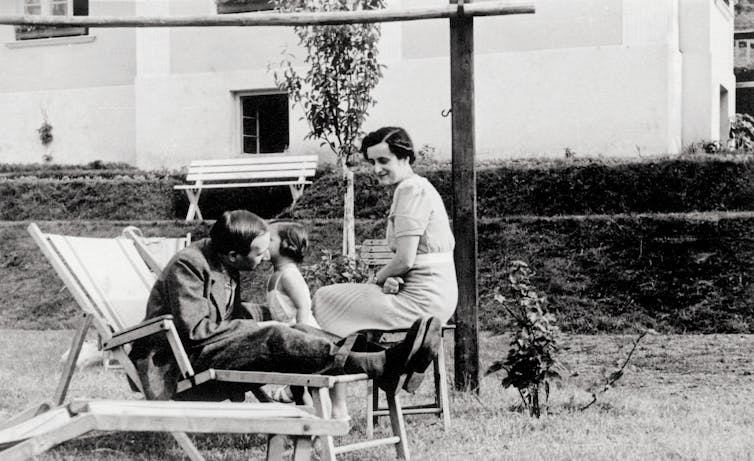
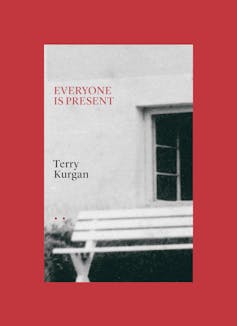
The first photograph in Terry Kurgan’s Everyone is Present shows what appears to be a mid-20th century idyllic scene of a young family at a spa in southern Poland.

It’s a scene that puts one in mind of the reverie in old photographs described by French theorist Roland Barthes in Camera Lucida and the nostalgic fragments used so evocatively by the Anglo-German novelist W.G Sebald in Austerlitz and elsewhere.

But Kurgan, the Johannesburg-based artist, writer and curator, is more forceful in her efforts to wrest meaning from this and other images. She “longs to be able to sit inside this photograph”, as she puts it, to work actively on its subject. She juxtaposes this image with others from the album she inherited from her grandfather, Jasek, to include the rest of the extended family and something of their complicated histories.

And she correlates the album with correspondence with family members and extracts from Jasek’s diary. That woman in the photograph is Jasek’s wife, Tusia, Kurgan’s grandmother. The child is Kurgan’s mother and the man reclining on the deck chair is Doctor Lax, who at that time was Tusia’s lover.

This photograph, she discovers, must have been taken in the summer of 1939, as Kurgan writes, “on the eve of one of the greatest atrocities of the twentieth century”.

In other photographs taken at the spa, people are shown reading newspapers that were likely reporting the threat from Nazi Germany. But there appears to be no reaction to this impending catastrophe. It’s the silence of these images on such matters that drives Kurgan to devise forceful new techniques to unlock their meaning.

She scans the photographs and scrutinises them on her computer screen: clothing, expressions, gestures all take on new significance as their detail is revealed. Objects or, as Kurgan calls them, “stuff”, are discovered and identified in the shadows and revealed as the repositories of intensely personal histories: what happened to the furniture when the apartment was abandoned? What happened to the cat? Did anybody water the flowers?

Connectedness, strife and betrayal

In another bid to get closer to her subject, Kurgan Googles the spa depicted in these early images. It is now trading on the days of its former glory, typified in the furniture and other objects shown in Jasek’s photographs.

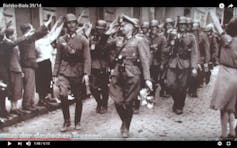
The photograph that underpins the second section of the book on the family’s flight from Poland as the Nazis invaded – and were welcomed by a large section of the local population – shows the street below the family’s apartment in the town of Bielsko. It is deserted except for two unknown men who appear to react to Jasek at the window.

Locals welcome Nazis as they invade Poland.
Supplied

Kurgan uses Google Street View to determine that the neighbourhood has changed very little over the past 70 years. But while Google allowed Kurgan an astonishing proximity to this distant place, it’s the random connection with the two men on the street in Jasek’s photograph that she ultimately finds to be more meaningful and real. She writes:

As social beings, we want to matter, to be noticed, to connect.

In a similar bid for connection, Kurgan regularly elides time when she wants to communicate the horror of the Holocaust, the Polish population’s complicity in this history, and even the lasting influence of previous generations of one’s own family.

She reacts to Jasek’s account of his arrival at Auschwitz – the concentration camp at which more than 1.1 million people were killed during the Holocaust – while it was still an ordinary Polish market town:

This short sentence plummets through the page, through my desk, through this grey concrete floor, and through the deep red Johannesburg earth.

And, on Jasek’s photograph of Roza, formidable mother of his perennially flirtatious wife: “She rebuffs him and ourselves in that split-second moment, and forever, as we gaze at her across more than seventy-five years. Now.”

Kurgan weaves major themes of modern Jewish history around Jasek’s account, in the diary and the photographs, of the family’s perilous flight from Poland via Romania, Turkey, Syria, Iraq, India and Kenya to Cape Town.

She notes repeatedly the different forms of betrayal perpetrated on Eastern Europe’s Jews by the people they had lived among for generations, when endemic anti-Semitism erupted on the back of the Nazi invasions, whether through direct assault, complicity or simply looting. Again, these are the histories of “stuff”.

For the affluent, their flight was not quite comparable to the current waves of migration moving, as Kurgan notes, in the opposite direction into Europe. But the experience of prejudiced bureaucracy, arbitrary closing of borders and abrupt implementation of quotas must have been just as humiliating.

Jasek’s photographs seemingly ignore these awful realities. They focus for the most part on family life with its own versions of strife and betrayal. Indeed, by all accounts, it was impossible for those caught up in it to make sense of this maelstrom.

History is now

In the end, Kurgan herself visited Poland: both the sites of her personal family history and those monuments of evil, the death camps.

Noticing her own reflection in a mirror as she tries with her camera to capture “a molecule of air they might have breathed”, she accepts the impossibility of this “very particular kind of retrieval”.

But that, of course, is the point. History is as much about the questions we ask as the answers it provides. In this book – by turns lyrical, angry, frustrated and forgiving – time collapses. The photographic present joins the past to the present. Everyone is present. Now.

Fourthwall’s production of the book, the quality of its images and the sensitivity of its design provide an excellent vehicle for both the strength and the delicacy of Kurgan’s essay.The Conversation

Michael Godby, Emeritus Professor, University of Cape Town

This article is republished from The Conversation under a Creative Commons license. Read the original article.
Unknown's avatar

Fantastic Beasts – experts explain the mysterious real life questions behind JK Rowling’s magic tales


File 20181121 161638 v0vvxq.jpeg?ixlib=rb 1.1
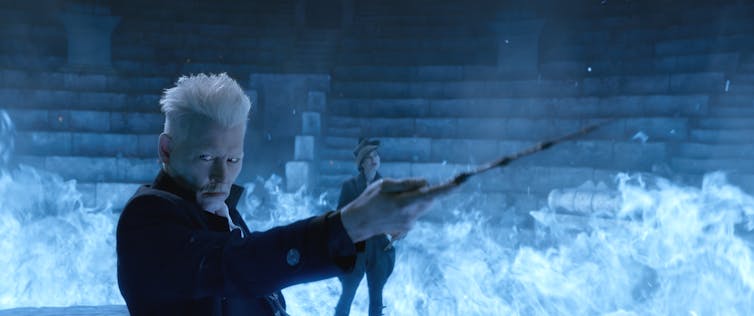
Johnny Depp as Grindelwald in Fantastic Beasts: The Crimes of Grindelwald.
© 2018 WARNER BROS. ENTERTAINMENT INC.

Nikk Effingham, University of Birmingham; Anna Cermakova, University of Birmingham; Heather Widdows, University of Birmingham; James Walters, University of Birmingham; Michaela Mahlberg, University of Birmingham, and Stephan Lautenschlager, University of Birmingham

Even in the real world there are witches among us, and fantastic beasts – and a touch of magic, too. And so to mark the release of Fantastic Beasts: The Crimes of Grindelwald, these experts have answered some of the more mysterious questions behind JK Rowling’s magical fiction. And they’ve made a series of short video explainers, too.

What would we see in the Mirror of Erised?

Professor Heather Widdows, John Ferguson Professor of Global Ethics

The Mirror of Erised (“desire” backwards), features in the Harry Potter films and The Crimes of Grindelwald. It is a magic mirror that shows “not your face but your heart’s desire”. When Harry – the neglected, lonely orphan boy – looks in the magic mirror, for example, he sees himself surrounded by a happy, loving family. His heart’s desire is to be loved and not alone.

The moral of the Mirror of Erised – and the Harry Potter universe is full of morals – is that the truly happy person sees only themselves as they really are.

But could many of us do this? In our increasingly visual and virtual culture, what many of us would likely see if we looked in the Mirror of Erised is an improved, perfected body, the imagined self, the Perfect Me. This is the self we are constantly working on. The self we imagine we will attain if only we stick to our diets, go to the gym and perform the prescribed tasks: brushing, pumping, plucking, creaming, firming, smoothing and erasing.

This is the self we seek to invoke in our doctored and digitally remastered selfies. The thinner, firmer, smoother, younger, you. Still you, but the better, best or even – if you believe the language of the beauty business – the “real” you.

Is there equality in the world of witches and wizards?

Michaela Mahlberg, Professor of Corpus Linguistics and Dr Anna Cermakova, Marie Sklodowska-Curie Fellow

In a captivating scene in Fantastic Beasts, little Modesty Barebone is playing hopscotch and singing:

My momma, your momma, gonna catch a witch,
My momma, your momma, flying on a switch,
My momma, your momma, witches never cry,
My momma, your momma, witches gonna die!

This ominous song alludes to the historical witch trials. The trials mainly focused on women and girls – and these historical connections contribute to the negative connotations we have of the word “witch”. Indeed, in today’s language, “witch” often refers to an unlikable, unpleasant or ugly woman.

But things are different for the word “wizard”. Wizards tend to have positive qualities, being wise and brave, for example – think of Gandalf from the Lord of the Rings books – and there are also positive expressions, such as “computer wizard”. The word “wizard” is also used less frequently than “witch”.

And so the words “witch” and “wizard” make a rather unequal pair. How Rowling’s Harry Potter and Fantastic Beasts series shift and question the meaning of these words for today’s children is really quite remarkable. She makes some witches (such as Hermione in the Harry Potter films) good, and some wizards, such as Grindelwald (played by Johnny Depp in the latest film) bad, subverting the old stereotypes. At the same time, it is interesting to see how our real world gender inequalities are mirrored in Rowling’s world of magic.

Are there real life Fantastic Beasts?

Dr Stephan Lautenschlager, Lecturer in Palaeobiology

In the Fantastic Beasts series, the audience is introduced to a range of weird and wonderful magical creatures: from winged horses and thunderbirds to demons and mischievous furry animals, which look like a cross between a mole and a platypus. While some of them might have been inspired by living animals, many of the beasts in the movies would seem to be too fantastic to be true if we encountered them in the wild. However, this might also be the case for many of the real-life fantastic beasts which inhabited this planet long before humans.

The evolutionary origins of modern animals date back more than 500m years, while the first traces of life itself go back as far as 3.5 billion years. Over that period of hundreds of millions of years, many animals which can only be described as fantastic beasts have evolved, conquered the water, land or air, and eventually become extinct again.

But proof for their existence is documented by their fossilised remains. In fact, the fossil record is full of fossil fantastic beasts and, as palaeontologists, we attempt to revive some of them. Not in real life, but by studying their fossilised skeletons to reconstruct their appearance, their biology and their behaviour.

What role do we play in the wizarding world?

Dr James R Walters, Reader in Film and Television Studies

The wizarding communities in the Harry Potter and Fantastic Beasts films live among ordinary people – the muggles, no-majs and non-magiques. These lives are sometimes intertwined as magical incidents spill over from one society to the next.

But who are these ordinary people? The monstrous Dursley family who abuse their magical nephew, Harry Potter? The childlike Jacob Kowalski, who cannot be trusted with the secrets of the wizarding world and must have his memory erased? Or the oblivious masses who feel only the effects of magic without seeing their causes? In these films, non-magical humans are often peripheral, inconvenient or even negative elements.

As ordinary humans, we are the muggles. In these worlds, we would be background details or minor complications. And yet the films allow us to become part of the magical world, as we move through its landscapes and share its secrets. We shake off our ordinariness and become temporary members of a society more spectacular, but less human. So, the Harry Potter and Fantastic Beasts films possess a magic common to all of cinema. As we watch the films – something I discuss further in this podcast – we are not ourselves. There, in the darkness, these films cast their spell of invisibility over us.

Will we ever be able to ‘apparate’?

Dr Nikk Effingham, Reader in Philosophy

In the world of Harry Potter, the wizards can magically move around, vanishing from one place and appearing in another. They might use “floo powder” or “portkeys”, or “apparate” away. And they can also move through time! Using a “Time Turner”, a witch or wizard can travel back into the past. But doing so is risky – who wants to end up like Madam Mintumble who travelled back to the 15th century and ended up ageing five centuries?

But if you’re careful, the skilled magician can manage to pull it off, as we know from when Hermione Grainger, from the Harry Potter stories, managed to regularly travel back in time to fit in her studies. Or when the protagonists of the books managed to push the boundaries of safety when they went back to save Sirius Black and Buckbeak the Hippogriff.

But does this make any sense? What does teleportation involve? Does being careful when we’re back in the past make a difference? And is time travel even possible? I can’t say whether time travel is physically possible (you’ll have to ask a physicist) but in my latest research, I argue that it is at least theoretically possible – like many things, we can’t rule out its possibility without first learning more about the physical world around us.The Conversation

Nikk Effingham, Senior Lecturer in Philosophy, University of Birmingham; Anna Cermakova, Marie Sklodowska-Curie Fellow, Centre for Corpus Research, University of Birmingham; Heather Widdows, John Ferguson Professor of Global Ethics, University of Birmingham; James Walters, Senior Lecturer in Film and Television Studies, University of Birmingham; Michaela Mahlberg, Professor of Corpus Linguistics, University of Birmingham, and Stephan Lautenschlager, Lecturer in Palaeobiology, University of Birmingham

This article is republished from The Conversation under a Creative Commons license. Read the original article.
Unknown's avatar

Finished Reading: An Act of War by Michael O’Connor


An Act of WarAn Act of War by Michael O’Connor
My rating: 3 of 5 stars

I first read this book at least 20 years ago and I think I read it in a day back then. I probably would have given it 4 stars back then and though I still enjoyed it this time, I don’t think I enjoyed it as much as I did the first time. It was still a good read though – it just didn’t have the polish I now expect from books I would give 4 stars to.

View all my reviews

Unknown's avatar

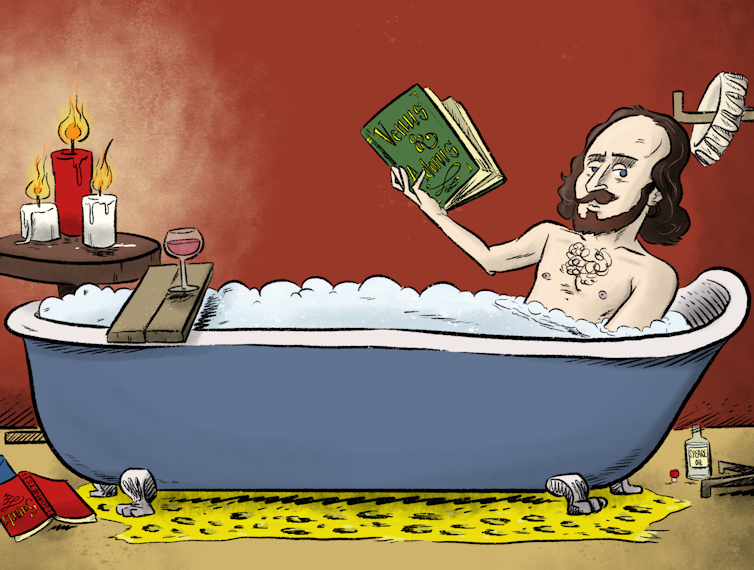
Friday essay: 50 shades of Shakespeare – how the Bard sexed things up


File 20181121 161641 8prl34.png?ixlib=rb 1.1

Wes Mountain/The Conversation, CC BY-ND

Stuart Kells, La Trobe University

It’s hard to imagine a more literary or successful author than William Shakespeare, formerly of Stratford-upon-Avon. Around the world his plays are widely taught and expensively performed. Journalists and scholars look to him for social and political insights. In Washington DC, notionally the capital of the free world, the Folger Shakespeare Library stands near the Capitol building and the Library of Congress as a grand memorial to the Immortal Bard.

Is there another author whose reputation could ever rival Shakespeare’s? Certainly not from the 16th century, nor the 17th. Perhaps Johnson or Swift from the 18th? Austen or a Brontë from the 19th? Woolf, Joyce or Hemingway from the 20th? There are contenders, to be sure, but no one has put Shakespeare in the shade.

And yet there is a problem with Shakespeare.

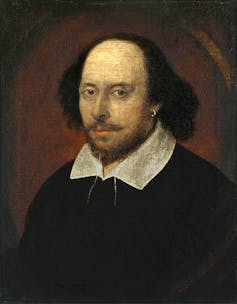
Thought to be the most authentic portrait of William Shakespeare.
Wiki Commons

Johnson, Austen, the Brontës, Woolf, Hemingway and Joyce all left behind evidence of their authorial lives. We can study diaries, letters, manuscripts, even juvenilia – a fulsome literary paper trail. With Shakespeare, though, the trail is meagre. Most of what we know of his life has come to us from arid official records, or via cryptic comments from contemporaries who hint at something mysterious or disreputable in the background.

What we notice most starkly is a documentary gap, one that people have attempted to fill in all manner of ways – by contacting Shakespeare through seances, or searching tombs and riverbeds for hidden manuscripts, or probing for secret messages in the plays, or positing all manner of “secret author” theories. According to those theories, William Shakespeare of Stratford was just a frontman for the true author of the Shakespeare oeuvre.

Many credible writers and scholars have embraced Shakespearean heresy. Disraeli, Emerson, Freud, William James, Mark Twain, Orson Welles and Walt Whitman all doubted Shakespearean authorship. Henry James was “haunted by the conviction that the divine William is the biggest and most successful fraud ever practised on a patient world”.

The heretics are right to be sceptical. Apart from the documentary gaps, there are good reasons to doubt Shakespearean authorship of at least some of the plays. They were published by men with a track record of fraud, and the printed versions conceal much about how they were produced, including the role of collaborators.

Fundamentally, though, the heretics are wrong. Thanks to four centuries of scholarship, we know William Shakespeare was an author. And we know a great deal about what kind of author he was.

Gerard Langbaine’s Dramatick Poets includes this anecdote about Titus Andronicus:

…the Play was not originally Shakespear’s, but brought by a private Author to be acted, and [Shakespeare] only gave some Master touches to one or two of the principal Parts or Characters: afterwards he boasts his own pains; and says, That if the Reader compare the Old Play with his Copy, he will find that none in all that Author’s Works ever receiv’d greater Alterations, or Additions; the Language not only refined, but many scenes entirely new: Besides most of the principal Characters heightened, and the Plot much increased.

The first significant reference to Shakespeare as a dramatist – Robert Greene’s famous “Shake-scene” attack – is a complaint about him taking credit, as an “upstart crow”, for the writings of others. There is other evidence, too, that much of his work consisted of revising and retouching plays by other people.

What did it mean for a play to undergo the Shakespeare treatment? We know the answer to that, too. It seems a lot of the treatment involved sexing things up.


Read more:
Friday essay: How Shakespeare helped shape Germaine Greer’s feminist masterpiece


Lewd Venus

Today, William Shakespeare’s surname is utterly respectable. In the 16th century, however, the name had very different connotations. It was an old and earthy name, even a rustic one, akin to “Sheepshanks” and “Silcock” and “Wetherhogg”. His peers were always making fun of his provincial origins. People spoke of his “killcow conceit” – simultaneously an allusion to his father’s humble position in the Warwickshire leather trade, and a suggestion that Shakespeare’s cobbled-together plays were heavy with crude imagery.

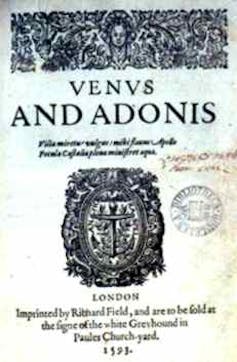
Shakespeare Venus and Adonis.
Wiki Commans

The name “Shakespeare” had another connotation as well. Shakespeare’s first reputation was as a poet, and particularly as a sex poet. In his three main books of poetry – Venus and Adonis, Lucrece, and the Sonnets – bawdy and erotic content is paramount.

Shakespeare made his first appearance in print with Venus and Adonis. Published in 1593, that book immediately earned a salacious reputation as an aid to what Michael Schoenfeldt called “solitary pleasure”. It is referred to in the anonymous Parnassus plays (1598–1602), in which the character Judico expresses love for the poem and its sweet, “hart throbbing” lines, and the character Gullio promises to “worship sweet Mr Shakespeare, and to honour him will lay his Venus and Adonis under my pillow”.

John Davies’ 1625 A Scourge for Paper Persecutors also mentions the poem, and suggests another way to enjoy it:

Making lewd Venus with eternall lines
To tye Adonis to her loves designes:
Fine wit is shown therein, but finer ’t were
If not attired in such bawdy geer:–
But be it as it will, the coyest dames
In private reade it for their closet-games.

Samuel Johnson would later list Venus and Adonis as one of the most scandalous and corrupting poems of the late 16th century.

He sex and she sex

William Shakespeare was very much alive above the ears and below the waist. A surprisingly high proportion of the documentary trail concerns his racy and bawdy exploits.

An important anecdote, from John Manningham’s 1601 diary, concerns a performance of the play we now call Richard III. Richard Burbage played the king and caught the attention of a beauty in the audience. The lady was so impressed by Burbage’s performance that she invited him to her home that evening — as long as he promised to stay in costume and character. Shakespeare got wind of the assignation and went first to the lady’s residence. Burbage arrived at the appointed time but Shakespeare was already inside, being “entertained and at his game”.

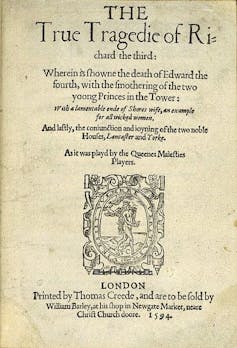
Copy of the anonymous history play Richard III.
Wiki Commons

When the lovers were informed that Burbage was at the door, a triumphant Shakespeare sent his colleague a mischievous reply that contained a sharp lesson in English history. “William the Conqueror,” he said, “was before Richard the Third.”

Jane Davenant, mistress of the Crown Tavern in Oxford, is rumoured to have been another of Shakespeare’s lovers. Her son William, the future poet laureate, inferred on multiple occasions that Shakespeare was his father in more than just a poetical sense.

By the time Shakespeare’s Sonnets were published in 1609, they were somewhat old-fashioned and enjoyed little success. But an earlier manuscript version had circulated in the 1590s. According to the clergyman Francis Meres, Shakespeare’s “private friends” had devoured these “sugared sonnets” with relish.

Today, no copies of the Sonnets manuscript are known to exist. An enduring fantasy for bibliophiles and book-hunters, the manuscript is also a puzzle. The printed edition is a fascinating shandy of hetero- and homosexual flavours. Apart from being more raw and racy, the manuscript Sonnets may have been differently organised, perhaps into sections according to whose appetites were being served. The manuscript may also have included more prefatory matter – such as a letter from the author – that explained what he was up to.

Willy Shake-Spear

A painting of the intimate relationship between Desdemona and Othello in Shakespeare’s play Othello.
Daniel Harris/flickr

Printed versions of Shakespeare’s plays started appearing in the mid-1590s, but not until 1598 did they carry his name on their title pages. The men and women who bought these thin quarto editions knew exactly what to expect. They had already been conditioned by the outputs of William Shakespeare, sex poet.

Like those of his closest peers – men such as Greene and Christopher Marlowe – Shakespeare’s plays are noteworthy for their bawdy and disreputable content. Everyone knows the scene from Othello in which Desdemona and Othello make “the beast with two backs”. There are hundreds of comparable examples. In Hamlet, the prince and Ophelia trade spicy banter:

Hamlet: That’s a fair thought to lie between maids’ legs.
Ophelia: What is, my lord?
Hamlet: Nothing.

Falstaff’s speech in Henry IV Part 2 speaks of Justice Shallow in terms such as these:

…the whores called him mandrake: [he] came ever in the rearward of the fashion, and sung those tunes to the overscutched huswives that he heard the carmen whistle.

In Love’s Labour’s Lost, Adriano de Armado makes a striking confession about the king:

…it will please his grace, by the world, sometime to lean upon my poor shoulder, and with his royal finger, thus, dally with my excrement, with my mustachio; but, sweet heart, let that pass.

OK let’s not get too carried away: “excrement” probably meant “beard”, but the contact is still intimate.

Passages of this flavour are what Shakespeare’s contemporaries meant when they said he wrote in a raw manner, “from nature”. And they are what Thomas and Henrietta Bowdler removed to make their 19th century Family Shakespeare. (They excised, for example, the “beast with two backs”.) Johnson wasn’t far from the Bowdlers in his views about the raw parts of Shakespeare. “There are many passages mean, childish, and vulgar; and some which ought not to have been exhibited, as we are told they were, to a maiden Queen.”


Read more:
Shakespeare’s lost playhouse – now under a supermarket


Shakespeare’s Hamlet was probably more vital and bawdy than its predecessor version, possibly written by Thomas Kyd and now lost. Certainly Shakespeare’s King Lear is racier and more involving than the anonymously authored prior play, King Leir, which was registered in 1594.

The Bard had good reason to rev things up. Playwrights sometimes shared in the extra profits from the performance of successful plays. Writers were smart to add spicy content that would appeal to audiences from all classes.

Saucy sources

Apart from adapting earlier plays, Shakespeare took material from histories and poems and novels. His extensive use of sources shows there was no “secret author” behind the scenes who reliably fed him texts. His own library of sources performed that role.

Shakespeare’s personal collection of books and manuscripts has never been found, but one conception of it is compelling: an erotic library rich with imported Dutch and Italian smut along with English works such as Thomas Cutwode’s scandalous The Bumble-Bee (1599) and Giles Fletcher’s equally disreputable Licia, or Poemes of Love (1593).

The field of Shakespeare studies is all about mystery and discovery. There are many uncertainties about Shakespeare, but his achievement as a libidinous “sexer upper” allows us to put one precious stake in the ground.

Although sex is the unlikely key to understanding Shakespeare’s achievement as an author, for a long time the academy shunned his racy side. That side was not, however, wholly overlooked.

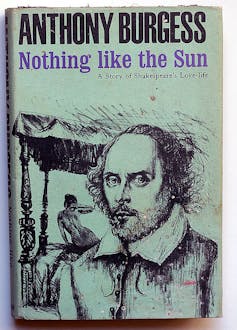
Nothing like the Sun, a story of Shakespeare’s life by Anthony Burgess.
Alexis Orloff/flickr

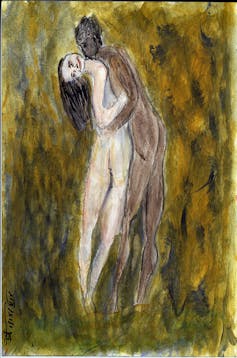
The New Zealand-born lexicographer Eric Partridge compiled the remarkable Shakespeare’s Bawdy (1947), which presents, among other things, scores of Shakespearean synonyms and euphemisms for vagina. Nothing Like the Sun (1964) by the novelist Anthony Burgess is “A Story of Shakespeare’s Love Life”; the covers of the Heinemann hardback and the 1966 Penguin softback show Shakespeare with his mistress, the mysterious “dark lady” of the sonnets.

Still, the Shakespeare of Partridge and Burgess is very different to the respectable, mainstream one. How did Shakespeare pull off the transformation from sex poet to literary monument?

Even in his lifetime he was shape-shifting, from boisterous lyricist and tearaway playwright to old-fashioned sonneteer and retired bookman. In the decade after his death, men tidied up his authorial legacy – and possibly added to it – but Shakespeare was still one writer among many, his reputation on a par with those of Marlowe and Middleton, and behind those of Jonson, Milton and Spenser.

But Shakespeare was tailor-made for the Romantic and Victorian eras, whose actors, scholars and hacks embraced and refashioned the Bard. Bowdlerising editors cut many of the ruder bits and added happier endings. By the 20th century, Shakespeare’s preeminence was immutable, his works as sublime and respectable as Beethoven’s symphonies or Mona Lisa’s smile. Things, though, could have been very different.


Professor Stuart Kells is the author of Shakespeare’s Library: Unlocking the Greatest Mystery in Literature (Text Publishing).The Conversation

Stuart Kells, Adjunct Professor, College of Arts, Social Sciences and Commerce, La Trobe University

This article is republished from The Conversation under a Creative Commons license. Read the original article.

Unknown's avatar

Book: Are short prime ministerships the new normal?


File 20181106 74754 yhd9jn.jpg?ixlib=rb 1.1
Malcolm Turnbull was the latest prime minister to be ousted before the end of his term in August, 2018.
AAP/Sam Mooy

Benjamin T. Jones, Australian National University

This is an edited extract from Elections Matter: Ten Federal Elections that Shaped Australia (Monash University Press 2018), edited by Benjamin T. Jones, Frank Bongiorno and John Uhr.


In 2004, the Australian Labor Party, led by Mark Latham, was expected either to win or closely contest the upcoming election. Instead, John Howard’s Liberal-National Coalition secured a comfortable victory, increasing its majority in the House of Representatives and securing a majority in the Senate.

Although disappointed, Labor took comfort in the fact that it had taken the coalition five attempts to oust the Hawke-Keating Labor governments. The conventional wisdom was that Australians simply do not change governments quickly. With the turbulent Whitlam years seen as an exception to the rule (and even he secured two successive victories), in post-war Australian politics, long terms in office was an expectation.


Read more:
Moment after moment of madness: Liberals manage the ugliest, messiest leadership challenge in history


This view might now be considered the old normal. Following the landslide Kevin07 victory, many predicted Kevin Rudd would be a long-serving prime minister, perhaps handing the reins to his popular deputy, Julia Gillard, in a third or fourth term. That he did not even see out one full term in office marked a new era in Australian politics.

Rudd’s swift dismissal cannot be explained away by his personal traits or leadership style. With Australia’s first female prime minister at the helm, Labor clung onto power following the hung parliament result of 2010 with support from nominally conservative rural independents Tony Windsor and Rob Oakeshott. Once again, a new prime minister would not see out a full term, with Rudd wrestling back control after a second leadership challenge.

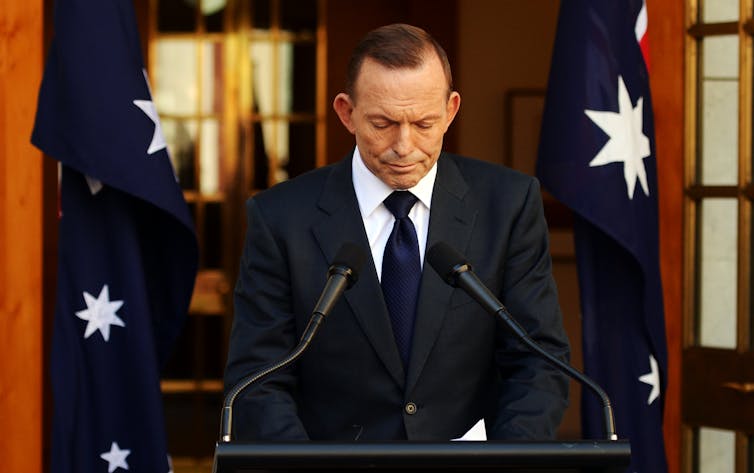
Tony Abbott was defeated by Malcolm Turnbull in a leadership ballot in 2015, following Labor’s pattern of not allowing prime ministers to serve out their terms.
AAP/Sam Mooy

This could perhaps be explained away as a particularly dysfunctional episode of Labor rule, except the Coalition would then follow the same pattern. In 2013, the newly-elected Abbott government promised strong and stable government under Coalition rule. “The adults are back in charge”, he smugly claimed. And yet, Abbott too would fail to see out his first term as prime minister, losing a leadership challenge to Malcolm Turnbull in 2015.

Turnbull won the 2016 election by a single seat in the lower house and the Coalition has consistently trailed Labor in the polls. As with the previous three terms of parliament, the prime minister who claimed electoral victory would not survive till the end.

This is the new normal of Australian political life. The coup against Turnbull marked the fourth consecutive term with a change of prime minister. John Howard in 2004-7 was the last prime minister to serve a full term in office, and even he was plagued by persistent leadership rumours leading to a public promise that he would hand over power to his deputy Peter Costello.

The new normal is marked by electoral volatility. The major parties can no longer take for granted a primary vote in the high 30s. As the Greens, Palmer United, One Nation, and the Xenophon Team, have shown, Australia is more willing than ever to cast large numbers of votes for minor parties as well as independents. It is no longer a truism that Australians do not change government quickly.

The old normal would presume that an incoming federal government will set the national agenda for a decade or more. Especially after the 2010 result, one term governments are entirely conceivable. The most pronounced feature of the new normal is the ease with which a prime minster can be replaced. Dumping a first term prime minster, considered political hubris for so long, is now a regular occurrence.

The BBC dubbed Australia the “coup capital of the democratic world” in 2015. Should Scott Morrison lose the 2019 election, there will have been six prime ministers in the six years since 2013.

Although the new normal represents a profound change, it is far from unprecedented. Australia had three prime ministers in 2013. While this may have seemed historic, it is the fifth time this has happened (1945, 1941, 1939 and 1904).

The early Federation period saw a high turnover of prime ministers. It was only when Billy Hughes took the top job in 1915 that Australia saw its first long-serving prime minister (seven years, 105 days) albeit with three different parties.


Read more:
Grattan on Friday: Morrison ticks the boxes but can’t hide the dysfunction


To the pessimist, the frequent change of prime ministers over the last decade can be seen as evidence of political instability and turmoil. Alternatively, much like Australian politics at the dawn of the 20th century, it could be seen as evidence of the flexibility built into Westminster democracy. It is a system that allows parties and leaders to change without always needing a fresh election. With Australian federal elections already frequent, every three years compared to four in the US or five in the UK, it is perhaps a blessing that a new prime minister does not necessitate a new election.

Kevin Rudd’s changes to the party rules mean it is probable – but by no means assured – that the next Labor government will serve a full term without changing leader. While it is unlikely the ALP will oust their next prime minister, there is no such guarantee from the public now used to a short turn-around of both parties and leaders.

How long the new normal lasts is entirely up to the electorate. The old saying goes that in a democracy, you get the government you deserve. This is particularly true of Australia, with around 95% of the adult population taking part in federal elections. Voters are empowered and elections do matter.The Conversation

Benjamin T. Jones, Australian Research Council Fellow, School of History, Australian National University

This article is republished from The Conversation under a Creative Commons license. Read the original article.
Unknown's avatar

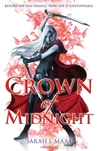
Finished Reading: Throne of Glass (Book 2) – Crown of Midnight by Sarah J. Maas


Crown of Midnight (Throne of Glass, #2)Crown of Midnight by Sarah J. Maas
My rating: 4 of 5 stars

View all my reviews

Unknown's avatar

Not My Review: The Folk of the Air (Book 1) – The Cruel Prince by Holly Black


Unknown's avatar

Not My Review: The Secrets of Moldara by Brianne Earhart