Unknown's avatar

Literature has long been sounding the alarm about sexual violence in Hollywood


File 20171204 22986 1u52pg0.jpg?ixlib=rb 1.1
For decades, novels have implored readers to look beyond the glamour and riches.
Trey Ratcliff, CC BY-NC-SA

Billy J. Stratton, University of Denver

Recent revelations about Hollywood’s culture of sexual harassment and violence might come as a surprise to many Americans.

After all, Los Angeles – home of what some call “the American image factory” – has long carried the allure of glamour, wealth and fame. Beckoned by the iconic Hollywood sign in the Santa Monica Mountains, the city, in many regards, has become synonymous with the American dream.

People familiar with the industry might tell a more complicated story. That group includes writers who have made Los Angeles and Hollywood their subjects: F. Scott Fitzgerald, Nathanael West, Evelyn Waugh, Gore Vidal, Joan Didion and Bret Easton Ellis. All have chronicled a seamier side of the California dream, a world awash with drugs, sex, violence and abuses of power.

So how did so many of us miss this? Could it have anything to do with the fact Americans who read literature recently fell to a three-decade low?

At the very least, the works of these writers show that literature can play an imperative role in our culture – that novels can give us a means of facing difficult issues that many of us may prefer to ignore, or don’t want to believe exist.

A city of vampires

In numerous novels since the 1930s, Hollywood’s underbelly has been revealed as a landscape rife with peril. And while many writers have explored the vice, corruption and disillusionment at the heart of Hollywood, few have gone deeper into the shadows than Nathanael West and Bret Easton Ellis.

West’s 1939 novel, “The Day of the Locust,” depicts the struggles of Faye Greener, an aspiring actress in pursuit of Hollywood fame and fortune – a dream laid waste by the men she meets along the way, who see her as little more than an object of their desires.

Pursued and stalked throughout the novel, Greener eventually turns to prostitution to make a living. Worse yet, to the novel’s protagonist, she’s the subject of disturbing rape fantasies. The story ends in a frenzy of violence at a Hollywood movie premiere – West’s ultimate denunciation of a culture and a city.

More than 40 years later, the characters of Bret Easton Ellis’s fiction are subjected to almost unspeakable forms of trauma and sexualized violence in “Less Than Zero” and “The Informers.”

In “Less Than Zero,” billboards emblazoned with the words “Disappear Here” loom over the landscape. They’re apparently advertisements that invite a blissful escape to some far-off resort. But for the novel’s main character, they become a menacing warning of a city that devours all who live and work there.

The novel’s main character, Clay, descends into the darkest recesses of this world – a journey to, as he puts it, “see the worst.” And indeed he does.

Although some of the horrors he witnesses occur in back alleys and basement clubs, the most shocking forms of violence – rapes, the viewing of snuff films – transpire at ritzy hotels and posh homes in Malibu, Bel Air and Beverly Hills. We are led to the realization that self-destruction, dehumanization and violence are built into the very fabric of Hollywood’s being.

Meanwhile, the young characters in “The Informers” live in a Los Angeles “swarming with vampires.” Many turn to alcohol, drugs and sex to cope with the depravity of lives that are hopelessly artificial and empty. For some, entertainment has devolved into watching videos of women being terrorized by “near-naked masked men.”

At one point, a main character, the son of a movie executive, meets a struggling actor.

“Unless you’re willing to do some pretty awful things,” the actor says, “it’s hard getting a job in this town.” The reader can almost anticipate the despairing surrender conveyed in his final words: “and I’m willing.”

Other novels, set outside of Hollywood, speak to what can be seen only as an epidemic of sexual violence: Toni Morrison’s “Beloved,” Louise Erdrich’s “The Round House,” Frances Washburn’s “Elsie’s Business,” Jessica Knoll’s “Luckiest Girl Alive.”

All hold a mirror to a world that many would prefer not to face.

Literature as ‘equipment for living’

Novels cannot replace the immediacy of the testimony offered by the courageous women who, in recent months, have publicly shared their experiences with sexual violence.

Nonetheless, such works can function as a vital corroboration for the heartbreaking truths that these women have revealed. They give a voice to perspectives that are marginalized and silenced.

The critic Kenneth Burke viewed literature not just as a form of amusement or intellectual reward, but as a way of addressing social problems by teaching, as he put it, “strategies for dealing with situations.”

An implicit element of all literature, he argued, is that it gives readers opportunities to imagine how they’d respond to complicated scenarios, from “what is promising” to “what is menacing” – all from the relative safety of our homes. He observed that readers can gain what he called an “equipment for living,” a means to help navigate our daily experiences.

Recent studies reveal other benefits. One found that deep reading makes us “smarter and nicer,” while another showed that reading literary fiction (as opposed to mass market fiction) helps people develop a greater sense of empathy.

The ConversationIn a country whose people have become increasingly isolated from and suspicious of one another, it’s something we need now more than ever.

Billy J. Stratton, Professor of American Literature and Culture; Native American Studies, University of Denver

This article was originally published on The Conversation. Read the original article.
Unknown's avatar

Two centuries on, Frankenstein is the perfect metaphor for the Anthropocene era


File 20171219 27562 yvxfyz.jpg?ixlib=rb 1.1
frankenstein.

Patricia MacCormack, Anglia Ruskin University

According to popular understanding, New Year’s Day 2018 belongs to the 68 years since the dawn of the Anthropocene Epoch – where human activity has so dramatically altered the Earth that natural phenomenon is now human phenomenon. Science fiction and fact, indeed all fiction and fact, are persistently mediated by humans. The effects of this blurring show that the role of fictional art (art that is fantasy) is as impactful as ever – perhaps more so, due to its ability to remind us that humans are capable of so much, but are less attentive to our culpability.

Humans now set the trajectory for the current epoch, yet we have little idea how that trajectory will look. We are active, able, creative agents in the world – the makers of the world. And we remain absolutely without a clue as to why we are, or what we are. Whether religious, secular or ecologically concerned, we are still chaotic accidents of organisms who ask the same questions as in other epochs and are responded to with the same resounding silence: why are we here? What are we? What is our purpose?

Increasingly, the value of humans is being questioned in the Anthropocene Epoch – an era which seems to threaten disaster as much it promises longer and better life. Two centuries ago one of the earliest examples of science fiction appeared on New Year’s Day that also asked these questions. Mary Shelley – a political radical, the daughter of the world’s most famous feminist and the wife of an infamous atheist – published Frankenstein: Or The Modern Prometheus.

Even in the title we see that Shelley understood the persistence of the above questions that each age jealously feels belongs only to their particular existential crisis.

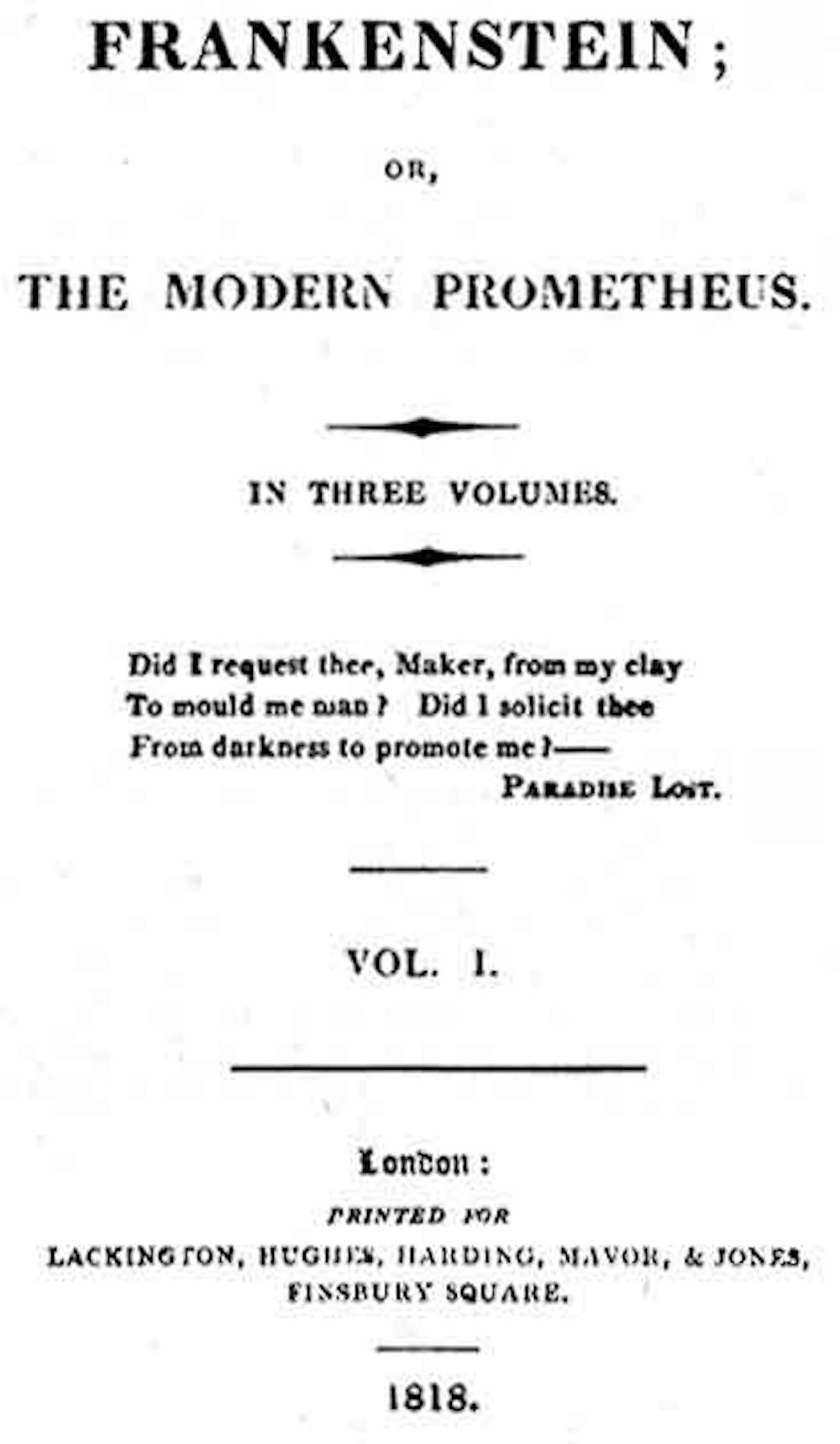
Frankenstein 18181 edition title page.

In Shelley’s frontpiece quote from Milton’s Paradise Lost, where Adam laments being created, Shelley immediately reminds us that there is a persistent tension in all tales of human existence between a creator who has the ability, but perhaps not the wisdom, to be accountable and responsible for their acts of creation – and a subject who knows not what to do with the life and knowledge they have been given without their consent or request.

Shelley invoked a monster filled with pathos, humble curiosity and ultimately despair – and a creator whose hubris elucidated him as lacking in empathy, megalomaniacal and whose pride was more important than its effect on other living beings.

While one could say the same of every age, the Anthropocene Epoch seems to be performing Shelley’s tale on a global scale – where a single monster is now many species of non-human, or minorities and oppressed humans. The creator, meanwhile, is governments, nation-driven patriots and multinational companies, much like Shelley’s overweening creator, Dr Frankenstein.

Horror made flesh

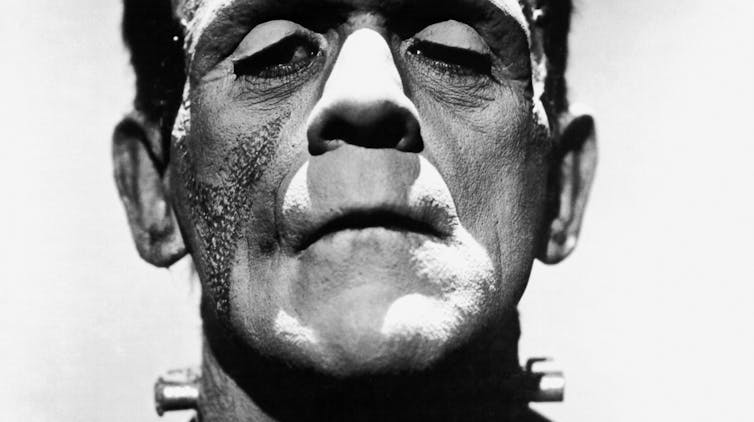
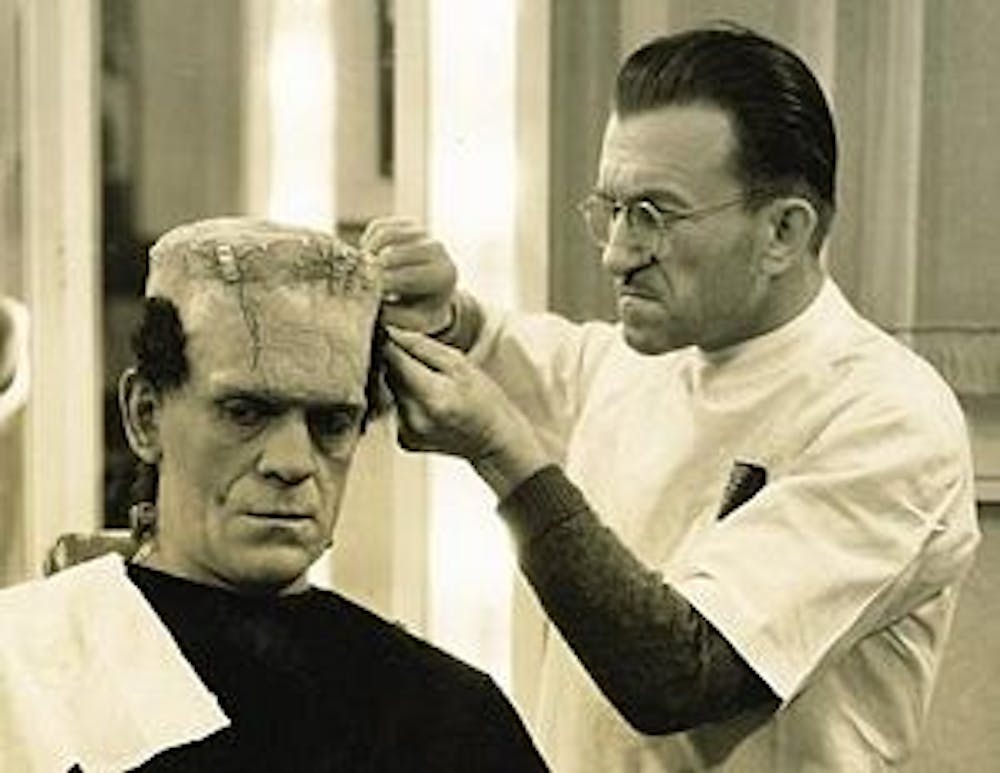
Shelley’s Frankenstein legacy has a surprisingly unique offshoot. It spawned, due to the creative genius of the famed make-up artist Jack Pierce, a reimagining of a literary character so different from the original that it has entirely replaced it to become a concrete icon of horror – the monster as incarnated by Boris Karloff in Frankenstein (1931) and the more faithful (to the book at least) adaptation, The Bride of Frankenstein (1935).

Jack Pierce turning Boris Karloff into Frankenstein’s monster in the 1930s.
By not known – Image source: http://www.lagorgona.es

While the book had already inspired one of the earliest horror cinema adaptations (the 1910 Charles Ogle film), James Whale’s 1931 film for Universal Pictures was the point which reversed the monster with the creator as the most important locus of the story, so turning it from tale to myth. The shift from focus on the God complex of Frankenstein to the wretched existence of the unloved monster marks a moment of humble self-reflection for audiences who identify more with a pieced together, almost mute, bumbling mass of flesh who simply seeks a “friend”, than with the irresponsibly power-mad scientist.

Perhaps reflecting humans’ focus from their maker (whatever that may be) to themselves, the spectacle of Karloff – placed gnarled, deformed and doubtful of the relevance of his existence after the first world war and heralding the imminent concerns of Sartre’s existentialism – is life meaningful? Are we hear for a reason? Do these questions matter? – evoked the dread and ugliness of a meaningless existence at the intersection of biology and technology made flesh.

Cinematically we have not seen a return to the Gothic Shelley adaptation. Recent versions seem twee compared to Hammer’s 1950-70s viscerality – and the sci-fi robot or genetic creation has overtaken Victorian aesthetics. Sleeker, stronger creations of more metal and less flesh allay our horror at simply being a cluster of mortal cells.

While vampires, werewolves and even zombies are sparkly, sexy and utterly hygienic, it has been a while since we have had a truly corporeally flawed yet articulate monster whose body as a patchwork reminds us of the patchwork of identities and ideologies we are.

The ConversationEmpathy with the monster may be an ideal means of navigating this age. We must embrace difference and vulnerability and reflect on the Frankensteinian powers we exert at the expense of others. We should focus not on why we are here, but how we can be here more creatively, more accountably – as part of a world which, in a way, is its own kind of sewn-together organism of multiple different parts without reason or meaning.

Patricia MacCormack, Professor of Continental Philosophy, Anglia Ruskin University

This article was originally published on The Conversation. Read the original article.
Unknown's avatar

Schools can’t tackle child literacy levels alone – it takes a village


File 20180110 46709 ypjxix.jpg?ixlib=rb 1.1
More than half of children under two and nearly half of children aged three to five are not being read to every day at home.
Shutterstock

Catherine Wade, Parenting Research Centre

The recently released NAPLAN 2017 results and findings from the latest Progress in International Reading Literacy Study (PIRLS) have got Australia talking again about how our children are faring when it comes to literacy.


Read more: NAPLAN 2017: results have largely flat-lined, and patterns of inequality continue


We know from PIRLS, while most Australian children are meeting international benchmarks for reading at year 4, nearly one in five are not meeting these benchmarks. Australia has one of the largest proportions of students who fall below the “intermediate” benchmark into the “low” or “below low” categories, compared to other English-speaking countries, including the US, Canada, and England.

Despite the range of steps that have been taken to address literacy levels across Australia, a large proportion of children are still not meeting international standards for reading. So what other approaches could we try?

Parents: an untapped resource

New research from the Parenting Research Centre highlights an area ripe for intervention: better supporting parents in reading to their children.

Our findings from a study of 2,600 parents showed more than half of children under two and nearly half of children aged three to five are not being read to every day.


https://datawrapper.dwcdn.net/ciPKO/1/


We found, while most children were being read to by an adult in the household four to five days a week, a concerning proportion were not being read to at all or very infrequently. Specifically, 13% of 0–2-year-olds and 4% of 3–5-year-olds were not read to at all by an adult at home in the previous week.

Our research also looked at how important parents’ educational values and aspirations for their children were and how they felt about their interactions with their children’s educators. The survey has national relevance, as most of the findings relate to broader parenting issues.

Why early reading is vital

We know from decades of international research that what parents do at home with their children has a profound effect on children’s learning outcomes. Children who experience enriched, cognitively stimulating home environments are at an advantage in the learning process because they have had exposure to many more words.

The evidence in support of providing a language-rich environment to children is vast. Children with language delays at school entry are at greater risk for academic difficulties. With flow-on effects to later academic and socio-emotional challenges, the imperative to tackle language and literacy problems early is paramount.

Sitting together, opening a book, and reading and pointing to words can be incredibly helpful in building the foundations of good literacy.
Shutterstock

A number of high-quality reviews of the scientific literature show good evidence for the benefits of parental shared reading for children’s literacy.

And while older children typically need less input from parents when it comes to actually looking at words on the page, that doesn’t mean the parents’ role in supporting reading diminishes. Creating a home environment that encourages time and space for books is key.


Read more: Research shows the importance of parents reading with children – even after children can read


If we know reading works, why don’t we do it?

The message that simply sitting together, opening a book, and reading and pointing to words can be incredibly helpful in building the foundations of good literacy has certainly cut through with many parents of young children.

But there are many reasons parents don’t read at home. As we know from sectors such as health, simply telling people what needs to be done – such as exercising more – does not take their personal context into consideration. Alone, it’s not enough to motivate people to adopt new patterns of behaviour.

Considering how best to support parents to read more often to their children is an important question and will depend on a thorough understanding of the barriers that are preventing them from doing so. Family and work pressures and parental confidence around reading books are some possible factors that could be further explored as barriers.

A shared concern

Children’s literacy is not the sole responsibility of parents, but it’s clearly an area where parents and schools can work together. This parent-educator partnership featured in our survey, which explored parents’ views about their interactions with kindergarten, child care and school teachers.


https://datawrapper.dwcdn.net/1bDZe/3/


Most parents (92%) felt comfortable communicating with their children’s teachers. Although 21% did not think or were unsure if their child’s teacher understood their child.


https://datawrapper.dwcdn.net/rK1uG/2/


Also, 20% did not agree they were able to participate in decisions that affected their child at kinder or school.

Of note, fathers tended to feel less comfortable talking with their child’s teachers than mothers did.

While 82% of parents felt their opinions were valued in discussions with their child’s educators, 11% had mixed feelings about this and 7% felt their opinions weren’t valued.


https://datawrapper.dwcdn.net/ILYt4/1/


Given what we know from research about the value of parents being connected with their children’s educational settings, it follows that parent-teacher partnerships are important for children’s educational outcomes.

Consequently, it’s important issues like literacy are looked at holistically. Literacy is not just as an education system issue, and not just a parenting issue. It’s a societal issue.

Parents are ready to engage

We found the vast majority of parents (93%) see their own contribution to their children’s learning in the early years as important. This supports the view that today’s parents are generally well placed for taking on information about how to improve their children’s literacy and educational outcomes.

It’s encouraging that most children are being read to at home – even if not every day. But in the context of concerns about Australia’s position in international literacy rankings there’s more to be done.

The ConversationThe message to parents is clearly “read early and read often”. The message for policy makers and professionals is “support parents to better engage with their children’s learning”. This could take many forms and is dependent on context. It could include strategies such as building literacy messages and materials into existing parenting support services and promoting online resources for parents, given our survey found 79% of parents look for answers online about parenting issues.

Catherine Wade, Principal Research Specialist, Parenting Research Centre

This article was originally published on The Conversation. Read the original article.
Unknown's avatar

Not My Review: Remembrance of Earth’s Past (Book 1) – The Three-Body Problem, by Liu Cixin


Unknown's avatar

From sleeping beauty to the frog prince – why we shouldn’t ban fairytales


File 20171213 31706 1k3e5cs.jpg?ixlib=rb 1.1
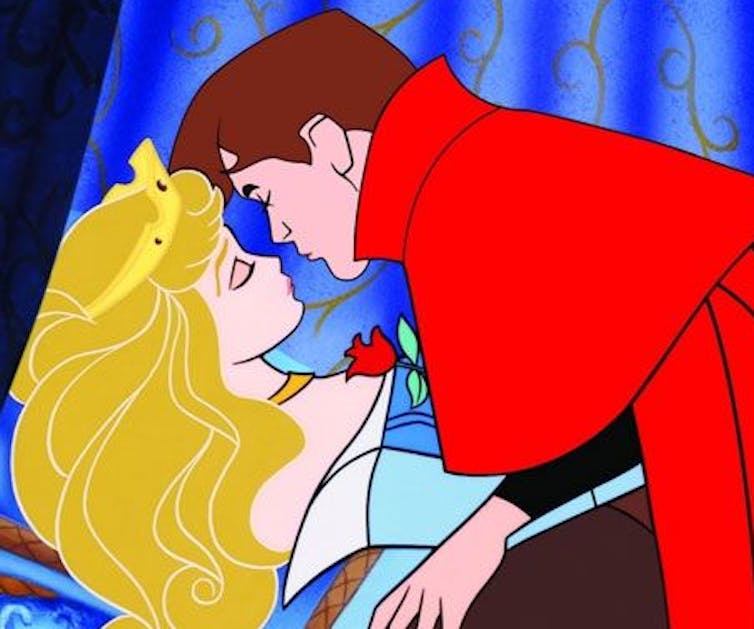
The famous ‘kiss’ scene from Sleeping Beauty.
Disney

Michelle Smith, Monash University

Recently, an English mother, Sarah Hall, prompted worldwide media coverage in response to her suggestion that Sleeping Beauty should be removed from the school curriculum for young children because of the “inappropriate sexual message” it sends about consent.

It’s not the only time fairytales have come under scrutiny recently. They are increasingly being targeted for “banning” within schools or avoidance by parents because of their perceived sexism, passive princesses, and reinforcement of marriage as girls’ ultimate goal. But can fairy tales actually be harmful as their critics believe?

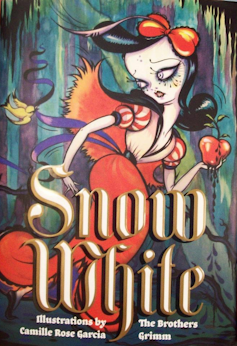
‘Snow White’ by the Brothers Grimm, as illustrated by Camille Rose Garcia.
Flickr CC

Fairy tales were once told – and then written – by adults for adult audiences. Early versions of many tales were often bawdy, salacious and replete with sexual innuendo. Since the Grimm Brothers removed these elements to reconfigure the fairy tale for children in the early 19th century, fairy tales have been seen as ideal, imaginative stories for young people. Almost all of us know the most popular stories from childhood reading or Disney films.

Tradition is not reason enough to continue a cultural practice that has become outmoded. Nevertheless, there are a range of reasons why these calls to restrict children from reading fairy tales such as Sleeping Beauty are misguided.

Children’s literature needn’t model ‘ideal’ behaviour

Initially, most children’s literature was didactic and preoccupied with instructing children in correct morals and drilling them with information.


Read more: A new twist on an old fairytale as a daughter dances away from the patriarchy


Adult readers today would struggle to find any pleasure in children’s literature prior to 1850, let alone today’s kids. In order to provide “delight” as well as “instruction”, children’s books represent a range of behaviour, including, in the case of fairy tales, the attempted murder of children, and punishments such as feet being severed and birds pecking out human eyes.

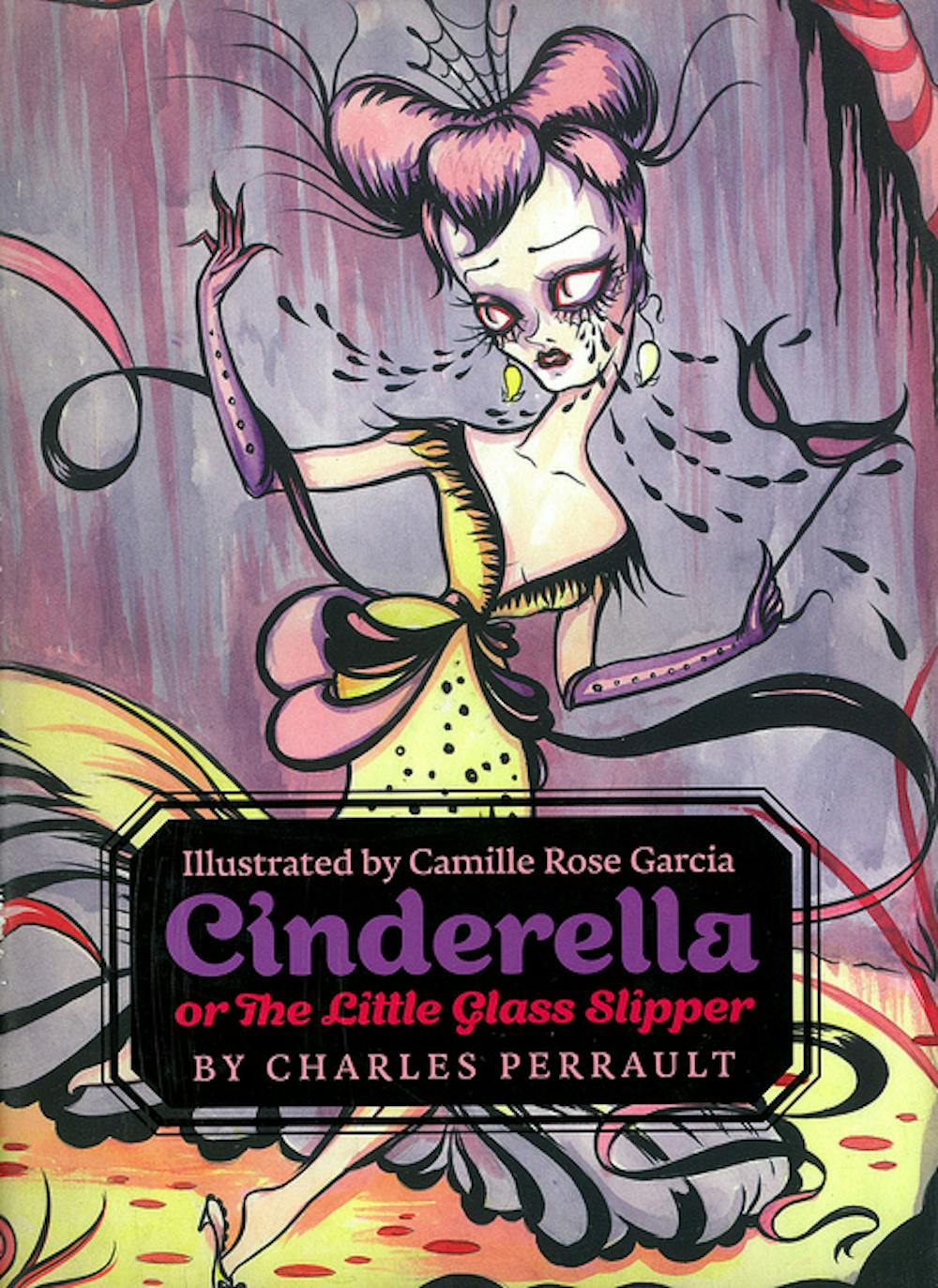
In Charles Perrault’s version of Cinderella, or the Little Glass Slipper (illustrated by Camille Rose Garcia) Cinderella leaves behind a glass slipper.
Flickr CC

Charles Perrault was the French author who added the famous motifs of the glass slipper and pumpkin coach to the Cinderella tale. In his version of Sleeping Beauty, after the Princess and the Prince marry in secret and have two children, the Prince’s mother is entirely unimpressed. Unsurprisingly within a fairy tale, the Prince’s mother is descended from ogres and she demands that the two children be killed and eaten for dinner by the whole family, with the macabre detail that the boy is to be served with Sauce Robert.

As in Snow White, in which the Huntsman refuses to kill the heroine and substitutes an animal heart for that of Snow White’s, no actual harm comes to the princess or her children but not before the ogress has prepared a tub full of vipers in a typical last-ditch attempt at villainy.

When we consider the norms of evil and violence in fairy tales – most of which are usually punished – it is bizarre to imagine every detail serving as a behavioural model for children. If we insisted that every character in children’s literature behaved precisely as we wish to teach children to behave then we would likely be presenting bland stories that no child would actually read.

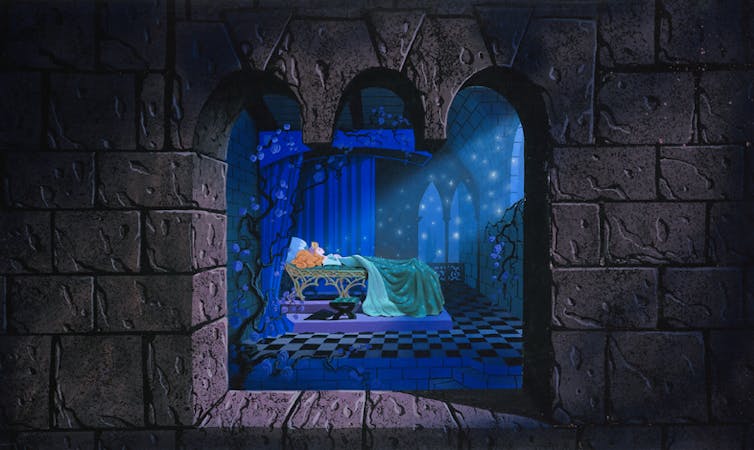
Maleficent’s curse came to pass on the Princess’ 16th birthday…but the good fairies changed the curse so the Princess would not die, but sleep ‘til awakened by true love’s kiss.
Flickr CC

Considering plot points in context

If we focus on one plot point, like the kiss in Sleeping Beauty, we can overlook the overall narrative context.

Within the tale, it becomes legend that the sleeping spell that has been cast on the Princess will only be broken after one-hundred years by the kiss of a king’s son. The narrative premise includes a premonition about how the magic will unfold and demands the resolution of the prince’s kiss to “save” the princess who must wait to be returned to consciousness.

While we might critique the emphasis on romance and passivity from a feminist perspective, the idea that the tale is promoting the equivalent of a Steubenville scenario in which an unconscious young woman is sexually assaulted ignores the magical logic of the fantasy world.


Read more: Once upon a time: a brief history of children’s literature


By that measure, we might see Prince Charming as a maniacal stalker as he demands all women in the kingdom try on the glass slipper in order to track down the attractive girl who failed to slip him her address before running off from the ball.

In Sleeping Beauty, it is significant that the Prince is told about the Princess being doomed to sleep until she is awakened by a king’s son. The Prince recognises that he is one of few people who can end the curse and resolves to tackle the brambles and thorns that surround the castle in which she is trapped in slumber.

Significantly, in the Grimms’ version, Little Brier-Rose, numerous young men try to push themselves through the thorny hedge and die miserably in the attempt. However the hedge turns into flowers for the Prince and allows him through. Only the right man, with the right motivations, and the one who can release the Princess from the curse – is permitted through.

Rather than being a parallel to a kiss taken without consent, the Sleeping Beauty kiss is akin to a paramedic giving mouth-to-mouth resuscitation to an unconscious person who would most usually want to be revived.

Many versions of every fairy tale

The version of Sleeping Beauty targeted in the UK is part of the “Biff, Chip and Kipper” series designed to teach children to read. These books aim to educate children in the mechanics of reading and, as such, some of the literary nuance, symbolism, and visual artistry present in many fairy tales and picture books based upon them are no doubt lacking.

It is important to recall that there is no definitive version of a fairy tale. Calls for “bans” of a particular tale ignore variations between, say, Perrault’s Sleeping Beauty complete with cannibalistic, viper-wielding ogress and the Grimms’ less violent adaptation.


Read more: Friday essay: why grown-ups still need fairy tales


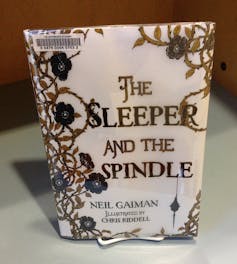
Rather than eschewing fairy tales entirely, parents and educators would be better placed to look to quality adaptations and retellings by outstanding children’s authors, such as Neil Gaiman’s The Sleeper and the Spindle, which merges Snow White and Sleeping Beauty.

Neil Gaiman’s The Sleeper and the Spindle.
Flickr CC

In this tale, the Queen sets out on a journey armed with a sword to save the Princess and is the one who rescues her through a kiss.

There is even a picture book version called Sleeping Bobby in which the gender roles are entirely reversed. Numerous parodies such as John Scieszka’s The Frog Prince Continued, in which the Princess’s married life with the frog is far from “happily ever after”, can also be a way for older readers to begin to question and play with the conventional gender expectations of some fairy tales.

Reweaving old stories into new

Fairy tales have been undergoing a continuous process of being rewoven into new stories for hundreds of years.

Just as many old tales have fallen out of favour and are no longer known, so too might some contemporary favourites eventually stop being told to children, potentially replaced by reworked versions or entirely new stories.

The ConversationThis storytelling method of old wine being poured into new bottles has a rich tradition and does not require our intervention. After all, the people who ban books in stories are always the villains, not the heroes.

Michelle Smith, Senior Lecturer in Literary Studies, Monash University

This article was originally published on The Conversation. Read the original article.

Unknown's avatar

Michael Wolff on ‘Fire and Fury’ with Stephen Colbert


Unknown's avatar

Not My Review: Winternight Trilogy (Book 1) – The Bear and the Nightingale, by Katherine Arden


Unknown's avatar

Not My Review: The History of the World by Walter Raleigh (1614)


The link below is to a book review of ‘The History of the World,’ by Walter Raleigh.

For more visit:
https://www.theguardian.com/books/2017/dec/25/100-best-nonfiction-books-no-99-history-of-the-world-by-walter-raleigh-1614

Unknown's avatar

Not My Review: Fire and Fury, by Michael Wolff


Unknown's avatar

Finished Reading: The Shifting Tides (Book 3) – Copper Chain by James Maxwell


Copper Chain (The Shifting Tides #3)Copper Chain by James Maxwell
My rating: 4 of 5 stars

View all my reviews