The pro-reading message is getting through to parents, who recognize that it’s an important habit. A summary report by Child Trends, for instance, suggests 55 percent of three- to five-year-old children were read to every day in 2007. According to the U.S. Department of Education, 83 percent of three- to five-year-old children were read to three or more times per week by a family member in 2012.
What this ever-present advice to read with infants doesn’t necessarily make clear, though, is that what’s on the pages may be just as important as the book-reading experience itself. Are all books created equal when it comes to early shared-book reading? Does it matter what you pick to read? And are the best books for babies different than the best books for toddlers?
In order to guide parents on how to create a high-quality book-reading experience for their infants, my psychology research lab has conducted a series of baby learning studies. One of our goals is to better understand the extent to which shared book reading is important for brain and behavioral development.
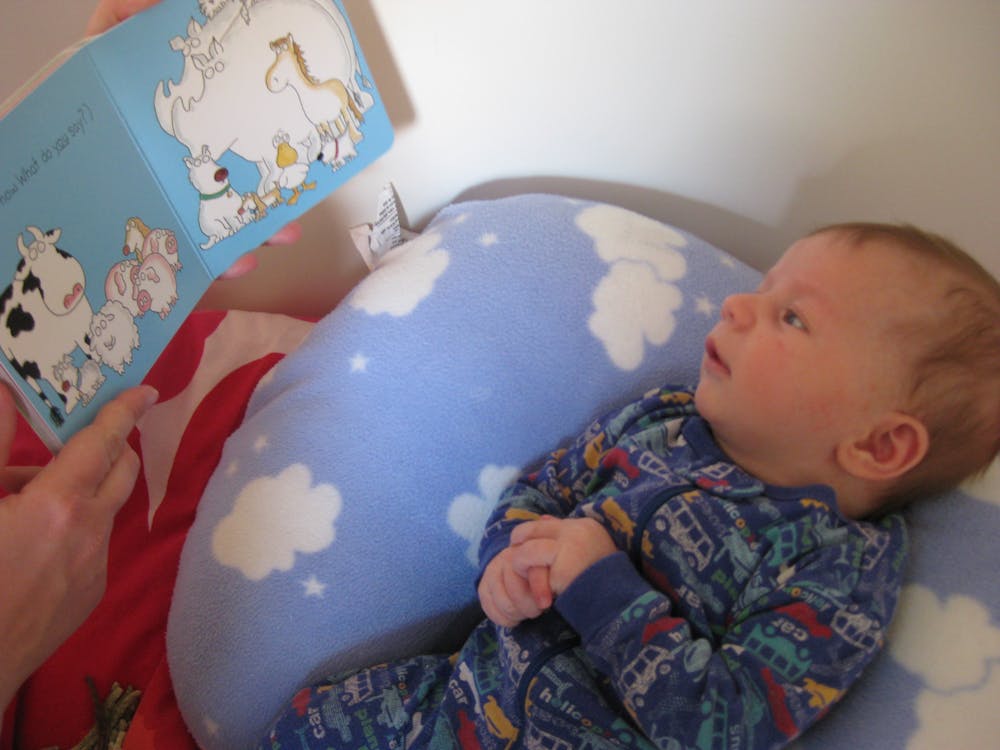
Even the littlest listeners can enjoy having a book read to them. Maggie Villiger, CC BY-ND
Shared book reading also likely enhances the quality of the parent-infant relationship by encouraging reciprocal interactions – the back-and-forth dance between parents and infants. Certainly not least of all, it gives infants and parents a consistent daily time to cuddle.
Recent research has found that both the quality and quantity of shared book reading in infancy predicted later childhood vocabulary, reading skills and name writing ability. In other words, the more books parents read, and the more time they’d spent reading, the greater the developmental benefits in their 4-year-old children.
This important finding is one of the first to measure the benefit of shared book reading starting early in infancy. But there’s still more to figure out about whether some books might naturally lead to higher-quality interactions and increased learning.
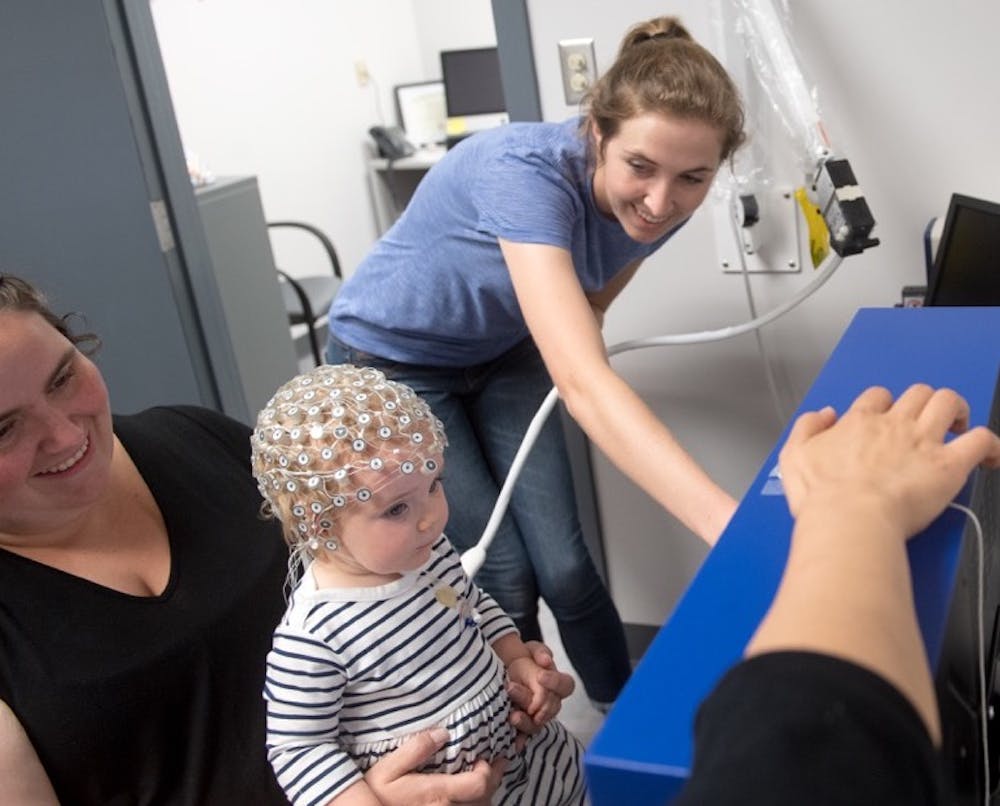
EEG caps let researchers record infant volunteers’ brain activity. Matthew Lester, CC BY-ND
Babies and books in the lab
In our investigations, my colleagues and I followed infants across the second six months of life. We’ve found that when parents showed babies books with faces or objects that were individually named, they learn more, generalize what they learn to new situations and show more specialized brain responses. This is in contrast to books with no labels or books with the same generic label under each image in the book. Early learning in infancy was also associated with benefits four years later in childhood.
First, we brought six-month-old infants into our lab, where we could see how much attention they paid to story characters they’d never seen before. We used electroencephalography (EEG) to measure their brain responses. Infants wear a cap-like net of 128 sensors that let us record the electricity naturally emitted from the scalp as the brain works. We measured these neural responses while infants looked at and paid attention to pictures on a computer screen. These brain measurements can tell us about what infants know and whether they can tell the difference between the characters we show them.
We also tracked the infants’ gaze using eye-tracking technology to see what parts of the characters they focused on and how long they paid attention.
Eye-tracking setups let researchers monitor what infants are paying attention to. Matthew Lester, CC BY-ND
The data we collected at this first visit to our lab served as a baseline. We wanted to compare their initial measurements with future measurements we’d take, after we sent them home with storybooks featuring these same characters.
Example of pages from a named character book researchers showed to baby volunteers. Lisa Scott
We divided up our volunteers into three groups. One group of parents read their infants storybooks that contained six individually named characters that they’d never seen before. Another group were given the same storybooks but instead of individually naming the characters, a generic and made-up label was used to refer to all the characters (such as “Hitchel”). Finally, we had a third comparison group of infants whose parents didn’t read them anything special for the study.
After three months passed, the families returned to our lab so we could again measure the infants’ attention to our storybook characters. It turned out that only those who received books with individually labeled characters showed enhanced attention compared to their earlier visit. And the brain activity of babies who learned individual labels also showed that they could distinguish between different individual characters. We didn’t see these effects for infants in the comparison group or for infants who received books with generic labels.
These findings suggest that very young infants are able to use labels to learn about the world around them and that shared book reading is an effective tool for supporting development in the first year of life.
So what do our results from the lab mean for parents who want to maximize the benefits of storytime?
Not all books are created equal. The books that parents should read to six- and nine-month-olds will likely be different than those they read to two-year-olds, which will likely be different than those appropriate for four-year-olds who are getting ready to read on their own. In other words, to reap the benefits of shared book reading during infancy, we need to be reading our little ones the right books at the right time.
For infants, finding books that name different characters may lead to higher-quality shared book reading experiences and result in the learning and brain development benefits we find in our studies. All infants are unique, so parents should try to find books that interest their baby.
My own daughter loved the “Pat the Bunny” books, as well as stories about animals, like “Dear Zoo.” If names weren’t in the book, we simply made them up.
It’s possible that books that include named characters simply increase the amount of parent talking. We know that talking to babies is important for their development. So parents of infants: Add shared book reading to your daily routines and name the characters in the books you read. Talk to your babies early and often to guide them through their amazing new world – and let storytime help.
The Australian government quietly introduced the Copyright Amendment (Service Providers) Bill 2017 to the Senate on Wednesday. If enacted, the bill will extend the scope of Australia’s copyright safe harbours – very slightly.
Safe harbours protect internet hosts and platform providers from monetary liability for copyright-infringing content posted or shared by their users. For example, if you post the latest Thor movie to YouTube, YouTube won’t be responsible for copyright infringement if it takes down that video. In Australia, we only extend this protection to internet services providers, not general purpose websites.
This matters because technology firms rely on limits to liability to manage their risks. Companies like Facebook or YouTube, which host millions of pieces of user content, would face serious difficulty starting in Australia because our laws on copyright infringement are so strict.
The new legislation is a step in the right direction, but it doesn’t go far enough to create an environment that fosters Australian innovation.
Excluding platforms from safe harbours doesn’t make much difference to tech giants like YouTube and Facebook, since they already operate within the United States safe harbours. But it does discourage Australian tech start-ups from the chance to experiment in a reduced-risk environment.
It is not just the US with broader copyright safe harbours than Australia – jurisdictions around the world extend safe harbours to internet intermediaries beyond ISPs.
The European Union, for example, provides that member states must ensure that any hosting provider will not be liable for unlawful content posted by users, provided it acts quickly to remove the content upon notice.
Both measures are low hanging fruit for the government. They improve our existing copyright law, but they don’t advance us far from the status quo.
The government is staying well clear of the more contentious, though far more impactful, potential reforms to the Copyright Act recommended by bodies such as the Australian Law Reform Commission and the Productivity Commission.
What are the copyright safe harbours?
The copyright safe harbours came about as a result of the US Digital Millennium Copyright Act (DMCA) in 1998. The DMCA represented an important bargain struck between the established content industry, such as big film and TV studios, and the burgeoning tech industry.
The content industry got a “notice-and-takedown” regime that required online service providers to remove material that infringes copyright. In exchange, the tech industry got copyright safe harbours.
Under this system, the service provider must quickly and efficiently remove infringing content if they are informed about it by the copyright owner. This notice-and-takedown scheme has become fundamentally important to the way the internet works today.
But in enacting the copyright safe harbours, parliament made a drafting error. Instead of extending protection to “service providers”, as the US law does, we gave protection to “carriage service providers” as defined in the Telecommunications Act.
Essentially, Australia only gave protection to internet service providers like Telstra, Optus and TPG, and not to platform providers like Whirlpool, RedBubble, YouTube or Facebook. For more than a decade, this has been a critical difference between US and Australian copyright law.
What’s changing?
The new bill appears to close the glaring gap between US and Australian law by replacing the term “carriage service provider” with, simply, “service provider”.
But the bill defines “service provider” to be either a carriage service provider; an organisation assisting persons with a disability; or a body administering a library, archives, cultural institution or educational institution.
It does not extend the safe harbour to those who actually need it the most – Australia’s internet hosts and platform providers.
This is a seriously missed opportunity for Australian innovators. There is a real risk for businesses, both large and small, who want to provide online spaces for people to communicate.
Our copyright laws potentially make hosts liable for much of the copyright infringing content that users may upload or share. But it can be prohibitively expensive and time-consuming to pre-screen all content before it is uploaded.
This is one of the reasons why many large social media platforms don’t base their operations in countries like Australia, and why Australian businesses are at a major competitive disadvantage compared to those in other countries.
Why not extend the safe harbour to Australian innovators?
There were early indications that the Australian government intended to extend the safe harbours to all online service providers, but these amendments were shelved.
Entertainment industry groups have been lobbying hard in recent years for measures that go beyond the notice-and-takedown scheme that the safe harbours provide. They want what they call notice-and-staydown: proactive filtering of unlicensed copyright content by service providers.
At the same time, copyright owners want higher payments. They use the term “value gap” to describe what they see as the difference between sites like Spotify that pay hefty licence fees to make content available to users and sites like YouTube that do not.
Content owners are no longer happy with the bargain they struck in the DMCA – they allege that sites like YouTube are gaming the system of the safe harbours.
There is a false equivalency at work here. Spotify is not a site for user-generated content and does not purport to be; sites like YouTube have everyday users at their core. If we believe that creative discourse, engagement and play matters then there is a cogent reason why sites that facilitate user-generated content might need some legal latitude.
However, this debate misses a more fundamental point. Limited safe harbour provisions hurt Australian creators and innovators. They increase the risk to innovators developing new technology products and platforms.
And, importantly, Australian creators miss the opportunity to exercise greater control over their creations through notice-and-takedown mechanisms that are easy to use and far cheaper than copyright lawsuits.







 It’s possible that books that include named characters simply increase the amount of parent talking. We know that
 And, importantly, Australian creators miss the opportunity to exercise greater control over their creations through notice-and-takedown mechanisms that are easy to use and far cheaper than copyright lawsuits.
 At the BookShelf
You must be logged in to post a comment.