
The link below is to a book review of ‘Common Sense,’ by Tom Paine.
For more visit:
https://www.theguardian.com/books/2017/sep/18/robert-mccrum-100-best-nonfiction-books-common-sense-by-thomas-paine

The link below is to a book review of ‘Common Sense,’ by Tom Paine.
For more visit:
https://www.theguardian.com/books/2017/sep/18/robert-mccrum-100-best-nonfiction-books-common-sense-by-thomas-paine

Aliki Varvogli, University of Dundee
A blackmailer steals a compromising letter from a woman of high standing. The police know he is keeping this letter in his home, but they cannot find it. Using the latest forensic tools they search every inch of the apartment, recording their efforts as follows:
We examined the rungs of every chair …. and, indeed, the jointings of every description of furniture, by the aid of a most powerful microscope. Had there been any traces of recent disturbance we should not have failed to detect it instantly.
A single grain of gimlet-dust, for example, would have been as obvious as an apple. Any disorder in the glueing – any unusual gaping in the joints – would have sufficed to insure [sic] detection.
Back in 1844, this description of the police using a powerful microscope with the promise of instant detection would have dazzled readers of Edgar Allan Poe’s The Purloined Letter. Yet this is not what solves the mystery. Instead the private investigator, Auguste Dupin, correctly surmises that the best place to hide such a letter is in plain sight. He finds it on the blackmailer’s mantelpiece.
The story is one of the earliest and best examples of crime fiction. It suggests that science and technology are sometimes not as powerful as empathy or intuition in solving crimes. Indeed, Poe queries science throughout his writings. In one poem he calls it a vulture that preys on the poet’s heart, replacing the magic of a writer’s imagination with its “dull realities”.

Try telling that to modern readers of crime fiction. These days, forensic scientists are one of the great staples of the genre. They are integral to everything from popular TV franchises like CSI and Line of Duty to blockbuster names like Patricia Cornwell and Jeffrey Deaver to many of the works showcasing at the Bloody Scotland festival in Stirling. There is also something about their incredible achievements that we often overlook: they are often a long way from the reality.
We love crime fiction because it is reassuring. Yes, human beings are capable of evil and cruel deeds, but criminals are always caught and usually punished. This formula, as WH Auden suggested in a 1948 essay on the genre, restores us to a “state of grace”. It helps us believe we are basically innocent and good, and that criminality is an aberration.
Forensic science amplifies this sense of comfort in crime fiction: it produces evidence that cannot lie; it brings the most cunning of criminals to justice. In a world with no god and no certainty, these fictional scientists fill a void. They let us think that our world can be examined, analysed and rendered legible. They are modern-day magicians whose wizardry reveals indisputable truths.

But does forensic science really hold all the answers? Sadly, no. Val McDermid, one of the big names appearing at Bloody Scotland, is one of the few authors who help us understand this. In Out of Bounds (2016) for example, the police are trying to determine whether a man was murdered or shot himself.
The amount of gunshot residue in his hand is inconclusive, we learn, and not inconsistent with a self-inflicted wound. How can scientific evidence be inconclusive? How come scientists talk of things being “not inconsistent”, rather than dealing in certainties?
This is where the trouble begins for forensic experts. Imagine a scientist giving evidence as a witness in court and having to explain the limitations of their field. Jurors are unlikely to appreciate that forensic evidence often relies on human interpretation; that blood spatter patterns or bite mark analysis do not tell a single, compelling and unambiguous story the way they do in books.
Yet the reality of the uncertainty of forensic science was recently laid bare in relation to the DNA laboratory of the office of New York City’s chief medical examiner. Seen as one of the most sophisticated forensics labs in the world, carrying out work for investigators across the US, certain scientists are now claiming some of its methods are unreliable. A group of prominent New York defence lawyers is calling for the inspections watchdog to carry out an investigation.
Meanwhile, America’s National Institute of Standards and Technology recently accused the forensics industry of lagging other professions when it comes to looking into and resolving errors. It said:
In recent years, high visibility errors have occurred at crime labs in almost every state. These have ranged from simple mistakes, such as mislabelling evidence, to testimony that overstates the scientific evidence, to criminal acts.
In thrillers, forensic evidence almost always leads the investigative team to a satisfying conclusion. We never finish a novel thinking the killer might be exonerated when the evidence is re-examined. Even when all is as it should be, forensic scientists have their work cut out trying to communicate the complexity of the evidence, while explaining how it might be both subjective and reliable at the same time.
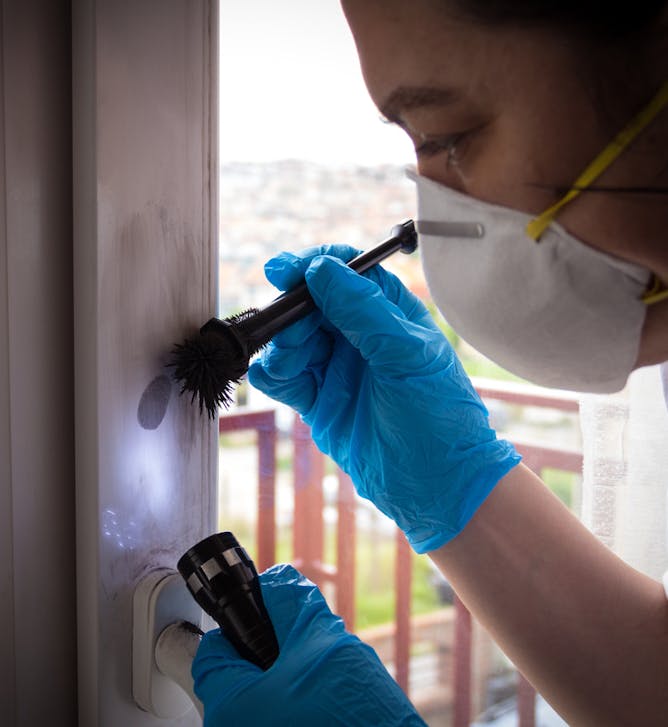
To make their case, scientists need much more than hard facts. They need to make their expertise accessible by using similes, metaphors and narrative examples. In fact, they need to be a little like novelists – which is ironic given that they have to dispel some of the misconceptions created by novelists in the first place.
 If there is a consolation in any of this, these experts can at least thank novelists for their public image. No matter how hard they have to work to seek and communicate knowledge, at least forensic scientists will always look glamorous while doing so. They might be the victims of our need for reassurance and certainty, but we don’t tend to treat them with the same hostility as Edgar Allan Poe.
Aliki Varvogli, Senior Lecturer in English and Associate Dean for Learning and Teaching, University of Dundee
This article was originally published on The Conversation. Read the original article.

Misty Adoniou, University of Canberra
Minister Birmingham released a report today recommending that all Year 1 students in Australia complete a phonics test. The panel responsible for the report has recommended that Australia adopt the Year 1 phonics screening check that has been used in England since 2011.
Phonics is the process of matching sounds to letters. It is an important skill when learning to read and write in English. There are two main approaches to teaching children phonics – synthetic phonics and analytic phonics.
Analytic phonics starts with taking a word that children know the meaning of, and then analysing it to see how the sounds in the word match the letters we see within the word. So five-year-old Emma will learn that her name starts with the sound “e” which is represented by the capital letter E, followed by the sound “m” which is represented by the two letters “mm”, and ends with the sound “u”, which is represented by the letter a.
Synthetic phonics starts with letters which the children learn to match with sounds. The meaning of the words are irrelevant, and indeed, inconsequential. The theory is that the children should master letter/sound matches first before trying to attend to meaning.
There is no evidence that one phonics approach is better than the other. In England, the US and Australia, there have been major inquiries into reading and all have concluded that systematic and explicit phonics teaching is a crucial part of effective reading instruction. But none have found any evidence that synthetic phonics approaches are better than analytic phonics approaches, or vice versa.
All inquiries have concluded that whatever phonic instruction method is chosen, it should be one part of a suite of skills children should have when learning to read.
The phonics test is based on synthetic phonics. The children are given 40 words on a computer screen, with no context. The words are not put in a sentence, or given any meaning. This is deliberate, and an important feature of a synthetic phonics approach, as the children must show they are not relying on meaning or prior experience with the word in order to successfully decode it.
To this end, 20 of the words the children are given are nonsense words, like “thrand”, “poth” and “froom”, to ensure they are not using meaning to decode the words.
Minister Birmingham is concerned about the numbers of students in Australia who are struggling with literacy. The decline in literacy standards of Year 9 students is very concerning, and he is right to be looking for solutions. But the solution will not be found in this phonics test for six-year-olds.
As the test has been has already been in use for six years in England we are fortunate to be able to learn from their experience. A major evaluation of the test conducted by the Department for Education in England found that the test is not delivering improvements in literacy capabilities, and in fact, is delivering some unwanted side effects, like class time being spent learning to read nonsense words rather than real words.
Numerous other recent studies of the implementation of the phonics test in England provide valuable information that allow us to test the claims for the test against research evidence.
Claim: The phonics test has improved reading results in England since its introduction.
Evidence: Year 1 children in England are certainly getting better at passing the phonics test. Over the past six years, pass rates have increased by 23%. This means around 90% of Year 1 children in England can now successfully read nonsense words like “yune” and “thrand”.
However research has found that the ability to read nonsense words is an unreliable predictor of later reading success.
And so far, the phonics test in England has not improved reading comprehension scores.
As the test only tests single syllable words with regular phonic patterns, it is not possible to know how many English children can read words like “one”, “was”, “two”, “love”, “what”, “who”, or “because”, as such words are not included in the test. This is unfortunate because these are amongst the 100 most common words in the English language, which in turn make up 50% of the words we read everyday – whether in a novel, a newspaper article or a government form.
“Yune”, “thrand” and “poth”, on the other hand, make 0% of the words we read.
Claim: The phonics test will pick up children who are having reading difficulties. Birmingham has stated “the idea behind these checks is to ensure students don’t slip through the cracks”.
Evidence: Research in England has found that the test was no more accurate than the teacher’s judgement in identifying children with reading difficulties. Teachers already know which children struggle. As researchers, teachers and principals
have all said – teachers need more support in knowing how to support those struggling children.
Claim: The phonics test will provide detailed diagnostics to support teachers to make effective interventions. The chair of the panel recommending the test says that the phonics test will drill into the detail of phonics to establish what children know.
Evidence: A thorough analysis of the test’s components found it fails to test some of the most common sound/letter matches in English, and indeed screens for a very limited number of the hundreds of sound/letter matches in English. They found that children can achieve the pass grade of 32 from 40 with only limited phonic knowledge.
Other research found the test fails to give any information about what the specific phonic struggles of a child might be , or whether the struggles are indeed with phonics.
These limitations mean the check has negligible diagnostic or instructional use for classroom teachers.
Australia is in the fortunate position of being able to learn from the research that has been conducted since the implementation of the phonics test and mandatory synthetic phonics teaching in England. The lesson is clear. The test is unable to deliver what was hoped. Australia should look elsewhere for answers to its literacy challenges.
Already state Education Ministers have begun to let Birmingham know that they will not be taking up the offer of the national phonics test.
 This may be an issue where Australia is able to overcome its intellectual cringe, and act on the research evidence rather than old colonial ties.
Misty Adoniou, Associate Professor in Language, Literacy and TESL, University of Canberra
This article was originally published on The Conversation. Read the original article.
 At the BookShelf