
 HMS Surprise (Aubrey/Maturin Series, Book 3) by Patrick O’Brian
My rating: 4 of 5 stars


Rod Lamberts, Australian National University
I have to start this review with a confession: I wanted to like this book from the moment I read the title. And I did. Tom Nichols’ The Death of Expertise: The Campaign Against Established Knowledge and Why it Matters is a motivating – if at times slightly depressing – read.
In the author’s words, his goal is to examine:
… the relationship between experts and citizens in a democracy, why that relationship is collapsing, and what all of us, citizens and experts, might do about it.
This resonates strongly with what I see playing out around the world almost every day – from the appalling state of energy politics in Australia, to the frankly bizarre condition of public debate on just about anything in the US and the UK.
Nichols’ focus is on the US, but the parallels with similar nations are myriad. He expresses a deep concern that “the average American” has base knowledge so low it has crashed through the floor of “uninformed”, passed “misinformed” on the way down, and is now plummeting to “aggressively wrong”. And this is playing out against a backdrop in which people don’t just believe “dumb things”, but actively resist any new information that might threaten these beliefs.
He doesn’t claim this situation is new, per se – just that it seems to be accelerating, and proliferating, at eye-watering speed.
Intimately entwined with this, Nichols mourns the decay of our ability to have constructive, positive public debate. He reminds us that we are increasingly in a world where disagreement is seen as a personal insult. A world where argument means conflict rather than debate, and ad hominem is the rule rather than the exception.
Again, this is not necessarily a new issue – but it is certainly a growing one.

The book covers a broad and interconnected range of topics related to its key subject matter. It considers the contrast between experts and citizens, and highlights how the antagonism between these roles has been both caused and exacerbated by the exhausting and often insult-laden nature of what passes for public conversations.
Nichols also reflects on changes in the mediating influence of journalism on the relationship between experts and “citizens”. He reminds us of the ubiquity of Google and its role in reinforcing the conflation of information, knowledge and experience.
His chapter on the contribution of higher education to the ailing relationship between experts and citizens particularly appeals to me as an academic. Two of his points here exemplify academia’s complicity in diminishing this relationship.
Nichols outlines his concern about the movement to treat students as clients, and the consequent over-reliance on the efficacy and relevance of student assessment of their professors. While not against “limited assessment”, he believes:
Evaluating teachers creates a habit of mind in which the layperson becomes accustomed to judging the expert, despite being in an obvious position of having inferior knowledge of the subject material.
Nichols also asserts this student-as-customer approach to universities is accompanied by an implicit, and also explicit, nurturing of the idea that:
Emotion is an unassailable defence against expertise, a moat of anger and resentment in which reason and knowledge quickly drown. And when students learn that emotion trumps everything else, it is a lesson they will take with them for the rest of their lives.
The pervasive attacks on experts as “elitists” in US public discourse receive little sympathy in this book (nor should these). Nichols sees these assaults as entrenched not so much in ignorance, more as being rooted in:
… unfounded arrogance, the outrage of an increasingly narcissistic culture that cannot endure even the slightest hint of inequality of any kind.
Linked to this, he sees a confusion in the minds of many between basic notions of democracy in general, and the relationship between expertise and democracy in particular.
Democracy is, Nichols reminds us, “a condition of political equality”: one person, one vote, all of us equal in the eyes of the law. But in the US at least, he feels people:
… now think of democracy as a state of actual equality, in which every opinion is a good as any other on almost any subject under the sun. Feelings are more important than facts: if people think vaccines are harmful … then it is “undemocratic” and “elitist” to contradict them.
The danger, as he puts it, is that a temptation exists in democratic societies to become caught up in “resentful insistence on equality”, which can turn into “oppressive ignorance” if left unchecked. I find it hard to argue with him.
Nichols acknowledges that his arguments expose him to the very real danger of looking like yet another pontificating academic, bemoaning the dumbing down of society. It’s a practice common among many in academia, and one that is often code for our real complaint: that people won’t just respect our authority.
There are certainly places where a superficial reader would be tempted to accuse him of this. But to them I suggest taking more time to consider more closely the contexts in which he presents his arguments.
This book does not simply point the finger at “society” or “citizens”: there is plenty of critique of, and advice for, experts. Among many suggestions, Nichols offers four explicit recommendations.
The first is that experts should strive to be more humble.
Second, be ecumenical – and by this Nichols means experts should vary their information sources, especially where politics is concerned, and not fall into the same echo chamber that many others inhabit.
Three, be less cynical. Here he counsels against assuming people are intentionally lying, misleading or wilfully trying to cause harm with assertions and claims that clearly go against solid evidence.
Finally, he cautions us all to be more discriminating – to check sources scrupulously for veracity and for political motivations.
In essence, this last point admonishes experts to mindfully counteract the potent lure of confirmation bias that plagues us all.
It would be very easy for critics to cherry-pick elements of this book and present them out of context, to see Nichols as motivated by a desire to feather his own nest and reinforce his professional standing: in short, to accuse him of being an elitist. Sadly, this would be a prime example of exactly what he is decrying.
To these people, I say: read the whole book first. If it makes you uncomfortable, or even angry, consider why.
Have a conversation about it and formulate a coherent argument to refute the positions with which you disagree. Try to resist the urge to dismiss it out of hand or attack the author himself.
I fear, though, that as is common with a treatise like this, the people who might most benefit are the least likely to read it. And if they do, they will take umbrage at the minutiae, and then dismiss or attack it.
 Unfortunately we haven’t worked how to change that. But to those so inclined, reading this book should have you nodding along, comforted at least that you are not alone in your concern that the role of expertise is in peril.
Rod Lamberts, Deputy Director, Australian National Centre for Public Awareness of Science, Australian National University
This article was originally published on The Conversation. Read the original article.

Meera Atkinson, University of Sydney
Do you read Australia’s First Nations (Indigenous) writers? If not, why not? People read for many reasons: information, entertainment, escape, to contemplate in company, to be moved. Reading can also be a political act, an act of solidarity, an expression of willingness to listen and to learn from others with radically different histories and lives.
In his new book, Australia’s Unthinkable Genocide, professor Colin Tatz writes that Australia suffers from “wilful amnesia”; storytelling is a way of remembering.
Despite good intentions, Royal Commissions, and endless policy initiatives such as Closing the Gap, conditions for many First Nations people remain unacceptable. During National Reconciliation Week, the Uluru Statement from the Heart was released, calling for “the establishment of a First Nations Voice enshrined in the Constitution”. Even if there remain differences of opinion within First Nations communities as to process and aims, the onus is on non-Indigenous Australians to respect First Nations demands to speak and be heard.
The time is well overdue for non-Indigenous Australians to engage with the First Nations of this country, and their narratives, on their terms. Interest in the experience and concerns of others is crucial to combating social ills like racism. Writing and reading literature can be acts of intimacy, and as such reading can be a vital form of listening.
In Australia, white writers and scholars are more read than writers and scholars of colour. Non-Indigenous Australians often simply fail to seek out other voices and perspectives. Sometimes it’s a case of not knowing where to start.
Tony Birch and Sandra Phillips have offered excellent suggestions for those keen to explore First Nations writing, and as Michelle Cahill points out, literary journals are also a rich source of discovery.
My own list is by no means definitive or exhaustive. It is but a handful of books I view as important reading. These are unique literary voices that command attention.
Don’t Take Your Love to Town
Ruby Langford Ginibi (Penguin Books 1988, UQP 2007)

Goodreads
This bestselling autobiography precedes the impressive entries into the emerging 21st century First Nations canon that follow. It is a contemporary classic of Australian literature, and it was the first book I read by a First Nations writer. Published the same year of Australia’s contested “bicentenary”, Langford Ginibi’s story continues to test the learned indifference of white Australians. Written during the Royal Commission into Aboriginal Deaths in Custody, Don’t Take Your Love to Town tells the tale of a woman caught at the intersection of gendered and raced injustice with admirable and endearing honesty.
Carpentaria and The Swan Book
Alexis Wright (Giramondo 2006, 2013)
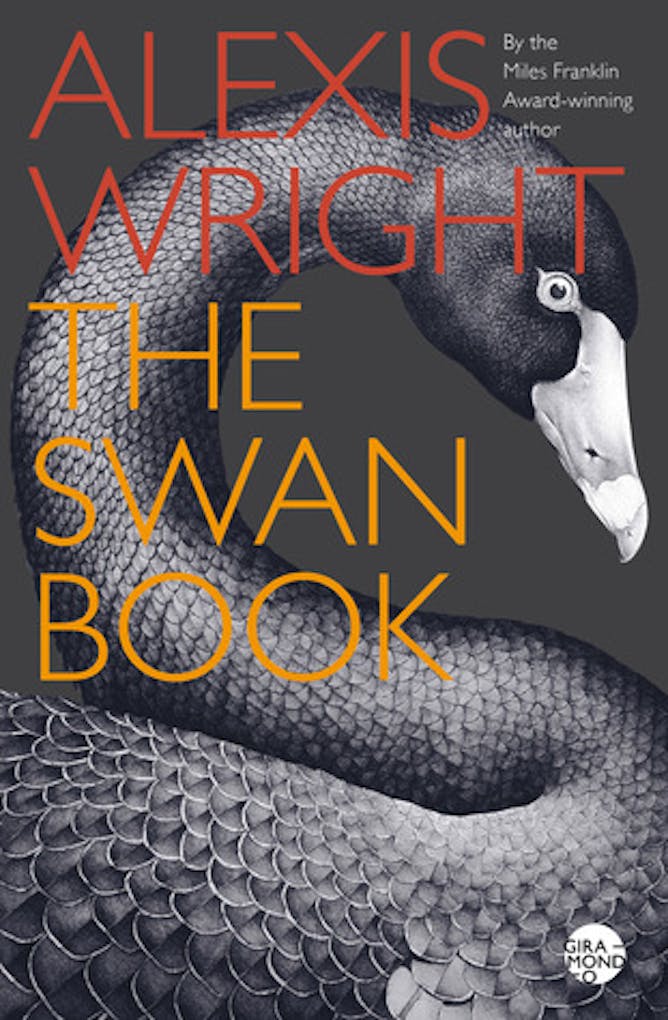
I’ve written about Carpentaria in an essay for Reading Australia, and I discuss both books at length in my forthcoming academic book The Poetics of Transgenerational Trauma. In short, these books matter. This is innovative writing forging cross-cultural trauma testimony that portrays a country in crisis and in desperate need of recovery from the devastating realities of colonialism and racism. There’s no way around it, Wright is not an easy read. These two novels are as far from literary comfort food as it gets. But those able to relax into Wright’s wildly experimental world-making are rewarded with insights and nothing less than a renewed vision of this land and appreciation for the complex communities that inhabit it.

Dirty Words
Natalie Harkin (Cordite Books 2015)
One of my favourite books of recent years, Dirty Words is a whip-smart conceptual collection of poems about the state of the nation and the spectre of its shameful history. Authored by a Narungga scholar and creative practitioner, this slim volume may well knock your socks off and leave you questioning everything you read and hear. Harkin’s poems about the domestic servitude of her Narungga forebears might even move you to tears.
Smoke Encrypted Whispers
Samuel Wagan Watson (UQP 2004)
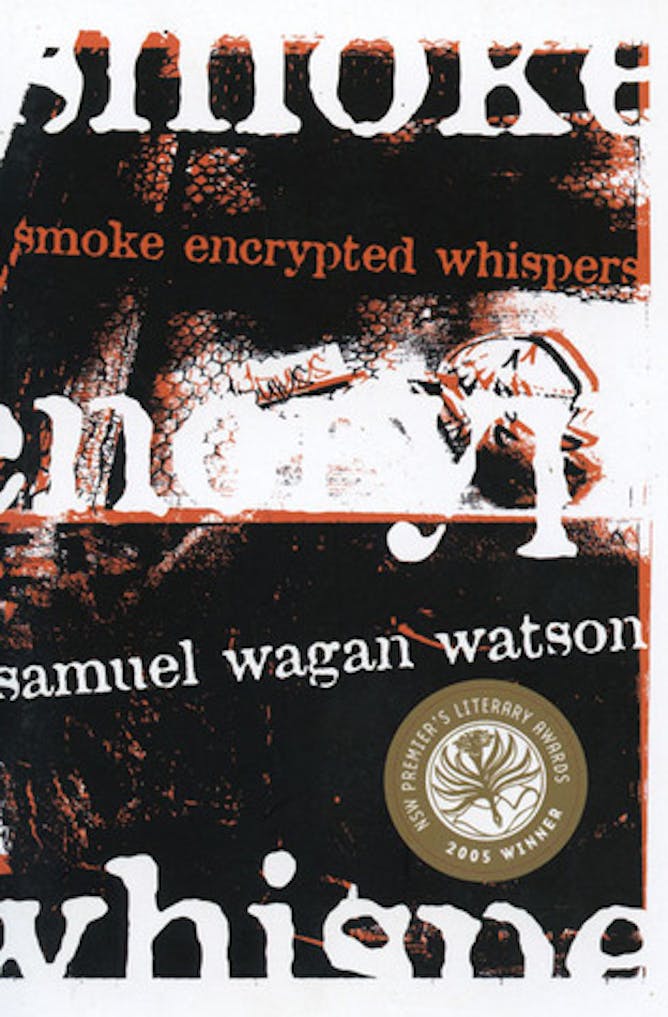
“Childhood anxieties would eventually help me realise the power of imagination”, writes Wagan Watson in “author’s notes # 1”. This generous, award-winning collection of poems later became a multi-modal arts project when its cycle of 23 poems served as inspiration for musical compositions. Poems like “white stucco dreaming” evoke familial ties within societal divides and the daily rituals of suburbia, while “a verse for the cheated” depicts the hidden tragedies of Queensland’s glamorous coastal tourist traps. At times Wagan Watson turns his muscular lyricism outward to consider the world at large, but he soon circles back to home-grown griefs and wonders.
Other highly recommended titles
Heat and Light
Ellen van Neerven (UQP 2014); Inside my Mother
Ali Cobby Eckermann (Giramondo Poets 2015); Mogwie-Idan: Stories of the Land
Lionel Fogarty (Vagabond Press 2012)
These books do the crucial work of testifying to transgenerational trauma and representing and celebrating surviving First Nations cultures and peoples. Each demonstrates, as Tony Birch puts it, the “potential for Aboriginal writing to productively shift the national story”.
Australians, generally speaking, have an inadequate understanding of transgenerational trauma and underestimate the effects of the extreme and sustained traumas experienced by First Nations communities. Transgenerational trauma is the process by which trauma is passed down through successive generations.
There is some debate about if and how this takes place, but transmission likely has various pathways through families, individuals, and culture at large. Colonialism and its aftermath – frontier wars, slavery, dispossession, and stolen children – proved a hotbed for severe traumas and legacies of transmission. The challenge is for non-Indigenous Australians to take responsibility for their own education and become familiar with the voices and concerns of those who have peopled this continent for eons.
Given the depth and scope of the inequity, clearly much more than reading alone is called for. But reading truth-telling accounts of our history and contemporary Australia by First Nations writers is one way of participating in a national dialogue.
What’s your favourite book by a First Nations writer? Leave your recommendations in the comments below.
 Read also: a Warlpiri translation of ‘Dreamtime’ and ‘The Dreaming’ – an introduction.
Meera Atkinson, Sessional Tutor, Creative Writing, University of Sydney
This article was originally published on The Conversation. Read the original article.
The link below is to a book review of ‘Sinai and the Saints – Reading Old Covenant Laws for the New Covenant Community,’ by James M. Todd III.
For more visit:
https://www.9marks.org/article/book-review-sinai-and-the-saints-by-james-m-todd-iii/
The link below is to a book review of ‘The Crook in the Lot,’ by Thomas Boston.
For more visit:
https://www.9marks.org/review/book-review-the-crook-in-the-lot-by-thomas-boston/
The link below is to a book review of ‘Travels in the Interior Districts of Africa,’ by Mungo Park.
For more visit:
https://www.theguardian.com/books/2017/jul/03/100-best-nonfiction-books-travels-in-the-interioir-districts-of-africa-mungo-park
 Arthur Britannicus by Paul Bannister
My rating: 3 of 5 stars
Arthur Britannicus (Forgotten Emperor #1)
by Paul Bannister

Jyotsna G. Singh, Michigan State University
“All the world’s a stage,” Shakespeare once wrote.
In recent weeks, that Shakespearean adage has been particularly resonant, with the New York Public Theater’s production of “Julius Caesar” attracting worldwide scrutiny because of the staged likeness between Caesar and President Trump.
Extolling the play as a masterpiece about power and political violence, director Oskar Eustis persuasively defended his interpretation as a warning about “what happens when you try to preserve democracy by nondemocratic means.”
Others, however, questioned whether this production was in good taste – and denounced it for encouraging violence against President Trump, particularly the scene in which Caesar is stabbed to death. Due to the backlash, Delta Airlines and Bank of America withdrew their corporate sponsorship.
In some ways, the contention – even rancor – of these debates about the Public Theater production would have delighted, and perhaps bemused, Shakespeare. They articulate the richness and urgency of our own democratic struggles – similar to the rich political complexity reflected in Shakespeare’s text itself.
As Shakespeare wrote the play, he drew on Roman history, a popular topic in 16th-century England. But he was also commenting on the political conflicts of the era. The power struggles depicted in “Julius Caesar” mirrored ongoing concerns in England with legitimacy, tyranny and potential threats of rebellion and deposition against Queen Elizabeth I, who did not have an heir. These anxieties were also exacerbated by historical memories of the English Civil War, also called the War of the Roses, going far back as the deposition and death of Richard II.
Shakespeare’s Rome is a place of brutal struggles between democratic ideals and human ambition. The assassination of Caesar is one of the most important events in Roman history, and Shakespeare had inherited over 1,600 years of ambiguity, with little consensus over whether Caesar’s killing was justified. He incorporated these debates into his play, offering his viewers multiple perspectives on the characters. Caesar is either a heroic, benevolent ruler or tyrant; Brutus is either a patriot or assassin.
Shakespeare’s Caesar is clearly a leader and politician with power – including some vanity and propensity to flattery – but also with wide popular appeal. When he returns triumphant from wars, the conspirators fear he will become a tyrant, a “Colossus” whereby the “wide walls” of Republican Rome “encompass’d but one man.”
Yet he seems to love and trust his fellow Romans, warmly inviting Brutus and other conspirators to share wine. And we also learn he bequeaths to his people, on his death, his personal possessions: To every Roman citizen he gives “seventy-five drachmas” and “all his walks, His private arbours and new-planted orchards” for public use.
Shakespeare also gives Brutus, the leader of the assassination plot, a refined conscience throughout the play. It’s evident in the many discussions Brutus has with his fellow conspirators, and it’s summed up when he describes his motivation for killing Caesar: “If then [any] friend demand why Brutus rose against Caesar, then my answer: Not that I loved Caesar less but that I loved Rome more.”
“Julius Caesar” offers a complicated, even poignant vision at the end. It ends in civil war and the defeat of the conspirators, following their internal dissensions and accusations of betrayal. Brutus commits suicide, but Mark Antony and Octavius, Julius Caesar’s grandnephew, victorious at the end, acknowledge Brutus’s nobility and wish to bury him with honor. Toward the close of Shakespeare’s next Roman play, “Antony and Cleopatra,” we see Octavius Caesar emerge as the singular ruler of Rome. Importantly, then, the Republican, democratic ideal is defeated, both in the play and in the Western world (until the American Revolution).
Overall, this picture of a divided Rome – a mix of power politics, of stoic ideals giving way to ego – should give pause to modern audiences. From the shifting perspectives on competing ambitions we learn that all rigid value judgments of “good” and “evil” politicians can be relative – and problematic – in our contingent world.
Yet, the ideals of democracy – in Rome and in our own times – have to be constantly guarded against demagogues, who also may be idealists, of all political stripes. Productions of “Julius Caesar” have typically evoked topical political analogies. Even seemingly traditional, period productions, such as the current Royal Shakespeare Company’s version in Britain, resonate with topical relevance, enabling the audience to deduce connections to today’s political climate.
It may be true – as some have suggested – that the analogy between Julius Caesar and Donald Trump is a bit forced. Regardless, the production is, as one reviewer put it, “a deeply democratic offering, befitting both the Public and the public – and the times.”
As a researcher and teacher of Renaissance drama, I’ve studied Shakespeare’s role as a cultural icon across different societies, cultures and eras. It seems that no matter where (and when) his works are being performed, they provide us with a complex, poetic language for imagining and interpreting the intractable world in which we live.
 During politically contentious times, it’s befitting that we turn more – rather then less – to Shakespeare.
Jyotsna G. Singh, Professor, Department of English, Michigan State University
This article was originally published on The Conversation. Read the original article.
 At the BookShelf
You must be logged in to post a comment.