
The link below is to an article that takes a look at new rules in Europe for ebooks.

The link below is to an article that takes a look at new rules in Europe for ebooks.

Nick Earls, The University of Queensland
While just a few years ago, headlines predicted eBook supremacy and the demise of the paper book, that’s now reversed. They’re now saying the Kindle is clunky and unhip and paper books are cool and selling well as eBook sales crash. But are today’s claims any more accurate than those of 2012? 
The latest round of headlines was triggered by UK Publishers’ Association figures noting a fall in consumer eBook sales of 17% in 2016, while physical book sales rose 8%. This statistic seems straightforward enough on the surface, but it pays to go deeper.
Mainstream media have long been in the habit of relying on figures from publishers’ associations, retailers’ groups and Nielsen data, but the industry has changed. While these measures are accurate, they are only accurate in terms of what they measure, and they represent far less of the industry than they once did. They are no longer a proxy for the industry.
Amazon’s Kindle was launched in November 2007. Barnes & Noble followed with their Nook in October 2009 and Kobo with their eReader in May 2010. Apple’s launch of the iPad in January 2010, meanwhile, introduced a non-specialist device that gave a pleasing eReading experience. US eBook sales rose 1260% between 2008 and 2010. By early 2011, US advisory group Gartner reported that industry researchers were predicting a 70% annual growth rate for eReader sales globally.
In February that year, the REDgroup, the parent company of Angus&Robertson and Borders in Australia – chains responsible for 20% of the country’s book sales – went into receivership. Retailers across the industry in Australia were noticing a downturn. After 5% growth in 2009, Australian book sales contracted slightly in 2010, then dramatically in 2011, with falls of 13% in volume and 18% in value, and significant falls continuing into 2012.
In January 2011, Amazon announced that, for the first time, it was selling more eBooks than paperbacks. According to Nielsen figures, US eBook sales went from US$69m in 2010 to US$165m in 2011, a 139% increase. They increased a further 30% in 2012 and 13% in 2013.
Nielsen figures, though, only record sales of books with ISBNs, something many independently published eBooks do not have. Despite not counting many eBooks, Nielsen still recorded sales as increasing, albeit probably at diminishing growth rates each year.

With increases in both average smartphone screen size and smartphone use, the 2014 to 2015 period marked another shift – the phone was becoming a significant reading tool. According to US Nielsen surveys, while the percentage of the eReading population reading primarily on tablets had increased from 30% in 2012 to 41% in 2015, the number of eBook buyers who used their phones to read at least some of the time increased from 24% to 54% in the same period.
Judith Curr, publisher of Atria Books, stated in 2015 that,
“The future of digital reading is on the phone. It’s going to be on the phone and it’s going to be on paper”.
EBook sales in the US, though, appeared to plateau at 2013 levels, according to Association of American Publishers figures, and then dipped early in 2015. In the UK, the Publishers’ Association reported digital sales for the year 2015 falling slightly and print sales growing minimally. “Readers take a pleasure in a physical book that does not translate well on to digital,” the Publishers’ Association stated, and declarations of “peak eBook” became commonplace. Those figures, though, do not tell the whole story.
As Simon Jenkins admitted in The Guardian last year when declaring that peak digital was at hand, the adult colouring book fad made a contribution to print sales in 2015. Unlike fiction blockbusters, sales of colouring books are almost entirely in print format.
In the case of the UK market, the £20.3 million generated by adult colouring books in 2015 matched the growth in the overall print market. Without it, the pattern of zero or negative growth seen in the preceding seven years would have continued. In the US, Nielsen reported that sales of adult colouring books surged from one million units in 2014 to 12 million in 2015. Australia was also part of the adult-colouring craze. Nielsen BookScan’s November 2015 Australian top 20 featured eight colouring books, each one of them outselling the most successful Australian novel.

Other factors were at work as well. Following the renegotiation of pricing between major American publishers and Amazon, eBook prices rose in the US Kindle Store in late 2014 and 2015. Until then, Amazon had pushed publishers to keep prices no greater than $9.99, and buyers had become conditioned to paying less than $10 for eBooks.
Publishers that increased prices above that mark subsequently recorded a fall in eBook receipts, and some identified higher prices as a factor. According to journalist Jeffery Trachtenberg, publishers viewed this pricing change as involving “some sacrifice, but they felt it was worth it to keep Amazon in check”.
The specific books published from one year to the next had an impact too. Some publishers noted that 2015 saw fewer “hot” titles. With nothing to match Frozen and the Divergent series, children’s and young-adult eBook sales fell 45.5% in 2015 in the US.
While the Association of American Publishers’s figures are based on a survey of 1200 publishers and often seen as authoritative, the Amazon Kindle Store stocks many independently published titles and titles published by small and micro publishers not captured by the survey.
At the same time as the association was reporting a drop in overall eBook sales, Amazon, the retailer with the majority of the US eBook market, reported increases in sales in terms of both units and revenue.
And other avenues were opening up that facilitated continued growth in eReading that was not feeding into the statistics. Public libraries were lending eBooks and subscription eBook libraries were opening for business – Oyster in September 2013, Scribd the following month and Amazon’s Kindle Unlimited in July 2014.
While subscriber downloads earned an author readers and, in the case of subscription libraries, revenue, they did not count towards sales.
David Montgomery, CEO of publishing services company Publishing Technology, drew on these factors to declare last year that publishing had split into two markets, with a widening gap between them.
Self-published and micro-published authors, particularly those writing genre fiction, were pricing their eBooks much lower and claiming an increasing share of the market, particularly through Amazon, while large publishers were increasing eBook prices in a way that reduced eBook sales.

This pattern has continued, and the rhetoric that pits one format against another appears to be continuing too. At the Digital Book World conference in January 2017, Nielsen presented 2016 data from more than 30 traditional US publishers showing a fall in eBook sales from 2015 to 2016 and hardback unit sales overtaking eBooks for the first time since 2012.
Despite their data being an estimate and covering relatively few publishers, Publishers Weekly ran its story on the presentation with the headline “The Bad News About Ebooks”. The week after the conference, the Sydney Morning Herald published a Bloomberg-sourced piece headed “How Print Beat Digital in the Book World”.
Association of American Publishers (AAP) data released in February 2017 appeared to confirm the decline of eBooks, with eBook sales for the first nine months of 2016 down 18.7% on the year before.
However, at the Digital Book World conference in January, other evidence was presented that attracted less media attention.
An analysis by the Author Earnings website (an aggregator and analyser of eBook sales data) identified that, outside the world of traditional publishing, authors who were self-published, independently published or published directly by Amazon imprints, had sold more than 260 million eBooks worth more than US$850 million in the US in 2016.
Total eBook sales by Amazon – which makes up 83% of the US eBook market by volume and 80% by value – rose by 4% from early 2015 to early 2016, at the same time as eBook sales recorded by the AAP were falling.

While no direct comparison exists for the UK market – where the Publishers’ Association reported a 17% fall in consumer eBook sales from 2015 to 2016 – 42% of eBook sales in that market are by self, indie or Amazon-published authors. This added up to 40 million of the 95 million units sold in the UK in 2016 – a percentage that is growing as the eBook market share held by the larger members of the Publishers’ Association falls.
The publishing industry has changed. It is no longer solely the domain of members of publishers’ associations and books with ISBNs that allow easy tracking and accumulation of data that appears robust but tells much less of the story than it once did.
It is too easy to have our attention grabbed, and sometimes our biases or hopes confirmed, by an appealing set of statistics from an authoritative source, and to misunderstand what those statistics are measuring.
It is also too easy to fall into viewing the evolution in eBook and print sales solely through the prism of Amazon and its often public power struggle with publishers, and to be drawn too deeply into seeing the future of publishing as one format versus another.
While it is possible to speculate about the future trajectories of the eBook and paper book markets, many confident pundits have been wrong before, as new factors have emerged that have significantly impacted reader behaviour and sales patterns.
From the practical perspective of writers wishing to connect their work with readers, it is prudent to see both paper and eBooks as significant for any book-publishing project in the present and near future, and to develop strategies to meet both of them. It is also prudent to look beyond both platforms to another, one that had long been regarded as a peripheral player: audiobooks.
All we can be sure of is that the digital platform is still evolving. What will an eBook be 20 years from now? What will a book be?
Nick Earls, PhD Candidate in Creative Writing, The University of Queensland
This article was originally published on The Conversation. Read the original article.

Louise Pryke, Macquarie University
“Forget death and seek life!” With these encouraging words, Gilgamesh, the star of the eponymous 4000-year-old epic poem, coins the world’s first heroic catchphrase. 
At the same time, the young king encapsulates the considerations of mortality and humanity that lie at the heart of the world’s most ancient epic. While much has changed since, the epic’s themes are still remarkably relevant to modern readers.
Depending upon your point of view, Gilgamesh may be considered a myth-making biography of a legendary king, a love story, a comedy, a tragedy, a cracking adventure, or perhaps an anthology of origin stories.
All these elements are present in the narrative, and the diversity of the text is only matched by its literary sophistication. Perhaps surprisingly, given the extreme antiquity of the material, the epic is a masterful blending of complex existential queries, rich imagery and dynamic characters.
The narrative begins with Gilgamesh ruling over the city of Uruk as a tyrant. To keep him occupied, the Mesopotamian deities create a companion for him, the hairy wild man Enkidu.
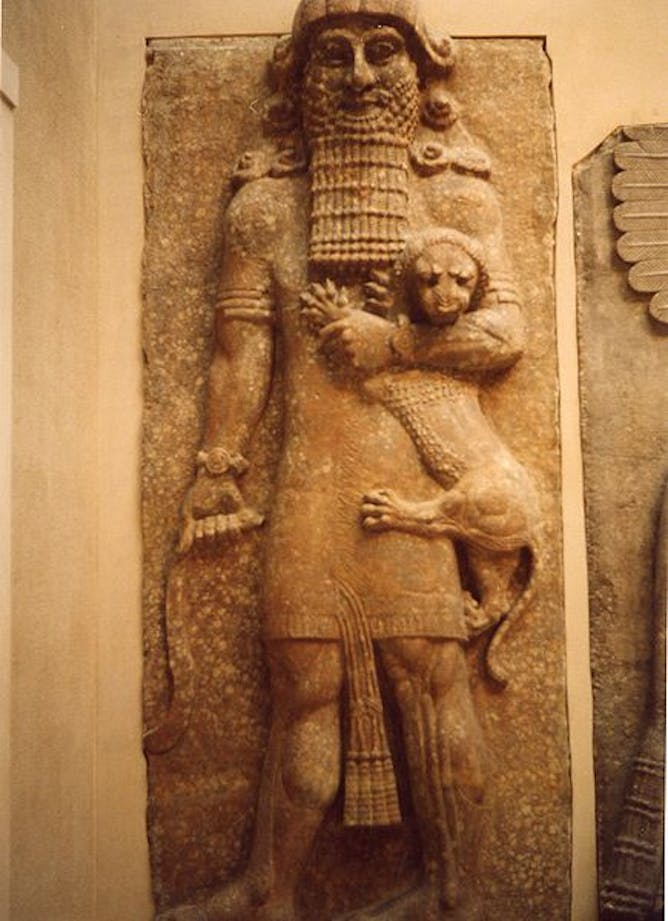
Gilgamesh sets about civilising Enkidu, a feat achieved through the novel means of a week of sex with the wise priestess, Shamhat (whose very name in Akkadian suggests both beauty and voluptuousness).
Gilgamesh and Enkidu become inseparable, and embark on a quest for lasting fame and glory. The heroes’ actions upset the gods, leading to Enkidu’s early death.
The death of Enkidu is a pivotal point in the narrative. The love between Gilgamesh and Enkidu transforms the royal protagonist, and Enkidu’s death leaves Gilgamesh bereft and terrified of his own mortality.
The hero dresses himself in the skin of a lion, and travels to find a long-lived great flood survivor, Utanapishtim (often compared with the biblical Noah). After a perilous journey over the waters of death, Gilgamesh finally meets Utanapishtim and asks for the secret to immortality.
In one of the earliest literary anti-climaxes, Utanapishtim tells him that he doesn’t have it. The story ends with Gilgamesh returning home to the city of Uruk.
Gilgamesh and his adventures can only be described in superlative terms: during his legendary journeys, the hero battles deities and monsters, finds (and loses) the secret to eternal youth, travels to the very edge of the world — and beyond.
Despite the fantastical elements of the narrative and its protagonist, Gilgamesh remains a very human character, one who experiences the same heartbreaks, limitations and simple pleasures that shape the universal quality of the human condition.
Gilgamesh explores the nature and meaning of being human, and asks the questions that continue to be debated in the modern day: what is the meaning of life and love? What is life really — and am I doing it right? How do we cope with life’s brevity and uncertainty, and how do we deal with loss?
The text provides multiple answers, allowing the reader to wrestle with these ideas alongside the hero. Some of the clearest advice is provided by the beer deity, Siduri (yes, a goddess of beer), who suggests Gilgamesh set his mind less resolvedly on extending his life.
Instead, she urges him to enjoy life’s simple pleasures, such as the company of loved ones, good food and clean clothes — perhaps giving an example of a kind of Mesopotamian mindfulness.

The epic also provides the reader with a useful case study in what not to do if one is in the exceptional circumstance of reigning over the ancient city of Uruk. In ancient Mesopotamia, the correct behaviour of the king was necessary for maintaining earthly and heavenly order.
Despite the gravity of this royal duty, Gilgamesh seems to do everything wrong. He kills the divinely-protected environmental guardian, Humbaba, and ransacks his precious Cedar Forest. He insults the beauteous goddess of love, Ishtar, and slays the mighty Bull of Heaven.
He finds the key to eternal youth, but then loses it just as quickly to a passing snake (in the process explaining the snake’s “renewal” after shedding its skin). Through these misadventures, Gilgamesh strives for fame and immortality, but instead finds love with his companion, Enkidu, and a deeper understanding of the limits of humanity and the importance of community.
The Epic of Gilgamesh was wildly famous in antiquity, with its impact traceable to the later literary worlds of the Homeric epics and the Hebrew Bible. Yet, in the modern day, even the most erudite readers of ancient literature might struggle to outline its plot, or name its protagonists.

To what might we owe this modern-day cultural amnesia surrounding one of the world’s greatest works of ancient literature?
The answer lies in the history of the narrative’s reception. While many of the great literary works of ancient Greece and Rome were studied continuously throughout the development of Western culture, the Epic of Gilgamesh comes from a forgotten age.
The story originates in Mesopotamia, an area of the Ancient Near East thought to roughly correspond with modern-day Iraq, Kuwait and parts of Syria, Iran and Turkey, and frequently noted as “the cradle of civilisation” for its early agriculture and cities.
Gilgamesh was written in cuneiform script, the world’s oldest known form of writing. The earliest strands of Gilgamesh’s narrative can be found in five Sumerian poems, and other versions include those written in Elamite, Hittite and Hurrian. The best-known version is the Standard Babylonian Version, written in Akkadian (a language written in cuneiform that functioned as the language of diplomacy in the second millennium BCE).
The disappearance of the cuneiform writing system around the time of the 1st century CE accelerated Gilgamesh’s sharp slide into anonymity.
For almost two millennia, clay tablets containing stories of Gilgamesh and his companions lay lost and buried, alongside many tens of thousands of other cuneiform texts, beneath the remnants of the great Library of Ashurbanipal.

The modern rediscovery of the epic was a watershed moment in the understanding of the Ancient Near East. The eleventh tablet of the Epic was first translated by self-taught cuneiform scholar George Smith of the British Museum in 1872. Smith discovered the presence of an ancient Babylonian flood narrative in the text with striking parallels to the biblical flood story of the Book of Genesis.
The story is often repeated (although it may be apocryphal) that when Smith began to decipher the tablet, he became so excited that he began to remove all his clothing. From these beginnings in the mid-19th century, the process of recovering the cuneiform literary catalogue continues today.
In 2015, the publication of a new fragment of Tablet V by Andrew George and Farouk Al-Rawi made international news. The fragment’s discovery coincided with increased global sensitivity to the destruction of antiquities in the Middle East in the same year. The Washington Post juxtaposed the “heart-warming story” of the find against the destruction and looting in Syria and Iraq.
The new section of Tablet V contains ecological aspects that resonate with modern day concerns over environmental destruction. Of course, there are potential anachronisms in projecting environmental concerns on an ancient text composed thousands of years prior to the industrial revolution.
Yet, the undeniable sensitivity in the epic’s presentation of the wilderness is illuminating, considering the long history of humanity’s interaction with our environment and its animal inhabitants.

In Gilgamesh, the wilderness is a place of beauty and purity, as well as home to a wild abundance. The splendour and grandeur of the Cedar Forest is described poetically in Tablet V:
They (Gilgamesh and Enkidu) stood marvelling at the forest,
Observing the height of the cedars …
They were gazing at the Cedar Mountain, the dwelling of the gods, the throne-dais of the goddesses …
Sweet was its shade, full of delight.
While the heroes pause to admire the forest’s beauty, their interest is not purely aesthetic. Gilgamesh and Enkidu are aware of the economic value of the cedars, and the text provides a clear picture of competing commercial and ecological interests.
Since Gilgamesh’s reappearance into popular awareness in the last hundred years, the Standard Babylonian Version of the epic has become accessible in numerous translations. This version was originally compiled by the priest, scribe and exorcist, Sin-leqi-uninni, around 1100 BCE.
The scholarly standard among modern translations is Andrew George’s The Babylonian Gilgamesh Epic: Introduction, Critical Edition and Cuneiform Texts (2003).
Despite its all-around excellence, the two-volume work is decidedly unwieldly, and the less muscle-bound reader would be well directed to The Epic of Gilgamesh: A New Translation (1999), by the same author. Most readable among modern treatments is David Ferry’s Gilgamesh: A New Rendering in English Verse (1992), which gives a potent, poetic interpretation of the material.
Like the snake that steals Gilgamesh’s rejuvenation plant, the Epic of Gilgamesh has aged well. Its themes – exploring the tension between the natural and civilised worlds, the potency of true love, and the question of what makes a good life – are as relevant today as they were 4,000 years ago.
Note: Translations are sourced from Andrew R. George 2003. The Babylonian Gilgamesh Epic: Introduction, Critical Edition and Cuneiform Texts, Volume 1. Oxford: Oxford University Press.
Louise Pryke, Lecturer, Languages and Literature of Ancient Israel, Macquarie University
This article was originally published on The Conversation. Read the original article.
The link below is to a book review of ‘London Labour and the London Poor,’ by Henry Mayhew.

 At the BookShelf


You must be logged in to post a comment.