There is a strange and troubled kind of intimacy between our own moment of climate change and 19th century Britain. It was there that a global, fossil fuel economy first took shape, through its coal-powered factories, railways, and steamships, which drove the emergence of modern consumer capitalism.
What might we now find if we look again at the literature of the 19th century? Although Victorian writers lacked our understanding of a warming planet, we can learn from their deep awareness of the rapid and far-reaching ways that their society was changing. In their hands, the novel became a powerful tool for thinking about the interconnections between individuals, society, economics, and the natural world.
North and South
One place to start thinking about such things might be Elizabeth Gaskell’s North and South (1855), a classic example of the “industrial novel” genre that flourished in the middle decades of that century.
Most of the novel’s events take place in the industrial town of Milton-Northern (Manchester), the epicentre of Victorian coal-fired industrial production. Our protagonist, Margaret Hale, is forced to relocate there due to family circumstances, and her first numb impressions are that the environment, the economy, and the city’s urban geography have all been transformed by fossil fuel consumption:
For several miles before they reached Milton, they saw a deep lead-coloured cloud hanging over the horizon in the direction in which it lay … Nearer to the town, the air had a faint taste and smell of smoke; perhaps, after all more a loss of the fragrance of grass and herbage than any positive taste or smell. Quick they were whirled over long, straight, hopeless streets of regularly-built houses, all small and of brick.
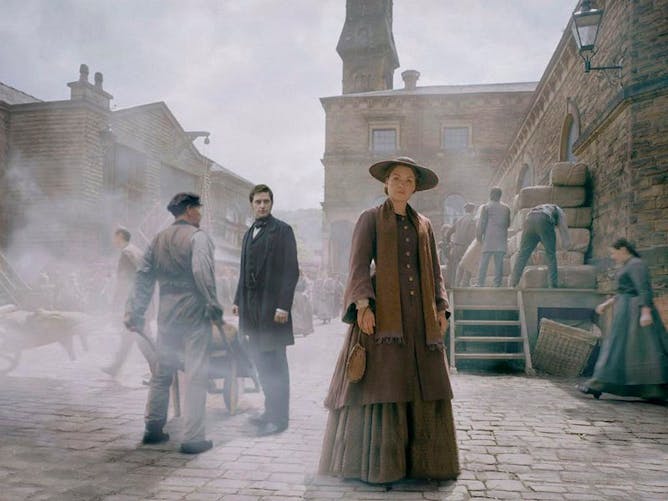
Milton is covered in a thick layer of pollution as a result of the town’s industrialisation, as depicted in the BBC mini-series North and South (2004), which starred Daniela Denby-Ashe as Margaret. British Broadcasting Corporation
Gaskell brings her refined but impoverished heroine into contact with a forceful cotton-mill owner, John Thornton — imagine if Pride and Prejudice were set in a factory. Their love plot offers a symbolic means of restoring harmony to a nation disrupted by the new economy, as Margaret softens the edges of Thornton’s laissez faire practices and brings about improved relations with his workers. As he admits to one of his acquaintances, near the end of the novel,
My only wish is to have the opportunity of cultivating some intercourse with the hands beyond the mere ‘cash nexus’.
Thinking about this resolution in light of the fossil fuel economy, however, what comes into focus is how vulnerable this harmonious social vision is to wider social and environmental forces. By the novel’s conclusion, the global market — the source of raw materials, investors, and customers — proves to be so powerful and destabilising that the harmony of Thornton’s factory can provide only temporary solace at best, and he is bankrupted:
Meanwhile, at Milton the chimneys smoked, the ceaseless roar and mighty beat, and dizzying whirl of machinery, struggled and strove perpetually… . Few came to buy, and those who did were looked at suspiciously by the sellers; for credit was insecure… . [F]rom the immense speculations that had come to light in making a bad end in America, and yet nearer home, it was known that some Milton houses of business must suffer[.]
Looking back at North and South now, we can see how interconnected its vision of a fossil-fuelled society and the economy is, and how artificial the borders of the nation prove to be when faced with the instabilities that it causes.
The Time Machine
Australian author James Bradley suggests that writers today, grappling with how to represent climate change, have found genres such as science fiction more suited to the task than classic realism.
“In a way this is unsurprising,” he comments, because of those genres’ interest in “estrangement” from everyday circumstances, and their fascination with “experiences that exceed human scales of being.”
The last decades of the Victorian era were, like now, a stunning time of generic innovation, and prominent amongst those late-century innovations were the “scientific romances” of H. G. Wells.
The Time Machine’s bleak view of humanity’s future (seen here in the 1960 film adaptation) is a chilling one. George Pal Productions
In The Time Machine (1895) Wells found a narrative device that would allow him to think about social and environmental change over enormous spans of history. Near the end of the novel, the inventor of the machine undertakes a voyage to the very end of the planet’s history:
I looked about me to see if any traces of animal life remained… . I saw nothing moving, in earth or sky or sea. The green slime on the rocks alone testified that life was not extinct… .
From the edge of the sea came a ripple and a whisper. Beyond these lifeless sounds the world was silent. Silent? It would be hard to convey the stillness of it. All the sounds of man, the stir that makes the background of our lives — all that was over.
In imagining this bleak beach, Wells is taking up contemporary predictions that the law of entropy meant the inevitable “heat death” of the universe. Global cooling rather than global warming, then, but one thing that resonates now is how the novel views humanity as a species — and a finite one, at that — rather than from a more limited individual or even national perspective.
The Victorians were the first to stare into the abyss of geological deep time, and to confront the idea of natural history as a succession of mass extinctions.
As a result, Wells raises the idea of a future where even technology cannot overcome calamitous natural processes, and dares to imagine a planet without a human presence.
Tess of the D’Urbervilles
The novelist Amitav Ghosh has recently described a “broader imaginative and cultural failure that lies at the heart of the climate crisis,” arguing that the characteristics of the realist novel have made it resistant to representing those environmental and social complexities. Does the realist novel really have nothing to offer and nothing to say in an era of climate change?
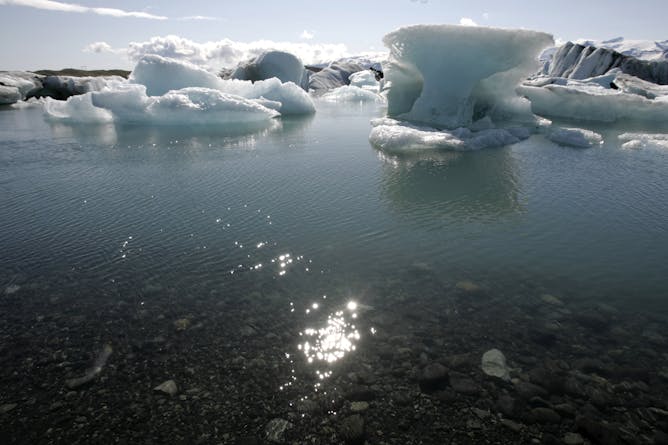
The melting icebergs of Breidamerkurjokull’s Vatnajokull glacier in Iceland: is there a role for the realist novel in an era of climate change? Ints Kalnins/Reuters
One place to look for an answer is another famously bleak Victorian text, Thomas Hardy’s Tess of the D’Urbervilles (1891). The plot is set in motion with Tess’s father’s discovery that his family name, Durbeyfield, is a corruption of D’Urberville, and they are in fact descended from an ancient family that once dominated the area. When they are ultimately thrown out of their home, the Durbeyfields end up seeking refuge at a church, amongst the graves of their ancestors:
They were canopied, altar-shaped, and plain; their carvings being defaced and broken; their brasses torn from the matrices, the rivet-holes remaining like marten-holes in a sand-cliff. Of all the reminders that she had ever received that her people were socially extinct there was none so forcible as this spoliation.
A bit like our own era of increasingly constrained resources, Tess inhabits an exhausted present, and she moves amidst the ruins left by previous generations who have consumed the material wealth that once made life abundant.
Hardy is also deeply attuned to the ecological damage produced by increasingly industrialised forms of agriculture. Late in the novel, when Tess is abandoned by her lover, Angel Clare, she is forced to accept work on the vast and stony fields of Flintcomb-Ash farm.
She labours through a brutal winter, and endures the relentless demands imposed by a steam-powered threshing machine — “a portable repository of force” — that reduces the workers to automatons. Around the same time, Angel abandons England for Brazil, only to find that English bodies do not translate to tropical ecosystems:
He would see mothers from English farms trudging along with their infants in their arms, when the child would be stricken with fever and would die; the mother would pause to dig a hole in the loose earth with her bare hands, would bury the babe therein with the same natural grave-tools, shed one tear, and again trudge on.
Gemma Arterton as Tess in the 2008 mini series adaptation. Stuck on a farm, Tess seesk to make ethical choices despite overwhelming constraints in Hardy’s novel. British Broadcasting Corporation
Both Tess and Angel — and the anonymous, sundered colonial families — seem to be climate refugees of a kind, caught between hostile climates and the environmental wreckage wrought by agribusiness.
What little Tess of the D’Urbervilles offers in the face of all this bleakness also centres on Tess. For one thing, she doesn’t just think of herself as an isolated individual, but sees herself as part of larger social and ecological collectives — her family, her fellow milkmaids, even the rural landscape.
She persists in her determination to care for those around her — including, most challengingly, the son she gives birth to after her rape — despite the weight of the moral and economic systems that bear down upon her. After her father refuses to let the parson visit, Tess chooses to baptise her dying son herself — naming him Sorrow — and then secures him a Christian burial:
In spite of the untoward surroundings … Tess bravely made a little cross of two laths and a piece of string, and having bound it with flowers, she stuck it up at the head of the grave one evening … putting at the foot also a bunch of the same flowers in a little jar of water to keep them alive.
Tess refuses to abandon her project of care despite its futility, persisting with her fidelity in the midst of catastrophe.
Literature in itself isn’t going to save us from global warming — if salvation is even possible, at this point — but then neither, on their own, will economics or science. But if Amitav Ghosh is right, and climate change has revealed an imaginative paralysis in western culture, one thing that the Victorian novel offers us is a means of thinking and feeling about our own moment anew.
The Sydney Writers Festival will host a session on the rise and rise of Cli-Fi featuring James Bradley, Sally Abbott, Hannah Donnelly and Ashley Hay on Friday May 26.
As the Australian Copyright Agency comes under pressure for appearing to use member royalties to enshrine self-serving copyright laws, it’s time to question the purpose of copyright. Some argue current laws ensure artists are fairly paid and make more local content. The evidence doesn’t support this idea.
Copyright is primarily concerned with creative works.
Exploitation of copyright occurs when the author of a creative work excludes all others from reproducing or otherwise using their work for up to 70 years after their death, unless they, the authors, agree to authorise any such use (i.e. pay a fee or a royalty under voluntary or compulsory licences).
On the pro-copyright side, we have the global movie and music industry, many IP lawyers and prominent authors.
The intention of copyright laws is to encourage people to create cultural products such as books, songs, movies and fine art etc. The argument goes that if the authors of these works (or their owners) can charge royalties to those who enjoy these works, then more people will decide to work as authors.
The author gets an income and can therefore spend more time creating works.
However, there are strong arguments that copyright may have gone too far. Royalties only go to a small amount of people, and they mostly prop up the incomes of “rent seekers”. Rent seeking is when income from copyright just makes existing creators wealthier and does not encourage more people to become creators.
The contra-copyright group see someadvantage from copyright lasting a few decades, but not the current system, which grants copyright for life plus 70 years after death (there are some exceptions).
Royalties should not be paid beyond the point at which the income stream has an effect on decisions to create more now. Existing copyright laws (which can give control for over 100 years) are merely lining the pockets of movie houses and the heirs of dead authors, without having any effect on the current group of artists.
Australian culture will falter without copyright
The next argument in favour of copyright is that the true value of copyright is the ability for the owner to control the use of their work through licensing.
Given the ubiquity of the internet, it is now very easy to copy works and local authors will not be able to make a living from their work.
Hence, any time or effort they put into creations will be in their spare time after working elsewhere. Enabling authors to receive some royalties goes some way towards providing them with independent income.
But the contra-copyright group say the fact that most royalties go to very few authors, or go overseas to the big music and movies houses and publishers, means copyright does little for emerging and local artists.
In fact, the best way to encourage the local cultural sector might be to offer stipends or grants directly to local artists.
It is not to use copyright to overcharge the ordinary householder; prosecute those who illegally download movies; or to waste the time of students and school teachers filling in royalty forms.
A right to control your creation?
Another pro-copyright argument is that copyright is needed to ensure authors are credited for, and control, their work. This is also known as “moral rights”, and creates the obligation to attribute creators and treat their work with respect.
But we could question whether this is the role of copyright. Gifting moral rights does not necessarily mean the artist should be able to decide who can read or watch his or her work for the purpose of genuine enjoyment.
Authors should be paid for their contribution to society
The pro-copyright group claim that royalties are justified on fairness grounds. People should be rewarded according to their contribution to society and as royalties are linked to use (reading or watching), it is a clever way to link contributions.
However, in terms of value to society, a case can be made that primary school teachers, civil engineers or surgeons should be paid more. And as copyright only delivers a living wage to very few artists, we can question whether the current laws are a fair system.
Fair use
The Productivity Commission recently agreed with the Australian government to reform the education statutory licensing scheme, but commented that this decision was missing a recommendation to move to a “fair use” system of copyright exceptions.
Fair use allows for certain circumstances where people can use copyrighted material without the copyright holder’s permission.
Australia does not have a fair use exception. It only has a more limited “fair dealing” exception which means we can only avoid permission for uses that are on a list.
A fair use system would allow users such as schools and universities to use works in some situations without paying any royalties. Maybe, we should limit copyright to 20 years and increase our stipends to local artists instead.
By and large, critics have taken Ivanka Trump at her word about her new book, “Women Who Work.”
She claims she wrote it before her father’s election, “from the perspective of an executive and an entrepreneur.” And though they criticize her for being trite, derivative, out of touch and racially tone-deaf, most readers have accepted the premise that this is a largely apolitical book.
Yet as every scholar of literature knows, each book contains what theorist Fredric Jameson has dubbed a “political unconscious.” In other words, through the sheer act of narrating, a book reinforces one particular point of view while policing others.
With this in mind, a close read of “Women at Work” reveals deeply political undertones. Throughout her narrative, Trump advances an ideology of individualism framed by unlimited choice, perfect health and no time constraints. While in many ways, it’s aligned with the principles of the Republican Party, most American working women would probably find her advice for tackling life’s challenges difficult to reconcile.
Time: The great equalizer?
The works of the major Russian writers I study rarely engage with political themes in overt ways. But in emphasizing everyday life, families and communities, writers from Leo Tolstoy to Ivan Turgenev reject the possibility of drastic societal upheaval. Written during a period of political transition and reform, these works are inadvertently conservative; they seem to rebuff the position of the left-wing revolutionaries who sought to destroy the status quo.
In the case of “Women Who Work,” Ivanka Trump’s underlying assumption – her political perspective – is that 21st-century women live a life driven by personal choice.
“You choose,” she writes at one point. These words are perhaps the motto of her book, which presents women’s lives as a series of choices: career, partner, friends and so on. This much is predictable enough.
As an heiress, Trump is perhaps hesitant to discuss finances. So her discussion of choice is instead framed by allocation of another currency: time.
This, she claims, is the great human equalizer.
“No matter your age, your background, your education, or your successes,” she points out, “we are all granted 168 hours in a week.”
According to Trump, we each have at our disposal a limited amount of time to distribute among daily tasks. Her empowerment of women rests on the premise that all it takes to juggle all work and family responsibilities is creative time management. If used in a proactive – rather than reactive – way, the currency of time allows human entrepreneurship to thrive.
But in truth, time is no great equalizer. Buried in this time calculus is the fact that Ivanka’s management skills are powered by her considerable wealth. On simple quantitative terms, someone who can’t afford a housekeeper or babysitter will surely have less time at their disposal than someone who can. If a college professor is able to work from home after hours, a waitress at a diner cannot. And never mind the waste of time and money that results from things we do not choose – like illnesses.
When illness is a choice
Indeed, you would also think, after reading Trump’s book, that 21st-century women don’t simply possess the power to choose how to allocate their time. They also possess perfect health.
Even as a harbinger of our mortality, time is no great equalizer because we have different levels of access to quality health care. Whereas more than half of American adults struggle with one or more chronic health conditions in their lifetime, Trump never betrays any vulnerability to illness and never discusses getting sick in “Women Who Work.” In fact, even though we know she’s given birth three times, after reading this book you would think that she’s never set foot in a hospital.
Throughout, Trump explains about how health conditions can be vanquished through mental balance.
“Proactive people are passionate and productive,” she writes, “they focus their energies on the things they can influence and improve: their families, their health, their work.” She spends considerable time noting how stress produces unhealthy eating habits and how she stocks her refrigerator with healthy snacks.
These comments, coupled with Trump’s apparent excellent health, seem to say that illness, too, is a matter of choice. And in this sense, her empowerment of women is founded on the same ideological underpinnings as the new GOP health care plan that just passed in the House of Representatives – a plan that emphasizes choice above all else, including compassion and access.
It’s a vision of life – and health – driven by market principles of efficiency and management (what academics like to call neoliberalism). In an op-ed he wrote advocating for an earlier incarnation of the bill, House Speaker Paul Ryan spoke shockingly little of health. Instead, he focuses on costs and health insurance markets.
Some Republicans have even stretched their choice doctrine to an absurd degree by suggesting, as Trump indirectly does, that perhaps we also choose our illnesses. As Republican Congressman Mo Brooks controversially declared, people who “lead good lives” won’t have to deal with preexisting conditions. This idea strikes me as Ivanka Trump’s female empowerment plan played to perfection: a life of self-actualization – to the point of the outright elimination of disease.
Operating with different currencies – but fueled by the same market-driven philosophy of individual management and investment – both the GOP health care plan and “Women Who Work” leave individuals to their own lonely devices, with the towering task of making the impossible possible through sheer force of will.
I’ve never met Ivanka Trump, so I have no clue what preexisting conditions she has. But after reading her book where she effortlessly handles raising three children, working two full-time jobs and going on eight-hour hikes in Patagonia, I strongly believe that she would be the perfect pitchwoman for the health care system advocated by the GOP health care plan. Both betray a shocking lack of empathy for those who lack choices.
By using time as a currency to insist on equality where there is none, Ivanka is not merely tone-deaf, but rather advancing the beloved GOP doctrine of free-market capitalism. With no external time constraints, Ivanka Trump suggests that we can all become happy, healthy and wealthy – just like her.






 At the BookShelf


You must be logged in to post a comment.