
The link below is to an article reporting on how Libro.fm has now launched an audiobook subscription service.
For more visit:
http://the-digital-reader.com/2017/03/10/libro-fm-launches-audiobook-subscriptions/

The link below is to an article reporting on how Libro.fm has now launched an audiobook subscription service.
For more visit:
http://the-digital-reader.com/2017/03/10/libro-fm-launches-audiobook-subscriptions/

Jeffrey Wasserstrom, University of California, Irvine
Thanks to the criticisms they’ve leveled in articles, interviews, tweets and letters to the editor, we know that many contemporary authors, from Philip Roth to J.K. Rowling, have a dim view of Donald J. Trump. 
But what would leading writers of the past have made of him?
We can only speculate (well, until someone invents a Rowling-like potion capable of bringing long dead writers back to life). But if I could ask one dead writer what he thinks of Trump, it would be Mark Twain, my favorite American author and someone whose travel articles I’ve written about in the past. While Twain is best-known for his novels, he was also an opinionated, prolific commentator on the personalities and political issues of his day.
I suspect Twain would have found Trump the showman – the pre-2016 version – a fascinating figure. He would have been appalled, however, by much about Trump the president.
I have no doubt about two things that Twain would find objectionable: the way that Trump has lashed out at TV sketches that mock him and his use of the phrase “enemy of the American people” to describe news organizations that criticize him.
Twain felt that no one was too grand to be satirized.
“Irreverence,” he wrote, “is the champion of liberty and its only sure defense.”
In America’s press, he admired its tendency to be “irreverent toward pretty much everything.” Even if this led to the newspapers laughing “one good king to death,” it was a small price to pay if they also “laugh a thousand cruel and infamous shams and superstitions into the grave.”
But pondering what, beyond this, Twain would make of Trump is an apt, tricky and timely exercise.
It’s apt because one of Twain’s novels, “A Connecticut Yankee in King Arthur’s Court,” features a man who travels through time.
It’s tricky because Twain’s views on many issues, including race, changed during his lifetime. Hence there are different Twains – as well as different Trumps – to consider.
Finally, imagining how Twain would view Trump is timely because when some have tried to look to history for an equivalent political moment, they’ll sometimes point to two decades – the 1880s and the 1900s – that happened to also be important in Twain’s life and career.
The Twain of the 1880s would have probably found the Trump of a decade ago – a brash, self-promoting businessman known for his candid comments and penchant for media attention – fascinating. He may have even befriended him.
But the staunchly anti-imperialist Twain of two decades later would have been as disdainful of Trump now as he was of the man he once called “far and away the worst president we have ever had” – the muscular nationalist Teddy Roosevelt.
My basis for the first claim comes from Twain’s friendship with a flashy, boastful Trump-like showman: Buffalo Bill Cody. Among the most successful entertainment impresarios of his day, Cody founded and starred in a traveling Wild West Show, which drew large crowds in America and Europe and was famous for its reenactments of legendary battles.
In 1884, Twain sent a letter to Cody praising his Wild West Show as a realistic, “distinctly American” form of entertainment. In Cody’s spectacle – as in “The Apprentice” – the emcee was a famous man who played up a version of himself, capitalizing on the audience’s awareness that he had done things in real life that he did in the show: firing guns, in one case; firing people, in the other.

During this period, Twain wrote four of his best-known books. It was also a time of intense nativism in the United States. Many white laborers, especially in western states, became convinced that Chinese laborers, who had crossed the Pacific in large numbers during the Gold Rush, were unfairly depriving them of jobs that rightfully belonged to them.
This prejudice triggered several violent outbursts – such as the 1871 Los Angeles riot, which cost 18 Chinese men their lives – and led to the 1882 Chinese Exclusion Act, which forbade the entry of Chinese workers to the United States.
Twain mocked the hypocrisy of the Exclusion Act: Just as the U.S. government was preventing Chinese from coming here, American traders and missionaries in China were denouncing the Chinese government for hindering their pursuit of profits and converts in the Middle Kingdom.
Some critics of Trump’s executive order on immigration say it “eerily recalls” the 1882 Chinese Exclusion Act. In both cases, we see fear, stereotypes and prejudice fomenting an environment in which some groups are deemed less worthy of rights and protections – indeed, less human – than others.
In one of his early works, 1872’s “Roughing It,” Twain was already castigating those who bullied and abused Chinese immigrants as the “scum of the population.” His disdain for xenophobia and prejudice only grew later in life.
He would be a fierce critic of Trump’s nativist rhetoric even if – perhaps especially if – he had previously praised Trump the entertainer.
By the early 1900s, Theodore Roosevelt was in the White House. Trump – whom some have compared with Roosevelt – has said that when he speaks of trying to “Make America Great Again,” one period he has in mind is around the turn of the 20th century.
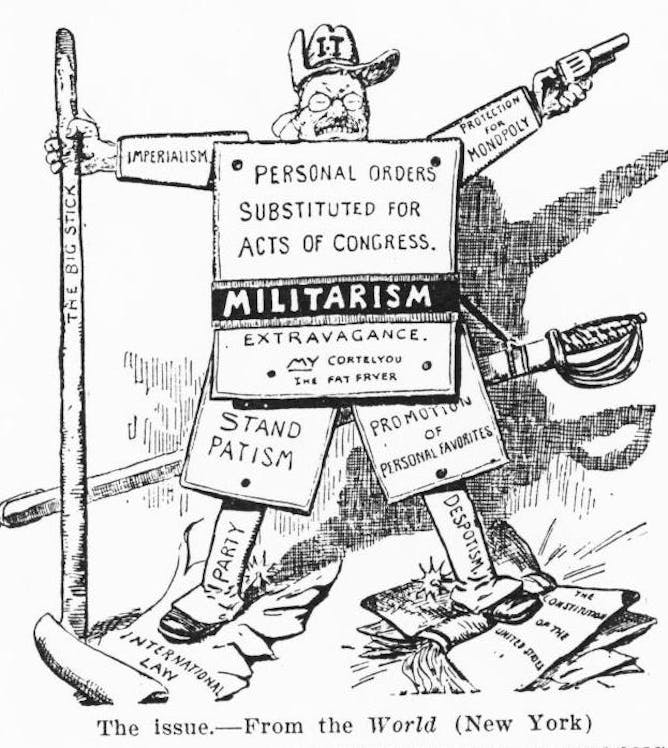
Around this time, Twain was not just a celebrated author but a leading figure on the lecture circuit. As both a speaker and an essayist, he was known for his satirical jabs. A key target of his became American expansionists, whom he skewered in, among other works, the 1901 essay “To the Person Sitting in Darkness,” which lambasts Americans for committing violence across the Pacific under the guise of “civilizing” backward peoples.
In 1900, there were two U.S. military campaigns underway in China and the Philippines. In China, U.S. soldiers joined forces with a host of other countries to fight the anti-Christian Boxer militants and the Qing dynasty. In the Philippines, American troops brutally suppressed Filipinos who sought independence.
Teddy Roosevelt was an enthusiastic supporter of these campaigns. The main goal in the Philippines and in China, Roosevelt insisted, was not enrichment but defeating “barbarous” enemies.
Twain disagreed. In his caustic “Salutation Speech from the Nineteenth Century to the Twentieth,” Twain dismissed the military campaigns as “pirate raids” that “besmirched” Christianity’s reputation.
Where Roosevelt saw the Boxers as just the latest wave of savages to be suppressed, Twain viewed them as patriots defending their threatened homeland, spelling out his position in essays, personal letters and public lectures.
The anti-imperialist Twain would likely have criticized other recent presidents. He wouldn’t have approved of George W. Bush’s invasion of Iraq, nor of the way Barack Obama employed drones.
Nonetheless, the writer would find Trump’s disparaging of Muslims and various other groups on the campaign trail – in addition to the immigration ban – particularly distasteful.
He wasn’t afraid to change his mind, and to admit that he had been wrong (as Trump is loath to do). He briefly supported the Spanish-American War, for example, but then spoke openly about how jingoism had blinded his moral concerns. And as American studies professor John Haddad has detailed, Twain’s previous praise for Cody didn’t stop him from walking out of a Wild West Show performance in early 1901. Cody had performed a reenactment of a 1900 Chinese battle, uniformly depicting the foreign invaders as heroes and the Boxers as barbaric villains. Twain thought his old friend was deeply misguided – and he let him know.
In 1901, Twain wasn’t alone in holding and expressing fervently anti-imperialist views. But he was in a minority. Most Americans felt that allied actions in China and U.S. ones in the Philippines were completely justified. So did many famous writers of the time, from Rudyard Kipling to “Battle Hymn of the Republic” lyricist Julia Ward Howe.
That’s one difference from today: Twain would find himself firmly in the literary mainstream – and would be far from alone in saying that a president who wanted to govern a truly “great” America should not look to the country at the turn of the 20th century for inspiration.
Jeffrey Wasserstrom, Professor of Chinese and World History, University of California, Irvine
This article was originally published on The Conversation. Read the original article.

Margaret Kristin Merga, Murdoch University and Saiyidi Mat Roni, Edith Cowan University
There is a common perception that children are more likely to read if it is on a device such as an iPad or Kindles. But new research shows that this is not necessarily the case. 
In a study of children in Year 4 and 6, those who had regular access to devices with eReading capability (such as Kindles, iPads and mobile phones) did not tend to use their devices for reading – and this was the case even when they were daily book readers.
Research also found that the more devices a child had access to, the less they read in general.
It suggests that providing children with eReading devices can actually inhibit their reading, and that paper books are often still preferred by young people.
These findings match previous research which looked at how teenagers prefer to read. This research found that while some students enjoyed reading books on devices, the majority of students with access to these technologies did not use them regularly for this purpose. Importantly, the most avid book readers did not frequently read books on screens.
There is a popular assumption that young people prefer to read on screens. This was mainly driven by education writer Marc Prensky who in 2001 coined the term “digital natives”. This term characterises young people as having high digital literacy and a uniform preference for screen-based reading.
But young people do not have a uniform set of skills, and the contention that screens are preferred is not backed up by research.
Despite this, the myth has already had an impact on book resourcing decisions at school and public libraries, both in Australia and in the US, with some libraries choosing to remove all paper books in response to a perceived greater preference for eBooks.
But by doing this, libraries are actually limiting young people’s access to their preferred reading mode, which in turn could have a detrimental impact on how often they choose to read.
Young people are gaining increasing access to devices through school-promoted programs, and parents face aggressive marketing to stay abreast of educational technologies at home.
Schools are motivated to increase device use, with Information and Communication Technology being marked as a general capability to be demonstrated across every subject area in the Australian Curriculum.
The drivers toward screen-based recreational book reading are strong, but they are not well-founded.
Reading on devices through an application leaves more room to be distracted, allowing the user to switch between applications.
For students who already experience difficulty with attention, the immediate rewards of playing a game may easily outweigh the potentially longer-term benefits of reading.
Digital literacy could also be an issue. In order to use a device to read books, children need to know how to use their devices for the purpose of reading books.
They need to know how to access free reading material legally through applications such as Overdrive or websites such as Project Gutenburg.
Research shows that reading books is a more effective way to both improve and retain literacy skills, as opposed to simply reading other types of text. Yet international research suggests that young people are reading fewer and fewer books.
While equipping children with devices that have eReading capability is unlikely to encourage them to read, there are a number of strategies, supported by research, that can help encourage children to pick up a book. These include:
Be seen to enjoy reading. This study found that a number of students did not know if their literacy teachers actually liked reading. Teachers who were keen readers inspired some students to read more often and take an interest in a broader range of books.
Create (and regularly access) reading-friendly spaces at home and at school. Loud noises, poor lighting and numerous distractions will not help provide an enjoyable reading experience, and are likely to lead to frustration.
Encourage regular silent reading of books at school and at home. Giving children time to read at school not only encourages a routine of reading, but it also may be the only opportunity a child has to read self-selected books for pleasure.
Teachers and parents should talk about books, sharing ideas and recommendations.
Continue to encourage your child and students to read for pleasure. While we know that children tend to become disengaged with books over time, in some cases this can be due to withdrawal of encouragement once children can read on their own. This leads children to falsely assume that reading is no longer important for them. Yet reading remains important for both children an adults to build and retain literacy skills.
Find out what your child enjoys reading, and support their access to books at school and at home.
Margaret Kristin Merga, Lecturer and Researcher in Adolescent Literacy, Health Promotion and Education, Murdoch University and Saiyidi Mat Roni, Lecturer, Edith Cowan University
This article was originally published on The Conversation. Read the original article.
The link below is to a book review of ‘Travels With a Donkey in the Cévennes,’ by Robert Louis Stevenson.
For more visit:
https://www.theguardian.com/books/2017/mar/06/r-l-stevenson-travels-with-a-donkey-in-the-cevennes-nonfiction-review-mccrum
The link below is to an article that takes a look at the best free ebook readers for 2017 thus far.
For more visit:
http://www.techradar.com/news/the-best-free-ebook-reader-for-windows
 At the BookShelf

You must be logged in to post a comment.