
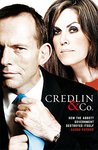
 Credlin & Co.: How the Abbott Government Destroyed Itself by Aaron Patrick
My rating: 3 of 5 stars

The link below is to a book review of ‘The Untold Story of the Talking Book,’ by Matthew Rubery.
Rita Matulionyte, University of Newcastle
When libraries lend books to the public, authors and publishers receive remuneration from the Government under the Lending Rights schemes, but this is not the case when libraries lend e-books. Is this fair?
This year, the government has distributed almost A$22 million under these Public Lending Rights and Educational Lending Rights Schemes. For each book in public library collections, creators receive $2.11 and publishers receive $0.52.
The amount that each claimant receives is often not very significant, with the majority of authors receiving between $100-500 annually. Still, a previous study has revealed that this remuneration constitutes the second most important source of income for creators from their creative work.
E-books, however, are not covered by these Lending Rights schemes. This may not be a big issue at the moment, since only 3.5% of library holdings are e-books and most publishers still release books both in print and e-book formats.
But e-book lending is increasing and, according to the Australian Library and Information Association, e-books are likely to reach 20% of library holdings by 2020. Also, most, if not all, self-published titles are done so in digital format only. Such self-published titles, if lent by libraries, would not qualify for any remuneration.
For this reason, authors and publishers have been lobbying the Government to extend the Lending Rights Schemes to e-books. Although the Book Industry Collaborative Council made such proposal already in a report of 2013, nothing has happened of yet.
One of the main reasons why e-books are not covered is that e-book lending is quite different from print book lending. In case of print books, authors and publishers are arguably losing on customers and revenues when libraries loan their books for free.

At present, in the case of e-books, many publishers chose not to sell these books to libraries. Also, publishers assume that libraries will lend e-books to many readers so they often charge libraries three or more times the price that consumers are paying for the same e-books.
While publishers charge libraries high prices for e-books, writers complain that these amounts do not reach them. Publishing contracts often don’t specify whether and how much authors receive for e-books sales or for e-lending.
This year, a Public Lending Rights scheme was extended to e-books in Canada, with no payments for e-books yet. A few weeks ago, the Court of Justice of the European Union has confirmed that European Lending Rights scheme applies at least to certain e-lending models.

Should Australia follow the trend? Australia’s publishing industry, like the industry worldwide, has been in a decline for a number of years. Despite this, it is still our second largest creative industry and it is of no question that Australian literature is greatly important for local culture and identity.
Government support for this industry, however, has been declining over years. In addition, the Productivity Commission has recommended that the government eliminate the restrictions on parallel imports of books. If the government acts on this, it will likely reduce the income of Australian publishers and authors.
The Commission has suggested that the government replace parallel import restrictions with some other cultural support measures. However, in the current neo-liberal climate, with constant pressure to decrease public expenditure, it is unlikely that government will create additional schemes to support local writing.
One option could be the extension of Lending Rights schemes to e-books. However, extension alone would do little if the current funds under the schemes were merely re-distributed from books to e-books. For effects to be felt, there would need to be increased funding under the schemes.

Rita Matulionyte, Lecturer in Law, University of Newcastle
This article was originally published on The Conversation. Read the original article.
Nicolas Suzor, Queensland University of Technology and Shereen Parvez, Queensland University of Technology
The Australian Government has just released the Productivity Commission’s report into Australia’s Intellectual Property Arrangements.
It’s a move that appears to have been designed to avoid some of the controversy of the copyright wars by releasing the report just before most Australians settle into their summer break.
The report does something that is very difficult in copyright debates: it sets out a rigorous, evidence-based case for reform. Academics have praised the “independent and systematic study that has assessed the effectiveness, efficiency, adaptability and accountability of Australia’s IP [intellectual property] laws”.
Good evidence about how well intellectual property laws are working is sometimes hard to come by. Intellectual property laws, including copyright and patent law, have to be very carefully calibrated. If they are too weak, it is difficult for investors to recoup their expenses in bringing new inventions, books, music and films to the market.
But when intellectual property laws are too strong, they restrict innovation and access to knowledge. They prevent people from making new inventions and creating new works, because access to existing materials becomes too expensive or difficult.
For consumers, they can make access to knowledge and culture much more expensive, and they can get in the way of education and the legitimate needs of disadvantaged members of society.
Scholars have pointed out for many years that the optimal balance between protection and access to knowledge is extremely difficult to pinpoint. As a result, intellectual property policy is a deeply controversial and emotional political arena. In the past, decisions about IP policy have been made on the basis of heavy corporate lobbying, gut-instinct, hunch and guesswork.
The Productivity Commission’s report is important because it reviews the available evidence and provides recommendations that we have good reason to think will improve Australia’s intellectual property laws.
After reviewing the evidence, the Productivity Commission’s view is that copyright law is not balanced, and that our laws:
[…] are skewed too far in favour of copyright owners to the detriment of consumers and intermediate users.
Probably the most significant – and controversial – recommendation is that Australia should introduce a “fair use” exception for copyright infringement.
Fair use allows people to use copyright material in ways that are fair, without asking for permission first. It has been extremely important in the United States for many different industries.
Filmmakers use it to make documentaries, libraries use it to digitise and preserve their collections, scholars use it for important data- and text-mining research, and search engines use it to index the web.
The Productivity Commission’s report is just the latest in a string of reports to recommend that Australia introduce a fair use exception. It found that Australia’s current exceptions to copyright:
[…] are too narrow and prescriptive, do not reflect the way people today consume and use content, and do not readily accommodate new legitimate uses of copyright material.

The report is detailed and comprehensive, and covers a lot of ground. The Productivity Commission recommended a raft of other changes to modernise Australia’s copyright laws, including:
preventing copyright owners from overriding consumer rights through restrictive contractual agreements
allowing Australian consumers to break digital locks on content that prevent lawful activities (like fixing a tractor)
fixing a decade-long oversight in our “safe harbour” regime that makes it extremely difficult for home-grown equivalents of YouTube or social media platforms to host content in Australia
clarify the law to ensure Australian consumers can use VPNs to access content lawfully available in other countries
ensure that the results of publicly funded research are made freely available to the public under Open Access policies
remove an exception from competition law that allows software and content companies to create exclusive deals and other restrictive licensing agreements that would otherwise be anti-competitive.
The timing of this report seems to be designed to minimise some of the controversy that it will generate. The commission’s report warns that it will be extremely difficult to “pursue change in the face of strong vested interests”.
The Copyright Agency, the Australasian Performing Right Association and the Australasian Mechanical Copyright Owners Society (APRA AMCOS), prominent players in the book industry and several authors have all issued statements that are highly critical of the commission’s report.
Their essential concern is that the expansion of user rights will result in reductions in revenues and investment in Australian creative industries and Australian creators.
The great difficulty here is that copyright law is extremely complex, and the debate is so emotive that the details often get lost in the heated arguments. What little empirical evidence we do have to guide policy is glossed over in a strong reaction against change.
The reaction of the established copyright industries is understandable. It has been very difficult for publishers and distributors to adapt to the internet, and they are only now beginning to develop business models that work in the digital age. The process has been painful to say the least.
In this context, many publishers, distributors, and creators feel besieged by efforts to reform copyright law for the digital age. But it is too late now to go back to a pre-digital world.
The restrictions on parallel importation, which have kept prices high for books in Australia, are a good example of laws that just don’t work for digital markets. If we expect consumers to obey copyright rules, it is clear that we need to work to make sure that the law and business models treat them fairly.
The great shame about the copyright wars is that sensible, evidence-based proposals for reform get mixed up with highly emotive reactions to “piracy”. The proposals by the Productivity Commission are careful and well justified. The evidence we have is that they are not likely to harm the actual revenues of Australian creators.
There is no doubt that we need new business models – and public funding – to support creators in the digital age. This is the hard work of real practical change that needs to happen to enable our creative industries to thrive.
The good news is that overseas examples show that it is possible for creators to make money in the digital economy. The Productivity Commission’s recommendations are a bet that digital is the future, and that making Australia’s laws more efficient and effective is critical to the health of our future industries.
We’re looking forward to the government’s plans to implement these recommendations, but it looks like 2017 will be a heated year for copyright debates.

Nicolas Suzor, Associate professor, Queensland University of Technology and Shereen Parvez, Graduate Research Fellow, Intellectual Property & Innovation Law Research Program, Queensland University of Technology
This article was originally published on The Conversation. Read the original article.
Belle Alderman, University of Canberra
It’s not always easy to keep kids reading over the summer holidays. But research shows that those who stop reading over these long breaks from school are actually at risk of seeing their reading ability drop during this period. This is called the “summer slide”.
But there are simple ways to prevent this from happening. Reading just four or five books over the summer can stop the slide.
Reading regularly also helps to develop a child’s language and comprehension, enhance listening and speaking skills, and help with the understanding of narrative and story. Reading to your child during pre-school years has even been shown to boost their literacy levels.
Children are, unsurprisingly, more likely to read when they find a story interesting and engaging. With this in mind, I’ve pulled together a list of great new books that have been published this year that are sure to keep kids engaged in reading over the summer break.

(Harper Collins Publishers, 2016) Ages: 0 – 3 years
Cameos of babies’ lives and their families feature in ordinary but universal scenes starring babies as they sleep, play, eat and explore life.
The short, familiar text, such as “Zane rubs corn in his hair” and “Vikram yawns and stretches”, is perfect for parents to read aloud. Lester is at her finest in capturing the minutia of the ordinary and rendering it memorable.
Further reading: Lester’s 48-page colouring-in book, Wonderful World, featuring characters and scenes from her books Imagine, Magic Beach and others, is the perfect companion.
Parents might collect Lester’s books and join in a game of “find the characters” appearing in the colouring book.

(Penguin, 2016) Ages: 1 – 5 yrs
Here’s a treasure trove of nine familiar favourites by a creator who excels in the art of simplicity, humour, playful images and universally loved stories including Grandpa and Thomas and Belinda. Allen’s jaunty language is perfect for reciting and performance by pre-schoolers.
Parents will enjoy performing words and actions and talking about the subtle character-building ideas, such as being kind to others and working together.

(Little Brown, 2016) Ages: 3 and up
These 60-second poems are perfect bedtime reading. Five countries, including Australia, feature in these 132 selections, each evoking strong emotions. Included are abecedarian, pantonums and haiku poems, plus others. The illustrations are minimalist and clever, ensuring imaginations are engaged.
Australia’s poems by Kathryn Apel, Mark Carthew, Sophie Masson and others add to the international flavour. Parents prepare for a rollicking read aloud and discussion of other kinds of poetry than those here.

(Black Dog Books, 2016) Ages: 5 and up
Welcome to country ceremonies are an important part of major events. They signify cultural greetings by Aboriginal elders who grant permission for visitors to enter their traditional lands.
This stunningly illustrated book has a deep yet simple text, which introduces its central concept through poetic language and earthy, evocative landscapes of blended colours and shapes of people and landscapes.
“We are part of the land and the land is part of us” reminds us to respectfully share cultural traditions. Parents might collect a range of picture books by Aboriginal creators for children, comparing illustration styles and discussing the meaning underlying traditional stories.

(Crows Nest, NSW : Allen & Unwin, 2016) Ages: 7 and up
Gibson’s debut, gem-like story offers likeable characters, a tasty dilemma and a satisfying ending. Appealing ingredients include a family of four French mice who adore food, family and fashion, intricately detailed illustrations, lavish banquets of French food and a text in delectable rhythm and rhyme.
Adults and child can explore places in the world, locate these on maps, and share cultural diversity.
Further reading: Similar in whimsical detail, but featuring enchanting rabbit characters, is the trio of books by Kate Knapp about Ruby Red Shoes. Ruby’s adventures to distant places are told in entrancing prose and feature detailed, whimsical illustrations.

(National Library of Australia, 2016) Ages: 8 and up
Australia is home to over 110,000 species of animals and here in Newton’s large, lavishly designed book are 120 – most existing only in Australia. The beautifully designed layout conveys information so jam-packed that readers will return again and again.
Basic and iconic information include slang, sports, places to visit, and lots of food. Adults reading this book (and the one below) with children might want to talk about the importance of looking after the environment.
Further reading: Tania McCartney’s book, Australia illustrated, in a similar large and inviting format, offers fascinating titbits about all Australian states and territories.

(Allen & Urwin, 2016) Ages: 8 and up
Artie and his best friend Bumshoe discover a cave-of-possibly-stolen-stuff, then match wits and defeat our shady characters including fang-toothed Funnel-web and the dastardly Mayor Grime.
High-appeal ingredients abound in this mystery-adventure: a struggling underdog; good-hearted friends; moments of bravery; slightly dangerous baddies and a rip-roaring pace. The quirky line illustrations perfectly capture inventions like the “super snotter” and shady characters in zany, slightly dark, line illustrations.
Parents might compare this work with other popular humorous authors and illustrators such as Andy Griffiths and Terry Denton with their Magic Tree House series.

(National Library of Australia, 2016) Age: 9 and up
Two masters of story and illustration combine their art to reveal a fascinating piece of Australian history — how “the world burst open” with the invention of the pedal radio. The facts are astonishing, but the human story adds great appeal.
Young Jim and his mum and dad love station life but long for human contact, and worry about disaster striking. Jane Jolley’s text is simple with appealing repetition perfect for reading aloud.
Robert Ingpen’s signature soft pencil sketches and luminous foldouts are unforgettable. Parents might find other books about significant inventions and innovations in our world such as transportation and the Internet, and talk how these have changed our lives.

(Allen & Urwin, 2016) Ages: 10 and up
Shaun Tan’s 15 short stories explore unique, perplexing and sophisticated ideas with unforgettable images. One story centres on Eric, tiny in size but large in heart. He leaves behind an unforgettable gift for his human friends. Another story features satirically decorated missiles in front yards. Tan puts a twist in this tale, prodding the reader to think. A family with little money creates a richly imaginative attic retreat.
Parents will enjoy reading Tan’s crisp proud aloud and luxuriate in his mesmerising illustrations, then discussing the many layers of his work. Then, as a family, put together the accompanying Shaun Tan 750-piece puzzle.

(NSW : Hachette, 2016) Ages: 12 and up
Occasionally a book leaves an indelible impression, irrevocably changing one’s worldview. This is one of those books.
Ten-year-old Subhi is a refugee, born in a permanent Australian detention centre. Though he knows no other life, his imagination soars and offers comfort. When he meets a young girl from the other side of the fence, their lives change forever.
Family members loved and lost weave throughout this story. The prose is lyrical, and there are light moments. Read this book as a family and explore injustices, hope and love.
You might also like “A love and feel for place : Australian illustrated children’s books – in pictures” by Leigh Hobbs.
• All the books listed were published in 2016 and reflect Australia’s rich and diverse creative talent.

Belle Alderman, Emeritus professor of children’s literature, University of Canberra
This article was originally published on The Conversation. Read the original article.
Nicola Yuill, University of Sussex
Most of us have an opinion about whether we prefer reading on screen or paper: but what difference does it make for children? The truth is that technology is now encountered from babyhood. Anecdotes abound of toddlers swiping their fingers across paper rather than turning the page, while parents and teachers express their fear of screen addiction as tablets introduce new distractions as well as new attractions for young readers.
Ofcom figures tell us that children’s screen use rises sharply towards the end of primary school (from age seven to 11) and in the same period, book-reading drops. Increasing screen use is a reality, but does it contribute to a loss of interest in reading, and does reading from a screen provide the same experience as the feel of reading on paper?
We looked at this in our research on shared reading. This has been a neglected topic even though it is clearly a common context for children when they read at home. It might be their regular homework reading of a book from school, or a parent reading them a favourite bedtime story.
We asked 24 mothers and their seven to nine-year-old children to take turns – mother reading or child reading – with popular fiction books on paper, and on a tablet. They read Barry Loser: I am not a Loser by Jim Smith and You’re a Bad Man, Mr Gum by Andy Stanton. We found that the children’s memory for the descriptions and narratives showed no difference between the two media. But that’s not the whole story.
The interactions of parent and child were found to be different in the independent ratings from video observation of the study. When they read from paper rather than a screen, there was a significant increase in the warmth of the parent/child interactions: more laughter, more smiling, more shows of affection.
It may be that this is largely down to the simple physical positioning of the parent and child when using the different media, as well as their cultural meaning. When children were reading from a screen, they tended to hold the tablet in a head-down position, typical of the way they would use the device for solo activities such as one-player games or web-browsing.
This meant that the parents had to “shoulder-surf” in order to share visual attention. In contrast, when parents read to their children on paper, they often held the book out to support shared visual engagement, tucking the child cosily under their arms. Some children just listened without trying to see the book, but instead curled themselves up comfortably on the sofa.

Our research joins a growing list of studies comparing paper and e-books, but the answer isn’t a simple one. Shared reading is different to reading alone, for a start. And we may be interested in whether screen or paper makes a difference in how children learn to read, to understand, and enjoy reading. In short there are multiple perspectives to consider – developmental, educational, literary and technological – if we are to decide which medium is preferable.
Most studies have compared children at the earliest stages of reading, using paper books, e-books with audio and dictionary support to help less-skilled readers, and so-called “enhanced” e-books with multimedia, activities, hotspots and games.
Text with audio support helps children to decode text, and multimedia can keep a reluctant reader engaged for longer, so a good e-book can indeed be as good as an adult reading a paper book with their child. But we don’t yet have long-term studies to tell us whether constant provision of audio might prevent children developing ways of unpicking the code of written language themselves.

There is also increasing evidence that adding multimedia and games can quickly get distracting: one study found that young children spent almost half their time playing games in enhanced e-books, and therefore they read, remembered and understood little of the story itself. But there is plenty of guidance for e-book developers on the what, where and how much of designing multimedia texts.
And that brings us back to perhaps the defining conclusion from our own study. Books versus screens is not a simple either/or – children don’t read books in a cultural vacuum and we can’t approach the topic just from a single academic field. Books are just books, with a single typical use, but screens have many uses, and currently most of these uses are designed round a single user, even if that user is interacting with others remotely.
We believe that designers could think more about how such technology can be designed for sharing, and this is especially true for reading, which starts, and ideally continues, as a shared activity in the context of close long-term family relationships. Book Trust figures report a drop from 86% of parents reading with their five-year-olds to just 38% with 11-year olds. There is a possibility that the clever redesign of e-books and tablets might just slow that trend.

Nicola Yuill, Senior Lecturer in Psychology, University of Sussex
This article was originally published on The Conversation. Read the original article.
Joanna Mendelssohn, UNSW Australia; Catherine De Lorenzo, UNSW Australia, and Catherine Speck, University of Adelaide
For some years we have been researching the how, why and wherefore of exhibitions of Australian art. We have tracked down retired curators and art museum directors, recording their memories before they fade.
We have crossed the country to see exhibitions. But most of the time we have been buried in archives and libraries. While large public libraries are excellent for general research, those small specialist libraries attached to state and national art museums are our essential tools of trade.
With the exception of the Edmund and Joanna Capon Research Library at the Art Gallery of New South Wales, these libraries are by appointment only. All the meticulously researched exhibitions of Australian and international art depend on their museum libraries – they track down works of art and tease out ideas from distant publications.
These libraries are our treasure trove. The Art Gallery of New South Wales press cuttings book goes back to the 1890s. There are international art journals dating from the 1890s, invitations to every imaginable exhibition, annual reports from the most unlikely places – as well as transcripts of scandalous court cases.
Most art museum libraries hold material associated with their own collections and exhibitions. Two institutions, however, have made their libraries international research hubs. At the Art Gallery of New South Wales, a succession of librarians have collected archives from Australian artists, curators and institutional records. The renamed National Art Archive is central to the proposed Sydney Modern Project.
For many years its secret weapon has been the head librarian, Steven Miller, the author of scholarly books and erudite blog posts while the visual resources librarian, Eric Riddler, has an uncanny ability to track down obscure archival photographs and identify the protagonists.
At the National Gallery of Australia in Canberra, James Mollison, its first Director, knew that an outstanding research library was an essential tool in positioning the gallery as an international leader. He acted accordingly in funding the library. When he was a young education officer at the National Gallery of Victoria, he had access to the specialist records that have been expanded into the Shaw Research Library, presided over by the ever helpful Luke Doyle.

Thanks to Mollison’s foresight, for almost 40 years the catalogues, books and archives at the National Gallery of Australia have been the envy of those who don’t live in the city. The monetary value is A$37 million, but the worth is much more.
The Chief librarian, Joye Volker, and the senior librarian, Helen Hyland, are both well-known to interstate and international visitors who have have benefited from their detailed knowledge of the collections. Their assistance to researchers has extended to sending digital versions of archives meticulously recorded over many years.
The retired Betty Churcher wrote most of her book, Australian Notebooks (2014), in the library, while Sasha Grishin’s Australian Art: a History (2014) says of Joye Volker and her staff: “It would not have been possible to complete this book without their assistance.”
When the Federal Government announced in September it was eliminating 63 positions from national cultural organisations, both Volker and Hyland were “let go”. With the “natural attrition” from other staff, this means the National Gallery library is now only open four days a week. Tough times mean hard decisions.
But libraries without librarians are just storerooms. Specialist librarians can make apparently tangential leaps and suddenly produce a raft of documents that give answers to questions the researcher is yet to ask.
As well as hard copy resources, when we visited Queensland’s Gallery of Modern Art Research Library Jacklyn Young and Cathy Pemble-Smith gave ready access to digital files and data bases. Specialist research librarians save months of time for hard pressed academic researchers and curators.
At the Art Gallery of South Australia Jin Whittington is surely one of the state’s living treasures with her specialist knowledge and generous spirit, answering constant queries on the finer details of the archive and library. Specialist librarians and archivists are crucial for primary research.
At the recent Art Association of Australia and New Zealand annual conference, the subterranean topic of conversation was the very future of the National Gallery’s library. Budget cuts may lead to its holdings being transferred to the equally under-resourced National Library.
Anthony White, president of the association, which represents art historians, curators and artists, said:
The art-specific knowledge that art librarians provide, as well as their unique expertise in advanced research skills, are indispensable for those historians, critics and curators who are opening new avenues in thinking about global visual cultures that speak to contemporary concerns.
This sorry tale is not unique to art, or even to Canberra. It is a part of the inevitable consequences of a succession of “efficiency dividends” by the Commonwealth Government which is placing public institutions on a diet akin to anorexia.

Joanna Mendelssohn, Associate Professor, Art & Design: UNSW Australia. Editor in Chief, Design and Art of Australia Online, UNSW Australia; Catherine De Lorenzo, Honorary associate professor, UNSW Australia, and Catherine Speck, Professor, Art History;, University of Adelaide
This article was originally published on The Conversation. Read the original article.
 At the BookShelf
You must be logged in to post a comment.