
The link below is to an article about the new book sharing site called BookLikes.
For more visit:
http://www.mediabistro.com/galleycat/new-blog-platform-for-bibliophiles-goes-live_b70399

The link below is to an article about the new book sharing site called BookLikes.
For more visit:
http://www.mediabistro.com/galleycat/new-blog-platform-for-bibliophiles-goes-live_b70399
Chapter 2: Crown of Thieves
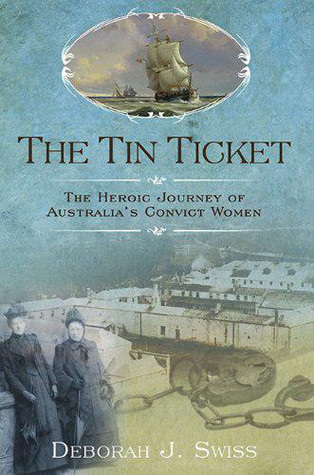
‘Crown of Thieves’ opens well enough for Agnes and her friend Janet. They have freedom to enjoy, but too soon the 2nd chapter continues the narrative of despair and forced labor that petty thieves were required to fulfill as payment for their crimes. First in Glasgow and then in Kilmarnock, where their hopes for a better life were cut short as a consequence of their short careers in petty crime. In such a setting, in such a time, there was little for street kids to do in order to survive and so to petty thieving they often returned. It was their undoing in a society that knew little of compassion and nothing of social welfare.
From Kilmarnock, via the trial in Ayr, the lives of Agnes McMillan and Janet Houston were propelled in an entirely unexpected direction – transportation to Van Diemen’s Land for a period of seven years. In reality there would be no return. They were convicts headed for Tasmania, Australia, as it is now known. The chapter ends with their arrival in London and Newgate Prison.
The Tin Ticket brings to life the harsh realities of life for the homeless and poor of Britain. They were products of a harsh system that punished those that could do little to help themselves and seldom was help offered to enable them to lift themselves out of their predicament. Certainly deserved criminals were transported to the penal colonies, but far too often it was those who fell through the cracks of an unsympathetic society that were punished for what they had become in order to survive. The recorded history of transportation takes on a human face through the stories of Agnes McMillan and Janet Houston. It is a reminder that convicts were real people and often not all that criminal at all.
Buy this book at Amazon:
http://www.amazon.com/gp/product/B0043RSIWI/
The link below is to a book review of ‘The Kind of Preaching God Blesses,’ by Steven J. Lawson.
For more visit:
http://www.challies.com/book-reviews/the-kind-of-preaching-god-blesses
The link below is to an article (with photos) that looks at various ‘bookish staircases.’
For more visit:
http://bookriot.com/2013/05/13/awesome-bookish-staircases/
The link below is to a general article on ebooks.
For more visit:
http://www.coolage.in/2013/05/12/e-books-changing-the-ways-of-reading/
The link below is to a book review of ‘Let’s Get Visible – How to Get Noticed and Sell More Books’ by David Gaughran.
For more visit:
http://www.teleread.com/ebooks/review-lets-get-visible-how-to-get-noticed-and-sell-more-books-by-david-gaughran/
Chapter 1: The Grey-Eyed Girl
Well I lasted one day before reading some more of this book – but I did finish one of the other books I was reading first and posted a book review of it, so that wasn’t too bad. I’ve convinced myself anyway, so I can now continue reading this book as well.
The first chapter begins the story of Agnes McMillan Roberts, a convict sent to Van Diemen’s Land (now known as Tasmania) from Glasgow in Scotland.
This first chapter paints a terrible picture of conditions for the poorer families of Glasgow in the 1820s. The early years were tough years for Agnes and her childhood was cut short by the abandonment of her parents – first her father, then her mother (who basically stopped being one). In the place of family, Agnes aged 12 found support in a ‘street gang’ of young girls and this led ultimately to her arrest for burglary. Her partner in crime and life was 13-year-old Janet Houston, who took the younger Agnes under her wing.
Fighting to survive the elements in a filthy city, petty crime was one of very few options open to Agnes and she took it. She was to pay the penalty for being a survivor, a penalty that she was required to pay because society failed to care for the less fortunate of her day. Her small gang of young girls were arrested at the scene of their crime and quickly sentenced.
Agnes and Janet were sentenced to 18 months forced labor at a woolen mill, working 15 hour days, 7 days a week. They were basically slaves, child slaves and poorly treated ones at that. Life at the mill was 18 months of torture, a slave labor that no child should have to endure. Yet this was the life that beckoned for thousands of children across Britain during the so-called Industrial Revolution. Child exploitation and exploitation of the poor were signs of the times.
Reading this chapter you can’t but feel for Agnes and her friend Janet. Abandoned by society, with no hope for survival except by embracing a world of what you could call the underbelly of 1820s Glasgow. To survive they turned to a life of petty crime. Sure they were by definition criminals, but it is difficult to feel anything but pity and compassion toward these young girls given the circumstances in which they lived. From out of the frying pan and into the fire though was the result, in what is just a terribly sad childhood for these young girls.
This first chapter leaves you asking yourself just who were the real criminals in all of this? Are the parents the real criminals? Are the upper class to blame for this? Is it the government’s fault? Is it society as a whole? 1820s Glasgow certainly makes me glad to be living in 21st century Australia.
Buy this book at Amazon:
http://www.amazon.com/gp/product/B0043RSIWI/
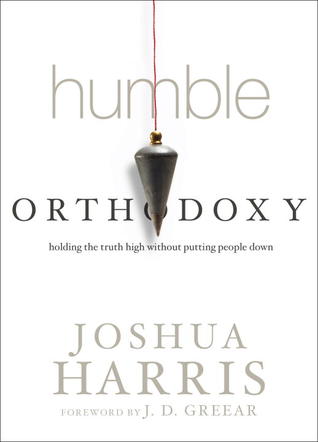 ‘Humble Orthodoxy – Holding the Truth High Without Putting People Down’ by Joshua Harris is a relatively new release, having been published on the 2nd April 2013, by Multnomah Books. I have the Kindle edition, which is available at Amazon and is linked to at the bottom of this review – other editions are linked to from that page. It is a relatively short work at just 96 pages, so it won’t take an extended commitment to read it.
The foreword is written by J. D. Greear, a senior pastor at The Summit Church in Durham, North Carolina and author of ‘Gospel: Recovering the Power that Made Christianity Revolutionary.’ The foreword is only short, which given the overall size of the book is probably a good thing, however it is a good quick read. I quite liked his thoughts concerning the Pharisees and Pharisaism, both of which are still in existence today.
In my youth as a young Christian (which is not always the same), having come to an understanding of the doctrines of grace, I found myself being very much the opposite of what this book calls for – a humble orthodoxy. I guess it shouldn’t surprise me as I was surrounded by plenty of Reformed Christians who behaved in the same way. Thankfully, over time, the Lord has been slowly transforming me by His grace and showing me a better way. Perhaps it would have been good for me to have had this book back then at the beginning of my Reformed walk – I may have been spared acting out with such displays of arrogant Pharisaism that I thought then were the very proofs of my orthodoxy.
I don’t believe that we ever completely leave the spirit of Pharisaism behind, not entirely. I see it rising to the surface on far too many occassions to think I can be free of it entirely in this fallen world. However it is no longer displayed with pleasure, though I continue to see it so wherever I look in Reformed circles – at least that’s how it appears to me. It has been a source of much grief in my own life over the years, not only personally, but through what I have seen displayed both individually and corporately throughout my experience of the Christian life. So this book when I first happened across it was one I was very keen to grab and read. I bought it for my ebook library and immediately began to read it.
Right from the beginning of the book, with the recommendations from various Christian leaders and with the short foreword already mentioned, I knew I wasn’t going to be disappointed with the thrust of the book. Humble Orthodoxy is certainly a good way to paraphrase the right approach to holding the truth, proclaiming the truth and defending the truth. But it is not only a good way to paraphrase it, it is a good and proper way to live it also.
There is no call to hold a lesser view of the Truth or a lesser version of the Truth, but to seek it out and to hold it and defend it. It is the attitude and manner in which that is done, that is the thrust of this book. I like the picture of doing so as with a tear in the eye, as living a humble orthodoxy in all areas of the Christian life, whether among God’s people or among unbelievers. Humble orthodoxy is what we should be seeking and maintaining at all times and in all places. Humble orthodoxy begins with knowing our proper place before God, seeing ourselves as God sees us and then living accordingly. With this mindset, which comes through the experience of knowing ourselves through the eyes of our gracious Lord and Saviour, will also come the right attitude towards others and ourselves. We will acknowledge and live in such a way that shows we haven’t ‘arrived,’ but are continuing on the journey towards a more humble orthodoxy. The experience of a dependant and an experimental Christian life in this fallen world propells us forward towards a more humble orthodoxy each and every day.
This is a book, being as small as it is, that will make a very useful tool for reminding me to pull my head in and to remember my proper place before the Lord and others. It will be re-read over the years and Lord-willing become a godly corrective whenever I need such to be applied. There is also a helpful study guide at the end of the book which can be used individually or as part of a group.
Buy this book at Amazon:
http://www.amazon.com/gp/product/B009MYAX98/
The link below is to an article that looks at the issue of ebook piracy.
For more visit:
http://pogue.blogs.nytimes.com/2013/05/09/the-e-book-piracy-debate-revisited/
The link below is to an author interview of Neal Thompson, author of the new Robert Ripley biography, ‘A Curious Man: The Strange and Brilliant Life of Robert “Believe It or Not!” Ripley.’
For more visit:
http://www.npr.org/2013/05/11/182260628/the-curious-story-of-robert-believe-it-or-not-ripley
 At the BookShelf
You must be logged in to post a comment.